Why Evolution is True is a blog written by Jerry Coyne, centered on evolution and biology but also dealing with diverse topics like politics, culture, and cats.
For some reason although I scheduled today’s Hili dialogue for 6:30 this morning, it didn’t go up, and I was just notified now by reader Jez. I don’t know what happened, but you can find it here or by clicking on the screenshot below. Do read it if you have time; I’d hate to have wasted all that effort!
Also, if you notice something way out of the norm like this, do email me ASAP.
As regular readers of WEIT know, Jerry’s major professor, Dick Lewontin, died last July at the age of 92. On March 29, 2022, which would have been Dick’s 93rd birthday, a memorial event was held virtually (see website here) to celebrate his life and work. Over 150 of Dick’s family, friends, students, and colleagues attended; a video of the event has been posted on Youtube.
During the event, which was hosted by Andrew Berry, sixteen speakers, representing only a sampling of the diverse facets of Dick’s life, each gave a brief reminiscence. The speakers were Stephen Lewontin (family), Ian Franklin (CSIRO Australia), Doug Futuyma (Stonybrook U), Dan MacArthur (Marlboro, Vt), Marc Feldman (Stanford U), David and Kathy Rosner (Columbia U), Lenard Diggins (Mass. General Hospital), Deborah Gordon (Stanford U), Peter Neufeld (Innocence Project), Dan Hartl (Harvard U), Peg Riley (U Mass Amherst), Einar Árnason (U Iceland), Sally Otto (U British Columbia), Michael Dietrich (U Pittsburgh), Diane Paul (U Mass Boston), and Dan Weinreich (Brown U). Ian Franklin’s remarks, because of the time difference, were taped.
Andrew managed to get all the speakers in during the allotted two hours. (I marveled at how deftly he handled so many speakers, getting them to run smoothly and on time, later remarking to him that he would make a first class cat-wrangler! ) He also showed a few clips of interviews with Dick and a selection of photos. He also read a couple of excerpts from written remembrances, including Jerry’s account of when he ran into Dick and his wife Mary Jane at the Harvard Square Theater, and they went up to the balcony to hold hands. After the main program, attendees broke out into various subsections for continued reminiscing and virtual reunions.
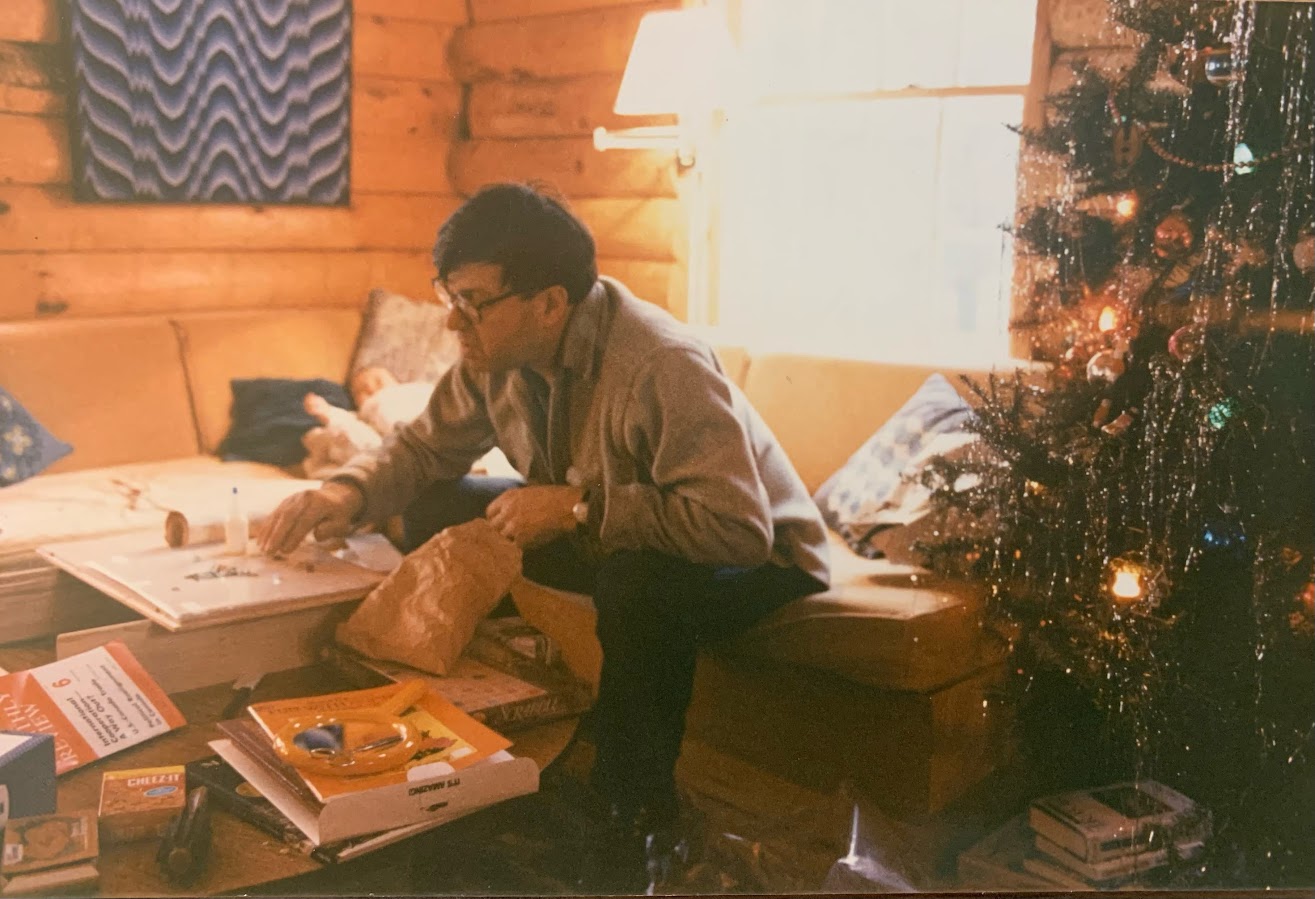
Vt Christmas. Photo: Nora Lewontin-Rojas.
Among the things I learned about Dick were two that came as a bit of a surprise. First, Dick enjoyed the birds in Vermont. He always seemed fairly indifferent to natural history, so I was glad to learn that he at least appreciated it around his home. Second, he was a great devotee of full Christmas celebrations with his grandkids, including all the corny details, like leaving something out for Santa to eat, and then eating it so it would be gone when the grandkids got up in the morning. It wasn’t a surprise that he indulged his grandkids– Dick always liked kids– but rather that a secular Jewish atheist would choose a traditional Christmas as the way to do it!
The organizing committee consisted of Andrew Berry, Diane Paul, Hamish Spencer, Deborah Gordon, Joe Felsenstein, Mike Dietrich, Elliott Sober, Brian Charlesworth, Rama Singh, Einar Árnarson, and Dan Weinreich, with the first four forming the core committee. My thanks to Andrew and all of them for a job well done.
Anglican priest Tish Harrison Warren continues to proselytize for Jesus in the op-ed section of the New York Times, but this time she does it by proxy—by interviewing one of her friends who was diagnosed with terminal prostate cancer. Click on the screenshot to read:
Now I don’t want to be too hard on her friend Timothy Keller, who founded an evangelical Christian church in New York City. After all, the guy is dying. And he’s finding his final comfort in Jesus and, especially, in the resurrection, as many Christians do. I for one wouldn’t want to be comforted by superstitions at the end, but hey, he’ll never find out he was wrong.
No, what bothers me more than Keller’s clinging to the myths of Christianity is his claim below that all things will be put right on Earth, but only if the resurrection happened. If that’s not true, then things will go on sucking. (Note, however, that there is absolutely no tangible evidence for the resurrection.)
At first I thought that Keller meant that all things will be set right after you die if the Jesus story be true. Or that somehow we would all come into God’s Kingdom on Earth (not in heaven) when the trumps sound and Jesus comes back at the Rapture. But I read the passage below twice, and it doesn’t seem to say that. I interpret to me this: IF THE RESURRECTION HAPPENED, then some day (day not specified), God “is going to put everything right.” That is, we’ll keep living our lives on Earth, but all evils will vanish.
You read this and tell me if Keller doesn’t mean that. (Warren’s question is in bold, Keller’s response in plain type. My own emphasis is in italics.
In your latest book, you wrote that our culture is experiencing a “crisis of hope.” Where do you find hope? What hope do you offer to others?
If the resurrection of Jesus Christ really happened, then ultimately, God is going to put everything right. Suffering is going to go away. Evil is going to go away. Death is going to go away. Aging is going to go away. Pancreatic cancer is going to go away. Now if the resurrection of Jesus Christ did not happen, then I guess all bets are off. But if it actually happened, then there’s all the hope in the world.
In J.R.R. Tolkien’s essay “On Fairy-Stories,” he says there are indelible human longings that only fantasy, fairy tales or sci-fi can really speak to. He says that all human beings have a fascination with the idea of escaping time, escaping death, holding communion with other living things, being able to live long enough to achieve your artistic and creative dreams, being able to find a love that perfectly heals. Tolkien says: why do we have those longings? And as a Christian, he thinks the reason is that we were not originally created by God to die.
We all deep down kind of know that this is the way life ought to be, and if the resurrection of Jesus Christ happens, then all those things are literally going to come true for us.
That’s the reason you have this paradox. On the one hand, the resurrection is a kind of very concrete thing to talk about, like “What is the evidence for this historical event?” Probably the single best book on this subject in the last 100 years is N.T. Wright’s book “The Resurrection of the Son of God.” [JAC: There’s new evidence?]
Yet if we come to the place where we accept it, then suddenly there’s no limit to what kinds of things we can look forward to. I know some of your readers are thinking, “I can’t believe there’s a person with more than a third-grade education that actually believes that.” But I do. And these last few months, as we’ve gotten in touch with these great parts of our faith, Kathy and I would both say we’ve never been happier in our lives, even though I’m living under the shadow of cancer.
Now I’m not sure exactly what Biblical exegesis tells us that Earthly evil will vanish if the resurrection occurred. Yes, the resurrection supposedly affords us a chance to find bliss in eternity (in Heaven, remember), but that doesn’t even hold for all Christians. Whether you believe in salvation through faith or salvation through works, the sheep will still go up and the goats will be fried.
As for “knowing the way life ought to be” in our hearts, well, the way we “know” how life should be will vary among people. And anyway, who says that the way life “ought to be” is the way God will make it? After all, aren’t God’s plans a mystery? Further, what the resurrection has to do with all this is unclear, save that it’s an example of eternal life for one person and a purported miracle.
Keller goes on to say that his belief gives extra power to the holiday of Easter. As I said, if this makes Keller feel better, more power to him, but the theology behind his reasoning eludes me. Surely there are some ex-Christians among the readers who can explain.
More curious is why The New York Times continues to publish this kind of stuff. If we use the Chicago Maroon editors’ view that op-eds with factual inaccuracies can’t be published, this one should have immediately been spiked. The NYT has no astrology column, and it has no comics. Why does it have this kind of theobabble?
UPDATE: I have removed the photos from the new paper as the authors have copyrighted them and won’t give me permission to use them. , but you can see them at the site.
In 2005, a paper in Science by Fitzpatrick et al. produced a flurry of ornithological excitement. The paper (click on screenshot below) adduced evidence that the Ivory-billed Woodpecker, Campephilus principalis—thought to have been extinct in the US (and elsewhere) since about 1940—was actually persisting in wet lowland forests of the South. This was based on sightings and recordings of calls, but the photographs weren’t that convincing. Nevertheless, the authors declared that the bird persists: click on the screenshot to read.
This magnificent beast, the third largest woodpecker in the world, used to have a fairly broad range across the South, but was limited to wet lowland forests with very old trees. Loss of habitat caused a big popuation decline, and fewer and fewer sightings were made. Here’s a photo of a male from Louisiana in 1935, and another, showing both sexes, is colorized below:
A colorized rendition of a photograph taken by Arthur Allen of an Ivory-billed Woodpecker at a nest in Louisiana’s Singer Tract, 1935. Photo: Cornell Lab of Ornithology
As you can see from the second photo, one distinctive feature of this bird is the sexual dimorphism in crest color: males have red crests and females black ones. Ivorybills also have a distinctive white “saddle” on their back, and white patches on the wings. These features, and the larger size of the Ivory-billed, distinguish it from a similar species, the pileated woodpecker (Dryocopus pileatus), the largest woodpecker known to exist in the U.S. (many of us have seen them).
Here’s a comparison of both species that I showed when I wrote about the Ivorybill in 2010. Note the white saddle of the Ivory-billed, absent in the pileated, and the sexual dimorphism of the crest. Also, there are differences in facial coloration. It is the superficial similarity of the ivory-billed to the pileated that has led people to declare that, after seeing the latter (they co-occurred), the former was still around.
Audubon’s painting:
And a drawer of preserved ivorybills from Harvard’s Museum of Comparative Zoology (again note the sexual dimorphism):
But over the years after 2005, repeated forays into Louisiana bottomland—the people who see these things tend to keep the locations secret as the places would get overrun with birders and gawkers—failed to turn up convincing evidence of the bird (a really good couple of photos or videos would do). And despite a movie made about the “rediscovery”, Ghost Bird (and a presentation on YouTube), people lost confidence that this elusive bird was still around, and interest waned. Except among a small group who have just published a paper.
And so, apparently, this woodpecker joined the passenger pigeon and Carolina parakeet as one of America’s most famous extinct bird species. It was declared an ex-woodpecker, singing with the Choir Invisible.
But wait—not so fast! I was alerted to a new paper by this tweet from Matthew, linking to a paper that gives pretty convincing evidence that the Ivory-billed Woodpecker is still around, though not numerous.
Anyone interested in ivory-billed woodpeckers should read this paper and especially look at the images and videos. Taken together, this evidence seems conclusive.
Multiple lines of evidence indicate survival of the Ivory-billed Woodpecker in Louisiana https://t.co/DmhXIteNrG
I’ve read the paper, as have two of my ornithological colleagues, and both declare that the evidence in the paper below is fairly strong. Click on the screenshot to read it, and download the paper here. Do note that this is an unpublished manuscript, and appears on bioRχiv. It must be reviewed and published before its credibility can increase.
What’s the evidence? Well, the authors scoured a 93 km² (36² mi) area of Louisiana bottomland and mosaic upland for ten years, using both high-flying drones (for 3 years) and trail cameras, and came up with a number of photos, as well as recordings and videos (the photos are the evidence they present. There were 438,000 camera hours of watching and about 1590 drone flights. The evidence, as they say above, is multifarious. It includes these features:
PHOTOS REMOVED AT AUTHORS’ REQUEST
1.)Morphology: Photos show the white saddle and a dimorphism of crest color, though the photos are admittedly not great. Here are a couple from the paper (captions from the paper; also, see the paper for the videos). I’ve put an arrow by the white saddle:
Enlarged: left column is an Ivorybill photographed years ago in Cuba (where they once lived as well), and the right column shows a new photo and enlargement:
The bird they photographed is also larger than related species photographed on the same tree. Here’s another photo.
There are also apparent differences in crest color seen in some photos like this one, with one member of a pair having a red crest and the other a black one:
2.) Behavior. The ivorybill has a different morphology of feet and legs from that of other woodpeckers. This results in a very different stance of the ivorybill when it’s sitting on a vertical trunk.
From the paper:
Most intriguing is that these images depict the distinctive morphological adaptations of the feet and legs of Campephilus woodpeckers as compared with Dryocopus woodpeckers like the Pileated Woodpecker (33). The phenotypically similar Pileated is one of the most unspecialized of the truly arboreal woodpeckers, while the Campephilus woodpeckers are characterized by pamprodactyly, a pedal morphology that enables the forward rotation of all four toes (33). The specialized modifications in the highly arboreal Ivory-billed Woodpecker are not so much in the structure of the toes as in the position of the legs. The feet are held outward from the body and are directed diagonally upward and sidewise (Figure 7), with both feet wide apart and more anterior relative to the body (33, 34). Usually the angle between the tarsi and the horizontal plane is ≤45˚, and often seem to be pressed against the tree trunk. This is very different from the condition seen in most woodpeckers, as, for example, the Pileated Woodpecker, where the legs are held more or less beneath the pelvic girdle, the joints are fully flexed, and the tarsi are held well away from the tree trunk. This generally results also in a more obtuse angle of the intertarsal joint (where the leg bends between the tibiotarsus and the tarsometatarsus), and is evidence of the better scansorial adaptations of the Ivory-billed Woodpecker compared to the PileatedWoodpecker (33). This obtuse angle is visible from a distance, is readily seen in our images (Figures 6, 7), and can be a useful identification clue in situations where lighting or distance makes it hard to observe plumage details with clarity (35). Combined with feet extended diagonally upward and to the side of the body, the stance of the birds appearing here are consistent with that of a Campephilus sp.
In other words, the ivorybills show what a feminist ornithologist might call “birdspreading”, with a wide stance, legs angled upward (not below the pelvis, as in the pileated), and feet forward. Two photos (A and D below) are from this study. No other woodpecker stands like this.
Fig. 7: Comparison of photographs taken of apparent Ivory-billed Woodpeckers in Louisiana from this study (A, D), with a colorized Ivory-billed Woodpecker, also from Louisiana, but taken by Arthur A. Allen in 1935 (B), and a Pale-billed Woodpecker (Campephilus guatemalensis) are directed diagonally upward and sidewise, with both feet wide apart and forward. The angle between the tarsi and the horizontal plane is ≤45˚ and there is an obtuse angle of the intertarsal joint. Photos (B) and (C) are from the James T. Tanner, and the Arthur A. Allen papers, respectively, courtesy Division of Rare and Manuscript Collections, Cornell University Library.
I encourage you to watch the two video clips (successions of trail-camera photos), which you’ll find here.
There are several other behavioral indices that these are ivorybills. Comporting with historical observations, the birds seen recently fly high and far, having big home ranges. They are also fast. All three of these features differ from the pileated, whose flight is quoted as being “rather slow, but vigorous and direct.”
Finally, while pileateds forage alone, the authors of the present paper saw three of the putative ivorybills foraging just a few meters apart—perhaps a family group. This of course is one anecdote, but it adds to the evidence.
The authors conclude (and I agree, along with some birders), that they have indeed seen living individuals of Ivory-billed woodpeckers.
But some ornithologists aren’t convinced, and for good reason: the evidence, while pretty good, is not strong enough to be dispositive. When I asked my colleague Steve Pruett-Jones what it would take to convince ornithologists that the species isn’t extinct, he said this:
Well, I’m not really sure. It would vary with the person I guess. Clear, unmistakable photographs or a video would do it.
The paper in question has not yet been peer reviewed and so there may be additional criticisms that come to light.
The criticisms of the earlier reports (over the last 10 years) were generally along the lines of ‘without a clear photograph, you can’t completely rule out a pileated woodpecker’.
This criticism or skepticism is also rooted in the belief/assumption that there are so many birdwatchers now, and there are so few large intact flooded areas where the bird could survive, that if it was still alive, it would have been seen by more people.
Steve, who is fairly convinced by the evidence, also sent me a link to the only summary of this new paper I’ve seen, from revkinbulletin. It does give criticisms, including some by ecologist Stuart Pimm. They don’t dismiss the evidence, but Pimm argues that the amount of habitat left for these birds is so small that some individuals must have crossed open areas and been seen by birders.
The conclusion is that old chestnut of scientific conclusions: “More work needs to be done.” But one thing is for sure: this new work (which is ongoing) will make birders think twice about declaring the ivorybill extinct, and will spur new efforts to find it. Of course without a concerted effort to save or increase the habitat (wet bottomland forest), seeing the bird is not the same thing as saving it.
While not a patch on some of the more speciose insect orders, that’s still a lot of species. Estimates are that this number represents less than half of the extant species out there. So, there’s still plenty of work to do.
And on that subject, I have decided that my mid-life crisis project is to name a new species of spider. Some men rebuild a muscle car, some build a boat, I’ve decided to name a species.
Just recently a park ranger friend of mine found a male of what I believe is the same species.
And that’s what I needed to be able to write a good description. The most reliable way to characterise different species of spider is by looking at the genital organs; palpal bulbs at the end of the pedipalps in males and the epigyne on the underside of females.
Since I’m doing this in my leisure time, I estimate it’s going to take me about 12 months to do all the microscopy, photos, drawing and writing to get the paper ready for submission.
And of course, I’m already getting sidetracked. In that same Readers’ Wildlife post I showed a picture of what I suspected was a male Arkys alticephala. Since then, I have become convinced that this is actually a male A. dilatatus. The problem is that male A. dilatatus has never been described (and the description of A. alticephala is from the 1800s and the species is in need of review).
Here’s one I found recently.
So, now with these putative dilatatus males I can describe the palpal bulb and tie off that species description….except.
I’ve seen a lot of people find these in closed wet forest, and they seem consistently different to the one above, especially with resect to the central abdominal tubercule.
And I’ve noticed that the females I’ve been calling dilatatus from closed forest look somewhat different to the females I’ve found elsewhere.
Closed forest dilatatus female:
Open forest dilatatus female:
Of course in order to know whether I’m right or not, looking at the palpal bulbs and epigynes is going to be the determining factor.
And lastly, I recently found a juvenile Arkys which I think is from an undescribed species currently called informally “candy-coloured Arkys” so I guess if I find a male of that species I may be up for more descriptions. Here’s my juvenile
Good morning on Monday, April 11, 2022: National Cheese Fondue Day. This is an excellent dish and a lot of fun; I wonder why it’s almost disappeared.
Wine Debacle of the Day: This white burgundy from the Ladoix region, only six years old, had very high ratings and I had very high expectations. It’s all chardonnay, but for $45 it was a bust. The wine was somewhat oxidized, and although drinkable, the sherry-ish flavors caused by the oxidation seriously marred the fruit flavors. I was really upset to find such a young wine, stored at proper temperature, to be off. Maybe it had been exposed to heat before I bought it. Anyway, I’ve had very few white burgundies, and the good ones are seriously great, but this one, well, I’d best forget it. See other people’s laudatory reviews here and here. I’d hate to give up my quest for good white Burgundy, but when you fail, your wallet gets a lot thinner.
A write from the pair led to the founding of The College of William and Mary in Williamsburg, Virginia in 1693. It’s the second oldest college in the U.S. after Harvard, and the undergraduate alma mater of Professor Ceiling Cat (Emeritus). Here’s its first building: the famous Wren Building; it’s the only building in North America designed by Christopher Wren. It housed the English Department when I was there, and I had several classes in the building. (Tourists going around Colonial Williamsburg would sometimes wander into our classes.)
1727 – Premiere of Johann Sebastian Bach’s St Matthew Passion BWV 244b at the St. Thomas Church, Leipzig
1881 – Spelman College is founded in Atlanta, Georgia as the Atlanta Baptist Female Seminary, an institute of higher education for African-American women.
Two Buchenwald photos from Wikipedia. This one is labeled “Prisoner of KZ Buchenwald with member of SS personnel after entry of U.S. Army, 1945″:
and “U.S. Senator Alben W. Barkley (D-Kentucky) looks on after Buchenwald’s liberation”:
1951 – The Stone of Scone, the stone upon which Scottish monarchs were traditionally crowned, is found on the site of the altar of Arbroath Abbey. It had been taken by Scottish nationalist students from its place in Westminster Abbey.
First of all, it was also the stone on which ENGLISH monarchs were traditionally crowned as well. Further, we’re not sure that the stone that was returned is the original one, but now it’s going to be located in Perth City Hall, to be used only during future coronations. Here’s how the throne looks with the stone:
1961 – The trial of Adolf Eichmann begins in Jerusalem.
I could show him signing the 1968 bill, but here he is signing the Civil Rights Act of 1964, only a few hours after the bill was passed. He uses more than a hundred pens! Do read Caro’s 4-volume biography of LBJ; the story of how he bulled the bill through Congress is totally engrossing.
Here’s a photo from Wikipedia, with the caption “Original 1976 Apple I computer in a briefcase. From the Sydney Powerhouse Museum collection.Note audio cassette player inside.
He was a brutal and nasty piece of work, and, in his later years, eccentric. Look at this title (my emphasis):
As the years progressed, Amin’s behaviour became more erratic, unpredictable, and strident. After the United Kingdom broke off all diplomatic relations with his regime in 1977, Amin declared that he had defeated the British, and he conferred on himself the decoration of CBE (Conqueror of the British Empire). His full self-bestowed title ultimately became: “His Excellency, President for Life, Field Marshal Al Hadji Doctor Idi Amin Dada, VC, DSO, MC, CBE, Lord of All the Beasts of the Earth and Fishes of the Seas and Conqueror of the British Empire in Africa in General and Uganda in Particular”, in addition to his officially stated claim of being the uncrowned king of Scotland.
His Excellency, etc.:
2021 – 20 year old Daunte Wright is shot and killed in Brooklyn Center, Minnesota by officer Kimberly Potter, sparking protests in the city, when the officer allegedly mistakes her own gun for her taser.
Smart, while locked up in a mental hospital, wrote a long poem, Jubilate Agno (“Rejoice in the Lamb”), that contains the best poetry about cats ever written: “For I will Consider my Cat Jeoffry.” You must read it now! Here’s one of its pages:
1925 – Viola Liuzzo, American civil rights activist (d. 1965)
1945 – John Krebs, Baron Krebs, English zoologist and academic
Those who hied themselves underground on April 11 include:
1890 – Joseph Merrick, English man with severe deformities (b. 1862)
He was, of course, nown as “The Elephant Man”, and even now we’re not sure what malady he suffered from. Here’s an 1889 photo of Merrick with its Wikipedia caption:
Joseph Merrick (1862-1890). The photograph was circulated to members of the public c. 1889 as a Carte de visite. This photograph was first published in The Elephant Man: A Study in Human Dignity by Ashley Montagu (first published in London and the United States in 1971; OCLC: 732266137)
. . . and the only surviving letter he wrote:
1926 – Luther Burbank, American botanist and academic (b. 1849)
1985 – Enver Hoxha, Albanian educator and politician, 21st Prime Minister of Albania (b. 1908)
1987 – Erskine Caldwell, American novelist and short story writer (b. 1903)
1987 – Primo Levi, Italian chemist and author (b. 1919)
2007 – Kurt Vonnegut, American novelist, short story writer, and playwright (b. 1922)
Here’s an hourlong biography and interview with Vonnegut filmed in 1983, when he was 61. He also reads from some of his works:
2017 – J. Geils, American singer and guitarist (b. 1946)
*Today’s NYT banner headline is especially distressing (click to read):
Their news summary:
Ukraine braced on Monday for a renewed Russian assault along its eastern front, even as officials continued to document and expose atrocities committed by Moscow’s forces around the capital of Kyiv, in what a growing number of Western officials claim are war crimes.
Officials in eastern Ukraine warned civilians still living in the region that time was running out to escape, as newly released satellite images showed an eight-mile-long convoy of Russian armored vehicles and trucks with towed artillery moving east of Kharkiv, the nation’s second-largest city,.
“Russian troops will move to even larger operations in the east of our state,” Volodymyr Zelensky, Ukraine’s president, told the nation overnight Sunday. “But we are preparing for their actions. We will respond.”
I have a bad feeling about all this. Russia’s getting frustrated at its slow progress, the “Butcher of Syria” is now in charge of the army, and I think Putin wants an end to this, and is willing to do anything to get it.
*It looks like Macron will win the French Presidential elections, despite predictions that he might lose to right-winger Marine Le Pen. In the first round of the multi-candidate election, Macron got 28% of the total vote, Le Pen 23%. Still, it’s closer than liberals (or centrist Macron) would like, and a lot closer than the last election, when Macron came in 30% ahead of Le Pen. The final election will be held April 24.
*Yesterday I wrote about Lizelle Herrera, the 26-year-old who was arrested in Texas and charged with murder after participating in a “self-induced abortion”. The problem for Texas is that the act of which she was accused didn’t appear to violate any state law. The murder charges against Herrera have now been dropped, and the state no longer considers this a “criminal matter”. However, Herrera is still subject to Texas’s new unconstitutional anti-abortion law if she helped someone else in the “self-induced abortion.” But, as I noted, if Roe v. Wade is overturned, and the Supremes throw the decision back to the states, it’s open season on women:
Her case could be an early sign of what is to come if Roe is overturned, Vladeck said.
When prosecutors charged Herrera, they might have been thinking of a pre-Roe abortion ban that is still on the books in Texas, Vladeck added, but has not been in effect since 1973 because it is unconstitutional under Roe.
Nine states still have pre-Roe bans, which could come back to life depending on what the Supreme Court decides in June.
*Reader Scott reports, via Newsweek, yet another case of a professor disciplined for using the n-word in a didactic way. This time it happened at San Diego State University.
Philosophy and ethics professor J. Angelo Corlett, of San Diego State University (SDSU), was removed from two courses—Philosophy, Racism and Justice, and Critical Thinking and Composition—on March 1, after complaints he used the n-word in a lecture.
Corlett said he used the slur to distinguish between racist language, and racial language; the latter he defined as “the mere ‘mentioning’ of a racial slur, without racist intent.”
In an op-ed published on Sunday in the San Diego Union-Tribune, Corlett said the SDSU dean had received “numerous student complaints” and claimed she told him he was “no longer effective in the course.”
Okay, this is yet another case of entitled student pretending offense, for surely they’re smart enough to distinguish the word used as a slur and didactically to make a point. It’s not rocket science!
*Are the days of repeated covid booster shots nearly over? The Washington Post reports that scientists are turning their attention to a less invasive and possibly more effective strategy: nasal sprays. This stops the virus where it’s most likely to enter the body:
The immunology is complex, but the idea is simple. A puff of droplets up people’s nostrils could provoke “mucosal” immunity — a virus-fighting force embedded in the tissue that lines the airways. The localized protection could stanch transmission and help stifle the next variant.
. . .the idea is gaining traction. Akiko Iwasaki, an immunologist at Yale University School of Medicine, said that in early 2021, she thought of her nasal vaccine research as preparation for the next pandemic. Then, the omicron variant changed the equation.
“Having seen all these new variants that are so much more transmissible and rendering our vaccines useless for infection prevention — that’s when we realized we may have the chance to contribute something during this pandemic,” Iwasaki said.
There are lots of problems with nasal vaccines, so don’t expect this to happen any time soon. And ask your doctor whether you really need a second booster (for most people, their fourth covid vaccine).
Meanwhile in Dobrzyn;
Hili: I’m guarding the new deal.
A: Take care not to exhaust yourself.
In Polish:
IIHili: Pilnuję ładu.
Ja: Uważaj, żebyś się nie zmęczyła.
And a note from Malgorzata about their refugee/guest, 8 year old Karolina. Paulina is the upstairs lodger who’s half the staff of Kulka and 1/4 of the staff of Szaron:
And there is a (not very good) picture of Karolina with her face painted as a cat and another cat on her arm. Paulina took her today to Włocławek to an event for children and Karolina was deliriously happy.
(See picture below.)
Andrzej’s caption: Paulina zabrała dziś Karolinę na zabawę dla dzieci pracowników w jej miejscu pracy i oddała dziecię jak malowane.
Malgorzata’s translation: Today Paulina took Karoline to an event for kids in her place of work and returned the child like a painting.
Cat on the arm!
Reader John sent a swell cat cartoon; click to enlarge:
Just saw a woman getting caught stealing pampers and baby milk in Tesco. I paid for it. If you’re having to steal baby milk and Tesco brand pampers at 8:15am, you defo had a hard night. She cried, and just said thank you over and over again.
This picture is screwing with my head! It’s the same image side by side. The angles are the same, it’s identical, but they look different 🤯 Aaagghhh! pic.twitter.com/AgkB1n4S4E
This story was reportd by Sophie Kasakove in yesterday’s New York Times and has been reported widely elsewhere (e.g., here). Click on the screenshot to read:
Yes, it’s Texas again, which of course enacted the nation’s most stringent abortion law, and making it enforceable by private citizens instead of the state. Any individual can report others involved in helping a woman get an abortion in Texas (the woman herself can’t be fined), and then can sue those “helpers” for $10,000 each. This case, however, is a bit different, for it involves the state charging a women with murder for the death of a fetus via abortion:
A South Texas sheriff’s official said on Saturday that a 26-year-old woman had been indicted on a murder charge in connection with the “death of an individual through a self-induced abortion.”
The woman, Lizelle Herrera, 26, was arrested on Friday and detained in Starr County, the official, Maj. Carlos Delgado, said in a statement reported Saturday by The Associated Press. Ms. Herrera was released on bail on Saturday, according to a statement from the Frontera Fund, an abortion rights organization. Her bond was set at $500,000.
While circumstances of the case remain unclear — the statement did not say whether Ms. Herrera was accused of having the abortion or aiding one, or how far along the pregnancy had been — the indictment comes months after the Texas Legislature passed several restrictions on abortion.
This apparently is not a violation of the new anti-abortion law, because she’s been charged by Texas and not reported by a private individual for purposes of a lawsuit, but it’s not even clear what law the woman has violated. In fact, the charge itself seems to abrogate the law (my bold below):
It is unclear what statute Ms. Herrera is being indicted under. An abortion ban that took effect in Texas in September, known as S.B. 8, prohibits abortion after six weeks but leaves enforcement to civilians, offering them rewards of at least $10,000 for successful lawsuits against anyone who “aids or abets” an abortion.
The Texas Legislature then enacted another law, S.B. 4, which establishes a criminal violation — a state felony punishable by a $10,000 fine and up to two years in prison — for providing medical abortion pills after 49 days of pregnancy, or for providers who fail to comply with a series of new regulations and procedures. That law also exempts pregnant women from prosecution.
One section of the Texas penal code exempts expectant mothers from being charged with murder in connection with “the death of an unborn child.” Most states instead target abortion providers when an abortion is deemed illegal. In most of the country, abortion is prohibited after fetal viability, generally 22 to 24 weeks, though several states are moving to ban abortions at much earlier stages in anticipation that Roe will be overturned.
According to the statement by Major Delgado, Ms. Herrera was indicted on the murder charge after she “intentionally and knowingly” caused the death of an individual by self-induced abortion.
So if Herrera helped another woman with that woman’s abortion, she must be reported and then a civil case brought against her, which is not what happened. If Herrera had a self-induced abortion, whether through pills or some other method, she cannot be charged with murder. Yet she was.
What we have here, in fact, is a charge brought on the explicit presumption that a fetus is equivalent to a living person who’s been born. I asked reader Ken Kucec about his take on this charge, and got this response:
As for the Texas abortion/murder case, it wasn’t brought under SB8, the Texas citizen-vigilante statute, but is being prosecuted by the Starr County district attorney’s office under Texas’s murder statute. It’s a novel application of the statute, turning on the “personhood” of a fetus, but we’re talking about Texas here (which is far and away the most prolific user of capital punishment) so there’s no telling what may happen.
Indeed. And if the U.S. Supreme Court, as expected, throws out Roe v. Wade, they may leave it to the states to enact their own regulations about abortion. In that case, Texas very well could criminalize abortion at any stage as a case of murder. If the U.S. Supremes deem it proper, the states can pretty much do as they want.
******************
The second article comes from The Bulwark, a centrist or right/center venue with an anti-Trump view. But its politics hardly matter because I’m not going to deal with that issue. Click to read, though the headline is misleading.
I’ve long been on the side of Gibson’s Bakery against Oberlin College, as Oberlin, under false accusations of racism, defamed the bakery in 2016 and engaged in sleazy manipulations (see my many posts here; but it’s best to read the Wikipedia entry on the case).
In 2019, a jury found the college guilty of “libel, slander, interference with business relationships, and interference with contracts in the Lorain County Court of Common Pleas.” The damage award to the bakery was huge: $44 million dollars in compensation and punitive damages. A judge later reduced the award to $31.5 million, with $6.5 million of that going for lawyers’ fees. That’s still a big bite for Oberlin College, which has been financially constricted since they had to put up security for that amount.
Oberlin didn’t give in but appealed. However, on April 1, the appellate court affirmed the civil verdict. The court’s 50-page finding is here. I haven’t read through the whole thing, but the upshot is that the original verdict stands. Reporter Daniel McGraw, who covered the case from the beginning, says this:
. . . the presiding judge, John Miraldi, set a high bar for the plaintiffs, ruling before the trial that little of what the students protesting outside the business said or did was admissible, because the plaintiffs could not attach the school to their students, who were exercising their free speech.
The Gibson’s legal team needed to prove two things: (1) that the school’s post-protest actions added fuel to the defamation fire; and (2) that the school knew that these actions were wrong, but kept the racist message going in order to satisfy parts of their student body and faculty.
The appeals court verdict lays out in great detail how Gibson’s satisfied those requirements.
There was testimony that some of the school administrators were themselves at the protest and handing out fliers. Administrators also allowed students to use college equipment to make copies, bought pizza and beverages to feed the protesters, and bought mittens for protesters whose hands were cold. The racism claim from the student senate resolution was emailed to all students and posted on the wall of the student center for a full year.
The second part—proving both intent and what the Oberlin College knew in terms of the veracity of the claims—is the heavier burden.
Some examples: A text from one administration official said they “hope we rain fire and brimstone on that store.” There were references to that “stupid bakery.” Another email said, “I’m baffled by [Gibson’s] combined audacity and arrogance.” And how, by fighting Oberlin College, Gibson’s “made their bed now.” One administrator suggested that restricting students’ use of their school-issued money cards at Gibson’s would be “another tool for leverage.” The dean of students was confronted with a retired professor who expressed skepticism that Gibson’s was racist. The dean’s response: “Fuck him, I’d say unleash the students.”
Oberlin was hoist with its own petard—administrators’ emails. This is an example of how the vindictivness of the woke, combined with their absolute certainty that they’re on the side of the angels, can lead them into trouble.
The error with the headline is its claim that the Oberlin matter has now “come to an end.” I didn’t see how given that Oberlin has dug in its heels about this case, so why shouldn’t they appeal to the Ohio Supreme Court? Reader Ken answered this query in a comment I didn’t see when I was traveling:
Oberlin can still seek rehearing by the three judge panel that decided the case or rehearing from all the active judges on Ohio’s Ninth District Court of Appeals sitting en banc. Failing that, the school can seek discretionary review from the Ohio Supreme Court.
If the Ohio Supremes decline to hear the case or if that court affirms the appellate decision, Oberlin’s final recourse would be to seek a writ of certiorari from the US Supreme Court. To do so, it would have to raise a federal issue rather than an issue of Ohio state law — in this instance, presumably an issue arising under the First Amendment. (This was how The New York Times got the defamation judgment awarded against it by Alabama courts before SCOTUS in New York Times v. Sullivan.)
Review before SCOTUS on certiorari is discretionary, too, with the Court granting review of something fewer than a 100 cases a year, out of over 10,000 annual petitions for certiorari. From what I know of the Oberlin case, it doesn’t appear to present a particularly compelling case for consideration by SCOTUS.
In the meantime, the interest on the trial judgment keeps mounting.
And I asked him one more question:
Do you THINK that Oberlin will continue the appeal process?
Ken’s response:
I think Oberlin’s attitude is in for a dime, in for a dollar, so I expect the school will probably run out the string to the bitter end, even though, as a general principle, a party’s chances of success diminish the further up the appellate process it seeks relief, since the standards of review get stricter and the court’s have greater discretion to deny consideration of the case.
In the meantime, two Gibsons have died without getting dime one. As The Bulwark reports:
The coda to this story is that David Gibson and his father, Allyn, owners of the bakery, both died during the intervening years. David Gibson testified in court that his father told him before the trial started that, “In my life, I’ve done everything I could to treat all people with dignity and respect. And now, nearing the end of my life, I’m going to die being labeled as a racist.”
So no, this case is not yet at an end. Oberlin has decided to run out its string, and I believe that further interest accrues on the fine that was assessed.