Confusion at Barnard about free speech, institutional neutrality, and academic freedom

January 25, 2024 • 11:15 am

According to the New York Times, Barnard College is in a big kerfuffle involving free speech, institutional neutrality, and academic freedom. The problem is that they’re conflating them all, so the campus is full of stress and argument that, with some good will, could be avoided. Here I proffer a simple solution to the College’s woes.

First, some terms. These are my takes, so others might disagree. Free speech is the ability to express yourself without censorship. The First Amendment protects your speech from being censored by the government, but not necessarily by anybody else, including your boss on the job. Public colleges and universities, however, must adhere to the courts’ construal of the First Amendment (they’re considered arms of the government), while private colleges need not. In my view, however, they should, for free speech is seen by many academics as the best way to get to the truth, with everybody able to discuss issues without being quashed. The University of Chicago, a private school, adheres to the First Amendment in our Principles of Free Expression, also known as the “Chicago Principles,” and these have been adopted by more than 100 colleges.

In contrast, institutional neutrality in academia means that colleges and universities remain neutral on political, moral, or ideological issues, and make no “official” statements about them. (Faculty and students, of course, are welcomed to express their personal views.) Thus, at Chicago, which adheres to institutional neutrality, you will (or rather “should”) find no department or unit of the university making any kind of statement about politics or ideology on its websites. This is an adherence to our Kalven Principles (also see here), which allow exceptions to neutrality only when the issues at hand are intimately connected with the mission of the University. Sadly, only a few schools in the country, including Vanderbilt and the University of North Carolina at Chapel Hill have officially adopted institutional neutrality, though I think all of them should. That’s because the purpose of Kalven is to not “chill” speech by avoiding intimidating people who want to speak up against positions that might be construed as “official”. Kalven and the Principles of Free Expression are designed to buttress each other.

There is, of course, a difference between free speech and institutional neutrality.  You can have free speech without institutional neutrality, so that individuals can speak their minds but departments and universities can also take “official” positions.  (I can’t imagine, however, having institutional neutrality without free speech, as the former makes sense only if you have the latter.) The problem with Barnard College, as outlined in the NYT article below (click to read), is that it has adopted free speech but isn’t trying that hard to be institutionally neutral. And this is causing problems.

As for academic freedom, that’s usually construed as the freedom of academics to teach and do research on what they want without interference. In other words, it is a freedom of inquiry. This is somewhat connected with freedom of speech (can a professor say whatever she wants to in a classroom? Nope.), but it’s not the issue at hand today, though both Barnard and the ACLU are conflating freedom of speech with academic freedom and with institutional neutrality. If they adopted the Chicago Principles and Kalven, they wouldn’t be in trouble. But there are lots of faculty who think that departmental websites, official emails, and other official venues should be able to express political opinions, and that’s where they get in trouble.

Click to read, though you may be paywalled:

First, Barnard College (in New York City, affiliated with Columbia University) has adopted the Chicago Principles, and so has free speech (NYT text is indented).

The Barnard faculty also held a vote in December affirming the “Chicago Principles,” a commitment to free expression, several professors said.

It’s in the institutional neutrality issue where they get balled up, because the professors cannot refrain from making political statements on official websites:

Three weeks after the Oct. 7 Hamas attacks on Israel, the Department of Women’s, Gender and Sexuality Studies at Barnard College in New York posted a statement on its departmental website in support of the Palestinian people.

Below the statement, the professors posted links to academic work supporting their view that the struggle of Palestinians against “settler colonial war, occupation and apartheid” was also a feminist issue. Two days later, they found that section of the webpage had been removed, without warning, by Barnard administrators.

What happened next has sparked a crisis over academic freedom and free expression at Barnard at a time when the Israel-Hamas conflict has led to tense protests on American college campuses and heated discussions about what constitutes acceptable speech.

“Acceptable”, however, means “speech that can appear on departmental websites”.  The departmental statement was removed because, at least for this issue, Barnard was enforcing institutional neutrality, which is good. (The claim that the Hamas/Israel war is a feminist issue is the way department always try to get around these restrictions.  In fact, I’d argue that if you’re a feminist, you’d want to support Israel, which doesn’t oppress women or gays. But I digress.)

Asked to explain why the page was removed, college administrators told the department that the statement and links were “impermissible political speech,” a statement from the department said.

And if that applied to all official” political, ideological, and moral issues, that would be great. Barnard would then be like the University of Chicago. The problem is that Barnard College seems to have taken it upon itself to judge whether some “official” political/ideological speech is okay, and other speech isn’t.  And that puts them in the position of being, as W. said, “The Decider.”  What speech is acceptable, and what is not.

The Barnard administration then, in late October and November, rewrote its policies on political activity, website governance and campus events, giving itself wide latitude to decide what was and was not permissible political speech on campus, as well as final say over everything posted on Barnard’s website.

And so we get stuff like this:

At both Columbia and Barnard, an all-women’s college that is formally part of Columbia University but has its own leadership and policies, administrators have asked the community to refrain from slogans and words that others may find hurtful. Both institutions have also issued reworded administrative rules that officially apply to everyone. But critics say that in reality, they are being used to curtail views the college does not want aired.

Under new rules Barnard emailed to faculty on Nov. 6, for example, all academic departments must submit changes to the content of their websites to the Office of the Provost for review and approval. All content on the college’s website may be amended or removed without notice, a related policy states.

Arthur Eisenberg, executive counsel with the N.Y.C.L.U., said that the policy gives the administration discretion to determine what is permissible academic discourse on the website. “And that’s the problem,” he said.

While the pro-Palestinian statement was taken down, for example, a statement by the Africana Studies Department decrying anti-Black racism and state-sanctioned violence in the wake of the killing of George Floyd in 2020 was permitted to stay up.

No “hurtful” speech? Trying to maintain a position like that is asking for trouble.

At Chicago, statements about George Floyd, structural racism, state-sanctioned violence, and Black Lives matter on departmental websites was taken down, simply because these were political statements that had nothing to do with the mission of the departments who issued them or our University.

And now the New York Civil Liberties Union (NYCLU) is warning Barnard that institutional neutrality amounts to “censorship”, not realizing that it is intended to prevent chilling of ideas. The problem is when you are trying to draw lines between “hate speech” and “other speech”. It’s best to just adopt Kalven and not permit any official speech on politics or ideology.

Apparently, the NYCLU doesn’t understand that, nor does it understand academic freedom:

The moves caught the attention of the New York Civil Liberties Union, which wrote a letter to Barnard’s new president, Laura Rosenbury, in December, warning that the website and political speech policies violated fundamental free speech principles and were “incompatible with a sound understanding of academic freedom.”

“Such a regime will inevitably serve as a license for censorship,” the letter said.

In a statement, the Barnard administration said that it had barred college resources from being used for political activity for at least a decade. Another policy barring political signs from being posted on campus was not directed at any ideology, it contended.

But the statement about George Floyd and “state-sanctioned violence” above is certainly a political statement. It would be barred here and, if Barnard adheres to its principles, it should be barred there. As for the ACLU defending “academic freedom”, that’s simply not what’s at issue.

The upshot seems to be that Barnard will approve of some political speech on department websites, but not all such speech. Sure, it’s fine to have the administration decide in advance what additions to department websites should be made, but they should simply ban all additions that make political, ideological or moral statements.

This kerfuffle is easily resolved:

Dear Barnard College,

The solution to your problems is this: adopt both the Chicago Principles of Free Expression, which you’ve already approved, but also the Kalven Principles of institutional neutrality.

Cordially,
Jerry Coyne
(University of Chicago

The big impediment is that some professors are so bursting with political bombast and feeling of virtue that they INSIST that their political views must be broadcast on their departmental websites. One example:

The Department of Women’s, Gender, and Sexuality Studies has now created its own website that is not administered by the college, and posted its pro-Palestinian statement and resources there. It has for the past two months been in discussions with Barnard’s provost office about permitting a link from its official website to this website, Dr. Jakobsen said.

Fine, have your unofficial website. But the answer to whether this should link to the departmental website is “NOPE!” If Barnard says it’s okay, then they’re opening Pandora’s box.

The Students for Justice in Palestine vow to continue violating University regulations

January 25, 2024 • 7:00 am

Yesterday I mentioned a letter I wrote to the Chicago Maroon, the University’s student newspaper, emphasizing that while the Students for Justice in Palestine has a right to express their hateful rhetoric on campus (it’s free speech), they must also abide by campus regulations about the nature of demonstration. The prohibitions, which SJP has violated, include these mentioned in my letter:

At the end of last year, the organization and its umbrella group, UChicago United for Palestine (the latter not a recognized student organization), have repeatedly violated the University’s Protest and Demonstrations Policy, including by engaging in demonstrations during prohibited hours without permits, deplatforming a group of peacefully assembled Jewish students, sitting-in in campus buildings, disrupting classes using loud megaphones, and blocking access to buildings. While these actions have led to some arrests, the legal charges have been dropped. This still leaves the possibility of institutional punishment, but whether the University will pursue the charges, or what the punishments will be—if any—are never disclosed to the University community. Unless punishments for such violations become public (names need not be given), there is no deterrent to illegally disrupting University activities. Punishments for other prohibited behaviors, like sexual harassment and assault, are publicized in a yearly report, so why not trespassing?

The connection between UChicago United for Palestine (UCUP) and SJP isn’t completely clear to me, but UCUP was described by the South Side Weekly as “a coalition of campus groups that includes CareNotCops, UChicago Students for Justice in Palestine, and the National Lawyers Guild at the university.” SJP describes itself on the university website, as a branch of a national organization:

Subject: Students for Justice in Palestine

Description: Students for Justice in Palestine (SJP) is a diverse group of students, faculty, staff, and community members at colleges & universities throughout the US. SJP UChicago is a chapter dedicated to raising awareness of the plight of the Palestinian people on the UChicago campus, as well as throughout the United States, and advocating democratic principles to promote justice, human rights, liberation, and self-determination for the Palestinian people.

Thus UCUP includes SJP, and both organizations comprise University students. Thus both groups must conform to the University’s Protest and Demonstrations Policy. They have violated this Policy repeatedly, and just vowed that they will continue to do so.

On December 9, 26 UCUP students and 2 faculty members were arrested, after being warned, for conducting an illegal sit-in in Rosenwald Hall.  For some reason, the charges were dropped against all the demonstrators.  There still remains the possibility of University discipline, but whether these students actually will be subject to the disciplinary procedure is a mystery I can’t get clarified, despite having made inquiries. And this is despite our own President’s statement about disruptive demonstrations and protests that include this:

We have policies and processes for guiding community norms, reporting instances that require investigation, and disciplinary action when needed. Our Dean of Students in the University will share more about those policies and processes with students later today.

Apparently, the University community is not allowed to be informed of whether discipline is imposed upon students who violate the Protest and Demonstrations Policy.  If it isn’t, then there is absolutely no bar for students to continue violating university regulations, disrupting University activities, blocking university buildings, shouting down other protestors, and so on.

It’s the University’s responsibility, I believe, to let us know if disciplinary action is indeed taken against protestors who violate University regulations, and then let us know the outcome (names need not be given), just as they do with other violations, including sexual harassment and assault. After all, the students on December 9 were charged with “criminal trespass”.

Now UCUP and the “National SJP” have exulted on their instagram page that not only were the charges dropped, but they will continue to engage in illegal activities.  Here’s what’s from the Instagram post below.

Note in particular the statements, “WE REJECT THIS. we know that it is imperative to disrupt business as usual.” This is an arrant threat that these groups will continue their illegal activities that disrupt campus, and it’s just one more reason to consider barring SJP (and UCUP, if it’s barr-able) from campus. Instead of saying they’ll abide by the protest regulations, these groups brag brag that they will continue violating them

Our administration appears to ignore that these illegal activities are publicized, that they disrupt the education we’re supposed to be proffering to students, and they constitute a reason why parents, particularly Jewish ones, might not want to send their kids here. SJP and UCUP are tearing the campus apart with illegal protests, and I call on our administration, while adhering to our Principles of Free Expression, to enforce the University’s Protest and Demonstration Policy.

Here’s the Instagram post issued by UCUP and SJP, which includes a request for donations to cover the “court fees” levied on the demonstrators.

Thursday: Hili dialogue

January 25, 2024 • 3:43 am

PCC(E) is decompressing from travel.

Meanwhile in Dobrzyn, Hili has her mind on one thing:

Hili: We have to summon our courage.
A: And dowhat?
Hili: Check what we have in the fridge.
.
In Polish:
.
Hili: Musimy się zdobyć na odwagę.
Ja: I co zrobić?
Hili: Sprawdzić co mamy w lodówce.
.


Southern trees

January 24, 2024 • 12:00 pm

by Greg Mayer

While Jerry’s traveling, I thought it would be a good time to post the second installment of southern trees. In the first, I showed mostly the epiphytes that grow on trees, and now it will be the trees themselves.

The northeastern US– roughly around the Great Lakes, New England, and the mid-Atlantic– is dominated by broad-leaved, deciduous, hardwood forests (think oaks, maples, hickories), grading to evergreen coniferous forest to the north, tall grass prairie to the west, and southern forest to the south. Interestingly, a big swath of the American south, like the far north, is dominated by coniferous forest: very tall pines, with a short, shrubby understory. As you get far enough south, the understory becomes palms.

Jacksonville, Florida, January 9, 2024.

The above photo is of a suburban front yard, but as either a remnant of the pre-development forest, or as a planted recreation, it gives a fair impression of a tiny bit of this southern conifer forest. We see about five pines, a thick palmetto (?Sabal sp.) understory, and to the left front and right background, two broad-leaved trees, deciduous on the left, evergreen on the right.

The pines have very long needles, many over a foot long, and longleaf pine (Pinus palustris) is one of the characteristic species. But there are several other pines with long needles, and I’ve never been able to convince myself that I can tell them apart. I think there are two species in this little stand, one with short cones and the other with long cones.

Jacksonville, Florida, January 9, 2024.

But cones vary both within a tree, related to age and cone-specific effects, and among trees of the same species, so I’m not sure. Here’s some of the range of variation in the long cones:

Jacksonville, Florida, January 9, 2024.

and among the short cones:

Jacksonville, Florida, January 9, 2024.

Many of the long cones were damaged, the scales being torn or chewed off. I’m not sure what does this, or why. Gray squirrels (Sciurus carolinensis) are common at this site, but I don’t think pine cone scales are edible or nutritious.

“Chewed” cone at top. Jacksonville, Florida, January 9, 2024.

There also seemed to be differences in the bark. The short cone pine has a more blocky texture to the bark:

Bark of “short cone pine”. Jacksonville, Florida, January 9, 2024.

While the long cone pine had longer, more flattened ridges; but, again, I’m not sure how much individual variation there is within species.

Bark of “long cone pine”. Jacksonville, Florida, January 9, 2024.

The broad-leaved trees included evergreen magnolias (Magnolia sp.):

Magnolia. Jacksonville, Florida, January 9, 2024.

with loads of their seed pods nearby. These pods were not under the magnolia, but over a fence and under one of the pines, so must have been moved– by squirrels?

Magnolia pods. Jacksonville, Florida, January 9, 2024.

This is the live oak of some sort (Quercus sp.) from my epiphyte post. Astute readers were able to identify the clumps of leaves higher in the tree as mistletoe.

Jacksonville, Florida, January 9, 2024.

The tree had lost most of its leaves, but still had some, including non-lobed, “live oaky” leaves”:

Jacksonville, Florida, January 9, 2024.

and slightly-lobed, much more, at least to a northerner, “oaky” leaves:

Jacksonville, Florida, January 9, 2024.

We’ll finish with the red maple (Acer rubrum) a tree I am very familiar with from the north, that in Florida seems to be semi-deciduous– losing most, but not all of its leaves in the winter. This row of trees is clearly planted:

Jacksonville, Florida, January 9, 2024.

And, though mostly leafless, there were some leaves still on the trees:

Jacksonville, Florida, January 9, 2024.

As with the previous post on this, please weigh in with plant identifications!

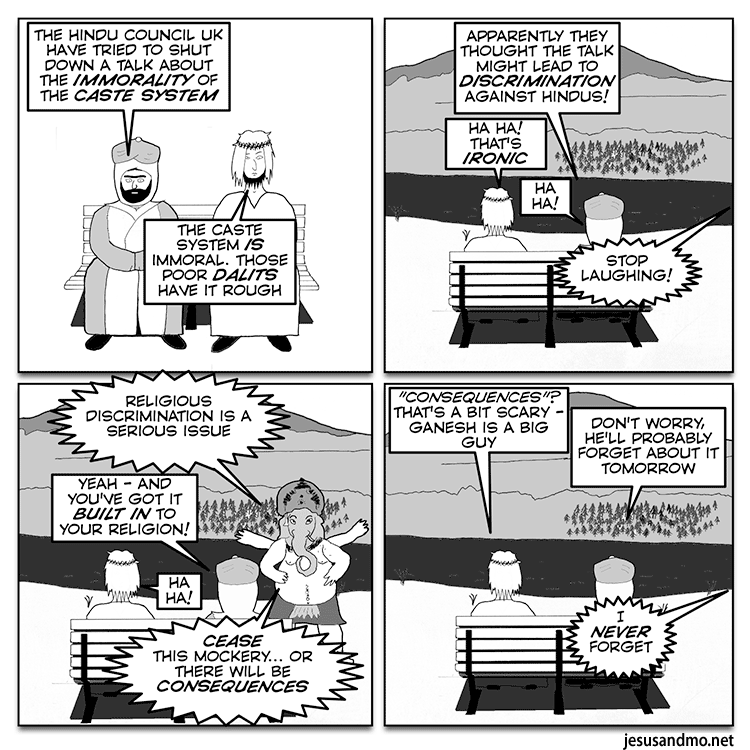
Jesus ‘n’ Mo ‘n’ caste

January 24, 2024 • 10:30 am

Today’s Jesus ‘n’ Mo strip, called “caste,” is based on a story at the National Secular Society’s website. in which a Hindu group threatens to report one of the NSS’s branches to the cops for blaspheming Hinduism. From the story:

A Hindu charity has threatened to report a secularist group to the police over a talk critical of Hinduism.

In December, Leicester Secular Society (LSS) held a talk, entitled “Hinduism: Wretched Immoral Compass”, by a former Hindu.

The talk aimed to “highlight the failure of Hinduism as a moral compass and show that it was flawed from the very outset”. It also examined “the contribution of several neglected Indian figures who stood for liberty, equality, fraternity, social justice, women’s rights, secularism/humanism and more”.

The promotional image for the flier included a diagram of the Hindu ‘caste system’.

Before the talk took place, LSS received an email from Rajnish Kashyap, general secretary of the London-based Hindu Council UK (HCUK), to express the charity’s “deep concern and offense [sic]” at the event’s title.

The email said the title “seems designed to appeal and incite hatred towards Hindus, who are one of the largest and most peaceful groups globally”.

It went on: “We intend to bring this matter to the attention of the local Hindu community, and local authorities, including the police.

The Divine Duo laughs it up—until Ganesha appears. Mo sets the elephant-headed God straight, telling him that the caste system builds religious discrimination right into the Hindu faith:

My letter to the Chicago Maroon about Students for Justice in Palestine

January 24, 2024 • 9:00 am

Over the last several months, I’ve seen and read about demonstrations on our campus by the pro-Palestinian group Students for Justice in Palestine (SJP), which apparently has roughly 200 campus branches in the U.S., Canada, and New Zealand.

SJP has been particularly active since last year’s October 7 massacre of Israelis and others, which they defended in a long letter (2,471 words!) in the Chicago Maroon, our student newspaper. Click below to read this hate-filled diatribe, or find it archived here. It was written a few days after the massacre but was updated and published in the Maroon on December 1.  The instant I saw this justification for butchery (just read the bit below), I felt that I somehow had to respond.

The beginning of the SJP’s “explanation”:

The events of the past week have been historic and unprecedented by all measures. Last Saturday, for the first time in history, Palestinian resistance groups broke out of Gaza, reclaimed land from the Israeli occupation, and seized control of numerous Israeli military posts. Scrambling to recover from this humiliation and collectively punish Palestine’s population for the accompanying violence inflicted on Israeli soldiers, settlers, and civilians, Prime Minister Benjamin Netanyahu has—predictably—resorted to openly genocidal tactics.

How euphemistic can you get?  But even before this letter appeared, the SJP engaged in several loud demonstrations (conducted with another non-student organization)—demonstrations that were almost frightening in their anger, hatred and calls for genocide (“from the river to the sea”, etc.) . It was simply scary to listen to these people, and for the first time in decades I felt a bit frightened to be a Jew, although a secular one.  Of course, their behavior is intended to frighten us, and many Jewish students have become intimidated.

And it doesn’t matter that I’m a secular Jew. SJP’s hatred of Jews doesn’t depend on whether or not they subscribe to the tenets of Judaism. As with the Nazis, secular Jews also count as targets.

On October 19, a peaceful demonstration by Jewish students in the Quad was disrupted by SJP, who had promised not to do so. This deplatforming, which canceled the demonstration (it involved a lecture by a rabbi, which is what Jews call a “demonstration”) violated several campus rules, which you can see in my post at WEIT on the incident, and it caused two Jewish students to write a heartfelt letter to the administration, which was never acknowledged, much less answered. The “dean on call” was summoned to quash the deplatforming, but she did nothing.

A group of faculty, including myself, also wrote to the administration, and eventually President Paul Alivisatos wrote a good letter to the University community explaining that University policy doesn’t allow the disruption of speakers. It didn’t give specifics, but at least to many of us it seemed prompted by the behavior of SJP. An excerpt:

In any venue, no member of our community may shout down or seek to prevent the protected expression of those with whom they disagree. You may not tear down a poster. You may not seek to intimidate or threaten another person, or prevent them from hearing an invited speaker. These are egregious offenses against our community. We have policies and processes for guiding community norms, reporting instances that require investigation, and disciplinary action when needed. Our Dean of Students in the University will share more about those policies and processes with students later today.

Good for the President! This is a clear expression of University policy, though I don’t think that any SJP students were warned or discipline for violating it.

Three days before the SJP letter appeared, on November 28, a Maroon “reporter,” actually a pro-Palestinian student activist who participates in SJP demonstrations, wrote a very long article (4,077 words) in a section of the Maroon called The Grey City. It’s really a puff piece for the SJP, describing a week of the group’s activities.  Click below to read that account or find it archived here.

There’s an “editor’s note” appearing at the beginning:

Editor’s note: Kelly X. Hui attended the quad protests and documented them as a protester with Students for Justice in Palestine UChicago and as an organizer with #CareNotCops and UChicago United for Palestine. The identities of protesters and organizers were kept anonymous.

This is hardly the objective reporting one expects from a news report! In effect, the Maroon did (and still does) harbor about 6,500 words of pro-Hamas “reportage” on its front page.

Was there any reporting on the other side—by those who are more pro-Israel? Not that I’ve seen. At the end of Hui’s piece there’s yet another editor’s note:

Editor’s note: As The Maroon’s long-form and narrative features section, Grey City seeks to produce coverage that gives students a direct voice in reporting. As a separate report, Grey City will soon be publishing a story written by pro-Israel student organizer [sic] who has been active in recent campus demonstrations.

This promised story hasn’t yet appeared, even though two months have lapsed. I might have missed it, but I don’t think so. I suspect that they couldn’t find anybody to write it. But if that’s the case the Maroon should have commissioned a piece. The newspaper owes its audience a more balanced view of the controversy.

At any rate, I felt that the paper needed a voice that argued against the discomfiting pro-Palestinian stand of these two long pieces, particularly the SJP’s screed justifying Hamas’s attacks of October 7.  And if there wasn’t such a piece, I had to write one. So I produced an op-ed for the paper that came out yesterday. You can see it by clicking below, and I’ve put the text of my letter below the fold at the bottom.

I am under no illusions about the pushback I’ll get for what I wrote. SJP is aggressive if it’s anything, and standing up against the organization, and for Israel, is not the most popular thing to do on campus these days.  But the laws of physics—instantiated in SJP’s writings, violations of campus policies (see photo below), and chants that, to many, are calls for the elimination of Israel (and probably not peacefully!), compelled me to write the letter.  In the absence of the promised pro-Israel article, my letter shows that at least shows that one member of the University community abhors the violence and hatred embodied in SJP. And I hope what I wrote gives a bit of succor to our intimidated Jewish students.

********

Click “read more” to see the text of my letter, which isn’t long. The photo that accompanies it is of an SJP demonstration, and below is an Instagram post from SJP that testifies to their blocking of the administration building (Levi Hall), a violation of University policy. Note that they’ve covered their faces with hearts, showing their cowardice at the same time. their failure to recognize a wildly inappropriate symbol.

Continue reading “My letter to the Chicago Maroon about Students for Justice in Palestine”

Wednesday: Hili dialogue

January 24, 2024 • 2:47 am

by Matthew Cobb

PCC(E) is returning from the West Coast, so light posting today. Feel free to behave in the usual, well-mannered way, in the comments, on whatever tickles your fancy.

Meanwhile in Dobrzyn, Hili is a materialist, as you would expect from an animal:

Hili: We do not have any other choice.
A: In what matter?
Hili: Unfortunately, we have to accept reality.
.
In Polish:
Hili: Nie mamy innego wyboru.
Ja: W jakiej sprawie?
Hili: Niestety musimy zaakceptować rzeczywistość.
.
For your morning delight, I give you this tweet. Note the dot is the size of Earth’s *orbit*.
.

From JAC, a bit of Nooz: Nikki Haley was trounced in the New Hampshire Republican primaries last night. It’s all over now: barring an aneurysm, Trump will be running against Biden in November. Ceiling Cat help us all!

The much-fabled power of New Hampshire’s fiercely independent voters wasn’t enough to break the spell Donald J. Trump has cast over the Republican Party.

Brushing aside Nikki Haley a little over a week after he steamrolled her and Ron DeSantis in Iowa, Mr. Trump became the first Republican presidential candidate who was not a White House incumbent to carry the nation’s first two contests. His winning margin of 11 percentage points in moderate New Hampshire demonstrated his ironclad control of the party’s hard-right base and set him on what could very well be a short march to the nomination.

For Ms. Haley, the former South Carolina governor, it was a disappointing finish in a state she had poured considerable resources into carrying. Her efforts to cobble together a coalition of independents and anti-Trump Republicans, with support from the state’s popular governor, were no match for Mr. Trump’s legions of loyalists.

. . .The contest now moves to South Carolina, the next competitive primary and one where Ms. Haley faces a steep uphill battle. Mr. Trump has led polls in her conservative home state by more than 30 points for months.

There’s little question that a defeat there for Ms. Haley would be devastating, making it difficult for her to justify carrying on in the race.

Figure from the NYT:

At FiveThirtyEight, most of the polls pitting Biden against Trump show Trump leading by a few percentage points, like this one with Trump 5% ahead (click to enlarge):