Why Evolution is True is a blog written by Jerry Coyne, centered on evolution and biology but also dealing with diverse topics like politics, culture, and cats.
Today is an important day for both Hili and Professor Ceiling Cat. It is a day for celebrating the relationships between felids and their humans.
Yes, tonight is the New Yorker Festival event “You, the Jury: Cats vs. Dogs.” Team Cat has its claws sharpened and many tricks up its forelegs, but I’m not at liberty to divulge them. Our members include Anthony Lane, Ariel Levy, Joyce Carol Oates, Jesse Eisenberg, me, and Anthony Hutcherson, who breeds Bengal cats (and a breed I hadn’t heard of, “Toygers”) in Washington D.C. Have a look at Anthony’s website, Jungletrax Cattery, to see some of the gorgeous cats he produces.
Posting may be very light today: I must change hotels and prepare for The Big Challenge. Cats must win!
And Hili has an appropriate dialogue:
Hili: At last, serious people in New York will be debating a serious matter.
A: What matter is that?
Hili: What do you mean, what matter is that? The superiority of cats over dogs. Jerry will be wearing THIS shirt!
In Polish:
Hili: Nareszcie w Nowym Jorku poważni ludzie będą debatowali o poważnych sprawach.
Ja: O czym?
Hili: Jak to o czym? O wyższości kotów nad psami. Jerry będzie występował w TEJ koszuli.
*****
And just a few minutes ago I got a good-luck note from Japanese artist Hiroko Kubota, who designed, embroidered, and also made the shirt depicted above (as well as the one below). She said,
Reader “amyt” found a bizarre church sign, and a counter-sign, on a recent trip. Here is her narrative and her photos:
We saw this photo on our way to a wedding (Sunday) in Mohican State Forest Ohio. We saw the church sign when heading north from Delaware, Ohio to a wedding. We did a 180 when we saw it and made a note to be sure and stop on the way home to shoot some photos. At that time we did not see the sign next door about disgracing the Lord.
On the way home (Monday) we pulled into the driveway to shoot the church sign. That’s when we saw the Tattletale Alarm sign on the locked gate. We found this ironic. If you have concealed weapons why “in God’s name” do you need a locked gate AND a sign for Tattletale Alarms?? That’s why I took that picture as well. We turned around and headed back down the road.
WHOA…….WTF—we saw the second sign. SCREECH, and then took that picture. I can’t say for sure if the second disgracing the Lord sign was there on our first pass-by or not, but I’m sure glad we saw it on the way home. Marengo Church is located on Route 229 just west on 61.
What’s next, assault rifles? Instead of communion wafers maybe they will start passing out bullets instead.
Note to non-Americans: “concealed carry” means you’re carrying a loaded weapon, usually a handgun, but out of sight.
Now who put that other sign up? It’s a mystery!
And amyt’s moggie, whom she calls “Mr. Cat.” Her caption is “Spot the orange cat.” Can you see it?
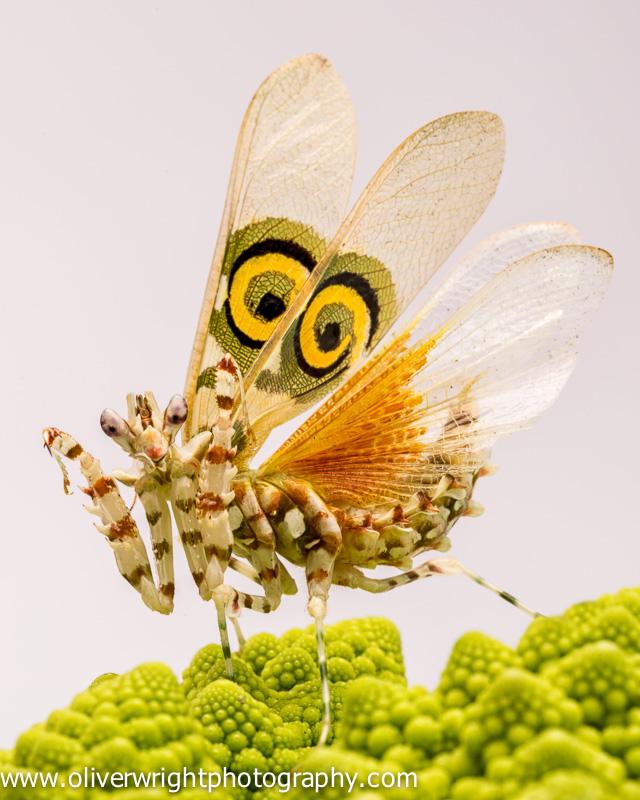
This fantastic photo of a spiny flower mantid displaying on one of those weirdly fractal bobbly Romanesco cauliflowers was taken by Leeds-based photographer Oliver Wright, who kindly gave me permission to reproduce it here. You can see a whole lot more photos – some macro, some not – over at his website.
This is a threat display (i.e. the animal is threatened so it’s threatening back by looking scary). The dark bits you can see on its eyes (and those of many other insects) are not in fact pupils, but are called the deep pseudopupil. These are optical effects that move in their position on the eye as you move your point of view, and they tell us about the organisation of the ommatidia [JAC: the small individual visual components] that make up the insect’s compound eye.
By JAC:
Finally, from a tw**t from Sofia Gabriela, a photo of an albino raccoon and its young spotted by Rick Stockwell in Le Sueur, Minnesota. Albinos in the wild are usually either unhealthy or easily spotted by predators, but this one seems to have reached adulthood and produced a litter. It’s clearly an albino than a case of leucism, as the eyes are without pigment.
I wish it luck. The young are, of course, normal, as albinism comes from having two copies of the mutant gene, which is recessive, and mating with a “normal” raccoon would produce all normally-colored young unless the male carried one copy of the albino gene, in which case half of the offspring would be albinos.
Here’s a clip with Sam Harris on yesterday’s “The Last Word,” Lawrence O’Donnell show on MSNBC. As usual, Sam is calm and eloquent, but makes his point forcefully, asking for Muslims as a whole to create a “groundswell” repudiating the kind of behavior evinced not only by ISIS, but the less extremist but still tribalistic and barbaric forms of sharia law in many Muslim countries.
As I said, I think that fight on Maher’s show was a watershed moment for American liberalism, forcing it to examine what “liberalism” really means in the face of Islamic extremism. Evidence for that is the many discussions in the media that that exchange inspired. I haven’t seen Nicholas Kristof’s column yet, but according to O’Donnell on this clip he agrees with Sam on many points.
At 10:40 Harris and O’Donnell discusses Reza Aslan’s new op-ed in the New York Times, “Bill Maher isn’t the only one who misunderstands religion”, an article that is is curiously ambiguous: it decries Islamic extremism, which surpised me, but then takes it back, implying that no religion is inherently violent and that religion is not so much a matter of belief as of culture, implying that Islamic violence does not come from Islam.
O’Donnell is a good interviewer, actually allowing his subjects to speak without interruption (he jokes at the start about others who don’t do that, and we can imagine who he has in mind).
Here are some random photos from the Lower East Side, where I’m staying; they include, of course, the all important Report on Noms.
Noms were procured at the famous Katz’s, perhaps the most famous delicatessen in New York. It’s on the corner of Houston and Ludlow Streets, and has been in operation since 1888. That is 126 years!. Here it is, an unprepossessing sight—but what culinary delights lie within!
Over the years (I’ve been going here since 1971), Katz’s has become increasingly famous, largely because that is where the famous “fake orgasm” scene took place in the movie “When Harry Met Sally.” Tourists flock here, and at the left, hanging from the ceiling, is a sign with an arrow pointing to the table where Meg Ryan showed Billy Crystal how women fake orgams.
What do you get at Katz’s? Pastrami on rye with mustard, of course, though corned beef is nearly as good and the hot dogs are creditable. They also have some of the best fries around, though I didn’t get any on this visit as they were being made when I arrived. (I couldn’t have been able to finish them anyway.)
To get a sandwich, you line up in front of one of the famous “countermen” (they’re all men), who hand-slice your meat from a big hunk of pastrami or corned beef. I asked the greeter who made the best sandwhiches, and he pointed to Juan, third counterman from the right. When I stepped up for my order, I put two bucks in his tip cup, and asked, as food critic Josh Ozersky had advised me, for a “pastrami, first cut, juicy.” Juan went back to the steamer and came back with a whole pastrami: apparently the first cut really is a first cut. While waiting for my sandwich, he slipped me a plate containing several slices of the delectable viand.
The sandwich came with a good ration of half-sour and dill pickles, and I picked up a Dr. Brown’s Cel-Ray Tonic (yes, a celery-flavored soda), the perfect beverage to wash down the salty pastrami.
And voilà: one of the world’s great meals. There have been kings who haven’t eaten so well!
The view above doesn’t give you an idea of the sheer volume of the meat, so I took a cross-sectional view of half of the sandwich, below. The pastrami was flavorful and full of juice; Josh didn’t steer me wrong. It was in fact the best pastrami sandwich I’d ever had.
You call that a sandwich? Now THIS is a sandwich!!!
After lunch I strolled the two blocks to Economy Candy, a Jewish-run store specializing in hard-to-find sweets or the candy bars of your youth. The store is mesmerizing:
Here’s a display of hard-to-find American candy. Who remembers the Mallo-Mar, the Zagnut bar, or the Sugar Daddy caramel sucker, responsible for the loss of many an American filling?
Economy is also one of the few sources of Fox’s U-Bet chocolate syrup, one of the three ingredients of the classic New York beverage, the egg cream, which contains neither eggs nor cream.
My own haul was a big bar of chocolate-covered halvah (Joyva brand, of course):
Here’s part of the Lower East side, where my granddad lived after he immigrated from Russia. This is a segment of Orchard Street, and the buildings were once all stores or tenements housing poor Jewish families. Traces of the Jewish past remain, as with Beckelstein’s fabric store on the right. Now the area is becoming gentrified with Starbucks and frozen yogurt shops. So it goes.
The New Republic kindly offered to print (and offer a bit of remuneration for) a revised version of the post I wrote criticizing John Gray’s vicious ad hominem attack on Richard Dawkins—a smear thinly disguised as a review of Dawkin’s autobiography. Curiously, Gray’s ill-tempered screed was originally published in The New Republic as well. Kudos to them for trying to get editorial balance on a piece that, I think, should never have appeared.
My rewritten response is called, “Richard Dawkins doesn’t deserve this fellow atheist’s smears” (subtitle: “Philosopher John Gray should attack his ideas, not his character”). Go have a look, if you wish, and join in whatever debate ensues.
According to today’s New York Times (for some reason I didn’t get a CNN bulletin), the 2014 Nobel Peace Prize was awarded to two people. You will know one of them: Malala Yousafzai, the Pakistani teenager (now 17) who was shot two years ago, nearly died, and then began campaigning for universal access to education (she was shot, probably by the Taliban, for the crime of trying to go to school). She is the youngest recipient of any Nobel Prize. The other recipient, from India, is Kailash Satyarthi. It’s lovely that an Indian and a Pakistani, two nations traditionally at odds, are sharing the Peace Prize.
And this is also nice:
British news reports said Ms. Yousafzai was at school in Birmingham, England, where she has lived since being treated for her gunshot wounds, when the prize was announced and was taken out of her class to be informed of the award.
Satyarthis isn’t as famous, at least to Americans, but, at 60, has an even longer record of activism:
In India, Mr. Satyarthi, a former engineer, has long been associated with the struggle to free bonded laborers, some born into their condition and others lured into servitude. For decades, he has sought to rid India of child slavery and has liberated more than 75,000 bonded and child laborers in the country.
Mr. Satyarthi began working for children’s rights in 1980 as the general secretary of the Bonded Labor Liberation Front, an organization dedicated to freeing bonded laborers forced to work to pay off debts, real or imagined. He also founded the Bachpan Bachao Andolan, or Save the Children Mission, an organization dedicated to ending bonded labor and saving children from trafficking.
“This is a very happy moment for every Indian,” he said in comments aired on the Indian news channel NDTV on Friday. “If with my humble efforts the voice of tens of millions of children in the world who are living in servitude is being heard, congratulations to all.”
Deserving recipients, and I thank Ceiling Cat that Pope Francis, who had been mentioned as a possible recipient, was a candidate for the prize. That would have put him on the list with Henry Kissinger as Egregiously Undeserving Awardees.
Finally, this is heart-warming:
. . . news of the Nobel Prize on Friday inspired jubilation and well-wishers in the Swat Valley, who spilled onto the streets and distribute [sic] sweets in a traditional celebration.
The winners. Photos: left, Olivia Harris/Reuters; right: Adnan Abidi/Reuters