
by Matthew Cobb
This fantastic photo of a spiny flower mantid displaying on one of those weirdly fractal bobbly Romanesco cauliflowers was taken by Leeds-based photographer Oliver Wright, who kindly gave me permission to reproduce it here. You can see a whole lot more photos – some macro, some not – over at his website.
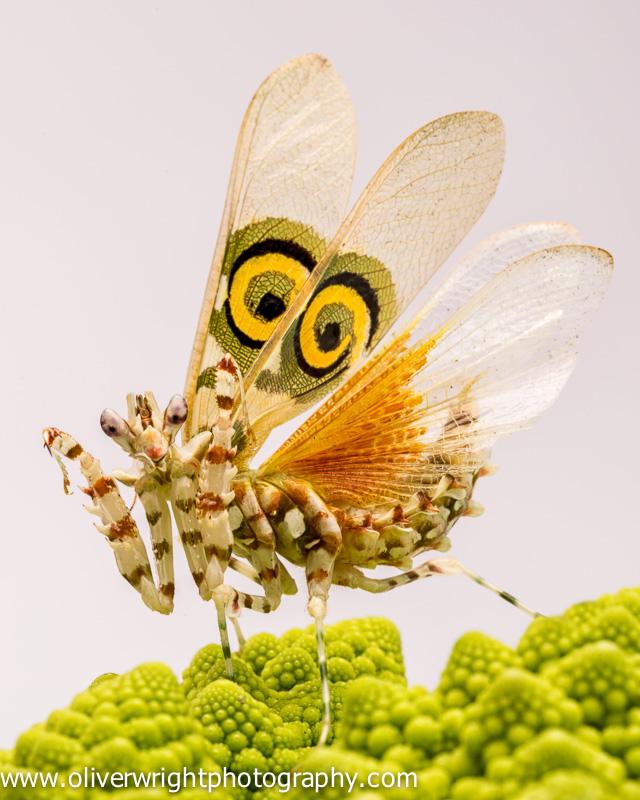
This is a threat display (i.e. the animal is threatened so it’s threatening back by looking scary). The dark bits you can see on its eyes (and those of many other insects) are not in fact pupils, but are called the deep pseudopupil. These are optical effects that move in their position on the eye as you move your point of view, and they tell us about the organisation of the ommatidia [JAC: the small individual visual components] that make up the insect’s compound eye.
By JAC:
Finally, from a tw**t from Sofia Gabriela, a photo of an albino raccoon and its young spotted by Rick Stockwell in Le Sueur, Minnesota. Albinos in the wild are usually either unhealthy or easily spotted by predators, but this one seems to have reached adulthood and produced a litter. It’s clearly an albino than a case of leucism, as the eyes are without pigment.
I wish it luck. The young are, of course, normal, as albinism comes from having two copies of the mutant gene, which is recessive, and mating with a “normal” raccoon would produce all normally-colored young unless the male carried one copy of the albino gene, in which case half of the offspring would be albinos.

~
Both pictures are way cool. It is strangely appropriate to have the mantis threatening to kick ass on this particular variety of cauliflower. ‘Mandelbrot ain’t got nuthin’ on me!’
I can see the mantis taking part in a photo shoot. “Now look fierce! That’s it! Perfect!”
Yes, both very cool.
Both great pix. It’s funny how the albino coon looks almost possumy.
Without the mask, it’s much more mustelid- (e.g. ferret-)like than raccoons usually look.
At least now if it commits a crime or does something heroic, we’ll be able to identify it.
Yeah, ferrety or possumy, to use the scientific nomenclature:-)
Those are great.
I like the one juvenile racoon looking at the camera with his/her mouth open as if giving a cool pose!
Or saying You lookin’ at me?
or “got meat?’
Gorgeous wings on the mantis!
Is it me? the pic of the raccoon goes to a different picture
http://whyevolutionistrue.wordpress.com/2014/03/22/raccoon-plays-the-aquatic-harp/
I see that too, when I click on the picture. Seems like there’s a few more ropes for Matthew and the rest of the back up crew to learn.
The link to Oliver Wright’s site doesn’t go to the picture shown here, either. Just the same, there’s still a lot of good pictures to be seen there.
That mantis is incredible.
The gene for albinism is fairly-well dispersed throughout our local squirrel population, but I can attest to having seen more than one ball of white fluff remaining on the grass where a hawk has made lunch out of one of these unfortunately-conspicuous rodents.
But while they’re around, white squirrels are fun to watch.