Why Evolution is True is a blog written by Jerry Coyne, centered on evolution and biology but also dealing with diverse topics like politics, culture, and cats.
It was a lazy day today, with one visit to an architectural/history site and then one big and delicious meal. After we had a leisurely breakfast and did our ablutions, it was nearly 11 a.m. We then walked the ten blocks to the Owens-Thomas House and Slave Quarters:
The Owens–Thomas House & Slave Quarters (originally known as the Richardson House) is a historic home in Savannah, Georgia, that is operated as a historic house museum by Telfair Museums. It is located at 124 Abercorn Street, on the northeast corner of Oglethorpe Square. The Owens–Thomas House was designated a National Historic Landmark in 1976, as one of the nation’s finest examples of English Regency architecture.
. . . The house is notable for its early cast iron side veranda with elaborate acanthus scroll supports on which the Marquis de Lafayette addressed the citizens of Savannah on his visit in 1825.
The house was built between 1816 and 1819, designed by the architect William Jay of Bath and financed and occupied by Richard Richardson. It was then purchased by attorney and politician George Welshman Owens, who was briefly mayor of Savannah and later a U.S. Representative.
The Owens family lived in the house for a while, but after some decades turned it into a boarding house, which is when Lafayette stayed there on his final visit to America on the 50th anniversary of the American Revolution—in which Lafayette played a huge role.
In 1951 the family turned the house over to the Telfair Academy of Arts and Sciences , which still owns it (I visited the other two parts of the Museum on my first day here).
The sign below gives pretty much the same information above.
The front of the house (I forgot to photograph the famous balcony). When Lafayette, an abolitionist, visited Savannah in 1825, the town kept all the slaves inside, along with the free blacks, so they wouldn’t be incited by Lafayette’s antislavery sentiments.
The back garden of the house, designed to be completely symmetrical. In the rear are the slave quarters. This is only part of them: the small house held 12 people, and there were a bit more than 20 enslaved people working for the white residents.
This sign was in the slave quarters, explaining why the guides and many of the signs used the terms “enslaved people” instead of “slaves.”
Inside the quarters, which slept at least twelve people, though many of the enslaved, like the cook and those who took care of the chlldren, slept inside the big house.
The dining room. Food was cooked in the basement, and since there was no dumbwaiter it was carried on trays up two floors from the basement and put in the butler’s pantry before being served.
The butler’s pantry was a small room, with four empty bottles of wine sitting on the sideboard. As the tour moved on, I picked up one of the bottles and saw what’s below: a bottle of Barton and Guestier bordeaux—from 1870! I’d never held a wine bottle that old before. And this chateau is still going strong; it was founded in 1725.
The structural material of the house was tabby, an equal mixture of sand, burnt oyster shells, water, and ash. It was an early form of concrete, and was quite durable. As you see, the tabby was covered with wood paneling.
This room was presumed to be the library/study, though now they’re unsure what all the rooms were used for.
This is presumed to be the oldest son’s bedroom.
And a mirror, at the bottom of which you can see a selfie of Professor Ceiling Cat (Emeritus):
The (presumed) master bedroom, now a word that’s out of favor for obvious reasons (I can’t remember what it’s supposed to be called now).
After the tour we walked home and then got in the car to drive to a restaurant I’d scoped out as a likely prospect: great food, not overly expensive and, most important, Southern. Yes, we went to Erica Davis Lowcountry. It turned out to be all I hoped for, though if you drove by this place you wouldn’t think to go in. But you’d be making a mistake if you didn’t.
We split two appetizers. First, oysters Rockefeller made with local oysters. Wikipedia describes the dish this way:
Oysters Rockefeller is a dish consisting of oysters on the half-shell that have been topped with a rich sauce of butter, parsley and other green herbs, bread crumbs, and then baked or broiled.
There were also collard greens, cream. and Parmesan cheese. It was scrumptious—the first time I’ve had this dish. With all that garnish you could still taste the oysters, and I love oysters. You’d think the dish would be too busy with all the ingredients, but the flavors mingled perfectly.
Another Southern classic: fried green tomatoes, these with feta cheese and balsamic vinegar reduction.
The menu was so full of good stuff (see the link above) that I asked the waiter what she recommended. Without question she mentioned the shrimp, which are local, fresh, and delicious. So I got a half pound of boiled shrimp. They came with clarified butter, shrimp sauce, and two sides (I chose cheese grits and deep-fried okra). And oy, were those shrimp good! I ate the shells, of course, as all good shrimp lovers do.
Tim had the Wassaw redfish, described as “pan-seared redfish filet, garlic beurre blanc, heirloom tomato, stone ground grits, fresh green beans.” He pronounced it excellent.
Betsy had two crab cakes along with green beans and cole slaw. As expected, the cakes were almost all lump crabmeat, with just a small amount of filling to hold them together. With a little bit of the sauce on the crab, it was a Platonic version of this dish.
And my Southern dessert: the third helping of banana pudding I’ve had on this trip—this time served in a Mason jar. This was the fanciest version of all I’ve had. As you can see, it’s topped with whipped cream dusted with vanilla wafer crumbs, with a whole wafer on the side. (Banana pudding sans vanilla wafers is unthinkable.) Then there’s a layer of banana pudding, then a layer of cake, and then a bottom layer of pudding with chunks of banana. This was the best version I had on this trip, and probably the best version I’d ever had. (I’ve eaten it many times, often with BBQ or a meat-and-three plate in the South.)
The meal was terrific, not very expensive, and prepared with great care. I’d recommend this place very highly to anyone who visits Savannah.
Without a doubt, the most famous “restaurant” in Savannah is Mrs. Wilkes Dining Room, formerly known as Mrs. Wilkes’ Boarding House (the apostrophe seems to be optional). It is a stupendous all-you-can eat Southern homestyle meal, formerly served to the lodgers at a boarding house. A bit from Wikipedia:
Mrs. Wilkes’ Dining Room was previously the dining hall of the Wilkes House, a downtown boardinghouse. Today the restaurant is housed on the ground floor of the same historic house, built in 1870, at 107 West Jones Street. The restaurant was described by author William Schemmel as “a treasure hidden away in a historic district town-house”. Its longtime owner, Sema Wilkes, published several cookbooks. As of 2024 her family continued to run the restaurant, serving lunch on weekdays.
We happen to be staying at about 200 Jones Street, so could walk get there in about 7 minutes, though waddling home the obligatory postprandial nap took a while longer!
More:
Mrs. Wilkes’ is noted for its homestyle traditions, in which guests are escorted in shifts of ten into the dining room, where a variety of dishes are freshly laid on one of several long tables. There is no menu; dishes are selected by the restaurant and change daily. Travel Holiday in 1993 recalled that the “tables were set with steaming bowls and platters of tasty Southern food”.
The guests sit at the table and pass the dishes around to one another like a family. There are usually long queues waiting to get in.
Usually?? Try “always”!
We tried to go on Monday, but didn’t make the first seating and so, lest we miss our Monday architecture tour, decided to return yesterday. The first three pictures are from Monday, but the line was the same (long) yesterday. The difference was that yesterday got there a full hour before it opened at 11 a.m., and so were seated as soon as the doors opened.
I’ve put a lovely YouTube video about the place at the bottom of this post, so be sure to watch it. It perfectly captures the Wilkes Dining Experience.
x
The line was longer than this but I wanted to fit in the house as well as the hungry customers.
I wanted Tim to photograph me holding a fried chicken leg (the place is famous for its fried chicken) and, sure enough, my chicken leg was on the sign by the entrance.
The place was about five minutes late in opening—a delay I couldn’t tolerate. Photo by Tim.
They take only case: no credit cards (there’s an ATM nearby).
Our table set up with some (but far from all) of the dishes we got, along with glasses of tea (sweetened, of course) and fresh roses. You can see collard greens, fried okra, macaroni salad, cucumber salad, and, well, I put below of what we were offered.
One of the two dining rooms after it filled up.
Immediately after sitting down, we were served both cornbread and fresh, hot biscuits.
And of course the food and atmosphere were conducive to making friends, and so we chatted with two amiable visitors from the UK, one from Manchester, where Matthew lives. I’m sure this is a particularly unique experience for Brits who aren’t familiar with southern American cuisine (the best in the U.S., in my view, especially if you throw in Texas brisket).
Here are the dishes that were put on the table, but we may have forgotten a few. There were more than two dozen, and you could help yourself to as much as you wanted. Our lunch took about an hour.
Below: my plate, the first of 2.5 platefuls I ate. Clockwise from 11 o’clock: biscuit, cornbread, collard greens, deep-fried okra, macaroni salad, pulled pork, black-eyed peas, stewed cabbage, rice with chorizo, sweetened yams, and fried chicken. As expected, the fried chicken was fantastic: among the best I’ve ever had. A crunchy, crackly exterior enshrouded juicy chicken.
This was, of course, only my first plate, as I wanted to try nearly all the dishes except stewed okra (okra is edible only when deep-friend, and ;then can be very good).
Me eating chicken–a breast this time, though I also had a thigh. Photo by Tim.
Here are Tim and Betsy digging in:
We were offered a choice of desserts: peach cobbler with vanilla ice cream or banana pudding studded with vanilla wafers. Since part of my stomach is reserved for desserts, I asked for (and got) both.
Cobbler:
Banana pudding:
We waddled home after that, and all of us needed a nap. I did not eat a bit of food until this morning, when I ate only two pieces of toast.
If you go to Savannah (and do go when it’s not summer), you MUST go to Mrs. Wilkes’. This is not optional.
Here’s a great video about the place I found on YouTube.
Just. a quick update on yesterday’s peramublations, which included sightseeing and food.
We’ve rented an Air BnB equivalent in downtown Savannah, and it’s on this lovely tree-lined street:
Only half a block away is Clary’s Cafe, an eatery made famous because it’s in the novel Midnight in the Garden of Good and Evil, a semi-true tale of life and a murder in Savannah in the 1980s. I read it before I came here, and it was pretty good.
Here’s Clary’s with an old-time sign. When I went to get coffee at 8 a.m. it was empty, but when we returned at 10 a.m. there was a 25-minute wait. The cafe became a lot more popular after it was featured in the novel as well as in the eponymous film directed by Clint Eastwood. From Wikipedia:
The author of Midnight in the Garden of Good and Evil, John Berendt, described Clary’s as “a clearinghouse of information, a bourse of gossip,” where he came to know the characters who would animate his narrative. James Gandolfini made an uncredited appearance as the cook in the two scenes filmed at the cafe.
A photograph of the cast hangs inside the restaurant, featuring Alison Eastwood (who plays Mandy), her father, Clint Eastwood (director), The Lady Chablis, John Cusack (John Kelso), Kevin Spacey (Jim Williams) and Jack Thompson (Sonny Seiler).
The unprepossessing interior, which does serve up good food.
Since one of my goals here is to eat as much Southern food as I can, I had that classic staple for breakfast: biscuits in sausage gravy. Very filling–and good.
And I decided to have dessert as well: bread pudding. (Do not food shame me! I don’t eat like this all the time!)
The Wormsloe State Historic Site, originally known as Wormsloe Plantation, is a state historic site near Savannah, Georgia, in the southeastern United States. The site consists of 822 acres (3.33 km2), protecting part of what was once the Wormsloe Plantation, a large estate established by one of the founders of colonial Georgia, Noble Jones. The site includes a 1.5-mile (2.4 km) dirt road lined with southern live oaks, the ruins of a small house with fortified walls built of tabby, a museum, and an area with recreations of colonial structures such as a blacksmithing forge and a house similar to those first built in the colony of Georgia (or as housing for enslaved people).
It was atmospheric even though not many of the original structures remain. Here’s part of the long and famous alley of live oaks. I love the Spanish Moss, which for some reason doesn’t seem to hang on the palm trees. Perhaps a botanical reader knows the reason.
I’m visiting with my oldest friends Tim and Betsy, whom I stay with when I go back to Cambridge, MA. I’ve known Tim since 1967 when we lived in the same dorm at William and Mary; Betsy arrived as a transfer student two years later.
Here are the remains of Noble Jones’s house, a fortified structure built in 1745 not only as a home, but to withstand attacks by the Spanish and to monitor traffic passing through the narrows of the adjacent Skidaway River. The walls were built of “tabby,” an early form of cement made of equal volumes of water, sand, lime, and ground oyster shells. (The shells were obtained from copious Native American middens.)
And after considerable discussion in the morning, we decided to have dinner at a place of great repute—the Driftaway Cafe, known for its seafood and excellent cooking. And yes, it lived up to its reputation.
As soon as I saw shrimp and grits on the menu, I wanted it. I asked the waiter if the portion was large, as I was famished, and she replied, “Yes, it’s very big.” And it was: a huge bowl of grits made with four types of cheese, loaded with plump fresh shrimp, and studded with bacon bits. I could barely finish it (washed down with sweet tea, of course), and I was glad I didn’t order the fried green tomatoes (another Southern dish) as an appetizer. All evening long I would groan sporadically, “Oy, am I full!”
This was by far the best shrimp and grits I’ve ever had: a Platonic dish!
Well, I got my tuches to Savannah at about noon yesterday, and it was already steaming hot. Since our Air B&B didn’t open until 4 pm (why so late?), I had to cool my heels somewhere for a few hours, so I decided to visit the Telfair Museum (a trio of museums downtown), buy a pass, check my bags, get some food, and return for some art-gawking before making my way to the apartment (conveniently located in downtown Savannah).
I parked my luggage at the Jespson Museum, got a recommendation for lunch, and slowly ambled through the famous squares of downtown Savannah to the Little Duck Diner (!), which looks exactly like the picture at the link. It’s duck-themed and serves duck in various guises, but of course I eschewed the waterfowl dishes. Here’s how it looks from the outside:
A logo from the menu (artist unidentified).
The menu is here, and I asked the waiter for recommendations, which is how I came up with the avocado grilled cheese sandwich, with two types of cheese, bacon, avocado, and tomato. I ordered iced tea, and was asked “plain or sweet?”. You know you’re in the South when they ask you that, and of course I got the sweet tea, which, as usual, was so sweet it was almost like liquid dessert. That’s how the “table wine of the South” is served. Lunch:
On my walk to the restaurant, I noticed a small hole-in-the-wall store that sold only cobblers and variations on banana pudding—two dessert specialities of the South—and stopped in to plug the dessert-shaped hole in my being. Again, the place had a duck motif!
The place was The Peach Cobbler Factory, of which there are several branches After ascertaining that the Peach Cobbler was made from canned peaches (fresh fruits are out of season), I had the banana pudding instead. It was a generous portion of that Southern treat, embedded in which were two vanilla wafers (obligatory) and a huge hunk of red velvet cake. It was excellent, and filled the remaining lacuna in my stomach:
I passed this restaurant after lunch, which had a truly Southern seafood menu (click to enlarge). I must get shrimp and grits on this trip. And I would die for some boiled (green) peanuts, which are delicious and which I’ve had only in Georgia
Oy, was it hot! I ambled back to the Jepson Center (one of the trio of museums), where they featured the art of Ossabaw Island, one of the 100 or so Sea Islands near the coast of Georgia (Savannah’s on the ocean). Like most of these, Ossabaw is accessible only by ferry and guided tour. I’m keen to visit Sapelo Island, the home of the last community of Gullah people, a group of black Southerners with their own language and distinctive culture. (They were, of course, enslaved before and during the Civil War.) Here’s an example of the Gullah language, also called Geechee, a creole language that mixes English and African words:
The art was local, but I was most interested in two paintings by Kahlil Gibran, a Lebanese emigrant whom most of us geezers know as a mystic and author of The Prophet(1923), a collection of quasi-mystical fables that many hippies and New Agers revered as “wisdom”. It was immensely popular and has been translated into many languages, but I wouldn’t recommend reading it.
I was surprised to learn that Gibran actually regarded himself more as an artist than a writer, and two of his paintings were at the museum. The first is a self portrait, which I photographed. The details of the painting are in the second photo below:
And a portrait of Gibran’s mother. The guy was a pretty good painter!
An artist from Ossabaw island painting in the Museum and photographed from above:
I might as well put up some photos from Botany Pond, as the ducklings will have hatched when I return (I timed this trip badly, but had no idea that Vashti would be nesting now). The eggs should hatch today or tomorrow, and apparently one was rejected from the nest, as it was found below it but some distance from the ledge.
First, turtles. I’ve now seen all five, so they survived the winter, and they love to bask on the rocks. I believe that there is one yellow-bellied slider (Trachemys scripta scripta) and two red-eared sliders (Trachemys scripta elegans; they are subspecies) in the photo below.
We call this “turtle yoga”:
Nuzzling:
The pair of wood ducks(Aix sponsa) are there nearly every day, but they really should be mating and nesting. We have no tree holes at the pond (a sine qua non for this species to breed), so I have no idea what they’re doing. They are gorgeous, though.
The male (I haven’t named either one):
And the female:
Finally, Vashti on her nest. I’m worried that when the ducklings hatch, they and Vashti will be assaulted by the undocumented drakes who visit the pond. It’s probably good that I’m gone, as I’d be beside myself with anxiety. I have two very reliable associates who are taking care of the waterfowl in my absence.
Note that the nest is lined with soft feathers that she plucked from her breast.
(Armon is still here, ineffectually trying to drive away interloper drakes.)
A close up. Vashti is immobile when on the nest, so I can get quite close to her, but do so only to ensure that she’s still there (she’s hard to see):
I am not usually fond of restaurants that serve many small “nouvelle” courses that are lovely and exquisitely curated, as they don’t usually get me full—my prime requirement for a good restaurant. But last night we went to one of these multicourse places and had one of the best meals of my life—and it left me sated. This is the story of that meal.
AT 5:30 I met up with my friend, the engineer and origami master Robert Lang, visiting Chicago to teach a two-day class in origami at a meeting. And, as I mentioned yesterday, he invited me to a well-known Chicago restaurant for a slap-up dinner, which lasted a full three hours. It turns out that his niece manages the place, and so we were able to obtain hard-to-get reservations. From Robert:
As I may have mentioned before, my niece Kate is the general manager at Next Restaurant, and she’ll get us in. (You may recall I tried this with you several years ago during a Chicago trip, but the airlines conspired to ruin my arrival. This time, I’m flying in the day before, so there’s more buffer.)
Next is in the family of restaurants owned by the famous chef Grant Achatz, the most famous of which is Alinea. Here’s a Wikipedia photo of Achatz at Alinea, preparing a dish tableside:
star5112, CC BY-SA 2.0, via Wikimedia Commons
There’s a University of Chicago connection with Achatz, and I well remember his diagnosis of, ironically, mouth cancer. I did not expect him to survive, but he did:
On July 23, 2007, Achatz announced that he had been diagnosed with stage 4 squamous cell carcinoma of the mouth, which spread to his lymph nodes. Initially, Achatz was told that radical surgery was necessary, which would remove part of his mandibular anatomy, including part of his tongue and large swaths of neck tissue. Later, University of Chicago physicians prescribed an alternative course of chemotherapy and radiation treatments. This led to full remission, albeit with some side effects including a transitory loss of his sense of taste, which eventually returned. On December 18, 2007, Achatz announced that he was cancer-free. He credited the aggressive protocol of chemotherapy and radiation administered at the University of Chicago Medical Center for driving his cancer into full remission. The treatment regimen, administered under the direction of Drs. Everett E. Vokes, Blair and Haraf at University of Chicago, did not require radical invasive surgery on Achatz’s tongue.
Yay! It’s been nearly twenty years now and he remains cancer-free. Achatz cooks at Alinea, but owns some of Next and, I presume, visits and gives feedback.
Every four months or so, the appropriately named Next changes its themes—themes that are quite eclectic. You can see the history of the changing themes since 2011 at its Wikipedia page, as well as reading about the difficulty of getting reservations. We were lucky to get in, but Robert began the request several months ago, and of course has a genetic connection to the restaurant.
The theme until the end of April is Japan.
From Next’s website:
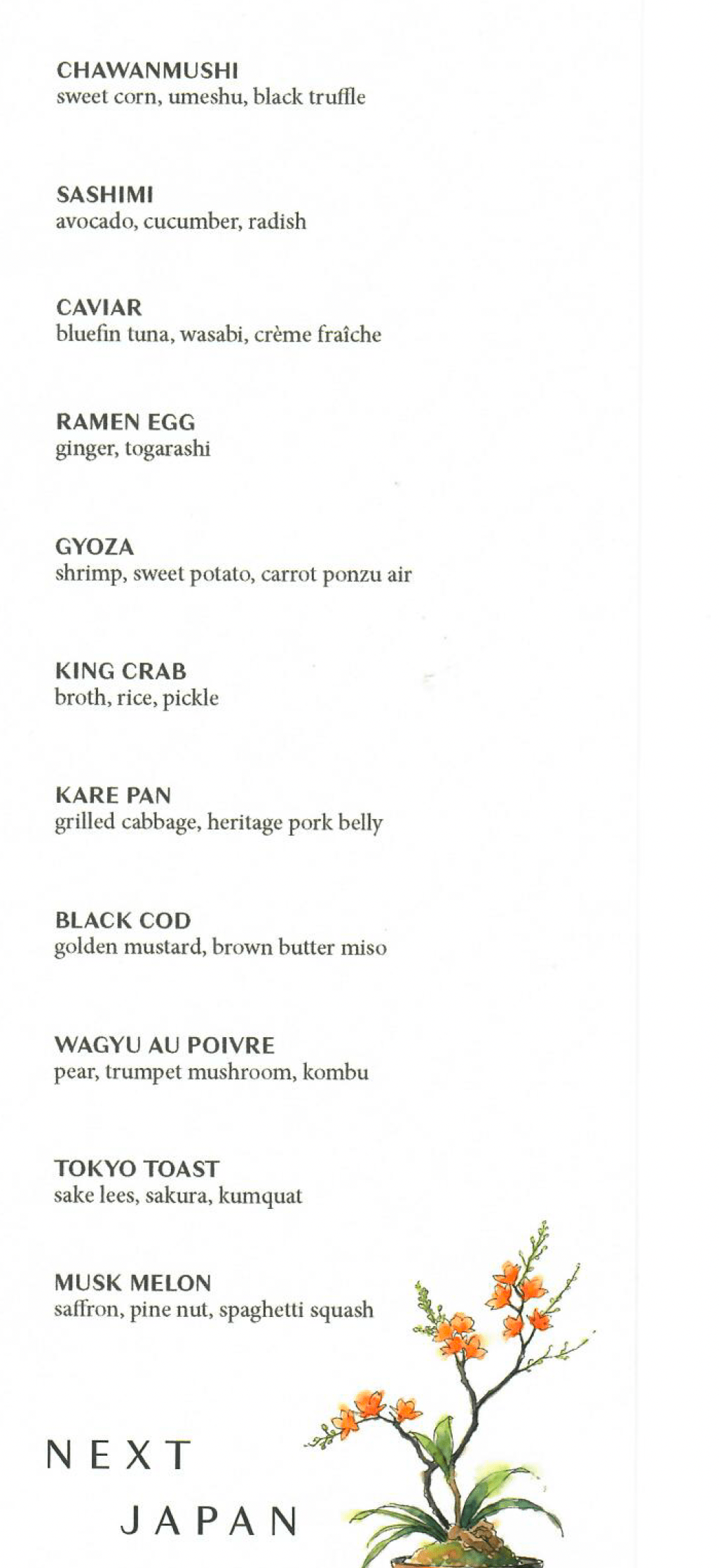
Robert sent me this photo the menu, so I knew we were in for a treat: There’s a more complete menu below. as we got a few extra dishes:
Below is Achatz from a FB video. To prepare for the meal, as he says, much of the Next team went to Japan and spent their time eating at a variety of humble and fancy restaurants. They then, said his niece, came back and spent a few months developing a menu that was inspired by what they tasted. I think the slurring of Achatz’s speech is due to his treatments for mouth cancer.
There is only one menu, and you can get it with or without a wine pairing (this one includes sake) or with non-alcoholic beverages. We got it with booze, of course, and the wines and sakes chosen matched the dishes remarkably well. They were fancy, tasty, and pricey wines. This place is a class act with some good palates working behind the scenes.
This is our menu; we were comped a few dishes because of Robert’s relationship to his niece, and so we wound up with eleven dishes, six wines, and two sakes (I love sake, and these were good ones, not obtainable, I was told, in local stores):
The food menu (this is what we were actually served including the gratis dishes; they apparently made up a custom menu post facto for us as a souvenir):
The wine-and-sake menu (while waiting for me, Robert was given a glass of champagne):
And now for the dishes (all photos by me except Robert’s, which are labeled “RJL”).
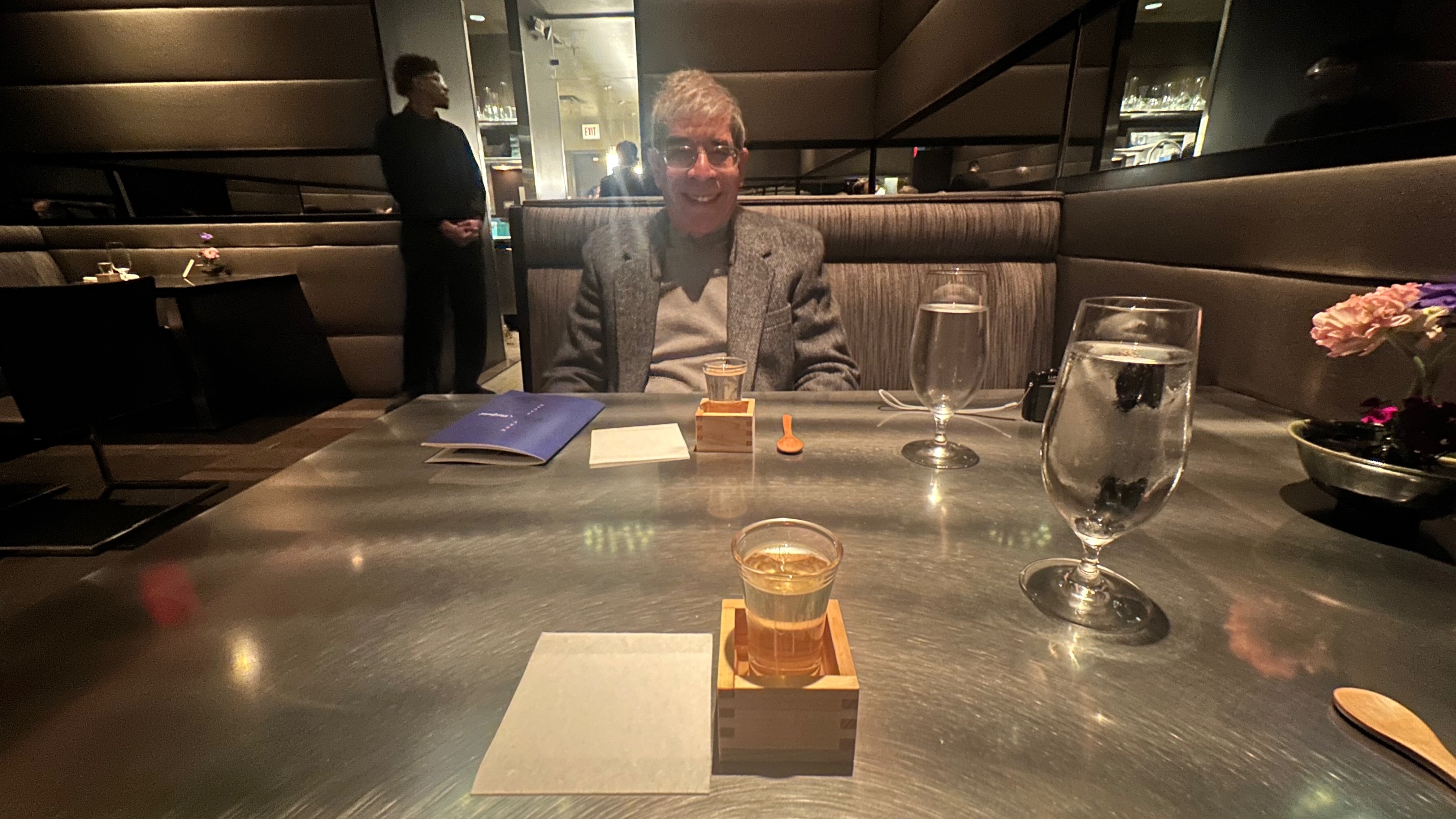
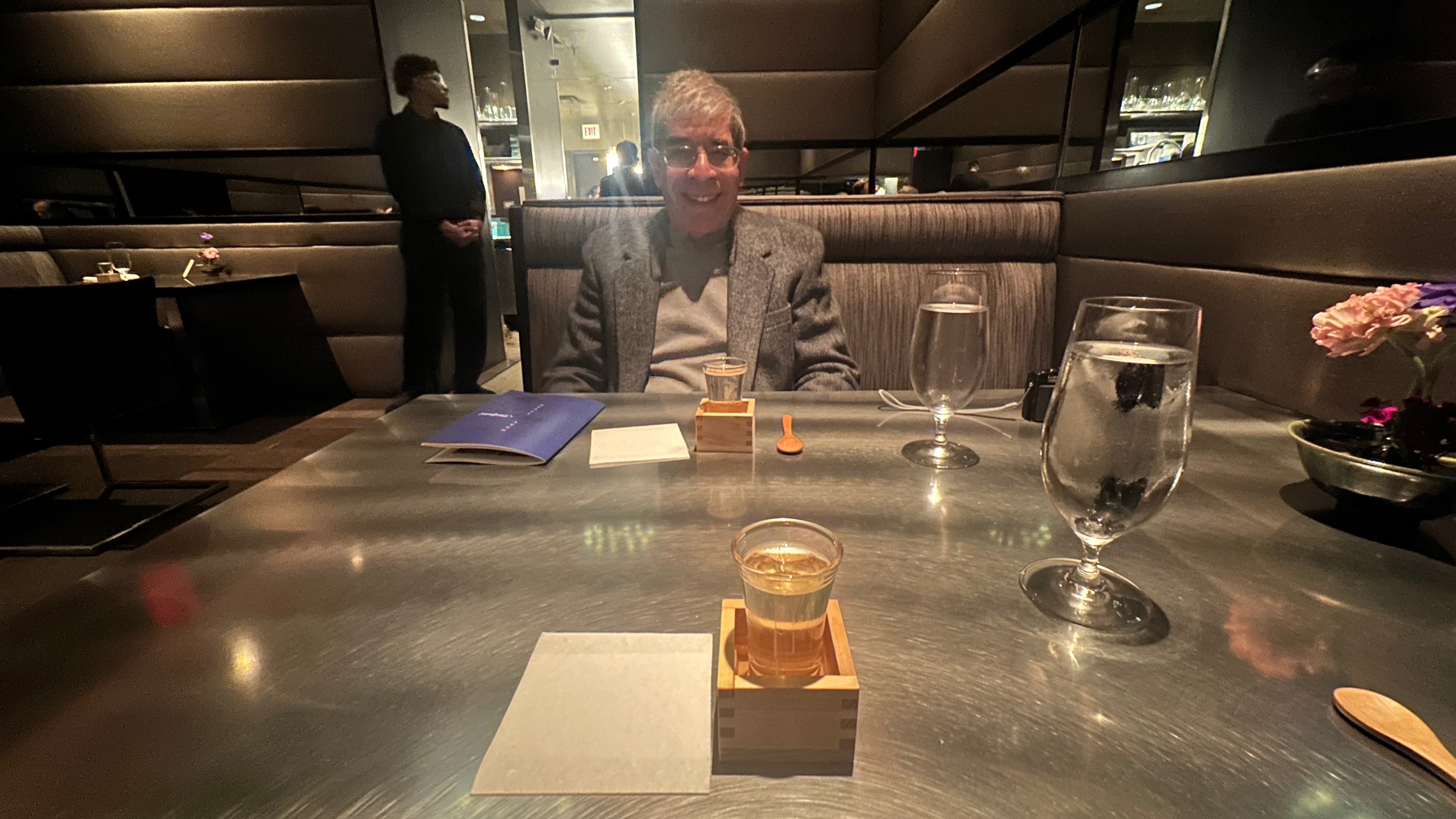
First, a glass of bottle-fermented sparkling sake, a real treat. It was served poured to overflowing in a glass inside a cedar box. After you take a few sips from the glass, you pour the rest of the glass into the cedar box and drink it from there, a traditional practice that gives the liquid a slight woody flavor:
The sake, one of several made by Masumi. It looks to cost about $60 a bottle retail: they did not stint on the wines but that was not near the most expensive libation we were served:
Me, excited before dinner; photo by RJL:
First course: chawanmushi (a savory egg custard), made with sweet corn, umeshu (a Japanese plum liqueur), and black truffle. Like nearly all the dishes, I had never tasted anything like it before. It was fantastic. Note the dried cornhusk garnishing the plate. It’s eaten with the wooden spoon:
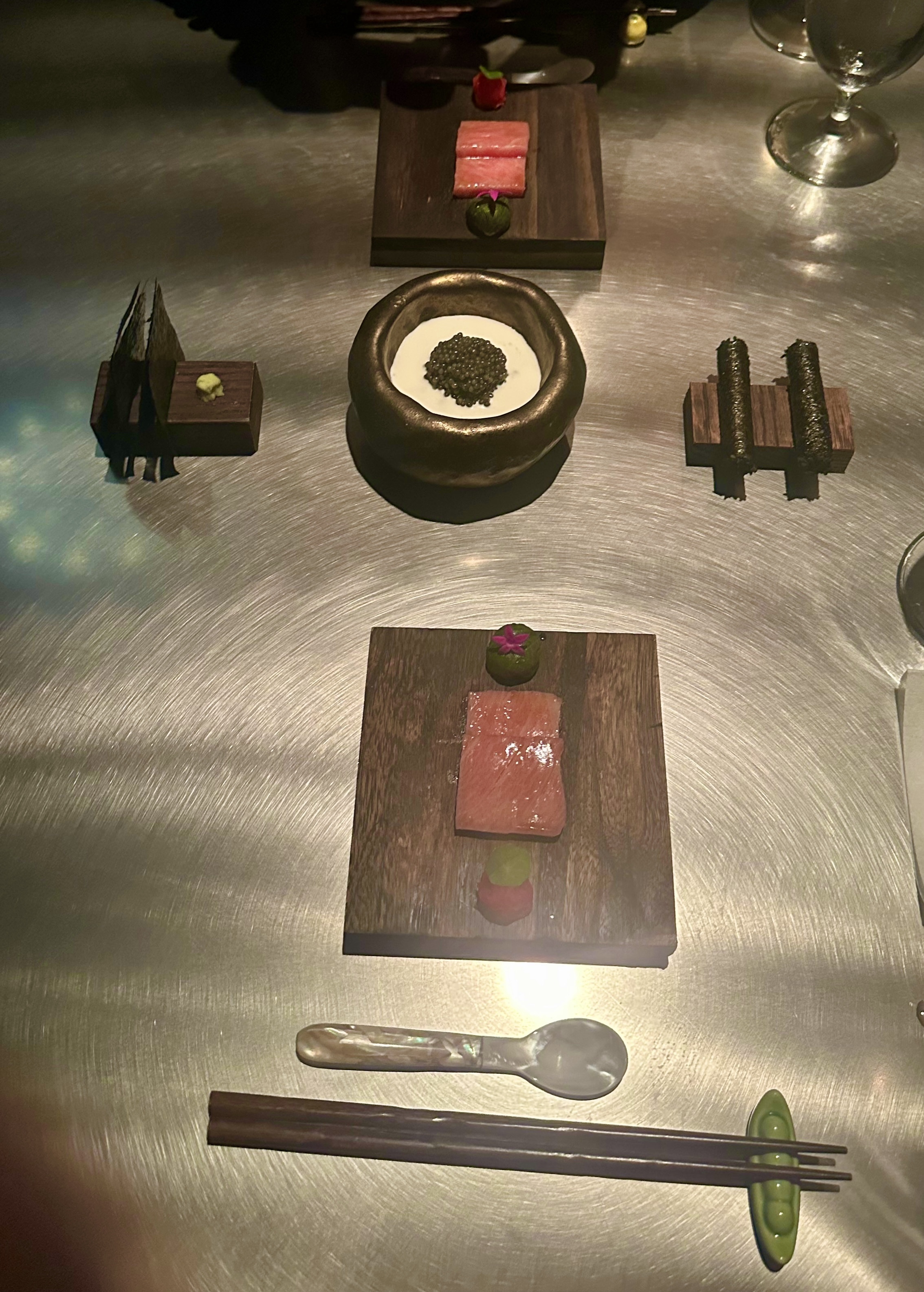
The next dish arrived at the table as a gift: osetra caviar (the second best in the world after beluga) served with bluefin tuna, wasabi, and crème fraîche. It came with four sheets of seaweed (to the right next to the wasabi), and two already-formed seaweed rolls (left) with unidentifiable goodies inside. You are supposed to roll the caviar, crème, wasabi, and salmon into a sheet of seaweed and eat it as if it were a luxurious Japanese burrito.
The only caviar I’d ever had before was pressed caviar made from irregular eggs, and sevruga caviar (the third rarest). It was hard for me to resist leaving the caviar out of the burrito and just eating it plain with the mother of pearl spoon (the traditional utensil), so I did eat some plain (fantastic) and also put some into two “burritos” (also fantastic). The two rolls to the left were eaten separately. Note the two “fruits”, actually pickled vegetables) at the top and bottom of the plate. I believe they are a pickled radish and a pickled cucumber, both decorated with nasturtium blossoms. Those, too, were amazing, full of complex flavors. The “pickle” was like the most delicious pickle you could imagine, and of course you can’t buy them as they’re made in house.
Photo by RJL. Note the lovely setting with chopsticks (and fancy chopstick rests) and spoons:
The wine: Vermintino, an Italian white wine made by Laura Ascero, light, crisp, slightly saline, and dry, a perfect accompaniment to the creamy burritos with caviar. These people know their wines:
Two cute little “ramen eggs” in a spoon with ginger and togarashi (the red spice on top), made to resemble the flavor of Japanese ramen (there’s no ramen in there, and I can’t remember what is). Two cute and savory bites.
A fancy dish: gyoza (a dumpling filled with shrimp and sweet potato), accompanied by a froth made from carrot ponzu. You can see the dumpling at 10 o’clock next to a savory crunchy thing. AI describes “ponzu” as “a tangy, citrus-based Japanese sauce made from soy sauce, vinegar, and citrus juice (like yuzu or sudachi), often with added mirin, dashi, and bonito flakes for a complex salty, sour, and umami flavor.” Again, it was like nothing I’d ever tasted.
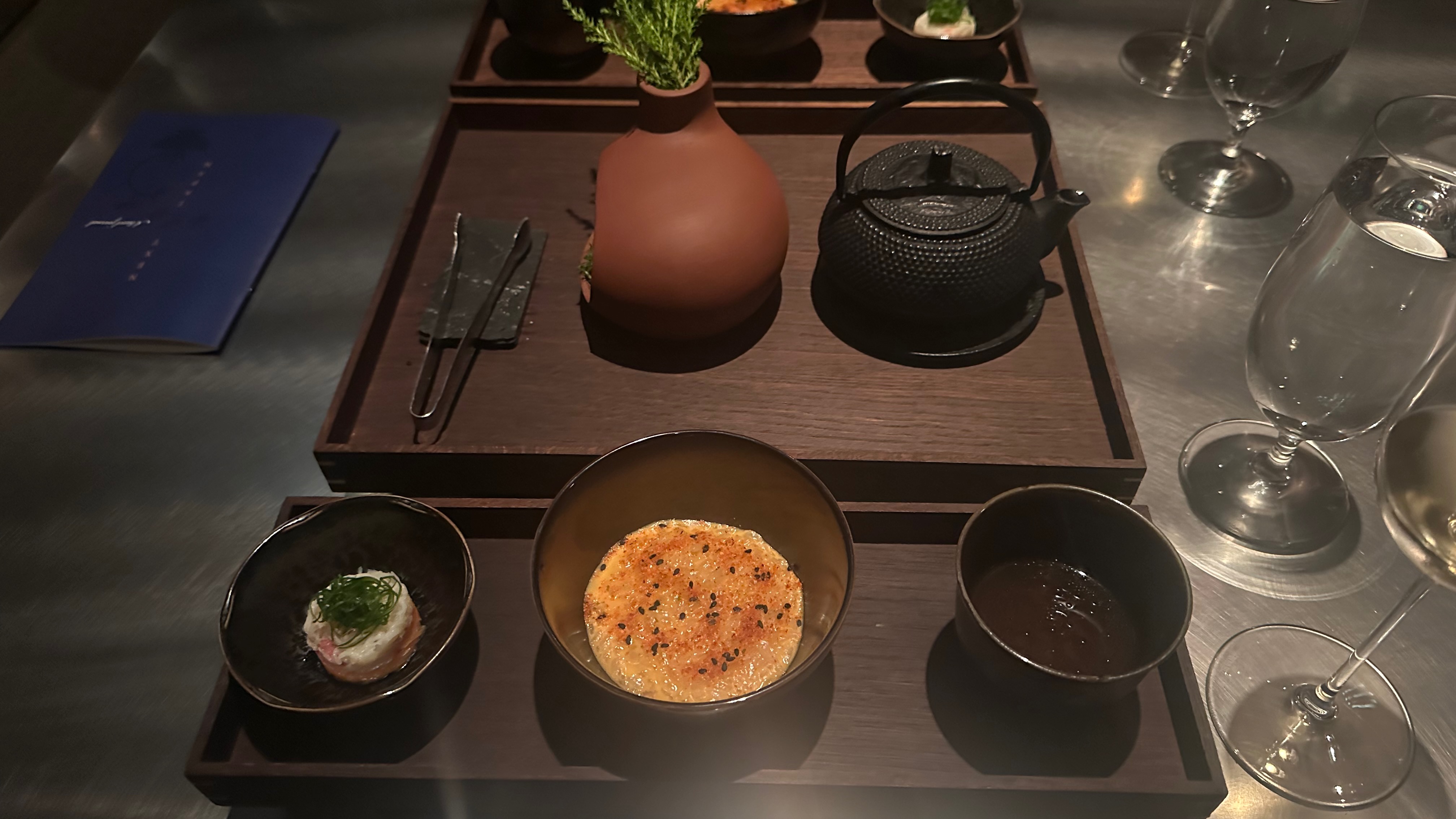
We continued with a fancy dish comprising three items: king crab to the left, a fancy rice in the middle, and a broth (I can’t remember what kind) to the right, with the broth poured from the traditional Japanese metal teapot. Above on the tray is also a pot with sprigs of fresh rosemary, with coals below them to create a herb-scented smoke while you had this dish. You could eat a bit of the incredibly sweet king crab with some rice, and then wash it down with the broth.
The seventh dish was kare pan (Japanese curry bread), filled with grilled cabbage and heritage pork belly. This was very complex, and look at the decorations! I didn’t photograph the inside but yes, it was excellent. There was no dish in the whole meal that I found less than inventive and tasty.
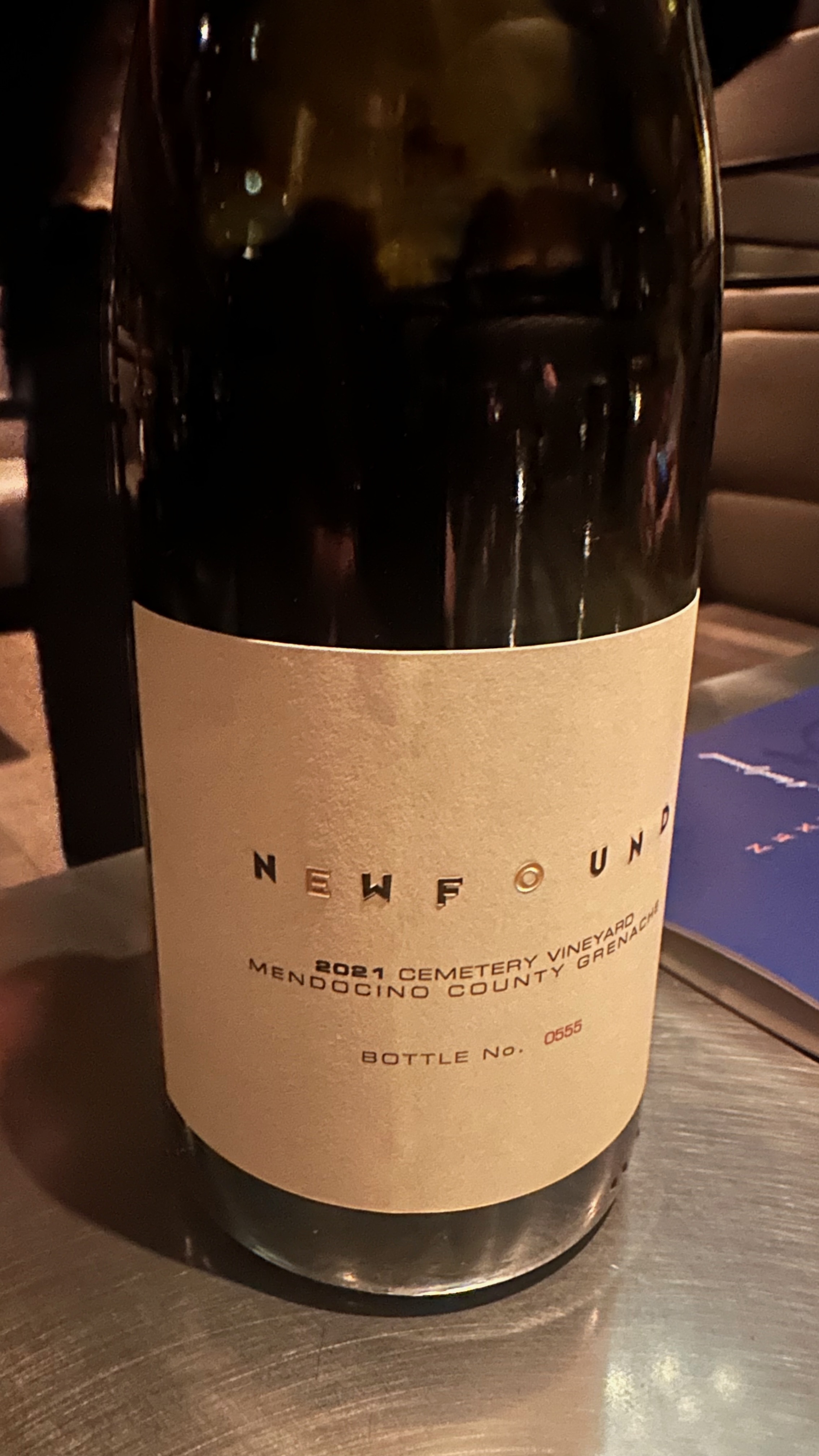
I couldn’t remember why they called it “Cemetery Vineyard” (they told us), but AI had the answer:
The “Cemetery Vineyard” (specifically the noted Rockpile Ridge site) is named for a distinct outcropping of rocks at the base of the vineyard that looks like giant, old-fashioned headstones. This specific block has been referred to by this name for over 140 years, long before the wine was commercialized
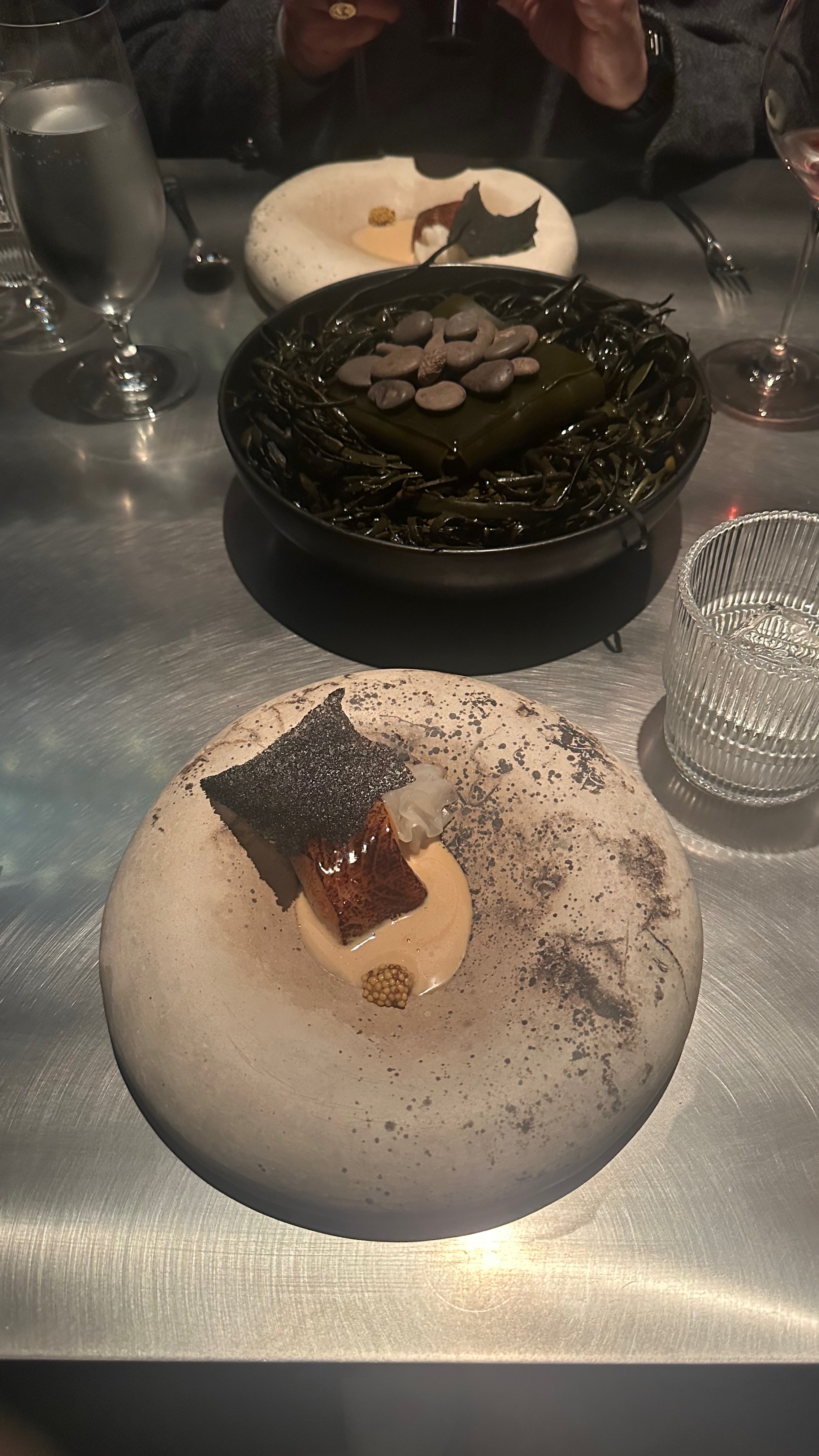
And then some fish: a luscious piece of grilled cod with a brown butter and miso sauce, accompanied by seaweed and golden mustard seed. I’m not much of a fish-eater but I loved this:
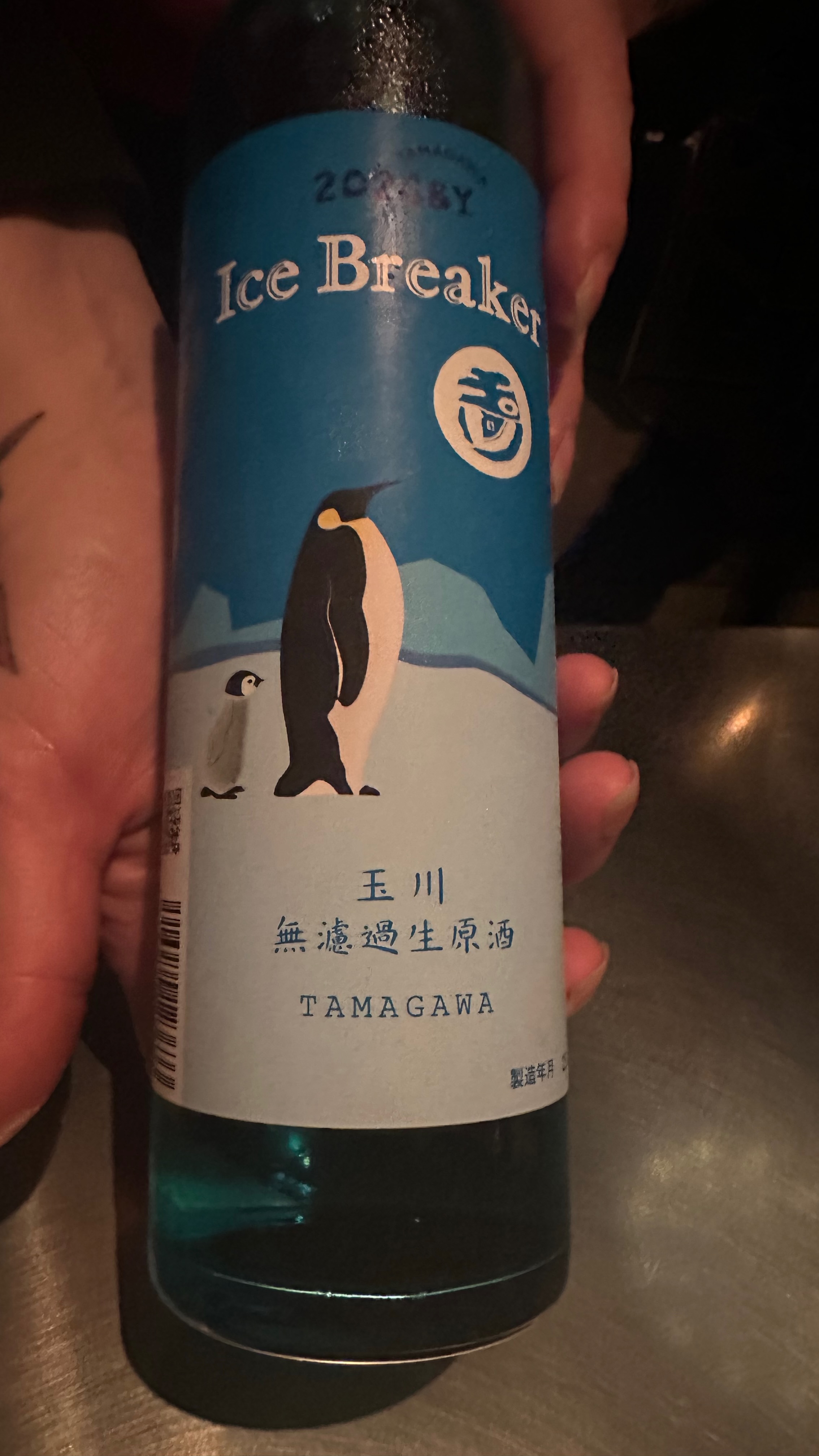
And for that dish of course we needed sake, and were poured a whiskey tumbler (with ice) of 2024 Tamagawa “Ice Breaker” sake. We were told it was unfiltered, and it was a stronger, slightly sweet, and luscious rice wine. And there was a penguin on the label! The website says this:
Tamagawa’s Ice Breaker is a cask-strength, fresh-pressed junmai ginjo that is undiluted, unpasteurized and unfiltered. This is a seasonal release always listed with the brewery year (BY).
Pairing Notes: The Ice Breaker sake is designed to be drunk over ice as a refresher in the humid Japanese rainy season. Try it with edamame, mackerel, skipjack tuna and eggplant with zesty grated daikon.
I believe the white stuff with the cod above is grated daikon (white radish), but I’m not sure.
When the cod was served, they also put a mysterious bowl of seaweed containing very hot rocks atop a seaweed packet. We asked what it was, and were told was part of the next course being steamed by the rocks while we ate the fish. See below. (Photo by RJL).
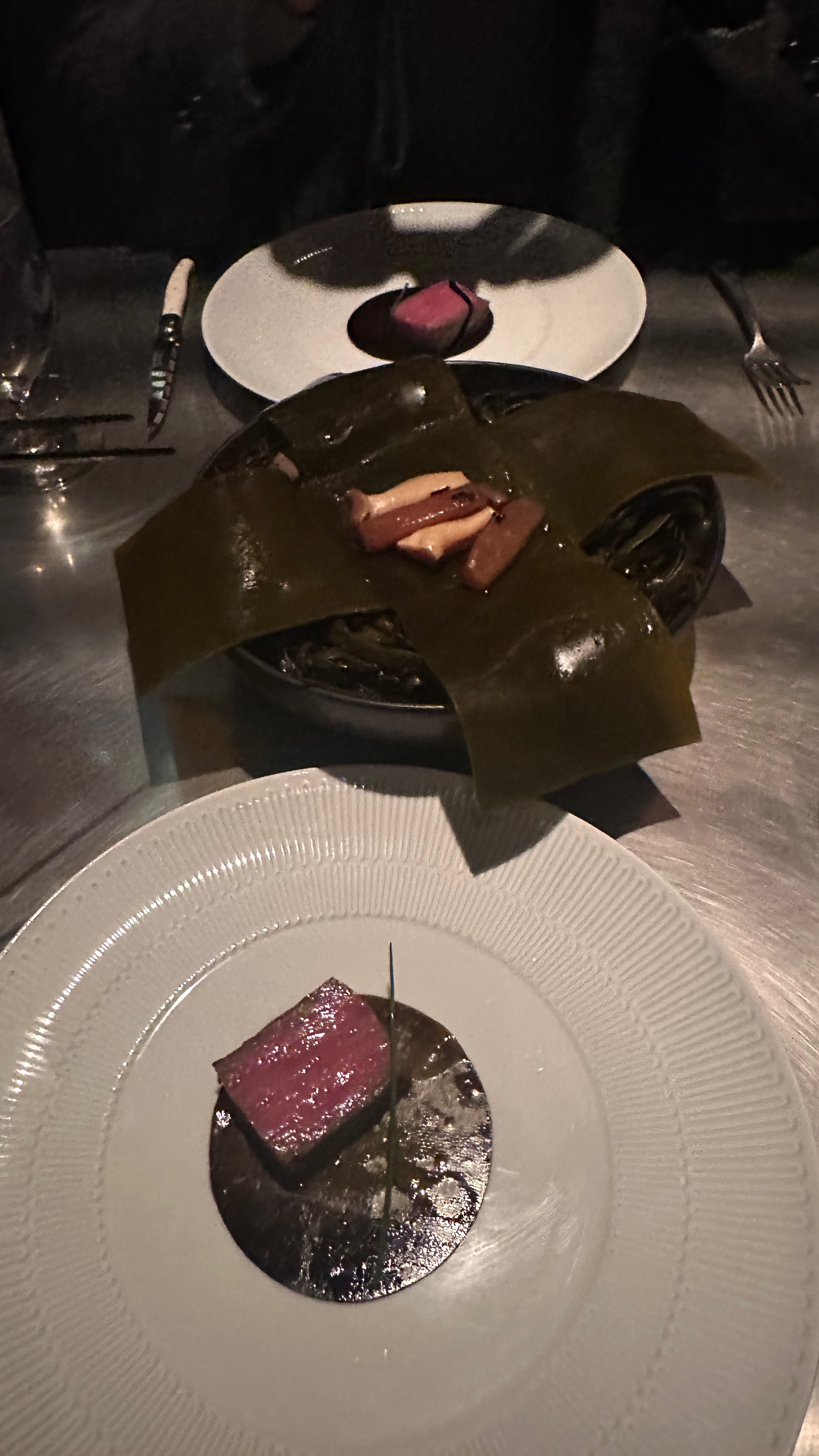
Where’s the beef? It was next in a “wagyu au poivre”, and yes, it was real wagyu beef from Japan, the first I’ve had. It was of course rare, and then the seaweed packet was opened to reveal the cooked accompaniments: pear and trumpet mushrooms, along with kombu (edible kelp). Photo by RJL:
Yummers! The beef was so tender and tasty that although the slice was not large, I ate it in very small bites so I could prolong the flavor. It was great with the meaty trumpet mushroom and the fruitiness of the pear:
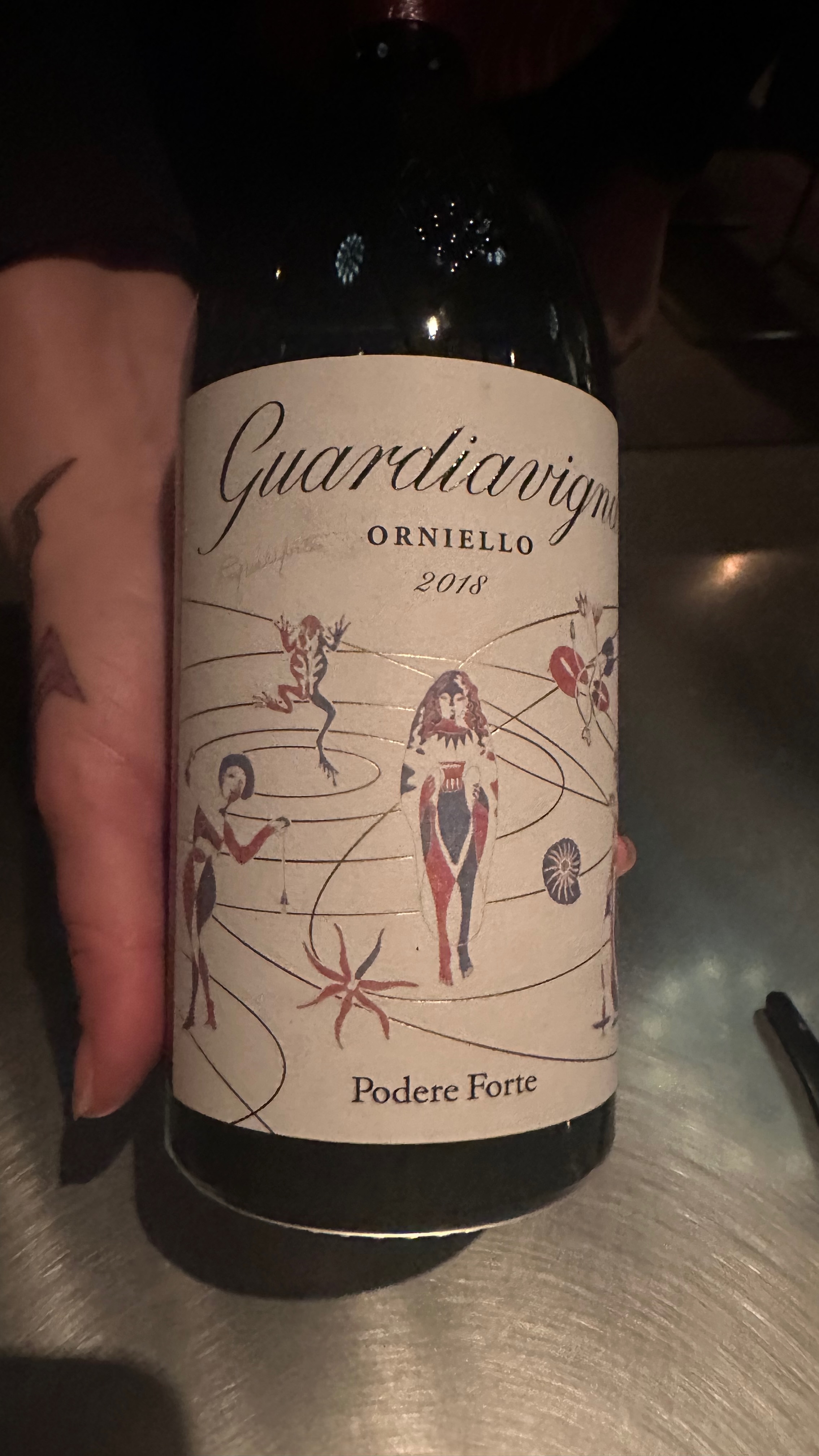
Of course with that you need a gutsier red wine, which came as a Cabernet Franc (often found in Bordeaux) from Podere Forte, an Italian winemaker. The designation was “Guardiavigna Orienello” with some age: 8 years. It’s a biodynamic wine, tasting much like a Bordeaux; the website describes it this way:
Guardiavigna is a version of perfectly and slowly ripened Cabernet Franc. An intense, deep and vast bouquet. Full bodied, with a very refined tannic structure. A very elegant and endless wine.
It goes for $150-$180 per bottle.
Photo by RJL:
With two courses left, we had dined for about 2½ hours, eating leisurely and catching up. Robert’s house is nearly rebuilt after the Altadena fire and should be done by June. His studio will take a bit longer.
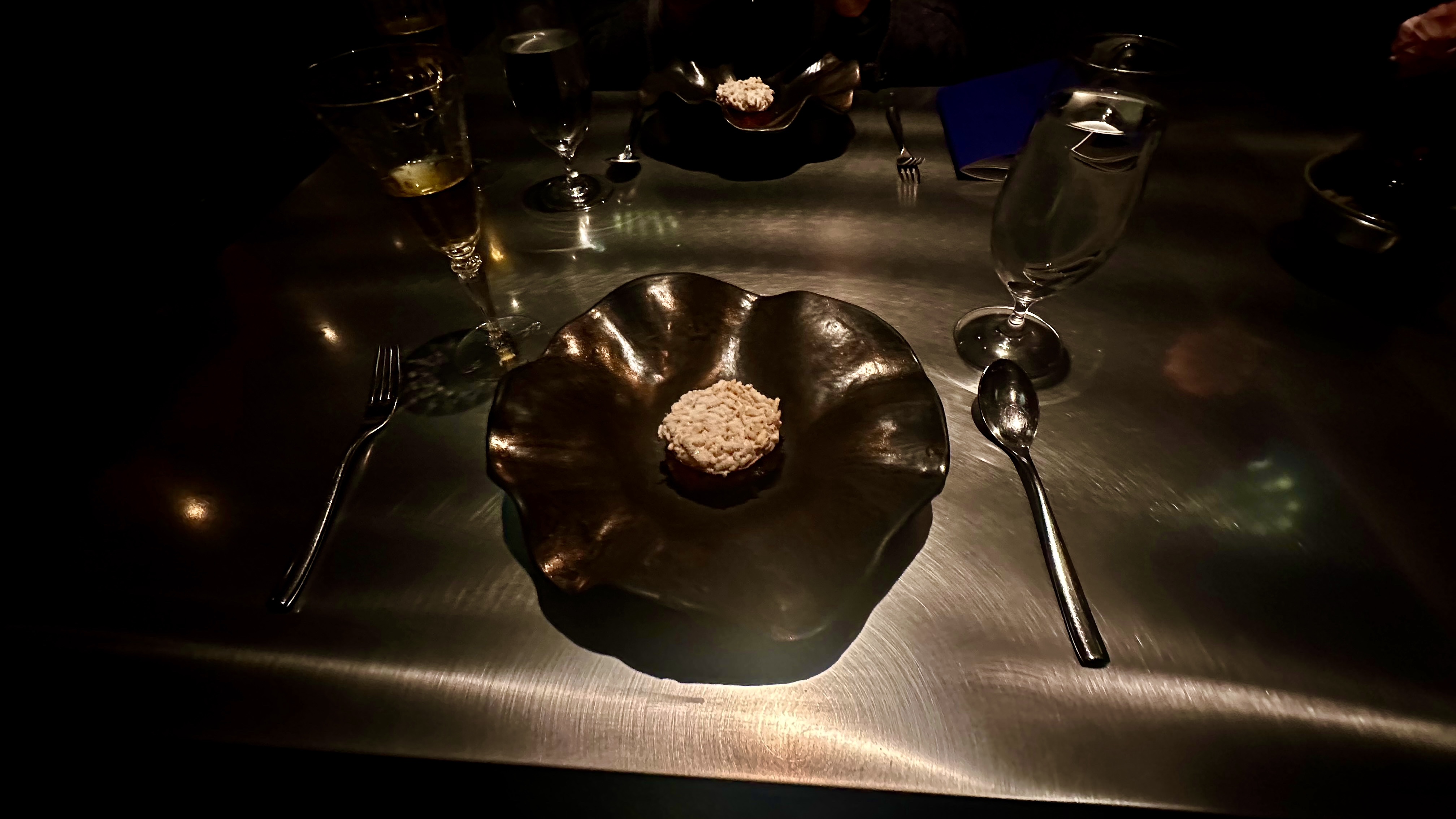
We were then treated to “Tokyo toast”, with sake lees (I guess the rice at the bottom of the fermenting tank), sakura (cherry blossom), and kumquat. You see that the dishes are inspired by the flavors the team encountered in Japan, but the dish itself is sui generis. It was a very elegant version of a Rice Krispy treat:
And the eleventh and last course: musk melon with saffron, pine nuts, and spaghetti squash. An inspired combination; you have to have a good palate to even think of putting these things together. They melded well. Again, the presentation was carefully thought out, with matching fancy plates, trays, and appropriate cutlery:
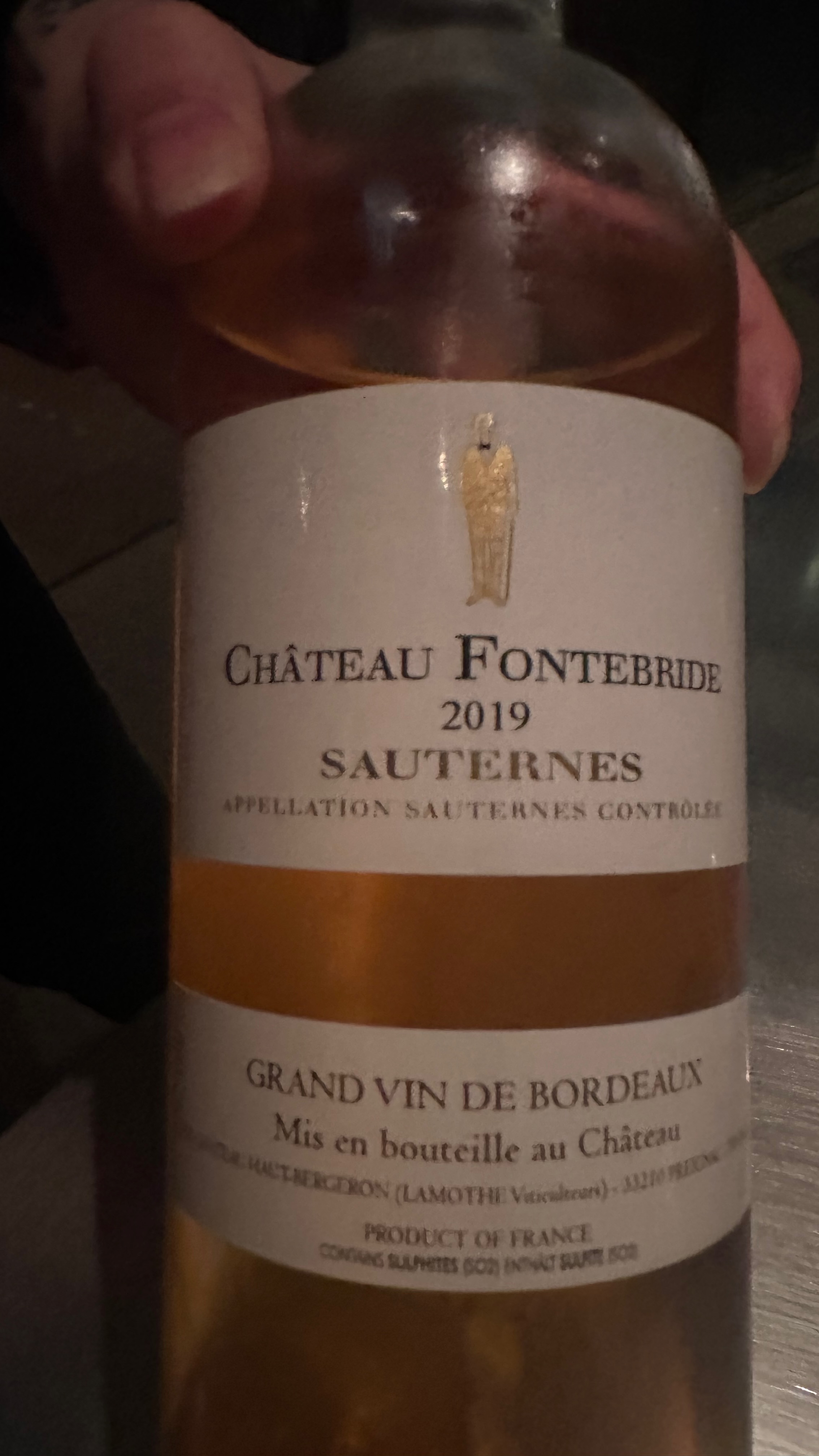
Sauternes, my favorite sweet wine, goes with very few things. I eat it either on its own or with a ripe peach or mango. It does not go with chocolate (Thomas Keller hasn’t learned that lesson.) But it did go with the musk melon, which is not too sweet, and the spaghetti squash, barely sweet. And so we were served a 2019 Château Fontebride 2019. That wine also counted as dessert. If you haven’t tried a Sauternes, which gets better and more golden as it ages, you might spring for one. (I brought Robert a half bottle of another Sauternes as a gift; it wasn’t clear whether it would make it back to California since Robert is staying with his brother in Chicago.)
And so we wound up at 8:30, having started at 5:30. I was replete, filled with great food and fancy wine, amazed at what we had eaten, impressed by the thought and care that went into the food and service, and, of course, slightly buzzed. Next is an amazing restaurant and I’d gladly go again—if I was willing to spring for the meal (I have no idea what it cost) and could get a reservation (the website says there are 10,000 people on the Next waiting list!).
When you have a long, sumptuous, and fancy meal like this, you leave the restaurant with a bracing sense of well being. (A Parisian chef once told me that you know a meal is good if the birds sing more sweetly when you leave.) I had that feeling, and of course it was helped along by the slight buzz from wine and sake.
Many thanks to Robert for inviting me, to his niece Kate, the manager, for greeting us and stopping by to chat during the meal (and of course running things), and the staff who organized, cooked and served.
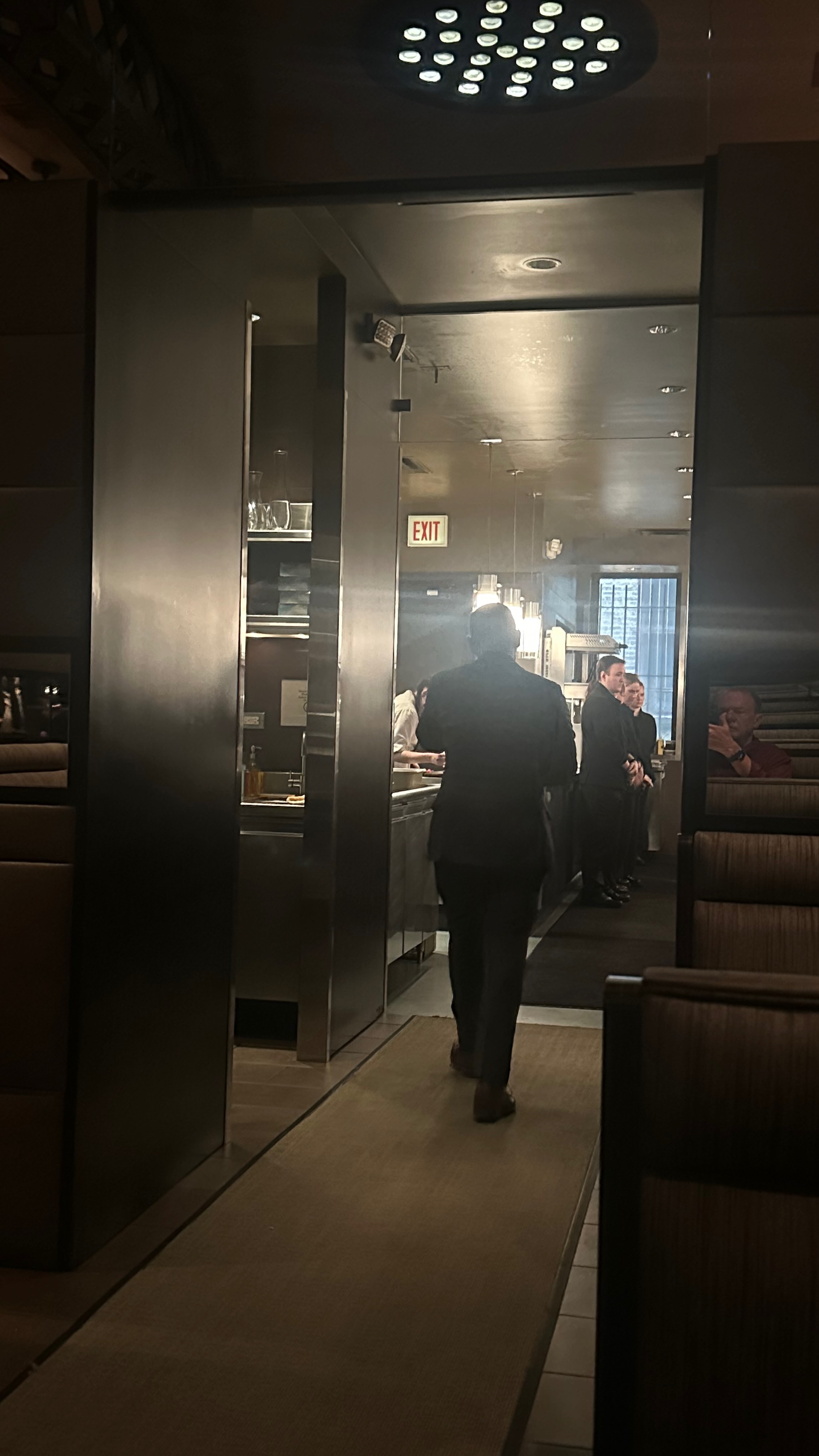
Oh, two dark pictures of the place, the first of the kitchen by Robert and the second of the main room by me. It’s not a large restaurant. Note the Japanese lanterns.
I know that I’m going to get criticized for putting this up, excoriated for eating fancy food and “privilege.” To those who would say that, take a hike. This was a rare treat, and all I can say is that there have been Japanese emperors who haven’t eaten this well.
As I mentioned yesterday, Robert Lang invited me to dinner last night at a famous Chicago restaurant called Next, whose metier is mulitcourse menus with a theme. And they completely change the theme every four months, so they’re always working on and testing the dishes to come (see the history of the themes at the Wikipedia link given in the first sentence). The theme of our meal was “Japan,” inspired by the restaurant chef, manager, and some staff having taken a trip to Japan to absorb the food and culture. They they returned to the U.S. and worked for a few months to develop dishes that were not explicitly Japanese, but inspired by the food they tried in Japan.
While preparing the account of our meal for a post, I realized that it is going to take some time, what with 12 dishes and 8 wines (including 2 sakes), as well photos of the menu and the restaurant. I will say now that it was one of the best meals I’ve had in America—even better than the vaunted French Laundry in California, where years ago I paid a lot for a disappointing meal.
We managed to get into this restaurant, which has a huge waiting list, because Robert’s niece is the general manager; and because of that we got a few gratis dishes.
The meal was terrific, with a largesse of small, lovely, and wonderful dishes and thoughtful and appropriate pairings with wines and sakes. The meal did not fail where many of small-dish places do: making you leave when you haven’t had enough to eat. This was not the case at Next: I left dazzled, sated, and a bit buzzed.
I will ask your indulgence because it will take me a few hours to crop the photos, insert them in a post in the proper order, and try to describe the dishes from a memory clouded by sake. The post will be up tomorrow morning.
To wet your whistle, here’s a photo taken by Robert, showing the introductory tipple, a glass of sake poured to overflowing inside a cedar box. This is traditional: you sip the full glass until it can be poured into the box, and then drink the rest from the box, which lightly flavors the sake with cedar. This was also a rare form of sake for me: a sparkling one.
All will be revealed tomorrow. Right now I am recovering.
I need a life—even if that is a life outside of writing for this website. That’s by way of informing you that posting here may be a bit light for about a week. I have a writing assignment, which is to answer Michael Shermer’s response to my own post on this site taking issue with his claim (also in his new book Truth) that we have a form of free will. (My response will appear at Skeptic.) I can do no other than answer a form of compatibilism that gives us free will simply by redefining the folk notion of free will in an un-refutable way so that that we do have free will even if all our behaviors and thoughts derive from and are compatible with the laws of physics. But I digress.
My second task is to go shopping for much-needed Chinese groceries (I ran out of everything during the cold spell), but, most important, to meet my friend origami master and engineer Robert Lang, who’s invited me for splendid dinner at Next. Next is a sister restaurant of Alinea—surely one of America’s most famous restaurants. Next is equally highly rated. Both Next and Alinea are run by the same chef, Grant Achatz (see a Facebook interview with him here). Robert’s in town for an origami convention, and the trip to Next is prompted by his rare appearance in Chicago and the felicitous fact that Robert’s niece happens to be the general manager of Next. I think that’s how we got reservations given that the site says, “On any given night, there can be 10,000+ guests on our waitlist.”
Next is so named because it changes menus to a new theme every few months. This most recent theme is Japan, and I have the menu, which has nine courses that look fabulous (Earlier, Robert provided some origami for the menu.) I’ll save the food experience for a post (with photos) tomorrow or Sunday. There will also be a wine pairing with the many courses, and I’m sure that a great and bibulous time will be had by all.
Stay tuned. As always, I’ll do my best, both at table and at this site. Oh, and don’t forget to set your clocks forward on Saturday night.