Readers’ wildlife photos

May 25, 2024 • 8:15 am

We’re running out of photos again, so I plead with and importune you to send in your good wildlife photos.

We have just a few photos today, and the first batch, from reader Steve Pollard, is salacious: LOCKED FOXES. As always, the contributor’s captions are indented and you can enlarge the photos by clicking on them.

I attach three photos taken a couple of months ago of a pair of locked American Red Foxes (Vulpes vulpes fulva) in our garden. They were taken with a phone camera at extreme range, so they are not the greatest, but it’s not something I’ve seen before.
From the magazine Wildlife Online:”Copulation lasts only a few seconds and, following ejaculation, the pair are locked together—a copulatory lock—for up to 90 minutes, owing to contraction of the vixen’s vagina and the swelling of the bulbus glandis tissue at the tip of the dog fox’s baculum”.
As the photos indicate, the lock can result in some awkward positions! In this case, the vixen tried several times to get free, twisting and even biting at the dog. The lock lasted for over 20 minutes. The cub from a previous engagement took quite an interest in proceedings.

From Florian Maderspacher, a marsh fritillary (Euphydryas aurinia), which, he says, “goes by the much nicer German name of Skabiosen-Scheckenfalter“.

From Lee Jussim.

Northern elephant seals (Mirounga angustirostris)  in California:

American robin‘s eggs (Turdus migratorius), New Jersey

Hatched eggs:

Swans and babies (Cygnus sp., also New Jersey):

Readers’ wildlife photos

May 24, 2024 • 8:15 am

Today’s photos come from UC Davis ecologist Susan Harrison.  Her notes and IDs are indented, and you can enlarge the photos by clicking on them.

Return to Crescent City Harbor

As a regular contributor to this feature, I’ll admit the obvious: bird photography, along with cat-based humor, cool new science stories, and sharing the foregoing pleasures with kindred spirits, can be a sanity saver in these anxious times.  (It’s so nice that Ed Yong agrees!)  In gratitude for this feature and to help keep it going, I’ve pulled together a batch of marine birds and other wildlife from a March 2024 visit to Crescent City, California.  These are some species not featured in a 2022 post from the same location.

Crescent City Harbor with California Sea Lions (Zalophus californianus) in foreground, Harbor Seals (Phoca vitulina) in middle distance, and historic Battery Point Lighthouse in far distance:

Sea Lions on jetty:

Sea Lion that lunged at me when I walked too close with camera glued to my face:

Pigeon Guillemots (Cepphus columba) courting:

Red-Necked Grebe (Podiceps grisegena), with reflections reminiscent of Edward Scissorhands:

Surfbirds (Calidris virgata) and Black Turnstones (Arenaria melanocephala), picking small critters off of wave-washed jetty rocks:

Point George in foreground, Tolowa Dunes in distance, and Siskiyou Mountains:

Readers’ wildlife photos

May 1, 2024 • 8:15 am

Today we have photos from reader James Blilie, whose captions are indented. You can enlarge the photos by clicking on them.

Spring has sprung in southern Washington state, where we live.  All of these are shot in our yard (or from our house).

We have a glorious showing of Empress Lilies Fritillaria imperialis that were (we assume) planted by a previous owner of the property.  These flowers give a huge early spring show and then die back to the ground quickly.  They smell strongly of skunk (very like skunk cabbage (Symplocarpus foetidus).

As Steve Simon (a photographer whose work I admire) says:  Work the scene.  And I did.  Some of these photos will show some camera technique which I will try to highlight.

A close-up with a telephoto lens and large aperture to blur the background (short depth-of-field; bokeh):

Then two shots showing the effect of lens focal length:

In this shot, I am going for the framing of the scene by the tree trunks and branches and I am including Mount Adams in the background.  A telephoto lens helps keep the foreground and background on a similar scale in the photo.  A small aperture (f/8) helps keep it all in focus (enough).

Last of the Empress Lily photos is another wide angle shot where I got very low to look up into the bells of the flowers and I got very lucky to capture a sunburst as well (this was not planned; the other 3-4 shots did not have it; luck is your friend)

Next are two shots of Mount Adams at sunset from a few days ago.

Some local wildlife:  A flock of wild turkeys (Meleagris gallopavo) with the Tom displaying for the ladies.  (These are a little fuzzy and have glare because I shot them through our windows.)

More local wildlife:  Early morning visit from our usual gang of Black-tailed Deer (Odocoileus hemionus), a sub-species of the Mule Deer (same binomial).

Early morning shots of our local mountains:  Mount Adams and Mount Hood.

Equipment:

Olympus OM-D E-M5 (micro 4/3 mirrorless camera; crop factor = 2.0)
LUMIX G X Vario, 12-35MM, f/2.8 ASPH.  (24mm-70mm equivalent, my walk-around lens)
LUMIX 35-100mm  f/2.8 G Vario  (70-200mm equivalent)
LUMIX G Vario 7-14mm  f/4.0 ASPH  (14-28mm equivalent)
LUMIX G Vario 100-300mm F/4.0-5.6 MEGA O.I.S.  (200-600mm equivalent)

Readers’ wildlife photos

April 27, 2024 • 8:20 am

Today is part 2 of photos of a part in southern Africa from reader William Terre Blanche; this is the second of two installments (the first is here).  His notes are indented, and you can enlarge the photos by clicking on them. I begin by quoting his introduction from yesterday:

Here are some photos from a visit last year to the Kgalagadi Transfrontier Park  (Kgalagadi means “place of great thirst” in the San Language).

This vast wilderness reserve used to comprise two separate game parks, the Kalahari Gemsbok National Park (South Africa) and the Gemsbok National Park (Botswana) separated by an unfenced border. However, in a historic 1999 agreement, South Africa and Botswana joined forces to create the world’s first trans-frontier nature reserve, the Kalagadi Transfrontier Park. It covers an amazing 38,000 km², an enormous conservation area across which the wildlife flows without any hindrance.

The Park is famous for its magnificent black-maned male lions, as well as an abundance of raptor species, but the beautiful desert landscape and unique atmosphere is probably what draws most return visitors there (myself included).

In December 2023, I had the privilege of spending almost 2 weeks in the park, and these are just some of the many photographs taken there (apologies, mostly birds, again..).

Three-banded Plover (Charadrius tricollaris)  These can often be seen using the typical plover run-stop-search method of foraging at any suitable body of water. The area had unusually good summer rains last year, and these pretty little birds were often seen:

Violet-eared Waxbill (Ureaginthus granatinus).  An almost impossibly brightly coloured little bird, they are actually quite common in the Kgalagadi, but the vibrant colours never ceases to amaze me whenever I come across one of them:

Sociable Weaver (Philetairus socius).  One of the most iconic sights of the Kgalagadi Transfrontier Park is the massive communal nests of the Sociable Weaver. Colonies of up to 500 birds build these nests in trees, telephone poles and sometimes rock faces. The nests are built entirely out of grass, and each pair builds its own nest chamber:

Northern Black Korhaan (Afrotis afraoides). Their raucous kraak-kraak-kraak call is often heard long before they are seen! Spends most of the day on the ground, searching for food which is mostly insects and occasionally small reptiles:

Cheetah (Acinonyx jubatus).  The world’s fastest land animal and Africa’s most endangered big cat. This female was presumably calling for the young, although I unfortunately never got to see them:

Urikaruus Wilderness Camp.  There are 3 main “Restcamps” inside the Park, plus a number of so-called Wilderness Camps. There are normally well off the beaten track, and mostly only reachable by 4×4 vehicle. There are no facilities whatsoever at these camps, so you have to be completely self-sufficient during the time spent there:

Male Lion (Panthera leo).  I spent a couple of nights at the abovementioned Urikaruus Wilderness Camp, and on the second morning was awakened at around 04:30 by a male lion roaring right under the room where I was sleeping (next to my car, in the picture below). This was at the same time exciting and terrifying, but one of the memories that will stay with me for life.

After a while he started moving away, and I was able to get a photograph of this magnificent animal:

Lioness:

Cubs.  On another occasion I spotted a single female lion lying in the shade of the tree a small distance from the road. After a couple of minutes she started calling, and these two cubs appeared from a nearby bush to join her. I can only assume that she had hidden them there, and after determining that the area was safe called them out into the open.


Readers’ wildlife photos

March 29, 2024 • 8:15 am

Posting may be light today as I have an event to attend. But please send in your photos. I have about two batches left, and today I’m featuring the work of people who sent me only one or a few photos.  Their comments are indented, and you can enlarge the photos by clicking on them.

From Lee Jussim

A young muskrat (Ondatra zibethicus) dining among pondscum:

Three from Claudia Baker.

On a winter’s walk one day last year, I came across this barred owl (Strix varia) high up in the branches of a tree. Just out there in the bright sunshine, having a snooze, open for anyone to snap a picture. What a beautiful sight. Made my day. The interweb says “originally a bird of the east (where I live), during the twentieth century it spread through the Pacific Northwest and southward to California”. They are fairly prolific around here (Ontario) and, according to a birding friend of mine, they are crowding out the other owls, especially the Barn Owl.

On an old spruce stump along my road, I spotted this fungus. When I tried to identify it, it was very confusing as there are so many. I think it is a Ganoderma lucidum, but I’m not sure. Perhaps a reader can weigh in. Sure are beautiful.

From Jon Alexander:

I just stumbled on some photos of a pigeon (Columba livia domestica) I took in 2013 from the 86th floor observation deck of the Empire State Building in New York City. (I straightened a couple today.) Not exactly the best photos of wildlife, but I like them. I don’t remember if I put a cracker there or if someone else put it there. But I imagine that some pigeons may have learned that crackers might be had with a little effort (or an updraft).

This is from Richard Pieniakowski.  I have many good pictures from him, but must download them from a Google Drive. This is from October, and a barred owl, like the one pictures above.

I just wanted to share this photo of a Barred Owl I captured the other day with you. I think that readers would appreciate looking at this silent hunter.

And from Reese Vaughn, a duck (I think it’s a mallard hen, Anas platyrhychos):

Betty Brown Duck graces the deck on the resaca in Brownsville, Texas. The Williamsons, Kay and John, are her staff. I have asked if she is a mallard hen and how long they have been feeding her — she swims up for food on an elaborate deck that belongs to my friends Kay and John Williamson and they call her Betty Brown Duck. They may be able to send more pictures. Every morning they feed a swarm of nutria, fish, and water birds.

Readers’ wildlife photos

March 18, 2024 • 8:15 am

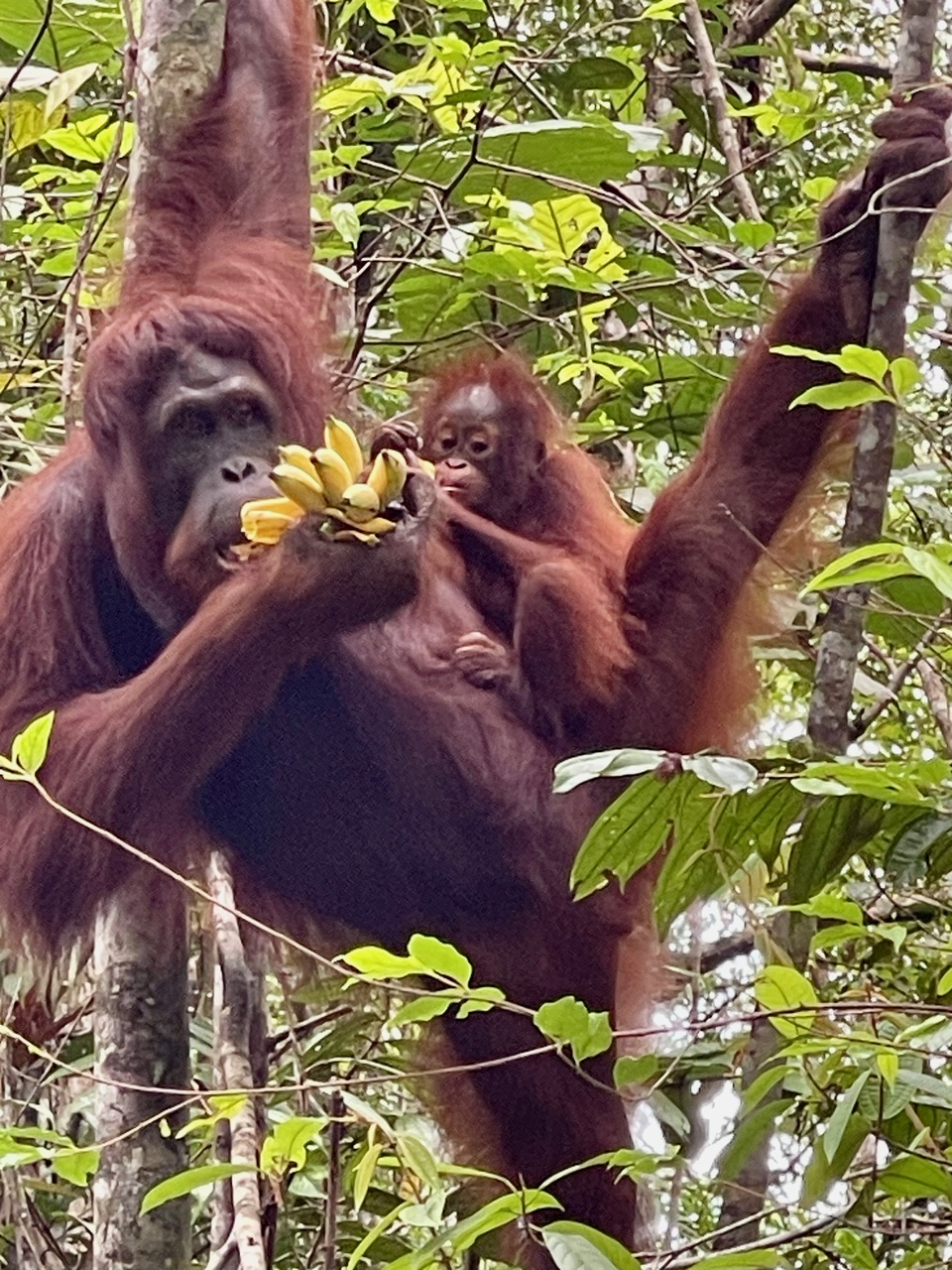
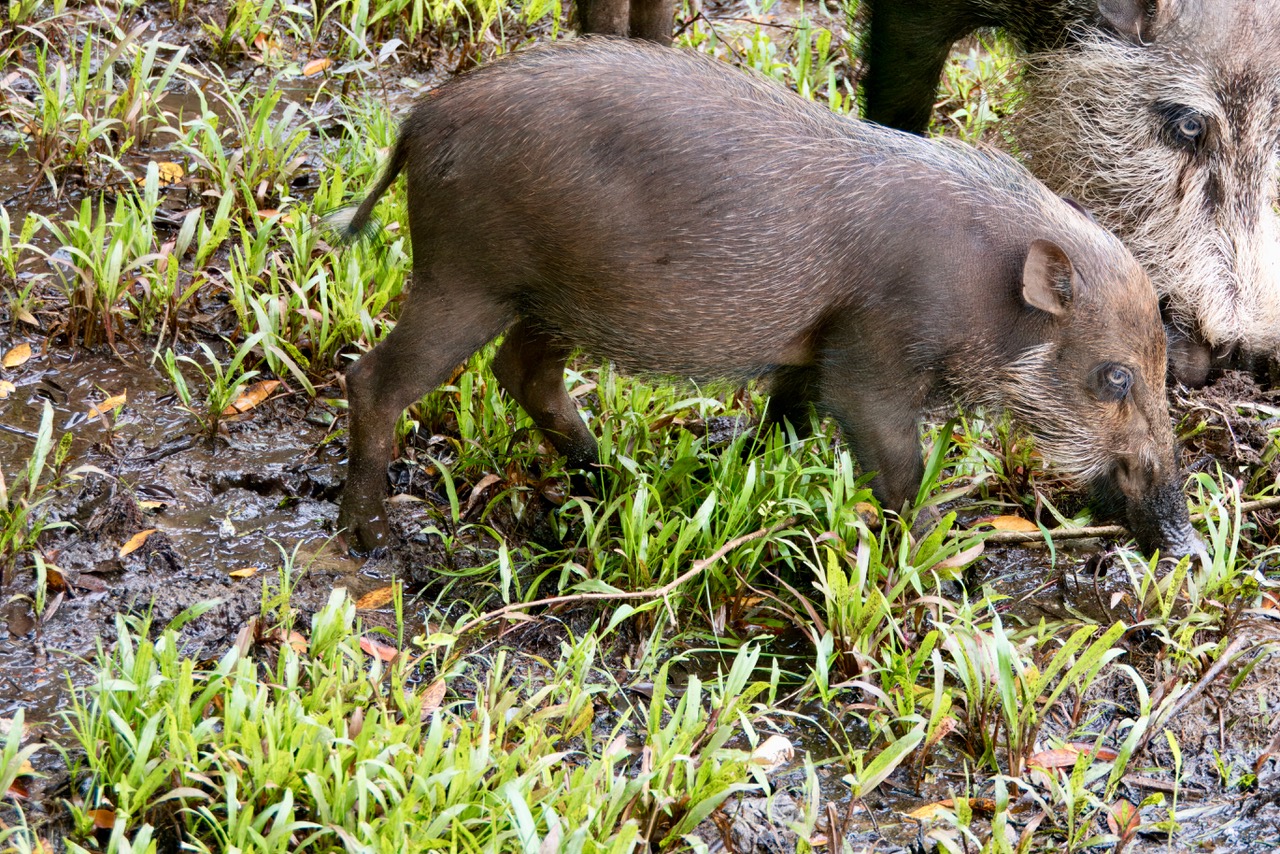
Today’s photos come from Borneo courtesy of reader Daniel Shoskes. His notes are indented, and you can enlarge the photos by clicking on them.

Just back from an incredible trip to Borneo. Just a smattering of the photos. Please forgive the lack of precision in species naming; I did my best to get the names from our guides.

First, a video of his whole trip can be seen here.

Orangutans (Pongo pygmaeus):

Bornean Bearded Pig (Sus barbatus):

Silvered leaf monkey (Trachypithecus cristatus):

Pit viper:

Macaque:

Flying squirrel climbing a tree (I have an amazing video of it gliding):

Macaque striking a Review #2 pose:

Sun Bear (Helarctos malayanus), smallest species of bear:

Proboscis monkeys (Nasalis larvatus):

Juvenile female, nose not as pronounced:

Green sea turtle (Chelonia mydas) laying eggs and getting measured and tagged:

Newly hatched turtles about to be released to the sea:

Macaque mother and baby:

Crocodile with monitor lizard in its mouth:

Oriental pied hornbill (Anthracoceros albirostris):

Monitor lizard:

Black-and-red broadbill (Cymbirhynchus macrorhynchos):

Rhinoceros hornbill (Buceros rhinoceros) :

Rhinoceros beetle:

An insect eating bat (species unknown) curled up asleep inside a banana leaf:

Tiger leech (Haemadipsa picta). Amazing to see: when you exhale near them they lunge towards the CO2:

Red leaf monkey (Presbytis rubicunda):

Readers’ wildlife photos

March 11, 2024 • 8:15 am

We are in serious trouble, folks. I have about three days’ worth of readers’ wildlife photos left, and that feature (like “Caturday felids”, which has a dearth of readers) is in danger of becoming extinct. Please send in your good wildlife photos.

Today we feature ecologist Susan Harrison with some lovely tropical animals and one landscape photo.  Her captions are indented, and you can enlarge the photos by clicking on them.

Costa Rica Miscellany

Here’s the third and last batch of photos from a February 2024 trip to Southwestern Costa Rica, during which I visited a wildlife-rich field station on the Rio Sorpresa (Surprise River) and saw many colorful birds, both there and in the nearby Corcovado National Park and the towns of Golfito and Puerto Jimenez.  Today’s photos mostly feature smaller and/or more subtly colored creatures from this trip.

Basilisk (Basiliscus basiliscus), also known as the Jesus Christ Lizard for its skill of dashing across water surfaces:

JAC: I’ve added this National Geographic video of a basilisk running on water:

Bright-rumped Attila (Attila spadiceus), whose distinctive song (“quit it, quit it, QUIT IT – aaaaah!”) is heard much more often than the bird is seen:

Panamanian White-faced Capuchin (Cebus imitator) looking angsty:

Charming Hummingbird (Polyerata decora):

Cocoa Woodcreeper (Xiphorhynchus susurrans):

Great Kiskadee (Pitangus sulphuratus), screaming its loud squeaky calls straight at me:

Green Iguana (Iguana iguana), a yard-long reptilian lawn mower:

Grey-capped Flycatcher (Myiozetetes granadensis) on Purple Mombin tree (Spondias purpurea):

Grey-capped Flycatcher on branch with Snakefern (Microgramma) epiphyte:

Common Pauraque (Nyctidromus albicollis), a member of the nightjar family, making its weird sounds:

Scarlet-rumped Tanager (Ramphocelus passerinii), which looks to me like a Red-winged Blackbird (Agelaius phoeniceus) turned sideways:

Northern Tamandua (Tamandua mexicana), a large placid anteater seen in Corcovado National Park:

Variegated Squirrel (Sciurus variegatoides):

Yellow-green Vireo (Vireo flavoviridis):

One of the many waterfalls on the Surprise River: