Readers’ wildlife photos

February 26, 2024 • 8:15 am

Please send in your wildlife photos as the tank, every emptying, is now worrisome.

Today we have some photos of Costa Rica by ecologist Susan Harrison of UC Davis. Her captions are indented, and you can enlarge the photos by clicking on them.

Along the Surprise River  

Southwestern Costa Rica has the greatest extent of lowland rainforest on the entire Pacific coast of Central America, thanks in large part to the country’s noble conservation history.  The Corcovado and Piedras Blancas National Parks anchor a thriving yet not-too-commercialized ecotourism industry, supplemented by many forest tracts acquired by conservation-minded individuals. Some Davis friends recently bought several hundred acres along the Rio Sorpresa (Surprise River), adjoining a small field station run by an expert mammalogist.   Naturally I had to go investigate!

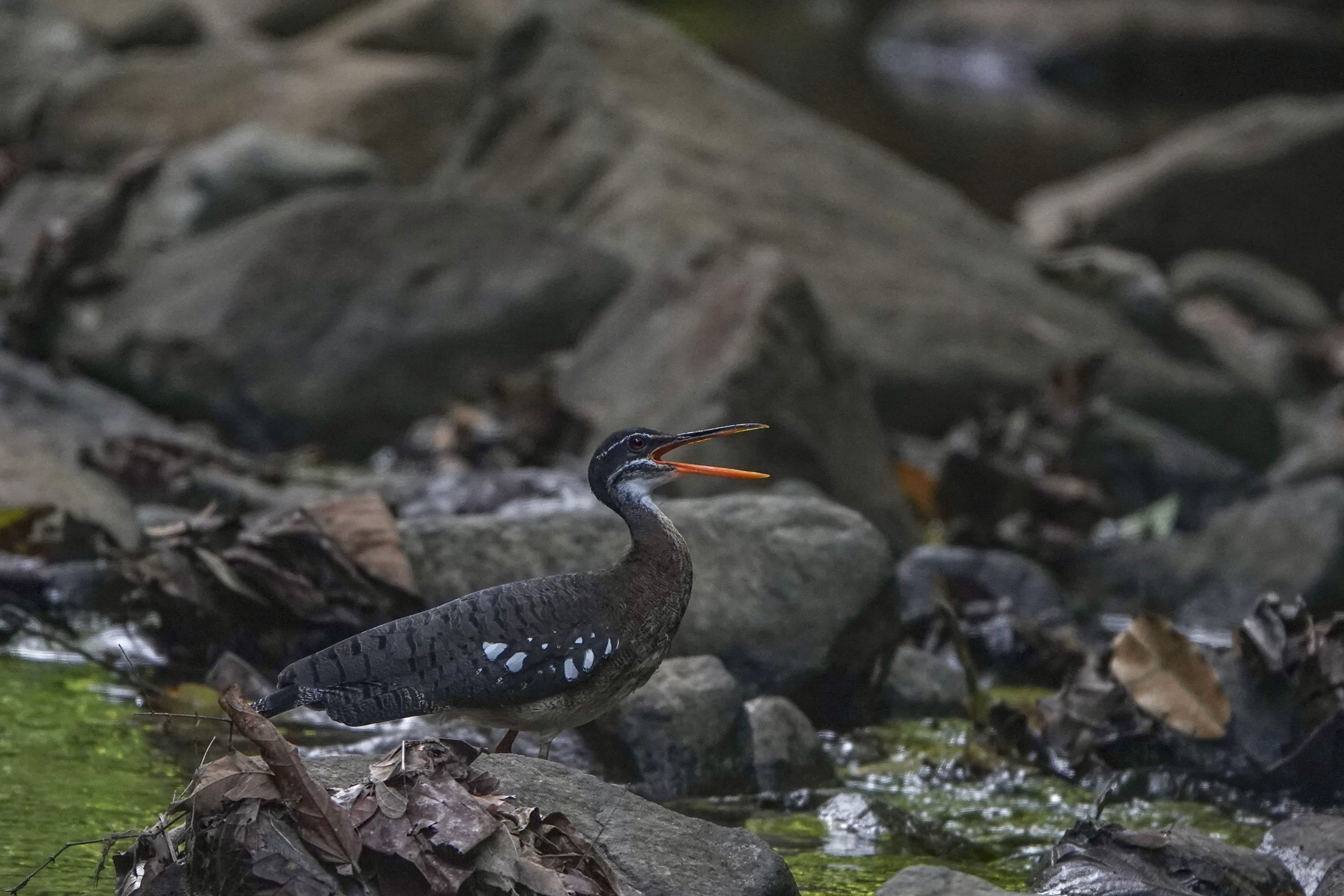
My most heart-stopping sighting was a Sunbittern – a very elusive resident of clear Neotropical streams that is distantly and uncertainly related to other birds.  Staking out a location where one had recently been seen, I had the privilege of observing its early morning rounds.

Sunbittern (Eurypyga helias):

Haunting the same stretch of the river, where receding water flows were trapping small fish in pools, was a Fasciated Tiger-heron – more common on the Atlantic slope than in this region.

Fasciated Tiger-heron (Tigrisoma fasciatum):

Kingfishers were ubiquitous along the river and came in three sizes:  large (the crow-sized Ringed), medium (the pigeon-sized Amazon) and small (the sparrow-sized Green).

Ringed Kingfisher (Megaceryle torquata):

Amazon Kingfisher (Chloroceryle amazona):

Green Kingfisher (Chloroceryle americana):

This group of White Ibises appeared to be recreating the Abbey Road album cover…

White Ibises (Eudocimus albus):

A troop of around 50 Central American Squirrel Monkeys moved around high in the trees, and were easiest to see when on the river’s opposite bank.   This species is only found on the Pacific slopes of Costa Rica and Panama.

Central American Squirrel Monkey (Saimiri oerstedii) adult:

Central American Squirrel Monkey juvenile:

At the field station, smaller birds visited feeders baited with split bananas.

Red-Legged Honeycreepers (Cyanerpes cyaneus):

Shining Honeycreeper (Cyanerpes lucidus):

Scarlet-rumped Tanager (Ramphocelus passerinii):

Our hostess, mammalogist Fiona Reid, was expert at finding bats for us to admire.

Tent-making Bat (Uroderma bilobatum):

Readers’ wildlife photos

February 20, 2024 • 8:15 am

Today we have photos from Rosemary Alles, a reader who runs an animal conservation organization in South Africa, and is also helping me organize my August trip to Kruger. She originally comes from Sri Lanka but now splits her time between South Africa and the U.S. But I’ll let her narrate herself (her text is indented), and you can enlarge her photos by clicking on them. Oh, and there’s a link should you wish to donate to the organization.

Sri-Lanka lies in the shadow of her giant neighbor India; a teardrop on the vast slate of the Indian Ocean. My family emigrated from our island nation many moons ago, leaving a jeweled landscape ravaged by corruption, ethnic violence, and terrorism.  My first home in the West was in Canada, and then, on the Big Island of Hawaii. These days, I travel between South Africa and Hawaii, centering my work on the protection of iconic megafauna, the Global March for Elephants and Rhinos (GMFER). These images were captured in Kruger National Park during a 3-day journey into Africa’s wild world. We work with wildlife rangers (the Black Mambas and Transfrontier Africa), their extended families, and their children to bring the wonders of South Africa’s wilderness to those who rarely—or never—experience it. Our work with the children in rural communities of Africa helps disrupt poaching and wildlife trafficking and heals the wounds inflicted by apartheid and history. Currently we are seeking donations to buy 4 large canvas tents to accommodate more children and young adults in our monthly programs designed to disrupt the distance between rural South Africans and their wild heritage; our target goal is 1500.00 USD. You can help us here.   [JAC:  dig down, please, readers. I don’t ask for anything for me, but these are other species of African mammals who are asking.]

African Bush Elephant (also called “Savannah Elephant,” Loxodonta africana) – male, aka, “Purple Haze”:

Saddle-billed Stork (Ephippiorhynchus senegalensis), female:


Grey Heron (Ardea cineria):

Young African Elephant bulls – jostling for dominance at water tank:

Woodland Kingfisher (Halcyon senegalensis):

African Giraffe (Giraffa camelopardalis), searching the horizon:

Young African Bull Elephant  – drinking at water tank:

African Red-eyed Bulbul (Pycnonotus nigricans):

Elephant Dreams. Mature bull in thicket:

African buffalo (Syncerus caffer); “I’m going to make you an offer you can’t refuse”:

European Roller (Coracias garrulus, migratory):

The iconic Olifants River in Kruger:

Our children and young adults:

Our children and young adults at Koru camp:

Below: images of Nkateko Mzimba, a Black Mamba/Transfrontier Africa Anti-Poaching Ranger at CITES CoP19 (the Convention on International Trade in Endangered Species of Wild Fauna and Flora – CoP19). Our group -GMFER- sponsored her trip and  accompanied her to Panama City in Panama for CoP19; this so she could advocate on behalf of Africa’s iconic wildlife.  CITES determines, via representative nation votes, the quotas of wild, endangered species and/or their body parts each country can exploit and export; it also regulates—and not well—quotas of trophy hunts. CITES’ representative body in the United States is the USFWS and operates under the Department of the Interior. By and large, and much like many international agencies, CITES is largely ineffective and vaguely corrupt. Still, it is the “best thing” we have to monitor and regulate the trade of endangered species. While in Panama, we collaborated with local schools for a celebration of wildlife on the opening day of CITES’ CoP19. During CoP19, Nkateko’s powerful testimony against Trophy Hunting was delivered prior to a victorious vote on a temporary moratorium on the live capture and trade of wild African elephants.“After a long and complex debate, Africa’s elephants were finally given some respite when the Convention in International Trade in Endangered Species of Wild Fauna and Flora (CITES) voted in favor of a temporary moratorium on further exports of live wild elephants at its Conference of the Parties in Panama.” – Born Free. 

************************

Nkateko describes how her life changed after she became a ranger – at CITES’ CoP19:

Nkateko testified on agenda Item: 66.4 at CITES’ CoP19 – moratorium on the live capture and trade of wild African elephants:

JAC: If only 300 readers donated $5 each, GMFER would reach its goal of providing shelter for local residents who are learning about wildlife in an effort to save them.  Think about making a small (or large) donation here. Money goes a long way in South Africa, so don’t feel shy about donating even $1 or just a couple of bucks. Thanks!

Readers’ wildlife photos

February 16, 2024 • 8:15 am

Today ecologist Susan Harrison features photos of everybody’s favorite sea mammal: sea otters! And for the ornithophiles, we also have some birds. The narrative is indented, and you can click on the photos to enlarge them.

Sea Otters & Others in Elkhorn Slough

Among the happier environmental news stories is the recovery of the Sea Otter (Enhydra lutris) along parts of the West Coast after near-extinction from overhunting. Sea Otters are well-known as “keystone predators” in kelp forests, where their avid devouring of sea urchins ends up maintaining the kelp beds and their abundant fish and invertebrates.

In Elkhorn Slough, an estuary on Monterey Bay, Sea Otters have also resumed being keystone species in coastal salt marshes. Here, according to recent findings, otters maintain the all-important eelgrass beds by consuming crabs that burrow and destabilize the banks.

(Elkhorn Slough is itself quite the environmental success story, as there few coastal marshlands in California as large or as well-protected.)

On an electric catamaran tour of Elkhorn Slough we were amazed at all the Sea Otters. The guide told us there are about 150 otters in the slough, and I joked that we must have seen all of them.   The otters float saucily on their backs, gobbling seafood and grooming their marvelous fur with its 1 million hairs per square inch (about as many hairs as an entire d*g).

The weather during our trip was wet and wintry, and many of these photos were taken in a light rain.

Sea Otters:

An unrelated surprise was when our catamaran passed the Western Flyer, on which John Steinbeck and Capt. Ed Ricketts made their legendary trip to the Sea of Cortez in 1940. The boat then endured a long career in the fishing industry, sank twice, and was ‘rediscovered’ in terrible shape in a Washington seaport by a Steinbeck fan.   It’s now been lovingly restored to its original 1937 condition.

Western Flyer:

Moss Landing, at the mouth of Elkhorn Slough, with a storm approaching:

Double-Crested Cormorants (Nannopterum auritum):
Forster’s Terns (Sterna forsteri):

Common Loon (Gavia immer):

Horned Grebe (Podiceps auritus):

Brown Pelican (Pelecanus occidentalis) with Red-Throated Loon (Gavia stellata):

Brown Pelicans:

Readers’ wildlife photos

February 13, 2024 • 8:15 am

We have a new contributor today, William Terre Blanche, with some photos I find particularly interesting, for they’re from where I’m headed in August. William’s notes and captions are indented, and you can enlarge the photos by clicking on them.

As promised, please find attached photos taken in the Kruger Park during my many visits over the years

The Kruger National Park is one of the premier nature reserves of the world, and at 2 000 000 hectares (almost 5 000 000 acres) also one of the largest. The park lies in the far eastern side of South Africa, on the border with Mozambique. On the western side the park is bordered by a number of private reserves, many of them sharing unfenced boundaries with the Kruger Park.

JAC: Here’s a map from Wikpedia showing Kruger in dark red. I’ll be there for several weeks in August!

By Htonl – Derivative of File:South Africa relief location map.svg, CC BY-SA 3.0,

Let’s start with the famous Big 5. The first 2 (Buffalo and Elephant) are almost guaranteed sightings in the Kruger Park, and with a bit of luck the other 3 as well. (The leopard, being almost exclusively nocturnal, is probably the toughest!)

I am keen birder, and have also included pictures of just some of the many bird species which make the Kruger Park a bird-watchers paradise.

All the below pictures were taken by myself, and all of them in the Kruger Park itself.

Cape Buffalo (Syncerus caffer).

Usually seen in large herds, although older males who are no longer able to keep up with the herd sometimes form small groups of 2 or 3 animals. They are grazers, and therefore mostly seen in grasslands. One of the favourite prey species of lions:

African Bush Elephant (Loxodonta africana).

By far the largest land animal on earth, a big male can weigh more than 6000kg and stand 4m high at the shoulder. They live in small family groups, which may come together to form larger herds. Family groups consist of females and young ones, always led by the matriarch:

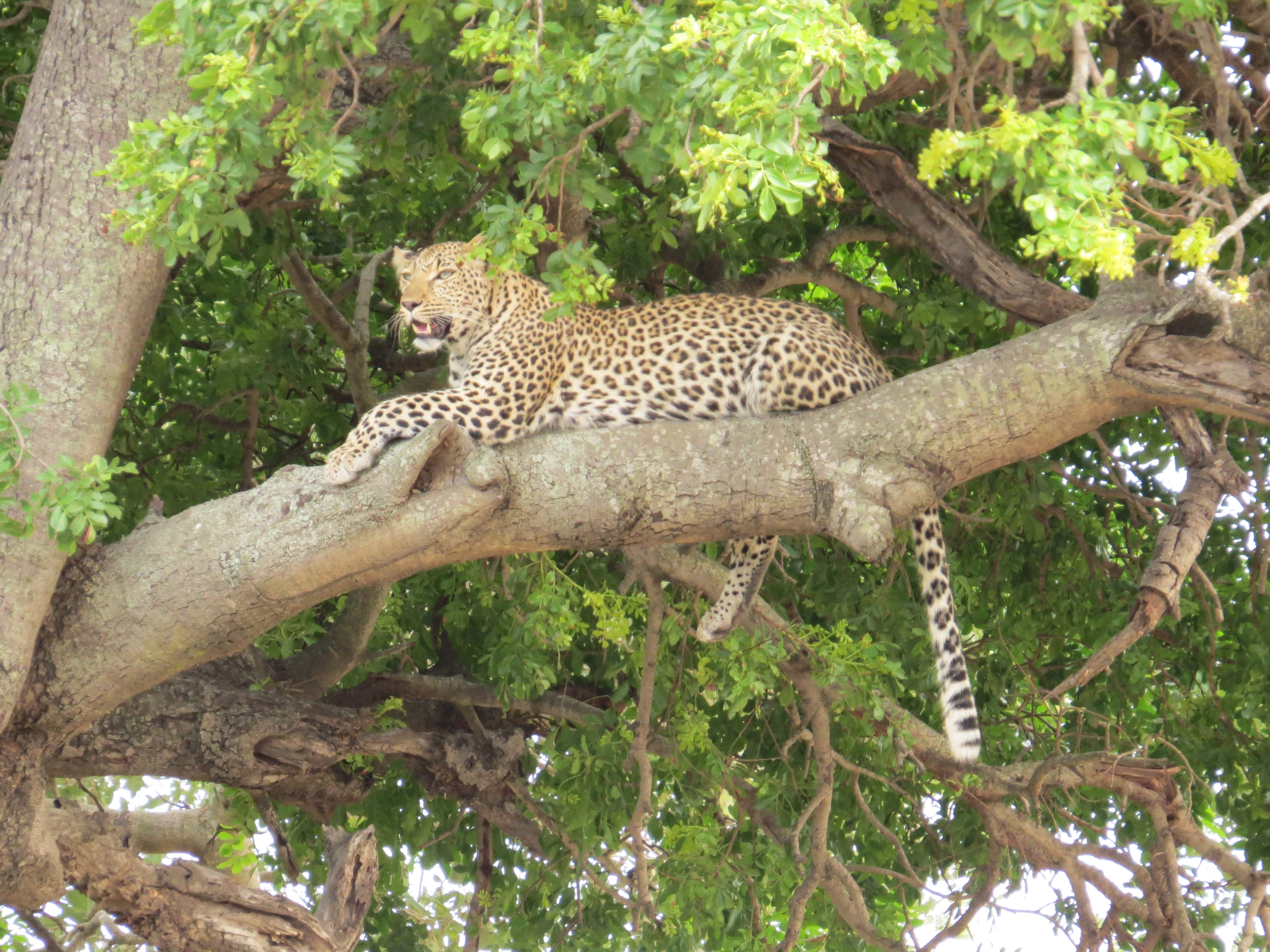
Leopard (Panthera pardus)

One of the most sought after sightings in the Kruger Park, and getting a LIT (Leopard in a tree) is always extra special. Active at night, they often rest in a tree during the day. They are mostly solitary, except when mating or when a young cub is with its mother:

Lion (Panthera leo)

The most sociable member of the cat family, often seen in prides, which are always led by a big male, or sometimes a coalition of males (which are usually brothers):

White Rhino (Ceratotherium simun)

Larger and much more common than the Black Rhino. They are grazers and therefore mostly seen where enough grass is available (Black Rhinos are browsers, with a pointed upper lip adapted for this). Both black and white rhinos are actually grey, and can best be distinguished by the difference in size (white rhinos are much larger), and their method of feeding:

Hippopotamus (Hippopotamus amphibus)

Most often seen in rivers and dams, with just the head and ears sticking up above the water. They are selective grazers, and sometimes travel long distances outside of the water to feed, mostly at night:

European Bee-eater (Merops apiaster)

As the name suggests, they are migrants, seen in South Africa from October to April, during the Southern Hemisphere summer. In winter they return to Europe and North Africa, where they also breed:

Little Bee-eater (Merops pusillus)

The smallest bee-eater in the region, they are resident, but with some nomadic movements in response to changing conditions. Usually seen in pairs or small family groups:

African Green Pigeon (Treron calvus)

Often seen near rivers where they feed on the fruit of wild fig trees. They below picture was taken from the restaurant deck at Skukuza Restcamp, which overlooks the Sabi River:

Lilac-breasted Roller (Coracias caudatus)

Probably the most photographed bird in the Kruger Park, for obvious reasons! These brightly coloured birds are common in the Park, and can often be seen perched on small trees next to the road:

Martial Eagle (Polemaetus bellicosus)

One of the largest eagles in the region, with a wingspan of up to 2.4m (the female is considerable bigger than the male). The below picture was taken in the beautiful late afternoon light near Letaba Restcamp:

African Scops Owl (Otus senegalensis)

A small owl (about 15cm), their repetitive insect-like “kruupp” call is a familiar nocturnal sound in the Kruger Park restcamps, where they are often heard, but seldom seen:

Woodland Kingfisher (Halycon senegalensis}

The loud trilling call of the Woodland Kingfisher is probably the one sound that most South Africans associate with hot summer days in the Kruger Park. Despite the name their diet consists largely of insects, and they are mostly seen away from water:

Readers’ wildlife photos

February 8, 2024 • 8:15 am

Hey, folks, I’m running low on photos, and submissions have been few recently. Please send in your good wildlife photos to keep this feature going.  Thanks!

Reader Mark Joseph sends in some Panama bird photos (and one primate photo) taken by his friend “Ed”, and I reproduce them here with permission.  The narrative and IDs are indented, and you can enlarge the photos by clicking on them.

From Mark:

I’m not much of a photographer, but I have a number of friends who are. One, name of Ed, just came back from a trip to Panama. I have his permission to share these photos with everyone. Six birds and a mammal!
Black-breasted Puffbird, Notharchus pectoralis:

Cinnamon Woodpecker, Celeus loricatus:

Crimson-crested Woodpecker, Campephilus melanoleucos:

Howler monkey and baby, Genus Alouatta; hopefully readers can provide the species:

Rufous Motmot, Baryphthengus martii:

Hepatic Tanager, Piranga flava:

Bay-headed tanager, Tangara gyrola:

Readers’ wildlife photos

February 2, 2024 • 9:40 am

Better late than never, I present you with today’s batch of wildlife photos, but also importune you to send in your photos lest we run out. Today’s batch comprises bird photos (and one mammal) from ecologist Susan Harrison from UC Davis, whose text and IDs are indented. You can enlarge the photos by clicking on them.

Fall 2023 and winter 2024 birds

Here is my 50th contribution, featuring various creatures seen in the western U.S. in late 2023 and early 2024.

Western Nevada (August)

Pinyon Jays (Gymnorhinus cyanocephalus), which live in colonies that move around after the seeds of Pinyon Pines (Pinus monophylla and others), and which appear to be in decline:

Juniper Titmouse (Baeolophus ridgwayi), in the same habitat and much more plentiful than Pinyon Jays:

Malheur National Wildlife Refuge, eastern Oregon (September)

Common Nighthawk (Chordeiles minor) day-sleeping on a branch:

Peregrine Falcon (Falco peregrinus) waiting by a bird feeder:

Virginia Rail (Rallus limicola) lurking beneath reeds:

American White Pelicans (Pelecanus erythrorhynchos) sailing overhead:

Great Horned Owl (Bubo virginianus) juvenile in cottonwoods (Populus):

Burrowing Owls (Athene cunicularia), adult and juvenile at a nest:

Steens Mountain, looking east to the Alvord Desert:

Pronghorn (Antilocapra americana) enjoying an irrigated alfalfa field:

Butte Valley, south-central Oregon (November)

Bald Eagles (Haliaeetus leucocephalus), overwintering:

Ferruginous Hawk (Buteo regalis), overwintering:

Sacramento Wildlife Refuge (January)

Common Gallinules (Gallinula galeata):

Northern Harrier (Circus hudsonius):

Peregrine Falcon, juvenile:

Northern Pintails (Anas acuta):

Readers’ wildlife photos

January 10, 2024 • 8:15 am

Thanks to the half-dozen readers who responded to my call for photos; our tank is now somewhat replenished and I can keep this going for a while. But please think of this site if you have good wildlife photos.

Today’s photos come from Jim Blilie of Washington State, but were taken by his son Jamie.  Jim’s captions are indented, and you can enlarge Jamie’s photos by clicking on them.

Jamie is now a freshman at Washington State University (WSU) at Pullman Washington. He is thriving there.  We love WSU.  It’s very welcoming and is focused on student success. Jamie is studying engineering.  Some of these photos were taken during backpacking trips he has taken to Idaho through the WSU Outdoor Recreation Center, a wonderful service WSU provides. Jamie is the wildlife photographer of the family, though has become a good landscape photographer as well.

Jamie did not identify this bird, photo taken a few feet from our house in Klickitat County, Washington; but I think it is a Western Kingbird (Tyrannus verticalis).  Any help with a positive ID would be welcome:

Bumblebee, species uncertain.  Taken on the trail to Lookout Mountain, Oregon, east of Mt. Hood:

Red-breasted nuthatch (Sitta canadensis) and an unknown species of flying ant, taken on Lookout Mountain, Oregon, east of Mt. Hood:

Golden Mantled Ground Squirrel (Callospermophilus lateralis), also taken on Lookout Mountain, Oregon, east of Mt. Hood:

A similar looking rodent:  Based on his location in the mountains of the Idaho panhandle, I think this is a Red-tailed Chipmunk (Tamias ruficaudus), although the eponymous part is not visible in the photo.  Jamie took this photo on one of his backpacking trips in northern Idaho:

Also taken on one of his backpacking trips to Idaho (Selkirk Range, close to Upper Priest Lake):  A very small brown spider (note the size of the adjacent moss).  We were unsuccessful in identifying this spider:

A Steller’s Jay (Cyanocitta stelleri), taken on our place.  We love the beautiful blue and black plumage of these jays.  These are very common here in winter.  In summer they seem to move to higher elevations (we are at 2000 feet (610m) above sea level) and then the Scrub Jays (Aphelocoma californica) move in for the summer.  The Steller’s Jays can make a pretty good mimic call of the Red-tailed Hawk’s scream (Buteo jamaicensis):

My favorite of the bunch:  A coyote (Canis latrans) in a snowstorm, taken from our back deck.  The coyote was perhaps 100 yards away:

A  beetle at 5600 feet (1707m) elevation in Oregon, taken on the Flag Point Lookout Tower.  Also unable to identify this beetle:

A Cyanide Millipede (Harpaphe haydeniana).  This millipede can exude hydrogen cyanide gas as a defense!  The photo was taken on the hike to the former fire lookout site, Sleeping Beauty, Skamania County, Washington.  This is a favorite hike (though unrelentingly steep) because of the very good views of Mount Adams from the top:

Finally, a ringer:  Jamie and me on top of Lookout Mountain with Mount Hood behind, just a day or so before he headed off to university:

Equipment:

Nikon D5600 (1.5 crop factor)
Nikkor AF-P DX 18-55mm f/3.5-5.6 G VR lens
Nikkor AF-P DX 70-300mm f/4.5-6.3 G ED lens
Sigma 150-600mm f/5.0-6.3 DG OS HSM lens
Canon PowerShot SX530