
Kruger: Day 4

September 4, 2024 • 9:30 am

Two more installments, and we’re out of the bush. We’d spent the previous night at the Satara Rest Camp, with superb rooms in small thatched huts (photos tomorrow).  And we took off especially early because there were rumors of lions nearby: the cats who apparently killed the African buffalo whose remains I showed yesterday.

The first sign of lions were spotted hyenas in the road (their minds were squirming like a toad). I hadn’t seen a hyena crossing before, but it was a harbinger of felids to come:

Clearly they were after the carcass of the buffalo that had been killed by lions, and now was topped with a hungry vulture. But why were the hyenas staying away from the carcass? They should be all over it, nomming the rotting buffalo meat.

The reason was that the predators who killed it (and there may have been more) were very close nearby, resting and waiting to finish picking at the carcass. Yes, ladies and gentlemen, brothers and sisters, and comrades, meet the first African lions (Panthera leo) that we saw in Kruger: two males. (Note that there is a small endangered population of the same species inhabiting the Gir Forest in India.)

As we watched, one male rolled over, exposing a distended tummy. He and the other lion had clearly eaten their fill of buffalo. Look at that fat boy!

The hyenas were there because they wanted a chance at the carcass, too, having clearly smelled or seen it, but they dared not approach it because of the lions. And so they stood around hungry, their gaze riveted on the carcass:

Fixated:

“I want some!”

But this one deigned to look at us (remember, we were in a car). I think hyenas should be in Isaac’s “ugly five” of animals, but they’re not. (I believe the Marabou stork is.)

As we drove along further, we spotted an ostrich. Is this a male or a female? (There is no third sex.). A male, of course, for male ostriches are black while females are brown:

A waterbuck  (Kobus ellipsiprymnus), recognizable from its shaggy coat, the horns (found only in males) and the white ring around its butt. Some Fun Waterbuck Facts from Wikipedia:

The waterbuck has a robust build. The shaggy coat is reddish brown to grey, and becomes progressively darker with age. Males are darker than females.  Though apparently thick, the hair is sparse on the coat. The hair on the neck is, however, long and shaggy. When sexually excited, the skin of the waterbuck secretes a greasy substance with the odour of musk, giving it the name “greasy kob”. The odor of this is so unpleasant that it repels predators. This secretion also assists in water-proofing the body when the animal dives into water. The facial features include a white muzzle and light eyebrows and lighter insides of the ears. A cream-coloured patch (called “bib”) is on the throat. Waterbuck are characterised by a long neck and short, strong, black legs. Females have two nipples. Preorbital glands, foot glands, and inguinal glands are absent.

The odiferous secretion apparently is detectable in the meat if it isn’t properly prepared, and so waterbuck aren’t eaten by humans as often as are other antelope.

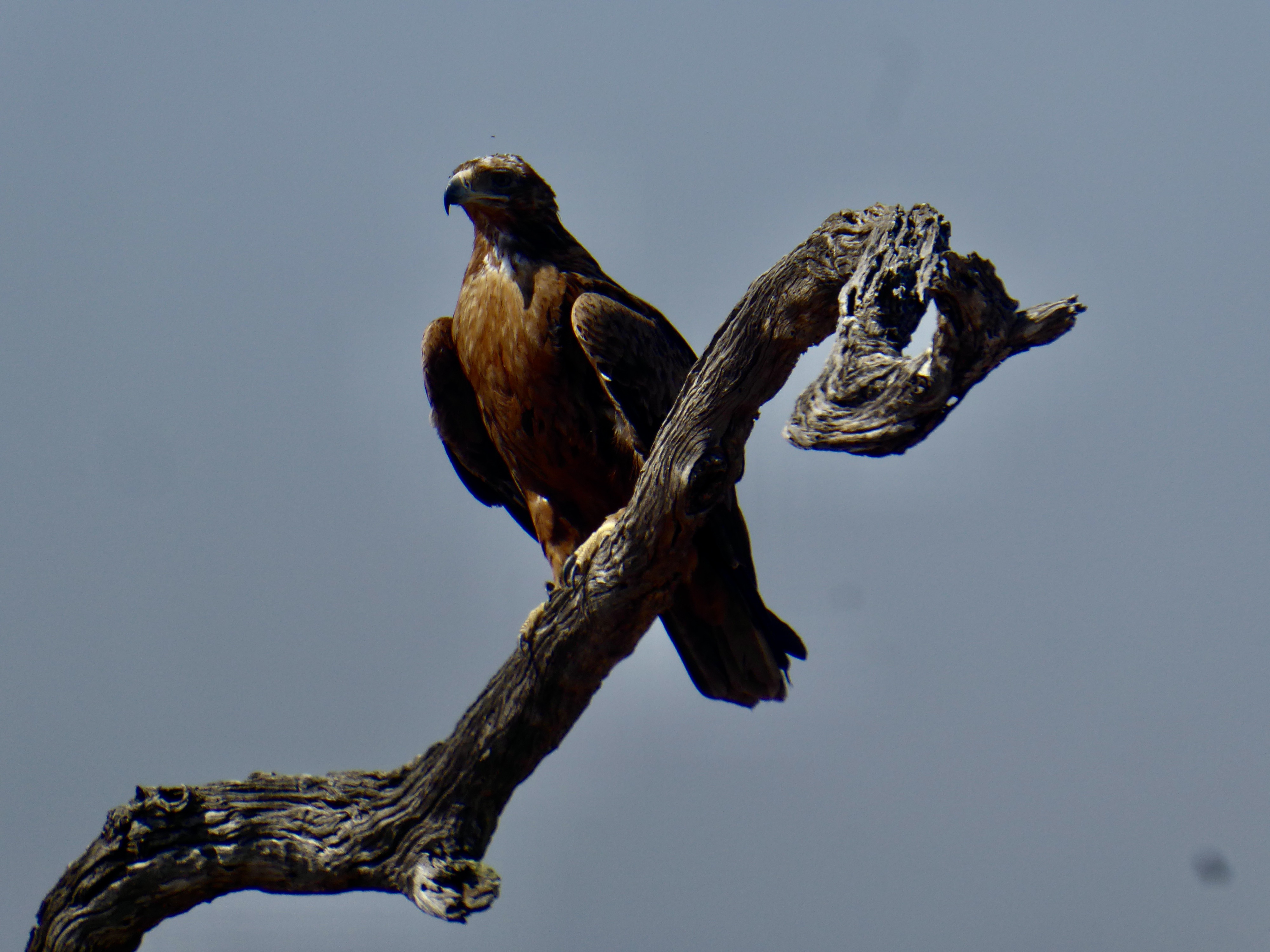
Why don’t we do it in the road? Martim identified this bird as a Tawny Eagle (Aquila rapax), consuming its kill, which I couldn’t identify, in the road. Its feathery legs place it in the group of “booted eagles” (subfamily Aquilinae), but it’s not the named “booted eagle” found rarely in Kruger:

A rare spot in Kruger, a secretarybird (Sagittarius serpentarius).  It’s a ground-dwelling predator that doesn’t fly often—mostly at night when it finds a tree to roost in.

From Wikipedia:

The secretarybird is instantly recognizable as a very large bird with an eagle-like body on crane-like legs that give the bird a height of as much as 1.3 m (4 ft 3 in). The sexes are similar in appearance. Adults have a featherless red-orange face and predominantly grey plumage, with a flattened dark crest and black flight feathers and thighs.

.  . The neck is not especially long, and can only be lowered down to the intertarsal joint, so birds must stoop to reach down to the ground.

. . . Prey may consist of insects such as locusts, other grasshoppers, wasps, and beetles, but small vertebrates often form main biomass. Secretarybirds are known to hunt rodents, frogs, lizards, small tortoises, and birds such as warblers, larks, doves, small hornbills, and domestic chickens. They occasionally prey on larger mammals such as hedgehogs, mongooses, small felids such as cheetah cubs, striped polecats, young gazelles, and both young and full-grown hares.

And they kill almost entirely by stomping on their prey!:

The birds often flush prey from tall grass by stomping on the surrounding vegetation. Their crest feathers may raise during a hunt, which may serve to help scare the target and provide shade for the face. A bird will chase after prey with the wings spread and kill by striking with swift blows of the feet. Only with small prey items such as wasps will the bird use its bill to pick them directly. There are some reports that, when capturing snakes, a secretarybird will take flight with their prey and then drop them to their death, although this has not been verified. Even with larger prey, food is generally swallowed whole through the birds’ considerable gape. Occasionally, like other raptors, they will hold down a food item with their feet while tearing it apart with their bill.

You can’t see how long its legs are below because they’re hidden in the tall grass:

Here’s a photo of a secretarybird skeleton taken from Wikipedia, showing how weird its body is. No other raptor looks like this:

Ryan Somma, CC BY-SA 2.0, via Wikimedia Commons

A grey heron (Ardea cinerea), widely distributed in Africa, Asia, and Europe:

A yellow-billed stork, found only in sub-Saharan Africa and Madagascar. I believe I’ve shown this bird earlier:

A beautiful Cape Starling (Lamprotornis nitens), endemic to southern Africa. It also hangs around places like rest stops and people’s houses where it might get a tidbit. Because its blue iridescence is seen only in certain lights, it often looks black, and thus its beauty isn’t noticed. (This is also true of our common starling.)

A panoramic view of the bush from an overlook. Click to enlarge the photo:

And a non-panoramic view of the bush. Remember, its barren absence of green-ness is because now in Africa it’s the dry season (winter). In summer, I’m told, the entire landscape is lush and looks completely different.

Photo below: an elephant has used its tusks to carve off pieces of this tree’s bark. Why do the pachyderms do this? For several reasons:

Where nature reserves house elephants, Africa’s largest land mammal is often singled out as the leading cause of destruction of the large trees that they share the landscape with. Elephants break trees to get easier access to the leaves, roots and nutrients. They also remove the bark to get access to the nutritious cambium layer underneath. As bark often strips off in a circular manner around the trunk, this may lead to ring barking, causing the tree to die off as the cambium layer is responsible for transporting nutrients upwards from the soil.

Here’s a video of an elephant removing bark:

The underappreciated impala:

I love their faces. Along with male nyalas, they may be the most beautiful of all antelopes I’ve seen, but I haven’t seen the tiny ones like klipspringers and dik-diks, whose photos are ineffably cute:

An older male impala whose horns have started to curve:

Two Egyptian geese (Alopochen aegyptiaca) and a Nile Crocodile. The birds are endemic to sub-Saharan Africa but have been introduced widely. I first saw them in a bay beside the Amsterdam railway station!

A male elephant leaning its butt against a tree. Yes, they can kill trees this way, too.

Another waterbuck with the “toilet-seat” ring around its butt:

I always try the local food when I can. The rest camp had a restaurant featuring this kind of food, including “chicken, pap, and ‘sas’ [sauce]”, and I much wanted to try pap.  Below is my dinner, with a roasted leg and thigh. Pap, formally called “ugali“, is a type of cornmeal similar but not identical to grits, and can be served in many different ways.

In this meal pap serves the same purpose as grits: a largely flavorless but nutritious starch that serves as a substrate for sauce or other toppings.  I loved the stuff when the ‘sas’, a type of tomato sauce made with various ingredients I’ve forgotten, was poured over the pap.

I love grits, too, though many people can’t abide their tastelessness. But they’re the perfect accompaniment to a breakfast of fried eggs, country ham, and red-eyed gravy. And I scarfed this meal down, too. It turns out that Isaac had independently ordered the same thing. See below for uncooked pap:

Pap comes in these large bags, which I saw when food was being given to hungry African villagers. It looks like white flour, with a very fine texture. Nutrients and vitamins are often added to the pap to supplement the diet:

And some signs at the Satara Rest camp extolling those who protect rhinos:

A rhino ranger with his equipment, including two horns that have presumably been removed to render the rhino immune from poaching:

And praise for the “honorary rangers” who protect the rhinos (click to enlarge the photo):

Sadly, this was our last full night at Kruger. But we had most of the next day in the park, too, and got to see the white lions at last! Stay tuned for the last segment: Day 5.

Kruger: Day 3

September 3, 2024 • 9:15 am

And it’s day three in Kruger, heading to a new place to sleep, but doing so very, very slowly, watching the roadside all day. As always, we got up before sunrise because there’s something ineffably lovely about the sun rising in the bush, with the only sound the chirping of local birds.  And you know that dawn means that all Ceiling Cat’s creatures will be stirring—at least the crepuscular and diurnal ones.

I’m lousy at identifying raptors (except for a mature bald eagle), but Isaac informed us that the one below is a booted eagle (Hieraaetus pennatus, also classified as Aquila pennata), which is actuallya Palearctic species but overwinters in places in Africa. Perhaps I’ve got the wrong ID, for the booted eagle appears to be very rare in Kruger:

The Booted Eagle is a summer migrant rarely seen in Kruger as it prefers the drier, mountainous habitats of the western Cape where there is a breeding population. The very few Booted Eagles that have been seen in Kruger are most likely northern hemisphere migrants that breed in north Africa and southern Eurasia.

They arrive in southern Africa usually during the course of November and depart in February before the end of the rainy season.

Birders—especially those with African expertise—should weigh in.

There’s no doubt, however, that the bird below is an African Grey Hornbill (Lophoceros nasutus epirhinus). It has an interesting behavior shared by some other hornbills:

The female lays two to four white eggs in a tree hollow, which is blocked off during incubation with a cement made of mud, droppings and fruit pulp. There is only one narrow aperture, just large enough for the male to transfer food to the mother and the chicks. When the chicks and female outgrow the nest, the mother breaks out and rebuilds the wall, after which both parents feed the chicks.

If the father dies while the female and chicks are walled in, the family is doomed, for the sealed-in mother undergoes a rapid molt of her flight and tail feathers (and therefore couldn’t fly even if she pecked down the wall) and thus depends on dad to supply the food. If he dies or leaves for some reason, there’s no food for anyone in the nest.

This is the remains of a (gulp) dagga boy, a lonely African buffalo expelled from the herd, making him vulnerable to predation. This one met that fate: he was taken down by lions, and we saw a male and female lion nearby on the next day (pictures tomorrow). They were hanging about saving the rest of the buffalo for a second meal of ribs.

Sightings of the common ostrich—Struthio camelus; there are two ostrich species in Africa—weren’t common in Kruger, but we saw enough to learn that it’s easy to tell the male from the female (as in all animals, ostriches come in only two sexes). Females are brown and males are black. Ergo, here we have a female:

Fun ostrich facts:

  • Ostriches are the largest birds in the world, standing up to 9 feet (2.8 meters) tall and weighing as much as 320 pounds (145 kg).
  • They are flightless but can run at speeds up to 45 mph (72 km/h), using their powerful legs to escape predators.
  • Ostriches lay the largest eggs of any living land animal, with each egg weighing about 3 pounds (1.4 kg).

And from National Geographic:

An ostrich’s powerful, long legs can cover 10 to 16 feet in a single stride. These legs can also be formidable weapons. Ostrich kicks can kill a human or a potential predator like a lion. Each two-toed foot has a long, sharp claw.

Finally, from an article in The Annals of Medicine and Surgery (I had to know):

 In one study of ostrich attacks, it was estimated that two to three attacks that result in serious injury or death occur each year in South Africa, where a large number of ostrich farms abut against both feral and wild ostrich populations.

And their mating behavior is bizarre; here’s an Attenborough video showing how rigorously a female sizes up a potential mate:

A common tsessebe antelope which we’ve seen before, but we didn’t spot many of them.

Termite mounds, which can become huge, abound in the park. Here are two:

The ecology of these mounds is fascinating, involving cultivation of a fungus garden (like leafcutter ants), a complex cooling system, and a queen who can live up to fifty years. You can read more about them here.

Oh, I crossed the Tropic of Capricorn again, and so you get another photo:

I love zebras because they’re gorgeous, and I always remember that their stripes are likely an adaptation to deter biting flies that can carry disease. But because they’re not one of the Big Five, and because they’re common, they are underappreciated. Look at these lovely Burchell’s zebras!

Notice the lazy zebra on the left, who’s resting its head on the butf of the middle one.

Below spotted hyena (Crocuta crocuta) near some zebra, all seeking access to a water tank (Kruger has built tanks and ponds to provide water, especially in this dry season.

There’s only one species of hyena, and gender activists love them because they think that the female’s “pseudopenis” means that they don’t really have two sexes. Those who make that claim are ideologically deranged. Here are the facts:

The spotted hyena is the largest extant member of the Hyaenidae, and is further physically distinguished from other species by its vaguely bear-like build, rounded ears, less prominent mane, spotted pelt, more dual-purposed dentition. fewer nipples, and pseudo-penis. It is the only placental mammalian species where females have a pseudo-penis and lack an external vaginal opening.

Note well: the FEMALES have a pseudopenis. They are females, not some sort of third sex. (You didn’t think this recounting would be free of ideology, did you?)

A white rhino; the only one we saw in the park.  It’s a rare spot, and do note that this one has had both of its horns sawed off by rangers to prevent poaching. The act, which is necessary to save the species, is a calculated compromise to save the animals’s life while reducing its ability to defend itself:

One of the loveliest places I saw in Kruger. Like the one I showed the other day with a bunch of elephants digging wells, this shot was taken on a bridge over a river (this one has water in it), and it’s in a place where you can get out and take photos. This one has elephants, a hippo, and a heron of unknown identity in it. See them all? This scene will remain in my mind as epitomizing the African bush:

The hippo was out of the water as it wasn’t too hot, and the heron was nearby looking for fish.

Note the two oxpeckers on the hippo below:

Reader Divy and her reptilophilic partner Ivan had a look at this turtle I photographed right under the bridge. Their ID:  “it is most likely a Serrated hinged terrapin (Pelusios sinuatus). Terrapin is mostly a regional term for certain turtles that live in brackish water, such as Diamondback Terrapins, or Red-eared sliders.”  This water is certainly not brackish, but neither is Botany Pond, where red-eared sliders were common.

The water was clear and shallow enough (hippos can’t swim and have to walk on the bottom) that we could get a good view of them while submerged. This one seems to have a baby with it, though the baby is not that small:

Here is a herd of hippos (another word for a grouping is a “thunder of hippos”):

We also visited a fascinating Elephant Hall at the Letaba Rest Camp, devoted entirely to the African bush pachyderm. Here is a group of school kids about to enter it as we were leaving.

Isaac came in with me, and photographed me next to the life-sized skeleton of an elephant. You can see how large they are:

I was fascinated to learn that, as this picture (and the video below) shows, elephants walk on their tiptoes, not on the soles of their feet. But it looks as if they’re walking on their soles because of the thick pads of flesh and fat under their toes:

Not only that, but each foot is planted separately from the others; no two feet hit the ground at the same time, as you can see in the video below (it also says that “the elephant is the only mammal that never lifts all four feet off the ground at the same time”). Note as well that they also walk relatively silently, and there’s doubt whether they can “run”, as opposed to just walking fast:

Elephant males battle for dominance, and they can kill each other with their tusks and heads. This is a skull of a male that was apparently killed by the tusk of another male piercing its head (the tusk shown below is added to show what probably happened):

Here’s Isaac showing the size of the tusks of one “tusker” male named Mafunyane. The tusks are larger than he is, and he isn’t small!

Mafunyane was one of the “Magnificent Seven” big-tusked bulls who lived in Kruger in the 1960’s; their skulls are in this hall and are described at the link just above. (They all died natural deaths; elephants tend to live about fifty to seventy years.)

Facts about this bull:

Mafunyane was the best-known member of the Magnificent Seven. His Tsonga name meant “the irritated one”, based on his temper and impatience with people. He avoided the major tourist routes. Mafunyane’s long, straight tusks dragged on the ground as he moved. He was a small elephant, however (only 327 cm high at the shoulder), and his tusks were shorter than most of the other Magnificent Seven’s. the tusks had an oval circumference, making them look heavier than they really were. The most unique characteristic of Mafunyane was the 10-cm-wide, 40-cm-deep gap in his skull. The hole stretched into his nostril, and he could therefore breathe and consumer rainwater through it. The origin of the gash is unknown, but it is believed to have been sustained during a fight with another bull whose tusk pierced the Mafunyane’s skull. Mafunyane died in 1983 of natural causes, around 57 years old.

And below you’ll see the skull of Shawu, who bore the longest tusks on record in a South African elephant. Shawu lived to be about sixty, dying of natural causes in 1986.


It was hot that day, and every beast took advantage of either water or shade. Here are two separate groups of impala, all clustered together in the shade of trees:

But of course I must show several pictures (not that different, to be sure), of my favorite African bird, the lilac-breasted roller.

What a beaut!

And, as the day drew to a close, we finally came upon a goal we failed to meet on an earlier trip to Timbavati with Kyle and Carrie: a sighting of the Southern Ground Hornbill (Bucorvus leadbeateri).  All of a sudden several of these fantastic birds appeared by the roadside, and weren’t the least spooked by our car (Isaac always turned off the engine when we took photos).

You can read all about this bird at either of the two links just above. Our sighting consisted of watching these hornbills pecking vigorously at the ground, trying to scare up a tidbit or two. They’re carnivores, but their habit of foraging on the ground gives them their name. From Wikipedia:

They forage on the ground, where they feed on reptiles, frogs, snails, insects and mammals up to the size of hares.  Southern ground hornbills rarely drink.

So, ladies and gentlemen, brothers and sisters, and comrades, I close by giving you seven pictures of Southern ground hornbills in diverse poses:

x

Kruger: Day 2

September 2, 2024 • 9:15 am

. . . aaaand we’re into our second day of the 4.5-day trip through Kruger National Park. First, if you wondered what the accommodations were like, this is my bungalow (yep, two beds for one person) at Shingwedzi Rest Camp.  Full bathroom with shower and plenty of hot water, good light, a decent and inexpensive restaurant, and a fridge in the room.  Who needs luxury lodges when, right outside the camp gates, lies a world of wildlife?

And so we’re back in the car, with the redoubtable Isaac looking for game. Here are the beautiful but largely ignored impalas. They’re ignored for the same reason that the virtues of Coca-Cola and onions are ignored: they’re simply too common to be truly appreciated. But, as Rosemary notes, “Impalas are the life-blood of the park; they bring life to many animals (via the cats and other creatures.” Alas, they are indeed the Buffet of Kruger, but they are beautiful and interesting in their own right.  Here’s a group of them (only the males have horns)

A male and two female impala. Look at those beautiful faces! They also show countershading: darker coloration on top with whitish bellies. This is likely a form of camouflage in which light falling from above makes the animal look more uniformly colored than if it were one color all over, making it less visible to predators.

I swear that Isaac has incredible vision. When we passed a giraffe, he mentioned that it must have survived a lion attack because there were scratch marks on its side. I asked Isaac to go back so I could see and photograph the scratches and, sure enough, here they are.  This is one lucky giraffe!

Giraffe crossing!

A passel of giraffe—four to be exact. Actually, the technical term for a group of giraffe is called a “tower” when they’re at rest and a “journey” when they’re moving. That makes sense—at least more sense than a “murder of crows.”

A singleton giraffe:

Zebras are skittish, and while I have some good pictures to come, on Day 2 I mostly photographs their rumps. But their rumps have a beauty all their own

If you’ve read this website regularly over the past few years, you’ll know that the best going explanation for why zebras have stripes is because black and white stripes seem to fend off biting flies, which can carry disease.  There’s now substantial experimental evidence to support the “fly hypothesis.” Just do a search for “zebra flies” on this website.

Note the gray stripes between the black ones on the rump.

A close-up of the tail:

A Black-backed jackal (Lupulella mesomelas) lapping up some water. This is a territorial, monogamous, and very vocal omnivore. They hunt, too; as Wikipedia notes:

In South Africa, black-backed jackals frequently prey on antelopes (primarily impala and springbok and occasionally duiker, reedbuck, and steenbok), carrion, hares, hoofed livestock, insects, and rodents. They also prey on small carnivores, such as mongooses, polecats, and wildcats.

Once again the impala can’t catch a break.

We’d usually set out, sans coffee, at about 6 a.m. to catch the flurry of wildlife activity that occurs in the cool early morning. At around 9 a.m. Isaac would find us a rest stop where we were allowed to get out of the car and eat.  Rosemary had planned well and brought her own food from the grocery store, but Isaac and I subsisted on what he brought for us all: instant coffee, milk, sugar, hot water (which he made every morning on the hot plate in his bungalow) and RUSKS.

Rusks are dry biscuits, and there are many versions in South Africa. Ours were hard and slightly sweet: perfect for dipping in coffee. Two cups of java and three rusks to dunk in them, and I was a new man (though still an old one). Here’s Isaac laying out breakfast at a rest stop. The rusks are in the ting to his right.

About half of my breakfast: a cup of instant joe and two rusks.

This rest stop was a lovely one, with an open picnic area with a thatched roof, all built around a lovely tree (I think it’s a fig):

A Southern red-billed hornbill, (Tockus rufirostris), certainly one of the most common birds not just in Kruger, but in the surrounding areas. They were brazen at picnic areas and restaurants, knowing that they might find a crumb (I didn’t feed them):

A lovely albeit leafless baobab tree, containing (as is often the case) the nests of the red-billed buffalo weaver (Bubalornis niger).

A breeding group of elephants (females and juveniles) having a long drink of water. Elephants prefer clean over muddy water (other animals aren’t so picky). Their favorite tipple that I’ve seen was the unchlorinated but fresh water in our swimming pool at Manyeleti. Note the babies!

A colorful saddle-billed stork (Ephippiorhynchus senegalensis), a denizen of sub-Saharan Africa that’s regarded as endangered in South Africa. Some information on its diet from Wikipedia:

The saddle-billed stork searches for prey by stabbing the bill into the water, catching prey by contact, and in the same way into mud and vegetation.It also hunts by visual detection. In one study with 255 minutes of observation, 71% of successful catches were due to visual foraging, and 29% due to tactile foraging. They usually feeds [sic] on aquatic prey such as fish lungfish (Protopterus spp.) and catfish (Clarias spp.), up to 1.3 kg (2.9 lb) in weight.  It swallow the fish head first and then drink some water [sic].  In case of large fish prey, they are often taken to the shore where pectoral fins may be clipped off before the fish is swallowed head first.  Saddle-billed storks opportunistically catch other prey such as frogs, snails, small mammals, birds, snakes, and insects such as grasshoppers, termites, and water beetles.  In an unusual case, the saddle-billed stork killed and consumed a red-billed Duck (Anas erythrorhyncha) and a spitting cobra (Naja mossambica). An unsuccessful attack on the slender mongoose (Galerella sanguinea) has been reported.


A baobab tree in the gathering dusk:

And a hippo.  Enlarge the photo by clicking on it and you’ll see its skin is pitted with scars and scratches. Male hippos have a tendency to fight with each other (to get females, of course), leading me to believe that this one is a man hippo (hippos, like all animals, have just two sexes).

The area of Kruger that encompasses one crossing to Mozambique. I got out to have my photo taken at a border but didn’t realize that this is a sensitive area and that the army/police could grab and question me. Fortunately, that didn’t happen, but I was duly chastised and chastened.

A further view into the border area. I don’t think this is Mozambique because the border is in the middle of a river.

A vervet monkey (Chlorocebus pygerythrus), the only primate we saw besides humans and chacma baboons. Fun vervet fact from Wikipedia:

Vervet monkeys have four confirmed predators: leopards, eagles, pythons, and baboons. The sighting of each predator elicits an acoustically distinct alarm call. As infants, vervets learn to make the variety of calls from observation alone, without explicit tutelage.

Here’s a short video of vervet alarm calls, and there are others on the internet as well, like the second half of this video.

Two kinds of animal-themed booze I found in a rest camp shop. Both mammals are found in Africa. See my Manyeleti posts for some good photos of African Wild Dogs.

Isaac and I had a running joke about dagga boys, the lonely, exorcised African buffalo that make me sad. Isaac learned not to point them out to me as “dagga boys” but as “single buffalo”.  But he and I were both fond of “dagga burgers”, the name of hamburgers in the camp restaurants. They come with onion rings on top, a real bonus. Here’s Isaac about to chow down on a dagga burger (I had one, too):

The tufts on this giraffe’s horns shown below show that it’s a female.

Both male and female Giraffes have ‘horns’ which are actually called ‘ossicones’. These Ossicones are formed from ossified cartilage and are covered in skin. The male has larger ossicones which they use for sparring, causing all the fur to rub off leaving grey bald spots on top of them. The females however don’t fight so their ossicones are thinner and you can see the fur standing up on them.

Male giraffe fight for females, of course, and do so by bashing their necks and heads together. This can occur with such ferocity that it can kill a giraffe. Even these gentle giants have their dark side. . . . .:

The “toilet-seat” ring of white on the rump of this antelope tells you that it’s a waterbuck (Kobus ellipsiprymnus). This is a male, for only one sex has horns.

Once again my vote for the most beautiful African bird goes to the lilac-breasted roller (Coracias caudatus). I have much better pictures in installments to come, but aren’t the colors gorgeous? (My friend Martim, an evolutionary ornithologist, gives his nod for beauty to the African Paradise Flycatcher; have a look at the link.)

Finally, a group of elephants managed to dig down to water in a dry river bed and drank greedily. Nearby, a herd of African buffalo waited patiently for the elephants to finish drinking, which tells you who’s dominant at a water source. We waited around to see if the buffalo would get their drink, but the elephants were thirsty (there was a warthog waiting, too), and so we left.

Next: Day 3, of course.

Kruger: Day 1

September 1, 2024 • 9:15 am

I think I’ve already mentioned some things about the giant and fantastic Kruger National Park in NE South Africa, but let’s start with the basics, which means some information and a map from Wikipedia:

Kruger National Park (Tsonga: [ˈkrúːɡà]Afrikaans: [ˈkry.(j)ər]) is a South African National Park and one of the largest game reserves in Africa. It covers an area of 19,623 km2 (7,576 sq mi) in the provinces of Limpopo and Mpumalanga in northeastern South Africa, and extends 360 km (220 mi) from north to south and 65 km (40 mi) from east to west. The administrative headquarters are in Skukuza. Areas of the park were first protected by the government of the South African Republic in 1898, and it became South Africa’s first national park in 1926.

Here it is below, in red. It’s HUGE! It’s bordered on the east mostly by Mozambique, but we also visited a spot in the north called “Crook’s Corner,” where three countries (South Africa, Mozambique, and Zimbabwe) meet. You can see that spot at the top of the reddish park map below, and it’s where poachers and other criminals used to flee one country to avoid the law by simply stepping across the border (this involves crossing a river) to to one of the other two countries, where they were from from pursuit. Nowadays immigrants from Mozambique cross the river into Kruger seeking a better life in South Africa.

For those who know the park, we entered at the Phalaborwa gate, did a zig-zag heading generally north, often taking dirt roads and taking diversions based on what Isaac heard from his fellow guides and from his own instincts.

We exited the park at the Orpen gate after having stayed four nights in comfortable and inexpensive bungalows: two at Shingwedzi and two at Pafuri. We had about 4.5 days of wildlife watching, at least eight hours a day. I’ll try to reconstruct a map of our travels in the next few days.

Go here to see a good map of the park that includes these locations. If you look at the map, you’ll see that to its west Kruger is surrounded by private game parks and nature reserves. Almost none of these have fences, allowing the animals to transit as they please over a huge area.

But a last meal before I left. A quarter bunny chow in Hoedspruit with beef (the mutton was better but this is still good). It’s filling, cheap, and tasty: a hollowed- out bread bowl (a quarter of a loaf) filled with curry. Note the perfucnctory “salad” to the side.

And the Hoedspruit version of a chocolate milkshake, which was very good:

On to the park. I recommend clicking on the photos to enlarge them.

This is the Phalaborwa gate where you formally enter the park in the north (there are nine entrance gates). You pay by the day on a sliding scale, with South African residents paying about a quarter of what foreigners do, which is fair given the difference in income. The money is for badly needed conservation fees.

Gates are strictly monitored, and open and close at roughly 6 a.m. and 6 p.m. respectively. This is also true of the 12 main “bush camps” where you can stay in well-equipped huts (there are also a couple of fancy private lodges, and “bushveld camps” with fewer facilities). If you are late and the camp is closed, you can still get in (with a reservation), but you have to pay a substantial “fine.”

At the entrance, and throughout the park, there are “sightings boards” showing which charismatic animals have been seen where and when (yesterday or today).  Note that they do NOT post sightings of rhinos because the poachers are, above all, after rhino horns, used in traditional Chinese medicine.

As I mentioned in previous posts. The rangers try to anesthetize all the park’s rhinos and cut off their two horns to prevent the animals from being killed by poachers, but the horns grow back and the process has to be repeated every four years or so.

Our first sighting of animals, apparently a pair of storks. I can’t remember the species.

Our guide Isaac told us that this is a group of social spiders who live in a sac attached to a large, insect-catching web. I believe this is a group of Stegodyphus mimosarum, the African social velvet spider. Individuals in a colony share food and care of the young spiders:

This zoomed-in shot of a raptor with a white chest may be an African hawk-eagle (Aquila spilogaster), but I can’t be sure. Later on we saw and identified a similar-looking species, the booted eagle (Hieraaetus pennatus).

Our first sighting of a mammal that became quite familiar to us, the African bush elephant (Loxodonta africana). (There’s also an African forest elephant in the same genus.) According to a recent census, there are roughly 13,0o0 elephants in Kruger, and the numbers are rising (there were only 725 in 2006).

There is continual debate about whether the increasing population poses a danger to the park, as they knock down trees and displace other species, and for a while they “culled” (i.e., shot) elephants to control the population. Of course big-game hunters in other places shoot them as trophies (an execrable practice), but it’s hard to think about mass killings of these beautiful and highly intelligent creatures when you’ve spent some time watching them.

Here are some small Lala Palms (Hyphaene coriacea). These are small ones, but, as Wikipedia notes,

The spongy pulp of the hard, brown fruit is edible and the fruit is eaten and sold in Madagascar and in eastern Africa; its Swahili name is Mkoma. The flavour has been compared to raisins and raisin bran.

Hippos (Hippopotamus amphibius) are hard to see out of the water, as they prefer spending their days submerged except for their eyes and nose, and generally come out of the water to graze only at night.  (Their skins are very sensitive to sunlight, something you’d think natural selection should remedy.) But on cool days you can see them grazing, always near water.

Here are two. They are considered among the world’s most dangerous animals because they are aggressive, unpredictable, and can run surprisingly fast.  500 people per year are killed by hippos, compared to only 22 for lions, but people are far more scared of lions.

This is a photo that I included because it’s part of my “animals crossing roads series”.  These are very common antelope that get no respect because they’re so common in the park: the impala (Aepyceros melampus). They’re everywhere and one tends to overlook them, but they’re very beautiful. Males have horns and females don’t, so these are females.

(Photo contrast adjusted by Christopher Moss to better show the countershading.)

A larger antelope, the greater kudu (Tragelaphus strepsiceros) with the characteristically spiral horns found only in males. They’re easily identified because both sexes are striped.

Remember, since you’re not allowed to leave your car, all these animals were photographed through open windows in our vehicle. Ergo, most were pretty close to the roadside. Most mammals, save zebras and some antelopes like impala, pretty much ignore cars, although a big bull elephant in the road threatened to charge us after spitting a rare piece of paper at us. Isaac, knowing the signs of elephant aggression (tilting the head sideways is a telling one), backed up the car slowly, and the elephant strode away.

Elephant crossing the road:

A Burchell’s zebra (Equus quagga burchellii) crossing the road. You will see several of these photos in the coming days because it is a ZEBRA CROSSING (in the UK that’s the name for a pedestrian crosswalk).

A rare spot despite its name, here are a few common tsessebe (Damaliscus lunatus lunatus) crossing the road.

A better shot of the tsessebe. In this species both sexes have horns. Horns in males only are a sign of sexual selection, but in some species males have larger horns than females, also indicating sexual selection but likely natural selection as well, giving some reproductive advantage to horned females.

Fun tsessebe facts from Wikipedia:

Several of their behaviors strike scientists as peculiar. One such behavior is the habit of sleeping tsessebe to rest their mouths on the ground with their horns sticking straight up into the air. Male tsessebe has [sic] also been observed standing in parallel ranks with their eyes closed, bobbing their heads back and forth. These habits are peculiar because scientists have yet to find a proper explanation for their purposes or functions

A herd of one of Africa’s most dangerous animals, the African buffalo (Syncerus caffer), a member of the “big five” referred to below; these are animals that are regarded as the most dangerous to hunt and kill with either spear or gun (the other four are lions, rhinos, leopards, and elephants):

One of the “big five” African game, it is known as “the Black Death” or “the widowmaker”, and is widely regarded as a very dangerous animal. African buffaloes are sometimes reported to kill more people in Africa than any other animal, although the same claim is also made of hippopotamuses and crocodiles. These numbers may be somewhat overestimated; for example, in the country of Mozambique, attacks, especially fatal ones, were much less frequent on humans than those by hippos, and especially, Nile crocodiles. In Uganda, on the other hand, large herbivores were found to attack more people on average than lions or leopards and have a higher rate of inflicting fatalities during attacks than the predators (the African buffalo, in particular, killing humans in 49.5% of attacks on them), but hippos and even elephants may still kill more people per annum than buffaloes. African buffaloes are notorious among big-game hunters as very dangerous animals, with wounded animals reported to ambush and attack pursuers.

In male buffalo, the horns grow together, fusing in the middle of the head in a structure known as a “boss.” This one doesn’t have a boss:

Here’s a “boss” male with the fused horns, as well as an oxpecker nibbling at his nose.

Below: the most iconic tree in Africa, the Baobab (Adansonia digitata). I didn’t see it leafed out (that’s during the African summer), but it’s unmistakable because of its large, bulbous trunk (It’s actually classified not as a tree but a succulent.) There are 8 species, but only this one is endemic to mainland Africa (6 others are native to Madagascar and one to Australia.

They can get very old (carbon dating puts an age limit of about 2,000 years). The tree has many uses for man, beast, and bird. Young leaves can be stewed as a vegetable, the roots and fruits are edible, and the seeds can be made into a flour. The bark can be made into fiber and clothes, and, in times of drought, elephants eat the water-rich underbark. And as for birds, see the second photo below.

There are often signs under baobabs in the park, and here’s one of them. What kind of miscreant would throw stones at owl holes?

The lovely impala lily (Adenium multiflorum), native to eastern and southern Africa. It’s a small succulent tree and was blooming everywhere in the dry winter season of our visit. The flowers are gorgeous and trees are planted widely around the camps.

Another baobab. I’d love to see these in the wet summer.

Isaac, the crack spotter, suddenly asked me out of nowhere, “Would you like to see a giraffe lying down?” I said, “Sure,” and asked him if this was an unusual event. He said “yes”.  Sure enough, Isaac had spotted two of them far before I could see them:

You may have wondered if giraffes sleep. The answer is, “Yes, but not much,” probably because they have to keep alert for predators (they can be taken down by lions, leopards, hyenas, and wild dogs, all of whom first go for the legs). Here’s some info about giraffe sleep from one website:

To start, let’s clarify that giraffes only sleep a few hours a day.

Some giraffes don’t even sleep that much. In captivity, adult giraffes have been observed sleeping as much as four and a half hours a day. In the wild, giraffes might only sleep about 40 minutes a day—and only about three to five minutes at a time.

Researches have observed three types of sleep in giraffes: standing, recumbent, and paradoxical. The latter sleep type is similar to REM (rapid eye movement) sleep. Standing sleep is characterized by a giraffe standing up, yet motionless, with its head tilted slightly more forward than it is when awake. This is thought to be essentially a light nap for giraffes and makes up a majority of their sleep.

During recumbent and paradoxical sleep, a giraffe can be observed lying down with their legs folded under them, their neck turned and arched backward and their heads resting on their rumps or the ground—similar to a swan.

When they drink at a waterhole, giraffe splay their legs widely to lower their body, allowing that long neck to reach the water.

A non-napping giraffe:

Zebra crossing!

We crossed the Tropic of Capricorn, where it’s allowed to leave the vehicle. I love official lines like the Equator (which I’ve also straddled) and borders between countries.

The Tropic of Capricorn is explained in the second photo below: it’s the furthest latitude south where the Sun appears directly overhead. That event occurs around December 21, the Winter Solstice in the northern hemisphere. Wikipedia notes that this is “the dividing line between the Southern Temperate Zone to the south and the Tropics to the north.”

Of course I had to straddle it: the line of rocks running between my legs.  Now I can say that I’ve stood astride this line, as well as the Equator. (I can’t remember standing on the Tropic of Cancer; the closest place to Chicago would be in Mexico.)

The explanation:

Two more giraffes. I couldn’t get enough of these majestic and beautiful animals. They’ve evolved, of course, to access leaves high up on trees that other animals can’t reach: an adaptation that comes with several costs.  They give birth standing up and the babies have a long tumble to the ground, which animates them to start their lives.

Here’s a giraffe giving birth in the wild. The baby takes its first wobbly steps within only a few minutes:

I believe I’ve discussed before the phenomenon of “dagga boys”: African buffalo who have been expelled from their herd because they’re old and can’t hold a position in the hierarchy (ca. ten years). They must thus wander, solitary or with a couple of other dagga boys, until they die or are taken down by predators like lions. They often roll in the mud because they have skin conditions, and are especially dangerous because, lacking the defense of their herd, they’re prone to attack.

In a later installment we’ll see the remains of a dagga boy killed by lions. These solitary animals, I think, must be lonely, and I find them ineffably sad. But such is nature.

A lovely male of the Greater Kudu.

And a giraffe sticking out its tongue:

One of the most amazing things we saw on day 1 (and remember, this is only the first of five days) was a huge herd of elephant digging for water in a dry river bed. Apparently elephants have a way of detecting water close to the surface, and when they find it, and are thirsty, they use their legs, tusks, and trunk to excavate a well that can be more than a meter deep. Here’s one female digging for water, and she found it:

This is only a small number of the more than fifty elephants I counted in the vicinity, and they’re all either digging for water or trying to get water from holes dug by others. Naturally the diggers wants a monopoly on their water and try to drive interlopers away, except for mothers who allow their babies to drink with them.  An elephant can take in 100 liters at a time, and about 240 liters per day.

Two photos of a mom allowing her baby to drink:

A bit more than half the group (I couldn’t get them all in one photo):

Finally, a male giving us the stink eye. Notice also that there are impala, kudu, and a single Marabou Stork  (Leptoptilos crumenifer) to the right of the elephant.

That was just Day One. There’s lots to come, but we made camp before closing time and had dinner (there are small and inexpensive restaurants in the camps).

More when I get time, probably tomorrow.

From Hoedspruit to Manyaleti Game Reserve (bonus mating lions)

August 16, 2024 • 9:30 am

Yesterday Rosemary kindly drove me the 45 minutes from Hoedspruit to the gate of Manyaleti Game Reserve, a spiffy facility that’s right next to Kruger. There are no fences, so they share wildlife. I’m staying in a tented camp for the next five nights, and it’s quite luxurious, including electric blankets to take the chill off the very cold nights (see the link for an idea of the facilities). More important, the place is teeming with birds and mammals, and includes what people call the “big five“: lions, rhinos, leopards, elephants, and African buffalo. This seems unfair to me, as surely the list should include giraffe, hippos, and, of course, warthogs.

More “game” below, but firat a few more pictures from Hoedspruit.

An unknown lizard on the fence in Hoedspruit (perhaps Greg or an African herper can help):

A mother warthog and her two babies in the yard:

On to the game reserve. This is what I saw beside the swimming pool when I checked in at the main center. And thus I knew I was in for something special. (Elephants drink from the swimming pools regularly, and we’re told to step aside when we pass them. They are quite used to humans, but are still wild animal and you must stay far away from a mother and its baby.)

More came to drink:

We began the drive after lunch (there are two 3½-hour drives a day, at 6:30 a.m. and 3:30 p.m.) by seeing a hippo skeleton. I suppose it died of old age, as I doubt they have natural predators here:

A proud male impala (Aepyceros melampus):

Some kind of ground-dwelling bird. I ask readers here to help me identify it:

African wild dogs (Lycaon pictus)! Colorful, social, and predatory, we were told these carry rabies, and, ranging widely, spread the disease throughout the parks:

From Wikipedia:

The African wild dog (Lycaon pictus), also known as the painted dog or Cape hunting dog, is a wild canine native to sub-Saharan Africa. It is the largest wild canine in Africa, and the only extant member of the genus Lycaon, which is distinguished from Canis by dentition highly specialised for a hypercarnivorous diet and by a lack of dewclaws.

It is estimated that there are around 6,600 adults (including 1,400 mature individuals) living in 39 subpopulations, all threatened by habitat fragmentation, human persecution and outbreaks of disease. As the largest subpopulation probably consists of fewer than 250 individuals, the African wild dog has been listed as endangered on the IUCN Red List since 1990.

The species is a specialised diurnal hunter of terrestrial ungulates, which it captures by using its stamina and cooperative hunting to exhaust them. Its natural competitors are lions and spotted hyenas: the former will kill the dogs where possible whilst the latter are frequent kleptoparasites. Like other canids, the African wild dog regurgitates food for its young but also extends this action to adults as a central part of the pack’s social unit. The young have the privilege of feeding first on carcasses.

We were lucky to see this rare species of d*g!

Another male impala. The landscape, you see, comprises low brush with occasional trees, and is exceptionally dry this year:

Another rare sighting: a black rhinoceros (Diceros bicornia). From Wikipedia:

The species overall is classified as critically endangered (even though the south-western black rhinoceros is classified as near threatened) and is threatened by multiple factors including poaching and habitat reduction. Three subspecies have been declared extinct, including the western black rhinoceros, which was declared extinct by the International Union for Conservation of Nature (IUCN) in 2011. The IUCN estimates that 3,142 mature individuals remain in the wild.

These magnificent (and HUGE) creatures are poached purely to procure their horns, which are used, among other things, as powdered additions to Chinese herbal medicine.

More from Wikipedia abut their size (I suspect I’ll see more of these as I have four more nights here):

An adult black rhinoceros stands 132–180 cm (52–71 in) high at the shoulder and is 2.8–3.75 m (9.2–12.3 ft) in length. An adult typically weighs from 800 to 1,400 kg (1,760 to 3,090 lb), however unusually large male specimens have been reported at up to 2,896 kg (6,385 lb). The cows are smaller than the bulls. Two horns on the skull are made of keratin with the larger front horn typically 50 cm (20 in) long, exceptionally up to 135.9 cm (53.5 in)

Our first lion (Panthera leo), a female:

A female and a young male (yes, lions, like all animals have only two sexes). They are remarkably inured to the presence of the safari vehicles (we aren’t allowed to get out), and we can often drive within about ten feet of them. Other animals, like antelopes, are far more easily spooked, perhaps because they evolved to fear predators.

A closeup of the female:

And the male, whose mane is only beginning to grow out:

A cub! Not a tiny one, to be sure, but not nearly of adult size:

Below: the largest eagle in the area, the Martial Eagle (Polemaetus bellicosus). Sadly, according to Wikipedia, it’s also endangered:

. . . it has feathers over its tarsus. One of the largest and most powerful species of booted eagle, it is a fairly opportunistic predator that varies its prey selection between mammals, birds and reptiles. It is one of few eagle species known to hunt primarily from a high soar, by stooping on its quarry. This species, an inhabitant of wooded belts of otherwise open savanna, has shown a precipitous decline in the last few centuries due to a variety of factors. The martial eagle is one of the most persecuted bird species in the world. Due to its habit of taking livestock and regionally valuable game, local farmers and game wardens frequently seek to eliminate martial eagles, although the effect of eagles on this prey is almost certainly considerably exaggerated. Currently, the martial eagle is classified with the status of Endangered by the IUCN.

Our guide told us that it can take small antelopes:

The guides communicate with each other by radio to each party know where the animals are, and they sometimes drive off the road to afford us a better view.

Our guide, Dan, said he was going to take us to a “lion wedding party”, which I thought would be a pride of lions. It was instead a pair of lions about to copulate. How Dan knew this I have no idea, but a mating pair of lions copulates every 20 to 30 minutes, doing the deed up to 50 times per day! I don’t know why copulation is so frequent. Perhaps it’s a bonding mechanism, or perhaps the male is trying to displace the sperm of a previously-mating male.  I’m sure one reader will know the answer

The nuptial pair of lions resting on the ground:

. . . . they then arose and repaired to a nearby tree. “Why don’t we do it in the shade?”

THE DEED.  The female lay down and the male was instantly on her. Copulation lasted only a minute, punctuated by a squealy roar that I presume accompanied ejaculation.

As soon as the deed was done, the male lion rolled over on his back and smoked a cigarette. Then both lions rested:

A happy male lion who has satisfied the imperative of all the genes that go to make up all lions: reproducing more genes that give the recipe for lions.

Readers’ wildlife photos

July 25, 2024 • 8:40 am

Well, except for singletons and some videos from Tara Tanaka, this is the very end of the queue. I hope it will be remedied soon.

Today’s photos come from UC Davis ecologist Susan Harrison, whose captions are indented. You can enlarge her pictures by clicking on them.

More from Finland:  mammals and songbirds

Here are yet more pictures from a May trip to Finland and Norway that was previously featured in posts on Arctic seabirds, other Arctic creatures, and birds of the northeastern Finnish forests.

Today’s post begins with mammals….

My first-ever Hedgehog (Erinaceus europaeus), in the half-light of 4:00 am in Oulu:

An unbearably adorable Red Squirrel (Sciurus vulgaris) defending a prize pine cone:

A Mountain Hare (Lepus timidus) in its summertime brown coat, and a far more nervous-looking one still wearing its conspicuous winter white coat; this species is found only in tundra, taiga, and moorlands of northern Eurasia:

A diminutive Roe Deer (Capreolus capreolus), belonging to a genus found only in Eurasia:

A young Eurasian Elk (Alces alces), closely related to our Moose (Alces americanus) rather than to what we call Elk in North America (genus Cervus, which in Europe are called Red Deer):

Next, some colorful songbirds:

Greenfinch (Chloris chloris):

Robin (Erithacus rubecula):

Bullfinch (Pyrrhula pyrrhula):

Siskin (Carduelis spinus):

And finally, some songbirds more remarkable for their elaborate music than for their plumages:

Thrush Nightingale (Luscinia luscinia):

Blyth’s Reed Warbler (Acrocephalus dumetorum):

Wood Warbler (Phylloscopus sibilatrix):

Readers’ wildlife photos

June 26, 2024 • 8:15 am

Today’s photos are from Doug Hayes of Richmond, Virginia, showing birds in a nearby swamp (there’s also one mammal and one reptile. Doug’s captions are indented, and you can click on the photos to enlarge them.

A couple more trips back to the Chamberlayne Swamp, this time showing some of the diversity of life at one of our favorite birding spots.

This dead tree seems to have been a nesting site for some time:

I spotted some movement and a baby bird popped up, begging to be fed:

It turned out that there were four babies in the nest:

Finally, the parents showed up. A pair of common grackles (Quiscalus quiscula):

The parents made many trips out over the swamp to get food for the babies.

The first anhinga (Anhinga anhinga) of the season. Anhingas have been nesting in the swamp for the past few years now:

While I was photographing the baby grackles, a group of birders walked by in search of what they thought was a palm warbler (Setophaga palmarum). Apparently, the bird had been zipping from tree to tree, not staying still long enough for them to photograph it. About five minutes after the group had passed, a small bird landed not ten feet away from me and just sat there. Yep, it was the palm warbler!:

A belted kingfisher (Megaceryle alcyon) resting after a long day of fishing.

A pair of great egrets (Ardea alba) getting ready to roost for the night:

There are lots of smaller turtles in the swamp, but this was the first time spotting a common snapping turtle (Chelydra serpentina). This monster was at least two feet long!

Eastern kingbirds (Tyrannus tyrannus) are fairly common around the swamp:

A solitary sandpiper (Tringa solitaria) hunting along the edge of the swamp:

This muskrat (Ondatra zibethicus) seemed to be curious about the group of birders standing at the water’s edge. It circled the area several times, getting close to us, then moving back to the center of the swamp:

Red-winged blackbirds (Agelaius phoeniceus) are the most common birds in the swamp. Very territorial, they can be seen mobbing larger birds and driving them out of their domain. I’ve even seen them chasing hawks and herons:

A killdeer (Charadrius vociferus) searching for food. These birds tend to gather at the shallow end of the swamp, well away from the other birds:

Camera info: Sony A7RV mirrorless camera body – Clear Image digital zoom feature used on most shots, Sony FE 200-600 zoom lens + 1.4X teleconverter, iFootage Cobra II monopod.