Readers’ wildlife photos

December 19, 2024 • 8:15 am

Today is the third and last part of Athayde Tonhasca Júnior’s travelogue, including ancient paintings, from Brazil (part I is here and part II is here).  Athayde’s captions are indented, and you can enlarge his photos by clicking on them. Without further ado:

Back in the day. Way, way back, Part III

JAC: the introduction to part I:

The Brazilian north-eastern hinterland is not a hospitable place for an outsider. Except for a short and intense rainy season, this is a dry, dusty and sizzling territory: a land of the cactus, thorny scrub and stunted trees. The native Tupi speakers called this semiarid region caa (forest, vegetation) tinga (white), and the term was adopted by the Portuguese settlers as caatinga. But the apparent harshness of the landscape misrepresents its ecological importance. The caatinga is a biota found nowhere else in the world, harbouring more than 2,000 species of vascular plants and vertebrates, with endemism in these groups ranging from 7 to 60%. And like every other Brazilian ecoregion, the caatinga has been severely degraded and fragmented. But its plants and animals have one place of refuge: the Serra da Capivara National Park in the state of Piauí. The park is a haven to numerous birds and endangered mammals such as the giant anteater (Myrmecophaga tridactyla), three-banded armadillo (Tolypeutes tricinctus), jaguar (Panthera onca) and other cats, and the maned wolf (Chrysocyon brachyurus).

The 129,140-ha park contains a massif of sandstone sediments formed some 430 million years ago when the whole area was submerged under a sea. The massif, smoothed by water and wind, was once the seabed, and pebble conglomerates on top indicate an overlying beach.

New:

In 1963, Niède Guidon organized an exhibition of prehistoric paintings in São Paulo. She was approached by one of the visitors with some pictures of ‘Indian paintings’ from places near his property in Piauí, a remote and forgotten region in the 60s. Guidon saw right away that those pictures were something completely different. She only managed to visit the area about 10 years later, and thanks to her, Serra da Capivara was discovered by the outside world – including Brazilians.

Pedra Furada (pierced rock), near the place where Guidon’s excavations provided evidence for a much earlier human presence in South America than previously thought:

Zuzu, one of the oldest human specimens found in South America. Assigned as female at discovery, later transitioned to male by researchers. Zuzu died approximately 9,600 years ago (Museu do Homem Americano).

How Zuzu may have looked (Santos & Moraes, 2023):

Superstition helped preserve Serra da Capivara. Tales of eerie voices and floating apparitions meandering through the canyons kept people away (can you see the face profile on the left wall?). Local elders warned youngsters about bad things happening to those who disturbed the ‘Indian paintings’:

Many of Serra da Capivara‘s pre-historic paintings suggest that life among the cliffs and canyons was not peaceful and idyllic. Here we witness a possible murder or execution:

A shagging scene, but not of a vanilla variety. The supporting character on the right hints of a threesome or, ominously, a non-consensual act:

Leaping deer:

Despite having survived for thousands of years, the wall paintings suffer the ravages of weather. The most vulnerable ones have been shielded from running water:

Some of the park’s residents like the ubiquitous coroa-de-frade (friar’s crown, Melocactus zehntneri) are on standby to inflict pain on the absent minded:

A slice of the bottom of the sea. Our minds need training to see things in geological time frames:

A parting view of Serra da Capivara. If you sit here for a while, you’d be taken by the silence. Nothing seems to move, and you only hear your own breathing:

Going home: 300 km to the airport on a mostly empty road, although you need to watch for goats grazing by the roadside. All that changes when you pass the towns along the way: mountains of plastic bags, rubbish and rubble everywhere. Places that don’t do justice to a small paradise hidden in the caatinga heartland:

Ich bin in Frankfurt und esse eine Brezel

December 10, 2024 • 6:45 am

Happy Tuesday; it’s December 10, 2024, and Coynezaa is just around the corner. There’s another holiday, too, but it celebrates a myth, whereas I am real.

It has been a hectic three days, but also fun: giving two talks (I fell off the stage during the first one), touring around Katowice, and eating large quantities of hearty Silesian food. I have a gazillion photos, but, as I’m cooling my heels in the airport in Frankfurt, I have no time to post them—save one. And that is the picture below, showing yours truly eating a classic German comestible in the airport.

If I look a wreck, I am. My plane left Katowice for Frankfurt at 6 a.m., which meant boarding at 5:30, which meant getting up at 2:00 a.m. and leaving my hotel, some distance from the planes, at 3 a.m.

I went to bed at 9, hoping for five hours of sleep, but woke up at 12:15, soon after midnight, and what with the excitement of impending travel it was clear that I wasn’t going back to sleep. So I watched CNN instead (the only English t.v. channel) to discover, via Anderson Cooper, that the police had actually caught the man accused of shooting health executive Brian Thompson. When the law caught up to him, the suspect, one Luigi Mangioni of New Jersey, was chowing down at a McDonald’s in Altoona, Pennsylvania.  And it doesn’t look good for him:

The Altoona officers who took Mr. Mangione into custody found that he had several telltale items that might tie him to Mr. Thompson’s killing, a crime that has riveted the nation while exposing Americans’ deep-seated anger toward the U.S. health insurance industry.

Mr. Mangione, officials said, had a gun and a silencer similar to the ones used in the Dec. 4 shooting, and a fake driver’s license that matched one used by the man suspected in the killing.

He also carried with him a three-page handwritten manifesto condemning the health care industry for putting profits over patients.

“These parasites had it coming,” it said, according to a senior law enforcement official who saw the document. It added: “I do apologize for any strife and trauma, but it had to be done.”

The document specifically mentioned UnitedHealthcare, the insurance giant where Mr. Thompson was chief executive, noting its size and the amount of revenue it takes in, the official said.

Yes, he’s presumed innocent until found guilty, but I’m here to tell you that the probability of any other verdict seems nil. He’s 26 and will surely, if convicted, spend the rest of his natural life behind bars.

Read more about the pinch at the archived link here. It was a nifty bit of police work, made easier by Mangione pulling his mask down just one time, when he was flirting with a woman at a hostel.  But once was enough: look at the hostel picture and compare it to the many circulating pictures of Mangione. I’m glad he’s caught, for nobody deserves vigilante execution, which is capital punishment without a trial. In fact, I don’t believe anybody deserves execution at all. Life without parole is more than enough, and remember that some people can reform.

But they’re very sad about the arrest over at P********a, where the fulminating miscreants are not only delighted, but have been egged on in their hatred by the Chief Miscreant himself, who urges his baying hounds before pulling the trigger to first find out who heads healthcare corporations that deny claims.  Then, as the capo says, “After you’ve followed the chain of decisions, then you can consider terminating some rich a-hole. It’s the polite thing to do.”

Indeed, nothing makes you look better to “progressives” than urging your readers to murder rich people, preferably CEOs of healthcare corporations.

In other news, where is Bashar al-Assad? Is he dead, as some suspect? Or has he fled to his pals in Russia?

Paul Krugman has written his last column for the NYT, and, over in France, the right-wing Marine Le Pen is plotting to topple the French government and replace it with one far more to the right. Sound familiar?

There are reports of continuing peace talks between Israel and Hamas, but I don’t think they’ll amount to much. If they result in releasing thousands of convicted Palestinian terrorists from jail, while not letting all the hostages go—indeed, if a settlement leaves anything of Hamas to govern Gaza, Israel will have lost.

And that’s the nooz till I get home and take a day to recover.

Christmastime in Poland

December 7, 2024 • 8:15 am

It’s a mere 18 days until Christmas and, of course, the First Day of Coynezaa.  Both festivities are marked by an overconsumption of food, and Coynezaa enjoys the advantage of having no religious overtones save encomiums for Professor Ceiling Cat (Emeritus).

Here in Katowice, in southern Poland, the Christmas Market is already in full swing in the town square, and I happened upon it walking back from the Silesian Science Festival (today I registered, tomorrow and Monday I speak). It was exactly what I’d expect a Polish Christmas market to be: full of fun, food, and just a bit of religion in the form of singing angels (not shown). Here are a few holiday snaps I took while crossing the town square.

Yep, here’s where we are:

Katowice has an ancient history, but lacks the charm of other Polish cities for two reasons: it was an industrial hub for mining coal and steel, and, under German occupation, many of its landmarks were wrecked, including the Great Synagogue, shown below next to the City Baths. It was completed in 1900 and razed by the Germans in 1939.  And of course most of the Jews were killed or sent away to be murdered.

Photo from public domain, Wikipedia.

An old building that remains in the city square:

Here is a monument that I take to be in honor of the local miners. Note the flowers and miner’s lamp at the base:

And everywhere people were having fun and laughing, expecially the kids. This one got a big soap bubble:

But the adults were also having a great time. There are various plastic status behind which you can stick your face to get a photograph. Like these people:

A penguin:

And a train chugging the kids through the market:

But of course people were there to get stuff, too: mostly food. Like these roasted chestnuts:

And look at this inventive and mouth-watering display of lollipops:

And, of curse, gingerbread, a Polish speciality for the holidays:

Very fancy gingerbread. These say “Happy Christmas” in Polish:

Various candies (caramels?), some of them flavored with booze (“piwo” is beer):

And what is a Polish market without sausages?

There were stalls selling non-comestibles, too. This one carried a variety of soaps, including these cat soaps in lavender and lily-of-the-valley (“kot” is “cat” in Polish):

Walking back to my hotel on the shopping street, I saw a big line in front of one shop. It was selling a variety of soft pretzels, and I would have joined the line had it been shorter:

There was a variety, including non-twisted pretzels filled with Nutella. The cinnamon pretzels were nearly sold out:

But below is a store selling the quintessence of Polish baked treats: pączki.  Wikipedia describes them:

pączek is a deep-fried piece of dough shaped into a flattened ball and filled with confiture or other sweet filling. Pączki are usually covered with powdered sugar, icing, glaze, or bits of dried orange zest. A small amount of grain alcohol (traditionally rectified spirit) is added to the dough before cooking; as it evaporates, it prevents the absorption of oil deep into the dough.  Pączki are commonly thought of as fluffy but somewhat collapsed, with a bright stripe around them; these features are seen as evidence that the dough was fried in fresh oil.

Although they look like German berliners (bismarcks in North America) or jelly doughnuts, pączki are made from especially rich dough containing eggs, fats, sugar, yeast, and sometimes milk.

(Note that when JFK proclaimed himself “Ich bin ein Berliner” in Germany in June, 1963, his attempt to forge solidarity with the divided people of that city actually meant, in German, “I am a jelly donut.”  He should have said “Ich bin Berliner.”)

Believe me; these pastries are superb! The only thing preventing me from trying one or three was that I was full from the ample spread of goodies in the Science Festival’s VIP room, to which I have access as a speaker. But have a look at these puppies! There are four zloty to the dollar, so each large filled pastry is about two bucks.

Happy Christmas from Poland!

I have landed!

December 6, 2024 • 10:11 am

I have arrived in Katowice (population 287,000), where it’s snowing, after a comfortable 5-hour train ride south from Wroclawek. I finished the novel I brought (A Gesture Life, by Change-rae Lee, highly recommended) and then reread the highlights of a book I’m reviewing for another site.

Although Polish trains have internet, I avoided using it, as for some reason I use long-distance transportation as a way to avoid being online.

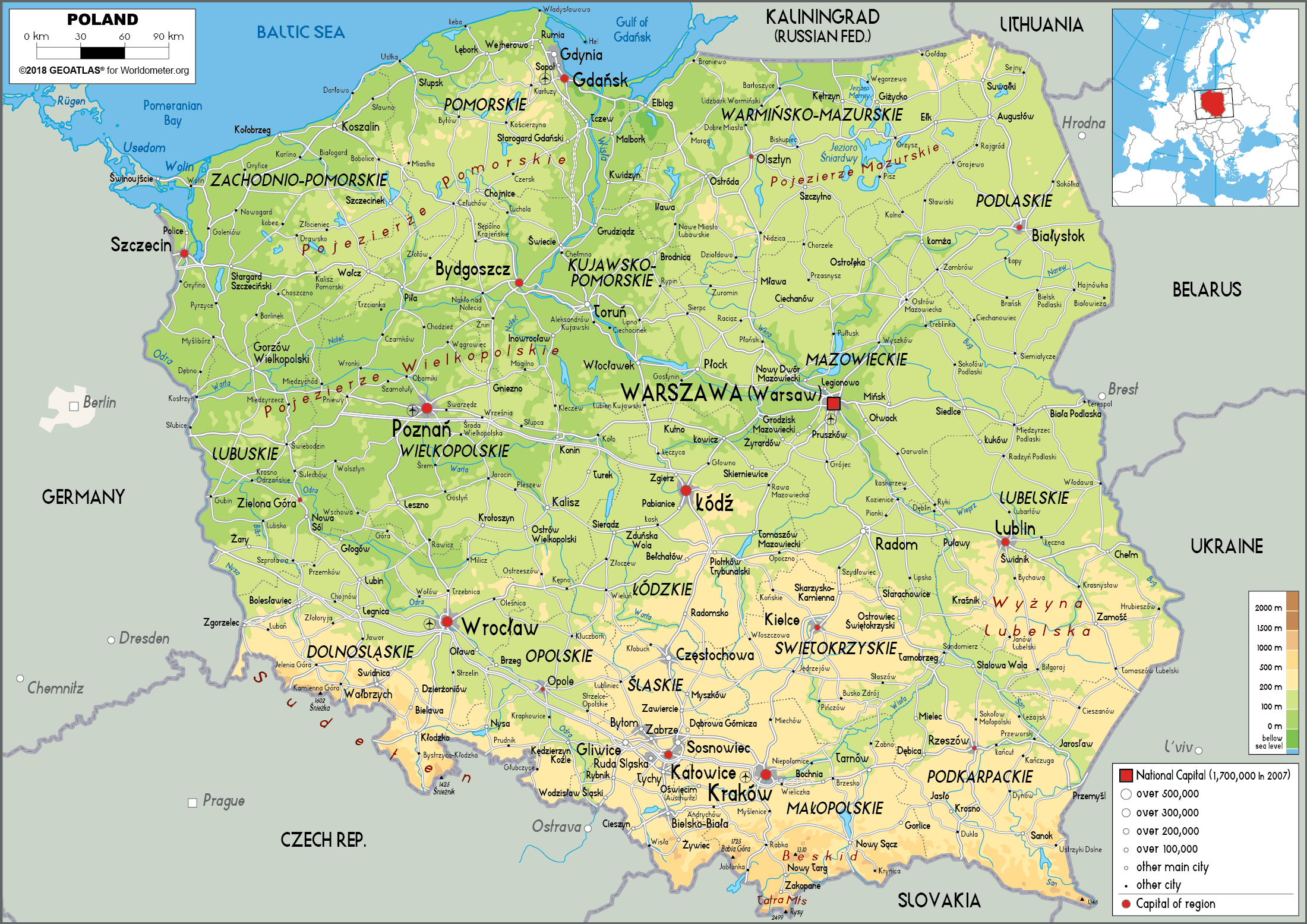
Here is a map of Poland from Worldometers. The northern arrow is the approximate location of Dobrzyn, and the southern one shows Katowice:

Tomorrow I’ll have a look at the festival, and then I give my talks on Sunday and Monday mornings, flying home early Tuesday (6 A.M.!) from Katowice via Frankfurt.

My week in Dobrzyn is, sadly, at an end, and it was great to see Andrzej and Malgorzata again, and to experience their patented brand of hospitality, including political conversation, a soft couch to work on (I finished my essay), four meals a day featuring great pies and cakes, and three—count them, three—moggies.  Dobrzyn is paradise enow. I will return, but I know not when.

In the meantime, here are photos of the cats. Hili was often scarce, trying to stay outside as long as possible before the weather becomes intolerably cold, or sleeping in the basement. But sometimes she’d favor me by lying on my bed, in which case I would join her with my book. She likes to burrow under the covers.

Below: Szaron and Baby Kulka on the windowsill, each on their own blanket. You will NEVER find Kulka and Hili together in this position, as they hate each other. For readers who have asked me why, I have no answer.

Apparently when Szaron came into the house as a rescued stray (Kulka formally lives upstairs with the lodgers but is often downstairs), Hili also hated him, but she got over that. Now Hili and Szaron are friendly, though not so friendly that they cuddle together. But Hili’s hatred for Kulka is implacable, and they avoid each other completely.

Two photos of Kulka. I have trouble telling her apart from Hili in photos, but Andrzej and Malgorzata have no problem. Kulka has more white on her face:

And Szaron, the world’s most affectionate cat. I had some good lap time with him yesterday. All it takes is one pat on the back and he begins purring like a motorboat, and will not stop, nor cease soliciting further petting, until you have to do something else:

Finally, my spiffy Katowice hotel room across the street from the train station. I had to take a panoramic picture to get it all in (click to enlarge).

Tomorrow I head to the conference to register and see what’s about, and perhaps have a look around the area, hoping to find some pierogi and potato pancakes.

More from Dobrzyn and surroundings

December 4, 2024 • 9:00 am

The weather here is atrocious: a constant cold drizzle from leaden skies, keeping us inside. Fortunately, the house is warm and there’s often a fire. Yesterday afternoon we went to see the progress on Elzbieta and Andrzej the Second’s new house a few kilometers near Dobrzyn. It is coming along wonderfully (see below):

First, though, our cats. Here is the hyperaffectionate Szaron, who has slept with me for three nights. (You may have seen this photo earlier today!)

I have never met such an affectionate cat. I swear, if you start petting him you have to stop of your own accord, for he will continue to demand pets forever!

Yawning.

Kulka, who can be distinguished from Hili because she has more white on her body:

More Kulka. Just this minute she had a violent altercation with Hili, screaming and lashing out at The Princess. They hate each other, and I can’t understand why. Cats!

Kulka at the window:

Kulka looking wary:

Hili in Andrzej’s chair, which she owns. Very often when Andrzej is working on the computer, Hili lies behind him as a kind of feline backrest:

Dinner: A delicious pork roast served the other night with potatoes and a Zubr:

When the cherry cheesecake was gone, Malgorzata made an apple cake, but a cake with a crust made of almonds, butter, eggs and sugar (Splenda):

The inside:

The leftover pork roast was made into a delicious stew, with the meat chopped up and served with stir-fried chopped peppers, leeks, Chinese cabbage, garlic, and soy sauce, along with different spices. It was terrific, and I had the leftovers for breakfast today.

Et voilà: Below is Elzbieta and Andrzej’s new house, which I suspect will be ready to move in by summer. You may remember that this house was eight years in the making, with one contractor or another refusing to take on the job. Finally someone offered to build it using old bricks from a demolished barn and some ancient wood from a house in southern Poland.

When I was here 1.5 years ago, the place was mostly a shell without a roof or second floor. It’s now a nearly completed house with the finishing touches being put on. It came with two stray dogs and a cat, all adopted by these animal lovers. I hope that Leon and Mietek—who remain in the Wroclawek apartment—get along with their new companions.

There is a huge garden outside where Elzbieta and Andrzej the Second are even now growing vegetables, flowers, and fruits.

The resident cat, named Hela:

And here’s Sofia, one of the resident d*gs:

The future dining room. It is all wood inside with exposed beams.  Because there are thieves about, either Andrzej the Second or Elzbieta must sleep in the basement at night, with their partner spending sleeping in the Wroclawek apartment. This will continue until the house is done.

There are at least three bedrooms.

Here is a heating stove, but a regular stove will also be installed nearby when the kitchen is finished. In the background is an inside wall made from the old barn bricks:

Two windows and views outside:

A view outside down toward the stream. Some miscreant destroyed the beaver dam that was there, but the beavers have returned and built a home by the bank:

The upstairs has a large master bedroom, and here’s its attached bathroom (everything is still under construction):

Here are two of the bricks taken from the 100-year-old barn and used inside the house. The first has the footprint of a d*g in it (Andrzej the second likes to display the bricks with impressions on them):

This one records the number of bricks made at the factory on a given day:

One cannot visit the house without being served snacks and tea. There were two kinds of cake (apple and bean) and a herbal tea concocted by Andrzej the Second. He also went into the garden and returned with a kind of pearlike fruit that we ate (it was good, though full of seeds). Does anybody know what this dark fruit is?

Dobrzyn: Day 2

December 1, 2024 • 8:15 am

Life goes on apace in this tiny town, with all of us working. Andrzej and Malgorzata are busy putting Listy together (supervised by Hili), and I am writing a piece for an online site, but more about that later.  It is too cold to go outside except for trips to buy groceries.

Here are a few photos from yesterday.

Andrzej at work. Note Editor-in-Chief Hili behind him in the chair:

Baby Kulka at work at her bowl (her real name is Kulka, but I always append “Baby” since I saw her first as a kitten):

Julia, the new baby (6 months old) from upstairs. Her father Mariusz is holding her:

Working on “my” couch with Szaron:

The cherry cheesecake baked by Malgorzata is half gone after one day (I have two pieces a day: one for breakfast and the other for third breakfast):

And me again with Szaron, working from the supine position. Szaron is the world’s most affectionate cat.

I got a short haircut before i traveled, but I can’t keep it from sticking up

Andrzej giving Hili a rare treat of cream. Part I: The Look. Treat impending!

Part II: Hili sniffs the cream:

Part III:  Hili laps up the cream. Szaron, rear, doesn’t get any:

And there’s now a stock of my favorite beer, Zubr (“Bison”) for dinner. Note the omnipresent Szaron:

And that’s a working day in Dobrzyn.

My grueling trip to Poland

November 30, 2024 • 8:15 am

Starting on Thursday afternoon, here is the course of my journey to Poland:

Thursday, Noon: had a can of soup: my last food until Friday evening.

5 p.m. Took Uber to O’Hare airport for 10 pm flight, supposing there would be traffic. I forgot it was Thanksgiving. The Uber was early, so I got there at 5:35, with four hours to wait until boarding. Did not want to read my book as I’m saving it for the five-hour train journay from Wroclawek to Katowice.

10 p.m. Thursday to 1:15 pm Friday: Plane flight to Warsaw’s Chopin Airport. No good movies, so I had to watch “Ocean’s 11,” which was okay for a crime movie, but I hoped for better. There was nothing better on tap. Food was dreadful, so I refused dinner and breakfast. Had two glasses of blackcurrant juice, which I always drink on flight to and from Europe. I do not understand why Americans have not adopted the blackcurrant, which makes terrific jams and juices

The flight was more than half empty, so I tried to sleep on the three seats in my row. I was unsuccessful, as I always am when trying to sleep on planes.

Friday, 1:30-1:45.  Because our flight was empty, I got through customs in just a few minute.

1:45-2:30: Long taxi ride from station to the new train station in Warsaw, as the one I usually use is under renovation

2:30-4:15: Wait in cold waiting room for train to Włocławek, the town nearest Dobrzyn. Bought ticket but was told that the train was full and that I would have to stand. Boarded train after a nearly two-hour wait on an uncomfortable bench. Still no food, though there was a McDonald’s and KFC in the station, heavily patronized by the travelers.

The train was packed and people were sitting on the floor. I couldn’t find space on the floor and so stood for half an hour with my bag and daypack. Finally found floor space for 1.5 hours when a traveler debarked. A truly uncomfortable journey. Andrzej told me I should have purchased a first-class ticket with a reserved seat, which doesn’t cost much more than my senior “standing only” ticket.

4:15: Arrived in Włocławek, picked up at station by Malgorzata’s and Andrzej’s lodgers, the kindly Paulina and Mariusz.

5 p.m. Arrived at Dobrzyn, where Malgorzata had held a tasty dinner for me. First food since I left Chicago.  I chatted with Andrzej and Malgorzata, worked a bit, petted the cats and went to bed at 9:30 pm.

Saturday. (today) woke up at 2 a.m., started with the brain-racing anxieties and was worried that I wouldn’t get much sleep. But my body put me to sleep and I woke up at 7 a.m., well rested. Made coffee and had a big piece of cheesecake for breakfast.

Readers can figure out how long my journey was and how long I went without eating given the 7-hour time difference between Chicago and Poland.

Now, into a shower!