
The New Yorker features Robert Lang and the incineration of his origami

January 21, 2025 • 9:00 am

You heard it here first, folks, so the New Yorker was slow on the uptake (and they don’t have the photos and videos that I featured). At any rate, the new issue features the recent story of Robert Lang, master origami artist and reader, whose wildlife photographs have been featured here often (and there are more to come).  If you don’t have a subscription, you can click on the NYer headline below and read the piece perhaps once, but otherwise I’ll give some excerpts from the story and add that a judicious inquiry might yield a pdf.

First, though, have a look at Robert’s origami page to see the incredible art he’s made. (I’ll wager he’s one of the ten best origami artists in the world.) As he told me, he lost virtually all of the art he had kept during the fire, which burned up his and his wife’s old home and studio, as well as a new home down the block. They have insurance and will rebuild.  In the meantime, I told him that I still had an origami duck he folded for me, and he responded that it was probably one of the few surviving original Langs.  It sits atop my computer, and here it is (it is another version of his “Duck Opus 11” on watercolor paper that you can see here).

And the story:

Here are some excerpts:

“The first thing you think of when you see your home engulfed in flames is, My world and future have changed,” Robert J. Lang, one of the world’s foremost origami artists and theorists, said recently. He was sitting in a small hotel room in Arcadia, California. The week prior, the house where he lived with his wife, Diane, had burned down when the Eaton Fire erupted and swept through Altadena, outside Los Angeles, with incredible speed, levelling entire neighborhoods. Robert’s studio, a separate property where he kept decades of his professional origami work—all highly flammable— along with research and personal artifacts, was also reduced to ash.

Diane walked in with their two dogs, Casey and Scout, who hopped onto the mattress and lay down. Diane, with no other place to sit in the room, joined them. “Two people offered their back yards for them to wander around in,” she said. “So, we were just in a back yard.”

The Langs had gone to sleep on a Monday night in their own bed. By Tuesday night, they were sleeping in their cars, with their many pets—the two dogs, two desert tortoises (Sal and Rhody), a Russian tortoise (Ivan), a snake (Sandy), and a tarantula (Nicki)—and the few things they could grab as they fled the inferno. The snake, tortoises, and tarantula were now being taken care of at the San Dimas Canyon Nature Center, rather than staying at the hotel. “Just to make my life simpler,” Diane, who works with the Eaton Canyon Nature Center, said.

In the early hours of Wednesday morning, Robert watched his studio burn from a nearby ridge. Then, at around 9 A.M., he and Diane learned that their home was destroyed. At sixty-three years old, Robert, who was profiled in this magazine in 2007, has been designing origami for most of his life; one of his early designs, in the seventies, was an origami Jimmy Carter. He used to be a physicist, working on things like semiconductor lasers, at places such as NASA’s Jet Propulsion Lab, before he decided to devote his time fully to origami. The studio held much of his art, and all of his tools. The laser cutter he used to help make prototypes had melted. “It’s now a pile of metal,” he said. “A 3-D printer is now a pile of ash.” Rare paper, including fig-based paper from a tiny village in Mexico, had burned. He went on, “There were correspondence letters with other origami artists over the years that were a historical record for me and perhaps for others. And then my exhibition collection was there. The pieces I had in MoMA”—a large grizzly bear, a bull moose, and a fiddler crab, all folded between 2003 and 2007—“are gone.” As he evacuated, however, he was able to grab a single piece of art work, perhaps his most famous: a framed, fifteen-inch cuckoo clock folded into dazzling complexity from a single sheet of paper

. . . .Most of the Langs’ days now are spent on details. Dealing with insurance. Filing documents of everything lost. Texting with neighbors. Walking the dogs. Checking the weather for changes in wind. Monitoring evacuation zone updates from the Watch Duty app. And, mainly, finding a more stable place to live.

Robert’s phone rang. Their real-estate agent had a prospective rental apartment they could see that afternoon.

“Ask him about the dogs,” Diane said to Robert. She explained, “We’d founda place we liked—a good vibe. But the owner said he didn’t want dogs.”

Robert hung up. “They take dogs,” he said. “We can see it at 3 P.M.”

“It’ll probably be for two years,” Diane said. “But we’ll rebuild. We still have our land. We even have the floor plans.”

And they will rebuild on the site of their new home and of their original studio. It may take a couple of years, but, as I said in my previous post, the Langs are remarkably resilient and are just getting on with what they need to do.

As for the cuckoo clock he saved: here it is, reproduced with permission. You can see it and read about it here, but he adds:

This is the one I saved.  There are four of them in existence (that I folded; lots of other people have followed the folding instructions to make their own versions). One of them was also in a fire that destroyed the owners’ apartment, but almost miraculously, it survived. He had a fourth-floor apartment in a building in which all the interior collapsed in the fire. After the fire, he was poking through the rubble in the basement, lifted a collapsed door that he recognized as his, and found the cuckoo clock, flattened, but unburnt. He sent it to me, and I spent some time restoring it (dampening, wiping off the ash that caked it, and re-folding/re-shaping it). I eventually got it back to its original appearance, though it still had bits of ash in crevices and smelled of smoke, but that just added to its character, and to my knowledge, it survives to this day.]

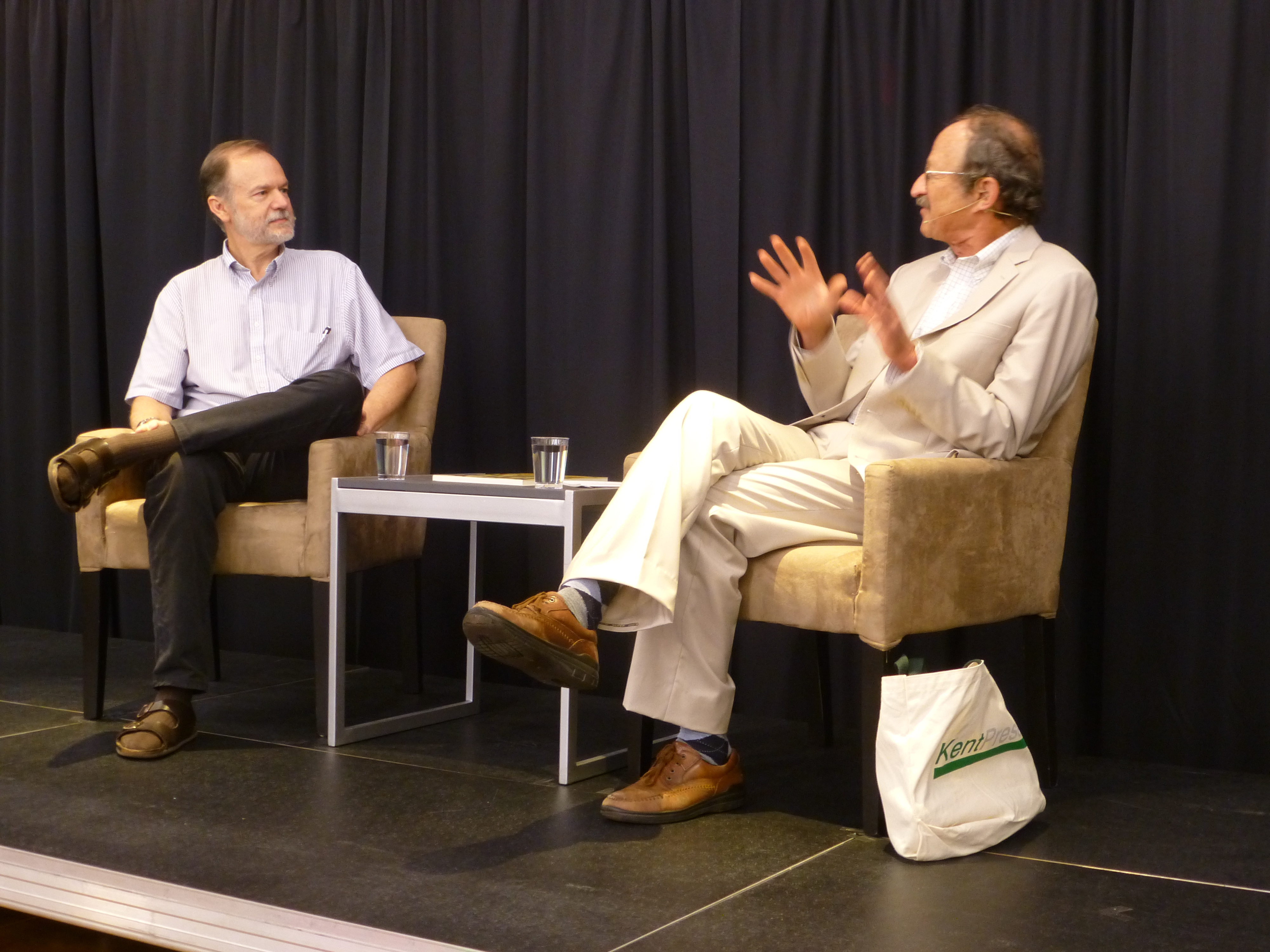
Here’s the first time I met Robert—at the Kent Presents meeting in Connecticut in August, 2018. (There’s a description here; sadly I’ve removed all photos from this site before January of last year because of copyright claims by stupid and venal firms, but there is a video of some origami that I’ve put below.) This photo shows part of Robert’s presentation, which was accompanied by slides of his artwork). Here Lang (left) talks to biology Nobel laureate Harold Varmus:
Here’s the video showing some of Robert’s origami:

Readers’ feats

October 16, 2022 • 1:30 pm

I used to have a “meet the readers” feature in which readers could send a photo and tell us a bit about themselves.  Today I’m putting up photos from emails I just got from two readers, informing us of their feats.  Well, the first one could be seen as a feat, but an unpleasant one. Readers’ explanations are indented.

This one comes from Darryl Ernst:

Not sure if you might remember a “Photos of readers” post that featured me and a picture of my beautiful Yamaha R1 motorcycle. Unfortunately, after decades of riding, I finally dropped my guard and allowed someone to hit me, and what was my favorite of many motorcycles over the years has been destroyed. In slow, heavy traffic approaching a busy intersection the light turned and I came to a stop at the red light. As is my SOP I checked behind me before I decided to stop. If I don’t like what I see, I go through the light, but in this case what I saw looked fine. The vehicle behind me was well back from me and was slowing down as if he too was coming to a stop, so I went ahead and stopped. And a couple of seconds later he plowed into me anyway, catapulted me off the bike and then would have run me over if I had not rolled out of the way. I’ve no idea what led to him doing that. Fortunately I’m fine, stiff and sore is all, but my favorite bike isn’t so pretty anymore. Which has me feeling a bit sad. Nothing lasts forever.

Before (from 2020)

Yesterday.  Good thing Darryl wasn’t hurt!

***************

From Max Blanke, who appears to have considerable skills:

Not wildlife, of course. My wildlife images tend to be horrible. Anyway, I finished this today, and had consulted WEIT commenters on the engraving prior to cutting.

Understanding that your site is not “Why Knives are Stabby”, I figured to send the attached images along anyway.

I combined late Roman and Anglo Saxon elements to come up with the basic design. The scales are Llanite, which we quarried ourselves this summer. The blade is laminated steel, the bronze salvaged from scrapped machine bearings. The blue stone accents are sodalite, from my big pile of interesting rocks.

It will be in the post to the new owner on Monday, who only knows that it is some sort of bladed weapon.

European blades are not my specialty. I did make a crusader’s sword not long ago with “Hello, I would like to chat with you about Jesus Christ” engraved on the blade in Middle English.

According to Max, the Latin on the blade translates as “”Now the die is cast”, attributed to Julius Ceasar upon crossing the Rubicon.

UPDATE:  Linda Calhoun just sent this “feat”. Her words:

Pumpkin pie: this is as close as I will ever come to a “feat”.

I have to admit it looks good!

Readers’ wildlife photos: senior Teddy bears

November 16, 2021 • 8:00 am

In 2014 I did a post showing “readers’ childhood plushies” (plush dolls or animals). We had many photos, but since the other day was National American Teddy Bear Day, I put out a call for readers to send me photos of their Teddies. Not all of these are Teddies, but most are, and the others are also cute (check out the completely unstuffed horse). Go to the first link to see other readers’ bears and dolls; the ones here are all new.

First, my own Teddy, familiar to readers as Toasty. I got him when he was born, so he’s a septuagenarian.  You can see that most of his fur is worn off, my mother had to replace the eyes several times, and his neck was sewn on when he was nearly decaptitated (he’s a “Frankenbear”).  He resides in my office

To cover his shame (even though he’s not anatomically “correct” my mother made him overalls. Here we are in my office in 2002:

From Cynthia Baron Radtle, who wrote on Facebook,  “OMG! Toasty looks exactly like my Teddy.”  Well, Teddy looks a bit more beat up, but there’s definitely a resemblance. 

Cynthia added this:

I will post a pic without the baby shirt. His body was so worn my mother had to sew a little body suit on him to keep the stuffing in. I’ve had him since infancy so I have no idea where I got him. Probably mom or dad.

Leonard added this on Facebook (no photo): “My step-daughter, half our age, has a similar bear in similar condition. When she took it to UBC to do her post-grad, it attracted the nickname ‘roadkill’.”

From Lynne Bond:

When I showed my husband your Toasty, he insisted I send you a photo of his Ah Baby:

From Chris Taylor:

Ok he is a Scottie not a Teddy, but he is my oldest soft toy.
This is Wowser, and he is exactly the same age as me – 65 last weekend!  He was made for me from sheepskin by a friend of my mother who worked with her as a nurse.  He is mostly intact, but has lost a bit of fur, and has a bandage on his leg where the sheepskin went a bit brittle. Not at all bad, because he was also played with by my brothers and sisters, and was even passed down to a niece and nephew for a while before coming back to me.
Wowser now lives with quite a lot of younger teddies.  For about four years I had a registered business making and selling hand-made bears.  So here also is Manuel, who is one of my bear designs!


From my friend Fred Crews, retired English professor (and chair of English) at Berkeley, critic of Freud, and writer for the New York Review of Books.

Your teddy bear has been brawling in the streets of Chicago, and he shows the effects. Not advisable. Here is my mother’s Steiff from 1908, when she was four years old—an indoor pet ever since.

When I pointed out to Fred that Steiff co-manufactured the original bears starting about 1904, and he may have a valuable antique on hand, he responded thusly:

We always knew it was a Steiff. I now remember that my mother called him “Oscar.” And here she is below, shortly before receiving the bear as a gift from her uncle (not shown). My mother’s name was Robina Gaudet, but she was always Ruby. Those are her parents in Bethel, Maine.

From Linda:

My bear Mikey is about 85 years old. Some fur is missing due to being thrown back and forth across the street. Sorry, no overalls 😀

And another from Linda, which she made herself:

I thought you might get a kick out of “ShakesBear” that I made for my mother.  I think it was in the 90’s when there was a fad on Bear names, e.g.: Bearishnikov, etc.  She was quite taken with the idea, being a bear aficionado, so I made this one for her.  Not as old as Mikey, Shakespeare is probably only 45.

A punny bear from Joe McClain:

And I thought you might be interested in a rare adult-onset teddy. My daughter Lauren gave him to me about 10 years ago, inspired by a story my mother told her. When I was little, I misunderstood the hymn “Gladly, the Cross I’d Bear.” So, please meet Gladly, the Cross-Eyed Bear. I had no teddy when little, but I did have Ruffy, Tuffy (dogs) and Harry the Owl.

From Steve Pinker. This website once had a contest to guess the name of his bear, for I didn’t find it on the Internet and thought readers could do some sleuthing. It turns out that Steve mentioned Wilfred in his lectures at Harvard, and one reader had attended one. So here’s Wilfred with the backstory from Steve:

Wilfred was a gift from my ex-wife Ilavenil Subbiah (a graphic artist and publicist working with MIT and with Commonwealth Fusion Systems, the fusion start-up), when we were first dating. She has a collection of more than a hundred bears.

From Matthew Cobb. I featured this in the previous post, but I’m putting it up again because it’s Matthew.

Here are pictures of my Teddy, who’s just called Teddy. I have had him for over 55 years, maybe since I was born – not sure. My sister Liz  made him the tartan trousers when I was very young – never known him without them. He has got a bit battered – his eyes were bits of brown  glass stuck on very long rusty dangerous bits of wire, which were  shoved into his straw-packed head. They were removed, probably for safety reasons, long ago. Now he looks a bit blind. His paws were covered with some kind of fabric, but that obviously rotted and got replaced about 20 years ago by my mother, who looked after him until about 10 years ago when I reclaimed him. My mum also did some brain surgery when, about 50 years ago, Teddy got left too close to a fire and suffered a nasty singe-based trepanation on the back of his head. She patched him up – not with vinegar and brown paper but with a piece of some old yellow curtains. He’s not very cuddly (the straw is very solid), nor very flexible, and  is getting rather threadbare (threadbear) but I suppose that’s also a  description of his owner. .

From Rik Gern:

What a coincidence you should be asking for teddy bear photos; I arrived at my mother’s house for a visit the other day and found this collection in the closet of the room I’m staying in! None of them had been mine though. I had a favorite monkey doll as well as a Casper the Friendly Ghost doll that went everywhere with me, but no teddys. I believe these belonged to one of my sisters.

Matt Young, who writes on The Panda’s Thumb website, proffers his own bear, Steph-Steph:

After seeing your splendid Teddy bear, my wife reminded me that my Teddy bear is a panda. Her name is Steph-Steph, and she is named after Stephen Jay Gould. Her cousin, Professor Steve-Steve, is a founder of The Panda’s Thumb. Here she is in 2005 lecturing about giant tortoises to a crowd of one.


From Cicely:

Not a childhood toy– but a current companion with his constant companion..

Eloise, the bat and Edward, the bear:

From Professor Jean Greenberg, member of Team Duck:

Here is my bear,  uncreatively called Teddy.

This is one of my oldest beloved childhood treasures. I used to stage little tea parties with my Teddy, also accompanied by a small stuffed lion and a beautiful cat hand puppet. The tea set was a mini-set that I gifted to friend’s little one after I found it in my mother’s apartment after she died. I could not bring myself to part with the bear, the lion and the cat puppet, which now sit in my bedroom together.

From Norm Gilinsky, the most messed up plushie of all!

Hah! I thought about this when you mentioned your Teddy the other day. Here is my childhood stuffed toy—a dog named “Sooty.” I carried him with me night and day until the stuffing came out of him. He’s completely flat! My mother kept him for many years and eventually gave him back to me. If you look closely, Sooty is mounted behind glass in a Riker Mount display box—a type of museum case. Sooty is somewhere between 63 and 64 years old. Doesn’t look a day over 60!

Photos of readers

August 11, 2019 • 2:00 pm

Well, here’s a new feature: photos of readers as they go about their everyday lives. If you want to be part of it—and this will hopefully be ongoing—just send me a photo of yourself doing something interesting, even if it’s just you at work, petting your cats (you do have one, don’t you?), or just about anything. The idea is to put faces to the names we read here every day.

The only Rool is that you should give your real name, though if you feel strongly that you don’t want to use it, your posting name.  And here’s the first one, sent by lutist Daniel Shoskes. It shows him and another regular, Peter Nothnagle, who, you might recall, wrote an epic document on the fictionality of Jesus. (Peter’s “regular” job is producing classical-music CDs.) There are two other musicians as well, though I don’t know if they’re “readers.”

Daniel’s caption:

Peter Nothnagle and I, faithful readers working together again to record another CD. (We have made 3 CDs together in the past. This is #4). I’m playing the Renaissance Lute. Soprano is Elena Mullins, with Rebecca Landell-Reed playing the viola da gamba. Church of the Resurrection near Cleveland, please forgive us our sins.
I invite readers to send similar photos, and I’ll put them up one at a time over an extended period.  Thanks!

Note to readers

March 16, 2018 • 1:00 pm

This policy has been up on “Da Roolz” site for some time, but I have been a bit lax in enforcing it. Please be aware of it, and, if you want people to see your website, connect your real name to that site. This is note #18.

If you post a link to your website, referring us or asking us to read something you’ve written on that site, the site cannot be anonymous; there must be a real named person who writes it. You have every right to keep your site anonymous, but I don’t have to link to it, for I believe people should stand behind what they say publicly. That said, I’m not demanding that commenters on my own site reveal their real names on this site.

If you’re a new reader here, please do look at the commenting rules (link above) before you post. Links by readers to their anonymous or pseudonymous sites will be removed.

Thank you.
—Management

A bad squirrel; and Gus lagniappe

March 19, 2017 • 7:30 am

Reader Chris sent us this amusing anecdote of domestic food thieving.

The dominant squirrel got impatient and gnawed his way into the feeder:

So I got out the tinsnips and an old tin can:

I see I’m not much of a tinsmith as yet, but I guess I am an example of an animal learning tool usage because of another animal….

Score: Human 1 Squirrel 0 (so far).

And a bonus Gus photo. Someone knows how to live life for comfort.

Readers’ Wildlife Photos: Hummingbirds & a Tanager

August 1, 2015 • 12:55 pm

Biologist and naturalist Lou Jost, who lives and works in Ecuador who regularly sends WEIT examples of his amazing photography and art has sent in some more photographs of hummingbirds, this time with a difference. Here’s what he wrote to Jerry.

In case people think that all hummingbirds are like the little buzzy things we have in the US, here is a hummingbird I saw last week that was almost as big as a swift or swallow. It’s called the Great Sapphirewing (Pterophanes cyanopterus). It is a very high elevation Ecuadorian and Colombian hummingbird, living around timberline at 3400-4000m. These huge hummingbirds have a more stately flight than the little guys, and they glide a lot. This is one of the largest hummingbirds in the world.
I watched it feeding on the turquoise-blue flowers of a giant terrestrial bromeliad (Puya sp.) whose wooly flower stalk was about 3-4m tall. This was a strange paramo (tropical high-elevation alpine grassland) studded all the way to the horizon with white-leaved Espeletia plants, in the aster family. These Espeletia are only found in very wet paramos and have a limited distribution in Ecuador. WEIT readers with good memories might recall reading about this genus of plants in relation to the recently-rediscovered Oxypogon hummingbird in Colombia. We were looking for Oxypogon hummingbirds here, but we didn’t find any, and none have ever been seen in Ecuador. But we have Espeletia in some spots, so maybe some day we’ll find one. (If one is ever found here, it will surely be a different species from the rediscovered one.)
P1010334v2
P1010335
P1010329
In the shrubby transition zone just below this paramo, my group saw another iridescent blue bird, the Golden-crowned Tanager (Iridisornis rufivertex). This is one of my favorite birds for its subtle but beautiful colors, and I was really happy to finally get pictures of it. We lured it in with recordings of its own song and the songs of small owls (which little birds love to mob).
P1010246
P1010314_5_6_tonemapped
For more info see: