Why Evolution is True is a blog written by Jerry Coyne, centered on evolution and biology but also dealing with diverse topics like politics, culture, and cats.
Send in your photos if you have some good ones, please. Thanks!
Today’s landscape photos come from reader Jim Blilie. Jim’s descriptions are indented, and you can enlarge the photos by clicking on them.
I’ve been having some fun participating in a Facebook group for black and white landscape photography. I’ve been revisiting many of my old images in software (Lightroom), creating what you might think of as “new prints” in black and white only.
These are all landscape photos from Washington and Oregon.
First a group from Cannon Beach, Oregon, a favorite retreat for us when the summer weather at our home in Klickitat County, Washington gets too hot:
Then three from the Palouse, the rolling loess-soil, wheat-growing region of Washington State (primarily) near Pullman, Washington, where our son, Jamie is now a junior studying engineering at Washington State University:
Then a photo of Mount Hood taken in winter from our place:
Norway Maple (Acer platanoides) leaves taken this past spring in Oregon:
Finally: A photo of Baker Lake, taken in September 1989 on a kayaking trip. This is scanned Tri-X Pan film:
I’ve been busy at the pond watching the ducks and giving a bit of a nosh to Mordecai and Esther, who are doing well. They look fat and happy, though I saw another drake at the pond today and the trio flew off together. (Yes, the males create a “rape culture” (the technical term is “forced copulation”) for the hens, who must constantly avoid ministrations of males other than their mate.) But now they are only two, and I check on them three times a day. Lots of people come by the pond and ask about the ducks, and when I tell them what I know (they like the names) they say that they can’t wait for the ducklings to appear. But Esther hasn’t nested yet, though she’s preparing to, and once she does and sits on all the eggs she lays, it’ll be 28 days till the babies hatch.
First, the stars of the show. Look at this beautiful hen! Esther’s speculum (the blue feathers) are bright and beautiful.
And her mate (for the moment, at least), Mordecai, with his iridescent green head. A friend of mine— the advisor to Team Duck—guesses that both ducks are two years old au maximum.
A video of Esther giving voice. She is one of the noisiest hens I’ve ever heard in the pond (remember, only females make the characteristic “quack,” while males make soft, low quacks). Here she is, loud and proud:
More quacking. I often think of having a wine-and-cheese party next to the pond, calling it “Cheese and Quackers.”
Esther is also busy “window shopping,” checking out the windowsills in adjacent buildings where she’ll build her next. So far she seems to have settled on the second floor of Erman Hall, part of our department. She hasn’t yet chosen the right window yet, as she appears in various windows. She seems to be favoring the second floor. One of our new faculty members has most of the second floor, and when I told her about the window-shopping, she was excited that Esther might nest on her lab window. (She likes ducks and the pond.)
Here’s Esther scoping out a second-floor window in Erman (she’s at the end of the arrow). Although wild mallards are ground-nesters, for some reason even young hens at Botany Pond start scoping out windowsills to avoid predators and pesky drakes. How they figure this out is a mystery to me, as they certainly can’t have the genes for nesting so high, and I doubt they learn it from watching other hens. One of my colleagues thinks that a window ledge is a “superliminal stimulus.” That is, mallard hens are known to nest on wooden platforms low to the ground or on bent-over tussocks of grass that are a foot or so from the ground. This protects them somewhat from predators like raccoons or possume. It could be that, like our evolved love of sweets and fats that now drives many us to a diet full of sugary foods, hens have an evolved preference for nesting a bit high, and that goes into overdrive when they see a safe windowsill with vines to anchor a nest.
More of Esther at Erman:
Here her head is tilted, a hen’s cutest pose:
After a nosh, both ducks like to preen, clean themselves by grooming and dunking underwater, and making big aplashes for futher cleaning. Here’s Esther doing all that. Note that her bill opens as if she’s quacking, but no sound comes out. I’m told that this is common in hens. When she rubs her head over her feathers, she’s oiling them.
Another loud bout of postprandial quacking and activity:
Ducks, like many birds, oil their feathers using the uropygial gland at the feathers near their tail. Wikipedia says this about it:
It is a holocrine gland enclosed in a connective tissue capsule made up of glandular acini that deposit their oil secretion into a common collector tube ending in a variable number of pores (openings), most typically two. Each lobe has a central cavity that collects the secretion from tubules arranged radially around the cavity. The gland secretion is conveyed to the surface via ducts that, in most species, open at the top of a papilla (nipple-like structure).
The uropygial gland is located on top of the tail base, on the lower back, just in front of the base of the tail feather quills. This area is generally featherless except for a tuft of feathers at the tip called the uropygial wick. The gland is bi-lobed, with two similar-sized sections.
The uropygial gland secretes a thick, transparent, complex oil (preening oil) that consists of diester waxes (uropygiols), fats, and fatty acids. Each lobe of the gland secretes oil through small papilla (nipple-like projections).
The oil secreted by the uropygial gland performs many functions, including waterproofing and maintaining the suppleness of the skin, feathers, and beak. The oil may have an antibacterial function.
During preening, a bird transfers this oil to its feathers by rubbing its head and beak against the oil gland and then spreading the oil over the rest of its feathers.
The uropygial gland is not normally visible unless the feathers are parted in this area or there is a problem with the gland.
Here you can see Esther rubbing her head and bill on the gland and then spreading it over her feathers. They mostly use their beak, but also dive and splash because mixing the oils with water helps spread it through the feathers, giving the duck essential waterproofing. They also use their heads and flexible necks to spread the oils, so there’s no part of her body (save her “chin,” perhaps) that she can’t reach:
Here’s a thorough cleaning and oiling of her wings. They don’t miss a feather! Ducks are immaculate, constantly grooming.
The drakes have to preen too, of course, as all mallards need to be waterproof and clean. Note Esther go for her gland at about 18 seconds in. Both ducks also engage in diving:
One more video of Esther preening. Notice how she goes for the uropygeal glands and uses her flexible neck to spread oils from her head and beak.
After bath time it’s nap time. They like to lie on the grass and cement on the pond edge in the afternoon, warmed by the sun to their west.
Notice how cryptic Esther is compared to Mordecai. His visibility is the price he pays for attracting a mate, but the females’ color and pattern help then hide from predators (and horny drakes). You can see her hunkered down to the right, looking like a clump of brown grass.
Here’s a cartoon map of the campus from 1932, labeled as ” Elizabeth Moore (“Betty”) Fisher’s (PhB’22) 1932 cartoon campus map. (University of Chicago Special Collections).” You can see the whole thing enlarged here (map below, click to enlarge):
and, enlarging Botany Pond, you see a lone duck (I added the arrow in the second picture below). Botany Pond was built in 1899 as part of the biology group’s research facilities, and you can see some early photos here. The pond and surroundings were designed by the landscape architects John Charles and Frederick Law Olmsted Jr., two brothers whose firm designed many notable spaces.
More than 100 years of ducks!
The pond has been under renovation for two years, as cracks in the walls, and an accumulation of schmutz, called for a ton of renovation. During that time the pond was empty and we were bereft from the lack of ducks (many also greatly miss the turtles and fish, which will be put back into the pond). During this slow period, I tended the squirrels, giving them high-class nuts like pecans and hazelnuts:
Fingers crossed for a good summer and a healthy crop of ducklings!
Today’s photos come from Mayaan Levy, whose captions and IDs are indented, and you can enlarge the photos by clicking on them.
Pacific crest trail animals
All photos were taken by my husband Micah on his Pacific crest trail (PCT) thru-hike last summer. Thru-hiking means having a continuous footpath, and hiking the trail in one go, and he had dreamt of achieving this impressive feat for about 12 years. This was his third attempt – the first was cut short due to work constraints and the second due to knee injury. But third time’s the charm – he walked from Mexico to Canada. Here you can read more about the PCT for those of you who are interested: https://www.pcta.org/
This will probably be a first batch out of three: animals, plants and views from the PCT. All photos were taken with a pixel 7 smartphone. Several quick notes before we begin:
The trail is not only for 20-somethings, and Micah noted how many people in their 50s and 60s he met along the way and how fit and fast they were. Just sayin’ – if that’s your dream – go for it!
I did the species identification and some might be wrong – please contribute the correct ID if you know it.Captions and text are written by me but are paraphrased from Micah’s stories about the trail.
The desert
Looks barren, but is full of life. The air is clear and crisp at sunrise then turns dusty and hazy with some warm winds from the east and the day’s heat. At sunset, reds and pinks give way to deep purple as hikers go to sleep at a billion-star hotel.
Sun spider of some type (order Solifugae) – it’s not a scorpion! And also not a spider! To the best of my understanding they don’t have any venom.
The mountains high in thin air, snow all around, gushing rivers and pine trees galore! The Sierras are considered the most difficult section of the PCT and also probably the most beautiful. I did the section too with Micah on his second attempt, including summiting Mt. Whitney on the summer solstice.
abiete coni figmentum imaginationis – some hikers having fun (and me getting to practice my Latin).
Yellow-bellied marmot (Marmota flaviventer) – marmots are hilarious. They tend to not be scared of people, and instead will try to get into your bag and steal your food. Sometimes they also like to pose for photos, and sometimes they tan on the rocks looking stoned:
Speaking of food thieves, in the Sierra hikers are required to carry bear canisters, which you can imagine as a bucket-size child (bear)-proof pill bottles. Information boards for hikers in Yosemite national park read: “if you have too much food and not all of it fits in the canister, stop! Sit and eat! Then try again.” In northern California most hikers ship their heavy bear canister back home. However, bears are clever animals and they have learned that food can be had at this location. Micah has set up his tent about 10 miles after shipping out his canister, only to have a bear circle his tent all night.
Another food thief, and the most dexterous one (I’ve seen them open zippers): the common raccoon (Procyon lotor), aka trash panda. They like to hang out around campgrounds, steal food and then act all innocent and go wash their hands:
Yes, there’s a lot of talk about food on trail – it’s probably the number one conversation topic.
Oregon and Washington
Yay Volcanos! The cascade range is magical in its deep, dark colors. And despite last year being extremely dry, you can tell that this environment is water-rich.
Cascades frog (Rana cascadae) – I think their skin is somewhat toxic to the touch, but I might be wrong:
This is a “find the animal” photo – there are actually two mammals here, sharing a habitat in the fog that’s so frequent in Washington’s mountains:
Pika (family Ochotonidea) – and the cutest animal on the PCT award goes to the pikas. They chirp (not sure that’s the right descriptor for their calls) saying “pet me!”, “adopt me!”. Unlike marmots which hibernate for the majority of the year, pikas run around in their rocky castles and continue to be cute throughout the winter:
Spruce grouse (Canachites Canadensis) spotted less than 10 miles from Canada:
Homo sapiens (I’m sure about this ID) – this is me in the photo. I joined Micah for Washington (Bridge of the Gods to the US-Canada border):
We have one small batch of photos left, folks, and. . . .
Today’s photos come from James Blilie and his son Jamie. The captions and IDs are indented, and you can enlarge the photos by clicking on them.
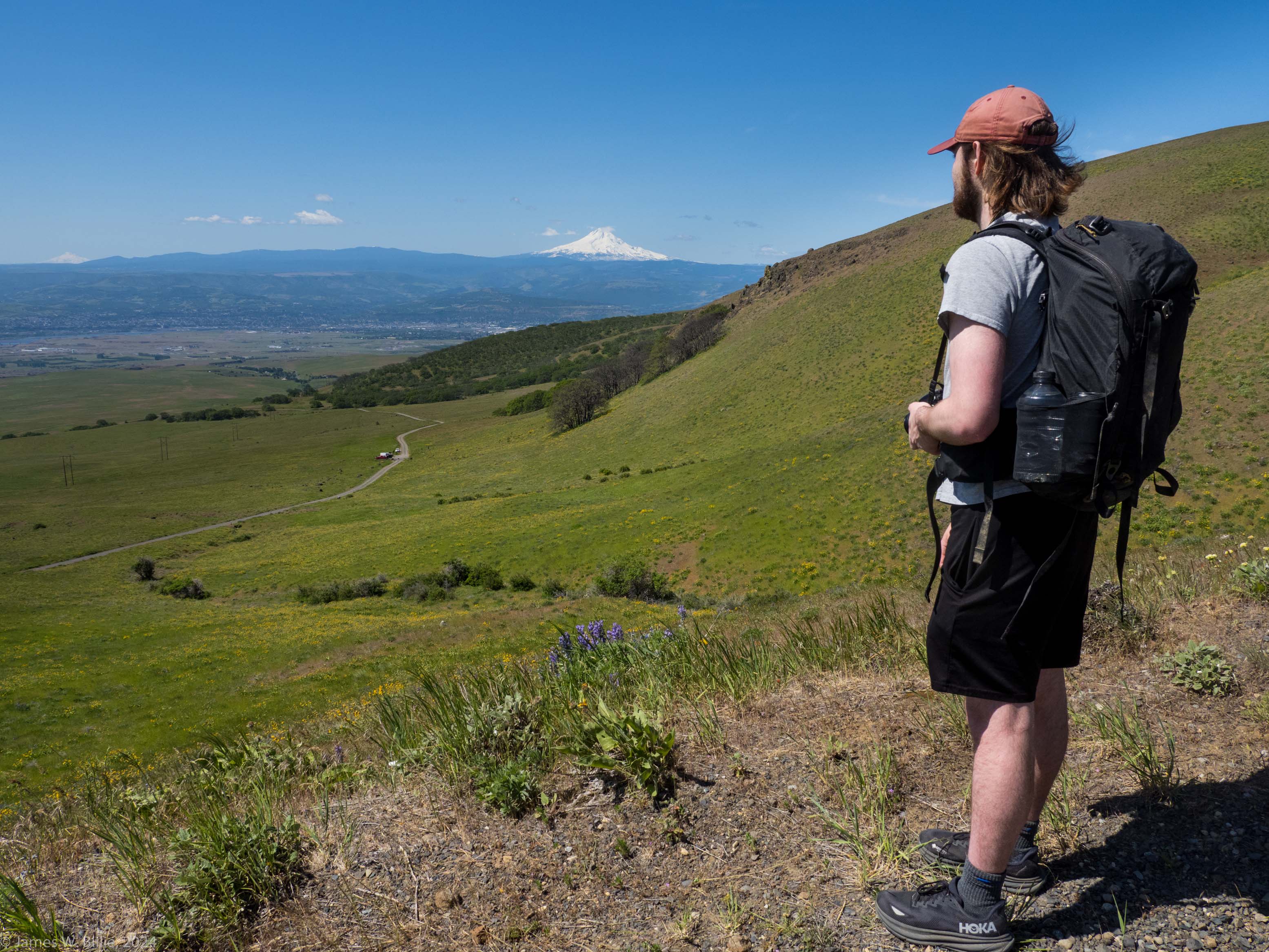
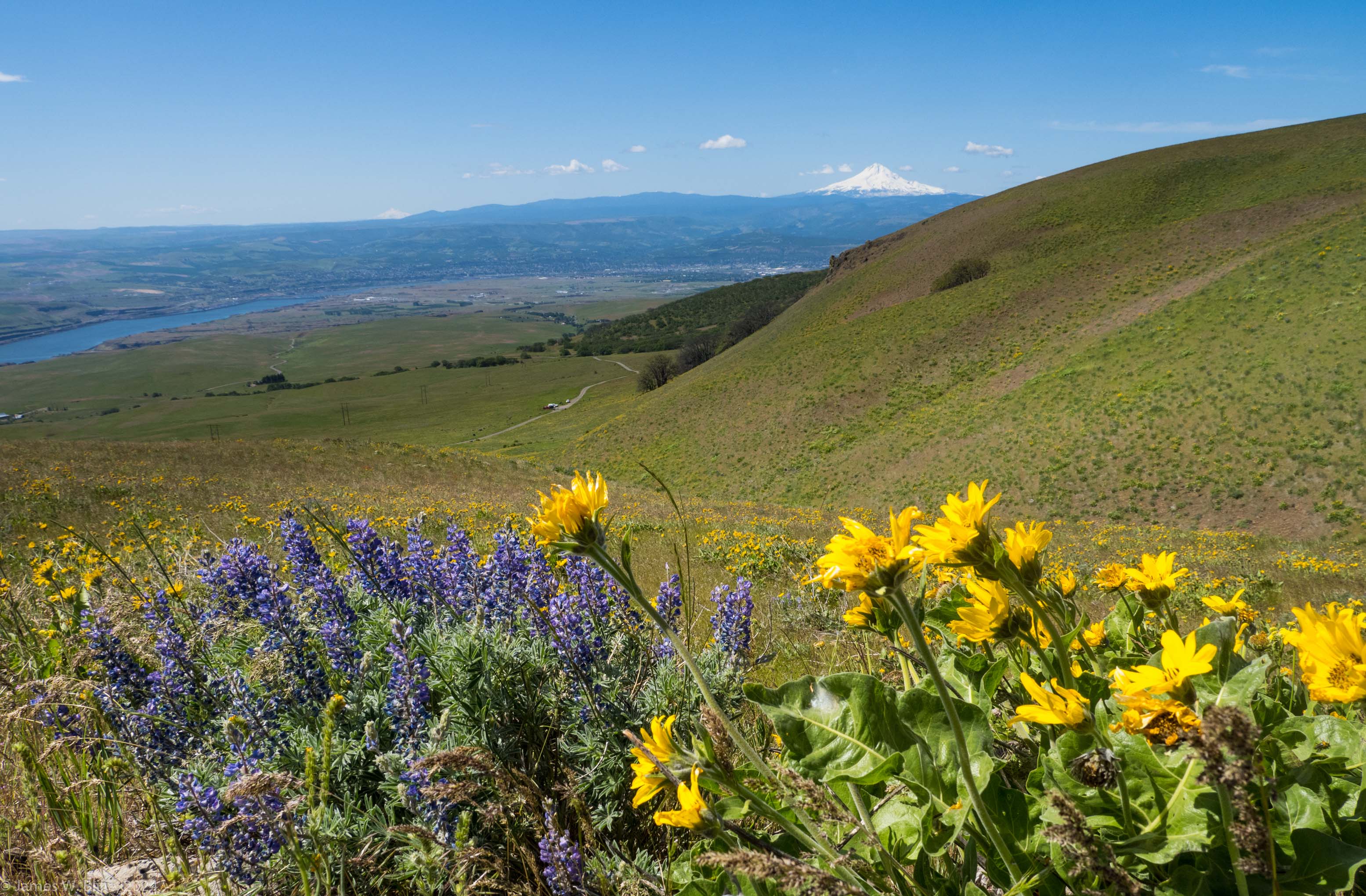
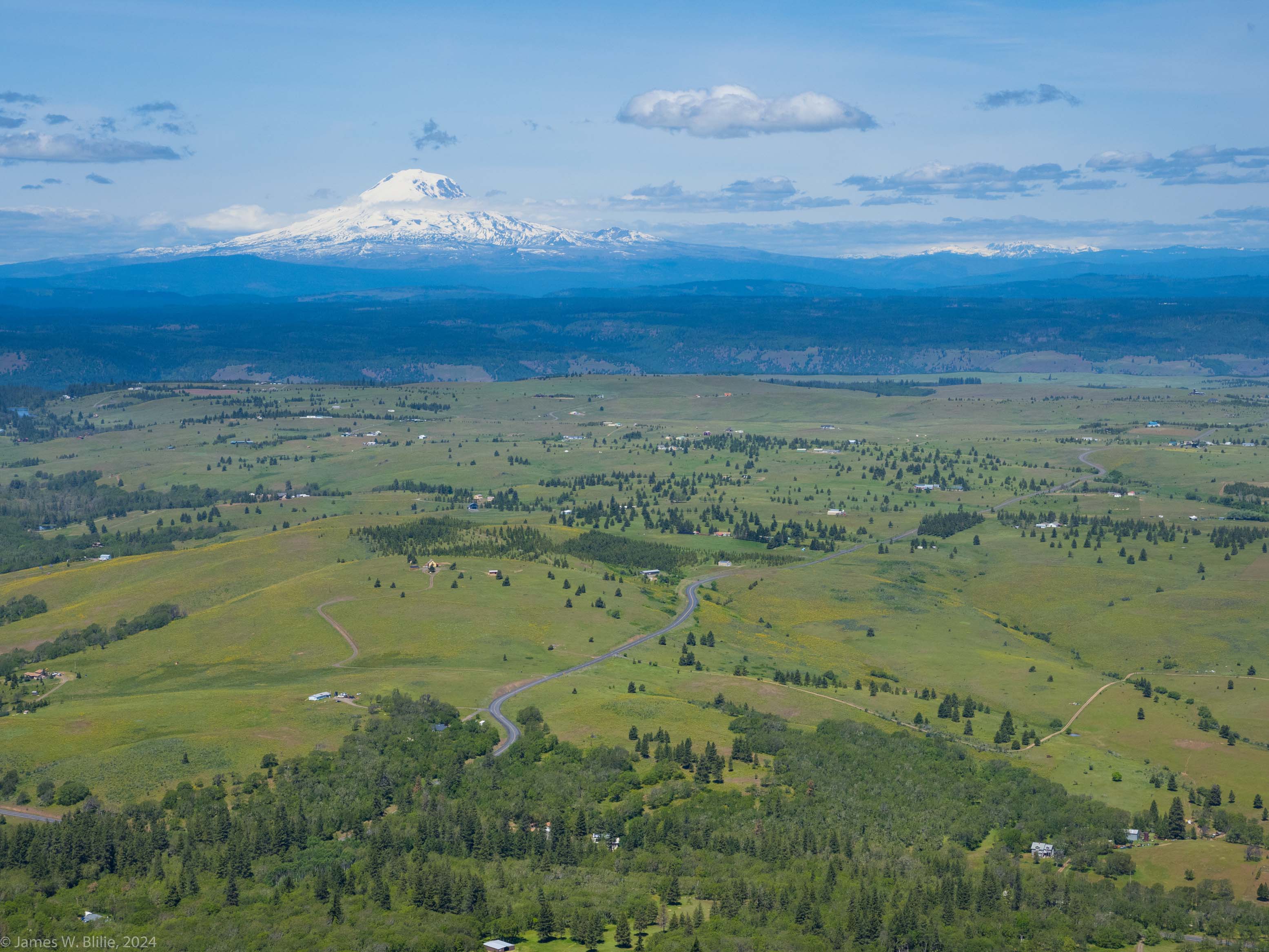
This is a set of photos by me and my son, Jamie, taken on a local hike near The Dalles, Oregon. We had a perfect day and the spring flowers were still in bloom near the top of the hike. Jamie recently completed his first year at WSU in Pullman, Washington and did really well studying mechanical engineering.
First, my photos:
Jamie on the trail:
Mount Hood with lupine (Lupinus spp.) and Balsam Root (Balsamorhiza spp.) in the foreground:
Today we have photos from reader James Blilie, whose captions are indented. You can enlarge the photos by clicking on them.
Spring has sprung in southern Washington state, where we live. All of these are shot in our yard (or from our house).
We have a glorious showing of Empress Lilies Fritillaria imperialis that were (we assume) planted by a previous owner of the property. These flowers give a huge early spring show and then die back to the ground quickly. They smell strongly of skunk (very like skunk cabbage (Symplocarpus foetidus).
As Steve Simon (a photographer whose work I admire) says: Work the scene. And I did. Some of these photos will show some camera technique which I will try to highlight.
A close-up with a telephoto lens and large aperture to blur the background (short depth-of-field; bokeh):
Then two shots showing the effect of lens focal length:
In this shot, I am going for the framing of the scene by the tree trunks and branches and I am including Mount Adams in the background. A telephoto lens helps keep the foreground and background on a similar scale in the photo. A small aperture (f/8) helps keep it all in focus (enough).
Last of the Empress Lily photos is another wide angle shot where I got very low to look up into the bells of the flowers and I got very lucky to capture a sunburst as well (this was not planned; the other 3-4 shots did not have it; luck is your friend)
Next are two shots of Mount Adams at sunset from a few days ago.
Some local wildlife: A flock of wild turkeys (Meleagris gallopavo) with the Tom displaying for the ladies. (These are a little fuzzy and have glare because I shot them through our windows.)
More local wildlife: Early morning visit from our usual gang of Black-tailed Deer (Odocoileus hemionus), a sub-species of the Mule Deer (same binomial).
Olympus OM-D E-M5 (micro 4/3 mirrorless camera; crop factor = 2.0)
LUMIX G X Vario, 12-35MM, f/2.8 ASPH. (24mm-70mm equivalent, my walk-around lens)
LUMIX 35-100mm f/2.8 G Vario (70-200mm equivalent)
LUMIX G Vario 7-14mm f/4.0 ASPH (14-28mm equivalent)
LUMIX G Vario 100-300mm F/4.0-5.6 MEGA O.I.S. (200-600mm equivalent)
I’m not getting any new wildlife photos, and while I have a few in reserve, I implore readers to send me their good photos if they want to keep this site going. Here’s an unusual contribution:
In June my friend Andrew Berry, who teaches at Harvard, took a long trek (several guides are is required, along with pricey permits) to Dolpo and the fabled (and previously off-limits) kingdom of Mustang in northern Nepal. Andrew has converted his 3,000 photos, plus some iPhone videos, into a 53-minute account of the trek, which I’ve put below. It was a fantastic journey.
It’s also a trek I always wanted to make. Sadly, now that Mustang has opened up (though only a few tourists still go), I’m too old to make this arduous trek, though when I hiked around Annapurna I used to stand at the border of the plateau at Jomsom and gaze northwest toward the (then) forbidden kingdom.
Note the dancing starting at 38:45: an authentic folk festival given that Andrew was the only foreigner in town. (It was the monsoon season.)
And if you want to read a brief, illustrated description of the trek, click on the screenshot below. The intro:
June ’23 was pretty open for me — time (yay!) for a visit to Nepal. Problem: the monsoon arrives in Nepal around the middle of June. Hiking through the rain isn’t what I had in mind, and it’s also rather self-defeating if you’re interested in seeing anything — the views are mainly, in the monsoon, banks of grey cloud. But there are parts of Nepal, contra the long-ago Heineken ad, that the monsoon doesn’t reach, namely regions the North of the main range, in the rain shadow of the big peaks. These transhimalayan regions are politically in Nepal, but are functionally — geographically, linguistically, and culturally — Tibetan. Hence my trip to Dolpa/Dolpo and Mustang. Remote country, and regions I’ve long wanted to visit [the first time I became aware of these areas was 41 years ago, during my first visit to Nepal. I hiked back then to the boundaries of both Dolpa and Mustang, and stared, tantalized, into both. They were however in those days off limits — foreigners prohibited (partly because of the proximity of the Chinese/TIbetan border). That’s however changed: these days the Nepalese Govt both restricts access and makes money by charging top dollar for permits]. The virtue of the expense (permits) + low season + remoteness is that these areas are relatively unfrequented by foreigners like me. In three weeks in the region this summer, I didn’t encounter a single non-Nepali.
I am of course wildly jealous. If you want to see all of Andrew’s photos, go here. Here’s just one of many:
Since it’s Sunday, we have a batch of themed bird photos from John Avise. John’s commentary and IDs are indented, and you can enlarge the photos by clicking on them.
More Birds of a Feather Flocking Together
Two weeks ago I posted avian flocks with odd numbers of individuals, so this week it should not surprise you that a follow-up theme is various avian flocks with even numbers of birds. The Snow Geese were photographed in Montana; all others in Southern California.