Readers’ wildlife photos

March 19, 2026 • 8:15 am

Today we have part 2 of Ephraim Heller’s photos of arachnids taken on a recent trip to Trinidad and Tobago (part 1 is here). Ephraim’s captions and IDs are indented, and you can enlarge the photos by clicking on them.

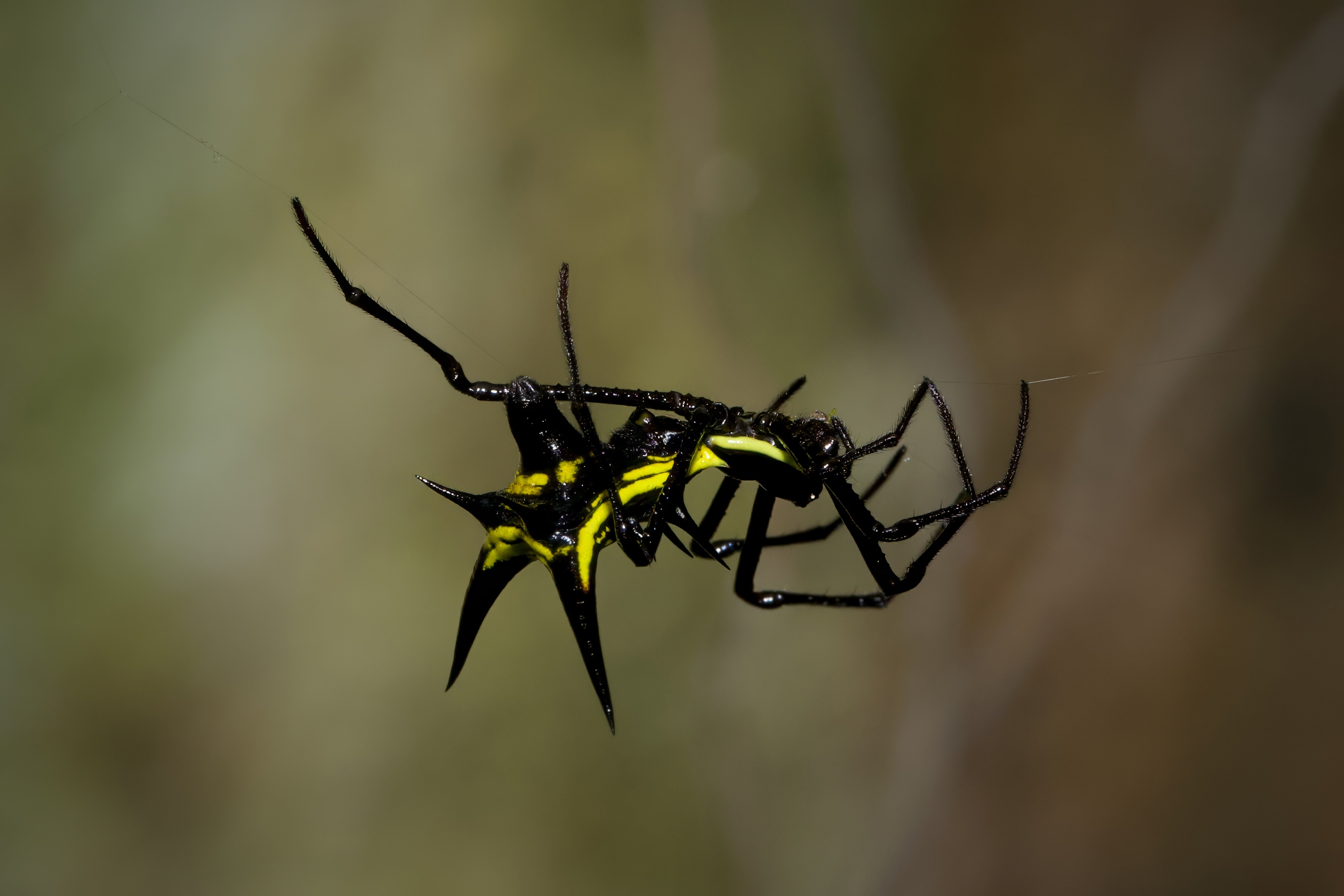
Spiny orb-weavers (genus Micrathena) include over 119 species. What immediately distinguishes micrathena from other orb weavers is the bizarre armature of the female’s abdomen: an array of hardened spines and conical tubercles that give these small spiders an alien appearance. These spines have evolved independently at least eight times within the genus and likely function as anti-predator defenses, making the spider difficult or unpleasant to swallow.
The tropical orb weaver (Eriophora ravilla) is a large, nocturnal species. What makes eriophora ravilla distinctive among orb weavers is its strictly nocturnal web-building behavior. Each evening after dark, the spider constructs an enormous orb web with a main support thread that can stretch over 18 feet, then tears down the entire interior webbing before dawn. During the day, the spider hides in a rolled leaf bound with silk, invisible to casual observers. I was attracted by the shape and coloration of these spiders:


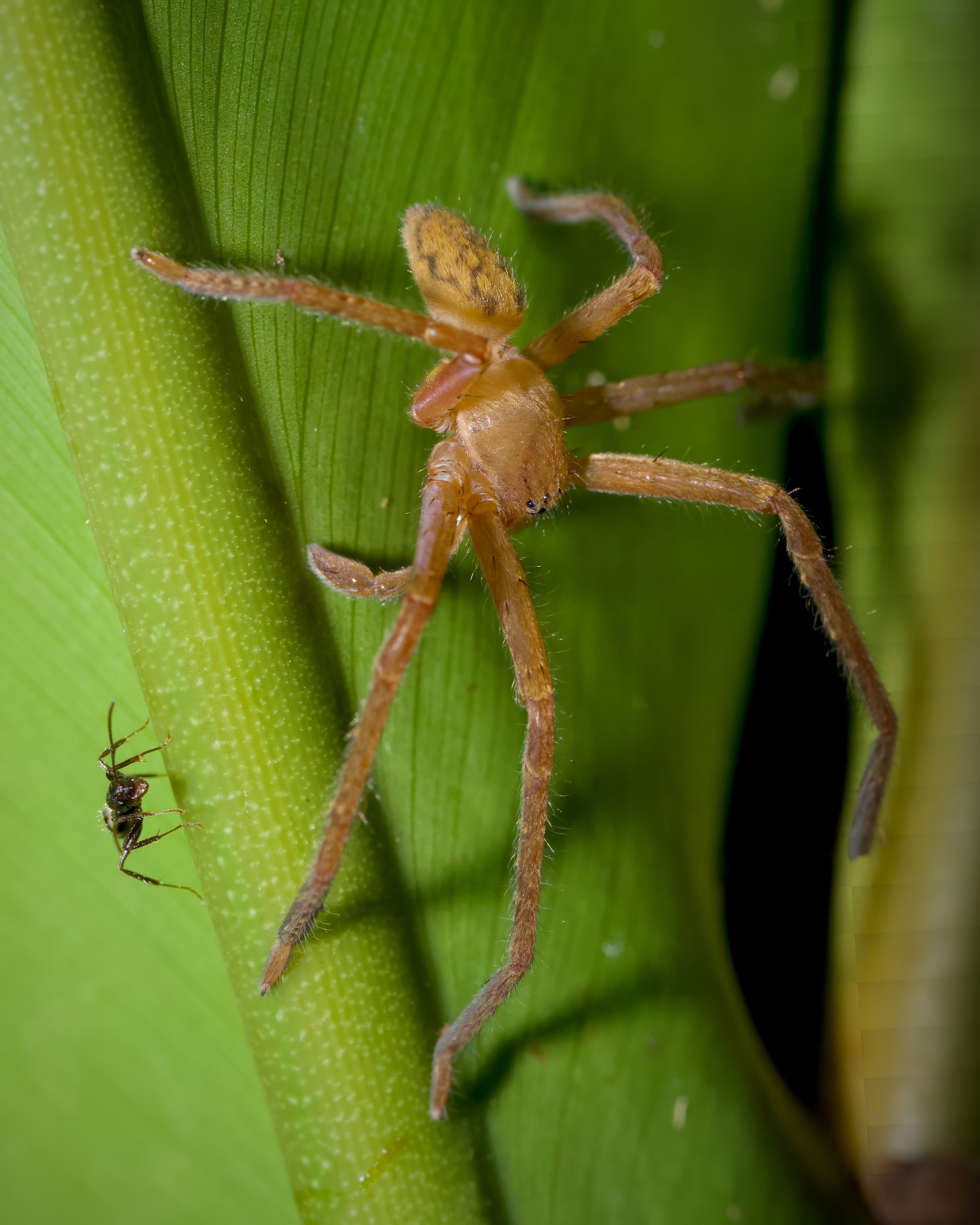
The genus Meri belongs to the family Sparassidae, the huntsman spiders. Huntsman spiders are characterized by their laterally extending, crab-like legs, rapid movement, and hunting lifestyle. They do not build webs. Instead, they actively pursue and overpower prey, relying on speed and ambush tactics. Sparassids are among the fastest-running spiders. Though their venom can cause local swelling, pain, or nausea in humans, huntsman bites are rarely medically significant. This handsome individual is perhaps Meri trinitatis:

Switching from spiders to their distant arachnid cousins, the harvestmen (order Opliones), the key differences are:

– Body plan. Spiders have two distinct body segments: a cephalothorax (prosoma) and an abdomen (opisthosoma), joined by a narrow waist called the pedicel. Harvestmen have a fused body in which the cephalothorax and abdomen are broadly joined, giving them a single, compact oval shape.

– Eyes. Most spiders possess six to eight eyes arranged in species-specific patterns. Harvestmen typically have just two eyes, often mounted on a raised turret (ocularium) atop the body.

– Venom and fangs. Spiders possess venom glands connected to their cheliceral fangs, which they use to subdue prey. Harvestmen lack venom glands entirely: they are completely harmless to humans.

– Silk. All spiders produce silk from spinnerets, whether they build webs or not. Harvestmen cannot produce silk at all.

– Respiration. Spiders breathe through book lungs and/or tracheae. Harvestmen breathe exclusively through tracheae, with spiracles located near the base of the fourth pair of legs.

– Reproduction. Male spiders transfer sperm indirectly via modified pedipalps. Male harvestmen possess a true penis and transfer sperm directly, a rarity among arachnids.

– Defense. When threatened, many harvestmen secrete noxious chemicals from specialized scent glands (ozopores) on the prosoma, producing a distinctive acrid odor. Spiders rely on venom, retreat, or urticating hairs (in tarantulas) for defense.

The harvestmen I photographed belong to the genus Phareicranaus in the family Cranaidae. Cranaids are stout, heavily armored harvestmen, very different in appearance from the daddy longlegs familiar to North Americans. I believe these are Phareicranaus calcariferus:

What makes this species notable for a harvestman is its parental care behavior. Field observations in Trinidad documented both maternal and possibly biparental care of young, a rare finding. Adult females were observed guarding clusters of nymphs, and in some cases, both a female and a male were present with young. This kind of prolonged parental investment is unusual among arachnids and speaks to the selective pressures – particularly predation by ants and fungal infection of eggs – that have driven the evolution of parental care in Neotropical harvestmen.

Finally, an unidentified harvestman:

Note: all of these photos were taken using a Nikon Z8 or Z9 camera, a NIKKOR Z MC 105mm ƒ2.8 VR S macro lens, and a Nikon SB-5000 Speedlight flash.

Readers’ wildlife photos

December 27, 2024 • 8:15 am

Send ’em in, folks! I’m running a bit low. . .

Today’s photos come from Mayaan Levy, whose captions and IDs are indented, and you can enlarge the photos by clicking on them.

Pacific crest trail animals

All photos were taken by my husband Micah on his Pacific crest trail (PCT) thru-hike last summer. Thru-hiking means having a continuous footpath, and hiking the trail in one go, and he had dreamt of achieving this impressive feat for about 12 years. This was his third attempt – the first was cut short due to work constraints and the second due to knee injury. But third time’s the charm – he walked from Mexico to Canada. Here you can read more about the PCT for those of you who are interested: https://www.pcta.org/

This will probably be a first batch out of three: animals, plants and views from the PCT. All photos were taken with a pixel 7 smartphone. Several quick notes before we begin:

The trail is not only for 20-somethings, and Micah noted how many people in their 50s and 60s he met along the way and how fit and fast they were. Just sayin’ – if that’s your dream – go for it!

I did the species identification and some might be wrong – please contribute the correct ID if you know it.Captions and text are written by me but are paraphrased from Micah’s stories about the trail.

The desert

Looks barren, but is full of life. The air is clear and crisp at sunrise then turns dusty and hazy with some warm winds from the east and the day’s heat. At sunset, reds and pinks give way to deep purple as hikers go to sleep at a billion-star hotel.

Sun spider of some type (order Solifugae) – it’s not a scorpion! And also not a spider! To the best of my understanding they don’t have any venom.

Pacific gopher snake (Pituophis catenifer):

Long-nosed leopard lizard (Gambelia wislizenii):

The Sierra Nevada

The mountains high in thin air, snow all around, gushing rivers and pine trees galore! The Sierras are considered the most difficult section of the PCT and also probably the most beautiful. I did the section too with Micah on his second attempt, including summiting Mt. Whitney on the summer solstice.

abiete coni figmentum imaginationis – some hikers having fun (and me getting to practice my Latin).

Sagebrush chekerspot (Chlosyne acastus):

Yellow-bellied marmot (Marmota flaviventer) – marmots are hilarious. They tend to not be scared of people, and instead will try to get into your bag and steal your food. Sometimes they also like to pose for photos, and sometimes they tan on the rocks looking stoned:

Speaking of food thieves, in the Sierra hikers are required to carry bear canisters, which you can imagine as a bucket-size child (bear)-proof pill bottles. Information boards for hikers in Yosemite national park read: “if you have too much food and not all of it fits in the canister, stop! Sit and eat! Then try again.” In northern California most hikers ship their heavy bear canister back home. However, bears are clever animals and they have learned that food can be had at this location. Micah has set up his tent about 10 miles after shipping out his canister, only to have a bear circle his tent all night.

Another food thief, and the most dexterous one (I’ve seen them open zippers): the common raccoon (Procyon lotor), aka trash panda. They like to hang out around campgrounds, steal food and then act all innocent and go wash their hands:

Yes, there’s a lot of talk about food on trail – it’s probably the number one conversation topic.

Oregon and Washington

Yay Volcanos! The cascade range is magical in its deep, dark colors. And despite last year being extremely dry, you can tell that this environment is water-rich.

Cascades frog (Rana cascadae) – I think their skin is somewhat toxic to the touch, but I might be wrong:

This is a “find the animal” photo – there are actually two mammals here, sharing a habitat in the fog that’s so frequent in Washington’s mountains:

Pika (family Ochotonidea) – and the cutest animal on the PCT award goes to the pikas. They chirp (not sure that’s the right descriptor for their calls) saying “pet me!”, “adopt me!”. Unlike marmots which hibernate for the majority of the year, pikas run around in their rocky castles and continue to be cute throughout the winter:

Spruce grouse (Canachites Canadensis) spotted less than 10 miles from Canada:

Homo sapiens (I’m sure about this ID) – this is me in the photo. I joined Micah for Washington (Bridge of the Gods to the US-Canada border):

Readers’ wildlife photos

November 21, 2024 • 8:15 am

Regular contributor Mark Sturtevant has once again sent us a batch of lovely insect photos, including some arachnids and one mammal). Mark’s captions and IDs are indented, and you can enlarge his photos by clicking on them.

The first part of this set are photographs from the gardens around my house, and then we move out to area parks. I live in eastern Michigan.

The lovely beetle shown in the first picture is a Lily Leaf Beetle (Lilioceris lilii). These become common on the lilies that the wife likes to grow, and they are a minor pest on them as they riddle the plants with holes. I had never seen the larvae, but while preparing this post I had learned that they hide under the leaves and I simply never looked there. The larvae are disgusting, as they cover themselves with their droppings as a deterrent. I should definitely photograph some next season!:

Next up is another example of Say’s Mantidfly (Dicromantispa sayi). In my last post I had shown a female, and this is a smaller male. This species of Mantidfly grows up by living and feeding inside the egg sacs of spiders, and there are always jumping spiders on our shed and that is where I find Mantidflies:

Back in the garden there is always drama of one kind or another. I was very elated one day to find a Cuckoo wasp foraging at the daisies, as shown in the next picture. I won’t be able to identify the species without careful inspection, but these beautiful wasps are usually challenging to photograph since they are normally very alert and active. I simply got lucky here. Cuckoo wasps are so-named because they are kleptoparasites in the nests of wasps or bees. Besides feeding on the provisions meant for the larvae of their hosts, they also eat the host eggs or larvae as well:

Predators commonly stay among the daisies in the garden, including the crab spiders shown in the next two pictures. I believe these are Misumenoides formosipes, based on the ridge that I could see just underneath the frontal eyes. The second picture shows one that has taken a Green Bottle Fly, Lucilia sericata:

Next are pictures taken from local parks. Here is one of our larger species of skipper butterfly, the Indigo DuskywingErynnis baptisiae. One can generally recognize skippers since they are usually moth-like butterflies, and they have distinctly hooked-shaped clubs on their antennae. In my younger years it was believed that skippers were a separate group from butterflies, but now they are found to be within the latter. And while we are at it, butterflies are now understood to be descended from moths, but let’s move on:

The remaining pictures were all taken on one day at a flower-filled and very productive meadow near where I work. There are more pictures from that park from this day, but those will have to wait for later.

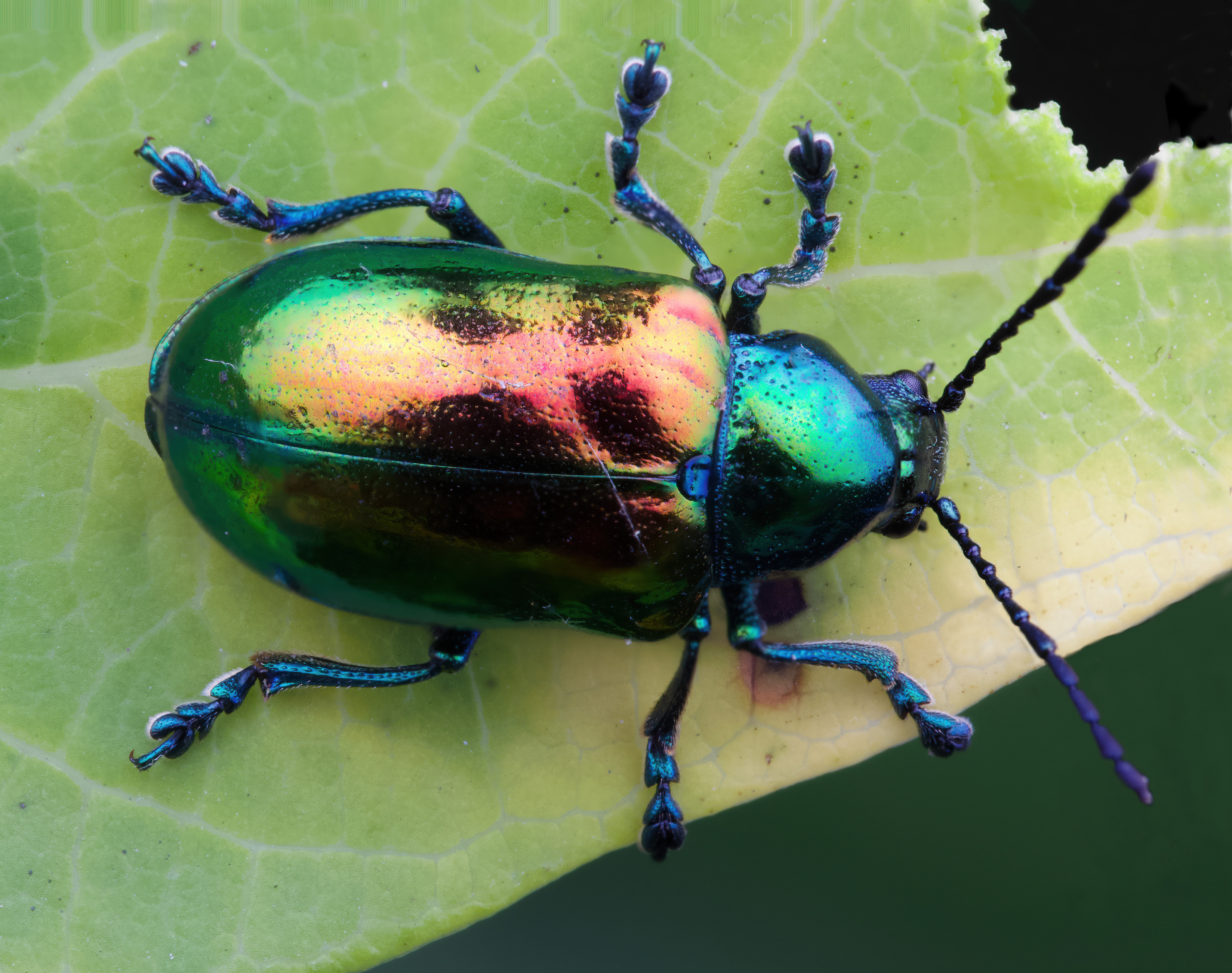
First up is this extremely metallic Dogbane Beetle (Chrysochus auratus). These are vegetarian on a narrow range of host plants, including Dogbane, which makes the insects toxic:

The beetle shown in the next picture had me stumped for a while, but the distinctly “flabellate” antennae and an old field guide helped me to narrow it down. This is a kind of Wedge-shaped beetle, Macrosiagon limbata, and that surprised me since it does not resemble the one species that I know from this obscure family. This one is a male, identified by its antennae. Females will lay eggs on flowers, and the active larvae that hatch will clamber onto a passing bee to be taken back to the nest. There they will consume the larvae in the nest:

Many Bergamot flowers were in the field, and they were well tended by many of these clear-winged sphinx moths (Hemaris sp), and you can see tthat it is a bumble bee mimic:

The final insect-related pictures show why I spend much time carefully looking under leaves. I will likely never learn the species names of these insects, however. The white mass on the right is a bundle of cocoons from the Braconidae family of wasps, which are small wasps that are parasitoids inside the bodies of caterpillars. The term “parasitoid” is preferred here, rather than parasite, since the insects live inside the bodies of their hosts – parasite-like – but they quite deliberately and slowly kill their host, while parasites aren’t supposed to do that on purpose. The eviscerated caterpillar has fallen away, unfortunately, but while it was there it would be laying across the cocoons, still barely alive for a time, and actively “protecting” the cocoons in a strange example of how a hosts’ behavior is changed by parasitoid wasps. I have seen this many times, and you can see it as well in this very entertaining Ze Frank video that Jerry posted recently.

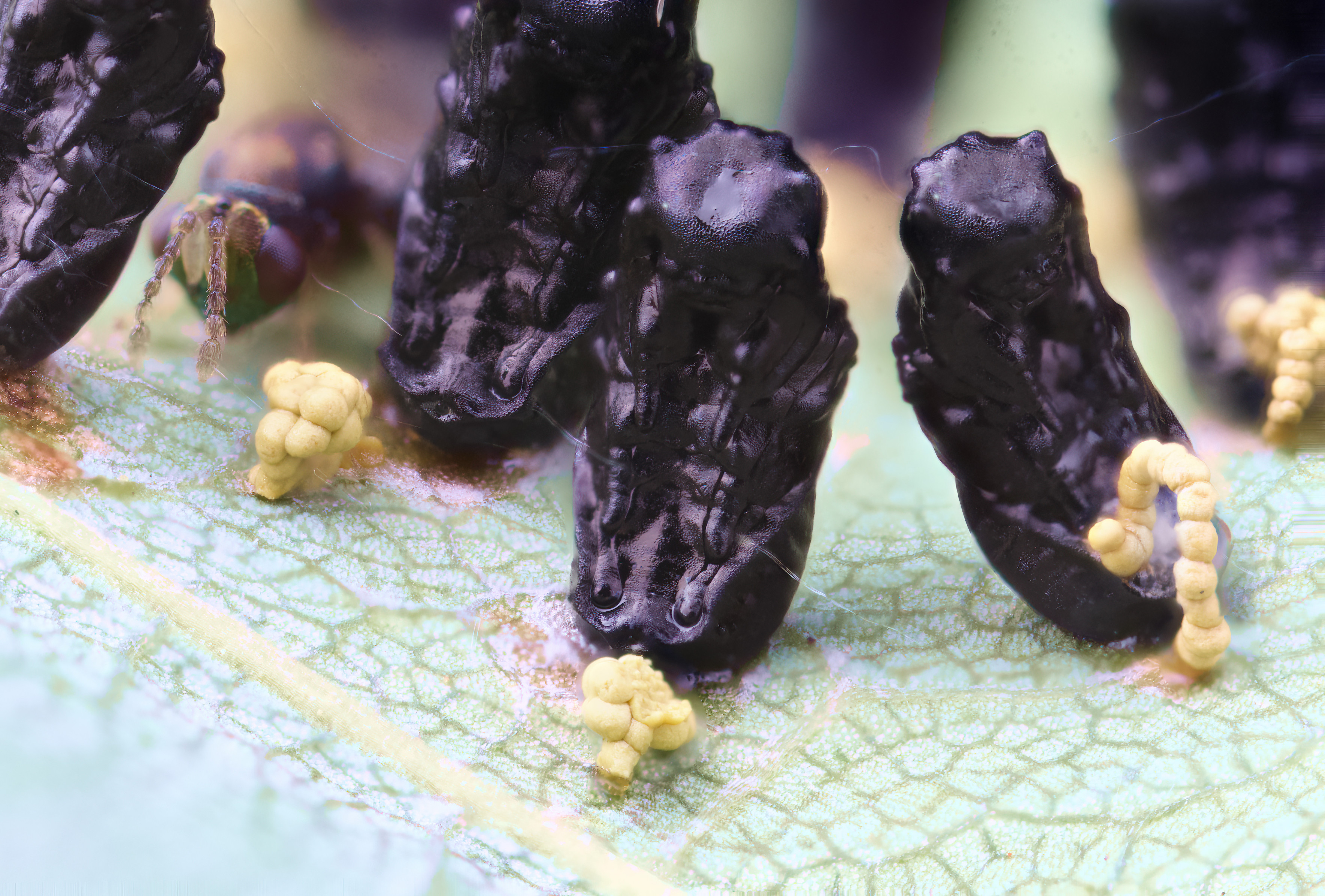
But that isn’t all. What are those black thingies to the left? Well, those are the pupae of a kind of hyperparasitic wasp – very small wasps that are parasitoids of the parasitoids. I had seen these mini-tombstones of pupae many times on plants, but this is the first time that I had enough context to understand the bigger picture about them. If you look carefully you will see an adult wasp among the pupae – a detail that I did not see at the time. Based on some findings in BugGuide, I suggest that this second group is from the Eulophidae family, as shown in the linked picture:

Next is a close-up of the Eulophid pupae. This required the Raynox 250 diopter lens to boost the power of the macro lens. The yellow stuff next to the pupae is called meconium, and they are the gut contents of the hyperparasitoid larvae. When a larva pupates, it will first purge its gut contents:

When I excitedly showed this amazing story to the wife, she was quite horrified.

After a pleasant and very productive afternoon spent in the flower-filled meadow, I noticed that I was being watched by a curious onlooker:

Readers’ wildlife photos

November 19, 2024 • 8:15 am

We have two batches left (including today’s), so please send in your wildlife photos.

Today’s photos of archnids come from Dean Graetz of Australia, whose IDs and notes are indented. You can enlarge the photos by clicking on them.

Backyard Spiders

Here in Canberra, we grow Australian native desert flowers in our backyard for their colour and insect attraction.  As a consequence, we also attract an array of spiders interested in trapping any visiting insects.  We find all spiders naturally interesting.  They have a 200-million-year fossil record and are a very successful lifeform with about 36,000 species, of which about 2,900 are found in Australia.  We wish to share them with you, such as this specimen.  Undoubtedly a female, she is intriguingly patterned and laying out a very sparse web.

A much larger example of these Flower or Crab spiders with legs folded ready to seize any visiting insect.  Her back pattern is very similar to that of the spider in the first image.  The ragged covering of hairs or spines make is difficult to immediately separate the spider body from the flower.

Leaf-curling Spiders  (Phonognatha graeffei) select a suitable leaf from the ground and, using silk, curl it to form a protective cylinder, silked shut at the top and open at the bottom.  They then live in this protective cylinder with only their legs showing, feeling for the vibrations of a captured insect.  As much as we try, we have never seen this construction happening live.

A distinct species of Flower-type spider, away from our backyard, industriously repairing her web after trapping and ingesting the innards of a wasp-type insect.  Its desiccated remains will be eventually cut loose and discarded.

A demanding situation to interpret.  Barely visible at the bottom of the cluster is a bee abdomen.  Swarming all over it are very young spiders that are suspiciously similar to the presiding web-owning female.  We did not witness the bee capture or the arrival of the young spiders.  So, which event came first?  Intriguing!

Another puzzling situation.  An unusually large amount of silk was used to wrap the butterfly, whose abdomen shape suggests its contents have not yet been liquified and extracted.  The view is of the spider’s underside where a curious spherical body is visible.  A parasitic tick?

An unknown species resting at the centre of her unfinished web.  The visible haloes of dots surrounding her are the small sticky deposits she has symmetrically spaced to eventually hold the long cross-lengths of silk, the last task of web construction.  Fascinating and thought-provoking.

The next two photos are borrowed and are not of our backyard, though we do occasionally find this famous spider here.  It is a large female Redback spider, guarding her near-perfect spherical egg sacs.  This species (Latrodectus hasselti) is well known in Australian popular culture.  It is seriously venomous, agonisingly painful, but apparently not lethal since the development of an antivenom.  It is well-known because, in rural settings, people have had their buttocks bitten while using an outdoor toilet (aka Outhouse) and they have never forgotten the occasion.

As well as regarded as serious threats to people, Redbacks are widely recognised as tough and effective predators.  Their silk is outstandingly strong, here trapping a struggling lizard, and their silk plus venom has been photographed killing small snakes.  Being tough and very effective are characteristics Australians respect. Consequently, many sporting teams use the name Redback because of their uniform colour and to imply their toughness and effectiveness.

So it is no surprise that when an Australian boot company wants to promote its tough and effective work boots, it uses the brand name Redback.  These boots are really ‘bloody good’ boots.  I have two pairs.

Readers’ wildlife photos

August 6, 2019 • 7:45 am

My photo tank is about half full, which means that I’ll importune you once again to send in your good wildlife photos.

Today’s contribution comes from Mark Sturtevant, crack arthropod photographer. His notes are indented:

The small moths in the first two pictures at first seemed too plain to bother with photographing, but they turned out rather interesting. The first is a tiger moth in the genus Virbia (I can’t get the species), followed by a Geometrid called Dyspteris abortivaria. I really like the delicate textures on the latter, since it looks like a piece of old parchment. Lepidopterists call it the ‘bad wing’ because it is difficult to spread its wings.

I was very happy to get the lovely moth shown in the third picture. This is the eight-spotted forester moth (Alypia octomaculata). They are usually challenging to approach, but this one was content to just sit with me while I took a large number of pictures. I shoot in full manual, and have never really picked up on metering with the camera. So getting the whites to not blow out while getting details in the back areas was tough!

The next picture is the caterpillar of the eight-spotted forester.

The little wolf spider shown in the next picture is a male in the genus Schizocosa. Note the fancy “leggings” on its front legs. This spider will likely use these in a display dance before a possibly cannibalistic female. I found a clip of such a dance here.

Next is a little but unidentified leafhopper nymph. This high-magnification picture was taken with a home made ‘super macro’ lens, consisting of a stock 50mm lens reverse mounted onto a helical extension tube.

I frequently see the very small but colorful wasp shown in the next picture. This is a cuckoo wasp, and they are parasitic on solitary bees and wasps. This one is possibly Chrysis angolensis. Cuckoo wasps are always hyperactive and very alert, but this one was content to just sit for pictures. The included link is to an article about the interesting biology of these little jewels.

One can count on finding large expanses of skunk cabbages in low-lying areas of forests. This is a favored hunting ground for our smaller species of bee-like robber fly shown in the last two pictures. I think these are in the Laphria sericea complex of species. Prowling around through the aptly named skunk cabbages is not entirely pleasant. Oy! The smell!

A lovely spider story

May 2, 2018 • 2:30 pm

On April 29 I put up a brief note about the world’s oldest known spider, who recently died in Australia at the age of 43. But that didn’t convey the affection that we scientists often feel for our research subjects, even if they’re spiders. And so the Washington Post has published a lovely article by Avi Selk, who drew “largely from research conducted by Barbara Main and Leanda Mason, who knew [the spider] best over nearly half a century.”

Read it—it won’t take long—and see if, even among the arachnophobe readers—you don’t feel a pang of loss at the poignantly described death of this aged trapdoor spider, known only as Number 16.

Her burrow and her trapdoor (photos by Landa Mason):

h/t: Grania

World’s oldest known spider dies at 43; scientists disconsolate

April 29, 2018 • 12:15 pm

This headline tells you how many of us feel about our research subjects (see also here):

The spider, a trapdoor spider (Gaius villosus), was not a coddled lab animal, but a real arachnid in the wild—in western Australia. Affectionately known as “Number 16”, she had been studied since 1974, presumably as a toddler, and was recently found dead. Her longevity beats the previous record—that of a Mexican tarantula—by a full 15 years. And the senior author of the study (see below) is of a venerable age herself.

From the Torygraph (my emphasis):

The arachnid is believed to have survived for so long by sticking to one protected burrow its entire life and expending the minimum of energy.

. . . Published the Pacific Conservation Biology Journal, the research is the life’s work of Barbara York Main, now 88, who first set eyes on Number 16 shortly after its birth.

. . . While trapdoor spiders are poisonous, it is the males, who leave their burrows to find a mate, which are usually encountered by humans.

A typical danger in Australia is homeowners finding what they believe to be dead spiders in their swimming pools, which can then rear up and attack when removed.

The trapdoor species typically take five to seven years to mature and will then invest their energies in a single burrow, with the females rarely venturing more than a few metres away from their place of birth.

Ms Mason said of the Number 16’s death: “We’re really miserable about it.

“We were hoping she could have made it to 50 years old.”

As far as I know (I used to keep tarantulas), females generally live longer than males, and not just because some of the males get nommed after mating.

The Curtin University publicity release is more science-y:

Lead author PhD student Leanda Mason from the School of Molecular and Life Sciences at Curtin University said the ongoing research has led to new discoveries about the longevity of the trapdoor spider.

“To our knowledge this is the oldest spider ever recorded, and her significant life has allowed us to further investigate the trapdoor spider’s behaviour and population dynamics,” Ms Mason said.

“The research project was first initiated by Barbara York Main in 1974, who monitored the long-term spider population for over 42 years in the Central Wheatbelt region of Western Australia.

Here’s the paper’s abstract from the Pacific Conservation Biology Journal (click on screenshot). Our library doesn’t carry this, journal and you’ll have to pay $25 (U.S.) to see the article, but I think you have the relevant data: