
Regular contributor Mark Sturtevant has once again sent us a batch of lovely insect photos, including some arachnids and one mammal). Mark’s captions and IDs are indented, and you can enlarge his photos by clicking on them.
The first part of this set are photographs from the gardens around my house, and then we move out to area parks. I live in eastern Michigan.
The lovely beetle shown in the first picture is a Lily Leaf Beetle (Lilioceris lilii). These become common on the lilies that the wife likes to grow, and they are a minor pest on them as they riddle the plants with holes. I had never seen the larvae, but while preparing this post I had learned that they hide under the leaves and I simply never looked there. The larvae are disgusting, as they cover themselves with their droppings as a deterrent. I should definitely photograph some next season!:

Next up is another example of Say’s Mantidfly (Dicromantispa sayi). In my last post I had shown a female, and this is a smaller male. This species of Mantidfly grows up by living and feeding inside the egg sacs of spiders, and there are always jumping spiders on our shed and that is where I find Mantidflies:


Back in the garden there is always drama of one kind or another. I was very elated one day to find a Cuckoo wasp foraging at the daisies, as shown in the next picture. I won’t be able to identify the species without careful inspection, but these beautiful wasps are usually challenging to photograph since they are normally very alert and active. I simply got lucky here. Cuckoo wasps are so-named because they are kleptoparasites in the nests of wasps or bees. Besides feeding on the provisions meant for the larvae of their hosts, they also eat the host eggs or larvae as well:

Predators commonly stay among the daisies in the garden, including the crab spiders shown in the next two pictures. I believe these are Misumenoides formosipes, based on the ridge that I could see just underneath the frontal eyes. The second picture shows one that has taken a Green Bottle Fly, Lucilia sericata:


Next are pictures taken from local parks. Here is one of our larger species of skipper butterfly, the Indigo Duskywing, Erynnis baptisiae. One can generally recognize skippers since they are usually moth-like butterflies, and they have distinctly hooked-shaped clubs on their antennae. In my younger years it was believed that skippers were a separate group from butterflies, but now they are found to be within the latter. And while we are at it, butterflies are now understood to be descended from moths, but let’s move on:

The remaining pictures were all taken on one day at a flower-filled and very productive meadow near where I work. There are more pictures from that park from this day, but those will have to wait for later.
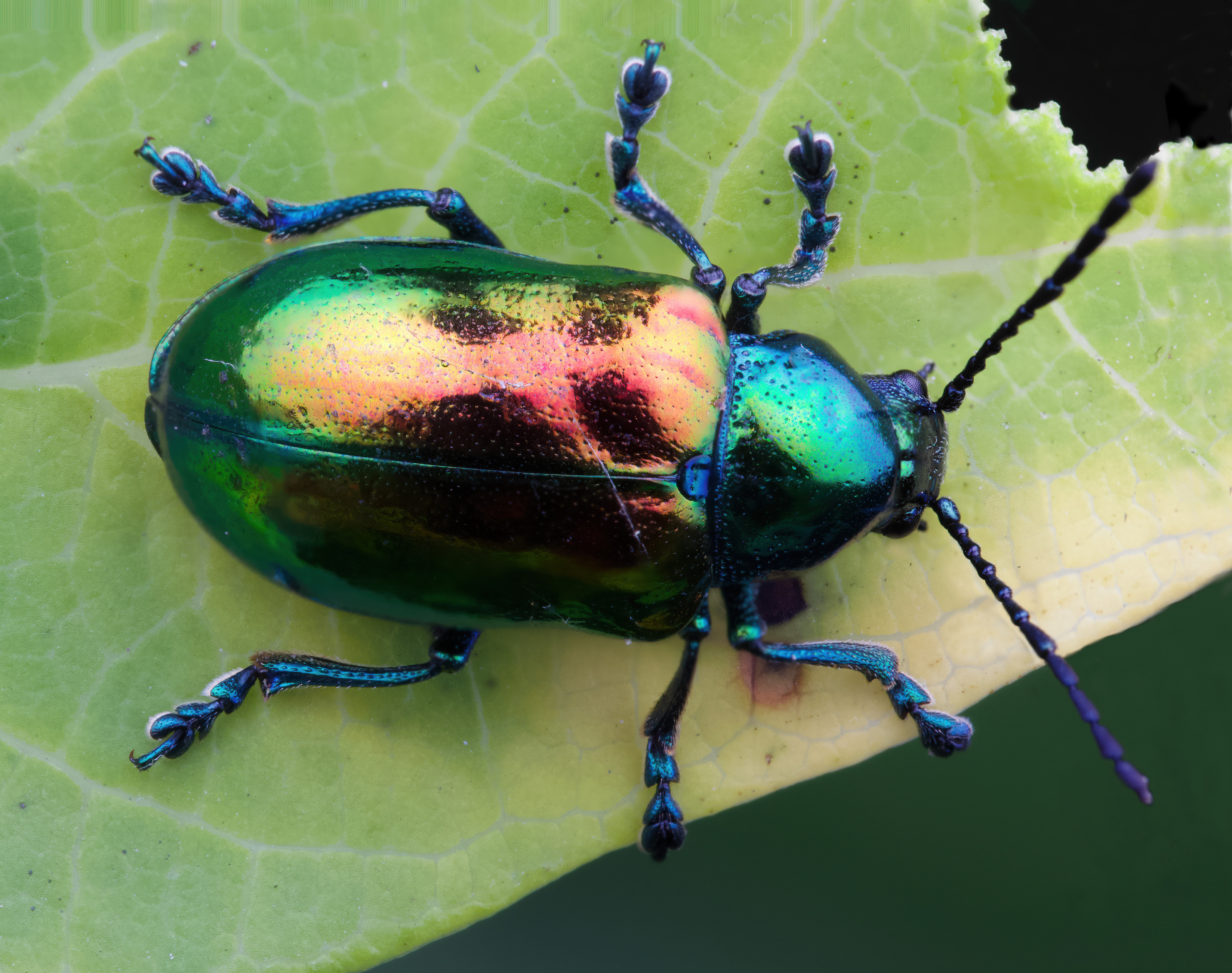
First up is this extremely metallic Dogbane Beetle (Chrysochus auratus). These are vegetarian on a narrow range of host plants, including Dogbane, which makes the insects toxic:
The beetle shown in the next picture had me stumped for a while, but the distinctly “flabellate” antennae and an old field guide helped me to narrow it down. This is a kind of Wedge-shaped beetle, Macrosiagon limbata, and that surprised me since it does not resemble the one species that I know from this obscure family. This one is a male, identified by its antennae. Females will lay eggs on flowers, and the active larvae that hatch will clamber onto a passing bee to be taken back to the nest. There they will consume the larvae in the nest:

Many Bergamot flowers were in the field, and they were well tended by many of these clear-winged sphinx moths (Hemaris sp), and you can see tthat it is a bumble bee mimic:

The final insect-related pictures show why I spend much time carefully looking under leaves. I will likely never learn the species names of these insects, however. The white mass on the right is a bundle of cocoons from the Braconidae family of wasps, which are small wasps that are parasitoids inside the bodies of caterpillars. The term “parasitoid” is preferred here, rather than parasite, since the insects live inside the bodies of their hosts – parasite-like – but they quite deliberately and slowly kill their host, while parasites aren’t supposed to do that on purpose. The eviscerated caterpillar has fallen away, unfortunately, but while it was there it would be laying across the cocoons, still barely alive for a time, and actively “protecting” the cocoons in a strange example of how a hosts’ behavior is changed by parasitoid wasps. I have seen this many times, and you can see it as well in this very entertaining Ze Frank video that Jerry posted recently.
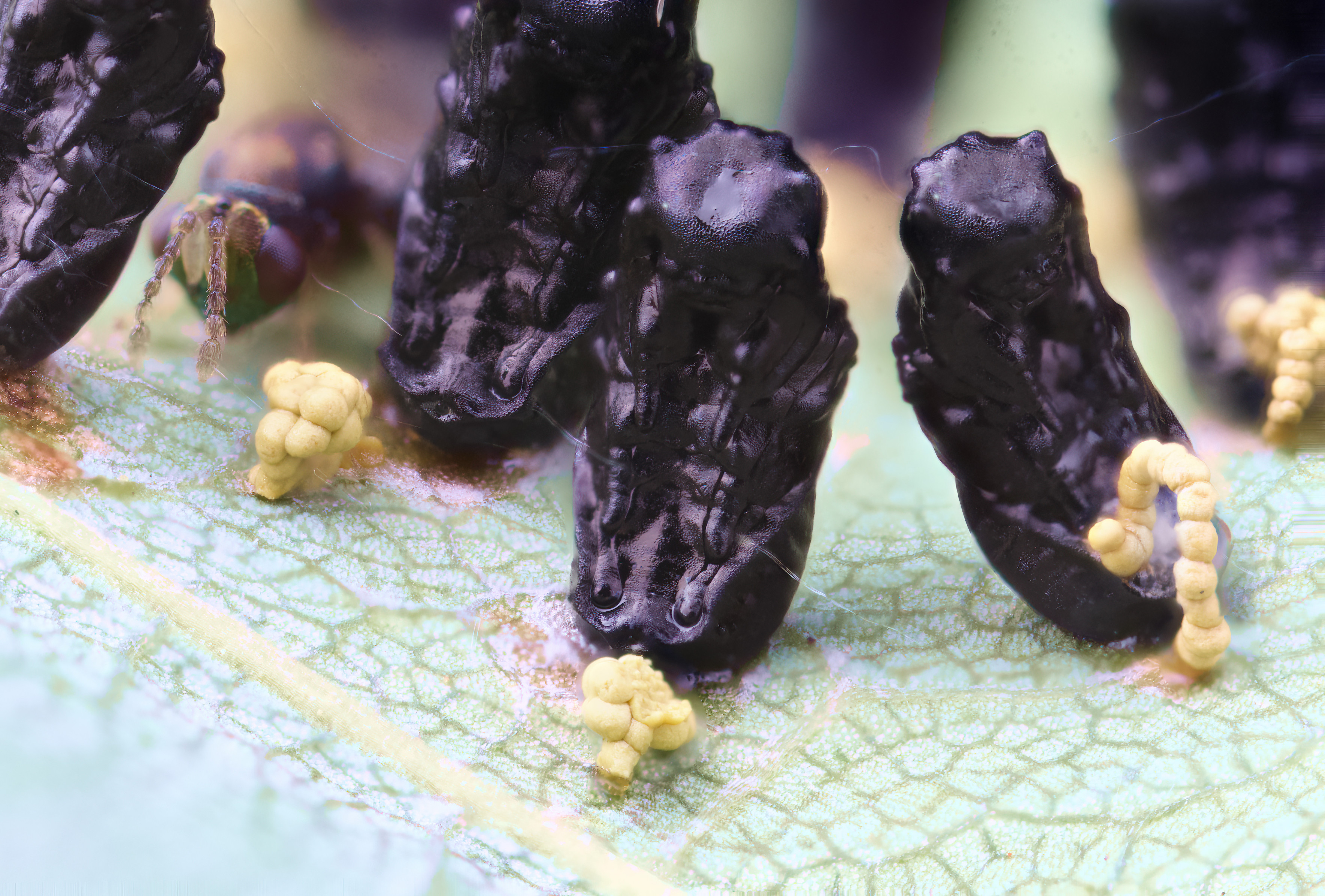
But that isn’t all. What are those black thingies to the left? Well, those are the pupae of a kind of hyperparasitic wasp – very small wasps that are parasitoids of the parasitoids. I had seen these mini-tombstones of pupae many times on plants, but this is the first time that I had enough context to understand the bigger picture about them. If you look carefully you will see an adult wasp among the pupae – a detail that I did not see at the time. Based on some findings in BugGuide, I suggest that this second group is from the Eulophidae family, as shown in the linked picture:

Next is a close-up of the Eulophid pupae. This required the Raynox 250 diopter lens to boost the power of the macro lens. The yellow stuff next to the pupae is called meconium, and they are the gut contents of the hyperparasitoid larvae. When a larva pupates, it will first purge its gut contents:
When I excitedly showed this amazing story to the wife, she was quite horrified.
After a pleasant and very productive afternoon spent in the flower-filled meadow, I noticed that I was being watched by a curious onlooker:

“Lily Leaf Beetle (Lilioceris lilii)”
I like that name
Exquisite work as usual – even an ostensibly yucky fly here has a definite intriguing aspect, like a model, or robot… something about it…
+1
I see Laura Helmuth has landed on her feet.
https://slate.com/_pages/cm3qctm2m0000lpkye5w6cw4v.html
We’re all horrified!
😀
This pleases me immensely!
Incredible bugs! The antennae on the Wedge-shaped beetle, the Macro…..?limbata is fantastic! (I’ll never spell that correct.)
What a world you’re tuning us into! Thanks!
Always tremendous value when the Readers’ Wildlife Photos come from Mark Sturtevant!
Hear hear!
Excellent as always Mark. You make Michigan (!) look like the wilds of Congo. Or Jurassic Park!
Love me dem bugs!
Thx
D.A.
NYC
Those mantidflies are freakin cool!
Oh Mark, what a gorgeous set. I’ll peruse them and the narrative several times. The Lilioceris lillii which I’ve never seen before at first glance looks a lot like the Cardinal beetle due to the coloring, though no close relation. Could you tell me what gear you used to take these? I will probably keep to my little automatic camera as long as it works (it was my late father’s and has sentimental value to me), but just in case…
Sorry for the late reply. Meetings and classes all day.
There is nothing remarkable here in terms of equipment. At the time I would be using the following:
Canon t5i body. This is a consumer grade crop sensor, easily bought used for a few $100).
Canon 100mm f/2.8L. That is a pricey high end lens, but only bc it’s a Canon brand. You can get an off-brand lens, used, for 1/2 as much.
Kuangren dual head external flash with homemade diffusers. This wonky flash ain’t that cheap for a Chinese flash, but it’s worth it. You can do with a single head flash from Neewer for $60-$80, and a commercial AK diffuser which you can learn about online. I would go that route if I had to do it over again.
If I had to do it all again, I would go with an OM camera system camera, macro lens, and AK diffuser. That set outclasses what I have and at a lower price.
Thank you, Mark, I will copy this for possible later use!
Beautiful close ups, and nice commentary! Thanks!
Thank you for these. Great camouflage on that fawn!
Great set of photos, with lots of weirdos. I had never heard of a beetle that uses bees to transport the eggs to the bee’s nest!
I think the Clearwing Moth might be a hummingbird mimic rather than a bee mimic. The green back, and the fake tail, among other things, makes me think this.
I agree it looks more like a hummingbird than a bee. But I’m not sure why a moth would benefit from resembling a hummingbird.
Hummingbirds are tougher, more alert, better eyes so they could usually evade an insectivorous bird. It is quite easy to closely approach a feeding hawkmoth (hence the nice picture). Much harder to approach a hummingbird. So an insectivorous bird would not bother to try to catch a hummingbird.
There are Hummingbird Moths (Hemaris thisbe) and Bumblebee Moths (H. diffinis). Here are both of them together:
https://content.ces.ncsu.edu/bumblebee-moth-and-hummingbird-moth
I think Mark’s moth is the Hummingbird Moth.
Great detail on those hyperparasitoid pupae. Glad that you identified those meconium deposits – I was wondering if the pupae were clearing their digestive systems. The same word is used for what’s in the human fetal colon.
Dang, I think my comment didn’t post, so at the risk of repetition — these magical photos, commentary and reader comments combined to make my day. (Which still would’ve been true even if it hadn’t been a boring workday…. 😀)
Great photos Mark! Thanks!
I started scanning the photos, without reading the notes at the top of the post, and saw the sharpness and lovely IQ and said to myself: These have to be from Mark Sturtevant! Sure enough.
Mark:
These photos are always amazing, and much appreciated. Thanks!