Readers’ wildlife photos

March 11, 2024 • 8:15 am

We are in serious trouble, folks. I have about three days’ worth of readers’ wildlife photos left, and that feature (like “Caturday felids”, which has a dearth of readers) is in danger of becoming extinct. Please send in your good wildlife photos.

Today we feature ecologist Susan Harrison with some lovely tropical animals and one landscape photo.  Her captions are indented, and you can enlarge the photos by clicking on them.

Costa Rica Miscellany

Here’s the third and last batch of photos from a February 2024 trip to Southwestern Costa Rica, during which I visited a wildlife-rich field station on the Rio Sorpresa (Surprise River) and saw many colorful birds, both there and in the nearby Corcovado National Park and the towns of Golfito and Puerto Jimenez.  Today’s photos mostly feature smaller and/or more subtly colored creatures from this trip.

Basilisk (Basiliscus basiliscus), also known as the Jesus Christ Lizard for its skill of dashing across water surfaces:

JAC: I’ve added this National Geographic video of a basilisk running on water:

Bright-rumped Attila (Attila spadiceus), whose distinctive song (“quit it, quit it, QUIT IT – aaaaah!”) is heard much more often than the bird is seen:

Panamanian White-faced Capuchin (Cebus imitator) looking angsty:

Charming Hummingbird (Polyerata decora):

Cocoa Woodcreeper (Xiphorhynchus susurrans):

Great Kiskadee (Pitangus sulphuratus), screaming its loud squeaky calls straight at me:

Green Iguana (Iguana iguana), a yard-long reptilian lawn mower:

Grey-capped Flycatcher (Myiozetetes granadensis) on Purple Mombin tree (Spondias purpurea):

Grey-capped Flycatcher on branch with Snakefern (Microgramma) epiphyte:

Common Pauraque (Nyctidromus albicollis), a member of the nightjar family, making its weird sounds:

Scarlet-rumped Tanager (Ramphocelus passerinii), which looks to me like a Red-winged Blackbird (Agelaius phoeniceus) turned sideways:

Northern Tamandua (Tamandua mexicana), a large placid anteater seen in Corcovado National Park:

Variegated Squirrel (Sciurus variegatoides):

Yellow-green Vireo (Vireo flavoviridis):

One of the many waterfalls on the Surprise River:

Readers’ wildlife photos

February 26, 2024 • 8:15 am

Please send in your wildlife photos as the tank, every emptying, is now worrisome.

Today we have some photos of Costa Rica by ecologist Susan Harrison of UC Davis. Her captions are indented, and you can enlarge the photos by clicking on them.

Along the Surprise River  

Southwestern Costa Rica has the greatest extent of lowland rainforest on the entire Pacific coast of Central America, thanks in large part to the country’s noble conservation history.  The Corcovado and Piedras Blancas National Parks anchor a thriving yet not-too-commercialized ecotourism industry, supplemented by many forest tracts acquired by conservation-minded individuals. Some Davis friends recently bought several hundred acres along the Rio Sorpresa (Surprise River), adjoining a small field station run by an expert mammalogist.   Naturally I had to go investigate!

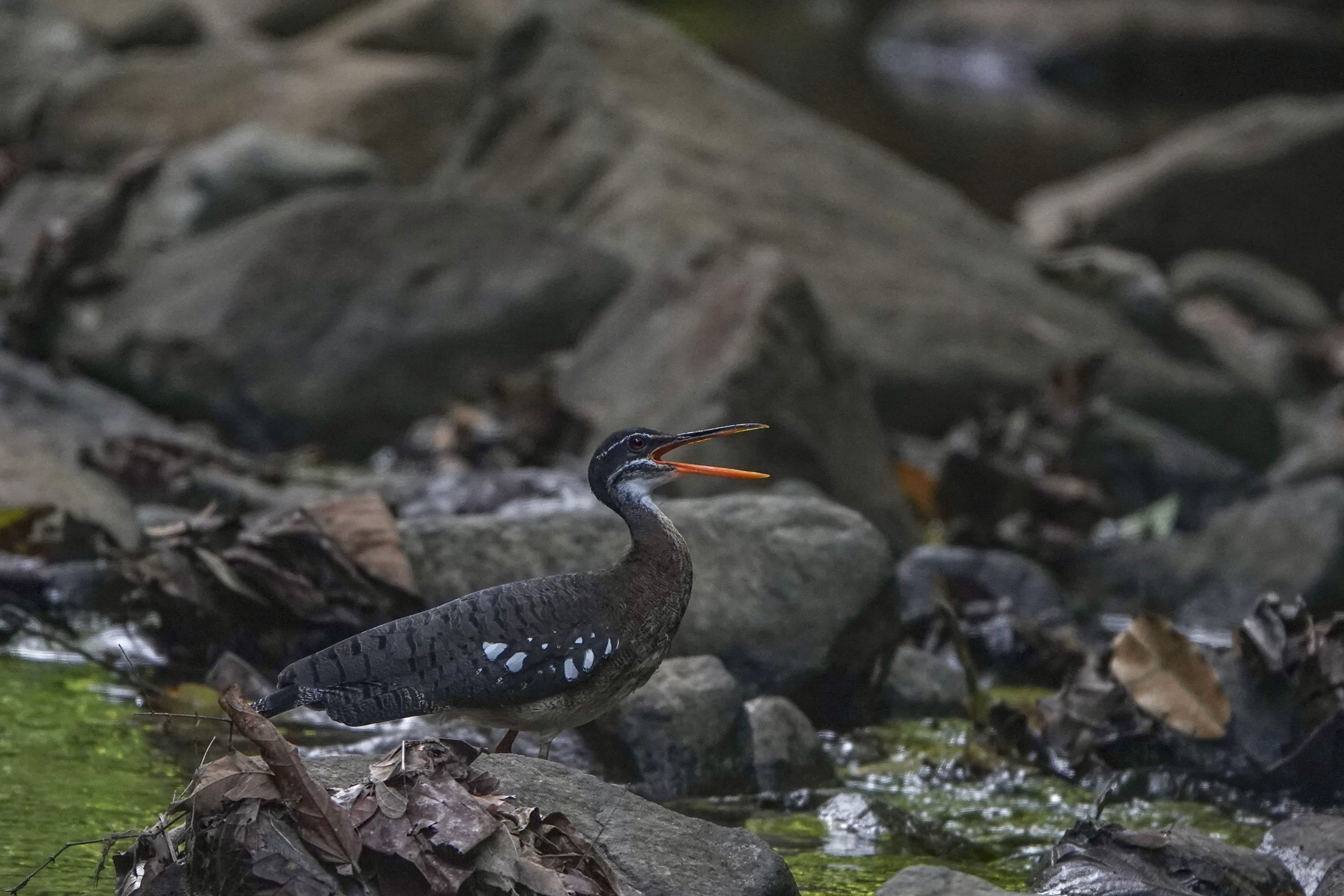
My most heart-stopping sighting was a Sunbittern – a very elusive resident of clear Neotropical streams that is distantly and uncertainly related to other birds.  Staking out a location where one had recently been seen, I had the privilege of observing its early morning rounds.

Sunbittern (Eurypyga helias):

Haunting the same stretch of the river, where receding water flows were trapping small fish in pools, was a Fasciated Tiger-heron – more common on the Atlantic slope than in this region.

Fasciated Tiger-heron (Tigrisoma fasciatum):

Kingfishers were ubiquitous along the river and came in three sizes:  large (the crow-sized Ringed), medium (the pigeon-sized Amazon) and small (the sparrow-sized Green).

Ringed Kingfisher (Megaceryle torquata):

Amazon Kingfisher (Chloroceryle amazona):

Green Kingfisher (Chloroceryle americana):

This group of White Ibises appeared to be recreating the Abbey Road album cover…

White Ibises (Eudocimus albus):

A troop of around 50 Central American Squirrel Monkeys moved around high in the trees, and were easiest to see when on the river’s opposite bank.   This species is only found on the Pacific slopes of Costa Rica and Panama.

Central American Squirrel Monkey (Saimiri oerstedii) adult:

Central American Squirrel Monkey juvenile:

At the field station, smaller birds visited feeders baited with split bananas.

Red-Legged Honeycreepers (Cyanerpes cyaneus):

Shining Honeycreeper (Cyanerpes lucidus):

Scarlet-rumped Tanager (Ramphocelus passerinii):

Our hostess, mammalogist Fiona Reid, was expert at finding bats for us to admire.

Tent-making Bat (Uroderma bilobatum):

Readers’ wildlife photos

February 8, 2024 • 8:15 am

Hey, folks, I’m running low on photos, and submissions have been few recently. Please send in your good wildlife photos to keep this feature going.  Thanks!

Reader Mark Joseph sends in some Panama bird photos (and one primate photo) taken by his friend “Ed”, and I reproduce them here with permission.  The narrative and IDs are indented, and you can enlarge the photos by clicking on them.

From Mark:

I’m not much of a photographer, but I have a number of friends who are. One, name of Ed, just came back from a trip to Panama. I have his permission to share these photos with everyone. Six birds and a mammal!
Black-breasted Puffbird, Notharchus pectoralis:

Cinnamon Woodpecker, Celeus loricatus:

Crimson-crested Woodpecker, Campephilus melanoleucos:

Howler monkey and baby, Genus Alouatta; hopefully readers can provide the species:

Rufous Motmot, Baryphthengus martii:

Hepatic Tanager, Piranga flava:

Bay-headed tanager, Tangara gyrola:

Readers’ wildlife photos

December 18, 2023 • 8:15 am

Today’s photos constitute part 1 of a three-part series of the fauna of Costa Rica. The photographer is Ephraim Heller, his captions are indented, and you can enlarge his photos by clicking on them.

On the first trip to Costa Rica, I wanted to learn more about the neotropical rainforest so I read Tropical Nature: Life and Death in the Rain Forests of Central and South America by Adrian Forsyth and Ken Miyata. Although published in 1984, the book is still a fascinating layman’s introduction to rain forest ecology. To my surprise and delight, the book contains the following description of a young Harvard graduate student named Jerry Coyne on his first visit to the rain forest:

A few weeks before Jerry was due to return to the Museum, his head began to itch…. At first, Jerry assumed that the itch on his scalp was a mosquito bite, as indeed it was. But unlike the usual mosquito bite, this one did not subside. It grew larger, forming a small mound, and besides scratching Jerry began to worry. After several days of private fretting he sought help. One of his fellow students, a medical entomologist, agreed to examine the wound. Her diagnosis sent a chill of fear through poor Jerry. Poking out of a tiny hole in his scalp was a wiggling insect spiracle. A hideous little botfly maggot was living inside the skin on his head and eating his flesh! This intimacy with nature was a little too much for Jerry, and he ran around in circles crying for the removal of the maggot. Unfortunately, removal of a botfly maggot is no simple task. This botfly (Dermatobia hominis) has existed as an unwanted guest in the skins of mammals and birds for countless generations. Its larvae have evolved two anal hooks that hold them firmly in their meaty burrow. If you pull gently on the larva, these hooks dig in deeper and bind it tightly to your flesh. If you pull harder, the maggot will eventually eventually burst, leaving part of its body inside the host, which can lead to an infection far more dangerous to the host than the original bot…. After his initial bout of hysterical revulsion, Jerry learned to accept his guest…. Jerry grew fond of his bot and the bot grew fat on Jerry. When Jerry returned to New England, his bot had produced a goose egg-sized swelling on his head.

I won’t tell you how the story ends, other than to say that it involves the Boston Red Sox and that Jerry survived.

For more photos you can follow me on Instagram.

Brown-throated three-toed sloth (Bradypus variegatus). The males have thge unusual marking in the middle of the back. You can see the green algae growing on its fur. Per Wikipedia: “Certain strains of fungi that grow on brown-throated sloth fur have been shown to possess anti-parasitic, anti-cancer, and anti-bacterial qualities…. In addition to the algae in their fur, brown-throated sloths also live commensally with a species of moth, Cryptoses choloepi, which lives in their fur, and lays its eggs in the dung”:

Hoffmann’s Two-toed Sloth (Choloepus hoffmanni). These nocturnal critters curl up to sleep during the day. This individual was about eight feet off the ground — close enough to touch. Like the three-toed sloths, two-toed sloths also have algae living in their hairs:

Central American squirrel monkey (Saimiri oerstedii). Mother and child:

Panamanian white-faced capuchin (Cebus imitator) reacting to my explanation of US politics:

Geoffroy’s spider monkey (Ateles geoffroyi) just hanging out:

Golden-mantled howler monkey (Alouatta palliata palliata) contemplating life:
White-nosed coati (Nasua nasua) snacking on berries. Coatis are related to raccoons. They are gregarious and it is quite entertaining to watch their interactions:
Northern tamandua (Tamandua mexicana). An anteater that spends time on the ground and in trees:

Collared peccary (Tayassu tajacu) nursing a baby:

Northern ghost bat (Diclidurus albus). A rare insectivorous bat that fees primarily on moths. We found a mother and child hanging under a palm leaf:

Green vine snake (Oxybelis fulgidus)? I’m poor at identifying snakes so please correct me if I’m wrong. We watched this individual hunt a frog. From the expression on his face, the snake seems quite happy with his meal:

Plumed basilisk (Basiliscus plumifrons). Also known as a Jesus Christ lizard, due to its ability to run across water. It displays the behaviour as a threat response, when fleeing predators. High speed is maintained in order to prevent sinking. Per Wikipedia: “While some insects are able to run on water using surface tension, basilisk lizards, which have much more mass, achieve this through alternative fluid dynamics. This lizard will use its hind leg to penetrate the surface of the water beneath it to create an air-filled cavity and then retract its leg before the cavity closes. This enables the basilisk lizard to minimize its contact with water. Additionally, this running technique reduces the drag experienced during the run while simultaneously allowing the lizard’s body to be propelled across the water at an average speed of 1.6 m/s (5.2 ft/s)”:

Common basilisk (Basiliscus basiliscus), another Jesus Christ lizard known for its ability to run on the surface of water:

Green iguana (Iguana iguana). These grow up to 2 m in length:


Readers’ wildlife photos

August 8, 2023 • 8:15 am

Thank Ceiling Cat: two readers came through with photos when the tank was empty. Today’s lot comes from Leo Glenn, who sends photos from Costa Rica. His captions are indented, and you can enlarge the photos by clicking on them.

Here are some more photos from my recent trip to Costa Rica.
There are four species of monkeys in Costa Rica: the Central American squirrel monkey (Saimiri oerstedii), the Panamanian white-faced capuchin (Cebus imitator), Geoffroy’s spider monkey (Ateles geoffroyi), and the mantled howler monkey (Alouatta palliata). As we were spending most of our time in parks and nature preserves, we were hopeful that we would see at least one of the species. It came as quite a surprise to us, then, that while we saw no monkeys in any of the nature preserves, a family of mantled howlers moved Into the trees next to our rental house and spent around 45 minutes eating, lounging, and playing. It was an amazing experience.


Like cats, they were masters at relaxing in the most precarious of positions.

We enjoyed watching them use their prehensile tails to move among the branches, sometimes hanging from them to reach the choicest leaves, which make up 75% of their diet.

Another species that we were hoping to catch a glimpse of was a coatimundi. And just as we pulled into the Monteverde Cloud Forest Reserve, a South American coatimundi (Nasua nasua) strolled right across the parking lot.

Coatimundis, known locally as pizotes, are members of the family Procyonidae, the same family as raccoons, and they share many of the same traits. Unlike the more nocturnal raccoons, however, coatimundis are diurnal.

In the cloud forest, we came upon a nest of red-tailed stingless bees (Trigona fulviventris). Our guide said that the honey they produce is inedible, but it has been used traditionally for medicinal purposes. I couldn’t find any information on that, but I did read that the sticky resin they make to build their nests has been used by fishermen to caulk leaks in their canoes. Another occasion when I wished I had a longer lens.

A tree fern (Cyathea holdridgeana). I was particularly excited to see this, as I have been obsessed with paleontology since I was a child. Tree ferns, along with Lycopods and Horsetails, were the predominant “trees” in ancient forests, before our current trees evolved. This particular species grows at elevations of 2400-2800 m, much higher than most other tree ferns in Central America. I believe we were at around 2100 m on this tour.

A colorful group of caterpillars. I was unable to determine the species, but they appear to be a moth in the genus Euglyphis.

And finally, our rental house came with a cat [Felis catus], whose name was Linda.

Linda asking to be let in.

Below: Linda’s favorite activity, after we let her in (other than begging for something to eat). She was 17 years old, and growing deaf. Her meow was loud enough to wake the dead (something she liked to do at five in the morning outside our bedroom window). But she was otherwise spry and hale. Of course we fell in love with her.

Readers’ wildlife photos

March 25, 2023 • 8:15 am

Reader Mike Canzoneri sent some photos of squirrel monkeys, which you can enlarge by clicking on them. He also sent a brief bio:

I was born and raised in the city of Chicago and have been a backyard zoologist since I was a little kid. I moved to Miami, FL in 1990 to be close to Everglades National Park (where I was a volunteer), then to Austin, TX in 1994 (for a better job) and finally to Costa Rica in 2005, where I spent my meager nest egg on three separate rain forest properties. I built a house on my southern Pacific coast rain forest property (about 100 acres) and live there most of the time.

Mike’s captions are indented, and you can enlarge the photos by clicking on them.

This is my first submission to Why Evolution is True Readers’ Wildlife Photos: endangered black-crowned Central American squirrel monkeys (Saimiri oerstedii oerstedii).

In January and February, the females give birth and the babies stay on their mothers’ backs until well into summer. Once the babies are close to the size of their mothers, the mothers try to shake them off but the babies resist for as long as they can.

All shots taken with my Nikon D850 and either the Nikkor 300mm f/4 or 500mm f/5.6 PF prime lens, except this first one taken with my Nikon D750 and Nikkor 500mm f/5.6 PF.

The mothers wear the babies like backpacks as they run up and down the trees and jump from one tree to the next, and they get tired and need to rest from time to time. I caught this mother doing a face plant into the bamboo to take a 30 second power nap.

I notice that the mothers try to help each other and stick together. I was lucky enough to be ready with my camera when this scene played out in front of me, where two mothers, each with a baby, all engaged in a group hug.

I’m not sure what had this baby’s attention but I liked the way the photo came out.

This baby was pushed off by its mother so she could take a break. She didn’t go too far and the baby clung to the branch, frozen in fear, until the mother came back a few minutes later.

Here is a shot of a mother nursing her baby.

Taken about two minutes after the shot right above, here is the baby holding on tightly to the mother.

Here’s a juvenile squirrel monkey just hanging out in a small tree.

To end the set I chose this photo of a juvenile gazing pensively up at the canopy.


Readers’ wildlife photos

February 9, 2023 • 8:15 am

Today we have a variety of photos from Daniel Shoskes.  The species are unidentified, but readers can help with that. Click on the photos to enlarge them; Daniel’s notes are indented.

From a cruise down the Peruvian Amazon organized by Natural Habitat Adventures (affiliated with the World Wildlife Fund). Have video with a glimpse of the elusive freshwater river pink dolphin but not photos.