Readers’ wildlife photos

June 26, 2026 • 8:30 am

We can keep going for two days after this, but if you got photos, please send ’em. Thanks.

Today’s batch is from Ephraim Heller, continuing his photos from a recent trip to Namibia. Ephraim’s captions are indented, and you can enlarge his pictures by clicking on them. Don’t miss the chameleon with its tongue extended!

Today I continue my series on a May-June 2026 visit to Namibia. I’m organizing the posts by habitat, in the order of our visits, so that you get a sense of the ecosystems. My last post focused on the Namib desert. This post focuses on my next destination, Swakopmund, a cold, fog-covered town along the Namib desert’s Atlantic coast.

Annual rainfall is less than 20 mm, but the town experiences ~180 days/year of thick fog, generated offshore when the cold Benguela Current contacts warm desert air. The fog typically settles in the early morning hours and burns off by mid-morning. The fog provides moisture that enables some vegetation to grow in a strip along the ocean. In addition, there is a small, brackish estuary at the mouth of the ephemeral Swakop River that supports marine birds. This photo, taken with my iPhone on an after-dinner stroll from a restaurant to our hotel, gives you a sense of the fog:

A herd of dromedary camels (Camelus dromedarius) grazing along the shoreline often startles visitors to Swakopmund. Dromedaries are not native to Africa. The species was domesticated on the southeastern Arabian Peninsula about 4,000 years ago and has not occurred naturally in the wild for nearly 2,000 years. They were imported to Namibia by the German colonial troops in 1889 for use as military pack animals in what was then German South West Africa. The animals I saw grazing along the shore are used by a local company for tourist rides. This is a handsome individual:

However, not everyone gets to ride the camels:

The most impressive aspect of our stay in Swakopmund was a short “living desert” safari. A guide took us on a walk and drive in the sand dunes immediately around the town. Where I saw pristine sand, the guide saw the telltale marks of animals burrowed in the sand.

The first individual he unearthed was a desert sidewinding adder (Bitis peringueyi), a small, ambush predator. The one he found was about 15 cm (6 in) in length. The eyes are positioned on top of the head rather than on the sides, adapted to allow the adder to bury itself in loose sand, leaving only the eyes exposed at the surface while waiting for prey. Prey includes sand lizards and barking geckos, which also provide most of the adder’s water needs. I took these close-up photos with my macro lens – kids, don’t try this at home:

Next, our guide uncovered a buried Namib sand gecko (Pachydactylus rangei), certainly the most charismatic of the desert critters. The large feet with webbed toes are good for running on loose sand and for excavating burrows. They burrow into dunes by day to escape the heat, emerging after dark to hunt insects and spiders.

These geckos also emerge during fog events and allow droplets to condense on their skin, then lick water from their own faces and bodies. In 2021 researchers reported that P. rangei produces a neon-green biofluorescence under UV and moonlight conditions using a new mechanism in terrestrial vertebrates. I wish I had known this at the time so I could have photographed them under moonlight. Regardless, these are clearly very happy creatures:

Of course, no visit to the Namib desert dunes is complete without a FitzSimon’s burrowing skink (Typhlacontias brevipes). The FBS is blind, legless, just a few inches long, and spends its entire life burrowed in the sand. The species has reduced eyes without eyelids and no visible external ear openings. It detects prey (ants, termites, ant-lions, and small beetles) by sensing the vibrations they produce when moving through sand:

Finally, our living desert guide found surface critter: a Namaqua chameleon (Chamaeleo namaquensis). The Namaqua chameleon is one of the largest chameleons in southern Africa (up to 25 cm or 9.8 in), and unusual in the family for being terrestrial rather than arboreal. In the early morning, this chameleon darkens to near black to maximize heat uptake; as body temperature rises, it lightens toward grey-brown to reduce absorption. Water is obtained through the diet, from morning dew, and through hygroscopic skin that absorbs moisture by capillary action (wow!). Nasal salt glands excrete excess sodium chloride and potassium, allowing salts to be processed without renal water loss:

The eyes can move independently, looking in different directions:

The tail is shorter than those of arboreal chameleons, and has lost its prehensile abilities:

The guide had some mealworms with which to entice the chameleon. It’s tongue was so fast its movement was hard to see with the naked eye:

Now for the birds. First up, a colorful common waxbill (Estrilda astrild):

Next, a common but lovely speckled pigeon (Columba guinea) with an excellent hair stylist and makeup artist:

A portrait of another common but colorful bird, the helmeted guinea fowl (Numida meleagris). This one looks pensive:

We took a tourist boat cruise to see the Cape fur seal (Arctocephalus pusillus pusillus) colony near Walvis Bay. The Cape fur seal population along the southwest African coast is estimated at 1.5 – 2 million animals, roughly two-thirds of which occur along the Namibian coast.

Cape fur seals are eared seals (family Otariidae) rather than true seals. Unlike true seals, which move on land by undulating their bodies, otariids can rotate their hind flippers forward and walk on all four limbs, giving them considerably more agility.

During breeding season, bulls fight to establish territories and maintain harems of 5 to 25 females. A bull may lose nearly half his body mass over the six-week breeding season without leaving his territory to feed. Mothers leave their pups on shore while they feed in the ocean. When they return to shore, mothers and pups find each other by making unique vocalizations, amazing in colonies of tens of thousands of animals.

Seal colonies on land are predated by black-backed jackals and brown hyenas, who target pups. At sea, they are preyed upon by white sharks and killer whales. Here’s a photo from the boat:

I’ll have more cape fur seal photos in a future post.

Our guide on the boat feeds fish to the great white pelicans (Pelecanus onocrotalus). While I don’t support baiting, one of the pelicans landed on the boat for its free meal, enabling me to get this portrait:

Readers’ wildlife photos

June 25, 2026 • 8:20 am

Today we have photos of Finland from ecologist Susan Harrison of UC Davis. Susan’s captions and IDs are indented and you can enlarge them by clicking on them.

Midsummer in the Åland Islands, Finland

On the tiny Åland Islands in the Baltic Sea, humans observe Midsummer Eve in traditional Swedish style.  Towering, vine-decorated maypoles are raised in an hourlong process of pole-pushing and rope-pulling, followed by folk music and dancing.

Midsummer Eve at around 9 pm, Kastelholm, Åland:

Birds, meanwhile, have even more urgent preoccupations than celebrating the summer solstice.  Parents are feeding screaming chicks, who jostle for the front of the chow line.

Mute Swans (Cygnus olor) pulling up seaweed for their cygnets:

Great Crested Grebes (Podiceps cristatus) providing transportation and food delivery:

Common Terns (Sterna hirundo), one pair feeding their sole chick fish and insects, while absent adults at the neighboring nest are awaited by two noisy chicks:

Jackdaws (Coloelus modedula), adult and ravenous juvenile:

Barnacle Geese (Branta leucopsis) defending their young against a passing human:

Black Woodpecker (Dendrocopus major), foraging to feed chicks that I didn’t manage to capture in this picture:

These species all have identical or near-identical sexes who share in raising the young, in contrast to the many bird species in which males are flashier and contribute less at the nest than females.

Readers’ wildlife photos

June 24, 2026 • 8:30 am

Reader Thomas sent some photos from a recent trip to Iceland. His captions and IDs are indented, and you can enlarge the photos by clicking on them. Be sure to see the spectacular ducks, especially the King Eider! (And don’t miss the horned grebe and the fluffy-tailed Arctic fox.)

I took these photos with my Sony RX10 IV on vacation in Iceland in May/June this year. A truly beautiful country with many bird species that are hard or impossible to see back home in Europe, especially up close, in large numbers and in breeding plumage:

This male Harlequin duck (Histrionicus histrionicus) is an expert in foraging in fast-flowing, rocky streams:

Male Barrow’s goldeneye (Bucephala islandica). It also favors fast-flowing streams, though seemingly slightly calmer ones than the Harlequin duck. Within Europe, these two duck species occur only in Iceland and are two of the three or four bird species that have colonized Iceland from America (rather than Europe):

Seven male Common eiders (Somateria mollissima), and even more out of frame, hoping to curry favor with a single female. She seemed to want to be left alone, but that was not in the cards. The males followed her around, constantly making amusing ‘a-ooh-oh’ calls:

A spectacular male King eider (Somateria spectabilis). I believe it does not regularly breed on Iceland, but some of them hang around in the coastal areas, sometimes hybridizing with Common eiders (Somateria mollissima):

A male Long-tailed duck (Clangula hyemalis). Not quite in full breeding plumage as shown by the white on its breast and crown, but handsome nonetheless:

Next up the three species of jaeger (or skua) that breed on Iceland. In the order of the photos: Great skua (Stercorarius skua), Parasitic jaeger (Stercorarius parasiticus), and Long-tailed jaeger (Stercorarius longicaudus). I had never seen any of them before, so these were among the highlights of the trip. The Great skua and Parasitic jaeger behaved like a mix of a gull and a falcon. The Long-tailed jaeger on the other hand reminded me more of the Swallow-tailed kite (Elanoides forficatus) of the Americas, with its long, forked tail and elegant, relaxed wingbeats. They are rare breeders in Iceland, which made finding and observing them all the more rewarding:

A pair of European golden plovers (Pluvialis apricaria), a joy to behold. Very common on just about any field in the country, together with Black-tailed godwit (Limosa limosa), Common redshank (Tringa totanus), Common snipe (Gallinago gallinago), and Eurasian whimbrel (Numenius phaeopus):

A pair of Red-necked phalaropes (Phalaropus lobatus), with the male left and the female right. Charming little birds, often foraging literally within arm’s reach. Phalaropes have reversed sex roles. The females are slightly more brightly colored, and the males hatch the eggs and raise the young:


The Atlantic puffin (Fratercula arctica). Iceland’s iconic bird for tourist merchandise, though not its national bird, which is the Gyrfalcon (Falco rusticolus) and which has unfortunately become quite scarce and was not seen by me:

Another puffin, this one dead in the beak of a Common raven (Corvus corax). The corvid clean-up crew had found a few lying dead on the beach at the bottom of a breeding site atop a cliff:

Common loon (Gavia Immer), showing off how beautiful black-and-white (with a hint of green) plumage can be:

Horned grebe (Podiceps auritus). Together with its partner it was doing its typical grebe-like courtship dance with head and neck movements. Any grebe in spring is a delight:

White-tailed eagle (Haliaeetus albicilla). They caused severe panic among all the other birds everywhere they showed up:

Arctic fox (Vulpes lagopus) at dusk, still largely in its white winter coat:

Reader’s wildlife photos

June 23, 2026 • 8:15 am

Why is this feature like lox and a schmear? A: Because it’s on a roll. (Sort of.) I now have a total of four sets of photos in the queue, one of which I’ll post today. But please send your good photos, and a warm handshake to those who have done so.  I hope people realize that readers who send in good add a unique feature for this website: high-quality and delightful pictures of nature. Do compliment the photographer if you like their photos.

Today we have pictures from Ephraim Heller, documenting his recent trip to Namibia. (More will be coming.) Ephraim’s captions are indented, and you can enlarge his photos by clicking on them.

Today I begin a series on a May-June 2026 visit to Namibia. I’m organizing the posts by habitat, in the order of our visits, so that you get a sense of the ecosystems.

The Namib Desert is the oldest desert on earth, with conditions that have persisted for 55 – 80 million years. At ~80,950 square km (31,250 sq mi), it is far and away the largest desert I have visited. It stretches ~2,000 km (1,200 mi) along southwest Africa’s Atlantic coast, including the entire length of Namibia. There is essentially no rain at all near the coast (2 mm/year average), but in places there is coastal fog that is the primary source of water for the desert plants. The stable climate over millions of years has resulted in high endemism. Of the ~3,500 documented species in the Namib, more than 1,000 are endemics.1-2. On the drive from the capital, Windhoek, visitors pass through Solitaire. It consists of a fuel station, a bakery and café, a general store, a small lodge, and a yard decorated with old vehicles. The nearest real town is hundreds of kilometers distant. When vehicles broke down, cars and trucks were simply left. Some of the collection includes American classics from the mid-twentieth century:

While having lunch at a picnic table in Solitaire, I observed several yellow mongooses (Cynictis penicillata) playing. Technically, Solitaire is semi-desert, so there are a few shrubs for the mongoose. They often share burrow systems with the local ground squirrels (Xerus inauris), which confused me as I tried to decide if I was seeing mongooses or ground squirrels. This is a mongoose:
Our destination in the Namib desert was Sossusvlei, where the sand dunes are among the highest in the world. “Dune 7” dune, the tallest, is 388 m (1,273 ft) in height. Vlei is the Afrikaans word for “marsh,” while sossus is Nama for “no return” or “dead end”.  The area is the drainage basin for the ephemeral Tsauchab river. The Namib Sand Sea, of which the Sossusvlei dune field is a part, is a UNESCO World Heritage Site. The dunes began forming around five million years ago. Sand from the Orange River was carried west into the Atlantic, swept north by the Benguela Current, then driven back inland by the prevailing south-southwest winds. Over millions of years the sand accumulated into a dune field ~32,000 sq km (12,400 sq mi) in extent. The sand is iron-oxide coated quartz, and younger sand near the base of dunes is paler while older sand higher up is a deeper reddish-orange, due to greater oxidation. The colors in these photos are real, and not simply me going wild with the saturation slider in my photo editing software. For scale, note the full-grown trees at the base of the dune in the first photo.

About a kilometer walk across the sand lies a small clay pan named Deadvlei (meaning “dead marsh”) where reside camelthorn trees (Vachellia erioloba) that have been dead for 600 – 900 years. There has been no water here since the fourteenth century! The combination of extreme dryness and intense heat inhibits microbial activity so thoroughly that the wood is preserved.

Gemsbok (Oryx gazella) and springbok (Antidorcas marsupialis) antelope are the primary large mammals of the Namib. Gemsbok can survive for extended periods without drinking free-standing water, meeting their requirements through vegetation. Here is a gemsbok in its habitat:

Here is a herd of springbok in their environment:

Toktokkie beetles (Onymacris unguicularis) are a group of darkling beetles with over 200 species in Namibia, and 20 in the Namib desert. We saw them throughout Namibia. I don’t know the species of this individual, but some species engage in fog-harvesting: when Atlantic fog rolls in, beetles climb to the crests of dunes and orient head-downward, body inclined away from the wind. Water condenses on the elytra, runs along ridges on the beetle’s back, and reaches the mouthparts. A beetle can take in water equivalent to ~40% of its body mass from a single fog event.

The garden locust or tree locust (Acanthacris ruficornis), is widespread across sub-Saharan Africa. Tt is technically a grasshopper:

Namaqua doves (Oena capensis) are ubiquitous, but I think they are pretty. They are the smallest doves on the African continent:

The Kalahari tree skink (Trachylepis spilogaster). I had no idea that some skinks are arboreal:

The extreme dryness and very low population density of Namibia make it one of the prime sites for astronomical observatories and night sky photographers:

Readers’ wildlife photos

June 21, 2026 • 8:15 am

Today’s collection is from math prof Abby Thompson at UC Davis, who sends us intertidal photos from California. Abby’s IDs and captions are indented, and you can enlarge her photos by clicking on them.

The photos were taken at Dillon Beach.

Orienthella piunca (nudibranch), with eggs (the white squiggly things), and a small crab spectating”:

Crab tracks- these always look to me like some complicated bicycle tire track, but apparently it’s just what happens if you skitter sideways on your claws. The crab is buried in the sand at the end of the trail, close-up in the next photo:

Crab- probably Romaleon antennarium, Pacific rock crab. Hunkering down, waiting for the tide to come back in:

Epiactis handi (sea anemone).  This is the unusual species of Epiactis which seems to occur only in a single (and hard-to-access) location near me.   I like to check in on them periodically:

Aegires albopunctatus (nudibranch) Salt-and-pepper nudibranch:

Pycnogonum stearnsi (Sea spider). Nestled into the seaweed, completely out of the water, on top of a rock:

Emerita analoga (Pacific sand crabs). Walking the beach at low tide sometimes it looks as though the sand is puckered- that’s likely to be bevy of some kind of tiny sand crab.     This photo shows the “puckering” from a distance of a few feet:

Pacific sand crabs from close up. A footstep will spook them, and they bury themselves completely in a split second.  Not a great photo, but if you look carefully I think you can see each one has its stalked eyes poking up:

Mopalia muscosa (mossy chiton). The inside of the shell- the animal is long gone, leaving these beautiful interior colors:

The beach at sunrise.

Readers’ wildlife photos

June 19, 2026 • 8:30 am

For many of you it’s been a three-day weekend; have you considered sending me photos? This is the last batch I have.

And today’s batch comes from reader Jan Malik. Jan’s captions and IDs are indented, and you can enlarge his photos by clicking on them.

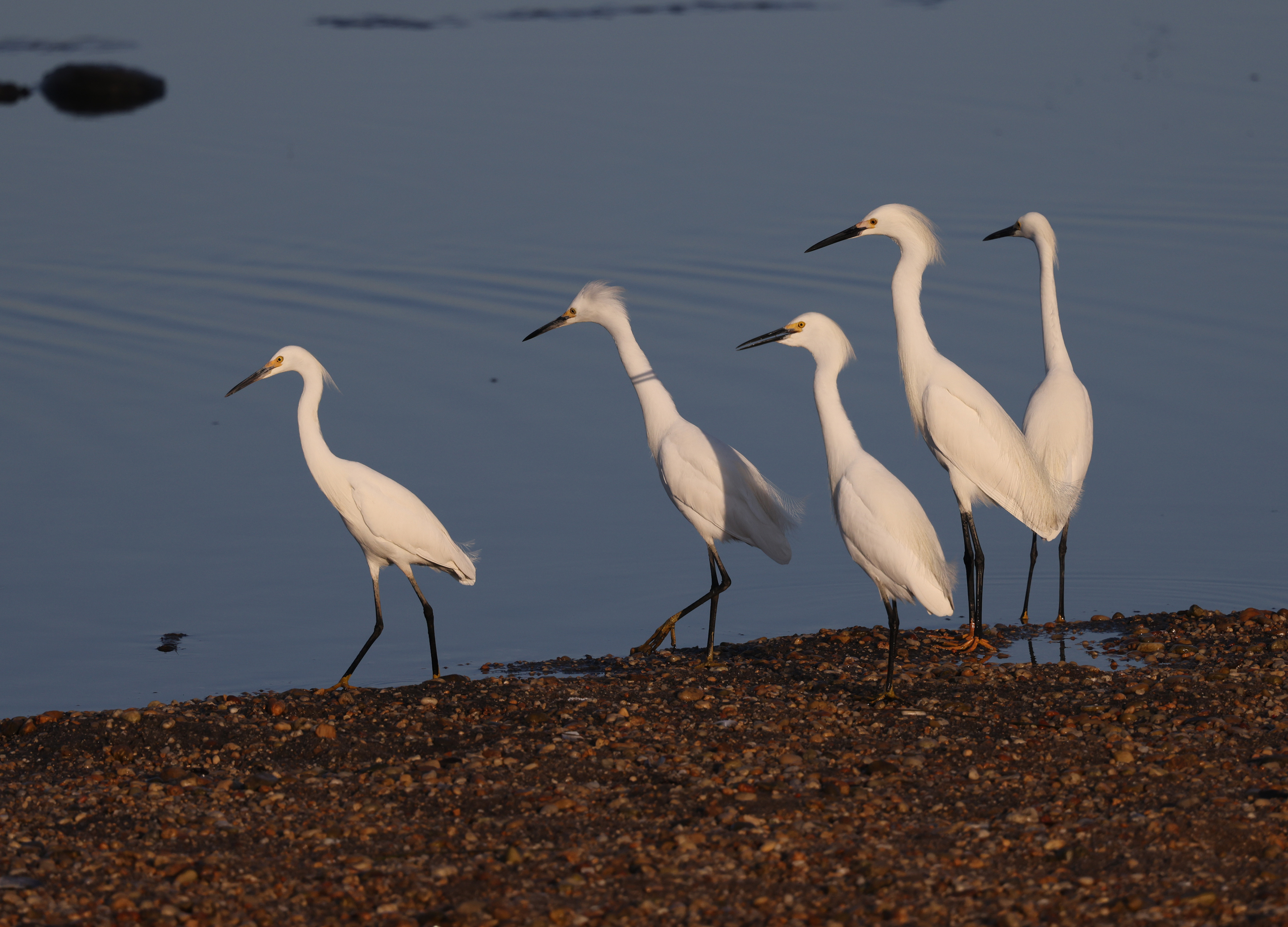
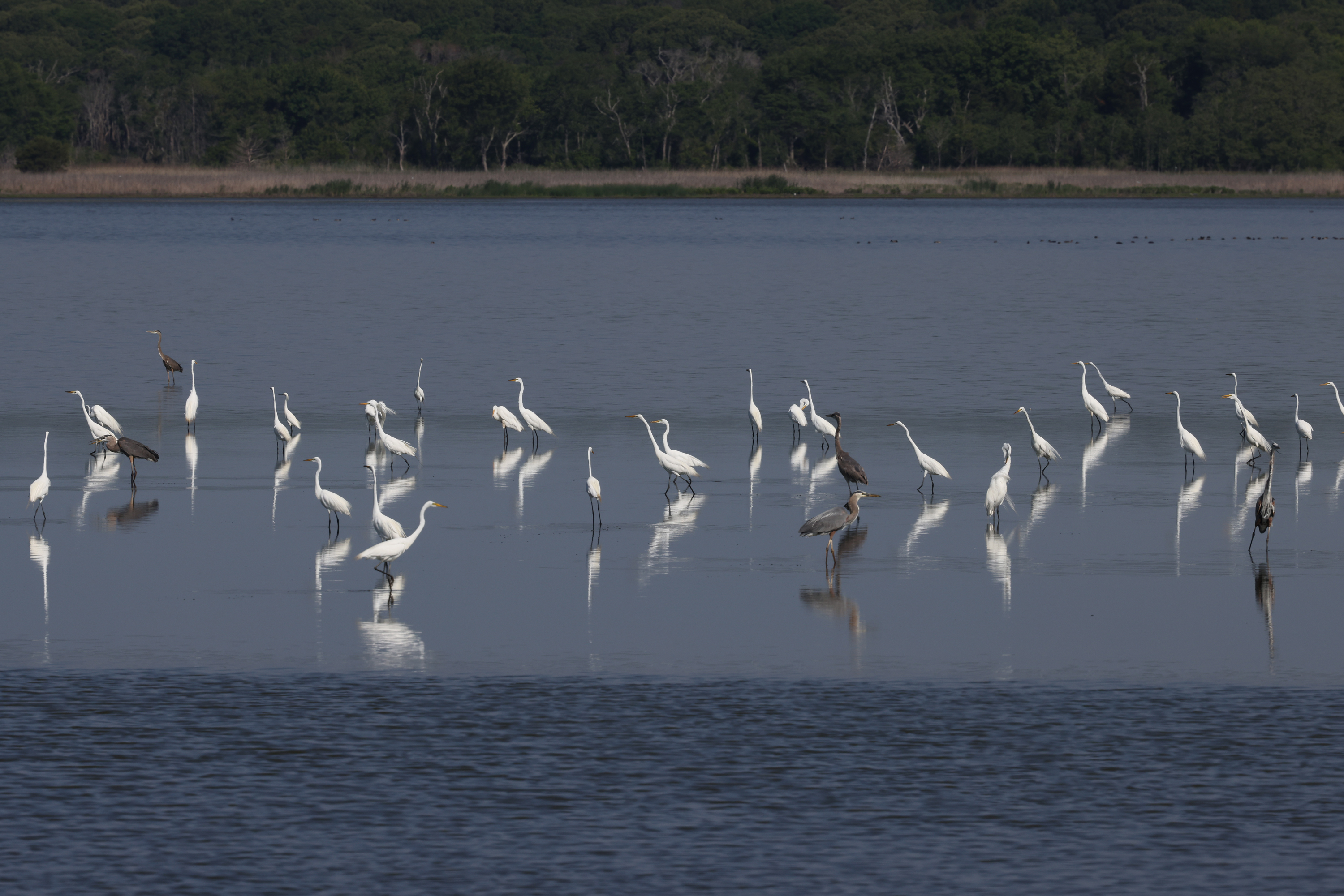
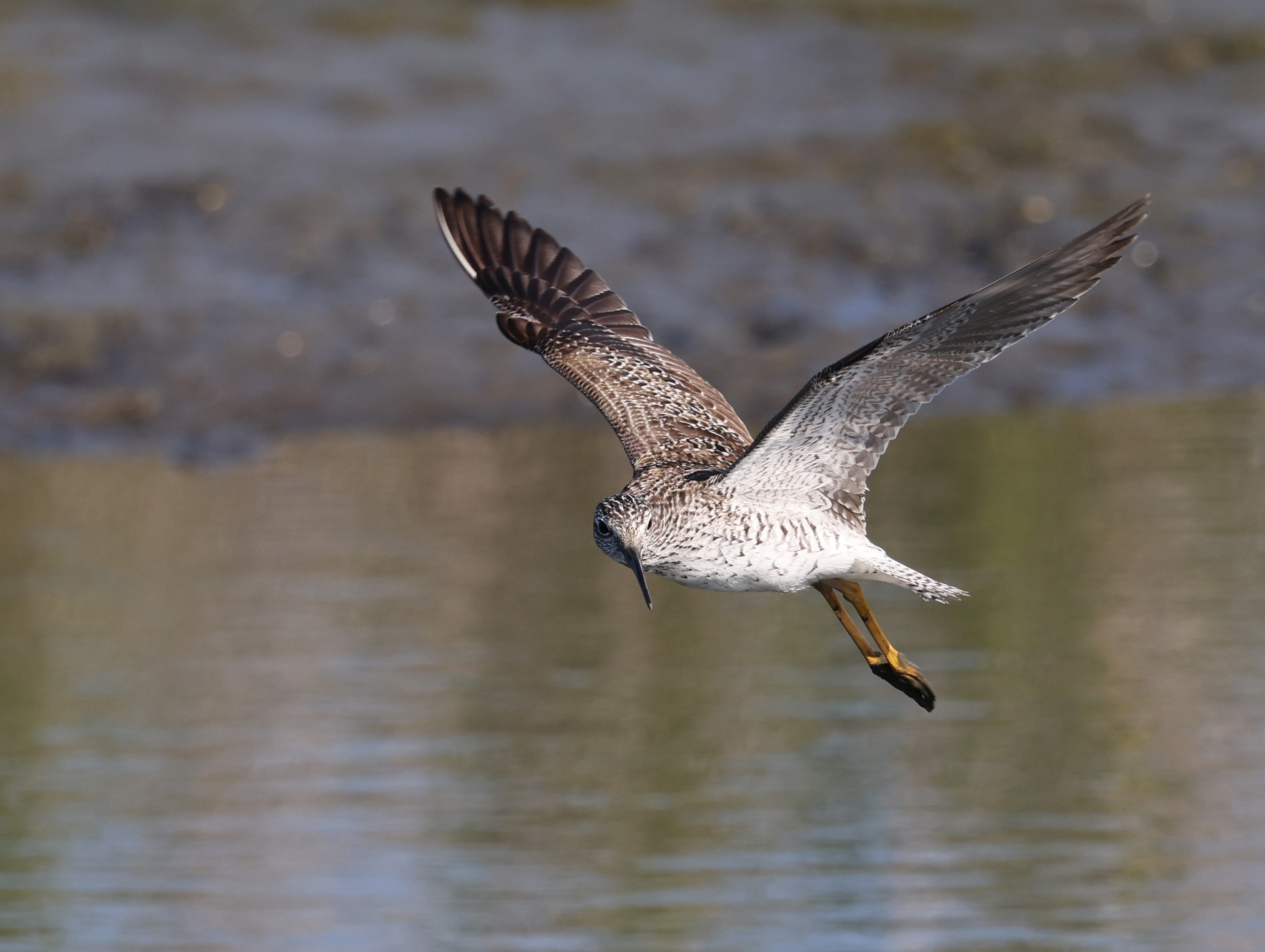
My home state of New Jersey is, for the most part, nothing to write home about, but it does have a few redeeming features, and one of them is the spring migration of birds (the fall migration is also good). Cape May, on the Delaware Bay side of the peninsula, is a particularly good spot to observe birds migrating from far south toward the Arctic. During my visit at the end of May, I took a few pictures of common bird species. I did my best to identify them, but small shorebirds can be difficult to pin down exactly to a species.

First, a pair of Willets (Tringa semipalmata), which may not be migrating too far but are rather already on their nesting grounds—they breed in Atlantic coastal marshes. Their calls are quite similar to those of oystercatchers, but a little less piercing:

Next, a Dunlin (Calidris alpina) in breeding plumage. They are fairly widespread in North America and may fly as far as Greenland or Nunavut. The spring coloration is far more striking than it is in winter;

A Red Knot (Calidris canutus) with its unmistakable cinnamon-orange breast and belly. These are long-range migrants; American birds winter in Tierra del Fuego and fly up to 9,000 miles to breed in the High Arctic. A good portion of their lives is spent along migration routes:

This is what Cape May beaches can look like during the peak of Red Knot migration. I think I took this picture in 2013. There was a fear that Red Knot numbers would decrease drastically, even to zero by some extrapolations (meaning complete extinction). Lately, their numbers seem to have stabilized, but their future is not secure. They rely heavily on horseshoe crab eggs in the Delaware Bay area, and these interesting animals are also under a lot of pressure—a perfect example of the ecological dependence of one species on another:

A Ruddy Turnstone (Arenaria interpres) in full breeding plumage. They also travel to the High Arctic but winter closer to home, in South America or the southern US states:

A Semipalmated Sandpiper (Calidris pusilla). It is a small American bird that spends its winters primarily along the northern coast of South America, as well as the Caribbean:

A Sanderling (Calidris alba) in full breeding plumage. These are cosmopolitan birds, present everywhere except Antarctica:

I suspect this is also a Sanderling, but still in winter plumage. Transitional plumage is exactly what makes shorebird identification tricky:

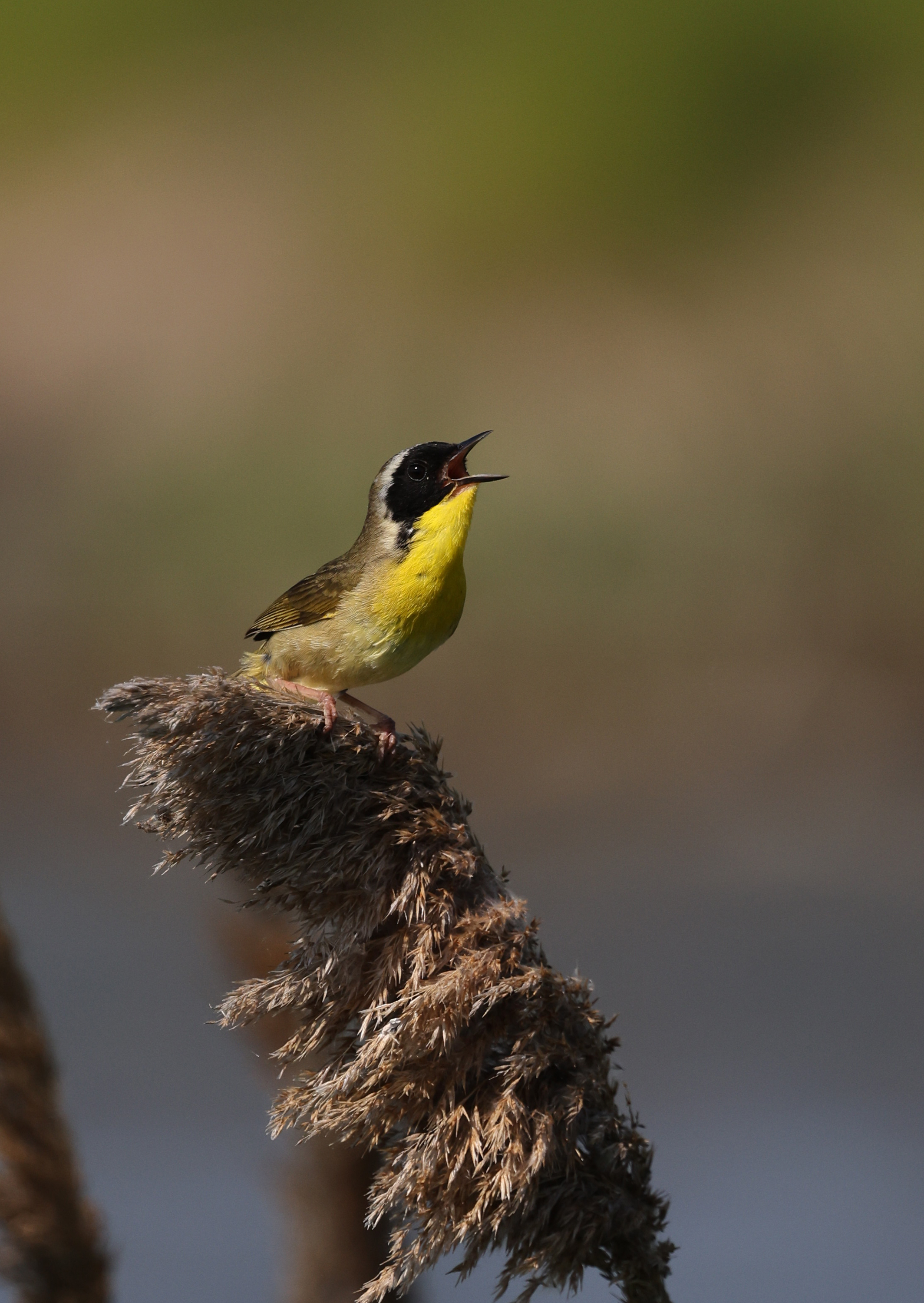
Coastal marshes had several nesting Seaside Sparrows (Ammospiza maritima). I think I could only see the males, who were singing from conspicuous perches, while the females stayed low. I consider these sparrows to be honorary shorebirds—they also probe mud for invertebrates with their large, sharp bills:

A local resident, an American Oystercatcher (Haematopus palliatus):

Another local, a Laughing Gull (Leucophaeus atricilla), eating a cluster of horseshoe crab eggs (together with a few beach pebbles). These “crabs” play an oversized role in the New Jersey coastal ecosystem:

Here, I suspect a Short-billed Dowitcher (Limnodromus griseus), almost identical in bill length to its “long-billed” cousin. Their bills are sensitive and tactile, allowing them to probe mud and sand fast, relying entirely on the sense of touch and feeding even in darkness:

During the peak of the spring migration, the birds continue their flight well after sunset. Living in the ‘Armpit of America’ has its moments:

Readers’ wildlife photos

June 16, 2026 • 8:15 am

Today’s plant photos come from Rik Gern of Austin, Texas.  Rik’s captions and IDs are indented and, as always, you can click on the photos to enlarge them.

Here are a few odds and ends from around my neighborhood for you.

When it’s the leaves fill out in the Summertime the Chinaberry Tree (Melia Azedarach) is pretty nondescript, but in the Winter when all that’s visible are the branches and berries, it is interesting and looks like it could have been designed by Dr. Seuss. The Chinaberry Tree is an introduced species, but is quite popular in this area:

The berries look like small wrinkled white grapes, but are hard as stones:

Here is another picture of the full tree, this time in black and white:

Another introduced species, originally from the Mediterranean, Rue (Ruta graveolens) is very popular with home gardeners:

Goldshower (Galphimia Glauca) hails from neighboring Mexico, but does quite well in the region:

This scrappy little plant is indigenous. It’s called a Silverleaf Nightshade (Solanum elaeagnifolium) due to the color of its flower, but I didn’t get to see it in bloom:

Here it looks like a tomato from a tough neighborhood, but it’s apparently more closely related to the potato:

The last image is a distortion of Chinaberry branches and berries. The clusters of berries made me think of the tinker-toy like models of chemical structures that you used to see in chemistry class, and that got me to thinking of DNA and all the plasticity of expression it allows for. Since this ended up with a vaguely Art Nouveau feel, I’m calling it DNA Nouveau: