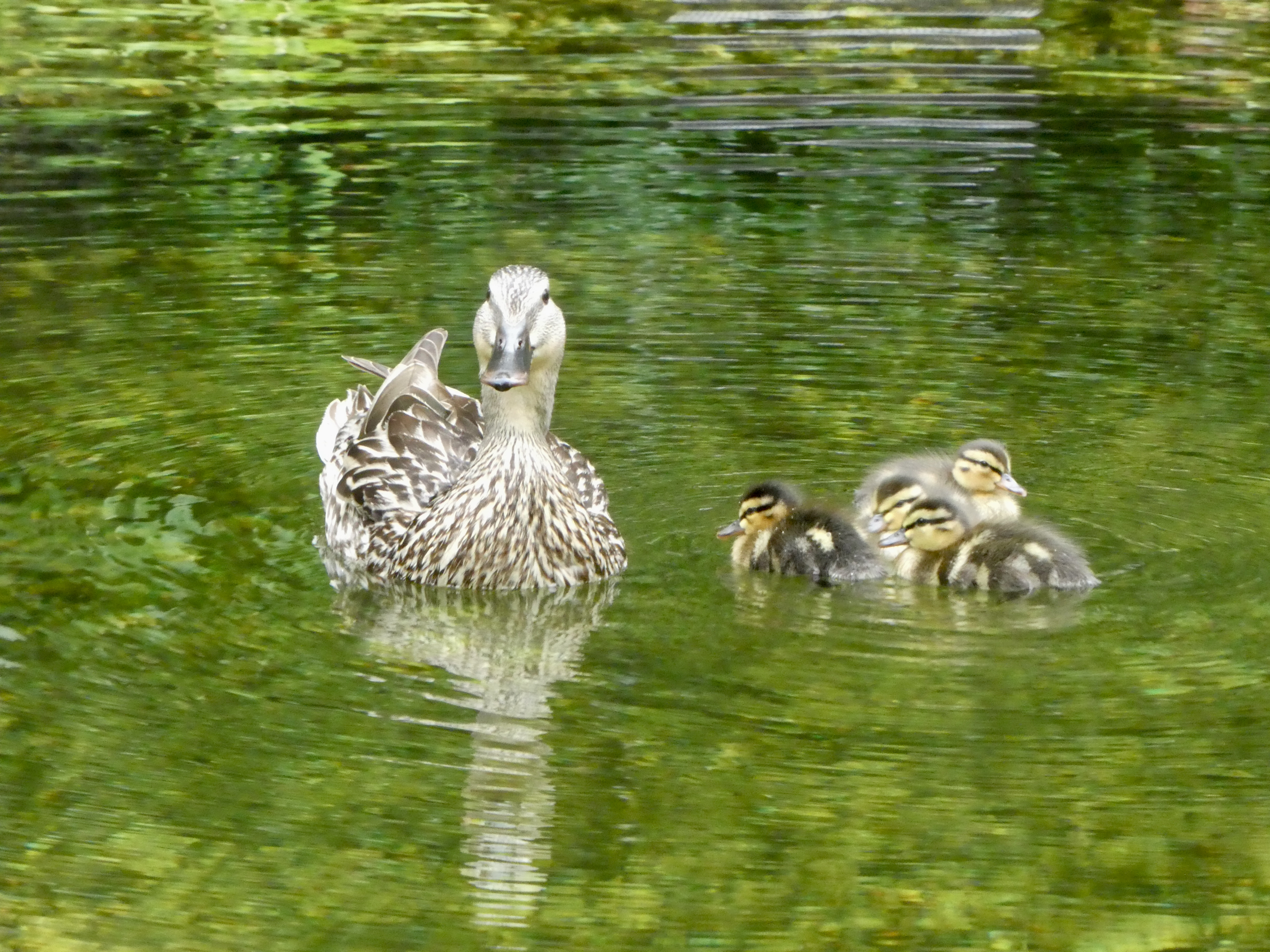
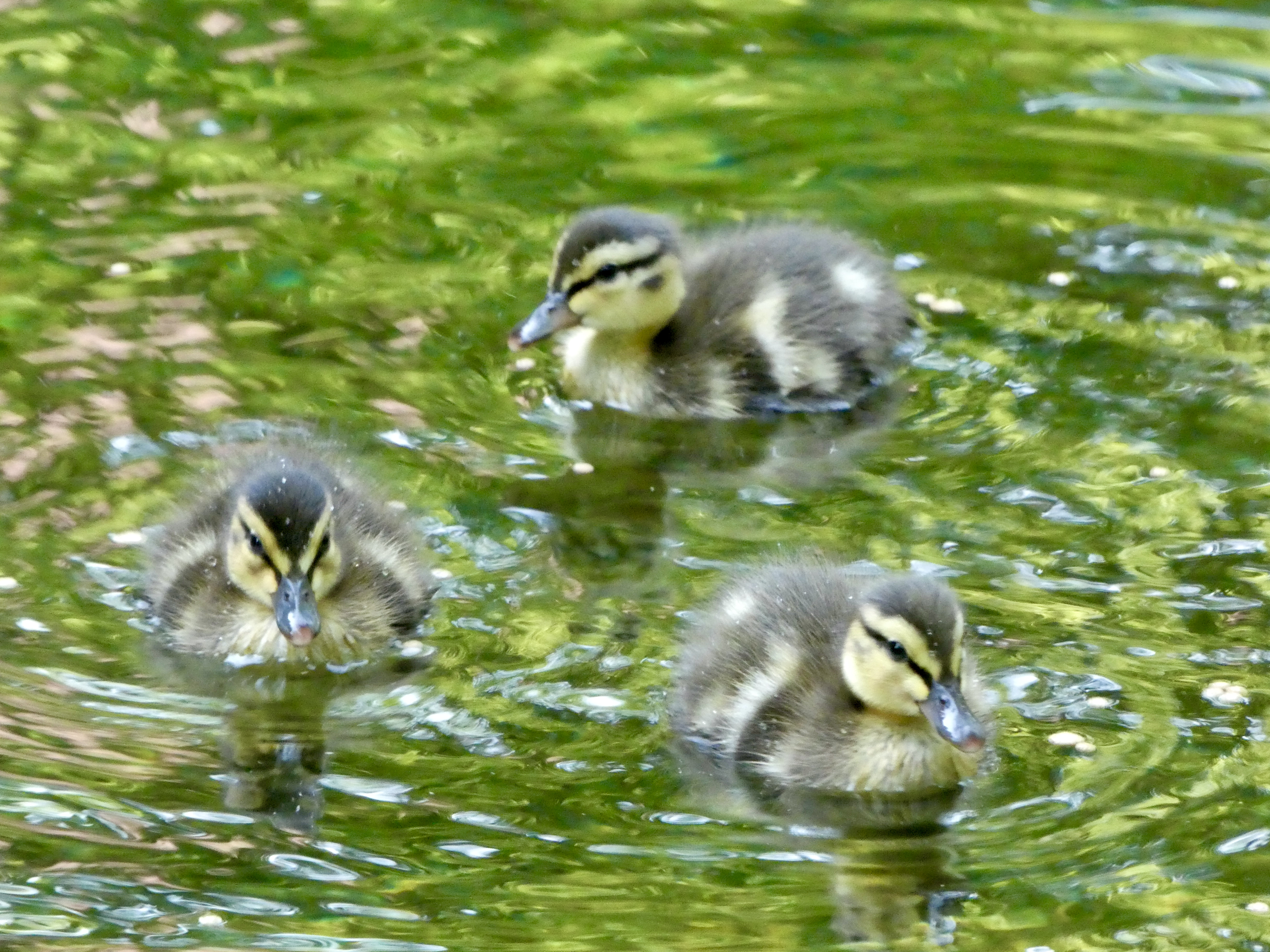
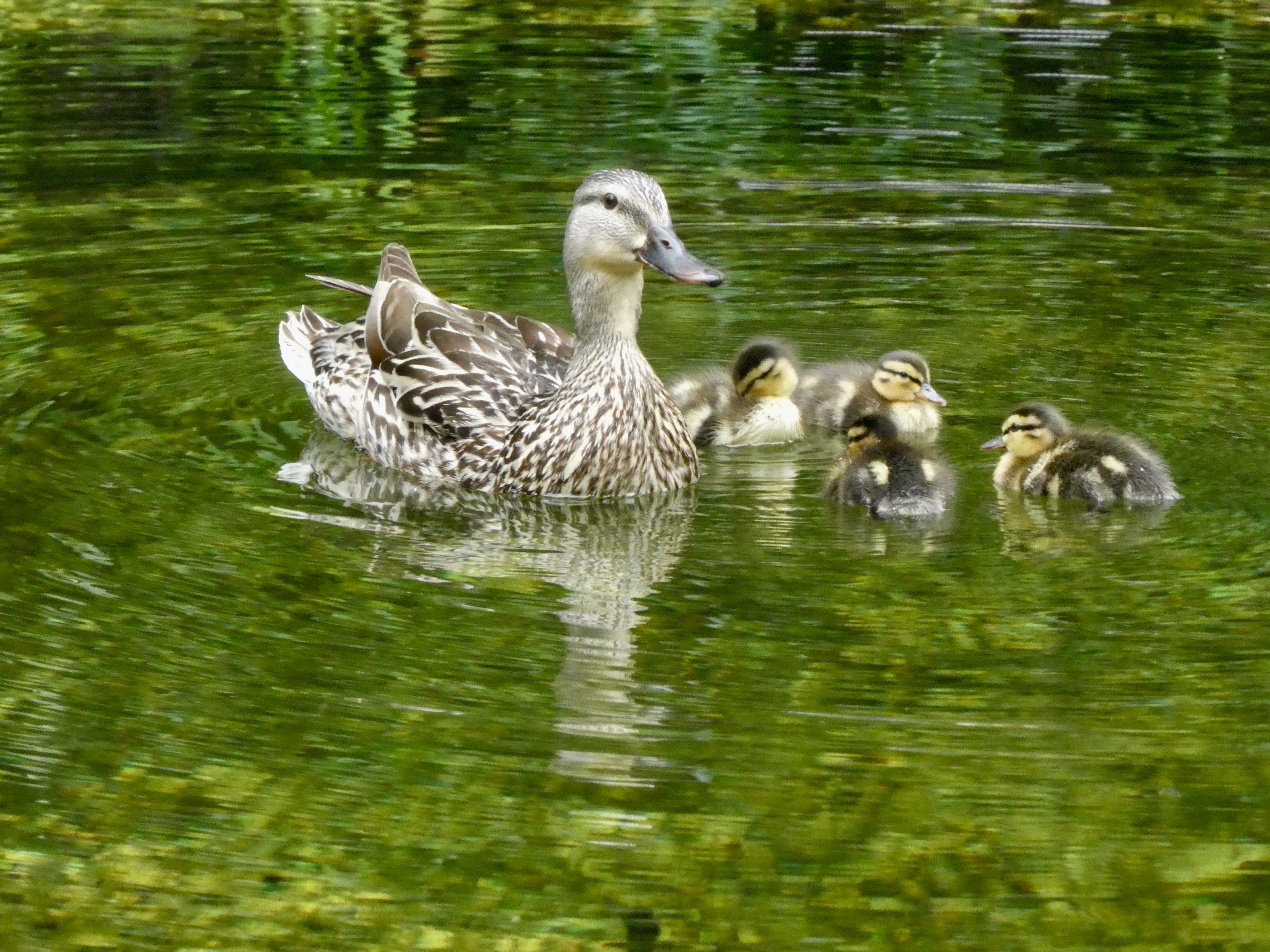
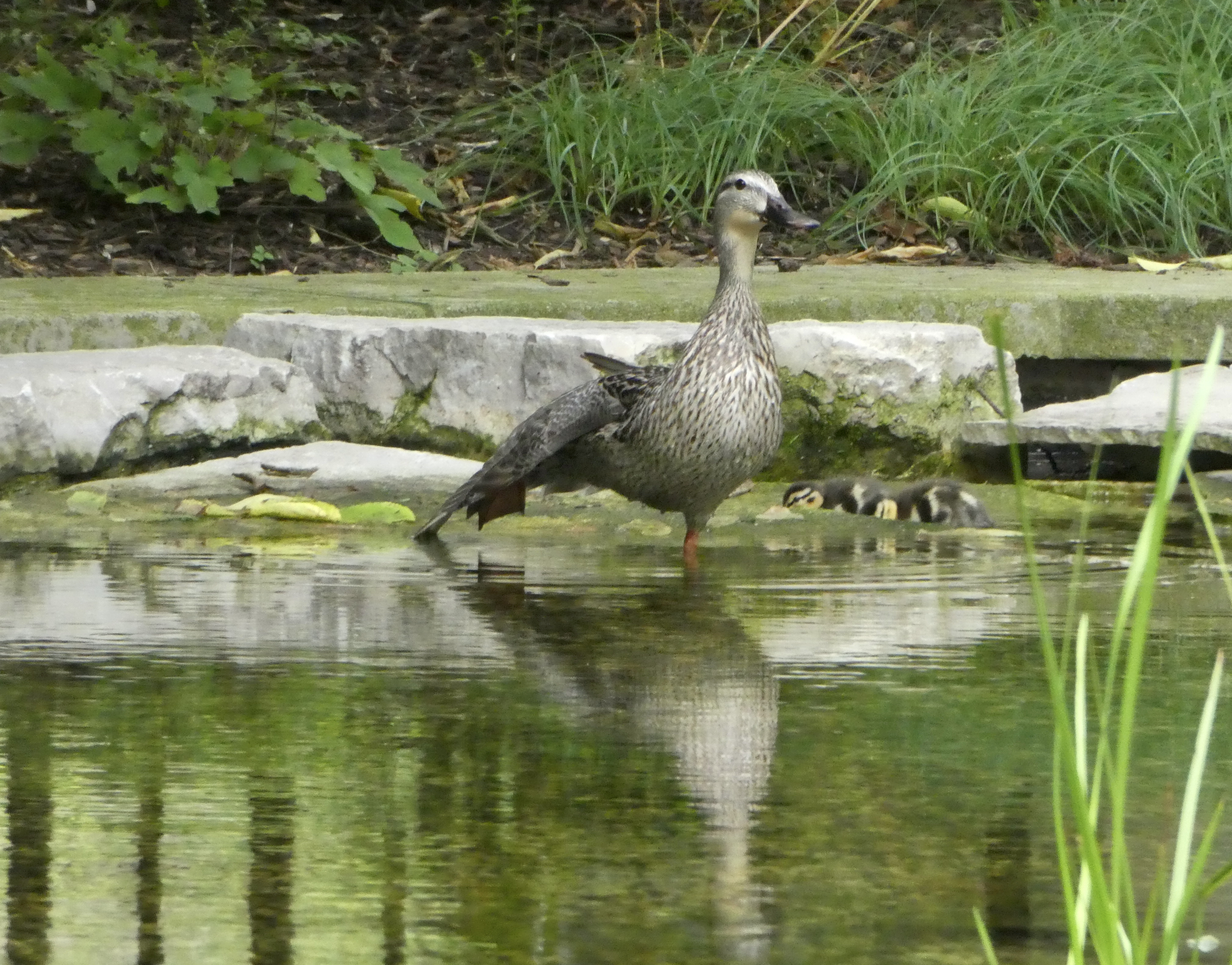
The gang’s all here!

July 21, 2026 • 9:50 am

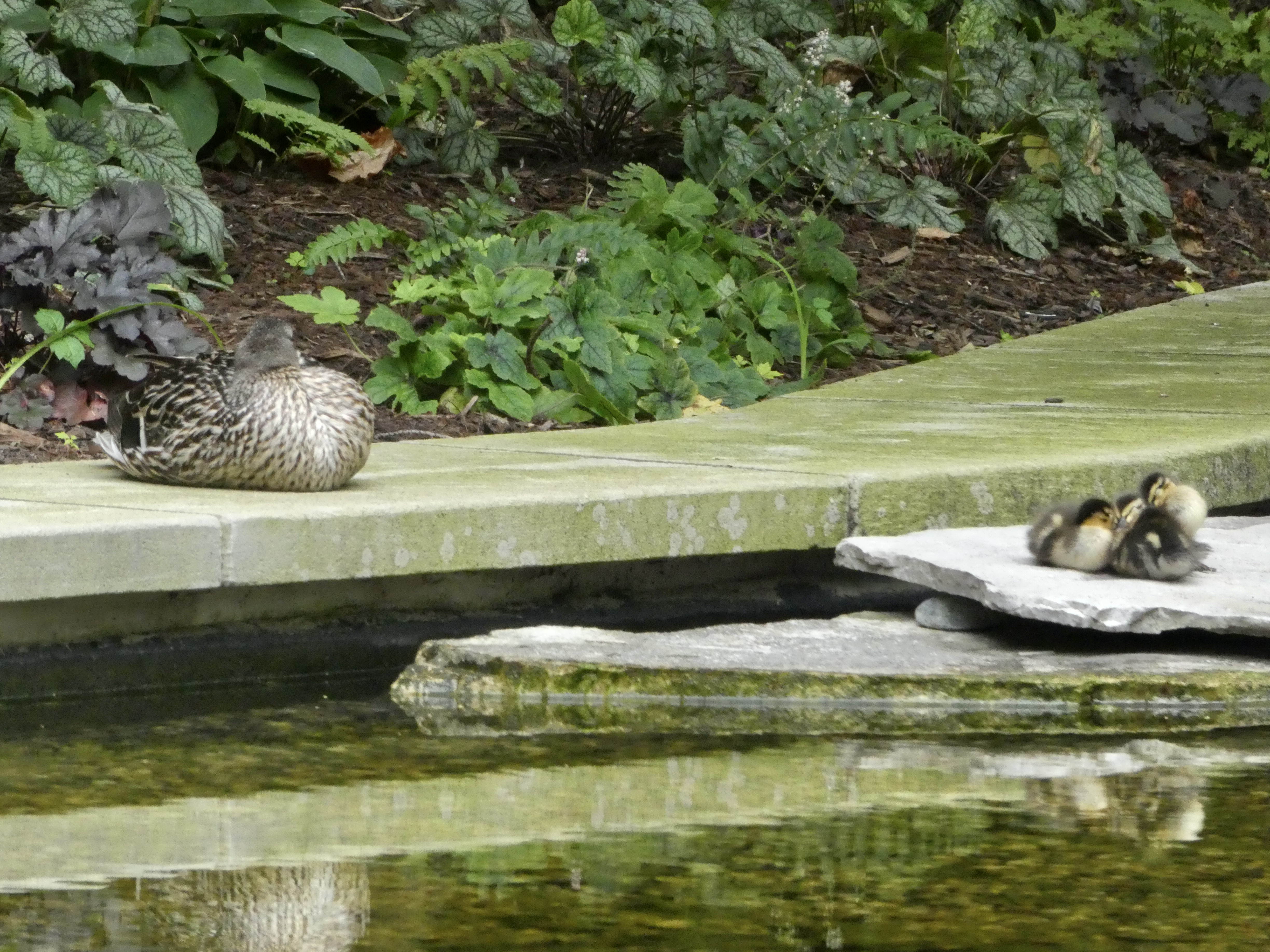
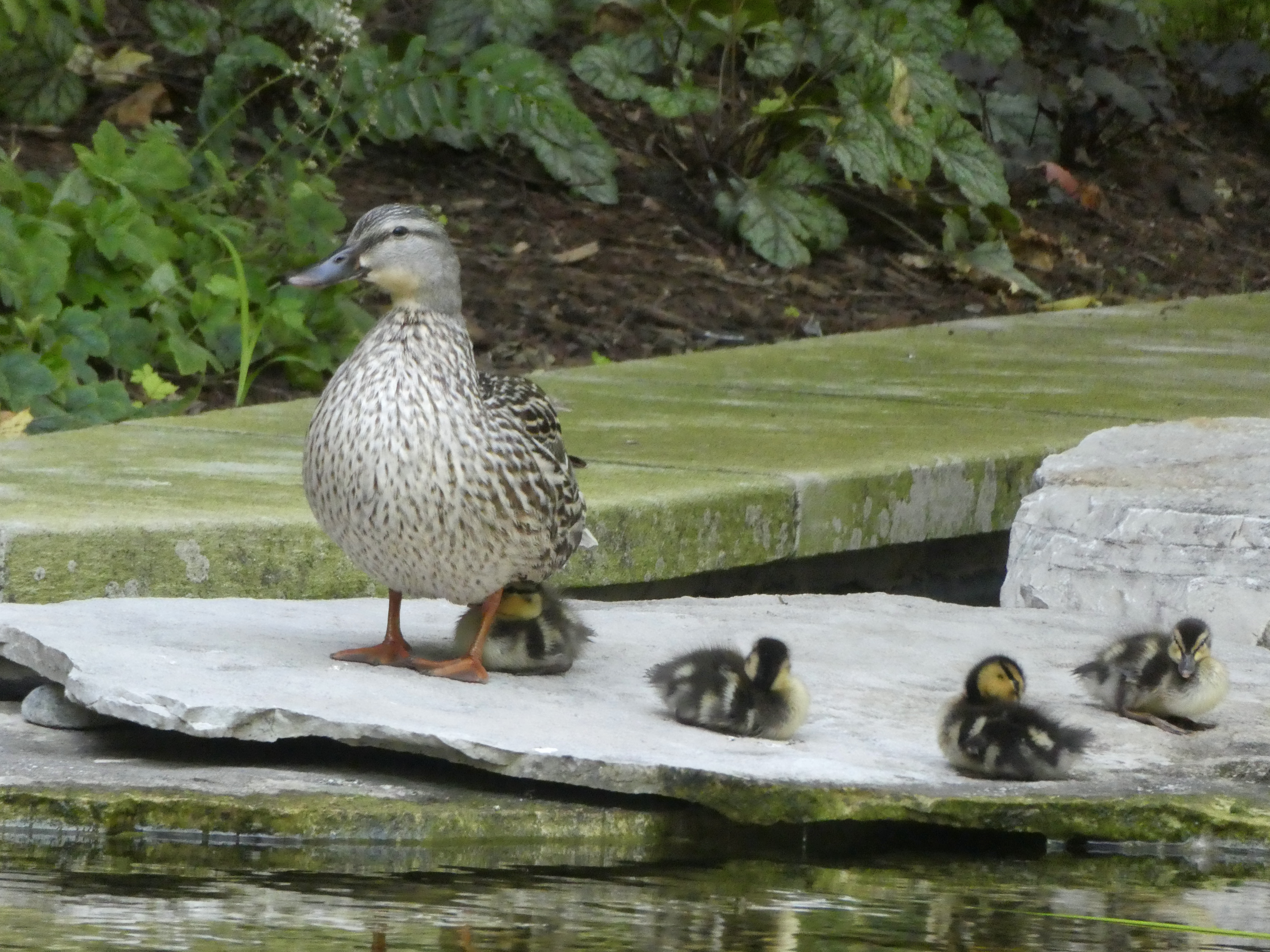
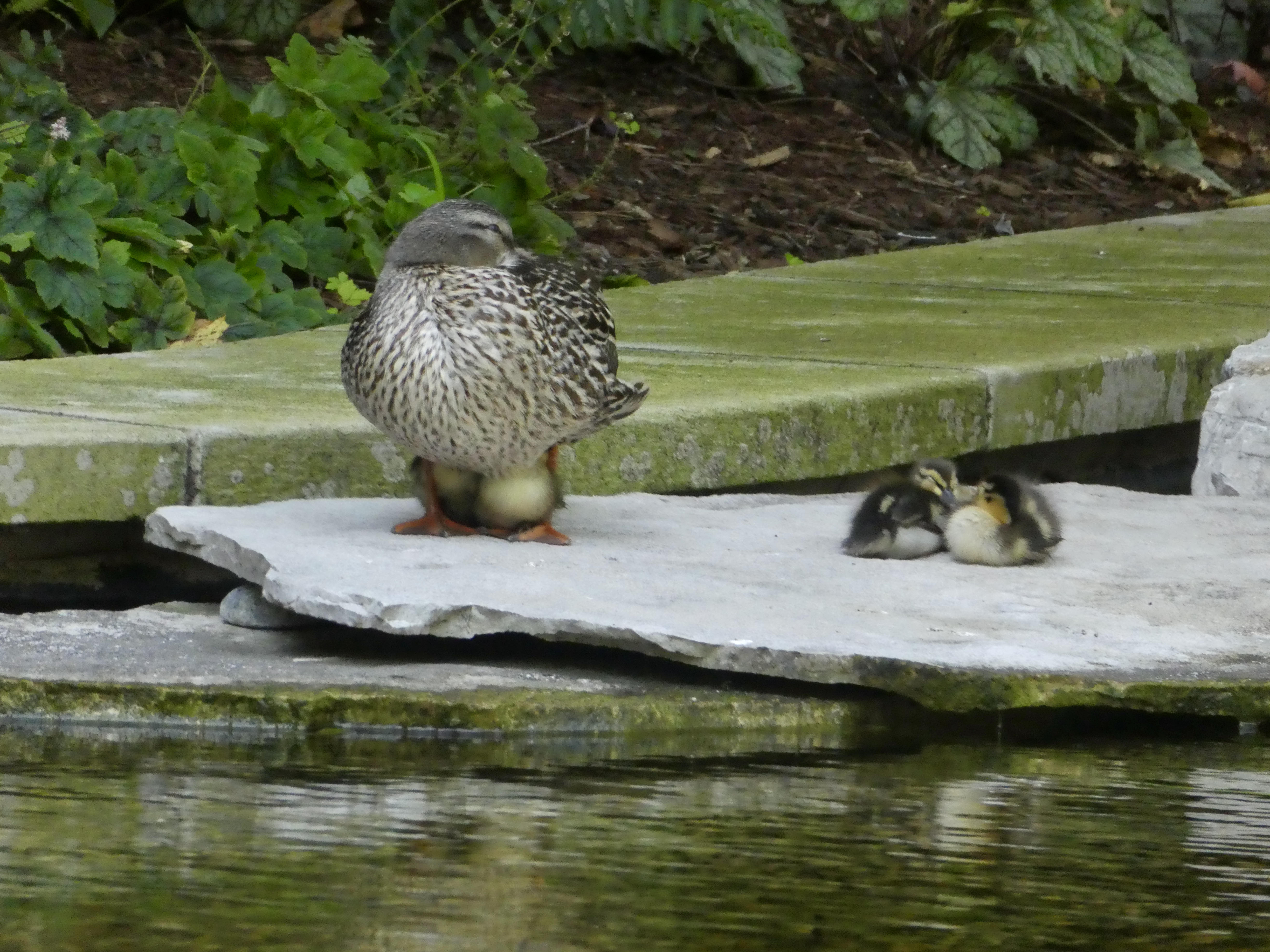
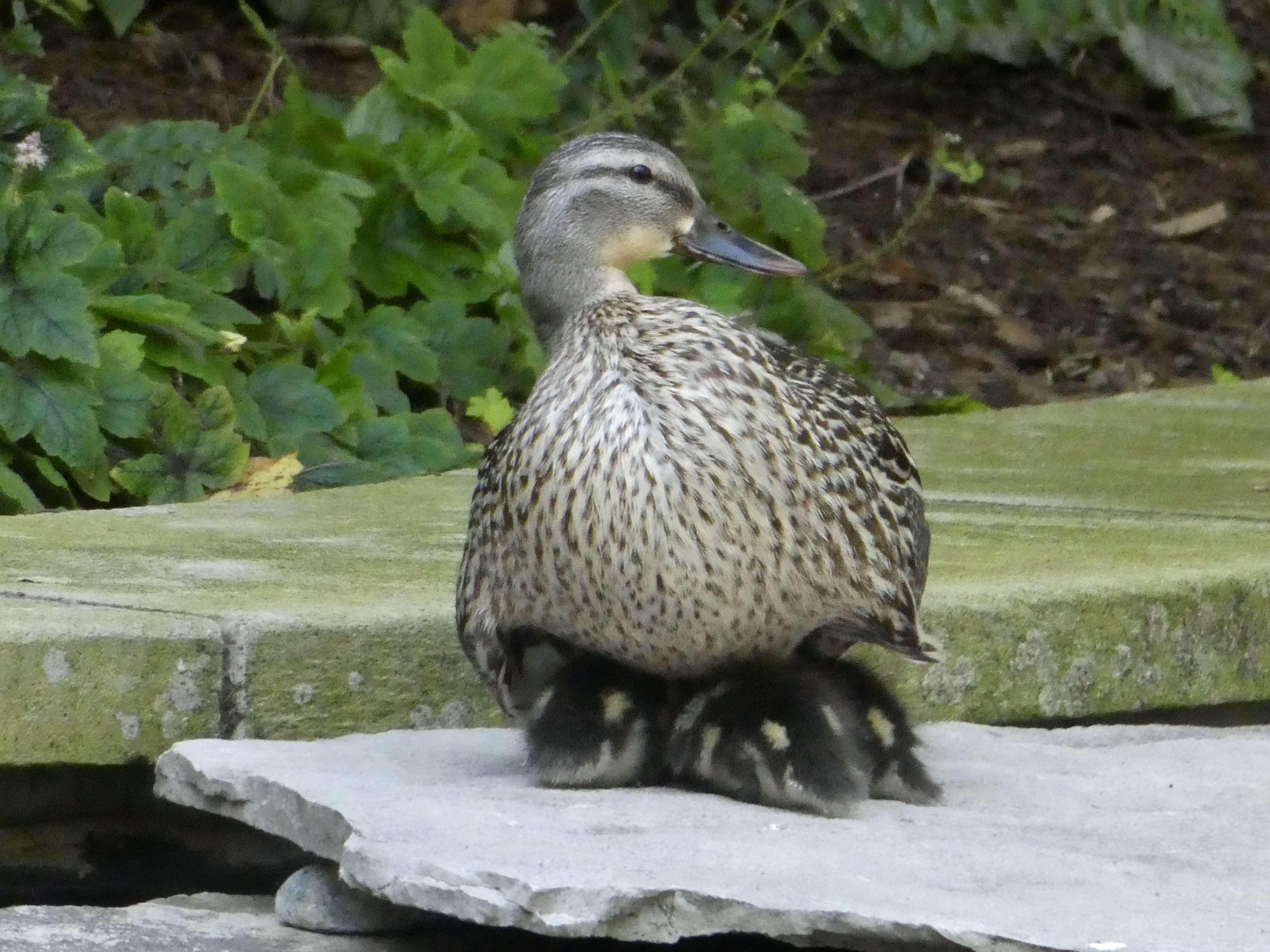
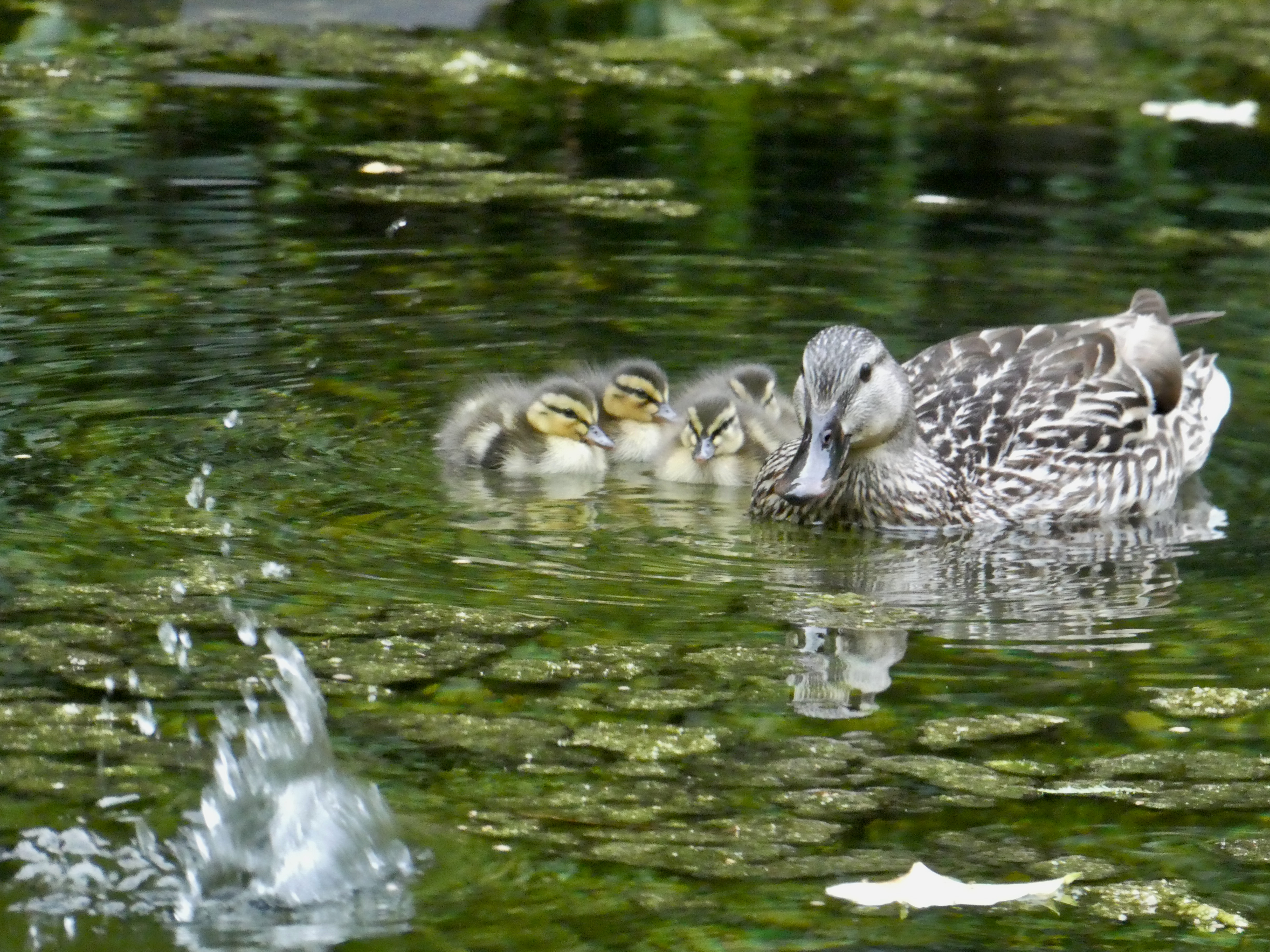
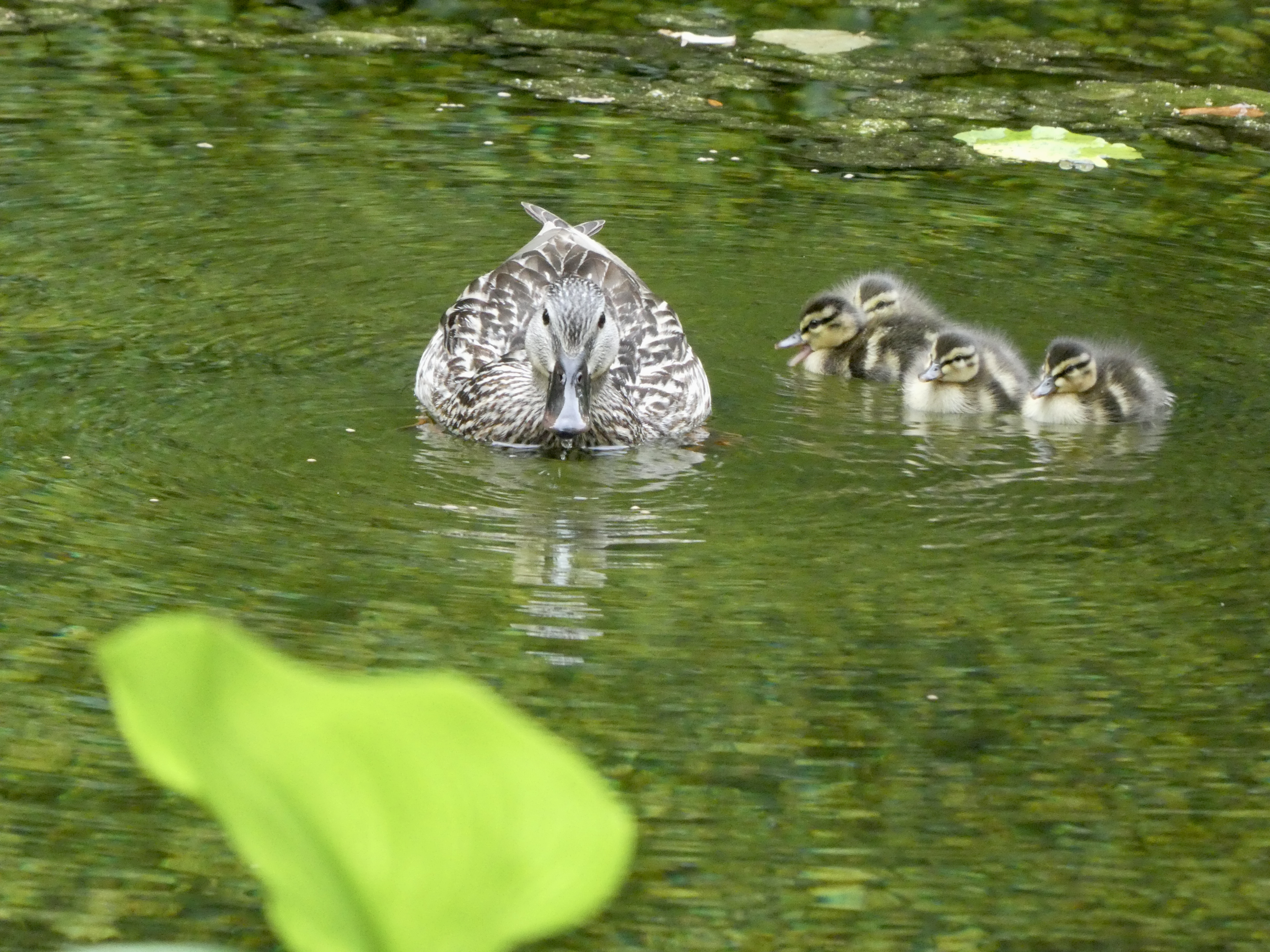
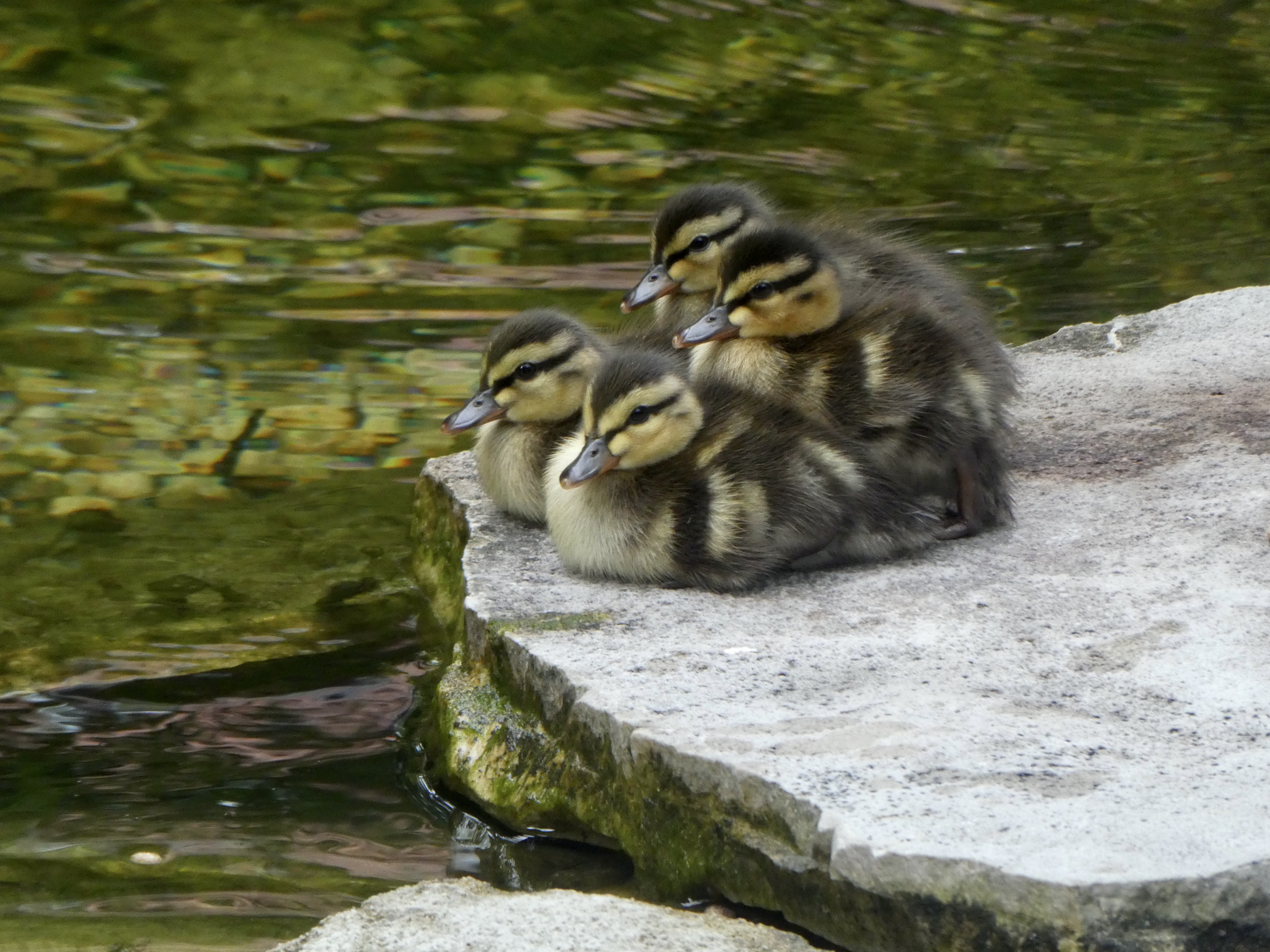
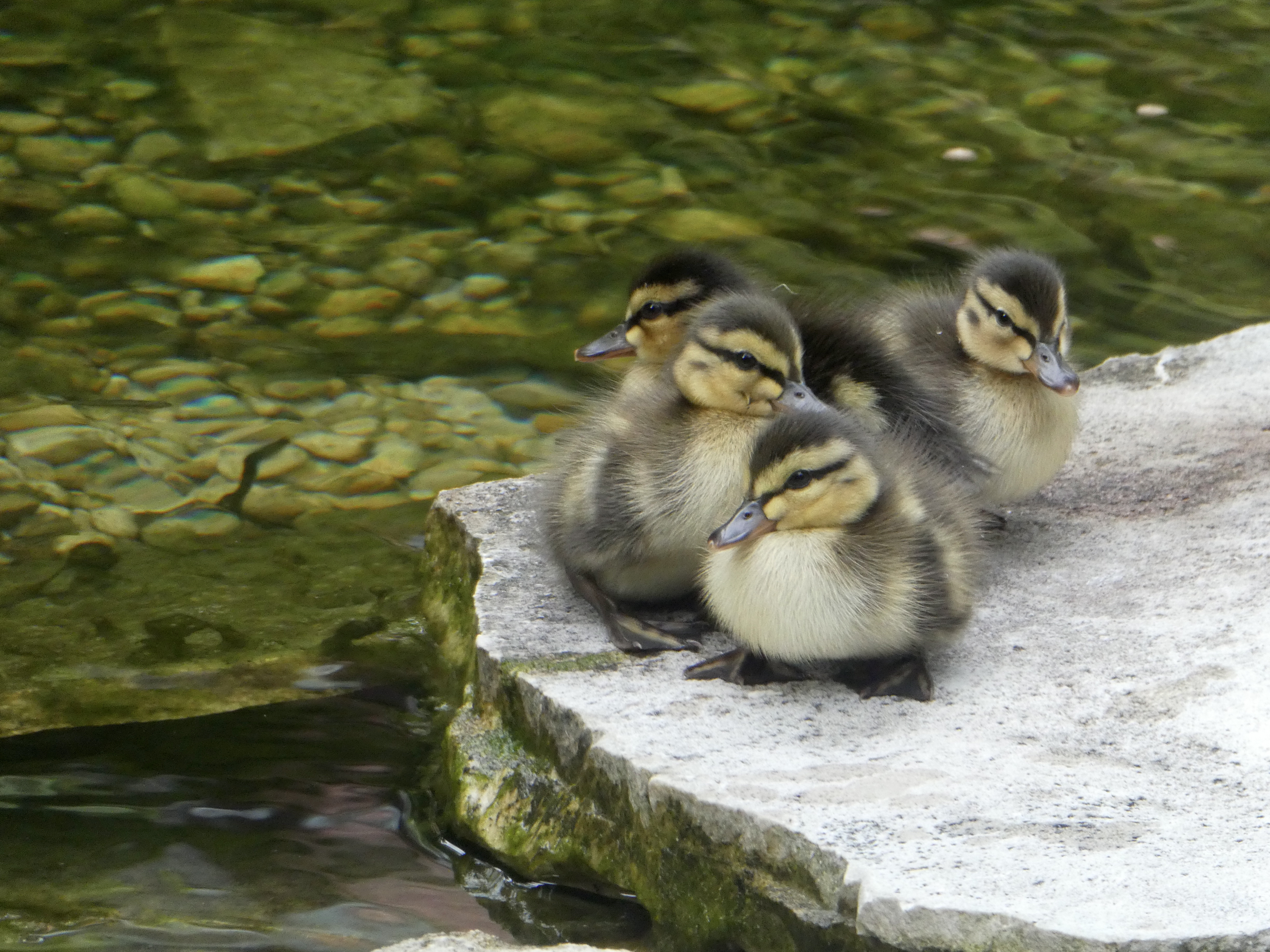
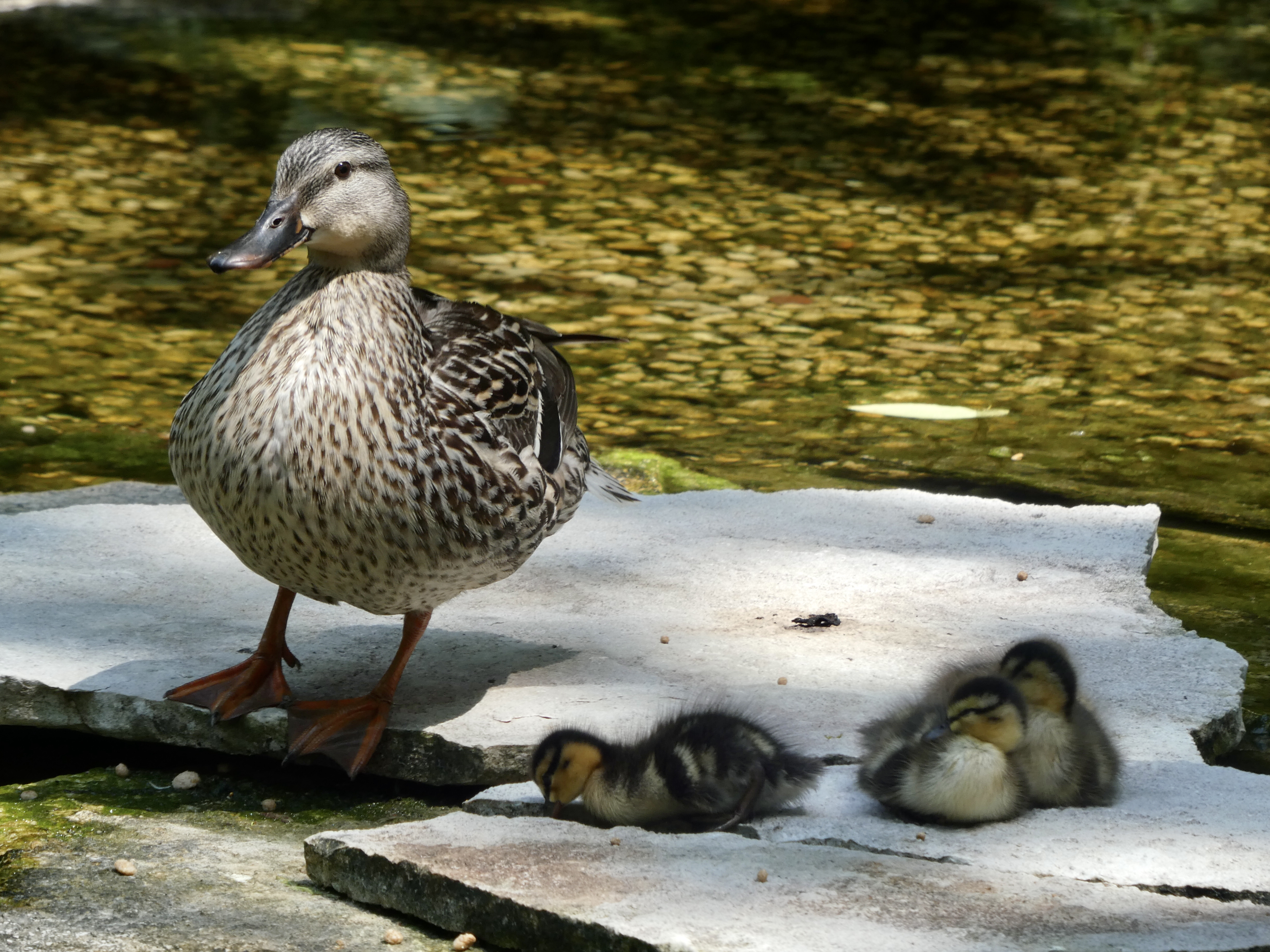
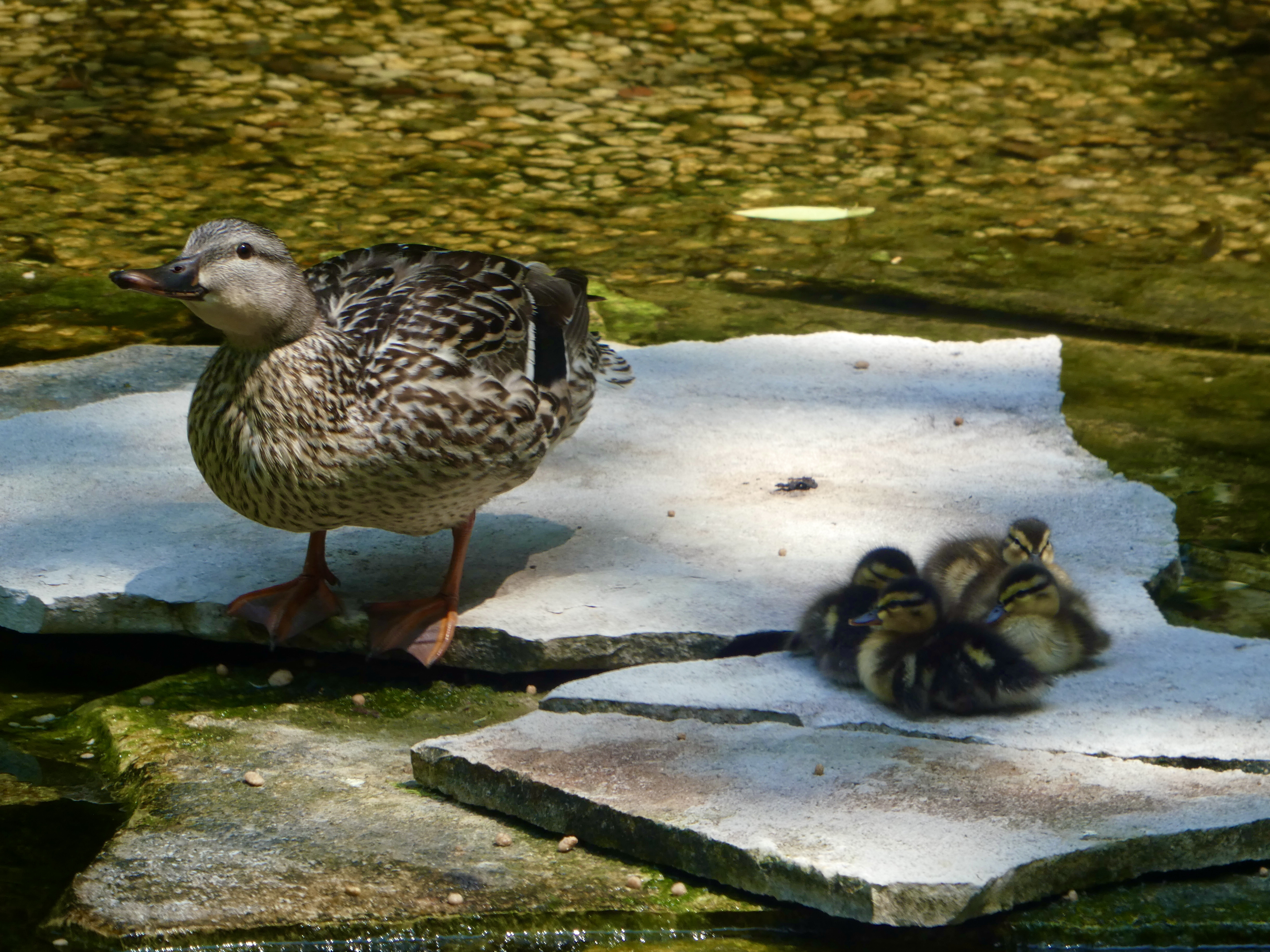
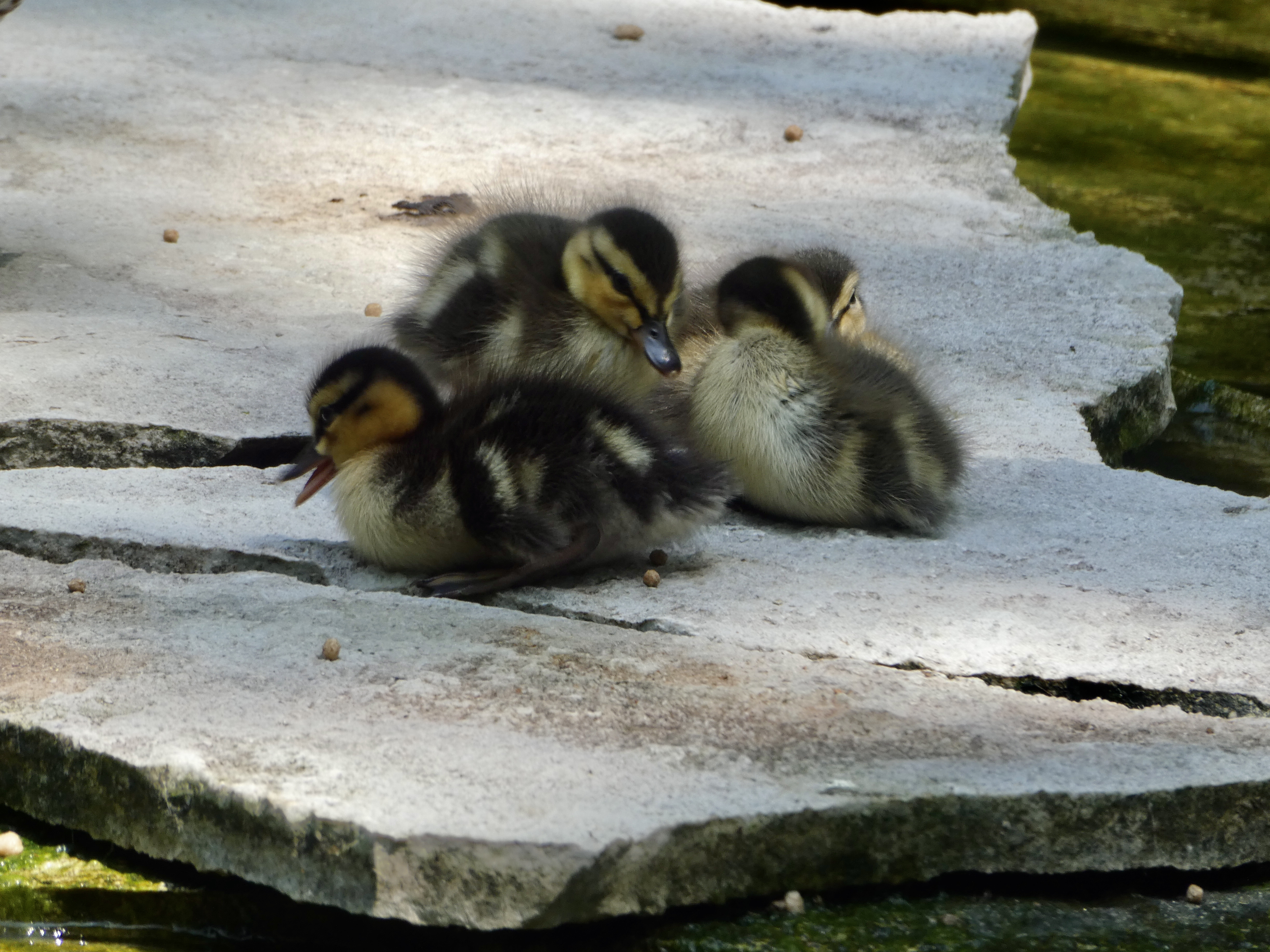
Since there’s no significant news today, allow me to bore you with my latest duck pictures, as I’m chuffed that all the babies are in their fourth day, having survived two nights without attrition. They look healthy, are eating heartily, and are lively, swimming around between bouts of napping with Miss Duck, their mom. All these photos are from this morning.

Feeding time (four—count them, four:

Their adorableness abides:

A postprandial stretch:

And an early morning nap, with Miss Duck being nearby. (I’ve already fed them twice):

And naptime turns into a huddle underneath mom. One underneath:

Two underneath (look at those fat little tummies!):

All underneath and getting warm. Miss Duck is proving to be a great mom.

I haz ducklings again!

July 20, 2026 • 8:45 am

Well, we have another brood of four ducklings in Botany Pond, and this time I’m hopeful they’ll grow up and fledge. Yes, it’s a late brood, but in two months they’ll be ready to fly, and the weather is good in mid-September.

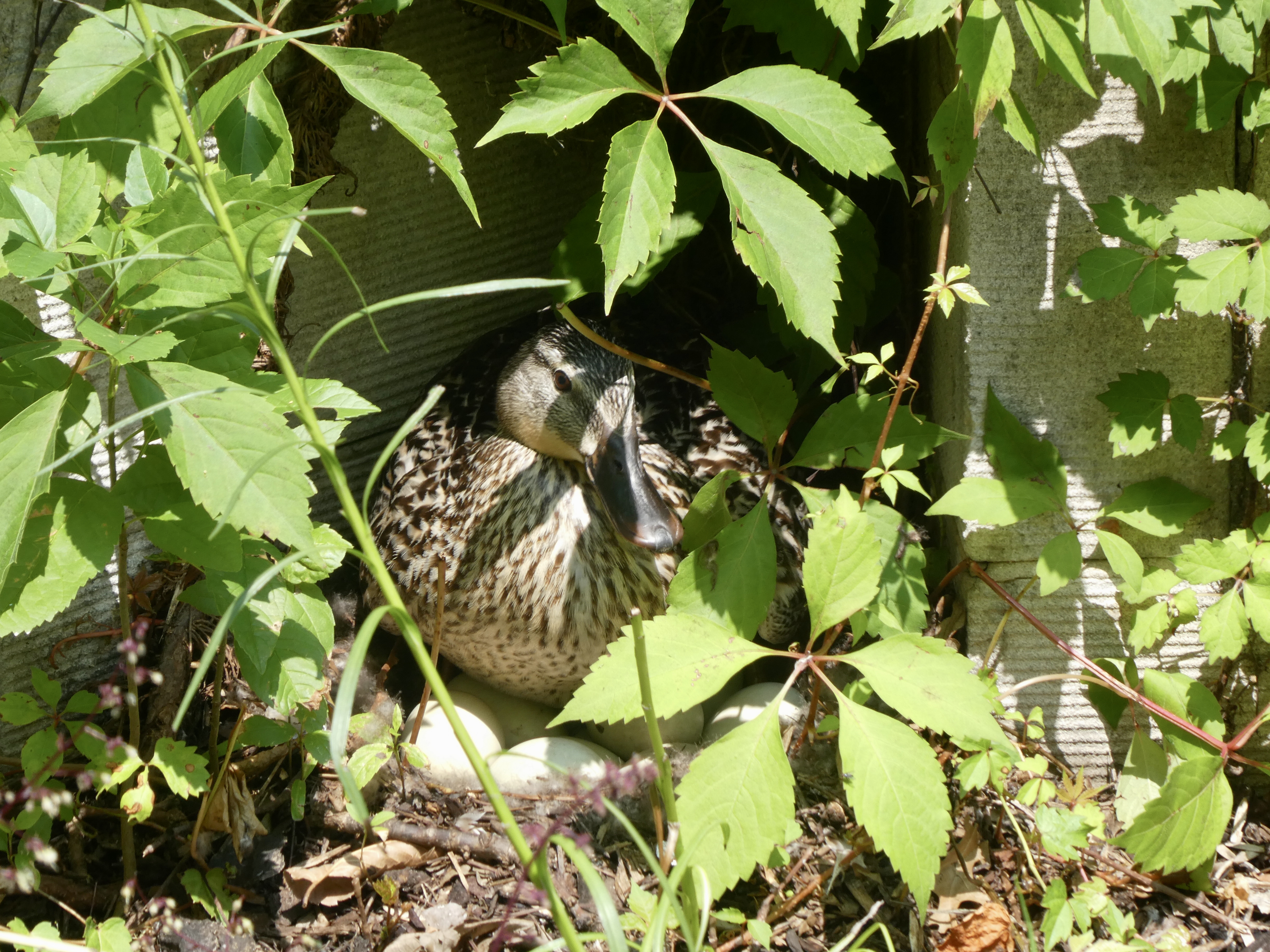
The story: four days ago an undergraduate alerted me to the presence of a nesting hen up against the student union building next to my own building. The hen had cleverly positioned her nest in a cranny in the building where it couldn’t be seen. A few shots.

I’ve circled the nest; you can see how hidden and inconspicuous it is. She must have been there for nearly month, unnoticed by anyone, when I came upon her, for her eggs hatched about a day after this and the incubation period is 28-29 days.

Here she is sitting on her eggs. It looks like a big pile o’ eggs, but in reality there were only five. It had been hot, and I hadn’t seen her in the pond, so not only was I unaware of her presence, but she must have gone without food or water in the blistering heat. I put a dish of cool water near her, and she didn’t seem very skittish.

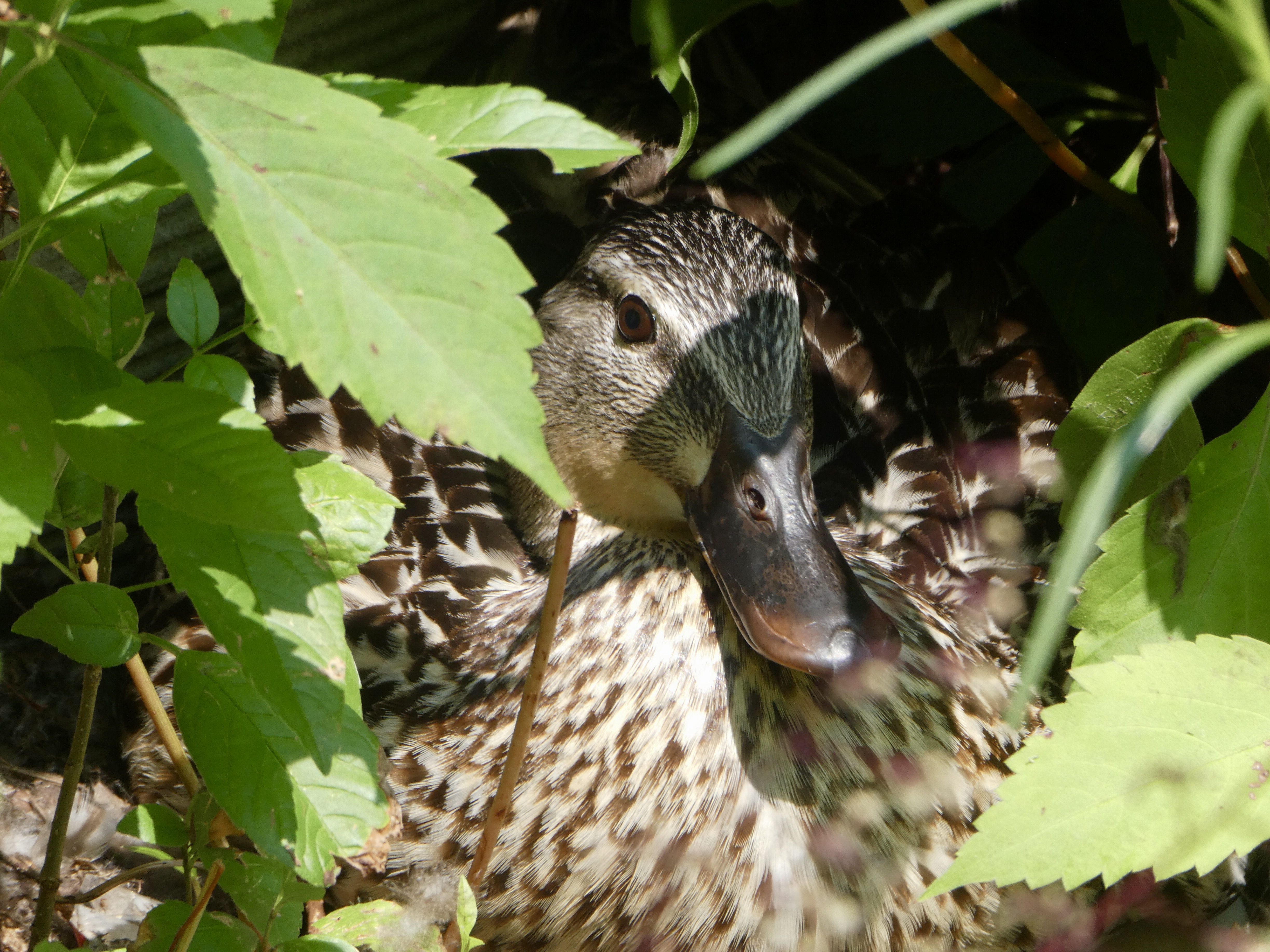
She is a lovely hen; there’s something appealing about her face.  As I’ve run out of duck names, I call her ‘Miss Duck”. She may be identical to Margot, as I haven’t yet checked bill photos, but I think she’s new. Also, unlike most hens, she nested on the ground rather than on a windowsill (wild mallards are ground-nesters).

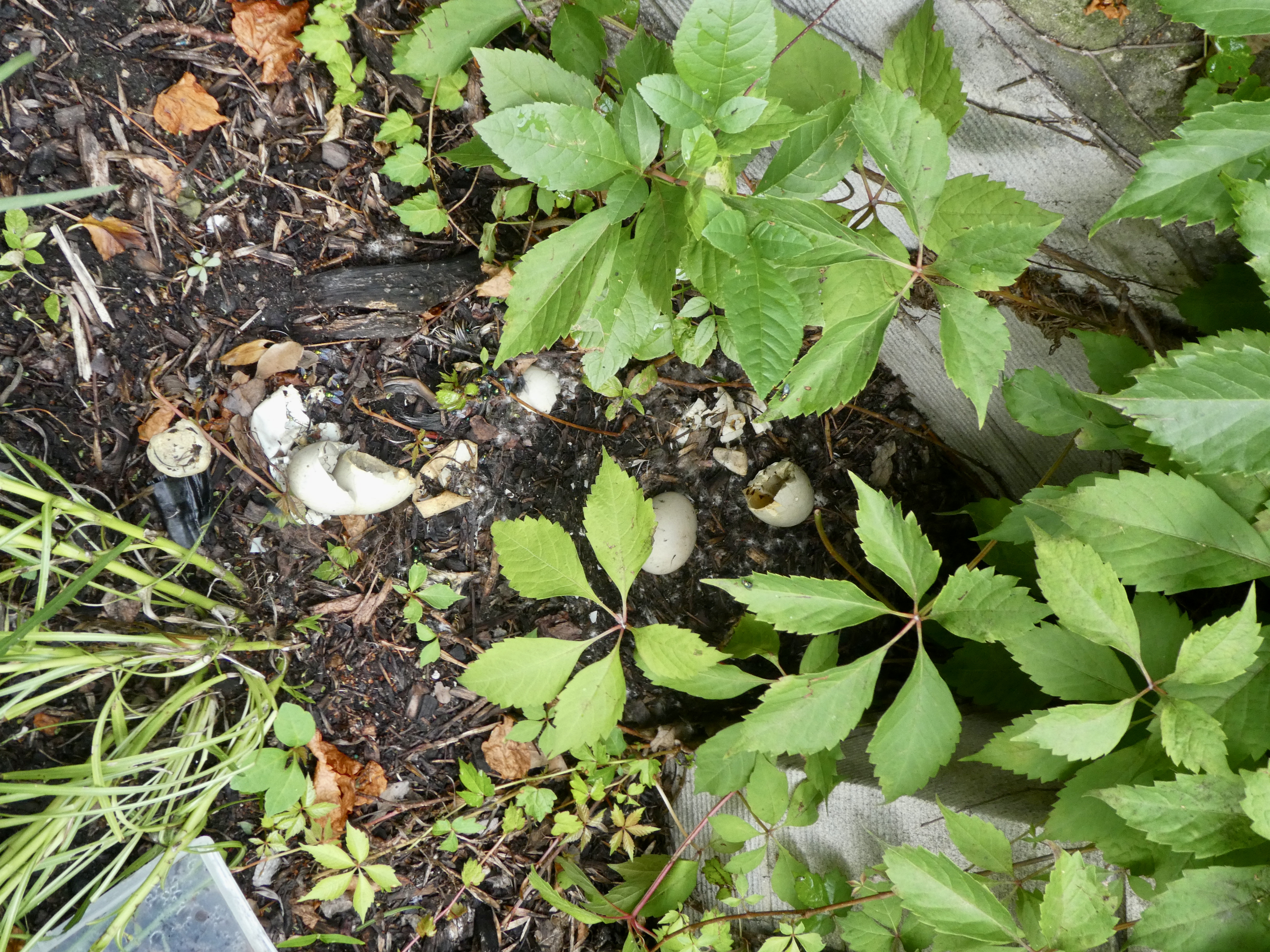
Yesterday (Sunday), I looked at the pondcam and saw a blob at the south end of Botany Pond, apparently followed by several smaller blobs. I went downstairs, and, sure enough, there was a duck with four ducklings. I went immediately to the nearby nest to see if there were any orphans hanging about, but no: there were broken eggshells and one unhatched eggs, which I kept warm for a day and a half though it didn’t hatch. This was Miss Duck in the pond, and she had laid five eggs.

The nest after hatching:

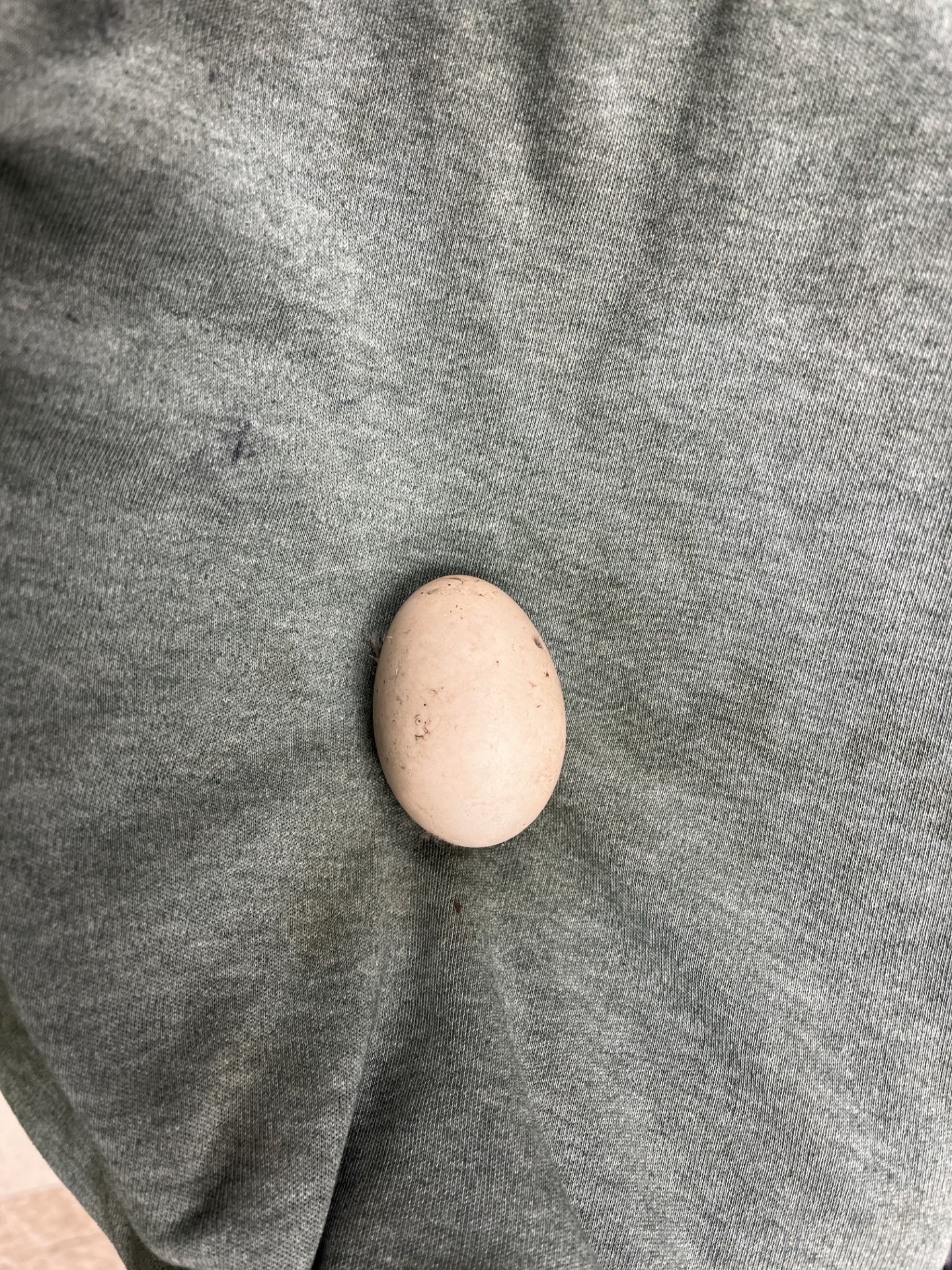
The one egg I saved, which was apparently infertile (I didn’t open it). It’s really light green, the normal color of mallard eggs, but the light in the lab makes it look pale orange.

And now the happy family. The babies are adorable, and Miss Duck is much tamer than the others we’ve had.  The splash of water is made by a fish, which somewhat startled Miss Duck.

I don’t know how she got to the pond; when I looked yesterday, it was about 6 a.m. Since the ducklings could not climb the stairs up through the breezeway, they must have been led around Erman, the building perpendicular to the one above, and then north again through the fence to the water. Miss Duck is smart.

Four is a small brood but she may be a young hen. Here are the babies, who, if they live, I’ll name after World Cup players. Aren’t they adorable? I think this is one of the best duckling photos I’ve ever taken:

More ducklings:

Since the dreaded Aggressive Drakes are gone, I have great hopes for this brood. The only problem is the algae: I don’t want the ducklings entangled in it and am asking Facilities to somehow remove surface algae without disturbing the ducklings.

They started eating yesterday.  Miss Duck had Big Duck pellets, while the babies nibbled at Little Duck Pellets and crushed mealworms.  This morning they were all still there, and were in the channel, where I fed them. Miss Duck has an endearing habit of quacking quietly when I greet her before feeding, and she’s learning my whistle.

Here they are yesterday on the rocks, sunning, drying off, and sometimes lying under mom’s belly:

I don’t think I could take another lost brood, so please cross your fingers that these little ones will grow up and fledge, and will not encounter ensnaring algae.

I have named the ducklings though I can’t distinguish them. With Matthew’s help, and because the ducklings hatched during the semifinals, I will name them

Messi (the GOAT),
Rodri (best player),
Kylian (golden boot), and
Erling (Norwegian star)

Readers’ wildlife photos

July 19, 2026 • 8:30 am

Today’s photos come from Dean Graetz, who notes, “I offer an unusual contribution to Readers wildlife photos.  It is an unusual personal story.” Dean’s captions are indented, and you can enlarge the photos by clicking on them. 

A Wild Life Extinction

Some 50 years ago, I encountered an unfamiliar way of Life.  It was a Wild Life: the lifestyle of Aboriginal people who have lived as nomadic hunter-gatherers in the Australian deserts for the last 60,000 years.  I met three old men, likely 60+ years of age, who could recall their first sighting of ‘Whitefellas’.  Their early lives were as nomadic hunter-gatherers, one that could be perilously difficult.  So, I began to follow any published stories of the desert dwellers from then until now, 50 years later, when they have stopped.  Some photos are mine with historic others borrowed from the Public Domain.  This was the spirit of the encounter.  There were 6 people in that vehicle

The location was Amata, in South Australia:  Aboriginal land: home of the Pitjantjatjara, a language which every member of the party spoke but me.  It was in one of the 10 named Australian deserts where the landscapes are as spectacular as the night sky.  Some important Dreaming stories are based on the constellations interpreted as the activities of animals, such the Emu, or people:

Because it is customary to bring gifts to your hosts, we shot two Red Kangaroos (Macropus rufus) knowing that they would be enjoyed as ‘properly good tucker’:

Our shot kangaroo retriever (effortlessly carrying 30+ kilos) was an important ‘law’ man and hunter.  By incredible chance, I knew of him (by name) from reading an anthropologist’s (1972) account of him:

His fame came from his ability to spear eagles in flight.  An astonishing skill:

It was difficult to hide the presents that we were bringing:

The three elders were happy to receive us with our gift of kangaroos.  Note that they are smallish men, likely protein-limited in early life, now getting ‘fat and shiny’ on store-bought food.  As an intruder, I took very few photos.  I noticed they were urinary incontinent but was later told that, as a condition of manhood, they had been circumcised as teenagers, then later they had opted to be sub incised (aka ‘whistle-dicked’) and were very proud of the seniority and masculine status that conferred.  Their dress and traditional accommodation (‘Wiltja’) in the background was their choice ignoring Whitefella’s available welfare.  The desert landscape was exceptionally lush in 1974; it was the wettest year on record:

They were reluctant (hand covering mouth) to talk about their younger days when there were no Whitefellas around.  They smiled at recalling their family group’s long travels – walkabout-  to hunt and ‘see’ their country.  They admitted that they ate more lizards than fat kangaroos, and there were some ‘tough times’ that were not be talked about.  Later, the three elders and their wives – who had been hidden – plus a few friends waited, for 20 minutes of cooking on an open fire, to eat the two kangaroos at one long evening sitting.  Around the neighbouring Whitefella campfire, the considered opinion of hunter-gatherers was that in 1974, ‘there is no one out there now’.  “All gone: all finish him up!”:

This brief contact was an end point of a long personal and professional interest in the desert landscapes and in the people who surprisingly endured their harshness.  As a university student (1950s) I was intrigued by photos, such as this, of full grown Aboriginal men (beards) but with teenager-sized bodies.  It had to be the result of malnourishment.  Why did they live there?  And, more importantly, how did they live there?:

In 1974, these questions were now in the past tense.  There were no hunter-gathering people still ‘out there’, living out their ‘wild’ lives.  Because of government concern for their welfare, efforts ensured they had all been ‘contacted’.  The deserts, ‘their country’, were now empty of its intriguing inhabitants.

Not so!  In 1977, a search party located a couple hiding for 30 years in the remote Gibson Desert fearing tribal vengeance – ‘The last of the Nomads’.  Then, in 1984, a small group, The Pintupi Nine, walked out of the desert and made contact – as below on day 2, first clothes.  Next, in 1986, a family group of seven (Richters/Rictors) emerged from the Great Victoria Desert.  Now 40 years later, we can conclude that hunter-gatherers are now extinct across  the Australian continent:


The hunter-gatherer life requires self-sufficiency.  Your food is only what you can find or kill.  Your tools are only what you can make.  Your only ability to manipulate the landscape is the fire that you ignite, and you control.

Does it matter that this nomadic way of life is no longer pursued in Australia?  No: but an understanding of what and when it was is important for our societal memory.  This quote from a historian says it all.

“Perhaps all people on Earth need a sense of the continuing existence of ‘nomads’, for all of our ancestors were once so.  They remind us of who we are.”

Readers’ wildlife photos

July 18, 2026 • 8:15 am

Today we have photos from Ephraim Heller continuing his series on a recent trip to Namibia. Ephraim’s captions and IDs are indented, and you can enlarge his photos by clicking on them.

I continue my series on a May-June 2026 visit to Namibia. I’m organizing the posts by habitat, in the order of our visits, so that you get a sense of the ecosystems. Today’s post features the south-western black rhinoceros (Diceros bicornis bicornis) and southern white rhinos (Ceratotherium simum simum) of Etosha National Park and the adjacent, private Ongava Game Reserve. This is one of the most important rhino populations in Africa. In other African national parks I was happy to see one or two rhinos. On this trip I was surprised and pleased to view dozens of individuals.

[Note to readers: I have a lot of difficulty distinguishing the two species. I would appreciate corrections from experts if I have made an identification mistake.]

White rhino in morning light:

My previous posts documented Namibia’s desert coastline. Etosha National Park lies inland. The region is semi-arid with mean annual precipitation of 300-430 mm (12-17 in) and hot summers with typical temperatures around 40 °C (104°F).

Proclaimed as a reserve in 1907 by the German colonial administration and later reduced by the South Africa administration to just a quarter of its original size due to political and agricultural pressure, the park today encompasses over 22,000 km² (8,500 mi²). It is Namibia’s flagship conservation area. The park is dominated by the Etosha Pan, a ~5,000 km² (1,930 mi²) saline depression that is the remnant of an ancient inland lake.

White rhino at night. You can see the impressive scarring along its torso:

On the southern boundary of Etosha National Park lies Ongava Game Reserve, a private conservation area whose name means “rhino” in the Herero language. Starting in 1991 with the purchase of ~30,000 hectares of former cattle farmland, the Reserve’s ecology has slowly recovered. While the Park is closed to visitors at night, the Reserve caters to photographers with lodges and photo blinds overlooking illuminated waterholes.

White rhino baby nursing at the waterhole at night:

I wondered whether the two rhino species compete with each other. I learned that despite being closely related, they occupy distinct ecological niches. The mopane and mixed woodlands provide critical browse for black rhinos, and the grasslands support white rhinos.

This young male white rhino came too close to a baby. The baby’s mother inflicted this wound as a helpful reminder to respect her baby:

The southern white rhino is the larger of the two species, with adult bulls commonly exceeding 2,000 kg and occasionally approaching 3,500 kg. Despite the name, both African rhinos are grey and no one knows why are they called “white” and “black.” White rhinos are obligate grazers that crop grasses. Their large head is held low and supported by a pronounced hump at the neck.

White rhino with an impressive horn. Note the hump at the neck:

Socially they are more gregarious than black rhinos, often forming small groups of cows and calves, with territorial bulls maintaining more solitary ranges. Southern white rhinos recovered from a severe population bottleneck in the late 19th and early 20th centuries and are currently listed as Near Threatened. They disappeared from Etosha and were reintroduced in the 1990s from South Africa.

White rhino in the grass:

White rhino in dawn light. I love the ear tufts:

Black rhinos are smaller and more compact, typically weighing 800–1,400 kg. Allegedly, their most distinctive feature is the prehensile, hooked upper lip used for browsing leaves, twigs, and shoots from bushes and trees (I can’t distinguish the difference in their mouths). The head is held higher than in white rhinos, and the back shows a saddle-like dip. They are generally more solitary and can be more aggressive.

Rhinos on the way to the waterhole at dusk. I’m told that these are black rhinos, but those sure are big humps:

In the mid-20th century, remaining black rhinos from elsewhere in Namibia were relocated into Etosha. With improved protection and habitat, the population recovered strongly to over 500 black rhinos. Namibia has the south-western subspecies. Etosha is a global stronghold for this population. The species as a whole remains Critically Endangered following catastrophic declines in the 20th century.

Black rhino baby at the waterhole at night:

Poaching remains the primary threat to African rhinos. The news here is mixed. Etosha National Park has not fared well due to its large size and public management, with dozens of rhinos poached annually in recent years. On the other hand, and to their great credit, Ongava has had zero poaching incidents in recent history due to its private ownership, smaller size, and intensive security (dedicated, armed, anti-poaching teams conducting foot patrols; trained canine units; aerial support; and continuous high-tech monitoring). Tourism revenue helps fund security. Dehorning is used selectively in some high-risk areas as an additional deterrent.

This black rhino appears to be a veteran of many battles:

Readers’ wildlife photos and videos

July 17, 2026 • 8:15 am

Today we have photos and videos of the California intertidal taken by math professor Abby Thompson of UC Davis. Her captions and IDs are indented, and you can enlarge the photos by clicking on them.

Just a few more great low tides for the summer. By August the kelp is so lush, it becomes harder to find interesting creatures, so I’m enjoying June and July.  These photos were taken during the full moon at the end of June.

Amblyosyllis anae (marine worm- it seems to be a summer of worms). This genus is relatively rare (or at least hard to find) here.   I had picked up a piece of sponge to look at under a microscope, and this guy crawled out, so I was lucky.  It was about ¼” long, and lively, as you can see in the video which follows.

Amblyosyllis anae video:

Megalorchestia corniculata (beach flea)- part of the beach clean-up crew.

Dirona picta (nudibranch):

Genus Eudendrium (hydroid):

Class Hydrozoa; this is the medusa (baby jellyfish) form of a hydroid, possibly of the Eudendrium in the previous picture (they were in the same dish). I don’t know what the yellow blob it’s attached to is; in the video following you can see it trying to detach itself:

Hydrozoa video:

Family Phoronidae– yet another type of marine worm, a “horseshoe worm”:

Genus Haliclona (sponge) – it takes an expert and/or a microscope to determine species for sponges. This type is very widespread, and a great color:

Ancula pacifica (tiny nudibranch):

Dendraster excentricus (Sand dollar) This is the “test” (internal skeleton) of a kind of flattened sea urchin. The live urchins stay below the low tide line, and they live in big clusters, sometimes propped up perpendicular to the sand.      Sort-of like the drawing of the oysters in Lewis Carroll’s “The Walrus and the Carpenter”, but underwater, and without the little shoes.

Mussel tracks- not tracks, of course, but for some reason mussels release droplets (presumably seawater?) when they’re exposed at low tide:

Anthopleura artemisia (moonglow anemone):

Moonset over Tomales Point. Moonset on June 30 was just before sunrise, making for some cool lighting:

Readers’ wildlife photos

July 12, 2026 • 8:15 am

We’re running out of wildlife contributions—I suppose we always are, but this is the last batch on hand. You know what to do if you have good photos.

Today we continue with Ephraim Heller’s photos from a recent trip to Namibia.  Ephraim’s captions are indented, and you can enlarge his photos by clicking on them:

Today I continue my series on a May-June 2026 visit to Namibia. I’m organizing the posts by habitat, in the order of our visits, so that you get a sense of the ecosystems. Today’s post features the Skeleton Coast, yet another coastal desert region.

Stretching 500 km along the Atlantic, the Skeleton Coast is where the cold, nutrient-rich waters of the Benguela Current collide with the Namib Desert, producing dense coastal fogs most mornings. The indigenous San once called the region “the Land God Made in Anger.” Portuguese mariners knew it as the Gates of Hell.

The name “Skeleton Coast” has a dual origin. It first referred to the vast quantities of whale and seal bones that once littered the beaches, remnants of the 19th- and early-20th-century whaling industry. Over time the moniker also came to encompass the skeletal remains of the ships wrecked along one of the most dangerous coastlines in the world. There are about 300 recorded shipwrecks, with a total of >1,000 estimated over centuries. Persistent, dense fog reduces visibility to near zero for days at a time. Strong, unpredictable currents and heavy surf pound the beaches. Offshore rocks and poorly charted shoals lie just beneath the surface. Before modern navigation systems, the featureless desert coastline offered almost no landmarks, and any shipwrecked sailor who managed to reach shore faced a waterless, nearly lifeless desert.

One of the most dramatic wrecks occurred in late November 1942 and the story was told in the book “Skeleton Coast” (John Marsh, 1944). The British refrigerated cargo ship MV Dunedin Star, carrying passengers, crew, and war supplies, struck a submerged obstacle. The master beached the vessel about 550 yards offshore. A motor lifeboat managed to ferry 63 of the 106 passengers and crew to the desolate beach before it was disabled by the heavy surf, leaving the remaining 43 people stranded on the breaking-up ship and those ashore with almost no supplies. What followed was a >2 month rescue operation that itself was plagued by bad luck and the difficult conditions of the Skeleton Coast. Here’s a photo of the Dunedin Star (courtesy of bluestarline.org):

Within hours of the distress signal reaching Walvis Bay, the South African tug Sir Charles Elliot and the minesweeper HMSAS Nerine set out, soon joined by the cargo ships Temeraire and Manchester Division. A land convoy of trucks departed from Windhoek and crossed the roadless desert to reach the survivors on the beach.

South African Air Force Lockheed Ventura aircraft flew supply drops, many of which were swept away by the wind and currents. One aircraft landed on what appeared to be firm ground only to sink into a salt pan, becoming stranded. Several weeks later, a recovery party returned for the plane. After on-site repairs and several days of digging the plane free, they managed to get it airborne again on January 29, 1943. The aircraft flew for about 43 minutes before one of the engines failed and it crashed into the sea. The crew survived the ditching, swam ashore, and were rescued by the returning land convoy a couple of days later.

While all of the Dunedin Star passengers and crew survived and returned to port by late December, 1942, some of the rescuers did not return until early February, 1943. However, the tug Sir Charles Elliot grounded near Rocky Point while returning, with two crew members losing their lives.

Enough with the history lesson. Now for the animals:

Cape fur seals (Arctocephalus pusillus pusillus) are the most conspicuous animals on the coast, with breeding colonies reaching more than 100,000–200,000 individuals during the November–December peak. The colony that I saw numbered about 1,000:

Males establish and vigorously defend harems of up to ~50 females, fasting for weeks while defending territory:

We saw (and smelled) many pup carcasses. High pup mortality from stampeding, predation, and starvation is the norm. The carcasses are the primary food for scavenging jackals and hyenas:

Black-backed jackals (Lupulella mesomelas) are one of the most basal extant wolf-like canids, with a fossil record extending back 2-3 million years and relatively little morphological change since the Pleistocene. On the Skeleton Coast their diet is opportunistic: they take seal pups and afterbirth, scavenge carcasses, and hunt birds and small mammals. Their kidneys are adapted to water scarcity, allowing them to thrive where freestanding water is absent:

Brown hyenas (Parahyaena brunnea) are the rarest of the living hyenas (global population 4,000–10,000) and is listed as Near Threatened. Sightings are rare, as they are shy and nocturnal. I was very lucky:

Along the Skeleton Coast they are beachcombers, ranging long distances at night to feed on seal carcasses, abandoned pups, and whatever jackals or other predators leave behind. Their jaws and dentition crack bones that many other carnivores cannot process. They live in small, stable clans (typically 4–6 related individuals) but forage largely alone. All clan members help provision cubs at communal dens:

Just inland from the beach begin the sand dunes. In this apparently sterile environment, I found a tractrac chat (Emarginata tractrac):

I normally don’t post lodge photos, but the lodge at which I stayed was remarkable both for its architecture and isolation. At over 120 km to the nearest village and over 400 km to the nearest paved road, I believe that it may be the most remote place I have slept. The buildings have a nautical motif:

Readers’ wildlife photos

July 11, 2026 • 8:15 am

Please send in good wildlife photos if you got ’em. The bad news is that I’ve run out of contributions. The good news is that Scott Ritchie of Cairns, Oz, gave me permission to steal photos from his Facebook page, and he’s a superb photographer.  This one shows a visit to an area that has black swans. Scott’s captions and IDs are indented, and you can enlarge his photos by clicking on them.

I went to Melbourne during the middle of January to visit friends. Of course, birds are my feathered friends. This report cover a visit to the WTP, Western Treatment Plant, at Werribee, Victoria. These names pass mythically from the lips of Australian birders. I’ve been there before and really enjoyed it, but this past trip was wild. WTP is a series of quite large, secondary sewage treatment ponds, and lagoons. These abut along the great Southern Ocean and you get this wonderful interaction of freshwater and saltwater wetlands and associated birds. These are used, particularly in our summer, as overwintering sites for migratory shorebirds. But there’s a lot of resident waterfowl and waders there too. The WTP is so valued that you have to have a key to the gate for access to the site. Fortunately, my friend David was a key-carrying twitcher.

The weather was crazy, with 45 KPH winds. One of the first things I discovered was that strong winds can really mess with a telephone lens. My lens was being buffeted by the gusty, easterly winds to the point where I had to remove the lens hood to stabilise the camera. But a few interesting things happen because of the wind. It was a great opportunity for BIF shots; birds in flight. Birds generally take-off and land into the wind, and because it was so strong, they were moving quite slowly. So I got nice shots of normally very fast birds such as terns and sandpipers as they came into land. Attached are some fun pics.

The next day I did a short walk through Banyule Flats Reserve, an urban Melbourne wetland. The highlight was to see the oh so cute Owlet Nightjar, as well as a family of Tawny Frogmouths. Shout out to Lyn Easton for leading the tour

A Black Swan (Cygnus atratus) Beach. The high winds packed the east facing beach with seagrass. And the Black Swans made for the buffet:

A beach of Blacks Swans, necks writhing like snakes.

Amazing!:

“Ahh, now that feels good.” An Australian Spotted Crake (Porzana fluminea) enjoys the breeze up its bum:

“Bugger off!” But is not happy with the hordes of shore flies:

An immature Black-shouldered Kite (Elanus axillaris) gives us the eye:

Whiskered Terns (Chlidonias hybrida) cruised flew slowly against the wind, providing good views for the camera:

. . . and another:

A Black Kite (Milvus migrans) swings down to pick up a dead little bird that was hit by a car:

A large flock of Australian shelducks (Tadorna tadornoides) fly into the WTP. It was great to see large numbers of waterfowl darken the skies:

I had fun shooting, small short birds they say, came into land against the wind at adjacent pool. This is a Red-necked Stint (Calidris ruficollis):

And here comes a Sharp-tailed Sandpiper (Calidris acuminata):

A family of Tawny Frogmouths (Podargus strigoides) greet the day at Banyule Flats Reserve:

But he poses stoically, “You can’t see me!”  Frogmouths sit still, imitating dead branches and stumps:

A bit of a loose feather gives him away:

An Owlet Nightjar (Aegotheles sp.) peeks out of his hole hollow. He stared at all the photographers down below. We must’ve started him because then he just disappeared. But we waited and waited:

“Come on, take your pictures!” He suddenly popped up, posing nicely: