Why Evolution is True is a blog written by Jerry Coyne, centered on evolution and biology but also dealing with diverse topics like politics, culture, and cats.
Well, folks, this is the penultimate batch of photos I have, so if you don’t contribute, the feature will die. Don’t make me beg.
Today, though, we have a contribution from reader Lukas Konecny, who has provided some introductory notes (indented). You can enlarge his photos by clicking on them.
Some of these nature shots are quite old and I have never had a good camera, but I tried to pick some good ones (some of the grasshopper photos may need zooming in and cropping but when I tried to do that, my software always distorted the photos). The cicada is from Greece (it sits on a wire rope), the rest are from Slovakia, the mushroom was in a forest and the dragonfly in my university dormitory in Bratislava while others (owls, hummingbird hawkmoth, cat, grasshopper) are all from a garden. The autumn owl (in a cherry tree) is from the same year (2015) as the spring owlet (in an apricot tree) so it might be the same bird. The grasshopper and the cat are from this summer – the cat watched me while I was releasing the grasshopper that had made its way to my room during the night and to my relief didn’t immediately attack it but let it fly away in peace. Maybe nature finding its way into human spaces is the common theme (except for the mushroom, that’s just autumnal feeling).
Regular contributor Mark Sturtevant has once again sent us a batch of lovely insect photos, including some arachnids and one mammal). Mark’s captions and IDs are indented, and you can enlarge his photos by clicking on them.
The first part of this set are photographs from the gardens around my house, and then we move out to area parks. I live in eastern Michigan.
The lovely beetle shown in the first picture is a Lily Leaf Beetle (Lilioceris lilii). These become common on the lilies that the wife likes to grow, and they are a minor pest on them as they riddle the plants with holes. I had never seen the larvae, but while preparing this post I had learned that they hide under the leaves and I simply never looked there. The larvae are disgusting, as they cover themselves with their droppings as a deterrent. I should definitely photograph some next season!:
Next up is another example of Say’s Mantidfly (Dicromantispa sayi). In my last post I had shown a female, and this is a smaller male. This species of Mantidfly grows up by living and feeding inside the egg sacs of spiders, and there are always jumping spiders on our shed and that is where I find Mantidflies:
Back in the garden there is always drama of one kind or another. I was very elated one day to find a Cuckoo wasp foraging at the daisies, as shown in the next picture. I won’t be able to identify the species without careful inspection, but these beautiful wasps are usually challenging to photograph since they are normally very alert and active. I simply got lucky here. Cuckoo wasps are so-named because they are kleptoparasites in the nests of wasps or bees. Besides feeding on the provisions meant for the larvae of their hosts, they also eat the host eggs or larvae as well:
Predators commonly stay among the daisies in the garden, including the crab spiders shown in the next two pictures. I believe these are Misumenoides formosipes, based on the ridge that I could see just underneath the frontal eyes. The second picture shows one that has taken a Green Bottle Fly, Lucilia sericata:
Next are pictures taken from local parks. Here is one of our larger species of skipper butterfly, the Indigo Duskywing, Erynnis baptisiae. One can generally recognize skippers since they are usually moth-like butterflies, and they have distinctly hooked-shaped clubs on their antennae. In my younger years it was believed that skippers were a separate group from butterflies, but now they are found to be within the latter. And while we are at it, butterflies are now understood to be descended from moths, but let’s move on:
The remaining pictures were all taken on one day at a flower-filled and very productive meadow near where I work. There are more pictures from that park from this day, but those will have to wait for later.
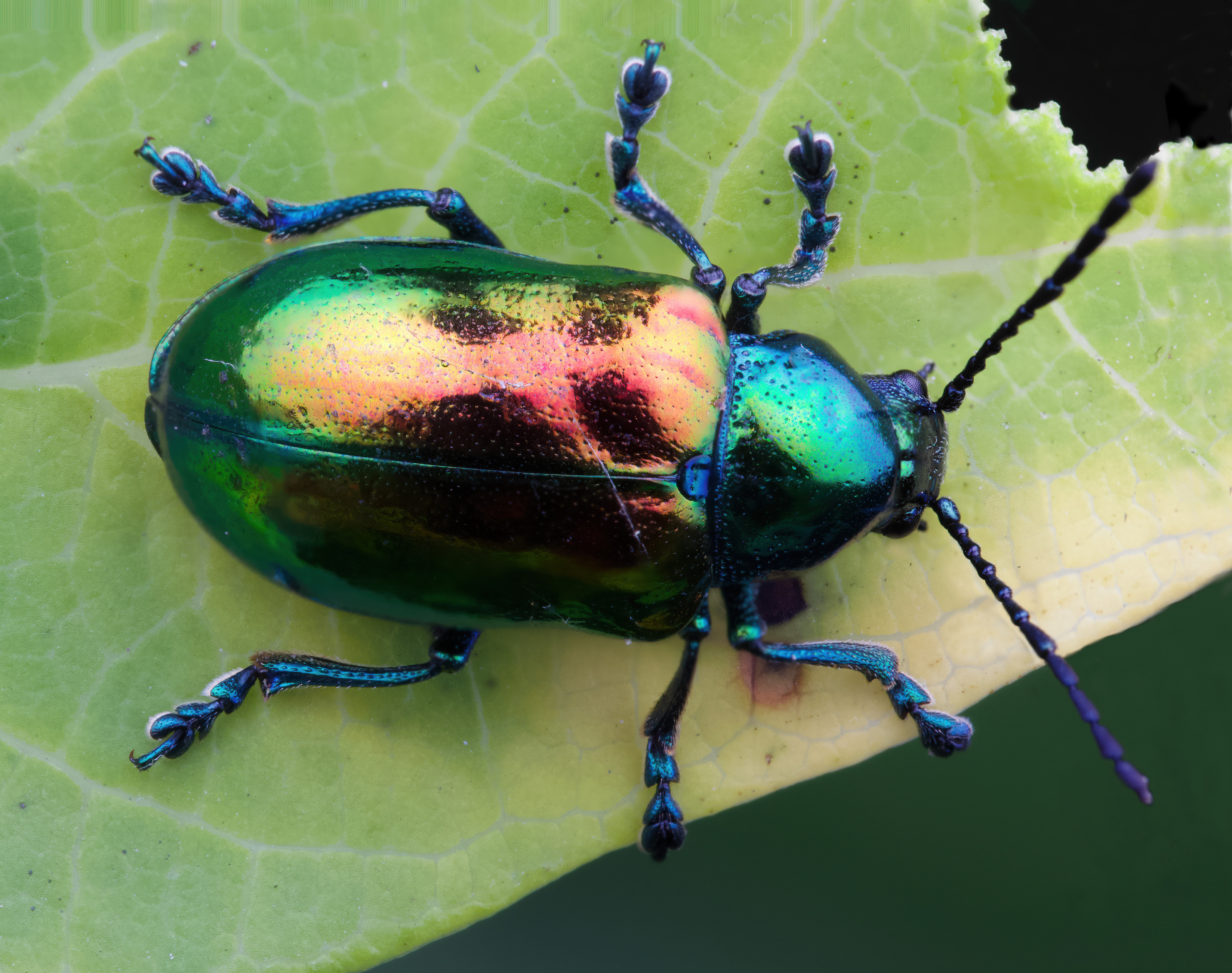
First up is this extremely metallic Dogbane Beetle (Chrysochus auratus). These are vegetarian on a narrow range of host plants, including Dogbane, which makes the insects toxic:
The beetle shown in the next picture had me stumped for a while, but the distinctly “flabellate” antennae and an old field guide helped me to narrow it down. This is a kind of Wedge-shaped beetle, Macrosiagon limbata, and that surprised me since it does not resemble the one species that I know from this obscure family. This one is a male, identified by its antennae. Females will lay eggs on flowers, and the active larvae that hatch will clamber onto a passing bee to be taken back to the nest. There they will consume the larvae in the nest:
Many Bergamot flowers were in the field, and they were well tended by many of these clear-winged sphinx moths (Hemaris sp), and you can see tthat it is a bumble bee mimic:
The final insect-related pictures show why I spend much time carefully looking under leaves. I will likely never learn the species names of these insects, however. The white mass on the right is a bundle of cocoons from the Braconidae family of wasps, which are small wasps that are parasitoids inside the bodies of caterpillars. The term “parasitoid” is preferred here, rather than parasite, since the insects live inside the bodies of their hosts – parasite-like – but they quite deliberately and slowly kill their host, while parasites aren’t supposed to do that on purpose. The eviscerated caterpillar has fallen away, unfortunately, but while it was there it would be laying across the cocoons, still barely alive for a time, and actively “protecting” the cocoons in a strange example of how a hosts’ behavior is changed by parasitoid wasps. I have seen this many times, and you can see it as well in this very entertaining Ze Frank video that Jerry posted recently.
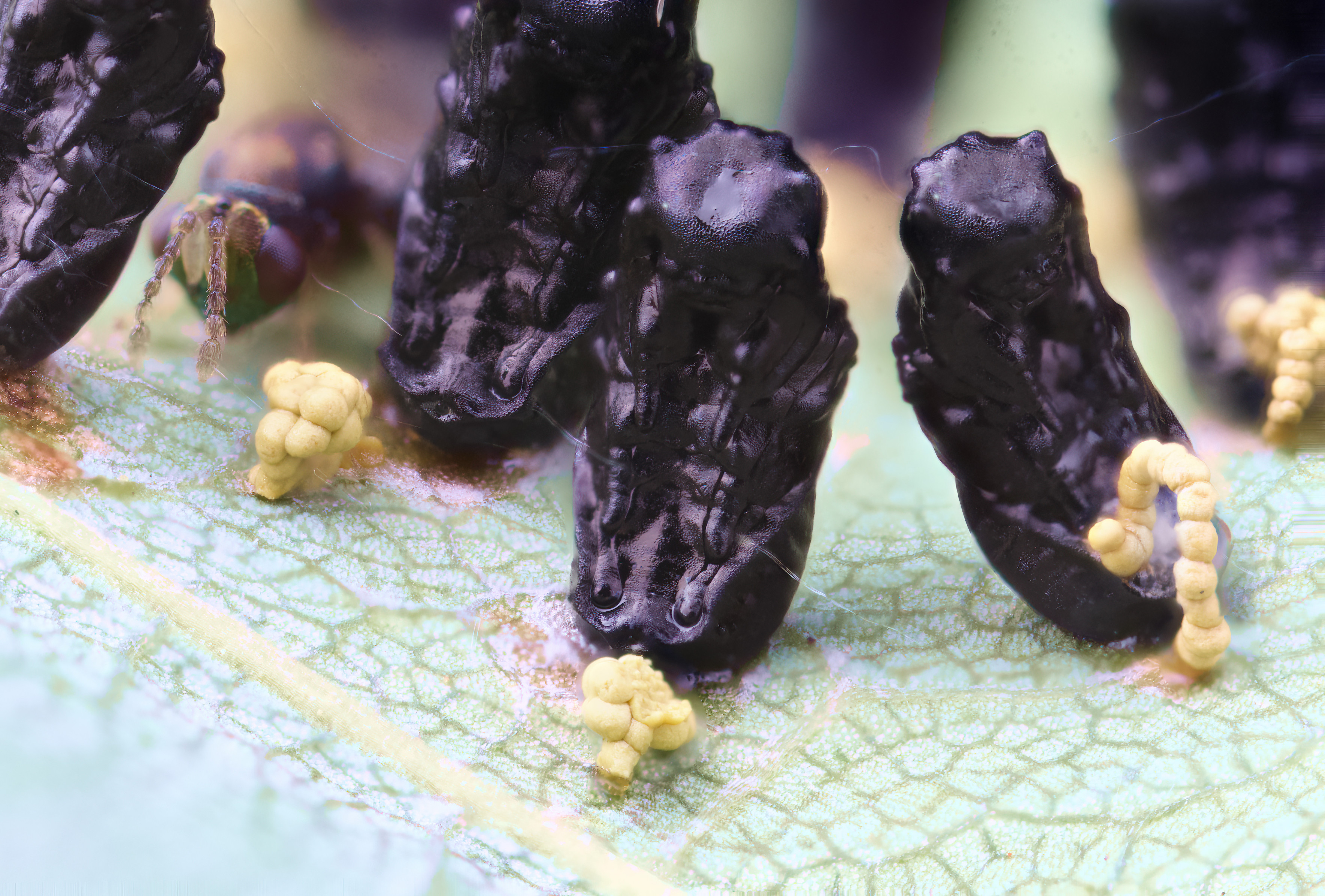
But that isn’t all. What are those black thingies to the left? Well, those are the pupae of a kind of hyperparasitic wasp – very small wasps that are parasitoids of the parasitoids. I had seen these mini-tombstones of pupae many times on plants, but this is the first time that I had enough context to understand the bigger picture about them. If you look carefully you will see an adult wasp among the pupae – a detail that I did not see at the time. Based on some findings in BugGuide, I suggest that this second group is from the Eulophidae family, as shown in the linked picture:
Next is a close-up of the Eulophid pupae. This required the Raynox 250 diopter lens to boost the power of the macro lens. The yellow stuff next to the pupae is called meconium, and they are the gut contents of the hyperparasitoid larvae. When a larva pupates, it will first purge its gut contents:
When I excitedly showed this amazing story to the wife, she was quite horrified.
After a pleasant and very productive afternoon spent in the flower-filled meadow, I noticed that I was being watched by a curious onlooker:
After today’s photos, we have only tomorrow’s photos, the regular Sunday contribution by John Avise. After Sunday: bupkes! Please send in your wildlife photos.
Today we have the fifth and final set of photos taken by reader Chris Taylor on his recent trip to Queensland (see here for earlier photos). Chris’s captions and IDs are indented, and you can enlarge the photos by clicking on them.
This is the final part of the photographs from Queensland.
In the final week of the trip, we spent the time back on the coast, visiting a number of locations.
This is the white form of the Pacific Reef Heron, Egretta sacra, seen on the rocks at Flying Fish Point.
There are a number of Mistletoes in Australia, most of which are parasitic on other trees and shrubs such as Eucalypts. The seed needs to be deposited on the branch of the host tree where it can germinate and grow its roots under the bark of the host tree. Mistletoes have coevolved with the Mistletoe Bird and a strategy has developed to ensure this is not left to chance. The seeds of the plant are enclosed in a fruit that attracts the bird to eat it. The seed quickly passes through the gut of the bird, which then defecates the seed onto the host plant. The seed retains a sticky coating which fixes the seed onto the branch, ready to grow and infect the host.
Nearby was one of the Clearwing Swallowtail butterflies, Cressida cressida. Unusually for a butterfly, they have few scales on the front wings, giving them a translucent appearance
Next, we went south to the area at the foot of the Wooroonooran range. The two highest peaks in Queensland, Mt Bartle Frere and Mount Bellenden Ker, are in this range. Although not tall by comparison to other mountain ranges, at only 1622m and 1593m elevation respectively, the range undoubtedly has a big effect on the weather of the Wet Tropics. We stopped in the town of Babinda, claims to be the wettest place in Australia, a distinction also claimed by the nearby town of Tully. Both of these towns have an annual average of more than 4.25 metres of rain. Because of the high rainfall, there are a number of pristine rivers flowing out of the range, such as Babinda Creek, here flowing out of the rainforest cloaking the slopes of the mountains
The mountains are made up of a lot of hard granitic rocks, and so there are a number of waterfalls in the range; these are the Josephine Falls
On the flatlands below the range is the Eubenangee Swamp. There is a small nature reserve here with a short hike through the rainforest. Lots of birds were calling, along with a colony of Fruit Bats. But they all kept up in the canopy, where they were well hidden, so the smaller denizens were the ones that caught our attention. For some reason most of the insects we saw here were dark in colour!
This butterfly is the Evening Brown, Melanitis leda. This insect is remarkable in that it takes two different forms, dependent upon the season. This is the Dry season form, which resembles a dried-up leaf. The Wet season form has a lighter brown colour and black and white spots.
Even the dragonflies here had dark wings! This is the Painted Grasshawk, Neurothemis stigmatizans.
In the dim light of the rainforest canopy, there was an exception to this rule. This is the Red-banded Jezebel, Delias mysis.
We left Eubenangee in the late afternoon, as the sun was making a light show through the Wooroonooran range, a finale to our stay in Queensland. Next day we caught the plane to fly back to Canberra.
Send in your good photos, please, as every day the tank gets lower.
But today we have a text-plus-photo essay by Athayde Tonhasca Júnior on one of his favorite subjects: plant pollination. Athayde’s comments are indented, and you can enlarge the photos by clicking on them.
Fair is foul, and foul is fair: hover through the fog and filthy air (The Weird Sisters)
Most angiosperms (flowering plants) need an agent to move pollen from one flower to another. This service could be provided by the wind, water, bats, birds, or, for the overwhelming majority of cases, insects. But a plant must advertise itself to attract visitors to its flowers. Visual traits such as colour, shape and size are effective lures, but for short distances only because most pollinating insects see as well as Mr Magoo: their visual acuity ranges from centimetres to a few metres, at best. A red flower must have a diameter of at least 26 cm to be recognised by a honey bee (Apis mellifera) 1 m away (Chittka & Raine, 2006). Insects’ vision is mediocre during daytime and goes down to irrelevant at night, except for a few specialised nocturnal species. Other sensory signals such as temperature, texture and even electrical fields are involved in flower recognition. But to attract insects from afar, plants rely on scent.
The majority of flowering plants produce volatile organic compounds (VOCs), a group of organic chemicals (that is, they all contain carbon) that quickly evaporate and disperse in the air. VOCs can act as herbivore deterrents, but a huge variety of them attract pollinators. These volatiles, released by petals or other plant tissues, persist long enough to reach insects and guide them to the flowers, but not for too long so that they don’t accumulate in the air and overwhelm insects’ sensorial capacity. Most of the attractant VOCs are ‘flowery’ scents such as benzyl acetone, which is one of the most abundant aromatic lures in flowers. You are likely to have smelled it from raspberries, cocoa butter, soaps and perfumes.
Pollinators are experts in detecting particular compounds from odour blends. And crucially for the pollination angle, they learn to associate specific fragrances with food, so they return repeatedly to its flowery source.
Tracking VOCs seems like a convenient and efficient way to get to pollen and nectar, but there are complexities involved. Scents released by a flower do not travel in a straight line the way light and sounds do. Air turbulence disperses, dilutes and mixes compounds, so that an odour plume is not a well-defined strand of airborne chemicals. And yet, pollinators manage to sort out the chaotic environs and make a run for the smell’s origin. Watch fruit flies navigating confidently through a turbulent atmosphere.
We don’t have a complete understanding of the ways pollinators track scents to find flowers, but we do know that the presence of certain compounds, their ratios in volatile blends, and the magnitude of the olfactory signal are important. The processes involved are complex, specific, and vulnerable to disturbances. Such as those created by a diesel-guzzling SUV driven to the farmers’ market for the purchase of locally grown organic carrots.
The engine invented by Rudolf Diesel (1858-1913) is the most fuel-efficient internal combustion engine because it converts more heat to mechanical work than any of its alternatives. It is also reliable and sturdy, so it was quickly adopted by industry, agriculture and transport to become the main source of power that keeps the world going. The diesel engine largely did away with coal and revolutionised the world’s economy by generating power efficiently and inexpensively. But its allure suffered a serious blow in the 2010s, when the first studies about its collateral effects came to light.
The combustion (burning) of diesel fuel results in a complex mixture of water, gases and aerosols. Study after study have shown that some of these by-products such as particulate matter (soot), nitric oxide (NO), carbon monoxide (CO) and oxides of nitrogen (NOx), are serious health hazards. They cause all sorts of ailments, from lung inflammation to exacerbation of emphysema and asthma. The World Health Organisation considers diesel exhausts carcinogenic agents as dangerous as asbestos. As if this evil cocktail wasn’t bad enough, it also promotes the formation of other harmful compounds such as ozone (O3). In the upper atmosphere, this gas is essential for life on Earth because it blocks most of the ultraviolet radiation from the sun. At ground level, ozone is a pollutant resulting from chemical reactions between NOx and VOCs in the presence of sunlight. These ground level VOCs have nothing to do with plants; rather, they come from solvents, biomass burning, industrial processes and, most importantly, incomplete fuel combustion.
Ozone is bad for us and bad for insects. It degrades plant-emitted VOCs and changes the ratios of compounds in a scent blend. As a result, pollinators detect VOCs at shorter distances, become confused, or worse: they may no longer recognise flowers’ chemical signals (Farré-Armengol et al., 2015). In a laboratory setting, adding ozone at concentrations commonly found in rural areas to the scent produced by the jasmine tobacco (Nicotiana alata) disrupted the attraction of one of its main flower visitors, the tobacco hawkmoth (Manduca sexta) (Cook et al., 2020).
The pale evening primrose (Oenothera pallida) grows in sandy and rocky habitats in the arid regions of northern Mexico and western USA. Its flowers release a scent loaded with monoterpenes, a class of chemicals found in various herbs, spices, conifers and fruits. Monoterpenes attract several visitors including the tobacco hawkmoth and the white-lined sphinx (Hyles lineata), which are two of the plant’s main pollinators. These moths have a keen sense of smell and can track pale evening primrose flowers from several kilometres away. But this plant-moth interaction can be severely disrupted by the nitrate radical NO3, a gas resulting from the reaction of ozone with NO2, the latter spewed by wildfires, power plants and diesel engines. Monoterpenes break down quickly in the presence of NO3, drastically reducing the reach of olfactory cues that moths rely on to locate flowers. In wind tunnel experiments, nocturnal levels of NO3 typically found in urban settings caused a 70% drop in number of flower visitations, resulting in a 28% reduction in fruit set (Chan et al., 2024). Sunlight degrades NO3, so this chemical is primarily a nighttime pollutant – bad news for moths and other nocturnal pollinators.
Image of hawkmoth (Hyles lineata) pollinating Oenothera flower. Researchers at the University of Washington found that nitrate radicals (NO3) in the air degrade the scent chemicals released by a common wildflower, drastically reducing the scent-based cues that nighttime pollinators rely on to locate the flower.
With the industrial revolution, urban spaces became choked with foul air. People in charge slowly woke up to the problem, and today many countries drastically reduced atmospheric pollution thanks to ever improving filtration technologies and strict regulations. Despite these advances, diesel exhaust and other emissions remain major environmental problems, particularly in countries undergoing rapid economic growth such as China and India.
The progressive deterioration of worldwide air quality is a serious threat to human health and certainly doesn’t bode well for plant reproduction, although the magnitude of this effect can only be guessed at. We already knew that clean air is vital for our eyes and lungs: more and more evidence tell us that it is also important to pollination services.
If you have good wildlife photos, please send them in, as we always need more. Today we have a word-and-picture post on butterflies contributed by Athayde Tonhasca Júnior. His words are indented, and you can enlarge the photos by clicking on them:
Fluttering souls
We may be unsympathetic to celebrities who moan about the encumbrances of being gorgeous, but not the Greek princess Psyche. Her striking beauty sent the goddess of love Aphrodite (Venus to the Romans) into a not so loving fit of jealousy. She devised a cunning plan; to dispatch her son Eros (Cupid) on a mission to make Psyche fall in love with the ugliest, wickedest man he could find. But Aphrodite should have taken a hint from her son’s name: Eros spoiled mum’s revenge by falling in love with Psyche. That didn’t work too well for the princess; she became separated from Eros and fell into the clutches of a resentful Aphrodite, who imposed upon her a series of terrible tasks. After many twists and turns worthy of a Mexican telenovela – you can read it all in Metamorphoses – the lovers were reunited. Zeus, Heaven’s Big Cheese, took pity on Psyche. He made her immortal and gave her in marriage to Eros. A happy ending.
Psyche’s tribulations and eventual redemption spoke of mortals’ aspirations, so in her newly acquired divine status, the princess became the goddess of the human soul. For the ancient Greeks, a dying person would breathe out his or her soul, which would fly to the underworld in the form of flickering shadows or spirits. In his History of Animals, Aristotle (384–322 BC) wrote that a butterfly’s cocoon was like a tomb, and the adult insect emerging from it was like the soul fluttering away from a human body after death. It’s no surprise then that the Greek word ψυχή (Psykhe) was used for ‘soul’ and ‘butterfly’. The representation of the soul as a butterfly was an appropriate symbol of the fragility and shortness of life, and that connection explains why goddess Psyche was often represented as a butterfly or as a maiden with butterfly wings.
Butterflies have much more to do with humans than merely representing the wanderings of our soul. Their colours and wing patterns, their gentleness and fragility and amazing life cycles have long enthralled naturalists, artists and writers. More books have been written about butterflies than any other insect. Butterflies don’t share the PR problem facing wasps, spiders and other invertebrates that are commonly lumped together as creepy crawlies. Most people like butterflies. Sometimes the attraction is excessive: over-collecting by amateurs, naturalists, and biologists menaces many butterfly species.
Butterflies are among our commonest and certainly most flamboyant garden visitors. We see them gracefully hopping from flower to flower, probing them with their conspicuous proboscis (tubular, flexible and elongated mouthparts specialised for sucking) for a sip of nectar. So, reasonably, we may assume these plant-insect associations are evidence for psychophily (pollination by butterflies). But that would be a too-hasty conclusion.
It has long been known that flower visitation does not necessarily result in pollination. That will happen only when pollen grains from the stamen (the male part of the plant) are transferred to the stigma (the female part). But many factors interfere with this process: the visitor may only collect nectar, bypassing the all-important pollen. If pollen is collected, it may be dropped before reaching a receptive stigma, eaten, or taken away to feed the visitors’ brood. Pollen grains passively attached to the visitors’ body may be too few, or located on the wrong part of the body so that it does not contact a stigma. For a variety of reasons, most flower visitations have no bearing of plant fertilisation.
Butterflies are largely nectar drinkers, tapping flowers’ abundant reserves of sugars and amino acids. Some species get their nutrition from ripe or rotten fruit, tree sap, wet soil, animal carcasses and even tears. But with the exception of pollen-munching Heliconius spp. (Young & Montgomery, 2020), butterflies stick to a liquid diet. They rely on their proboscis, an intricate feeding apparatus that works as a drinking straw ranging in length from around 6 mm to a record 52.7 mm for the immaculate ruby-eye skipper (Damas immaculata) (Bauder et al., 2014).
Pollen is inconsequential to most butterflies. They don’t collect it willingly and their bodies are not adapted to unintentionally transport significant amounts of pollen grains like bees and flies. And that is a problem for plants: they invest a lot of energy producing nectar to attract pollinators. If a visitor goes away with a bellyful of nectar but no pollen, the plant has been a victim of nectar theft (when visitors take nectar without pollinating the flower). Butterflies as a group may have evolved to be nectar thieves, which from the plants’ point of view is nothing short of parasitism (Wiklund et al., 1979). This form of larceny is not restricted to butterflies: bees, flies, birds and most other visitors will steal nectar if given the opportunity (Irwin et al., 2010). But most of the 20,400 or so described species of butterflies don’t compensate their thievery by pollinating their victims.
Butterfly visitors are detrimental or indifferent for a wide range of flowering plants. But, as invariably is the case in biology, things are not simple or straightforward. Butterflies are abundant flower visitors and some species are long distance flyers, therefore with great potential for pollen dispersal. Some plants have not let these traits go to waste: they adopted psychophily as their main or sometimes only means of sexual reproduction. A few plants do that by producing reproductive structures that facilitate pollen transfer by butterfly wings. Others, like the Carthusian pink (Dianthus carthusianorum), hide their nectar at the bottom of narrow, tubular flowers that exclude most visitors, but not butterflies with long proboscises. While moths can take nectar while hovering over a flower, butterflies need to land to feed. The Carthusian pink obliges them with flowers shaped with a flat rim, which is a convenient landing platform for butterflies. This European plant is found in dry, grassy habitats of altitudes of up to 2,500 m, and it depends entirely on butterflies for pollination (Bloch et al., 2006).
Carthusian pink:
In some cases, butterflies intending to commit thievery have the table turned around on them, so that the would-be cheaters become the cheated.
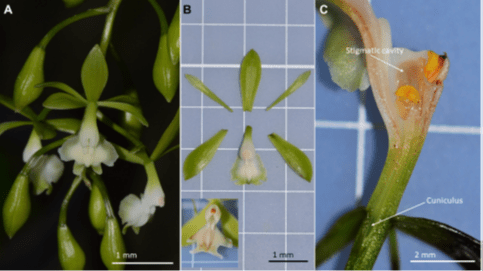
Crucifix orchids (Epidendrum spp.) comprise over 1,400 species distributed from the southeastern United States to northern Argentina. This group of plants is highly diverse morphologically and ecologically, but most investigated species share one feature: a dry cuniculus. This structure is concealed in the column (the fused reproductive parts characteristic of orchids) and normally functions as a nectar reservoir. The majority of crucifix orchids have no nectar to bargain, but that doesn’t deter a range of butterflies. Probably attracted by the orchid’s scents, they probe the flower’s column and cuniculus in search of a non-existent reward. Ending up empty-handed is not the butterflies’ sole unpleasant surprise: the floral tube is narrow and bent, so that a visitor has to struggle to retract its proboscis. This temporary detainment – which could last for over one hour – increases the chances of a butterfly leaving the flower with pollinia (a blob of pollen) attached to its proboscis. This stratagem works very well for the orchids, so that butterflies and some day-flying moths are their only or main pollinators.
Butterflies do not belong to pollinators’ Premier League, but the Carthusian pink, crucifix orchids and several other plants demonstrate that psychophily is not that rare. Butterflies fly over large distances, are attracted to a variety of plants and make repeated visits to flowers. These features must compensate for some of their shortcomings, and we surely have much more to discover about their role in plant reproduction.
Matthew sent in this latest “True Facts” video from Ze Frank; it’s about some of the most amazing and nefarious insects around: parasitoid wasps. (There’s an ad in the middle.)
There are a lot of questions and “I don’t know” answers here. The gall wasps are especially fascinating from an evolutionary viewpoint, as they somehow modify a plant’s gene expression to make the plant grow a gall that can house the wasp.
We don’t know how they do this, but even the gall wasps inside their houses can themselves be parasitized by other species of gall wasps (Again, we don’t know how these “hyperparasitoids” detect and find a larval host inside a gall). Finally, we don’t understand how natural selection has modified a parasitoid wasp so that it injects stuff into its host that modifies the host’s behavior, making iot a “zombie host.”
The photography is amazing; it seems to get better with every one of ZeFrank’s videos.
Do watch this; you’ll learn some natural history and, I hope, be amazed at the achievements of natural selection.
I’m pleased to say that Athayde Tonhasca Junior is back with a text-and-photo biologist lesson—it’s about the deleterious effects of wasps. His text is indented, and you can click on the photos to enlarge them.
Housing disasters
On February 6, 1996, Birgenair Flight 301 took off from Puerto Plata in the Dominican Republic, heading towards Frankfurt, Germany with 189 people on board. As the 757 jet began to ascend, the captain noticed that the airspeed indicator on his side of the cockpit was displaying increasingly dangerous figures. Confusion, miscommunication and bad decisions among the crew ensued, ending with loss of control of the aircraft. About 5 minutes after take-off, the plane crashed nose-down into the sea. There were no survivors. Investigators believed that the Pitot tube (the instrument that measures the speed of flowing air) on the captain’s side was blocked, resulting in conflicting voice warnings, disconnection of the autopilot, changes of thrust and pitch, and ultimately catastrophe.
That wasn’t the first major accident caused by clogged Pitot tubes. On 12 September, 1980, Florida Commuter Airlines Flight 65 crashed on the way from Palm Beach, Florida, to the Bahamas, killing all 34 people on board. Investigators could not determine the cause of the disaster, but believed one of the most likely factors was Pitot tube obstruction.
In both accidents, there were strong suspicions about the culprit: the yellow-legged mud-dauber wasp (Sceliphron caementarium). A native of North America, this wasp was introduced all over the world including in isolated places such as Hawaii, Samoa and Madeira. Like all mud-dauber wasps (families Sphecidae and Crabronidae), S. caementarium builds its nest from mud. After mating, a female will look for a muddy puddle or pond edge. She will gather a ball of mud with her mandibles and take it to an enclosed spot to lay the foundations of her nest. She will make several trips to get more mud, finish her first nest cell and start the process again. Mud-daubers are not particular about their nesting sites so long as they are dry and sheltered. Rock ledges and tree hollows would do, and so would many manmade structures such as housing eaves, windowsills, bridges, garages, open-air porches, and any hole of suitable size such as, disastrously, a Pitot tube opening.
The aeroplanes involved in both accidents had been sitting on the tarmac for several days before their last flights, giving plenty of time for mud-daubers to find the Pitot tubes and clog them with mud. Incredibly, in the case of Flight 65, the obstruction was detected during take-off, so the plane was taken back to the hangar for engineers to fix the problem. But as crew and passengers were in a hurry to get going, the affected Pitot tube was not disconnected and cleared with compressed air as recommended. Instead, a quicker alternative involving a narrow screwdriver and a coat hanger was employed. The aeroplane took off again, and soon afterwards everybody on board was dead.
The yellow-legged mud-dauber wasp didn’t go out of its way to cause aeronautical mayhem; it was only taking advantage of seemingly ideal sites to rear its young. And this wasp is good at it. Like other species in the group, it is a formidable spider hunter. The female tracks down a web-spinning spider and paralyses it with its venomous sting. She drags the comatose, helpless victim to her nest, then leaves to find another prey. In the words of Mrs Charles Meredith (Edinburgh Journal 265: 51-52, 1849), the wasp invades “the peaceful retreat of some cobwebbed recluse, which, until now, safe from house maids and brooms, has meshed and devoured his flies in comfort, but is at length seized and straightaway trussed and packed up, half alive, by the dark avenger”. After harvesting a sufficient number of spiders—up to 25—the wasp lays an egg in one of them, seals the cell and starts another one, building up to 30 cells. Inside each cell, a larva will hatch and feast on the spiders, which are all immobilised but alive and fresh. Upon consuming every spider, exoskeleton and legs included, the larva pupates and turns into an adult, who chews a hole in the muddy wall and flies away. While female wasps construct homes and hunt, males do their bit by hanging around flowers, feeding on nectar while waiting for the opportunity to meet a hard-working maiden.
Mud-dauber wasps can be quite abundant in some places, so ecologists suspect they may be a significant mortality factor for spider populations. Pollinators seem to have no dog in this fight, but under the principle of ‘my enemy’s enemy is my friend’, fewer spiders could be seen as a good outcome for pollinating insects. But spiders have no preference for any insect in particular: they will take anything that comes their way. Insects that feed on plants’ vegetative parts (leaves, petals, etc.) are significantly more abundant than pollen or nectar feeders, so they are more likely to become spiders’ victims. On the other hand, spiders’ presence may discourage flower visitors. The truth is that we don’t know the workings and outcomes of wasp-spider-pollinator interactions.
In Australia, another introduced wasp is a matter of concern for air travellers: the keyhole wasp (Pachodynerus nasidens). As its common name implies, this wasp readily takes residence inside a keyhole – or any suitable space including electrical sockets, gaps in windows and abandoned nests of other wasps. House et al. (2020) suspected that machinery on airport grounds offer many hazardous nesting opportunities for the keyhole wasp such as vent lines, tail pipes, engine probes and Pitot tubes. The researchers set out replica Pitot tubes from five common aeroplane models at four locations in Brisbane Airport and monitored them for 39 months. There were 93 instances of blockage by keyhole wasps, an unacceptable figure for aviation safety standards.
Australian authorities have considered trying to eliminate the keyhole wasp from Brisbane’s surroundings, the species’ current area of distribution in the country. Such an initiative is not likely to succeed. Insects are notoriously resilient against eradication attempts, and the keyhole wasp is a known tramp species (an organism inadvertently dispersed around the world by humans). It has left its native South America to invade North America and some Pacific Islands, probably as a stowaway in ships and aeroplanes. Even if Australia managed to become wasp-free, it’s not likely to remain so for too long. A costly eradication programme would be an extreme measure, considering that simpler ones are at hand: the first and obvious preventive measure is to cover Pitot tubes of aeroplanes idling for a long time at gates or in storage, as recommended by manufacturers (of course, somebody must remove the covers before a flight: forgetting to do it has caused accidents). The second measure is to check Pitot tubes when the aircraft has been stationary for extended periods, again as advised by manufacturers’ maintenance manuals.
Most insect species adapted to man-made environments carry on unnoticed by us, and some do even better there than in natural habitats. A few may occasionally damage buildings, and in some special circumstances such as mud-dauber and keyhole wasps having access to aircraft, life and property are vulnerable. These risks should not be downplayed, but it’s worth remembering we can also adapt and manage the dangers. Coexistence is rarely impossible.









_Psiche_abbandonata_(modello,_1816).jpg)


.jpg)
