Readers’ wildlife photos

April 29, 2025 • 8:15 am

Reader Debra Coplan made a trip to Baja, and today sends us photos. Her captions and IDs are indented, and you can enlarge the photos by clicking on them.

I had the opportunity to visit the Baja Peninsula this past weekend, and would like to share some of the wonderful vegetation I saw from the that area. We went as far south as the Sonora Desert region to Catavina, east of the Pacific Ocean. Catavina is about 300 miles south of the border.

We had to drive from the north which had Mediterranean desert foliage to the Sonora Desert which had little rain. The Mediterranean desert gets hurricanes which dump water to an area in that more northern part of the desert.

The Mediterranean desert is north of Sonora desert, but they abut next to each other. Sometimes we saw Mediterranean desert on one side of the road and Sonora-type vegetation on the other . A clearer transition between the 2 areas became evident as we went south into drier region: one side being lush with taller plants and the other side dry with low plants.

I am not a biologist, so hopefully I’ve identified the plants correctly.

Boojum Tree – Cirio Idria columnaris

This is an plant endemic to this Catavina area of the desert. It is the signature plant of the region, and can get to 70 feet tall. The flame of leaves on the top are golden like a flame at the top of a candle. See top photo.

The second Boojum had a stalk that was in an area of more water so it looks more lush.  The name Boojum is in reference to Lewis Carroll’s poem, “The Hunting of the Snark”. It is looks a bit like an upside down carrot with a whitish stalk.

On the road on the way out of Catavina we were stopped by the military police checking to make sure we did not steal a Boojum tree to transplant up north.
CardonPachycereus pringleiL

This particular cardon had a genetic mutation so instead of growing up, it grew sideways. The man is about 6’ tall.  I was fascinated by the one limb that wasn’t affected by the mutation.

California penstemonPenstemon californicus:

I am including this penstemon flower because it was my favorite story. I loved how it gets pollinated. Unfortunately, the plant was down below a steep creek so I did not get a photo.

Various species of bees in the region are guided into the flower by the purple lines pointing the way to the back of the flower. It reminds me of an airplane coming in for a landing.

As the bees go in, the pollen rubs from the antlers (male part) off onto the bee.  You can see the long anthers but unfortunately there was no pollen in this one. The bees then fly off to another penstemon where the pollen interacts with the stigma (female part) deeper in the flower to pollinate.

Nightshade Mariola, Solanum hindsianum

Unfortunately I don’t have a picture of a flower on this plant either,  but was amazed by the pollination story.  This plant had very tiny opening at the end of the yellow anthers. It’s very hard for bees to get into the tiny opening to get the pollen so they use buzz pollination.  The bees grab hold of the yellow anthers and vibrate their bodies, which forces the pollen out and onto their bodies, where it gets distributed.

Hedgehog cactus, Echinocereus:


In Catavina, inland from the Pacific Ocean, we visited a cave of the Cochimis, the indigenous inhabitants of this area.


A steep 10-minute hike up huge boulders of the Sonora desert reveals a cave with some paintings that were about 4,000 years old.   I have no idea what dyes they used, but heard they were not from plants of this area.

There is the head of a hummingbird in the painting below:

Readers’ wildlife photos

April 5, 2025 • 8:40 am

We’re running a bit low on photos, so if you have good ones, send them in.

Today’s batch comes from our most regular regular, Dr. Mark Sturtevant, but with an unusual theme. Mark’s captions are indented, and you can enlarge his photos by clicking on them.

And now for something completely different. Over the past few years, I have been exploring a type of photography called light painting. This term can refer to different kinds of artistic photography, but the one I practice involves taking multiple long exposures of a still-life scene illuminated only by a flashlight. The images are then imported into a photo editing program and blended together using digital paintbrushes. This technique can produce a single image with dramatic lighting effects that would be impossible to achieve in a single shot. While the process requires patience and basic familiarity with image editing software, I believe only minimal artistic skills are necessary. Anyone can do this!

In this small set of pictures, I showcase some of my light painting still-life projects. Since they incorporate natural and scientific objects, they may align with Readers’ Wildlife Photos in a broad sense.

The first images illustrate the initial steps of the light painting process. It begins by arranging a still-life scene in front of a camera on a tripod. I always take a few bright-field shots like this first picture. While a preliminary image like this may appear quite ordinary, and the surroundings can be cluttered, this step is useful in order to figure out the composition. The shells in this picture are part of my large collection of marine and freshwater specimens.

Next, the camera is set for a long exposure (typically 15-20 seconds). After turning off the room lights, I work in total darkness while “painting” over a portion of the scene with a small flashlight. After the shutter closes, I repeat the process with another long exposure, illuminating a different part of the scene. It’s essential to avoid moving the camera between exposures, and it is essential to keep the flashlight moving in order to create soft shadows. Here are two examples of such images, taken straight out of the camera.

This sequence is repeated several more times. In this case, I took approximately two dozen pictures, though I likely didn’t use all of them in the final picture.

The next step involves loading the images into a photo editing program and selectively blending them together. While many photographers use Photoshop for this, I prefer GIMP, which is a free alternative to Photoshop. I do nearly all of my photo editing in GIMP. The images are stacked as layers, one on top of the other, so that each picture is perfectly aligned. This alignment is why it’s crucial to keep everything stationary during the photography process.

A layer mask filter is applied to the top layer, and this allows me to use a digital paintbrush to selectively make parts of the top image transparent to reveal the corresponding areas of the image beneath it. This technique is non-destructive, meaning the pixels in the top image remain intact and can easily be restored if needed.

Once I’m satisfied with how the first two images are blended, I merge them into a single picture layer. I repeat this process for each subsequent layer until the final composition is complete.

And with that, here is the finished image of the seashells.

Next, I’d like to share a few more light painting projects. This is a human skull that I’ve had most of my life and it is called “Uncle Herbert.” Based on the shape of the eye sockets and other details, I consider Uncle Herbert was a male, though I could be mistaken. This was my very first light painting, and I was pleasantly surprised by how easy the process was!

In this final scene, Uncle Herbert is used again alongside objects related to “Human Biology,” which is what I call this picture. The old microscope belonged to my father, and the human vertebra in the foreground is a well-worn teaching specimen I purchased long ago.

For anyone interested in trying out this kind of photography, here is a tutorial about using a flashlight. (Click on “Watch on YouTube”).

And here is a tutorial on using layer masks in Gimp. Photoshop would be very much the same, and I expect there are other photo editing programs.

Finally, one can find a couple more of my light painting photos here, including a very complicated one that almost broke me.


The New Yorker features Robert Lang and the incineration of his origami

January 21, 2025 • 9:00 am

You heard it here first, folks, so the New Yorker was slow on the uptake (and they don’t have the photos and videos that I featured). At any rate, the new issue features the recent story of Robert Lang, master origami artist and reader, whose wildlife photographs have been featured here often (and there are more to come).  If you don’t have a subscription, you can click on the NYer headline below and read the piece perhaps once, but otherwise I’ll give some excerpts from the story and add that a judicious inquiry might yield a pdf.

First, though, have a look at Robert’s origami page to see the incredible art he’s made. (I’ll wager he’s one of the ten best origami artists in the world.) As he told me, he lost virtually all of the art he had kept during the fire, which burned up his and his wife’s old home and studio, as well as a new home down the block. They have insurance and will rebuild.  In the meantime, I told him that I still had an origami duck he folded for me, and he responded that it was probably one of the few surviving original Langs.  It sits atop my computer, and here it is (it is another version of his “Duck Opus 11” on watercolor paper that you can see here).

And the story:

Here are some excerpts:

“The first thing you think of when you see your home engulfed in flames is, My world and future have changed,” Robert J. Lang, one of the world’s foremost origami artists and theorists, said recently. He was sitting in a small hotel room in Arcadia, California. The week prior, the house where he lived with his wife, Diane, had burned down when the Eaton Fire erupted and swept through Altadena, outside Los Angeles, with incredible speed, levelling entire neighborhoods. Robert’s studio, a separate property where he kept decades of his professional origami work—all highly flammable— along with research and personal artifacts, was also reduced to ash.

Diane walked in with their two dogs, Casey and Scout, who hopped onto the mattress and lay down. Diane, with no other place to sit in the room, joined them. “Two people offered their back yards for them to wander around in,” she said. “So, we were just in a back yard.”

The Langs had gone to sleep on a Monday night in their own bed. By Tuesday night, they were sleeping in their cars, with their many pets—the two dogs, two desert tortoises (Sal and Rhody), a Russian tortoise (Ivan), a snake (Sandy), and a tarantula (Nicki)—and the few things they could grab as they fled the inferno. The snake, tortoises, and tarantula were now being taken care of at the San Dimas Canyon Nature Center, rather than staying at the hotel. “Just to make my life simpler,” Diane, who works with the Eaton Canyon Nature Center, said.

In the early hours of Wednesday morning, Robert watched his studio burn from a nearby ridge. Then, at around 9 A.M., he and Diane learned that their home was destroyed. At sixty-three years old, Robert, who was profiled in this magazine in 2007, has been designing origami for most of his life; one of his early designs, in the seventies, was an origami Jimmy Carter. He used to be a physicist, working on things like semiconductor lasers, at places such as NASA’s Jet Propulsion Lab, before he decided to devote his time fully to origami. The studio held much of his art, and all of his tools. The laser cutter he used to help make prototypes had melted. “It’s now a pile of metal,” he said. “A 3-D printer is now a pile of ash.” Rare paper, including fig-based paper from a tiny village in Mexico, had burned. He went on, “There were correspondence letters with other origami artists over the years that were a historical record for me and perhaps for others. And then my exhibition collection was there. The pieces I had in MoMA”—a large grizzly bear, a bull moose, and a fiddler crab, all folded between 2003 and 2007—“are gone.” As he evacuated, however, he was able to grab a single piece of art work, perhaps his most famous: a framed, fifteen-inch cuckoo clock folded into dazzling complexity from a single sheet of paper

. . . .Most of the Langs’ days now are spent on details. Dealing with insurance. Filing documents of everything lost. Texting with neighbors. Walking the dogs. Checking the weather for changes in wind. Monitoring evacuation zone updates from the Watch Duty app. And, mainly, finding a more stable place to live.

Robert’s phone rang. Their real-estate agent had a prospective rental apartment they could see that afternoon.

“Ask him about the dogs,” Diane said to Robert. She explained, “We’d founda place we liked—a good vibe. But the owner said he didn’t want dogs.”

Robert hung up. “They take dogs,” he said. “We can see it at 3 P.M.”

“It’ll probably be for two years,” Diane said. “But we’ll rebuild. We still have our land. We even have the floor plans.”

And they will rebuild on the site of their new home and of their original studio. It may take a couple of years, but, as I said in my previous post, the Langs are remarkably resilient and are just getting on with what they need to do.

As for the cuckoo clock he saved: here it is, reproduced with permission. You can see it and read about it here, but he adds:

This is the one I saved.  There are four of them in existence (that I folded; lots of other people have followed the folding instructions to make their own versions). One of them was also in a fire that destroyed the owners’ apartment, but almost miraculously, it survived. He had a fourth-floor apartment in a building in which all the interior collapsed in the fire. After the fire, he was poking through the rubble in the basement, lifted a collapsed door that he recognized as his, and found the cuckoo clock, flattened, but unburnt. He sent it to me, and I spent some time restoring it (dampening, wiping off the ash that caked it, and re-folding/re-shaping it). I eventually got it back to its original appearance, though it still had bits of ash in crevices and smelled of smoke, but that just added to its character, and to my knowledge, it survives to this day.]

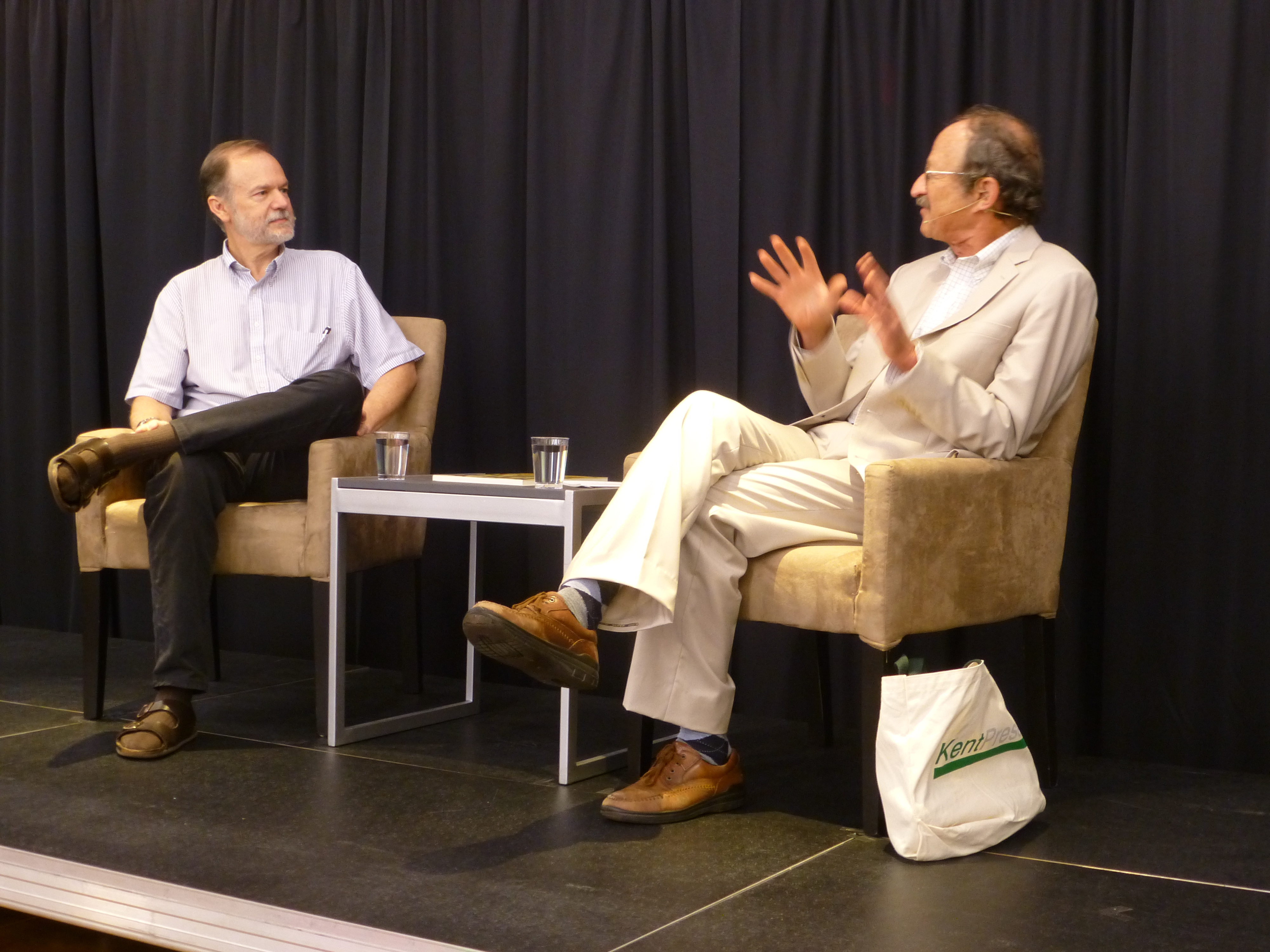
Here’s the first time I met Robert—at the Kent Presents meeting in Connecticut in August, 2018. (There’s a description here; sadly I’ve removed all photos from this site before January of last year because of copyright claims by stupid and venal firms, but there is a video of some origami that I’ve put below.) This photo shows part of Robert’s presentation, which was accompanied by slides of his artwork). Here Lang (left) talks to biology Nobel laureate Harold Varmus:

Here’s the video showing some of Robert’s origami:

Readers’ wildlife photos

December 19, 2024 • 8:15 am

Today is the third and last part of Athayde Tonhasca Júnior’s travelogue, including ancient paintings, from Brazil (part I is here and part II is here).  Athayde’s captions are indented, and you can enlarge his photos by clicking on them. Without further ado:

Back in the day. Way, way back, Part III

JAC: the introduction to part I:

The Brazilian north-eastern hinterland is not a hospitable place for an outsider. Except for a short and intense rainy season, this is a dry, dusty and sizzling territory: a land of the cactus, thorny scrub and stunted trees. The native Tupi speakers called this semiarid region caa (forest, vegetation) tinga (white), and the term was adopted by the Portuguese settlers as caatinga. But the apparent harshness of the landscape misrepresents its ecological importance. The caatinga is a biota found nowhere else in the world, harbouring more than 2,000 species of vascular plants and vertebrates, with endemism in these groups ranging from 7 to 60%. And like every other Brazilian ecoregion, the caatinga has been severely degraded and fragmented. But its plants and animals have one place of refuge: the Serra da Capivara National Park in the state of Piauí. The park is a haven to numerous birds and endangered mammals such as the giant anteater (Myrmecophaga tridactyla), three-banded armadillo (Tolypeutes tricinctus), jaguar (Panthera onca) and other cats, and the maned wolf (Chrysocyon brachyurus).

The 129,140-ha park contains a massif of sandstone sediments formed some 430 million years ago when the whole area was submerged under a sea. The massif, smoothed by water and wind, was once the seabed, and pebble conglomerates on top indicate an overlying beach.

New:

In 1963, Niède Guidon organized an exhibition of prehistoric paintings in São Paulo. She was approached by one of the visitors with some pictures of ‘Indian paintings’ from places near his property in Piauí, a remote and forgotten region in the 60s. Guidon saw right away that those pictures were something completely different. She only managed to visit the area about 10 years later, and thanks to her, Serra da Capivara was discovered by the outside world – including Brazilians.

Pedra Furada (pierced rock), near the place where Guidon’s excavations provided evidence for a much earlier human presence in South America than previously thought:

Zuzu, one of the oldest human specimens found in South America. Assigned as female at discovery, later transitioned to male by researchers. Zuzu died approximately 9,600 years ago (Museu do Homem Americano).

How Zuzu may have looked (Santos & Moraes, 2023):

Superstition helped preserve Serra da Capivara. Tales of eerie voices and floating apparitions meandering through the canyons kept people away (can you see the face profile on the left wall?). Local elders warned youngsters about bad things happening to those who disturbed the ‘Indian paintings’:

Many of Serra da Capivara‘s pre-historic paintings suggest that life among the cliffs and canyons was not peaceful and idyllic. Here we witness a possible murder or execution:

A shagging scene, but not of a vanilla variety. The supporting character on the right hints of a threesome or, ominously, a non-consensual act:

Leaping deer:

Despite having survived for thousands of years, the wall paintings suffer the ravages of weather. The most vulnerable ones have been shielded from running water:

Some of the park’s residents like the ubiquitous coroa-de-frade (friar’s crown, Melocactus zehntneri) are on standby to inflict pain on the absent minded:

A slice of the bottom of the sea. Our minds need training to see things in geological time frames:

A parting view of Serra da Capivara. If you sit here for a while, you’d be taken by the silence. Nothing seems to move, and you only hear your own breathing:

Going home: 300 km to the airport on a mostly empty road, although you need to watch for goats grazing by the roadside. All that changes when you pass the towns along the way: mountains of plastic bags, rubbish and rubble everywhere. Places that don’t do justice to a small paradise hidden in the caatinga heartland:

Readers’ wildlife photos

December 14, 2024 • 8:15 am

Athayde Tonhasca Júnior is back with part 2 of his 3-part travel series, “Back in the day. Way, way back” (part 1 is here). His captions are indented, and you can enlarge the photos by clicking on them.

Back in the day. Way, way back, Part II

Serra da Capivara National Park is crisscrossed by a 450-km network of roads and paths; you could spend months exploring it all. Some sites are accessible by wheelchair, others require commando-style slogging. Admission is free, but you must hire a licensed guide. You wouldn’t want to go scouting on your own anyhow; the area is a labyrinth of dead-end canyons, steep climbs, sharp bends and sphincter-clutching rock ledges.

The lone yellow canopy at the bottom of the gorge is Handroanthus serratifolius, which drops all its leaves during blooming. These sheltered canyons retain water, hence the leafy trees:

The location where Niède Guidon made her discoveries (see previous post). Her team dug out soil, stones, roots and everything else 5 m down from the walkway; it took them almost 10 years. The wall is covered with pre-historical paintings:

Reams of paper and gallons of ink have been spent interpreting some of the wall paintings. With no written record from these ancient peoples, explanations are no more than guesses:

Whatever is happening here, you wouldn’t want to join in:

A large animal is about to be dispatched with a strike to its head:

Two capybaras. This painting was adopted as the park’s logo (see next):

This sign advises people with heart problems, acrophobia (fear of heights) or who are out of shape not to take this trail. We found out why in no time:

Going up. If you zoom in on the circle, you will see the steps towards the top. From a distance, the terrain looks steeper and more dangerous than actually is:

At the top with Nestor, our excellent guide. He does this trail several times a week:

Going down. Slowly:

A rock cavy (Kerodon rupestris), an endemic species to eastern Brazil. These rodents are hunted for food, but are safe in the park. Apparently their predators can’t keep up because they are all over the place and not spooked by people. Rock cavies use collective latrine spots on rocks where their faecal pellets and urine accumulate and turn into resin-like concretions. Wherever you sit, you have a good chance of landing on rock cavy excreta:

The saxicolous (rock-dwelling) Tropidurus helenae, a species only described in 1990 and supposedly endemic to Serra da Capivara. This little lizard is incredibly curious, coming close to check you out. According to our guide Nestor, it is attracted to blue and green colours:

Readers’ wildlife photos

November 22, 2024 • 8:15 am

Athayde Tonhasca Júnior is here to present the first part of a three-part text-and-photo series on Brazil. Athayde’s captions are indented, and you can enlarge his photos by clicking on them.

Back in the day. Way, way back

The Brazilian north-eastern hinterland is not a hospitable place for an outsider. Except for a short and intense rainy season, this is a dry, dusty and sizzling territory: a land of the cactus, thorny scrub and stunted trees. The native Tupi speakers called this semiarid region caa (forest, vegetation) tinga (white), and the term was adopted by the Portuguese settlers as caatinga. But the apparent harshness of the landscape misrepresents its ecological importance. The caatinga is a biota found nowhere else in the world, harbouring more than 2,000 species of vascular plants and vertebrates, with endemism in these groups ranging from 7 to 60%. And like every other Brazilian ecoregion, the caatinga has been severely degraded and fragmented. But its plants and animals have one place of refuge: the Serra da Capivara National Park in the state of Piauí. The park is a haven to numerous birds and endangered mammals such as the giant anteater (Myrmecophaga tridactyla), three-banded armadillo (Tolypeutes tricinctus), jaguar (Panthera onca) and other cats, and the maned wolf (Chrysocyon brachyurus).

The 129,140-ha park contains a massif of sandstone sediments formed some 430 million years ago when the whole area was submerged under a sea. The massif, smoothed by water and wind, was once the seabed, and pebble conglomerates on top indicate an overlying beach.

A view of Serra da Capivara National Park, a geologist’s delight:

The park is surrounded by a 10-kilometer buffer zone that is also protected. In this private property contiguous with the park, the rocky walls echo the racket of howler monkeys (Alouatta spp.):

At the base of the sandstone massif, there are hundreds of hidden shelters and overhangs, where ancient peoples expressed themselves through rock art. Thousands of prehistoric paintings sprawl on rock walls and ceilings depicting armadillos, rheas, jaguars, lizards, capybaras (the only capybaras in the Capybara National Park are painted on walls), as well as human figures hunting, playing, dancing, having sex, and being nasty to each other. The images were mostly painted with red ochre (haematite) and other clays; some were made with burned bone charcoal. Because there are no organic components in the pigments used in the paintings, it is not possible to date them precisely. The lower estimates are around 5,000 years.

A rhea painted under this shelter:

Among animals and people, a woman gives birth (highlighted by the arrow):

“The kiss”, one of the most famous paintings in the collection. But in truth we have no idea whether the image indeed depicts two people kissing:

A poor soul saying goodbye to this world in the maw of a jaguar or puma – identified by its paws:

The creation of the park and its protection came about thanks to the efforts of archaeologist Niède Guidon, who also managed to kick off a major kerfuffle in the archaeological world. Based on her excavations carried out between 1978 and 1987, Guidon concluded that the Capivara paintings could be over 12,000 years old. And more: she found evidence of hearth fires and stone tools in layers ranging from 5,000 to 60,000 years, the oldest dates for human habitation in the Americas (Guidon & Delibrias, 1986). Guidon’s conclusions started an ongoing debate because they challenged the established Clovis First theory, which argues that people colonised North America via the Bering Straits ~13,000 years ago, then moved down into Central and South America in the following millennia. Her critics, mostly American archaeologists, claimed the tools she found were made by monkeys or are natural objects altered by weather, and that her carbon hearth samples were the result of natural fires. Guidon, who’s backed by French archaeologists, retorted that ‘Americans should excavate more and write less’. Ouch.

Because of its biodiversity, outstanding geology, pre-historical paintings and more than 1,300 archaeological sites, the park became a UNESCO World Heritage Site in 1991:

Guidon may have been vindicated because subsequent excavations in Argentina, Brazil, Chile and USA have also raised doubts about the Clovis First theory. It seems possible now that humans came to the Americas in a series of colonising waves through the Bering Straits starting way before 13,000 years (Waters & Stafford, 2007). But Guidon’s conjecture that Homo sapiens first arrived in South America crossing the Atlantic from Africa, perhaps as far back as 100,000 BC, has received scant support. For one thing, genetic analyses contradict her.

A soup kitchen queue? A religious ceremony? A conga line?:

During the short and unpredictable rainy season, a roaring waterfall runs through this natural gutter:

Hell to the left:

Hell doesn’t look too bad:

A view of the caatinga, with the Museu do Homem Americano (Museum of the American Man) in the distance. All ‘dead’ vegetation will burst into green life at the first downpour:

Readers’ wildlife photos

July 30, 2024 • 8:15 am

Today Doug Hayes of Richmond, Virginia, has sent a batch of pictures showing the primate H. sapiens engaged in a ritual of unknown evolutionary signifiance; it’s called “dancing”. Doug’s captions and IDs are indented, and you can enlarge the photos by clicking on them.

Here’s my latest photoshoot done for Starr Foster Dance to publicize their next show, Page To Stage III at Richmond, Virginia’s Firehouse Theatre December 5th – 8th, 2024. This will be the third Page To Stage presentation, a cross-disciplined project combining the art of writing and dance. Writers were asked to submit short works of prose or poetry, which would be interpreted in dance by chorographer Starrene Foster and her dancers.

The dancers pictured here are the core members of the company: Shannon Comerford, Molly Huey, Fran Beaumont, Angela Palmisano and Madison Ernstes. Other dancers, drawn from the Richmond dance community, will be added as needed. The show will consist of eight pieces, of which three pieces have been choreographed and are in rehearsal.

In addition to the choreography, Starrene is also designing and sewing the costumes as well as collaborating on the original music and lighting design! For more information on the company (and more of my photos), visit www.starrfosterdance.org. The Firehouse Theatre’s website is www.firehousetheatre.org.

Core members of Starr Foster Dance (L to R) Fran Beaumont, Shannon Comerford, Molly Huey, Angela Palmisano and Madison Ernstes:

For this group shot, the flash units were aimed at the ceiling and bounced down on the dancers. Starr loves shadowy and mysterious looking lighting similar to stage lighting. Dresses designed and sewn by Starrene Foster:

Another group shot, this time, Angela and Molly were asked to come up with a unique move while Shannon, Madison and Fran jumped in the background:

Angela Palmisano executing a leap. Each dancer was encouraged to execute a different jump for the individual photos:

Angela Palmisano, Molly Huey and Madison Ernstes:

Fran Beaumont and Shannon Comerford:

Molly Huey in flight!:

Madison Ernstes levitating:

Angela Palmisano, Molly Huey and Madison Ernstes execute a group jump:

Shannon Comerford:

 Another double jump by Fran Beaumont and Shannon Comerford. They are actually off the ground, not kneeling:

Fran Beaumont does her jump:

Photo info: All photos were shot with the Sony A1 camera body and Sony FE 24-105 lens – usually set at 35mm for group and duo photos, 50-90mm for solo shots. The camera was set to do a burst of 15 shots per second for the action photos.

Lighting was with two Wescott FJ400WS battery-powered monolights set to “Freeze” mode which allows burst shooting at up to 20 frames per second, enabling the flash to keep up with the camera’s burst speed. The camera’s flash synch speed was 1/350th of a second which eliminates motion blur from ambient light – a problem with older cameras and flash units when photographing fast action. Until recent improvements in camera technology and flash units’ electronics, sync speed was limited to only 1/60th of a second.

The flashes were triggered by a wireless FJ-X3 S (for Sony cameras) radio transmitter capable of controlling 20 flash units per channel simultaneously (32 channels with the capability of independently programming six groups of up to 20 flash units). Photos were shot at ISO 400 and edited in Adobe Photoshop and Topaz Photo AI (noise reduction and enhancement)