My article in Quillette: “Can art convey truth?”

December 26, 2025 • 10:05 am

Last June I went to the Heterodox Academy’s annual meeting, this time in Brooklyn, New York. I had been asked to be on a panel, “The Duties & Responsibilities of Scholars”, which included, besides me, Jennifer Frey, Louis Menand, and John McWhorter.  The introductions were by Alice Dreger and Coleeen Eren.

I knew of two of the panelists—Menand (a Harvard professor of English, distinguished author, and writer for the New Yorker), and McWhorter, (a Columbia University linguist, writer, and columnist for the NYT who’s been featured regularly on this site).  That was enough to intimidate me, so I spent several months reading about the topic beforehand, concentrating on academic freedom and freedom of expression.  Some of my thinking on these topics was worked out in posts on this site that you might have read. Along the way, I realized that the “clash of ideas” that is touted as essential (indeed, perhaps sufficient) to guarantee the appearance of truth, does not produce any kind of “truth”. (This clash, discussed by John Stuart Mill and Oliver Wendell Holmes, is often said to be the reason why we need freedom of speech.) But the clash doesn’t home in on truth unless you put into the mix some empirical evidence, essential for finding the “propositional truths” defined in my article below.

That led to my realization that the purpose of universities stated by many people is incomplete. As I say in my new Quillette piece (click on the screenshot below, or find it archived here):

Likewise, the common claim that the most important purpose of colleges and universities is to expand, preserve, and promulgate new knowledge—to find consensus truths—is also wrong. Finding truth is not the purpose of the literary arts like literature and poetry, the visual and graphic arts like film, painting, animation, photography, and the performing arts like theatre, dance, and music. These fields cannot find truth because that is not why they exist nor why they are taught. (Other areas like economics and sociology, often considered part of “the humanities,” can find truth insofar as they engage in empirical study of reality.)

It’s not just art that can’t find truth without evidence, but also philosophy. (I won’t deal with math here, as I’m still thinking that one over). I don’t deal with philosophy in the article, but I haven’t yet found an example of philosophy coming up with a testable propositional truth without dragging in empirical evidence.  But this doesn’t mean I think that philosophy (or the humanities in general) shouldn’t be taught in college. As I say in my piece:

First I should address the anti-art bigot charge. Just because I see art as a source of something other than the kind of truth uncovered by science does not for a moment mean I’m dismissive of art. My undergraduate education included courses in Greek tragedy, Old English (I can still read Beowulf in the original), modern literature, ethical philosophy, and fine arts, creating in me a desire to keep learning, to keep being inspired, to keep discovering art. I have derived and continue to derive extraordinary pleasure and betterment from art and other branches of the humanities. Science gave me a career, but the arts have given me at least as much in life as science has. But what I’ve gained from art has not been truth.

The rest of the piece, which I won’t expend on as you can read it at the link below (you might have to give Quillette your email address, but you can accces it for free) explains, at least implicitly, why I still think that the humanities (which includes all forms of art) should be taught in schools, for the purpose of such instruction, while not finding truth, is to give us a hunger to expand our experience.  One more sentence:

Finding truth is not the purpose of the literary arts like literature and poetry, the visual and graphic arts like film, painting, animation, photography, and the performing arts like theatre, dance, and music. These fields cannot find truth because that is not why they exist nor why they are taught. (Other areas like economics and sociology, often considered part of “the humanities,” can find truth insofar as they engage in empirical study of reality.)

. . . The real value of art, then, is not that it conveys knowledge that can’t be acquired in other ways, but that it produces emotional and cognitive effects on the receiver, usually conferring an experience of beauty. Art can enrich how we think about ourselves and other people, and, crucially, allow us to view the world through eyes other than our own. Through reflection, this expansion of experience can enhance our knowledge of ourselves. But that is subjective rather than propositional knowledge.

I showed this piece to a friend this morning, who asked me this: “Your argument is basically ‘the humanities have other uses so we need to keep them in universities.’ So it begs the question — why should they be housed in universities? You seem to suggest the answer is because it makes people feel and think in other ways. Is that kind of personal development something university resources should be dedicated to? A lot of administrators and politicians these days answer no.”

But my answer is “yes“. As I wrote her:

Yes, you ask a good question and I should have answered it. It’s sort of implicit in the piece when I relate how much I’ve benefited from learning about the arts personally, and that is from the arts (literature, etc.) having awakened my desire to learn more. The arts are one of the great areas of human endeavor, and for that alone should be taught in universities.  As I said, it sparks the desire to think about oneself, or learn other perspectives, and while that’s not truth in the scientific sense, it should be taught for that alone.  Ditto philosophy. Ethical philosophy was an important course I took in college, and without that I wouldn’t know about the history of people’s ideas on morality, even though morality turns out to be subjective.
In the end, I think that colleges should stay the way they are, save for the elimination of teaching religious dicta, as in some divinity schools, and that the purpose of a college education is more than just the expansion, production, preservation, and promulgation of (propositional) knowledge.  Why AREN’T universities the place for absorbing the artistic endeavors of humanities? Where else would you learn about it?

And I added that philosophy, which I still don’t think can find truth on its own, is one of the most valuable tools we have for sorting out dreck in arguments, and helping us home in on the truths by thinking logically. Ethical philosophy, in particular, was important to me as it made me think about exactly why I thought things were moral or immoral, and why—a quest I’m still on. So of course philosophy should stay in the college curriculum. The only thing that should be eliminated is the teaching of religious dogma (as opposed to the history and content of religion), dogma that is often promulgated in divinity schools.

The video discussion above is long: 75 minutes, but if you want to listen to the bit on truth in humanities, and see McWhorter and Menand try to tar and feather me, start about 22 minutes in and listen for about six minutes.  It’s in that section that I think McWhorter made an admission that undercut both his and Menand’s argument—an admission I note in the last paragraph of my Quillette piece:

Curiously, I think that perhaps my art-isn’t-truth stance is not as extreme and unreasonable as my eye-rolling, shoulder-shrugging friends in the humanities imply. As I mentioned, at the Heterodox Academy panel Menand and McWhorter were the eye-rollers and shoulder-shruggers, but I see that they too have run up against the objective/subjective issue in their own thinking.   For example, in an exchange about whether Leonard Bernstein’s symphonies are greater than his musicals, McWhorter wound up admitting, “There is no truth: it’s a matter of informed opinion and opinion on what you have decided you value in art.” Agreed!

McWhorter makes his claim starting at 27:55.  You don’t have to watch the video, but do read the piece, which at about 2000 words is short.

Readers’ wildlife photos

November 10, 2025 • 9:12 am

Today we have a contribution of miscellaneous flora and fauna from reader David Riddell, a Kiwi.  His descriptions and IDs are indented, and you can enlarge the photos by clicking on them.

Recently I sent in some pictures of seabirds to be posted here, several of them taken on a trip to New Zealand’s Chatham Islands. I thought I’d add a few more images from that trip, starting with this group of Pitt Island shags (Phalacrocorax featherstoni).  These are endemic to the Chathams – one of two species found only there, and one of 13 New Zealand cormorant species, which are generally all referred to as shags in this country.  There are fewer than 500 pairs of both Chatham species, and their numbers appear to be declining.  Unfortunately these are not in breeding plumage, when they look a lot more handsome:

Shore plovers (Charadrius novaeseelandiae) were wiped off the New Zealand mainland by exotic mammalian predators by the 1870s, and for more than a century existed only on Rangatira Island, which lies just off Pitt Island in the Chathams. Small populations have now been re-established on a couple of predator-free islands off the New Zealand mainland, as well as another island in the Chathams group, but the global population is still below 200.  Intensive predator control on Pitt (where a few feral cats persist) has recently allowed the odd pair to breed there, which is where we saw this one, along with a recently fledged juvenile:

In the 1970s there were only about 50 Chatham Island oystercatchers (Haematopus chathamensis). With management there are now over 300, but they are still the world’s rarest oystercatcher.  These were on Pitt, very close to the shore plover above:

Back on main Chatham, the parea, or Chatham Island pigeon (Hemiphaga chathamensis) has benefited from predator control which has seen its numbers rise from a low of about 45 birds in 1989 to an estimated population of more than 600. They are larger and greyer than the New Zealand pigeon, or kereru (Hemiphaga novaeseelandiae), with a stouter, more brightly coloured bill:

For comparison, this is a kereru, which are reasonably common and widespread on the New Zealand mainland:

Not the most photogenic of creatures perhaps, but this is a chick of one of the world’s rarest seabirds, the Chatham Island taiko, or Magenta petrel (Pterodroma magentae). First described from a bird collected in 1867 by the Italian research vessel Magenta it was tentatively identified in the 20th century with the taiko, which was believed to be extinct.  The identity was confirmed in 1978 when ornithologist David Crockett found live birds in the southwest of Chatham Island.  About 20 breeding burrows are currently known, many with observation hatches like this one, and mostly within a predator-fenced reserve.  The total population is probably fewer than 200, though slowly increasing:
The Chathams only have one lizard species, the Chatham Island skink (Oligosoma nigriplantare). It’s extinct on the main island, but is still common on Pitt and the outlying islands:

The Chatham Island red admiral (Vanessa gonerilla ida) is an endemic subspecies which is notably common throughout the islands:

The Chatham Islands’ plants also show a high degree of endemism. This is a rautini (Brachyglottis huntii), sometimes called the Chatham Island Christmas tree as it flowers conspicuously in the height of the southern hemisphere summer.  This one is a bit past its best in March:

The Chatham Island geranium (Geranium traversii) is a pretty little flower sometimes grown in rock gardens on the mainland:

There was an attempt to establish a business farming emus (Dromaius novaehollandiae) in New Zealand late last century, but it never became a significant industry, though a few of the big birds remain here and there, mostly in small flocks (herds?) on lifestyle blocks. They’ve gone feral in a few areas, although they are still not officially recognised as part of the local avifauna.  Chatham Island now has dozens roaming wild through central parts of the island; there’s talk of trying to eradicate them, but for now they’re an unexpected addition to the landscape:

Much of Chatham Island is occupied by a huge brackish lagoon, along the shores of which, at a spot called Blind Jim’s Creek, you can find fossilised shark teeth. These are between 30 and 60 million years old; most are mako (Isurus oxyrhynchus, or perhaps an ancestor), but other species, including Otodus megalodon, also occur.  In the background of the picture below there are also some fossilised urchin spines, which are present along with the teeth.  Three of us found this collection in about an hour of searching:

It’s a bit hard to make out, but this is a dendroglyph, markings carved into the bark of a kopi (Corynocarpus laevigatus) tree by the Moriori, who were the original inhabitants of the Chathams. They had one of the world’s only true pacifist societies, and when Maori from New Zealand invaded in 1835 they put up no resistance.  Consequently they were massacred, many of them were eaten (Maori were cannibals), and the rest enslaved.  Within a century the last full-blooded Moriori was dead, though a few people today still claim Moriori ancestry, descended from slaves and their Maori masters.  The dendroglyphs are now at least 190 years old, and very few are left.  We found this one, not signposted and not visible from the track, entirely by chance, in a patch of forest where their presence was not known, or at least not publicised:

Readers’ wildlife photos

November 7, 2025 • 8:15 am

I’m running pretty low folks, so if you have good wildlife photos, perhaps you’d like to collect them, write a bit of text, and shoot them my way. Thanks.

Today we have another photo-and-text journey from Athayde Tonhasca Júnior. This is part II, and you can find part I here, which explains the region.  Athayde’s captions are indented, and you can enlarge the photos by clicking on them.

Chapada Diamantina – II

We continue our journey inside Lapa Doce.

There’re lots of water stored in pools, nooks and crevices in all these cave networks. This water was vital to local populations before wells and distribution systems arrived. The doce of Lapa Doce is an allusion to água doce (sweet water), the Portuguese term for ‘fresh water’. These waterbodies are home for all sorts of creatures, including the endemic, blind and albino catfish Rhamdiopsis krugi:

Many skeletons of extinct creatures such as saber-tooth tigers, prehistoric armadillos, horses, and giant sloths have been found on the ancient riverbed. Here, a Eremotherium laurillardi giant sloth is flanked by a 1,80 m human:

The Scream II:

Everywhere: the relentless destructive/constructive action of water:

In some thousand years, this stalactite and stalagmite will come into contact and fuse into a column. You can’t see it from pictures taken by phones under torchlight, but mineral water is dripping ever so slowly from the tip of the stalactite:

The end of the trail, through another collapsed doline. Back to a world of blinding light and sizzling temperatures:

Some of the hundreds of cave paintings found on the walls of collapsed dolines in the region. They have not been dated, we know nothing about the artists, which didn’t stop wackos infesting the internet with extraterrestrial theories:

These cavities under the cave projection look like the result of water drips, but looks are deceiving. Each hole is a trap. A careless insect falling in will try to climb out, dislodging soil particles that send sensory signals to a predator buried on the bottom of the pit– an antlion larva, a lacewing-related insect (family Neuroptera) that will seize the prey, inject it with venom and suck up its innards:

Danger, danger everywhere. An apparently benign bank along the trail…:

… is an ideal ambushing spot for a trapdoor spider (infraorder Mygalomorphae). The door is a hinged segment of a silk cocoon that hides a patient spider:

What would Western art have been like without religion?

September 19, 2025 • 11:15 am

Here’s a quick question.  After the arrival of Christianity in Europe and before the Renaissance, much of the music, painting, sculpture, and architecture produced in the West had a religious subject or was inspired by religion. And yes, I know that there are exceptions (ballads, secular portraits, Dürer’s rabbit, etc.), and I know that much of the religious music was commissioned by sponsors or employers (Bach, etc.). And yes, there were hardly any novels until secularism had taken hold in the Renaissance.  But the great cathedrals, the Last Supper, some of the great sculptures of Michelangelo, and some of the greatest paintings of Leonardo would not exist without religion, whether it was a subject of the art or simply an inspiration for it.

And so my simple question: if religion had not existed at all in the West (I’m not talking about the Middle East or Far East), how would art be different?

Would the greatest artists, sculptors, and composers simply have devoted their talents to depicting or writing music about secular subjects: portraits, scenes of everyday life (e.g., Vermeer), landscapes, and the like.  Maybe we’d have works as great as The Last Supper, The Passion of St. Matthew or the Pietà, but they wouldn’t have Christianity as their subject.

If you say, well, patrons were responsible for great religious art, and the artists simply did their bidding, my response would be: so what? Patrons may have been imbued with religious sentiments, for everyone was a believer, and those patrons simply commissioned art that corresponded to their sentiments. That is still religious art produced because of religion.

One thing I know for sure: we wouldn’t have the great cathedrals of Europe. But would we have other buildings just as beautiful? I don’t think so.

I am not of course saying that religion has been a net benefit to civilization. But perhaps it was for art, at least for a while.

As Richard Dawkins would say, “Discuss”.

Oh, and here’s a great piece of religious art to inspire your answers:

original file by Stanislav Traykov, CC BY-SA 3.0, via Wikimedia Commons

Readers’ wildlife photos

September 2, 2025 • 8:40 am

Well, “wildlife” today means “H. sapiens engaged in ritual movements.” Yes, Doug Hayes of Richmond, Virginia sends us more dance photos. His captions are indented, and you can enlarge his photos by clicking on them.

I have been photographing my friend Starrene Foster’s dance company, Starr Foster Dance, since she founded it over 20 years ago. The company has performed throughout Virginia and at venues and festivals around the country. The company is currently in rehearsal for a busy fall/winter schedule of performances. First up, on September 5th, Starr Foster Dance will perform at Richmond’s Dogwood Dell dancing to live music by the band Rattlemouth. On September 7th they will perform at Gallery 5 in downtown Richmond appearing with Fuse Ensemble as they present a work for vocalists, dancers and audio that explores the concept of mimetic desire – the work of French philosopher Rene Girard. For more information, visit http://www.starrfosterdance.org

The band Rattlemouth can be found here; the Fuse Ensemble here, Gallery 5 here, and Firehouse Theater here.

These photos are for publicity and social media for the company’s upcoming season. The Starr Foster Dance core lineup (l to r): Sarah Carrington, Madison Ernstes, Molly Huey, Roya Baker-Vahdani, Shannon Comerford:

From an earlier photoshoot. Fran Beaumont (center) had to leave the group after many years due to her new job’s schedule making it difficult to attend rehearsals and performances:

Shannon Comerford’s leap. Starr asked each dancer to do an eccentric, twisting jump:

Molly Huey’s take on the eccentric leap:

This is a seven-frame sequence of the jump from which the previous photo was taken. The camera was set in high-speed burst mode with a shutter speed of 1/320th of a second and the flash units were set to “freeze” with a flash duration of 1/10,000th of a second. The flash units are able to recycle and fire fast enough to keep up with the camera shutter. Until recently, cameras were only able to synch at 1/60th of a second and flash units required a full second or more to recycle:

Sarah Carrington:

Madison Ernstes:

Sarah Carrington and Roya Baker-Vahdani:

Shannon Comerford, Madison Ernstes, Molly Huey:

Publicity photos for the dance, Mercy. From the early photoshoot when Fran Beaumont was still with the group. Costumes by Starr Foster. Mercy will premiere December 4th – 7th at the Firehouse Theater:

Current company lineup posing for Mercy. The final piece will utilize the company plus several guest dancers yet to be cast:

Another photo from the Mercy photoshoot:

Camera info:  Sony A1 II camera body, Sony G-Master 24-70 zoom lens, 3 Westcott FJ-400 monolights (wireless, self-contained battery powered), Westcott FJ-X3S radio controller for Sony cameras capable of controlling 200 units at once. Each monolight was assigned a separate channel for individually adjustable light output. Adobe Photoshop and Topaz Photo AI software.

Readers’ wildlife photos

August 1, 2025 • 8:15 am

This is my last batch of reader photos. If you have any, please contribute or the feature goes kaput! Thanks.

Today we have some anthropology photos from reader Jim Blilie. Jim’s captions are indented, and you can enlarge the photos by clicking on them.

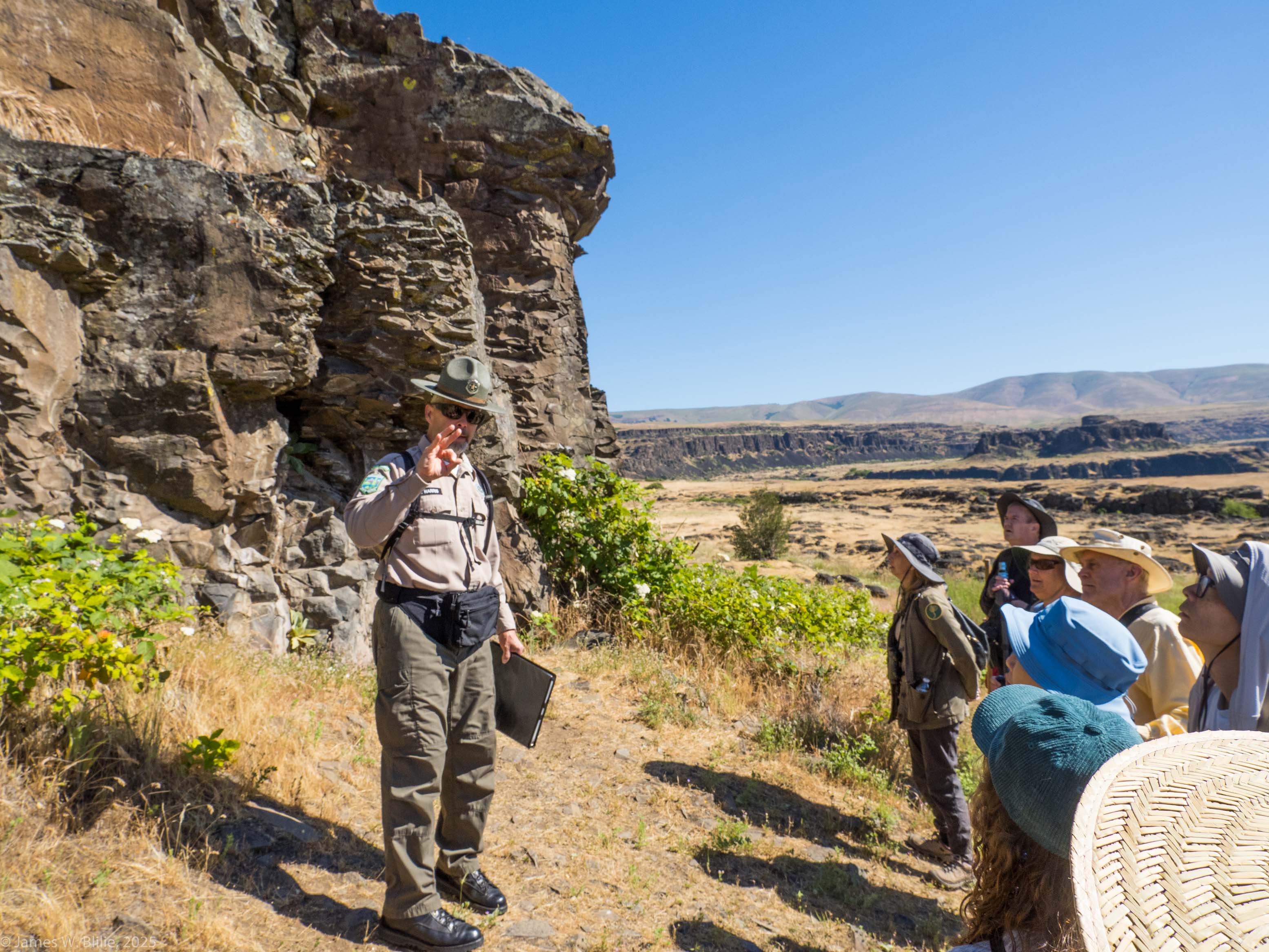
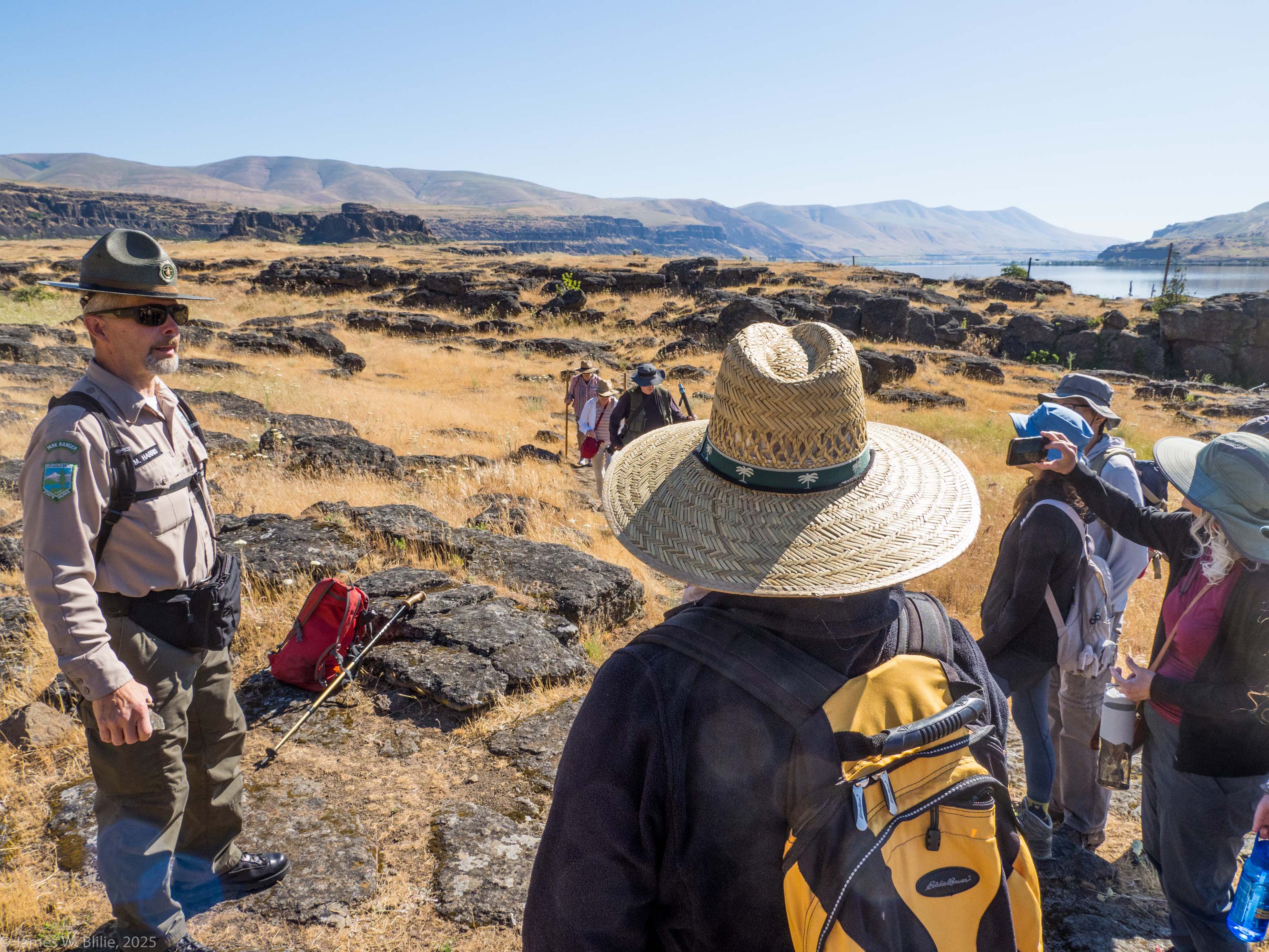
I hope that your readers find this set interesting.  These photos were taken yesterday (30-May-2025) on a tour of petroglyphs and pictographs in the Columbia Hills Historical State Park near Dallesport, Washington.  The area where we live has a profusion of petroglyphs and pictographs.  In my very extensive travels and hiking in the American West, I’ve found that almost any likely flat rock surface will have petroglyphs or pictographs on it.  This state park is near where important Native American villages existed along the Columbia River, so the stone images are concentrated here.  In cooperation with the YakimaWarm SpringsUmatilla, and Nez Perce tribes, the state park offers guided tours of these images.

Not so many years ago, one could hike the area freely with a state park pass.  However, recent vandalism has forced the tribes and the state to close the area to all except tribal members and guided tours.  Unfortunately, we saw direct evidence of this need (vandalism).  The vandalism has taken the form of markings on the images (people trying to do rubbings and leaving marks over the images – we saw this) and gun shots to the images (we saw this too, see photos).

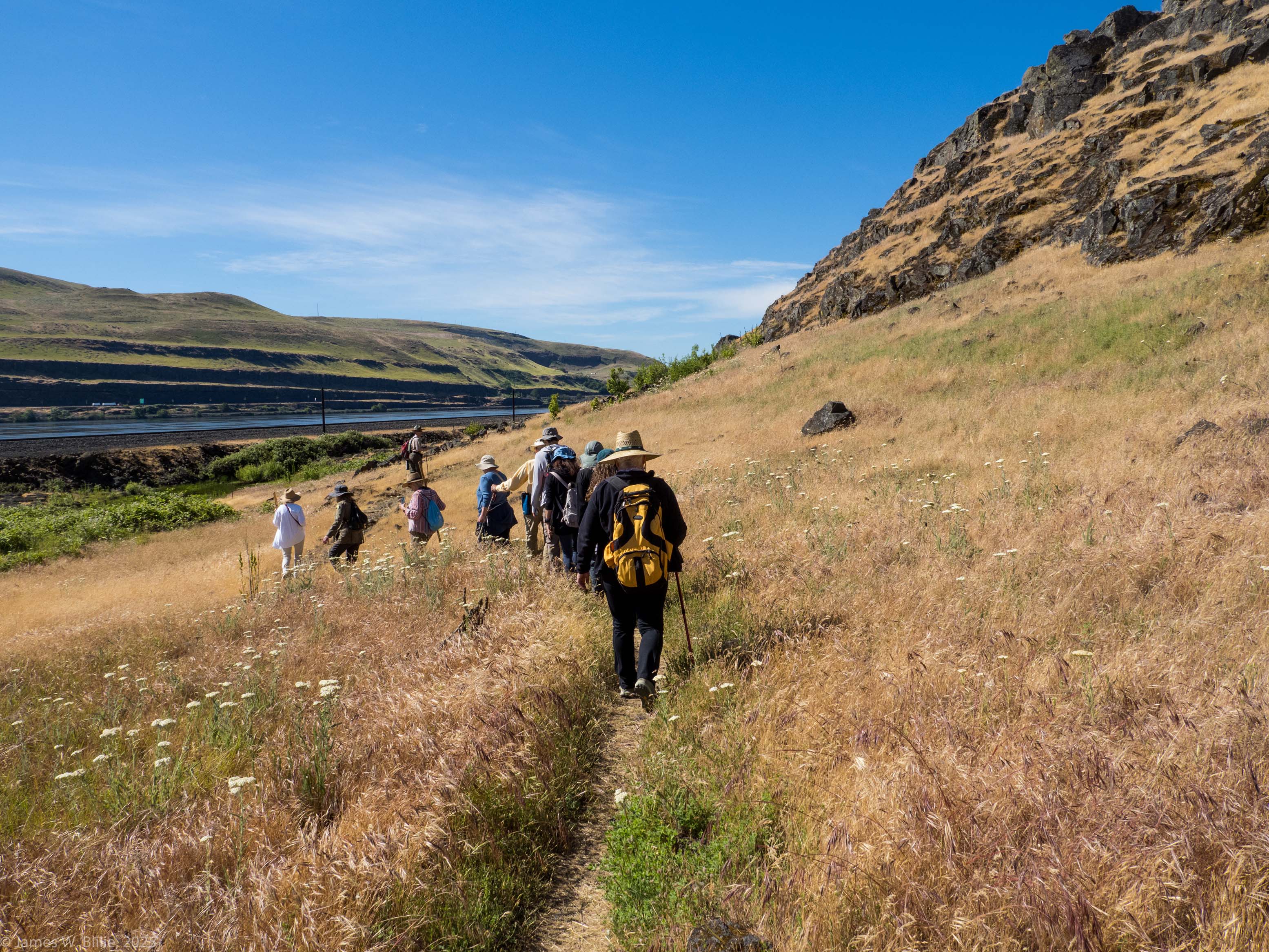
The tour is called the She-Who-Watches tour after the eponymous and most spectacular of the images.  There’s high demand for these tours and you will want to book months (!) or at least weeks in advance.  But the tour is well worth it.  The walk is short (about a mile, total, I estimate) and pretty flat; but does cover some rough and uneven ground; and it gets hot (carry water and protect yourself from the sun).  Most of the people, including the guide, used walking sticks for stability.

I highly recommend this tour.

First are some general images of the area.  This park is in the Columbia River Gorge and these are typical scenes from the Gorge.  The geology is dominated by the Columbia Plateau flood basalts and, of course, the Columbia River.  (I highly recommend Professor Nick Zentner’s videos on the geology of the Pacific Northwest.)

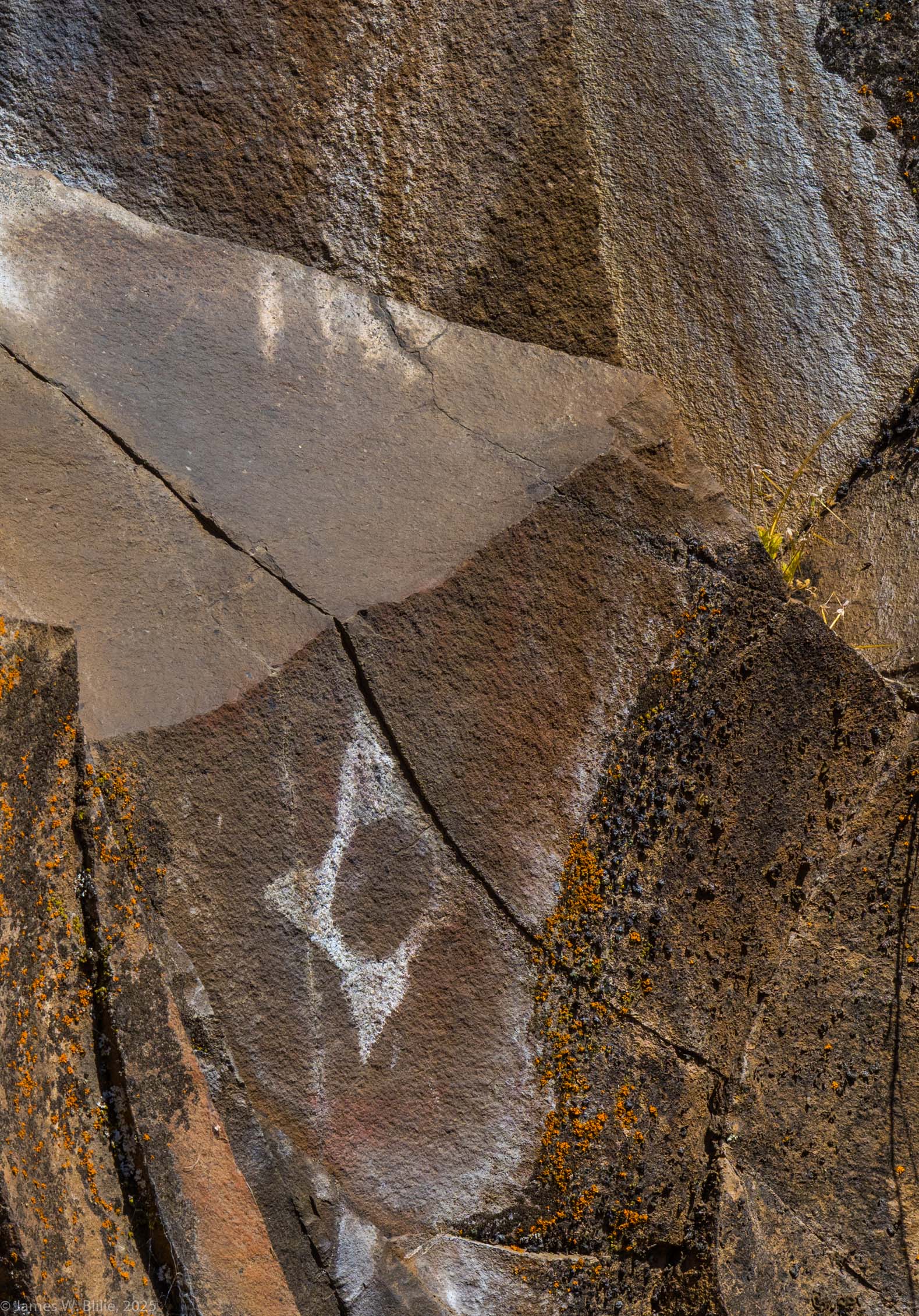
Next are photos of some of the smaller images in the park.  All these images are incised into the hard basalt rock (petroglyphs) or painted on the rock (pictographs) in white, red, and black pigments.  These images have survived centuries in a harsh environment, exposed to an intense sun all summer.  It’s still uncertain what was used as binder(s) to apply the pigments.

Now the main event, the She-Who-Watches image, which is a shallow petroglyph also painted with pigments (pictograph).  Please look closely at the most magnified image.  See the fresh pits in the image?  These are gunshot impacts, made by some hooligan.  People’s idiocy and disrespect is sometimes mind-boggling. We are lucky that basalt is so hard and resistant to impact damage.

The next image shows a small “altar” just below the She-Who-Watches image.  This area is an active sacred site for the local tribes noted above.  I took these photos from about 15 feet away and I did not go closer out of respect.  (Some people went right up to the “altar” with their phones.  Obviously, I’m not religious; but still.)  Back at the parking lot, there was a large family group of Native Americans preparing to visit the site.

Lastly are photos of a fairly large number of petroglyphs displayed at the parking lot.  These were moved from their original sites when The Dalle Dam was constructed (1952-1957) and its impoundment would have inundated the images.  Also shown as some informational signs about these images.  These images can be viewed without a tour (just a state parks pass).

JAC: The one below looks like a wildcat!

Caturday felid trifecta: History’s “most fabulous cat painting”; an old to Coal, a Parliament Hill cat; hot cats from the NYRB and 3 lagniappes

July 26, 2025 • 11:00 am

We’re back again with an excellent felid trifecta, this time with three—count them, three—items of lagniappe.  Given the waning interest in this feature, however, I’m still considering deep-sixing it. It’s more work than you think.

First, ArtNet has a nice article on what it calls the “world’s most fabulous cat painting”, called “My Wife’s Lovers”.  There’s a Wikipedia article on it, along with a high-resolution reproduction of the painting, which is coming.  You’re about to see it.  It’s almost here. And yes, here it is (click to enlarge).  As the article and Wikipedia entry shows, the painting has a checkered and colorful history.

Click below to read the ArtNet article:

An excerpt:

Carl Kahler’s 1891 painting My Wife’s Lovers just might be the most magnificent painting of cats in the history of art—and the story behind it is one incredible tail! The sumptuous portrait of 42 cats, mostly angoras, was commissioned by the ultimate cat lady, San Francisco millionaire Kate Birdsall Johnson, to enshrine some of her favorite feline friends in perpetuity. That’s right: there were others. Some claim she had nearly 300 cats. Others say her clowder maxed out at 50.

In recent years, the painting has enjoyed a new burst of popularity, driven by social media (with social media hashtags such as #meowsterpiece) and bolstered by a stunning 2016 sale at Sotheby’s where it earned a whopping $826,000, more than two times its presale high estimate of $300,000 (that comes out to $19,667 per cat).

The artist behind the work, Carl Kahler, is today known best for such resplendent paintings of cats. Another of his works, Three Black Cats, recently appeared at Sotheby’s this past February. But before taking on the commission for My Wife’s Lovers, the artist had actually never painted one.

Born in Austria in 1856, Kahler established a career in Australia and New Zealand painting horse racing. The artist came to San Francisco en route to Yosemite, where he planned to paint nature scenes. Then fate intervened in the form of an invitation to the mansion of Kate Birdsall Johnson, a millionaire well-known for her art collecting and philanthropy, who offered him the career-altering commission. Other works in her collection included the ethereal 1874 painting Elaine by Toby Edward Rosenthal as well as Greco-Roman antiquities.

Johnson resided at a lavish summer property, known as Buena Vista Castle, which was famously the largest estate north of the Golden Gate. The sprawling grounds had formerly been the Haraszthy family vineyard (today, it is home to the Bartholomew Estate Vineyards). In the estate’s 40-room Victorian mansion, Johnson’s cats were said to occupy an entire floor and were attended to by their own servants. Along with felines, Johnson kept prize-winning dogs, horses, cattle, and a veritable aviary of cockatoos, parakeets, and canaries. Kahler would spend three years living at the castle, amid this menagerie, sketching the cats and familiarizing himself with their unique personalities.

. . . In its final form, My Wife’s Lovers, completed in 1891, is six feet tall, eight-and-a-half feet wide, and weighs over 200 pounds. Johnson’s 42 felines appear tiered on steps draped with silk and, as with the great Renaissance tableaux, in various states of emotion. Some are resting, playing, and cuddling. A group on the lower left gathers around a moth. At the center of the portrait is Sultan, a handsome, large cat with green eyes and brown and yellow markings on his white fur. Johnson is said to have paid some $3,000 for Sultan on a trip to Paris. Next to Sultan is a white angora cat with blue eyes who is believed to be Johnson’s cat, His Highness (who appeared in another of Kahler’s paintings).

. . .In the 1940s, the painting enjoyed fame as a subsequent set of owners would take My Wife’s Lovers on a national tour and present the painting at Madison Square Garden in New York for a cat show. Some 9,000 prints of the painting were said to have been sold alongside the tour, and in 1949, Cat Magazine called My Wife’s Lovers “the world’s greatest painting of cats.”

Today, Kahler’s magnum opus is back in Northern California, purchased in the Sotheby’s bidding battle by John and Heather Mozart, fittingly eclectic collectors whose passions run from majolica and Portuguese colonial furniture to Elvis’s memorabilia. In 2016, the painting made its most recent public appearance at the Portland Museum of Art in Oregon. While cat and art lovers can only hope this meowvelous painting comes back on view soon, for now, the painting continues to delight on social media.

This is Sultan (l) with what is probably His Highness. Unlike medieval painters, who could never get cats right (they always wound up looking like humans), Kahler did an excellent job, don’t you think? And it’s sad that a 48 ft painting like this is now out of public view.

And its fate as described in Wikipedia:

The center of the painting shows her cat Sultan, bought by Johnson during a trip to Paris. Johnson lent the painting for the 1893 Chicago World’s Fair, and in the next year it was acquired by Ernest Haquette for his Palace of Art Salon in San Francisco. While the salon was destroyed in the 1906 San Francisco earthquake, the painting survived it.[5]

My Wife’s Lovers subsequently hung in Frank C. Havens‘ Piedmont Art Gallery in Piedmont, California, and was later purchased by a couple from Chicago. In November 2015, the painting was sold at Sotheby’s to a private California buyer for US$826,000.

In 2016, the Portland Art Museum displayed the piece between February 2 and June 8, 2016, and partnered with the Oregon Humane Society to raise awareness of cat adoptions.

Here’s a social media post; feel free to make your own meme as the painting is in the public domain:

A Tik Tok video of Kahler’s painting, “Three black cats.”

@sothebysinstitute

Have you ever felt like you were being watched by a painting? Carl Kahler’s Three Black Cats does just that—but cat lovers find it more cute than creepy. 🐈‍⬛🐈‍⬛🐈‍⬛ This painting will be part of the 19th Century European Art Sale at @Sotheby’s New York beginning February 5, 2025. 🖼️ : Three Black Cats, Carl Kahler (1856 – 1906), oil on canvas #CarlKahler #EuropeanArt #Art #Cats #CatPainting #ThreeBlackCats #Sothebys

♬ original sound – Sotheby’s Institute

********************

Speaking of black cats, here is a memoriam in Canada’s National Post to a well known Canadian moggie, a black cat named Coal. He was o9ne of the Parliament Hill Cat Colony in Ottawa, which I visited (but I guess I didn’t post about it.)  Click below to read the Post article.

An excerpt:

In his 17 years of life, Coal was a source of comfort, a documentary movie star and something of a lobbyist.

He lived a bright and happy life roaming Parliament Hill and later after adoption. But, instead of a pension or a job title, he had jet-black fur, whiskers and a long, fluffy tail.

Coal, the last of the Parliament Hill cat colony, died of a rare and aggressive form of cancer on Tuesday beside his human dad, Danny Taurozzi, and feline adopted brother Winston.

“Coal’s condition had become grievous and irremediable, beyond what love, medicine, or therapies could ease,” a post to Coal’s Facebook page read. “It was time to let him go.”

I visited the cats on Ottawa’s Parliament Hill before they were adopted out, but I can’t find the post I made of them. Here’s a bit more:

In an interview with the Ottawa Citizen, Taurozzi spoke of Coal’s fulfilling life.

The feline had cameos in international documentaries, was a certified therapy cat, visited animal-loving members of Parliament and posed for photos with emergency responders as a “little nudge” for better protection for animals.

“Coal himself was a gentleman feline with a heart of gold, with not one mean bone in his body,” Taurozzi said. “He was a very loyal buddy.”

Before he was starring in movies and posing for photos, Coal called the grassy lawns of Parliament Hill home.

In the 1920s, cats were acquired to deal with rampant rats and mice in the basement of Centre Block. Thirty-five years later, the cats were replaced by pest-controlling chemicals. Without a pension or a dollar to their name, the retired felines remained on the Hill, attracting thousands of tourists, filmmakers, Hill staff and MPs each year.

“I’ve been told more than once that they were stress relievers for the people on the Hill,” Taurozzi said, adding that former prime minister Stephen Harper and former MP John Baird were fans of the sanctuary. “Just to get the pressure out of the day.”

The cats lived in a sanctuary of insulated, small houses similar to the nearby Parliament buildings, maintained and fed by volunteers. The sanctuary was closed in 2013 and all the remaining cats were adopted.

. . . All of his cats are well cared for, Taurozzi underlined, but he went to extra lengths to provide Coal with the best possible medical attention. He sought opinions from three medical veterinary professionals to confirm Coal’s cancer diagnosis and raised $15,000 in donations to pay for medical expenses.

“I shared 12 years with Coal, so I got a really close one with him the day before he died,” Taurozzi added. “He joined me in bed, just put his head on my shoulder for a little bit, and left.

Here’s a 3-minute video about Coal and his adoptive father:

Here’s a photo I took of the Parliament Hill cat condos in 2007 when I was visiting my friend Barb Best (hi, Barb!), and below that my map of Ottawa which shows the “Cat Condos” by Parliament:

******************

Finally, from the New York Review of Books, here’s an article about “hot cats” from art editor Leanne Shapton (click below). I give an excerpt:


An excerpt:

Our thirty-fourth art newsletter comes via The New York Review’s editorial group chat, where some of our staffers have recently been posting photos of their pets in the summer heat. I love drawing cats, and I find a lethargic cat lying supine to be a beautiful thing. Herewith, please find a gallery of our beloved, overheated cats.

The rest of the newsletter describes what’s in the issue, but I couldn’t resist putting up two of Leanne Shapton’s drawings of hot cats. There are more at the site:

My own cat, Biscuit, is surviving the summer by sprawling on towels, eating fish skins, and recently enjoyed the Fourth of July fireworks tucked into the armpits of my daughter’s hoodie.

***************************

Lagniappe: From Cats That Have Had Enough of Your Shit:


Moar lagniappe:

Even MOR lagniappe:

h/t: Texas Linguist, Lianne