Why Evolution is True is a blog written by Jerry Coyne, centered on evolution and biology but also dealing with diverse topics like politics, culture, and cats.
It’s Friday, so let’s have a butcher’s at the Dorm Ducks. They’re about six weeks old now, and all ten ducklings are thriving. Mother Maria is on the scene most of the time, and is a very attentive mom. You’ll see how fat the little buggers are, and how much they’ve grown. Blame the Mazuri Duck Chow, mealworms, and plenty of fresh water (about 20 gallons per visit), much of which we schlep several blocks in gallon milk jugs. It’s not an easy job, but somebody has to do it.
Here are some photos and two videos from July 31:
Tub o’ ducks!
The ducklings like to lie on tufts of grass on the patio, even though there’s a whole lawn right nearby. But they like to stay close to Mom and their siblings.
The tub gets a bit crowded at times. . . .
But sometimes a lucky duck gets the tub all to itself. Here’s a video of one having a high old time swimming, drinking and ducking. We’d prefer a pond, of course, but that’s not available.
Napping on a tuft. Notice the closed nictitating membranes protecting the eyes.
The lovely Maria, who hatched all these babies:
More bathing, noshing, and preening in this video:
. . . and another shot of Mother Mary:
A baby in all its grown-up splendor. The secondary wing feathers are coming in, and today the primaries were visible.
Another improvised swimming pool. I used to use these containers in my incubators to keep my flies under high humidity. Never did I dream that they would serve as duck bathtubs.
According to this post on Richard Dawkins’s Substack site, Jordan Peterson challenged him on Twitter to answer two questions. Dawkins decided to answer both because, as he said below, he respects Peterson:
A colleague sent two challenges to me, posted by Jordan Peterson, suggesting I should respond. I’m happy to do so because I greatly respect Dr Peterson’s courageous stance against a bossy, intolerant thought-police whose Orwellian newspeak threatens enlightened rationalism. The hero of 1984, Winston Smith, was eventually persuaded by O’Brien that, if the Party wills it, 2+2 = 5. Winston had earlier found it necessary to stake out his credo. “Freedom is the freedom to say that two plus two make four. If that is granted, all else follows”.
Yes, Peterson is gutsy enough to say what isn’t popular but often worth saying, though he’s also vociferous about some stuff that isn’t admirable—like his admiration of religion. But you have to give him credit for not really caring whether his beliefs make him demonized. Click below to Read Richard’s answers.
The first question:
Richard begins his answer with a caveat:
My answer to the question is no if you include supernaturalism in your definition of a religion, and a dear colleague takes her stand on this distinction. But the following three similarities are enough for me to justify a yes answer to Jordan’s question. The first of the three is characteristic of religions in general. The other two are kin to Christianity in particular.
The similarities are Heresy Hunting, Hereditary Guilt, and Transubstantiation. This is his example of the last one:
Similarly, in the cult of woke, a man speaks the magic incantation, “I am a woman”, and thereby becomes a woman in true substance, while “her” intact penis and hairy chest are mere Aristotelian accidentals. Transsexuals have transubstantiated genitals. One thing to be said in favour of (today’s) Catholics: at least they don’t (nowadays) insist that everybody else must go along with their beliefs.
Hemant Mehta, who has long gone down the Woke Rabbit Hole, will be sharpening his knives when he reads that.
And the second question:
Part of Dawkins’s answer:
I see this accusation again and again in graffiti scribbled on the lavatory wall that is Twitter. Peterson’s tone is more civilised, of course, but the message is the same. We who have spoken out against the irrationality of religion are to blame for the rise of the irrationality of woke.
. . . I get the point, but I love truth too much to go along with it. I, along with Sam Harris, Dan Dennett, Christopher Hitchens, Victor Stenger, Lawrence Krauss, Michael Shermer, and others, are against all religions without exception. And that includes the cult of woke. To oppose one irrational dogma by promoting another irrational dogma would be a betrayal of everything I love and stand for.
Whatever else there is to admire about Peterson, his affection for religion, which may be of the “Little People” variety (e.g., “I am no believer, but religion is essential for everyone else as a social glue”), is not only an acceptance of the unevidenced, but a false belief that superstition is necessary for a good society (viz. Scandinavia). It’s also patronizing.
But it may be that Peterson really believes in, say, Christianity. I’d love to sit him down and ask him questions about whether he believes in the Resurrection, heaven, and so on, but I’m 100% sure that his answers would be so tortuous that you wouldn’t get an intelligible answer.
Today’s photos are from ecologist Susan Harrison at UC Davis. Her captions are indented, and you can enlarge the photos by clicking on them.
Rare Blue Bunting Meets Feisty Green Towhee
In mid-July, a male Indigo Bunting (Passerina cyanea) – quite a rarity west of the Rockies – took up residence on a broken-topped Shasta Red Fir (Abies magnifica var. shastensis) in a flowery 6,500’ meadow at Mt. Ashland. He stayed for two weeks, singing intermittently, even though only the closely related Lazuli Buntings (Passerina amoena), and a stream of Southern Oregonian birdwatchers, were available to admire him.
My first visit yielded a distant view of the Indigo Bunting in his fir tree:
Returning two days later, my hopes of a better photo were dashed despite hours of hiding quietly near his tree. So here’s an Indigo Bunting from Texas in 2022:
The problem was that an aggressive Green-Tailed Towhee (Pipilio chlorurus) chased the Indigo Bunting away – which I saw happen – and usurped the fir tree for his own singing purposes:
The Green-Tailed Towhee did not seem to mind sharing the tree with foraging birds. These included a dragonfly-catching Dark-Eyed Junco (Junco hyemalis)…:
And Rufous Hummingbirds (Selasphorus rufus) alternated between visiting Scarlet Gilia (Ipomopsis aggregata) flowers and perching atop shrubs or trees:
Postscript: After four days of no sightings, the Indigo Bunting was observed singing on a tree about a half-mile away across the meadow. Let’s hope the Towhees leave him alone!
Readers are welcome to mark notable events, births, or deaths on this by consulting the August 4 Wikipedia page.
And there’s a Google Doodle today (click to go to sites) celebrating the life and work of Altina Schinasi (born on this day in 1907, died 1999), described as “a US sculptor, filmmaker, entrepreneur, window dresser, designer, and inventor. She was best known for designing what she called the “Harlequin eyeglass frame”, popularly known as cat-eye glasses.” Vanity Fair has a piece and a video showing her describing the glasses.
Speaking briefly at Reagan National Airport after his arraignment Thursday, former president Donald Trump slammed the indictment as a “persecution” and called it “a very sad day for America.”
Trump, who held an oversized black umbrella as a light rain fell, also criticized Washington itself.
“It was also very sad driving through Washington, D.C., and seeing the filth and the decay and all of the broken buildings and walls and the graffiti,” he said. “This is not the place that I left. It’s a very sad thing to see it when you look at what’s happening.”
Trump noted that polls showed him with a substantial lead in the Republican presidential primary and baselessly accused President Biden of using the indictment as a way to hamper a would-be political rival.
“We can’t let this happen in America,” he said. “Thank you very much.”
I haven’t lived in the D.C. area for years, but I find it hard to believe that the filth, decay, and graffiti all happened in the last three years. As for “we can’t let this happen in America,” if he’s referring to him being indicted, my response would be YES WE CAN, AND WE DID. It’s to America’s eternal shame that this string of indictments hasn’t put a dent in Trump’s approval ratings. Oh, and there’s this:
Former president Donald Trump was allowed to leave court without travel conditions, and no cash bond was required. U.S. Magistrate Judge Moxila A. Upadhyaya ordered, however, that he must not violate federal or state law while awaiting trial and that he must not communicate with anyone known to be a witness, except through counsel or in the presence of counsel.
I wonder if she was thinking of Trump’s attempt to intimidate state officials into giving him the number of votes he needed to win the 2020 election.
*Why haven’t Trump’s six co-conspirators in the January 6 case been indicted? The NYT gives some hints:
Some were household names, others less familiar. Among them were Rudolph W. Giuliani, John Eastman, Jeffrey Clark, Kenneth Chesebro and Sidney Powell.
On Tuesday, most of these same lawyers showed up again — albeit unnamed — as Mr. Trump’s co-conspirators in a federal indictment accusing him of a wide-ranging plot to remain in office despite having lost the election.
The appearance of the lawyers at the center of the case suggests how important prosecutors judged them to be to the conspiracy to execute what one federal judge who considered some of the evidence called “a coup in search of a legal theory.”
The lawyers’ placement at the heart of the plot while remaining uncharged — for now — raised questions about why Mr. Smith chose to bring the indictment with Mr. Trump as the sole defendant.
In complex conspiracy cases, prosecutors often choose to work from the bottom up, charging subordinates with crimes to put pressure on them to cooperate against their superiors. It remains unclear precisely what Mr. Smith may be seeking to accomplish by flipping that script.
Some legal experts theorized on Wednesday that by indicting Mr. Trump alone, Mr. Smith might be seeking to streamline and expedite the case ahead of the 2024 election. If the co-conspirators were indicted, that would almost certainly slow down the process, potentially with the other defendants filing motions and seeking to splinter their cases from Mr. Trump’s.
“I think it’s a clean indictment to just have Donald Trump as the sole defendant,” said Soumya Dayananda, a former federal prosecutor who served as a senior investigator for the House Jan. 6 committee. “I think it makes it easier to just tell the story of what his corrupt activity was.”
Another suggested theory is that this intimidates the yet-to-be-indicted, making them ponder cooperating with the prosecution lest they wind up indicted like Trump. Only time will tell.
*From reader Jez: “Unlike the female shot putter competing in the hurdles the other week, there’s no excuse for this terrible performance.
Somalia’s sports minister publicly apologized Wednesday and ordered that the chairwoman of the national track and field federation be suspended after a seemingly untrained female sprinter represented the African country at the World University Games in China and took more than 20 seconds to finish a 100m race.
Minister of Youth and Sports Mohamed Barre Mohamud said his ministry did not know how 20-year-old Nasra Abukar Ali was selected to compete in the women’s 100m at the student games in Chengdu on Tuesday.
The ministry separately released a statement directing the Somalia Olympic Committee to suspend national athletics federation chairwoman Khadija Aden Dahir amid allegations that Nasra Abukar was a relative of hers and was given the chance to compete at the games because of that.
. . .Somalia’s university union said it had not sent any runners to China as part of an official Somali team.
A video of the agonizingly slow run by Nasra Abukar was shared across social media and Mohamud said that the performance was embarrassing for Somalia.
In her qualifying race, Nasra Abukar was immediately left behind by the other runners and finished about 10 seconds after the winner. Despite being dead last, she did a little skip in the air as she crossed the finish line.
You can see the race in this tweet. The Somali “sprinter” just lopes along like a aged Sunday jogger.
The Ministry of Youth and Sports should step down. It's disheartening to witness such an incompetent government. How could they select an untrained girl to represent Somalia in running? It's truly shocking and reflects poorly on our country internationally. pic.twitter.com/vMkBUA5JSL
But let’s cut them a break: things are tough in Somalia these days.
*The WSJ is kvetching about the U.S. team’s performance at the women’s World Cup: “Will the real U.S. women’s soccer team please show up?” The article gives reasons for the teams lackluster performance so far, though of course there’s a note of U.S. jingoism that I’m slowly abandoning (I’m rooting for underdog Colombia now.)
The USWNT’s [US Women’s National Team’s] struggles aren’t hard to see. Even if you don’t know football from North American football, you can tell something looks off.
There’s a case that this is progress, that a Women’s World Cup run is no longer an USWNT given, that global soccer is catching up and threatening decades of dominance. Brilliance is starting to flicker elsewhere, and new powers are coming. Look at the rise of a team like Jamaica, which knocked out Brazil. Or South Africa’s Banyana Banyana, into the knockout for the first time.
It’s fresh theater, a broader product, good for the game. Not long ago, only a handful of nations had a chance to knock off the USWNT. Now potholes lurk everywhere, like Portugal, which Tuesday came within a closing-minutes thuuuuunnnk off the post from sending the U.S. women home from New Zealand in their worst loss ever.
Well, that shows why there are more good women in the Cup than ever, but the U.S. team still looks off, and that isn’t explained by that theory, which is the Wall Street Journal’s. As jingoists, they lay some of the blame on American nay-sayer, but then admit that the U.S. women’s team isn’t up to snuff:
Some of this blowback is overheated, tinged with politics and Schadenfreude from USWNT detractors who don’t intend to watch a minute of action. But the vibe is undeniably different. The USWNT is a historic success story, a program built on the pillars of Title IX, transforming women’s sports in this country, successfully achieving pay equity with the men’s team and minting celebrities like Mia Hamm, Abby Wambach, Alex Morgan and Megan Rapinoe.
They have had their wobbles and setbacks (no Olympic gold since London 2012) but come World Cup season they reliably turned into Marvel characters. For all the hand-wringing at the moment, they still have a shot at figuring this out and becoming the first team, men’s or women’s, to ever win three consecutive World Cups.
But it’s feeling like a reach—and not just because here come the Swedes, a nemesis which beat the USWNT at the Rio and Tokyo Games. The 2023 U.S. team has indeed been underwhelming. It meanders, it plays with little urgency or even a clear strategy. Anyone who woke up at 3 a.m. ET for the 0-0 Portugal result and managed to stay awake should be studied by scientists. The team looks stuck between the USWNT of the future and the USWNT of the past, as its present slips away.
I’d love to watch the Sweden game, though I don’t really have a dog in that fight (as I said, I’m rooting for the very low underdog Colombia). I guess I’m not tribalistic enough to be caught up in the success or failure of the USWNT.
*CNN reports that the Burgess Shale in the Canadian Rockies, famous for preserving soft-bodied animals, has now yielded what seems to be the world’s oldest known swimming jellyfish:
The oldest examples of swimming jellyfish, which lived in Earth’s oceans 505 million years ago, have been discovered high within the Canadian Rockies. Researchers found 182 fossils encased within the rock of the famed Burgess Shale fossil site.
The fossils belong to a previously unknown species of jellyfish, called Burgessomedusa phasmiformis, that shows just how evolved these creatures already were millions of years ago.
The exceptionally well-preserved fossils are a remarkable find, given that the soft-bodied animals are made of 95% water. The jellyfish measure about 8 inches (20 centimeters) in length.
Here’s a reconstruction from the paper along with its original caption:
(From paper): Figure 5. Life reconstruction showing a cluster of Burgessomedusa phasmiformis gen. et sp. nov. swimming above the benthos. This reconstruction is based on the Raymond Quarry Burgess Shale community with clusters of Vauxia sponges represented in the foreground. Artwork by C. McCall.
From the paper:
Burgessomedusa possesses a cuboidal umbrella up to 20 cm high and over 90 short, finger-like tentacles. Phylogenetic analysis supports a medusozoan affinity, most likely as a stem group to Cubozoa or Acraspeda (a group including Staurozoa, Cubozoa and Scyphozoa). Burgessomedusa demonstrates an ancient origin for the free-swimming medusa life stage and supports a growing number of studies showing an early evolutionary diversification of Medusozoa, including of the crown group, during the late Precambrian–Cambrian transition.
Here’s a remarkable impression fossil from the paper but reproduced by CNN. This could only have been made by a fairly rapid deposition of very fine sediment over the jellyfish. The Burgess Shale continues to yield remarkable creatures!
IFrom CNN): A rock slab shows one large (right) and one small (left) bell-shaped jellyfish with tentacles. The smaller animal is rotated 180 degrees. Photo: Jean-Bernard Caron/Royal Ontario Museum
Meanwhile in Dobrzyn, Hili is bored:
A: Where are you going?
Hili: I have to change environment, I’m bored by this one.
In Polish:
Ja: Dokąd idziesz?
Hili: Muszę zmienić środowisko, tu już mi się znudziło.
********************
From Barry (I can’t make out the cartoonist:
From Nicole:
And from Craig, who found a “no diving” sign at the dry end of his local pool:
Retweeted by Masih. Will this guy get in trouble?
Star Iranian footballer Voria Ghafouri: “no weapons can defeat armed brains.” https://t.co/p7TfDddH2E
— chocolate chip😁🖖🏼🏳️🌈🟧🥂🟦 (@cannoli1000) July 11, 2023
From the Auschwitz Memorial: a tweet I retweeted:
Anne Frank, of course, was only one of many Dutch Jews murdered by the Nazis. Betty Mol, however, was gassed upon arrival. The Nazis murdered more Jews from the Netherlands than any other country: roughly 115,000. https://t.co/Y4daEy8DTf
What a tournament: upset over upset! And one of them was Germany’s tie with South Korea, 1-1, a result that sent the team packing back to Deutschland—their first ever failure to leave the group stage. And although Colombia lost to Morocco, 1-0, the gutsy Colombians get to stay in. Sixteen teams remain in the knockout round, with fifteen total games left to give us a champion.
Germany will of course have known the math: A win was all that was required to ensure passage to the round of 16 of the Women’s World Cup. But Canada had known the math, too, and went out anyway. So did Brazil and New Zealand and Portugal, all gone for the want of a single precious goal that never came.
Yet a World Cup that has had some improbable moments — Jamaica eliminating Brazil, the U.S. team advancing thanks to a single, favorable bounce — got perhaps its biggest stunner so far on Thursday: Germany, the second-ranked team in the world, is out after the strangest finish to the group stage in its history, two games requiring only one win, and in which it got none.
South Korea, a team that was effectively eliminated before the match even kicked off, a team that had not scored a goal before in the tournament before Thursday, took an early lead and then held on for a tenacious, improbable, almost unthinkable 1-1 tie with Germany. That result was not good enough for the Germans only because Morocco, another unlikely contender, beat Colombia, 1-0, on Anissa Lahmari’s goal off a rebound from a saved penalty kick.
Here are the highlights of the Germany-South Korea game:
And here are the highlights of Morocco’s 1-0 victory over Colombia. Morocco scored after a failed penalty kick rebounded:
Here’s the upcoming schedule. With several of its toughest opponents out, the U.S., which plays Sweden on Sunday, has a fighting chance to win it all:
It’s rare when a Kiwi scientist writes an article calls out the erosion of their country’s science by an overly worshipful attitude towards “indigenous ways of knowing” (Mātauranga Māori in New Zealand). Over at BreakingViews.co.nz, Auckland zoologist Brian Gill blasts the tendency of New Zealand’s science societies to kowtow towards “other ways of knowing.”
How did he get away with this? Because he’s retired, of course. As the Kiwi who sent me this link said, “Our critics will say that all of these articles are written by white, male boomers. However, retired members of this group are basically beyond retribution. I know retired scientists who totally agree with us yet are afraid to say anything.”
Click to read:
Here’s a few excerpts from the piece:
It’s the perfect time for science groups to promote science’s history and philosophy, and make clear the power of the modern scientific method. The Royal Society of New Zealand (RSNZ) publicises individual science projects that it funds. But it and other science groups seem strangely silent on the benefits of science thinking generally.
The RSNZ [Royal Society of New Zealand], formerly our science academy, in 2010 amalgamated with the Humanities Council. It now focuses heavily on Maori and Pacific culture and identity, and promotes what it calls “multiple knowledge domains” with science rather off to one side. The RSNZ rejected the Listener letter-writers’ “narrow and outmoded definition of science”. That’s the former science body responding under influence of the humanities, which often portrays science as merely one of many world views, all equally valid. It’s a serious problem that New Zealand now lacks an academy devoted solely to science.
The New Zealand Association of Scientists (NZAS) claims to be “an independent body that stands for and advocates for science and scientists”. Yet, after the letter of the “Listener Seven”, the NZAS seemed to have a new ideological purpose. Instead of supporting science and the letter-writers, it stated in its press release that science “has an ongoing history of colonising when it speaks over Indigenous voices” and that matauranga Maori (traditional knowledge) has “equal importance and role in scientific work”.
In the new school science curriculum the Ministry of Education has included “mauri” (a mystical force that some believe is present in animate and inanimate objects). Other cultures have a similar concept (“vitalism”) but in Europe it was discredited as part of science in the early 1800s. Shamefully, the science organisations have been tight-lipped on this important issue in science philosophy, seemingly unwilling to defend science thinking in schools.
Perhaps they consider science too powerful to need promotion. Or they may feel that too strong an advocacy for the scientific method makes other world views look inadequate. They might just be falling in line with the current attitude of the liberal (some say “illiberal”) left, that “Western” institutions deserve no praise.
Gill goes on to list some of “the characteristics of science” which, he said, are too often neglected by those promoting or adjudicating science in New Zealand. They include Universality, Evidence, Endless Scrutiny, Objectivity, Grand Theories, Openness and Publication, and Neutrality (science itself cannot “colonize,” “marginalize,” or “oppress”). The paragraph below, for example, shouldn’t need saying, but it does—over and over again—in New Zealand.
1) Universality. Modern science has roots in Asia and the Middle East as well as in Europe so it isn’t “Western”. Science today is an international and universal endeavour. There is only one kind of science and it has no national, regional or cultural varieties. Talk of “Western science” or “Indigenous science”, meaning particular kinds of science, betrays poor understanding. Concepts can be part of science only if they are known and understood around the world by scientists irrespective of cultural background.
This is largely ignored in New Zealand, where “indigenous science” is conceived of as something different from (though perhaps complementary to) “Western science.”
Yes, it was a huge mistake to bring humanities into the RSNZ, because it is largely the humanities folk who are destroying science in New Zealand with jargon-laden articles about how “western science” should be coequal to indigenous science in schools, and are involved in a large indigenous grab of power and money that will give Māori “ways of knowing” (which include tradition, superstition, religion, and morality) and workers unwarranted control over science curricula and projects.
Have a look, for example, at some of the Marsden Fund grants given in 2021 to Kiwi investigators. The purpose of these grants is to “support excellence in science, engineering, maths, social sciences and the humanities in New Zealand by providing grants for investigator-initiated research.” Millions of dollars handed out!
Now don’t get me wrong: there are plenty of other grants that involve real science. (I didn’t even go through the whole list of 2021, and I see a similar pattern in 2022‘s awards.) But you can see how indigeneity and wokeness have invaded an institution formerly devoted to promulgating science, with the real damage being the millions of dollars diverted from real science into projects that seem unproductive. I doubt that a huge infusion of money was given to the RSNZ to support projects like those above, so it’s likely that this is a real diversion from real science.
Make of it what you will, but the Royal Society of New Zealand has become a joke. How to fix it? Gill suggests a start:
All these characteristics describe a brilliant system with a unique and pre-eminent role in modern society, but our science bodies seem too coy to tell us. Perhaps the RSNZ should de-merge to release science from the stifling embrace of the humanities. Or the RSNZ could at least allow its “multiple knowledge domains” to speak separately even if at times they contradict each other. We may need a new organisation: “Advocates for Science”. It would be for those prepared to put science thinking ahead of social justice activism.
What would that represent? Well, as in the joke, “What do you call a thousand lawyers at the bottom of the ocean?” the answer is “A good start.” Unfortunately, the RSNZ is beyond redemption, and they will never, ever “de-merge”, nor even allow its multiple knowledge domains to speak separately.” That last idea is not a good one, anyway, for it assumes that “other-ways-of-knowing” projects will still be funded.
The grants above, and similar ones, total millions of New Zealand dollars (each worth 61¢ US).
As I’ve described before, I collected the first specimen of Atelopus coynei, a small tropical frog that now has its own Wikipedia page. I collected it in the late 1970s on a field trip to Ecuador with my grad-school bestie, the late Ken Miyata, a man who’s sorely missed (he died in a fishing accident in 1983). As I had loaned Ken $500 to help him pay for rent and food, he did me the honor of naming the frog after me.
As it was rare, and first found in coastal Ecuadorian wet forests, which have largely disappeared, I eventually assumed that my frog was extinct, a metaphor for my own life. But, mirabile dictu, it was rediscovered by the great naturalist and photographer Andreas Kay on February 7, 2012 at Chinambi, Carchi, Ecuador. This was far from the sea, in the rain forest of the Andes foothills near the Colombian border, and the frog was still listed as “critically endangered.”
Then, in 2017, I got an email from naturalist Lou Jost, who reads and contributes to this site, telling me that A. coynei had been found on land close to the EcoMinga Foundation’s Dracula Reserve (Lou co-directs the foundation).
. . . . in December 2017, Javier and our herpetologist and reserve manager Juan Pablo Reyes organized an expedition to explore land we hoped to buy to expand the Dracula Reserve. The expedition included Mario Yanez, a well-known herpetologist from Ecuador’s National Institute of Biodiversity. They were thrilled to discover a good population of Atelopus coynei on one of the properties we were considering!!!! They also discovered another species that had been lost in Ecuador, Rhaebo colomai, though that species was known from a population in nearby Colombia. To top it off they discovered a dramatic completely unknown frog species, yellow with blue eyes!!! This is an amazing area and saving it has become a high priority for us. We are being helped by the Orchid Conservation Alliance, the University of Basel Botanical Garden, and the Rainforest Trust.
The three species mentioned above:
Atelopus coynei, photo by Juan Pablo Reyes and Jordy Salazar/EcoMinga. Isn’t it a beaut?
dav
Rhaebo colomai (photo by Mario Yanez):
The new yellow species with blue eyes (photos by Juan Pablo Reyes and Jordy Salazar/EcoMinga). I don’t know if it’s been described in the literature yet:
But now the story of A. coynei has been supplemented, as workers at the Dracula Reserve have made the first sighting of its tadpoles! As Lou wrote me on July 28:
We have a monitoring program for Atelopus coynei, and during that monitoring, our sharp-eyed reserve guards found the world’s first-ever A. coynei tadpoles! This is really nice to see, as an indicator of breeding and also as a new piece of the species’ biology. I’ll send pictures to you as soon as I receive them (I haven’t seen them yet). Yippee!
Of course I begged for photos, and yesterday Lou sent some of an adult and several tadpoles along with this note:
Here are the adorable tadpoles and an adult, taken in our Dracula reserve. We are carefully monitoring the population and it looks very healthy. We’ve managed to significantly expand the Dracula Reserve, thanks to grassroots campaigns by the Orchid Conservation Alliance, Reserva: Youth Land Trust, and Rainforest Trust. The photographers of the tadpoles, Milton Canticuz and Luis Micanquer, are local residents who were hired by us as reserve wardens and have become passionate conservationists. I hope you can come and visit them some day!
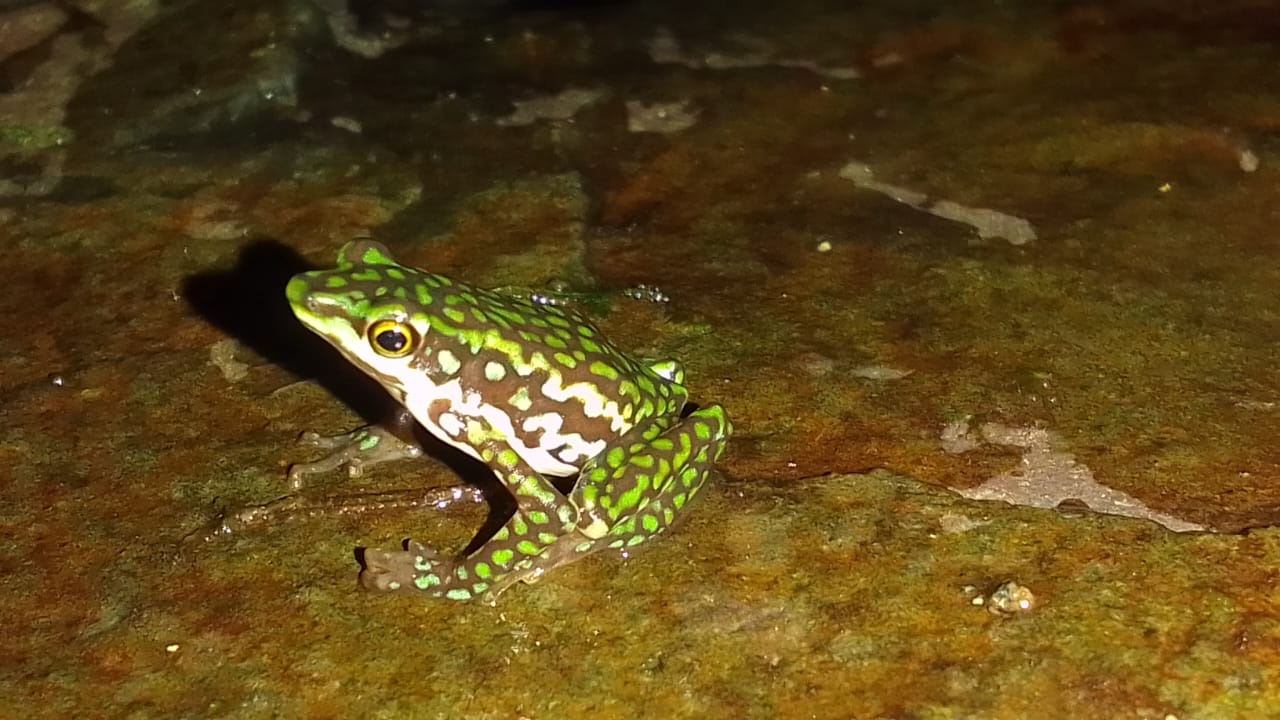
I surely will. This name is forever, as the scientific names of animals cannot be changed PLUS I’ve never done anything that would make me be canceled. Here is the gorgeous A. coynei and its tadpoles sent by Lou and photographed by Canticuz and Micanquer:
My beautiful, beautiful frog:
And the first photos of its tadpoles:
Note the developing legs:
Of course I asked if Lou was 100% sure that these were A. coynei tadpoles, and he replied:
No, I’m not 100% sure; it is their deduction based on their knowledge of the patterns of local frogs, and our herpetologist experts (who know the local fauna well) concur.
Atelopus coynei, the Rio Faisanes stubfoot toad, is a species of toad in the family Bufonidae endemic to Ecuador. Its natural habitats are subtropical or tropical moist lowland forests, subtropical or tropical moist montane forests, and rivers. It is threatened by habitat loss.
Description
Atelopus coynei can be differentiated from other similar species by its ventral patterning, thick fleshy finger webbing that covers its first finger, and from its long hind limbs that cause its heels to overlap when the legs are positioned perpendicular to the body (Miyata 1980).
Range and habitat
Atelopus coynei formerly ranged across the northwestern Andes foothills in Carchi, Imbabura, Pichincha and Santo Domingo provinces of Ecuador, where it lives along stream banks in primary and secondary montane forest between 500 and 2,000 meters elevation.
It currently found in only four disjunct areas in Carchi Province, including two locations in Dracula Reserve and Río Chinambi.
Adults are diurnal, active on rainy days on the rocky banks of river and streams. They rest at night on the leaves of streamside vegetation. They lay eggs on rocks in flowing streams. Tadpoles are typical of Atelopus, remaining attached to rocks. [See photos above for tadpoles on rocks.]
Conservation
The conservation status of Atelopus coynei is assessed as critically endangered. It has a very small population which is continually declining from loss and degradation of its habitat, chiefly from agricultural activities. The population is estimated at fewer than 250 mature individuals.
Stay alive, my frog, and please outlive me! I know that Lou, his colleagues, and the EcoMinga Foundation are doing their best.