Friday: Hili dialogue

June 28, 2024 • 6:45 am

Welcome to, June 28, 2024, and National Tapioca Day. I liked the pudding with its “fish eyes”, and now tapioca pearls, made from starch extracted from the cassava plant, have been used to make the wildly popular bubble tea, which I also love. At least have some bubble tea today: it’s everywhere now:

Howief, CC BY-SA 3.0, via Wikimedia Commons

It’s also National Ceviche Day, National Cream Tea Day (with scones, strawberry preserves, and clotted cream!), International Body Piercing Day, National Food Truck Day, and INTERNATIONAL CAPS LOCK DAY

Readers are welcome to mark notable events, births, or deaths on this day by consulting the June 28 Wikipedia page.

Da Nooz:

*I haven’t watched the debate yet, as I went to bed early with a terrible stomach ache (I think I ate something bad). But I’ll watch it this monrong. I’m better now, but the NYT suggests the debate was a total debacle, with Trump blustering and Biden, sadly, losing it.  It’s SO bad that Democrats (including the mushbrain Nick Kristof) is calling for Biden to be replaced as a candate. Here are all 12 NYT op-ed columnists weighing in, and all think that Trump won or, for two of the clueless, that it was a draw (click to read):
SAVE YOUR COMMENTS FOR THE UPCOMING POST (AFTER READERS’ WILDLIFE).

I’ll watch it this morning, but we’ll have a reactions post for readers this morning. Posting may also be light today, as we have a department party at noon to celebrate the departure of our beloved departmental administrator, who’s been here for several decades.

Here’s the whole debate:

and MSNBC’s 3-minute summary:

*Over at his Substack Site The Silver Bulletin, statistician Nate Silver, founder of the site FiveThirtyEight, announces, to my dismay, that “The Presidential election isn’t a toss-up.”  (h/t Rosemary) Oy vey, because he’s putting the odds in Trump’s favor. He’s just published a new model for predicting outcomes.  It’s a long post, but here’s the upshot:

It’s not my job to tell you how to vote, and I hope that we have some Trump (and RFK Jr., etc.) voters among the Silver Bulletin readership. Republicans buy sneakers — and sign up for Substack newsletters. But I think it’s important to be up front, because I’ve been rather lucky in one sense in my election forecasting career. I began making election forecasts in 2008, and in literally every presidential year since then, I haven’t really had to deal with a conflict between what I personally wanted to see happen and what my forecast said. This year, I do have that conflict. The candidate who I honest-to-God think has a better chance (Trump) isn’t the candidate I’d rather have win (Biden).

. . .And what I’d noticed over time is that the reasons that Trump would win have gradually become somewhat more compelling than the reasons for Biden. Emphasis on gradually and somewhat. Biden clearly could win in November. He won the same matchup four years ago. Not only would he be within a normal-sized polling error of Trump if the election were held today, but there are still four-and-a-half-months to go.

Still, the items on the “reasons to think Trump might win” checklist have proven to be more robust. There’s Biden’s age, which voters have extremely persistent concerns about. There’s the very high inflation of mid-2021 through mid-2023 — which has considerably abated, but still is reflected in much higher prices than when Biden took office. There’s the fact that the global mood is pessimistic and that incumbents have been getting crushed everywhere around the world. Plus, some of the factors I thought would be an advantage for Biden haven’t proven to be. There’s less of a fundraising gap than I expected, for instance, and I’m not sure that Biden has run the smarter tactical campaign.

. . . . When the model was finally done on Sunday night, it turned out that Trump was favored by a slightly larger degree than I’d anticipated at Manifest — although Biden retains highly viable paths to victory.

, , , It would be easy to overstate the case, however. Trump does still lead in our national average — however narrowly. But the bigger problem for Biden though is that elections in the United States aren’t determined by the popular vote. His current popular-vote disadvantage is modest — modest enough that a couple more polls like the recent Fox News national poll could be enough to put him ahead. And the fundamentals part of our model — which in the case of the Silver Bulletin, just means the economy and incumbency — slightly helps Biden, as I’ll cover in the next section.

. . . . Of course, you could also argue for subjective adjustments that go the other way, like for Trump’s criminal convictions. I just don’t think it’s so obvious that there are strong gravitational forces pulling in Biden’s direction. In a time of extremely high polarization, elections tend toward being 50/50 affairs, and it’s a challenge to win the 50/50 races when you’re at a disadvantage in the Electoral College.

It’s a long article but a good one, and we Democrats are right to worry A LOT about Biden’s chances in this election.

*NYT columnist Pamela Paul, in her latest piece called “Who you calling conservative?“, has the same beef I do: not agreeing 100% with “progressive Leftists” automatically turns you into a right-winger, or even a “fascist.”

You know you’ve touched a nerve with progressive activists when they tell you not just that you’re wrong but that you’re on the other side.

Such is the fate of any old-school liberal or mainstream Democrat who deviates from progressive dogma. Having personally been slapped with every label from “conservative” to “Republican” and even, in one loopy rant, “fascist,” I can attest to how disorienting it is given my actual politics, which are pure blue American only when they aren’t center French.

But it’s not just me. New York magazine’s liberal political columnist Jonathan Chait was accused of lending “legitimacy to a reactionary moral panic” for critiquing political correctness. When Nellie Bowles described the excesses of social justice movements in her book “Morning After the Revolution,” a reviewer labeled it a “conservative memoir.” Meghan Daum, a lifelong Democrat, was accused of having fallen into a “right-wing trap” for questioning the progressive doctrine of intersectional oppression.

If this was just about our feelings, these denunciations could be easily brushed aside. But the goal and the effect is to narrow the focus of acceptable discourse by Democrats and their allies. If liberals are denounced for “punching left” when they express a reasonable difference of opinion, potentially winning ideas are banished.

. . .In the run-up to a tight election with a weak Democratic candidate and a terrifying Republican opponent, pushing liberals and centrists out of the conversation not only exacerbates polarization, it’s also spectacularly counterproductive.

Take President Biden’s recent executive order severely limiting asylum. The Congressional Progressive Caucus chair Pramila Jayapal accused him of trying to “out-Republican the Republicans.” Mother Jones called the action “Trump-like.”

Meanwhile, according to a recent Axios poll, even 42 percent of Democrats support mass deportations of illegal immigrants. It’s no secret this election will be fought in the swing states and won in the middle, which makes another poll’s finding that 46 percent of independents in support even more concerning for the party’s electoral prospects.

Consider other liberal political positions that have been denounced by the progressive left: Criminal offenders — even those not named Donald Trump — should go to prison and a well-trained and respected police force provides community safety.

The goal of progressives may be solidarity, but their means of achieving it are by shutting alternative ideas down rather than modeling tolerance. Leah Hunt-Hendrix, a co-author of a recent book called “Solidarity,” said those liberals who critique illiberalism on the left are “falling into the right’s divide-and-conquer strategy.”

But liberal people can disagree without being called traitors. Liberals can even agree with conservatives on certain issues because those positions aren’t inherently conservative. Shouldn’t the goal be to decrease polarization rather than egg it on? Shouldn’t Democrats aim for a big tent, especially at a time when registered party members are declining and the number of independents is on the rise?’

It may sound a bit defensive (and I probably do at time, too), but the more progressive Democrats, who are increasingly insinuating their policies into Biden’s agenda, may help cost Biden the election in November. It certainly cost Jamaal Bowman the election this week.

*The Sackler family, infamous for making and sneakily pushing opioids on the American public (read the fantastic book about them, Empire of Pain), have lost one in the Supreme Court.  The judges ruled that the family could not be exempt from civil lawsuits, which could bankrupt the gazillionaire family easily, under the bankruptcy plan they confected.

The Supreme Court rejected a bankruptcy plan for OxyContin-maker Purdue Pharma that would have allocated billions of dollars from members of the wealthy Sackler family to combat opioid addiction in exchange for shielding them from civil lawsuits over their alleged role in fueling the drug epidemic.

The 5-4 decision marks a victory for the minority of opioid victims who voted to reject the settlement plan because they want to continue pressing lawsuits against the Sackler family members who own Purdue, and a loss for the majority of opioid victims and state and local governments who voted to accept it.

The high court said U.S. bankruptcy law doesn’t allow for a release of the Sacklers’ legal liabilities stemming from their ownership of Purdue when not all opioid-related plaintiffs have accepted the terms offered by the company’s family owners, whose wealth has been estimated at $11 billion.

Justice Neil Gorsuch wrote for the majority, joined by Justices Clarence Thomas, Samuel Alito, Amy Coney Barrett and Ketanji Brown Jackson. Justice Brett Kavanaugh filed a dissent, joined by Chief Justice John Roberts and Justices Sonia Sotomayor and Elena Kagan.

Notice the split in the liberal Justices here, with Jackson joining the conservatives and Roberts joining the liberals (Roberts is becoming saner every year), though it’s above my pay grade to weigh in on this particular decision.

Thursday’s ruling—among the highest-profile bankruptcy decisions ever from the high court—weakens the ability of corporations and their insiders to use bankruptcy to resolve mass litigation alleging they harmed consumers.

The Sacklers didn’t file for bankruptcy themselves and didn’t agree to place “anything approaching their full assets on the table” for distribution to opioid victims, Gorsuch wrote. “Yet they seek a judicial order that would extinguish virtually all claims against them for fraud, willful injury, and even wrongful death, all without the consent of those who have brought and seek to bring such claims,” he wrote.

Nothing in U.S. bankruptcy law authorizes that outcome, Gorsuch said.

Now the Sacklers will have to reorganize some kind of bankruptcy plan that leaves them open to civil cases.

*Doctors Without Borders (“MSF”) has been beefing because one of their staff in Gaza City was killed in an IDF strike. At any rate, the staffer proved to be a terrorist who made rockets for Islamic Jihad. turning rockets into precision-guided rockets, and thus he was an enemy combatant whose death likely saved the lives of many Israelis.  I am not sure whether MSF knew of this terrorist connection. Although I dislike the organization, I wouldn’t accuse them of knowingly hiring terrorists.

(The organization has long denigrated Israel, and it kills me that I gave them over ten thousand bucks as the proceeds from a multiply-illustrated and Kelly-Houle illuminated copy of Why Evolution Is True that I auctioned off on eBay. Had I known the extent of their Jew-denigration then, I would have found some other charity.)

A Palestinian Islamic Jihad rocket expert, named by Doctors Without Borders as a staffer, was killed in an Israeli drone strike in Gaza City on Tuesday, the military said.

Médecins Sans Frontières (MSF), or Doctors Without Borders, reported on Tuesday morning that Fadi al-Wadiya was one of its staffers.

The organization said in a post on X that al-Wadiya was killed along with five other people, among them three children, while riding his bicycle to the MSF clinic where he worked.

A Palestinian Islamic Jihad rocket expert, named by Doctors Without Borders as a staffer, was killed in an Israeli drone strike in Gaza City on Tuesday, the military said.

Médecins Sans Frontières (MSF), or Doctors Without Borders, reported on Tuesday morning that Fadi al-Wadiya was one of its staffers.

“Killing a healthcare worker while on his way to provide vital medical care to wounded victims of the endless massacres across Gaza is beyond shocking; it’s cynical and abhorrent,” Caroline Seguin, the organization’s local operations manager, was quoted saying in a statement.

The Israel Defense Forces later in the day confirmed that it had killed al-Wadiya, saying that he was an Islamic Jihad operative involved in developing the terror group’s missiles.

. . . Al-Wadiya was involved in “the development and advancement of the organization’s missile array,” the military said in a statement.

The IDF said he was also a “source of knowledge” within the Islamic Jihad, in the fields of electronics and chemistry.

According to ther IDF, Hamas fired at an aid convoy:

Meanwhile, on Tuesday, Hamas launched mortar shells at Israeli troops escorting a United Nations humanitarian aid convoy in the central Gaza Strip, the military said, publishing footage of the incident.

The IDF and COGAT had been coordinating a UN Children’s Fund (UNICEF) convoy, part of a mission to reunite children from northern Gaza with their families in the south, according to the military.

Here’s the IDF’s picture of al-Wadiya in his two roles, MSF on the left and wearing a Palestinian Islamic Jihad uniform on the right:

It’s sad if any civilians were killed, but if you look at the video (below), you don’t see anybody around al-Wadiya, so I would take that claim with a grain of salt.

Here’s the outrage from MSF:

And a response:

The IDF’s video of the drone strike in Gaza City. Google translation:

An Air Force aircraft, under the direction of the Southern Command and AMN, attacked earlier today in the Gaza City area and killed the terrorist Fadi Jihad Muhammad Alwadia, who served as an operative in the GAP terrorist organization and was involved in the development and promotion of the organization’s missile system. Also, the terrorist was a unique center of knowledge in the organization in the fields of electronics and chemistry.

And yes, there could have been bystanders; it’s hard to tell.

Meanwhile in Dobrzyn, Hili feels depressed about the world and also unloved:

Hili: I’m going to you with a specific goal.
A: What goal?
Hili: I need closeness.
In Polish:
Hili: Idę do ciebie w określonym celu.
Ja: Jakim?
Hili: Potrzebuję bliskości.

Shhh. . . Szaron is sleeping:

*******************

From reader Smith Powell, and oldie but a goodie:

From Science Humor, a joke for chemistry nerds:

A bumper sticker from Linkiest:

Retweeted by Masih; I did a Google translation (if you don’t know the principals, look at the links).

On the right side of Massoud Al-Madikian, on the grave of Qassem Soleimani, and on the left side of Laili Mahdavi, the mother of Siavash Mahmoudi.

Anas Saleh, the guy who told the Zionists to raise their hands and then exit has been caught and charged with coercion in the third degree.

From Luana,  The Biden Administration is not doing a good job with this stuff! See the NYT article here.

From Malcolm. “Laugh, kookaburra, laugh kookaburra; gay your life must be.”  What a call! It must be the weirdest of all bird songs (it’s a territorial call):

From Barry. This is EXACTLY what it’s like in Istanbul!

My friend Anna Krylov is in Istanbul and sent me this photo (I’m not sure what this is; it may be a mosque; but the cats are certainly tame ferals).

From the Auschwitz Memorial; one I posted:

Two tweets from Dr. Cobb, who is back in Manchester. The first one is his own tweet:

Look at these beautiful mammals:

Fred Crews died

June 27, 2024 • 9:30 am

If you’ve studied Freud, or read the New York Review of Books, then you’ll surely have heard of Fred Crews.  Although I met him only once (see below), we exchanged tons of emails over the years and, after reading his works, became a big fan and admirer. Sadly, according to the NYT, Fred died six days ago at his home in Oakland. He was 91.  The NYT gives a fair accounting of his accomplishments; click on the link below or see the archived obituary here. Indented quotes in this piece, save for the last one, come from this NYT piece:

Fred was a literary critic—and later a Freud critic—and taught English at UC Berkeley for 36 years, eventually becoming Chair before retiring. He told me he left because he couldn’t stand the way literary criticism was going, becoming too tendentious and ridden with various “theories”, effacing the value of a work of literature itself. He made fun of these schools of criticism in two of his books (The Pooh Perplex and Postmodern Pooh) in which the Winnie the Pooh stories were analyzed through the lenses of various literary schools. The books are hilarious, and the NYT says this about them:

As a young professor at Berkeley, Mr. Crews made a splash in 1963 with “The Pooh Perplex,” a best-selling collection of satirical essays lampooning popular schools of literary criticism of the time; they carried titles like “A Bourgeois Writer’s Proletarian Fables” and “A.A. Milne’s Honey-Balloon-Pit-Gun-Tail-Bathtubcomplex.”

Writing in The New York Times Book Review, Gerald Gardner called it a “virtuoso performance” and “a withering attack on the pretensions and excesses of academic criticism.” (In 2001, Professor Crews published “Postmodern Pooh,” a fresh takedown of lit-crit theories.)

The Pooh Perplex should be read by all English majors, or anyone who likes literature. It’s a hoot! Click below to see the Amazon site:

Fred was perhaps the most scientific literary critic I know of.  This was seen both in his willingness to change his mind (he began as a Freudian critic but later repudiated Freud), and in one of the big projects of his life, debunking Freud, which he did elegantly, trenchantly, and in a thorough way that nobody has rebutted (the critics didn’t like his analyses mostly because they were imbued with love of Freud).

And having read a lot of Freud myself and being appalled as a scientist by its empirical vacuity, I agreed with Fred: Freud was simply a charlatan, fabricating theories that were never tested, pretending he had hit on the truth, and stealing ideas from others.  As you know, Freud did, and still does, dominate the mindset of Western intellectuals.  But Freud was also tendentious, an intellectual thief, and a miscreant in his own life, as well as a cocaine addict whose addiction influenced his work. If you want to read one book to show what a fraud the man was, go through Fred’s book Freud: The Making of an Illusion (2017), which is at once a biography and a demolition of Freudianism as a whole.  You can get the book on Amazon by clicking on the title below. Anybody who has the pretense of being an intellectual in our culture simply has to read this book; and it’s best read after you’ve read some Freud, so you can see the effectiveness of Crews’s demolition.

The NYT says this about the book:

“Freud: The Making of an Illusion” was his most ambitious attempt to debunk the myth of Freud as a pioneering genius, drawing on decades of research in scrutinizing Freud’s early career. Writing in The New York Times Book Review in 2017, George Prochnik found the book to be provocative if exhaustingly relentless: “Here we have Freud the liar, cheat, incestuous child molester, woman hater, money-worshiper, chronic plagiarizer and all-around nasty nut job. This Freud doesn’t really develop, he just builds a rap sheet.”

But Freud didn’t develop: his ambition was overweening from the start, as was his tendency to fabricate stuff and steal ideas from others.

I read many reviews of that book, and virtually all were negative, for they were written by acolytes of Freud, many of whom, lacking a scientific mindset, had no idea that his theories were fabricated, false, or untestable. Even now Freud has a strong grip on the therapy culture, and you can still find expensive analysts who will make you see them several times a week at unbelievable prices. They may mutter a few tepid disavowals of Freud, but their technique is based on Freud’s model.

Fred was a great guy, and in the face of this criticism, he simply moved on, unleashing other attacks on Freud, and on other unpopular views. More from the NYT:

Professor Crews started writing for The New York Review of Books in 1964, beginning with a review of three works of fiction, including a story collection by John Cheever. His essays over the decades covered a lot of territory, literary and otherwise, and while his writing was invariably erudite and carefully argued, it was often mercurial, by turns sarcastic, penetrating, acerbic and witty.

What’s wrong with mercurial?  Here the NYT is trying to sneak in some criticism, but I urge you to read some of his essays yourself (you can find many of the NYRB  essays here, and some are free).  The writing is wonderful and stylish. I don’t get why “mercurial”, turning at times to humor, sarcasm, and penetrating analysis, is pejorative.

Another unpopular cause that Fred took up after retirement was the reexamination of the case of Jerry Sandusky, which I posted about (and about Fred’s commentary) in 2018.

One unlikely cause that he devoted himself to in recent years was to assert the innocence of Jerry Sandusky, the former Penn State assistant football coach who was convicted in 2012 of sexually abusing young boys and is now in prison.

“I joined the small group of skeptics who have concluded that America’s paramount sexual villain is nothing of the sort,” Professor Crews wrote in one article in 2021, adding, “believe it or not, there isn’t a shred of credible evidence that he ever molested anyone.”

He also went after “recovered memory therapy” in league with his friend Elizabeth Loftus (see my post here, which contains a comment by Fred). That, too, rests on no empirical evidence, but simply on the wish-thinking assertions of therapists and prosecutors.

Professor Crews linked the charges against Mr. Sandusky to another of his notable targets, the recovered memory movement, which took hold in the 1990s and which he saw as stemming from the excesses of psychoanalytic theory. His two-part essay, “The Revenge of the Repressed,” which appeared in 1994, was included in his collection “Follies of the Wise,” a finalist for the 2006 National Book Critics Circle Award.

“Thanks to the ministrations of therapists who believe that a whole range of adult symptoms can probably be best explained by the repression of childhood sexual abuse,” he wrote in The Times in 1997, “these people emerge from therapy drastically alienated not only from their families but also from their own selves. In all but the tiniest minority of cases, these accusations are false.”

Professor Crews’s work “was and remains an invaluable weapon, wielded on behalf of sanity and science, against the forces of ignorance, self-interest and moral panic,” Carol Tavris, a social psychologist and another longtime critic of recovered memory therapy, said in an email.

His recovered memory essay prompted a series of no-holds-barred exchanges with readers that spilled over into multiple issues of the magazine. Professor Crews was often at his most full-throated in The Review’s letters to the editor column, where intellectual debates can border on trench warfare.

He proved to be a merciless adversary over the decades, especially for Freud supporters, and in the process helped elevate the letters column into something of an art form.

“Mercurial” my tuches!

And some on his other efforts (he was a busy man):

Frederick attended Yale University and received his Ph.D. from Princeton in 1958 with a dissertation on E.M. Forster. He joined the faculty at Berkeley in 1958 and taught there until his retirement in 1994. In the mid-1960s, he became involved in the antiwar movement, serving as a co-chairman of Berkeley’s Faculty Peace Committee, “but when even moderate Republicans joined the antiwar cause around 1970, I felt that my activism wasn’t needed anymore,” he told an interviewer in 2006.

In addition to his essays and critical works, Professor Crews wrote “The Random House Handbook,” a popular composition and style manual first published in 1974, and edited several anthologies and style guides. He was a member of the American Academy of Arts and Sciences.

Fred helped me once or twice by suggesting edits on my own popular writing, and in gratitude I purchased, at long distance, a good bottle of Italian red wine at a store in Berkeley, and then told Fred to go pick it up.

As I said, Fred was a great guy, and despite the academic squabbles in which he participated (which show both his heterodoxy and his courage), he was a man of sanguinity and of even keel.

His emails were works of art themselves, and during one of our exchanges I asked him what, given his numerous achievements (and battles), he thought was his most memorable accomplishment. I still have his response, and here it is (I’ve given a link to what he cites):

My most memorable feat, though it originated simply from a book review assignment, was the exposé “The Unknown Freud,” in NYRB, issue of 11/18/93. It caused the biggest hubbub in the magazine’s history. When there was a similar stir, a year later, regarding my piece on recovered memory, NYRB decided to turn the two controversies into a book (The Memory Wars: Freud’s Legacy in Dispute). Because I’ve always been a debater, the sparring with shrinks was a special pleasure.

Indeed!

After many years of e-communication, I finally met Fred and his wife Betty for lunch in Chicago in 2009. That was a great pleasure, and here’s a photo of Fred and Betty that I took in the restaurant. He doesn’t look like a man who would battle with shrinks and academics, does he?

No prayers need be offered, for Fred was a diehard atheist, but I’ve given a few thoughts in this short memoriam.  The world in general, and especially the literary world, is poorer for his absence.

Readers’ wildlife photos

June 27, 2024 • 8:15 am

We have one small batch of photos left, folks, and. . . .

Today’s photos come from James Blilie and his son Jamie.  The captions and IDs are indented, and you can enlarge the photos by clicking on them.

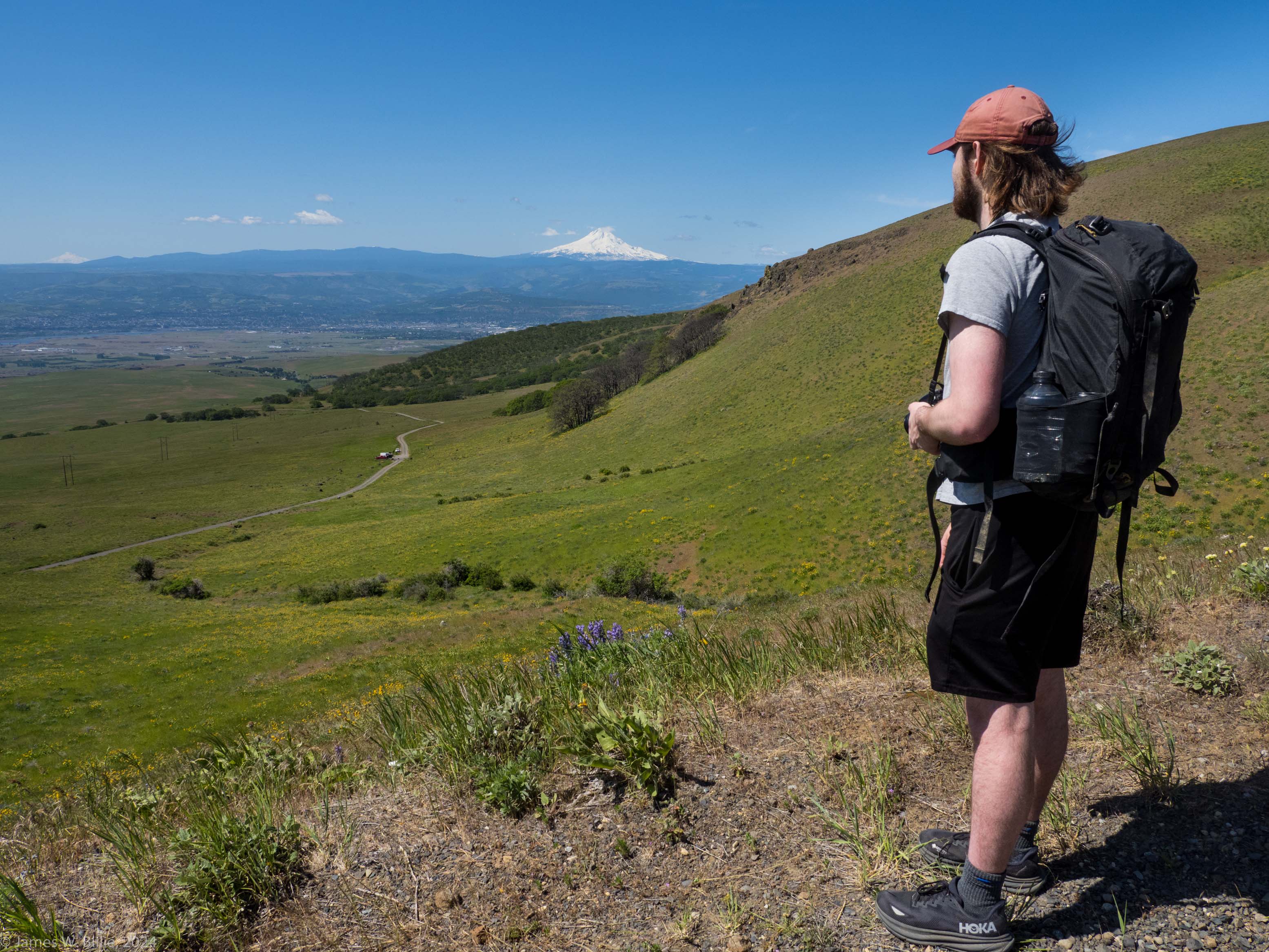
This is a set of photos by me and my son, Jamie, taken on a local hike near The Dalles, Oregon.  We had a perfect day and the spring flowers were still in bloom near the top of the hike.  Jamie recently completed his first year at WSU in Pullman, Washington and did really well studying mechanical engineering.

First, my photos:

Jamie on the trail:

Mount Hood with lupine (Lupinus spp.) and Balsam Root (Balsamorhiza spp.) in the foreground:

Mount Adams (Washington) and the Klickita River Gorge.  Looking north from the top of the ridge:

The gorge of Swale Creek from the top of the ridge:

Then Jamie’s photos:

A Western Meadowlark (Sturnella neglecta), caught making his lovely spring call:

A Western Fence Lizard (Sceloporus occidentalis), basking.  Jamie is MUCH better at spotting wildlife than I am!:

A female Horned Lark (Eremophila alpestris).  She thought she was hidden behind a grass tuft, and Jamie was able to approach very close:

Paintbrush (Castilleja spp.) in bloom:

Balsam Root:

A flower we did not identify, at around 3600 feet elevation.  (Taken with his Nikkor 105mm f/2.8 macro lens, a superb lens.)

Equipment:

Mine:

Olympus OM-D E-M5 camera (micro 4/3, crop factor = 2.0)
LUMIX G X Vario, 12-35MM, f/2.8 ASPH.  (24mm-70mm equivalent)
LUMIX 35-100mm  f/2.8 G Vario  (70-200mm equivalent

Jamie’s:

Nikon D5600 camera
Nikkor 105mm f/2.8 “Micro” (macro lens, 1:1)
Nikkor 18-55mm f/3.5-5.6 G VR lens
Sigma 150-600mm f/5.0-6.3 DG OS HSM Lens

Thursday: Hili dialogue

June 27, 2024 • 6:45 am

We’re rushing headlong into July, for it’s already June 27, 2024, and it’s National Ice Cream Cake Day (and National Onion Day).  Here’s how they grow onions for many commercial chain restaurants, like Outback Steakhouse (I’ve never been there, but their Blooming Onion is famous):

Here’s a blooming onion from Scotty’s Steak House (in Wikipedia). It’s like a huge flower of onion rings: a single large onion battered and fried:

Waptaff assumed (based on copyright claims)., Public domain, via Wikimedia Commons

DON’T FORGET THAT THE PRESIDENTIAL DEBATE IS TONIGHT. I think it’s gonna be on several television channels, and it begins at 8 pm. Big fun!

It’s also National Indian Pudding Day (perhaps my most favorite dessert, especially served warm with vanilla ice cream), Industrial Workers of the World Day, National HIV Testing Day, Canadian Multiculturalism Day, Helen Keller Day (she was born on this day in 1880) and lived to be 87, Mixed Race Day in Brazil, National PTSD Awareness Day, and Seven Sleepers’ Day or Siebenschläfertag, a German holiday based on a legend, and the weather today is supposed to predict the weather over the next seven weeks (all in Germany, of course).

Readers are welcome to mark notable events, births, or deaths on this day by consulting the June 27 Wikipedia page.

Da Nooz:

*The NYT summarizes the important Supreme Court cases on the docket this year, some of which have already been decided. But there are nine other big one waiting for a ruling. All of them, both decided and to-be-decided, are summarized at the link, and you can also see the article archived here.

No Supreme Court term in recent memory has featured so many cases with the potential to transform American society.

The court has already decided that Mr. Trump can stay on the ballot and that an abortion pill will remain widely available. The justices have yet to issue rulings in about nine other major cases, including ones affecting Mr. Trump as well as ones on the opioid crisis, homelessness, social media and the power of administrative agencies. The next set of rulings is set to come down starting at 10 a.m. on Thursday.

In recent years, some of the court’s biggest decisions have been out of step with public opinion. Researchers at Harvard, Stanford and the University of Texas conducted a survey in March to help explore whether that gap persists.

For each case, the article answers four questions: Is there a major precedent involved?; Are there recent rulings on the subject?; What is at stake?; and Where does the public stand?  It’s a very useful summary, and of course you’ll want to look at “immunity for former Presidents” and “Jan. 6 obstruction charges.”

*Swiss tennis great Roger Federer got an honorary doctorate at Dartmouth this year, and his graduation speech has become a viral hit:

Mr. Federer, who dropped out of school in his native Switzerland at 16 to play professionally, noted early in his remarks that he was not an obvious choice for a commencement speaker.

“Keep in mind, this is literally the second time I have ever set foot on a college campus,” he told the more than 2,000 graduates.

After some warm-up jokes about beer pong (which is said to have been invented at a Dartmouth fraternity party) and a few shout-outs to local institutions (“I got a chance to hit some balls with my kids at the Boss Tennis Center … I also crushed some chocolate chip cookies from Foco”), Mr. Federer got down to business and offered the graduates some tennis lessons that doubled as life lessons.

The part of the speech that has caught on with audiences far beyond the Ivy League environs of the Dartmouth campus — prompting numerous TikTok videosmany of them set to inspirational string music — was his reframing of his years of dominance on the tennis court.

“In the 1,526 singles matches I played in my career, I won almost 80 percent of those matches,” Mr. Federer said. “Now, I have a question for all of you. What percentage of the points do you think I won in those matches?”

The answer was 54 percent.

“In other words,” he said, “even top-ranked tennis players win barely more than half of the points they play.”

He went on, “The truth is, whatever game you play in life, sometimes you’re going to lose. A point, a match, a season, a job.”

Oh, and Wikipedia gives some info on his diet:

Federer follows a more flexible diet than most of the other players on tour, with pizza being Federer’s favorite dish. Federer’s personalized pizza from Player’s Restaurant was created by Chef Yan Dilie and has fresh figs, Parma ham, rocket and white truffle cheese cream. He also reportedly enjoys chocolate. Federer is a self-confessed lover of pasta and he has said that his personal favourite is the classic spaghetti pomodoro, which he ordered before every match during the 2020 Australian Open.

Well, the advice that you’re not going to win everything is a bit anodyne for graduation speakers, but at least it might hit home for some of his entitled audience. Here’s his speech:

*Bret Stephens’s column at the NYT “Should American Jews abandon elite universities?“, answer the question “yes, pretty much”. Stephen is the NYT’s most sensible writer about America’s reaction to the war, especially with respect to campuses:

The notable fact about the anti-Israel campus demonstrations is that they are predominantly an elite phenomenon. Yes, there have been protests at big state schools like the University of Nebraska, but they have generally been small, tame and — thanks to administrators prepared to enforce the rules — short-lived. It’s Stanford, Berkeley, Yale, Penn, Harvard, Columbia and many of their peers that have descended to open bigotry, institutional paralysis and mayhem.

Two questions: Why the top universities? And what should those on the other side of the demonstrations — Jewish students and alumni most of all — do about it?

. . .How did the protesters at elite universities get their ideas of what to think and how to behave?

They got them, I suspect, from the incessant valorization of victimhood that has been a theme of their upbringing, and which many of the most privileged kids feel they lack — hence the zeal to prove themselves as allies of the perceived oppressed. They got them from the crude schematics of Diversity, Equity and Inclusion training seminars, which divide the world into “white” and “of color,” powerful and “marginalized,” with no regard for real-world complexities — including the complexity of Jewish identity. They got them from professors who think academic freedom amounts to a license for political posturing, sometimes of a nakedly antisemitic sort. They got them from a cheap and easy revision of history that imagines Zionism is a form of colonialism (it’s decidedly the opposite), that colonialism is something only white people do, and that as students at American universities, they can cheaply atone for their sins as guilty beneficiaries of the settler-colonialism they claim to despise.

They also got them from university administrators whose private sympathies often lie with the demonstrators, who imagine the anti-Israel protests as the moral heirs to the anti-apartheid protests and who struggle to grasp (if they even care) why so many Jewish students feel betrayed and besieged by the campus culture.

. . . . But the real problem lies with some of the main convictions and currents of today’s academia: intersectionality, critical theory, post-colonialism, ethnic studies and other concepts that may not seem antisemitic on their face but tend to politicize classrooms and cast Jews as privileged and oppressive. If, as critical theorists argue, the world’s injustices stem from the shadowy agendas of the powerful and manipulative few against the virtuous masses, just which group is most likely to find itself villainized?

Not even the most determined university president is going to clean out the rot — at least not without getting rid of the entrenched academic departments and tenured faculty members who support it. That could take decades. In the meantime, Jews have a history of parting company with institutions that mistreated them, like white-shoe law firms and commercial banks. In so many cases, they went on to create better institutions that operated on principles of intellectual merit and fair play — including many of the universities that have since stumbled.

If you are an Ivy League megadonor wondering how to better spend the money you no longer want to give a Penn or a Columbia — or just a rising high school senior wondering where to apply — maybe it’s time to forgo the fading prestige of the old elite for the sake of something else, something new. That’s a subject for a future column.

Yes, the man is right, but it will be a long time before the prestige of a place like Harvard will fade so much that it’s no longer highly attractive to applicants and their parents.

*The Wall Street Journal asked those who have debated Biden and Trump, and other politicos, how each man could beat the other.  Here are some responses:

. . . . . “[Trump is] going to try to get Biden rattled,” said former Ohio Gov. John Kasich, who debated Trump while vying for the 2016 Republican nomination. “If Biden takes the bait, he’s going to be hitting to Trump’s agenda, not to his own.”

For Biden to beat Trump, that might be the key: avoiding getting pulled into a school yard-brawl style debate and allowing the former president’s aggressive antics to play out in real-time for viewers.

Jeff Roe, a Republican political strategist who worked on Sen. Ted Cruz’s 2016 bid for the GOP nomination, said Biden needs to come in with three major points he aims to make and focus on those points.

He added that Trump can be expected to taunt Biden even when his microphone is off.

Philippe Reines, a Democratic strategist who played Trump during 2016 mock debates for Clinton, said Biden could beat Trump on the merits—or Trump “just implodes, beats himself, which is what I think he did in one of the two debates in 2020,” referring to their first matchup that year.

and for Trump?

However, Biden is a self-professed “gaffe machine” and has struggled with long-winded answers and meandering digressions. Trump could benefit from being restrained, which might lead Biden to commit an unforced error or be lulled into an awkward pause—which would be magnified in the audience-free CNN studio.

“His weakness was that he didn’t always conclude thoughts or arguments authoritatively, which sometimes made it seem like his train of thought wasn’t complete or he was trailing off,” said Andrew Yang, who faced Biden on several multicandidate debate stages during the 2020 primaries.

During a Democratic primary debate, Biden’s future vice president, Kamala Harris, told him that she didn’t think he was a racist, but it was hurtful to hear him talk about the reputations of two deceased segregationist senators he had worked with. She also sharply questioned his opposition to federally ordered busing to integrate schools during the 1970s, saying “there was a little girl in California who was part of the second class to integrate her public schools…and that little girl was me.”

Biden called Harris’s broadside a mischaracterization of his record, but the exchange showed that his decadeslong political career could make him vulnerable.

Remember, the debate begins TONIGHT at 9 p.m. ET/ 8 p.m. CT, coming from CNN’s studios in Georgia.

*Speaking of the debate, the polling continues, and although a poll of all Americans show the race to be a virtual tie, remember that the Presidency is decided not on the basis of popular vote, but on Electoral College votes, which is simply stupid. Nevertheless, the WaPo gives us pause for thought:

We have gathered the best available national and state level polling data, and factored how citizens in each state voted in the last two presidential elections, to calculate whom voters currently favor in the presidential race.

Donald Trump is leading in 5 of the 7 battleground states that are most likely to determine the outcome of the election. The polls are particularly close in the first three battlegrounds below, meaning our average is within a normal-sized polling error of 3.5 points and either a Trump or President Biden victory is plausible. In the other four battlegrounds, the candidates’ polling leads are larger, but the race is still close.

Well, it’s still a squeaker, but I can’t wrap my head around the notion that Trump is even considered electable in America.

Meanwhile in Dobrzyn, Hili is having a Big Think:

A: Do you have a moment?
Hili: No, I’m thinking about what’s most important.
In Polish:
Ja: Masz chwilę czasu?
Hili: Nie, jestem zajęta myśleniem o tym, co najważniejsze.

Szaron is outside on the windowsill:

And Andrzej notes, “The cherries in our orchard are ripening.” They are pie cherries, and I hope Malgorzata freezes some so I can have cheery pie on my next visit to Dobrzyn:

*******************

An awesome meme from Anna Krylov, who, like the rest of us, is becoming a misanthropist:

A bumper sticker from Linkiest:

From Science Humor:

Posted by Masih. Ahmad Reza Djalali is an Iranian doctor arrested on trumped-up charges of espionage:

Pinkah poo-poos the Scientific American article I discussed the other day:

From Barry, who says he “loves this little guy.” Sound up to hear this laughing kookaburra laugh! And read the Wikipedia section on its call.

From Malcolm; a cat masseuse:

From Malgorzata: a woman from Manchester calls for the elimination of the Jews:

From the Auschwitz Memorial, one that I reposted.

Two tweets from Dr. Cobb. First, firing the bard (a household singer and poem-reciter):

. . . and a pack of capybaras wandering around at dawn (in single file!):

First evidence for insects crossing the ocean

June 26, 2024 • 11:15 am

A NYT “Trilobites” article by Monique Brouillette drew my attention to a new paper in Nature Communications documenting, with a variety of evidence, what is the first known flight of any insect across a big ocean. In this case the insect was the ubiquitous Painted Lady Butterfly (Vanessa cardui), the most widespread of all butterflies, and the ocean was the South Atlantic Ocean.

Tomasz Suchan et al. found Painted Ladies on the coast of French Guiana, and, using four different methods, suggest that their most likely origin was West Africa or Europe.  This means that they flew, over a period of 5-8 days, a distance bertween 4200 km (2600 miles) and 7000 sm (4350 miles).  It’s amazing, as butterflies can’t have done that without help: in this case, the wind.

Here’s a Painted Lady (upper side):

Jean-Pol GRANDMONT, CC BY 3.0, via Wikimedia Commons

I worked on long-distance insect movement for several years as a postdoc and young professor, but we marked our Drosophila flies with fluorescent dust and never even tried to find any movement this long.  Click on the screenshot below to go to the Nature paper, or find the pdf here.

First: the discovery (indented sections are from the paper), a group of exhausted Painted Lady butterflies on the coast of South America, found 11 years ago.

Three of about ten observed individuals were captured alive on the beach at ~6:00 am on the 28th of October 2013, apparently arriving after a vigorous flight across the ocean, judging from their damaged wings and resting behavior on the sand. Painted ladies are strong migrators, known for their recurrent trans-Saharan flights and a multigenerational cycle spanning ca. 15,000 km between the Afrotropical and the Palearctic regions. V. cardui is nearly cosmopolitan, but stable populations have not been recorded from South America. The individuals found on the coast of French Guiana should therefore have originated from populations in North America, Europe or Africa.

Thus there was more than one individual, suggesting that they stayed together during the long-distance migration, which is hard to understand.  We can rule out a South American origin of these butterflies simply because stable populations of the butterfly aren’t found on that continent.

Then Suchan et al. used four methods, all of which suggested that the butterflies had a West African or European origin (or both: hatched in Europe, migrated to West Africa, and then crossed the ocean). This means, since they were crossing water, that they had to move long distances without refueling. Although they can cross the Sahara, they can also refuel when doing so.

Here are the methods the authors used:

1.)  Wind.  Apparently wind data (speed and direction) are available for different altitudes from the National Oceanic and Atmospheric Administration. The winds at various altitudes up to 2000 m were inconsistent in direction for the five days before Oct. 26 and the three days after the capture data (Oct. 28-31), but were consistent in direction (east to west) on the 2 days before the capture, which the authors say is “exceptionally favorable for the butterflies to disperse across the Atlantic from West Africa, assisted by winds.

The wind assistance, then, would have been operative for only 2 days, but could have helped on the other days of the 5- 8-day journey if the insects had been at altitudes with the right winds. Is that feasible? They also must have used their own flapping power, but they could not have had the fuel to fly consistently for that entire period on their own.

2.) Genetic affinity.Using RAD-assisted mapping of DNA variation, the authors found that African + European populations, which are similar to each other, were both distinctly different from those of North America.  And the exhausted Painted Ladies found in South America clearly were genetically related to the African + European ones and not to the North American ones, implying that yes, they had crossed the ocean from either Europe or North America.  (It’s also known that October is when Painted Ladies are a high densities in these areas.) Below you can see the genetic clustering. As the key shows, the green butterflies, found on the beach, clearly clustered with both African and European butterflies (red and orangish respectively), but were distinctly different from North American butterflies (blue dots). This is strong evidence that the butterflies found in French Guiana came from across the Atlantic Ocean:

(from the paper): A Principal Component Analysis (PCA) using SNPs with less than 10% missing data per sample and pruned for LD (13 206 SNPs), the variances explained by the two first axes are 6.26% and 5.21%;

3.) Pollen carried by the butterflies. This was a clever idea: the authors did a DNA sequence of the pollen grains found on the bodies of the beach-captured butterflies. (Butterflies pick up pollen when sipping nectar from flowers.) Most of the species found weren’t informative as they couldn’t be classified or represented widely-distributed Neotropical species, but they also found grains from two plant species endemic to the Sahel region of Africa: a narrow biogeographic swath across the subsaharan region. The plants were the Senegal Tea Plant, Guiera senegalensis, and Christ’s thorn jujube, Ziziphus spina-christi, both flowering shrubs, and both found only in the Sahel. They’re in yellow on the bar chart below, both in the bar graphs of pollen frequency and geographic distribution. G. senegalensis was especially highly represented on the butterflies, far more numerous than the pollen of any other species.

Both species were flowering at the time the butterflies were found (flowering season is Aug.-November), also supporting an African origin of the butterflies.

(from the paper) Classification of the obtained ITS2 metabarcoding sequences processed using a denoising pipeline (see Methods), and blasted on curated databases from A PLANiTS83 and B Sickel et al.82 using the SINTAX classifier. In addition to plants present in French Guiana or widely distributed (green bars), two Sahelian endemic plants (yellow bars) were found among the pollen recovered from the bodies of the painted lady butterflies in South America: Guiera senegalensis and Ziziphus spina-christi, the former being especially common. Source Data is available in Supplementary Table S3.

One thing that puzzles me is the existence of “Neotropical pollen grains”. Those would be from the South American tropics, and how did they get on the butterflies? Did they nosh on South American plants after they crossed the ocean? The authors don’t discuss this.

4.) Isotope analysis. I was unfamiliar with this method, but apparently the ratio of isotopes of two elements, strontium and hydrogen, are indicative of the “reproductive habitats” of different areas of the world, and the ratios found in the butterflies’ wings had the highest probability of coming from West Africa and/or Western Europe (Portugal, France, Ireland, and the UK). This also raises the possibility that these butterflies were on their regular migration from Europe across the Sahara, and then were blown off course by the wind. Lacking any direction-finding ability when off course (we also found that this was true of Drosophila), they just kept flapping until they made land in South America. Almost surely most of them would die along the way.

But could they really make it, even if assisted by wind? The authors suggest that they could. Even though they couldn’t flap continuously for 5 to 8 days, they could also glide:

We assessed the feasibility of a transatlantic crossing by estimating energetic requirements and dispersal duration of V. cardui when using different flight strategies.. In the absence of wind-assistance, we estimate that painted ladies could travel a maximum of ~780 km without refueling, far less than the 4200 km distance across the Atlantic. Therefore, the painted ladies must have relied on the easterly trade winds that were present preceding the capture date. Furthermore, even with wind-assistance, painted ladies using an exclusively active flight strategy would travel a maximum of ~1900 km before depleting their energy reserves. Therefore, painted ladies must be using an alternating strategy of active flight and minimum-effort flight (i.e. flapping only to stay aloft and gliding), a behavior that is known from monarchs and other butterflies. Assuming that painted ladies use the same alternating flight strategy as monarchs (with a 15:85 proportion of active:minimum-effort flight) and with the assistance of wind (average windspeed of 7.47 m/s based on trajectories starting 26–28th of October), the painted ladies we captured in French Guiana could have crossed the Atlantic from West Africa in 5–8 days, but only if their starting fat reserves were at least as high as 13.70% of their body mass.

Of course the trade winds blew in a consistent direction only for two days during the crossing, not the 5-8 days suggested by the authors.  And even if the butterflies were loaded with fuel, it’s hard to see how they could make it. But the other evidence convinces me that these individuals did have an African origin, and maybe hatched in Europe. The authors suggest that gliding was important, but I don’t know if it’s been seen in this species of butterfly. And how do butterflies glide, anyway?

The authors suggest that these butterflies hatched in Europe, and give this schematic of their journey (Europe gets a nod since the isotope ratios there are closer than African ones to what was found in the butterflies’ wings):

(From the paper): C  Infographic summarizing the possible natal grounds and dispersal pathway of a flock of V. cardui butterflies across the Atlantic from West Africa to South America, through a non-stop flight of a minimum of 4200 km during 5–8 days. The total flight distance for these individuals could be as long as 7000 km if they developed in Western Europe. Source Data can be obtained online using the provided code (see code availability). Butterfly illustrations by Blanca Martí.

Now the authors note other cases long-distance migration of insects, even one across the Indian Ocean. But most of the other long-distance migration of insects involves en route refueling (except for the dragonfly, and although they don’t give the overwater migration distance for it, Wikipedia says 2500 km).  This butterfly beats the dragonfly by 1700 km.

For example, the dragonfly Pantala flavescens apparently migrates annually across the Indian Ocean. The monarch butterfly (Danaus plexippus) also annually migrates between Canada and Mexico, and tagged individuals have demonstrated flights as long as 4635 km (2880 miles). Recent work using light aircraft and individual radio tracking of death head’s hawkmoths (Acherontia atropos) recorded a remarkable maximum ground speed of 69.7 km/hour (19.4 m/s). These scattered reports of individual feats of migration both in terms of distance covered and flight speed are important: collectively they indicate that trans-oceanic LDD events may be sufficiently frequent to have played an underestimated role in biogeographic dispersal over time (cf. panbiogeography).

The upshot:  Although the evidence varies in strength, the genetic evidence and the pollen-grain evidence alone are pretty convincing that these butterflies came from Africa, and perhaps originally from Europe.  I’m not sure whether they’d be able to colonize South America, as they were exhausted, probably not capable of reproducing, and Painted Ladies aren’t found in South America.

There are still puzzling things about the hypothesis, including where the Neotropical pollen grains came from on the butterflies, and whether Painted Ladies are actually capable of gliding. But the evidence suggests that this kind of long-distance nonstop movement is possible in butterflies, and without refueling. (Painted Ladies are already known to fly long distances when they can refuel.) There’s surely enough data here for lepidopterists to start combing the beaches of eastern South America during October and November!

Readers’ wildlife photos

June 26, 2024 • 8:15 am

Today’s photos are from Doug Hayes of Richmond, Virginia, showing birds in a nearby swamp (there’s also one mammal and one reptile. Doug’s captions are indented, and you can click on the photos to enlarge them.

A couple more trips back to the Chamberlayne Swamp, this time showing some of the diversity of life at one of our favorite birding spots.

This dead tree seems to have been a nesting site for some time:

I spotted some movement and a baby bird popped up, begging to be fed:

It turned out that there were four babies in the nest:

Finally, the parents showed up. A pair of common grackles (Quiscalus quiscula):

The parents made many trips out over the swamp to get food for the babies.

The first anhinga (Anhinga anhinga) of the season. Anhingas have been nesting in the swamp for the past few years now:

While I was photographing the baby grackles, a group of birders walked by in search of what they thought was a palm warbler (Setophaga palmarum). Apparently, the bird had been zipping from tree to tree, not staying still long enough for them to photograph it. About five minutes after the group had passed, a small bird landed not ten feet away from me and just sat there. Yep, it was the palm warbler!:

A belted kingfisher (Megaceryle alcyon) resting after a long day of fishing.

A pair of great egrets (Ardea alba) getting ready to roost for the night:

There are lots of smaller turtles in the swamp, but this was the first time spotting a common snapping turtle (Chelydra serpentina). This monster was at least two feet long!

Eastern kingbirds (Tyrannus tyrannus) are fairly common around the swamp:

A solitary sandpiper (Tringa solitaria) hunting along the edge of the swamp:

This muskrat (Ondatra zibethicus) seemed to be curious about the group of birders standing at the water’s edge. It circled the area several times, getting close to us, then moving back to the center of the swamp:

Red-winged blackbirds (Agelaius phoeniceus) are the most common birds in the swamp. Very territorial, they can be seen mobbing larger birds and driving them out of their domain. I’ve even seen them chasing hawks and herons:

A killdeer (Charadrius vociferus) searching for food. These birds tend to gather at the shallow end of the swamp, well away from the other birds:

Camera info: Sony A7RV mirrorless camera body – Clear Image digital zoom feature used on most shots, Sony FE 200-600 zoom lens + 1.4X teleconverter, iFootage Cobra II monopod.