Gametic oppression?

August 5, 2025 • 10:40 am

This link goes to a “call for papers” for an upcoming conference at Yale in April of next year (or click on title below).  The announcement appears on a webpage by Rene Almeling, who appears to be one of the two organizers of the conference:

Rene Almeling
Professor of Sociology, Public Health, History of Medicine, and Women’s, Gender, and Sexuality Studies
Yale University

Sarah S. Richardson
Aramont Professor of the History of Science and Professor of Studies of Women, Gender, and Sexuality
Harvard University

The conference is designed to lead to the publication scientific papers dealing (probably not kindly) with “gametocentric sex”.

Here’s the gist of the announcement (bolding is mine)

Inspired by rapidly emerging developments in the science and politics of fertility and by the rise of gametocentric definitions of sex, as well as a decades-long tradition of gender scholarship about gametes in relation to sex, race, sexuality, and health, we invite contributions to a workshop for early-career researchers in the social sciences and humanities who are developing the next generation of scholarship about eggs and sperm. Our aim is to provide mentorship for further development of works-in-progress, either in the form of dissertation chapters or publishable articles.

We invite proposals from early-career researchers – e.g. graduate students, postdoctoral scholars, assistant professors – in the social sciences and humanities as well as interdisciplinary scholars in the health and life sciences who are studying any aspect of eggs and sperm. We are especially interested in creative and innovative theoretical and/or methodological approaches, and we intend for the topic of “gametic politics” to be understood broadly. Potential topics might include (but are definitely not limited to):

  • analyses of how gametes have figured into historical and contemporary definitions of sex;

  • the politicization of gametes across multiple domains, such as medicine, education, sports, and law;

  • the intersection of gametic politics with myriad forms of inequality, such as those associated with gender, race, class, and sexuality;

  • how various scientific approaches to gametes are mobilized in political discourse;

  • individual experiences of and beliefs about gametes, including in relation to one’s gender identity;

  • the emergence of gametic metaphors and their implications for science and society.

As the first bit notes, the whole affair was inspired by “gametocentric definitions of sex,” which of course are not definitions but actually “concepts”, in the same way that the “biological species concept” (BSC) is not an a priori definition of species, but a recognition and encapsulation in words of a biologically observed near-universal.  The BSC arose because it has been recognized forever that nature is not a “spectrum of animals and plants”:  there’s no continuum between blackbirds, parrots and falcons. Or between clover, white oak trees, and poison ivy. Rather, nature is “lumpy”, with different nearly discrete groups that we call “species”. To understand how a continuous evolutionary process leads to a nature that is “lumpy,” the BSC arose to recognize that the “lumps” are maintained by reproductive isolating barriers that impede gene flow between nature’s “lumps.”. As Allen Orr and I wrote in the first chapter of our book Speciation, the BSC immediately gives us a research program for understanding the origing of species (those “lumps”): find out how the reproductive isolating barriers arise.  The BSC arose because it not only recognized a near-universal in biology (such near-universals are rare), but also was utilitarian, explaining the origin of the lumps.  This is why Darwin, who didn’t have a good definition of species, was unable to understand the origin of species, despite the title of his great 1859 book. It should have been called The Origin of Adaptations instead.

Likewise, it was recognized over a century ago that all animals and vascular plants (with a few exceptions caused by developmental anomalies) come in two flavors, male and female, and these differ because the former have small mobile gametes and the latter large immobile ones. I’d prefer saying “the gametocentric CONCEPT of sex,” for the gamete-size concept holds in all these organisms, and no other concept of sex holds across all those species. So again we have a concept to deal with something nearly universal in nature that, as a bonus, helps us understand evolution.

Of course I know little about the genesis of this seminar, nor read the papers of the organizers, but the stuff in bold leads me to believe that this symposium seeks to overturn the “gametocentric definition of sex” because it is seen as oppressive to those who feel that they are not really members of the sex recognized by their gametes.

Unfortunately, holding any other view of biological sex not only makes the recognized binary not universal, but also effaces our ability to understand evolutionarily important phenomena like sexual selection. Like the BSC, the gametocentric species concept is utilitarian as well as nearly universal. To those benighted individuals who say that biological sex is really a complex mixture of various traits, including “lived experience” and “one’s psychological self concept”, I’d ask, “Well, how many biological sexes are there in humans? An infinite number?”  Is that true of foxes, ducks, and iguanas, too?”  Remember that three biological societies declared that sex was a spectrum in all species, but then took down that declaration because a lot of biologists opposed it. In fact, in later correspondence the three societies admitted that their initial declaration was misleading–and conceded a lot of our points.

As I’ve said repeatedly, the binary concept of biological sex is the only one that makes sense, but it says nothing about people’s feelings about what gender they really are, doesn’t justify our mistreating people who feel neither male nor female (or feel they’re not members of their natal sex), and is certainly not transphobic. Recognizing that helps explain why, over and over again—probably a dozen times—natural selection has led to the evolution of two sexes—and each time the same gametic distinction is the result.  Understanding why there are only two sexes coming from these independent origins is another question answered only by recognizing the sex binary.  As Ronald Fisher wrote in his magesterial The Gentical Theory of Natural Selection:

No practical biologist interested in sexual reproduction would be led to work out the detailed consequences experienced by organisms having three or more sexes, yet what else should he do if he wishes to understand why the sexes are, in fact, always two?   (pp. ix of 1958 Dover edition)

Now I may be defending something that this conference actually accepts, but I’m guessing from the announcement that the purpose is to show that the sex binary is oppressive because not everybody feels “male” or “female”. And if that’s the case, we have another example of ideology trying to erode scientific knowledge in the name of social justice.

We shall see next year. In the meantime, I’ll continue to defend the binary concept of sex based on gamete size and mobility.

U.S. Olympics bars trans-identified men (“trans women”) from competing athletically against biological women

July 23, 2025 • 1:00 pm

This is apparently a done deal, though probablydone for the wrong reasons. The NYT headline gives the important result; click on it below or read the archived version here:

A summary:

The United States Olympic & Paralympic Committee quietly changed its eligibility rules on Monday to bar transgender women from competing in Olympic women’s sports, and now will comply with President Trump’s executive order on the issue, according to a post on the organization’s website.

The new policy, expressed in a short, vaguely worded paragraph, is tucked under the category of “USOPC Athlete Safety Policy” on the site, and does not include details of how the ban will work. Nor does the new policy include the word “transgender” or the title of Mr. Trump’s executive order, “Keeping Men Out of Women’s Sports,” referring to it instead as “Executive Order 14201.”

Mr. Trump signed the executive order on Feb. 5.

The committee’s new policy means that the national governing bodies of sports federations in the United States now must follow the U.S.O.P.C.’s lead, according to several chief executives of sports within the Olympic movement. Those national governing bodies oversee many, but not all, events in Olympic sports for all ages, from youth to masters’ competitions.

In a letter sent by email to the “Team USA Community,” the U.S.O.P.C. acknowledged on Tuesday that its policy had changed. The letter, from Sarah Hirshland, the U.S.O.P.C.’s chief executive, and Gene Sykes, the president, said the committee had held “a series of respectful and constructive conversations with federal officials” since the executive order was signed.

“As a federally chartered organization, we have an obligation to comply with federal expectations,” the letter said, adding that the committee would work with the national governing bodies to implement the new policy.

. . .Those new rules still allow trans women to compete, but only in the men’s category.

All others who aren’t eligible for the women’s category, including nonbinary athletes, transgender men and intersex athletes, will also be limited to competing in the men’s category, the policy says.

The right reason for such a ruling is because it because it’s fair to women, and because trans-identified men, especially but not exclusively those who have gone through male puberty, have on average an athletic advantage over biological women.

But fairness doesn’t seem to undergird this ruling was made. After all, the Olympics has had years to ponder this issue, and basically punted on it, saying that each sport had to make its own rules.  The clue: the USOPC explicitly cited Trump’s Executive Order when announcing its decision, and without federal support, Los Angeles would be unable to host its scheduled Summer Olympics in 2028. In other words, the decision was likely made not out of fairness, but out of fearfulness. It’s sad when bullying and fear replaces fairness in this way.

But I’ll still take it, because regardless of the reasons, this is what I’ve always thought was the right thing to do. It is not transphobic, nor does it “erase” trans people.  Trans people or those who aren’t biological women can nevertheless still  compete in athletics if they wish, but in men’s divisions. Alternatively, and perhaps more fairly than that, there could be an “other” division for those who aren’t either biological males or biological females. (I can’t deal with all other exceptions now, as they will take careful consideration.)

Most Americans agree with me on this issue.  A recent Pew survey shows that:

A new Pew Research Center survey finds that majorities of U.S. adults favor or strongly favor laws and policies that:

  • Require trans athletes to compete on teams that match their sex assigned at birth (66%)
  • Ban health care professionals from providing care related to gender transitions for minors (56%)

The first issue is the one at hand, and two-thirds of American adults favor what the USOPC just did.  But you can bet that this doesn’t settle the issue for the distant future. After all, Trump won’t be President forever (despite what some readers think!), and a “progressive” President could easily change things back. On the other hand, I think the moral arc of athletic fairness is bending towards justice, especially with the data increasingly showing general athletic advantages of trans-identified males over biological women.

Alex Byrne’s “colleagues” dogpile him for co-writing a critique of American pediatric gender medicine

July 7, 2025 • 8:45 am

Alex Byrne holds a chair in philosophy at MIT, and has done considerable research on gender issues.  This has resulted not only in several papers but also in an estimable book, Trouble With Gender: Sex Facts, Gender Fictions. I read the book and liked it, and eventually became convinced of its thesis that the idea of “gender” is so slippery that it really shouldn’t be used at all. “Sex roles” would do as well, but somehow even I continue to use the g-word.

Luana sent me this new development in the Byrne saga. Because Alex contributed to the writing of a Health and Human Services Review of treatments for pediatric gender dysphoria, he is in the process of being demonized by a group of academics. It’s not that there’s anything wrong with the HHS review, really; the demonization came because it was issued by an HHS whose head was appointed by Trump, and also because it goes along with the increasing evidence that treating childhood dysphoria with “affirmative care” is deeply problematic, leading to premature dispensations of hormones and surgery to adolescents and children who, without that “care,” would mostly come out as gay.

But the pre-puberty treatments, often given before any reasonable age of consent, deprive those children of any chance of a meaningful sex life—including one without orgasms—forever. And the mutilation involved in sex-role-altering surgery surely requires consent of someone who understands the consequences—someone who’s mature. (I waffle between the ages of 18 and 21.) But if you deviate from the “progressive” party line that “gender-affirming therapy”—the one-way escalator from dysphoria to hormones and often to surgery—is the essential cure for gender dysphoria, then what is happening to Alex will happen to you, too.

Finally, Alex is getting dogpiled because his critics aver that, because he’s a philosopher, he has no expertise to weigh in on issues involving gender, even if he’s written about them repeatedly in scholarly venues. That’s rich because, as you’ll see, most of his critics don’t even approach Alex’s level of expertise.

The whole brouhaha serves to demonstrate that “cancel culture”—the attempt to ruin someone’s career if they transgress “progressive” ideological stands—is alive and well.

The announcement of the dogpile was tweeted by Jesse Singal, who has suffered his own accusations of “transphobia” for taking positions similar to Alex’s:

Here’s the letter, with the link in the heading:

Dear Professor Alex Byrne,

It was alleged in May that you were among the anonymous authors of the HHS report on pediatric trans care. The report, among other things, issues the alarming recommendation that trans youth should not have access to gender-affirming care, despite the leading pediatric medical body in the country supporting the efficacy and life-saving potential of these treatments. [1]

In light of your recent confirmation [2] of these allegations, we as your colleagues at MIT, in philosophy, and in higher-education feel it necessary to speak out.

While we are not here calling for official or unofficial sanctions, we the undersigned believe that your behavior (a) perpetuates harm toward the trans community; (b) constitutes a failure to uphold your responsibilities as an academic; (c) is the result of an extremely misguided decision to collaborate with the Trump administration.

Marginalization of Trans Communities. While you claim to support the right of trans people to live freely, in practice your behavior does not support this right. Since 2020 you have published a number of academic articles, as well as one book, arguing against trans inclusivity. And there can be no doubt that such rhetoric, along with the new HHS report, further marginalizes and stigmatizes trans people, both within and outside of philosophy. [3]

But your contribution to the HHS report raises serious issues well beyond this particular issue about marginalization. Indeed, we submit that the allegations against you should be a cause for significant concern, even for those who share your views about trans people.

Let us explain.

Academic Professional Ethics. We are happy to grant that your participation in the authoring of the report is an exercise of your academic freedom. Per the 1940 Statement of Principles on Academic Freedom and Tenure, jointly agreed upon by the AAUP and AAC, academic freedom entitles professors to freedom in research and publication of results. [4]

But since 1966, the AAUP has also agreed on a Statement on Professional Ethics. [5] Per this 1966 Statement, professors are obligated to “exercise critical self-discipline and judgment in using, extending, and transmitting knowledge” and to “practice intellectual honesty”. We take this to mean that as academics, we also have a responsibility to the public to not misconstrue the scope of our expertise, nor comment in our capacity as academics on issues where we lack the requisite expertise. It is, of course, compatible with professional academic ethics to express one’s views publicly, even when one is not an expert, i.e., one might lobby for a particular candidate or write an op-ed in a newspaper.  But contributing to a document as an expert in an area in which one is not an expert is contrary to professional standards.

The HHS cites contributors to their report on pediatric trans care as including medical doctors, medical ethicists, and a methodologist. [6] While you are a highly regarded philosopher of mind and have recently written on the philosophy of gender, you are not a medical ethicist by training. Moreover, to our knowledge, you do not have medical or scientific training, nor have you published any peer-reviewed pieces in medical journals.

Given your lack of the requisite expertise, we believe it is inappropriate for you to engage in the shaping of national medical policy on gender-affirming care for trans youth. Familiarity with theories of gender made from the armchair does not equip one to make expert judgments about the quality of medical studies, nor about the lived experiences and needs of trans youth and their families.

In contributing to a medical report that will have significant negative impacts on the lives of trans youth across this country, we believe that you have failed to uphold your responsibility as an academic to provide expert testimony only on matters included in your domain of expertise.

Collaboration with the Current Presidential Administration. The past few months have witnessed the Trump administration engage in the kidnapping of international graduate students from the streets, the deportation of innocent people to dangerous foreign prisons without due process, the cutting of lifesaving aid to millions across the world, and the undermining of the independence of colleges and universities across the country. We find these actions appalling, unethical, and undemocratic.

For these reasons, we believe it is deeply myopic for any academic to collaborate with the Trump administration in this moment, regardless of one’s particular views about gender. However misguided one may think “gender ideology” is, it is simply unconscionable to for that reason, make common cause with an administration so engaged. Indeed, were the Trump administration to suddenly decide tomorrow to support gender-affirming care for minors, we hold that it would be equally shortsighted and reprehensible if trans advocates were to then overlook everything else the administration is doing and join them as collaborators.

There is already a term of criticism for when a government appeals to pro-LGBTQ+ policies so people turn a blind eye to its other, harmful actions: that term is ‘pinkwashing.’ In this moment, we need a similar term of criticism for gender-critical theorists who overlook the rest of a government’s appalling behavior, merely because that government shares one’s views on gender. One can think that trans politics is misguided and also refuse to collaborate with such an administration.​​​​​​​

By contributing to the HHS report, we believe you have not only misconstrued the extent of your academic expertise, but have also badly misjudged the gravity of the current administration’s actions.

As of yesterday, the letter was signed by (according to my count) 211 people, 31 of whom who refused to give their names and appear as “anonymous”, 65 who say they are graduate students, and 57 who say they are undergraduates. (See the signers by clicking on this link.) While there is some overlap between these groups, it’s fair to say that about half the signers lack either the courage or the expertise to call out Byrne for “lack of expertise”. What kind of person would refuse to give their names when engaging in such a dogpile?

And note that the “expertise” of those judging Byrne’s expertise (probably without having read his book or the rest of his work) include students or professors in mathematics, mechanical engineering, women’s history, urban studies and planning, aerospace engineering, computer science, chemical engineering, bioengineering and a even “Anonymous (Staff)”. (I didn’t bother to look up some of the others whose fields weren’t specified.)

What is clear about these critics are several things (characterization and bolding below are mine):

a.) Many of them have not read Byrne’s work on gender and transitioning, as judging from their signing a letter that mischaracterizes his views (see his response below).

b.) His real crime is almost Soviet-style in its nature: “Collaboration with the Current Presidential Administration.” Because the report came out as an HHS document, it can be traced to Trump, ergo to Satan, and ergo Byrne is an agent of Satan.  It’s Trump, Jake! Read this again and weep (from the letter):

Collaboration with the Current Presidential Administration. The past few months have witnessed the Trump administration engage in the kidnapping of international graduate students from the streets, the deportation of innocent people to dangerous foreign prisons without due process, the cutting of lifesaving aid to millions across the world, and the undermining of the independence of colleges and universities across the country. We find these actions appalling, unethical, and undemocratic.

For these reasons, we believe it is deeply myopic for any academic to collaborate with the Trump administration in this moment, regardless of one’s particular views about gender. However misguided one may think “gender ideology” is, it is simply unconscionable to for that reason, make common cause with an administration so engaged.

Whatever else the administration has done, and I’ve made it clear that I deplore nearly all of it, it’s crazy to say that you shouldn’t try to help it provide more salubrious forms of gender care given Trump’s EO on the issue. Kids are being mistreated, and you shouldn’t help them because in so doing you’re co-signing an HHS document?

c.) The collaboration of Byrne on a public document is characterized as a breach of professional ethics, since he’s a philosopher and therefore lacks “expertise”. From the “Dear Professor Alex Byrne” letter:

Given your lack of the requisite expertise, we believe it is inappropriate for you to engage in the shaping of national medical policy on gender-affirming care for trans youth. Familiarity with theories of gender made from the armchair does not equip one to make expert judgments about the quality of medical studies, nor about the lived experiences and needs of trans youth and their families.

Byrne answers this in his response (see links and excerpts below).

d.) These people who decry Byrne for lack of “expertise” are apparently themselves unaware of the increasing evidence against “affirmative” pediatric gender care, especially the use of “blockers”. They cite American organizations ideologically determined to support “affirmative care”, but don’t even mention Britain’s Cass Review, which led to the dismantling of all but one of that nation’s gender clinics and a ban on puberty blockers for people younger than 18. Several European countries now allow puberty blockers only as experimental treatments, forbidding them as instruments of  general “affirmative care”.

e.) It’s clear that although the letter denies any attempt to ruin Alex’s career, accusing him of professional malfeasance clearly has that end. It will predictably encourage his colleagues—not just at MIT but everywhere—from associating with him, and will drive away students who would otherwise seek his mentorship. As Byrne says in a Washington Post op-ed noting why he co-authored the HHS report:

The hostile response to the review by medical groups and practitioners underscores why it was necessary. Medicalized treatment for pediatric gender dysphoria needs to be dispassionately scrutinized like any other area of medicine, no matter which side of the aisle is cheering it on. But in the United States, it has not been.

I was familiar with the other authors — there are nine of us in all — and I was confident that we could produce a rigorous, well-argued document that could do some good. Collectively, we had all the bases covered, with experts in endocrinology, the methodology of evidence-based medicine, medical ethics, psychiatry, health policy and social science, and general medicine. I am a philosopher, not a physician. Philosophy overlaps with medical ethics and, when properly applied, increases understanding across the board. Philosophers prize clear language and love unravelling muddled arguments, and the writings of pediatric gender specialists serve up plenty of obscurity and confusion.

f.) Finally, and perhaps most important, nowhere in the letter do the signers engage in the claims of the HHS report. The proper way to engage something like the report is with rational counterargument and data, not with accusations of “lack of expertise” or of being on “the wrong side of the aisle.” This is implied in these tweets, two by Byrne’s wife Carole Hooven, who suffered her own demonization on the basis of sex and gender—to the extent that she had to leave her department at Harvard:

Robert P. George, a political philosopher at Princeton, also notes the letter’s failure to engage the recommendations of the HHS report:

Byrne’s reply is a document of unusual rationality, calmness, and maturity, and simply dismantles the dogpile letter above. I don’t have space to reproduce it all, but I will give the first bit:

Dear colleagues and others,

Thank you for your open letter (reproduced below), concerning my involvement in the recent Department of Health and Human Services Review of treatments for pediatric gender dysphoria, which I discussed in a June 26 Opinion for the Washington Post.

The topic of pediatric gender medicine is emotionally fraught, and some people understandably feel vulnerable, angry, and frustrated. However, an open letter of this sort is not a constructive way to express one’s view that a colleague has committed professional ethical lapses and errors of judgement. Formal university channels as well as more collegial options are available, including writing opinion pieces. Encouraging individuals on social media to join a public condemnation of a colleague is inimical to the mission of the university.

The letter makes two main complaints:

(A): I have breached “professional standards” in contributing to the Review because of my “lack of the requisite expertise”; this “constitutes a failure to uphold [my] responsibilities as an academic.”

(B): Given the actions and policies of the current administration, my decision to take part in writing the Review was “extremely misguided” and “unconscionable.”

Framing the letter, you write that “since 2020 [I] have published a number of academic articles, as well as one book, arguing against trans inclusivity.” Despite referring to my “rhetoric,” you give no quotations or citations in support. People interpret “trans inclusivity” differently, but on an ordinary understanding of that phrase I haven’t argued against it. For example, from the preface of my book, Trouble with Gender:

[N]o one’s pursuit of a dignifying and fulfilling human life is impeded by anything in the pages that follow–neither transgender people, nor women, nor gay people, nor any other relevant constituency. If there is any doubt about that at the start, I hope it will vanish by the end.

You also accuse me of producing work that “further marginalizes and stigmatizes trans people.” Indeed, you have “no doubt” that this is the case. Since you provide no evidence for this claim, I will not address it here, except to say that I disagree.

The last 2+ pages of Byrne’s letter take up the claims (A) and (B) that he says his critics make, and simply demolishes them. But he ends on a conciliatory note:

Our “Ethos, Diversity, & Outreach” webpage says that “the Philosophy Section aims to create a vibrant and tolerant intellectual community with heterogeneity in backgrounds and opinions, and where the overriding norms are those of civilized rational argument.” I endorse these aims and commend them to you. As some of you know, I enjoy talking to people with very different perspectives from my own. My office door is always open if any of you would like to discuss the issues raised by your letter in person.

The misguided, erroneous, and hamhanded letter of the critics above shows the extent to which science and medicine have been politicized in America, injected with ideology to the extent that if you collaborate on an endeavor coming from the “wrong side of the aisle,” people on the “right side of history” (or so they think themselves) will try to ruin your career. This is a reprehensible endeavor from people infused ideology, hate, and anger.

The Atlantic takes on “affirmative care”

July 2, 2025 • 11:02 am

One sign that there has been a sea change in America’s gung-ho enthusiasm for “affirmative care” of minors with gender dysphoria is the mainstream media’s recent critiques (or just objective analyses) of the problems with such care. These critiques have exposed the lies promulgated about such care, largely by the “progressive” Left. The new article in The Atlantic by staff writer Helen Lewis is one such journalistic corrective (read it by clicking on the screenshot below or by reading it archived here). And you should read it.

One of the factors prompting the article appears to have been the Supreme Court case The United States v. Skrmetti, which upheld a Tennessee law banning the use of hormones or puberty blockers for “gender affirming care” in cases of gender dysphoria in minors. Such care was allowed, however, if modification of sexual traits was necessary to allow an individual with a disorder of sex determination to “conform to their sex assigned at birth” (Wikipedia’s words, not mine).  The case was decided along ideological lines by a 6-3 vote, but in general I agreed with the decision, having felt that medical treatment for transition should be permitted only if a person with gender dysphoria was old enough to have mental maturity to decide. (I waffle between 16 and 18 on this one, but it’s 18 in Tennessee).

Author Lewis, in fact, was willing to allow medical transitioning to begin in younger children with dysphoria, but changed her mind after seeing WPATH, progressives, doctors, and government officials repeatedly lie about the condition and how to fix it. To quote her (all the article’s quotes are indented):

I have always argued against straightforward bans on medical transition for adolescents. In practice, the way these have been enacted in red states has been uncaring and punitive. Parents are threatened with child-abuse investigations for pursuing treatments that medical professionals have assured them are safe. Children with severe mental-health troubles suddenly lose therapeutic support. Clinics nationwide, including Olson-Kennedy’s, are now abruptly closing because of the political atmosphere. Writing about the subject in 2023, I argued that the only way out of the culture war was for the American medical associations to commission reviews and carefully consider the evidence.

However, the revelations from Skrmetti and the Alabama case have made me more sympathetic to commentators such as Leor Sapir, of the conservative Manhattan Institute, who supports the bans because American medicine cannot be trusted to police itself. “Are these bans the perfect solution? Probably not,” he told me in 2023. “But at the end of the day, if it’s between banning gender-affirming care and leaving it unregulated, I think we can minimize the amount of harm by banning it.” Once you know that WPATH wanted to publish a review only if it came to the group’s preferred conclusion, Sapir’s case becomes more compelling.

Here are three of the issues that Lewis raises:

1.) Lying or misleading people about gender dysphoria and its treatment.

ACLU lawyer Chase Strangio was guilty of promulgating the lie that failure to effect gender transition in dysphoric children would lead to their suicide. He in fact made this statement when he argued Skrmetti before the Supreme Court, and had to admit under questioning that there was acxtuallyno evidence for this assertion:

“We often ask parents, ‘Would you rather have a dead son than a live daughter?’” Johanna Olson-Kennedy of Children’s Hospital Los Angeles once explained to ABC News. Variations on the phrase crop up in innumerable media articles and public statements by influencers, activists, and LGBTQ groups. The same idea—that the choice is transition or death—appeared in the arguments made by Elizabeth Prelogar, the Biden administration’s solicitor general, before the Supreme Court last year. Tennessee’s law prohibiting the use of puberty blockers and cross-sex hormones to treat minors with gender dysphoria would, she said, “increase the risk of suicide.”

. . . But there is a huge problem with this emotive formulation: It isn’t true. When Justice Samuel Alito challenged the ACLU lawyer Chase Strangio on such claims during oral arguments, Strangio made a startling admission. He conceded that there is no evidence to support the idea that medical transition reduces adolescent suicide rates.

At first, Strangio dodged the question, saying that research shows that blockers and hormones reduce “depression, anxiety, and suicidality”—that is, suicidal thoughts. (Even that is debatable, according to reviews of the research literature.) But when Alito referenced a systematic review conducted for the Cass report in England, Strangio conceded the point. “There is no evidence in some—in the studies that this treatment reduces completed suicide,” he said. “And the reason for that is completed suicide, thankfully and admittedly, is rare, and we’re talking about a very small population of individuals with studies that don’t necessarily have completed suicides within them.”

Here was the trans-rights movement’s greatest legal brain, speaking in front of the nation’s highest court. And what he was saying was that the strongest argument for a hotly debated treatment was, in fact, not supported by the evidence.

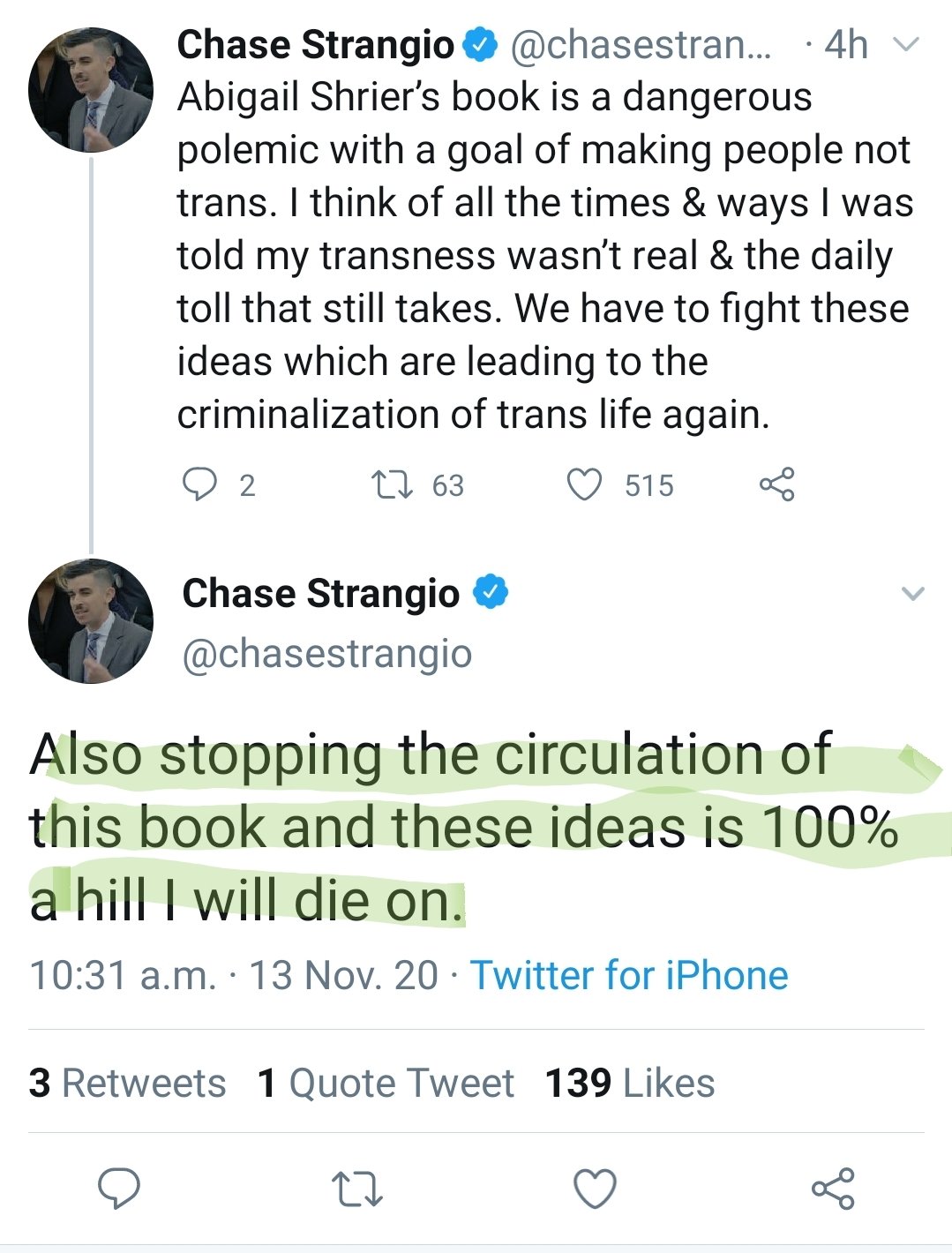
Strangio is one of the biggest proponents of affirmative care, and even took to Twitter advocating censoring Abigail Shrier’s book on gender dysphoria, Irreversible Damage. (Strangio is a trans-identified female.) Imagine an ACLU lawyer advocating censorship!

The “Dutch Protocol” (see below) was often cited by American organizations like the World Professional Association for Transgender Health (WPATH) or by physicians to justify affirmative care of minors. But the Dutch Protocol (affirmative care with medical intervention in children of younger ages) is basically without convincing clinical evidence:

Perhaps the greatest piece of misinformation believed by liberals, however, is that the American standards of care in this area are strongly evidence-based. In fact, at this point, the fairest thing to say about the evidence surrounding medical transition for adolescents—the so-called Dutch protocol, as opposed to talk therapy and other support—is that it is weak and inconclusive. (A further complication is that American child gender medicine has deviated significantly from this original protocol, in terms of length of assessments and the number and demographics of minors being treated.) Yes, as activists are keen to point out, most major American medical associations support the Dutch protocol. But consensus is not the same as evidence. And that consensus is politically influenced.

There’s an article at the site of Our Duty that discusses the shortcomings of the Dutch protocol, and is accompanied by a video of Dr. Patrick Hunter  testifying before the Florida Board of Medicine; it’s a summary of the flaws of that protocol, which was applied to children much younger than 18. Here’s the video, which is short (9 minutes):

2.) Demoniziong those who question “affirmative care”.

There’s Strangio, of course, who tweeted this (and later removed it):

And this:

Marci Bowers, the former head of the World Professional Association for Transgender Health (WPATH), the most prominent organization for gender-medicine providers, has likened skepticism of child gender medicine to Holocaust denial. “There are not two sides to this issue,” she once said, according to a recent episode of The Protocol, a New York Times podcast.

Boasting about your unwillingness to listen to your opponents probably plays well in some crowds. But it left Strangio badly exposed in front of the Supreme Court, where it became clear that the conservative justices had read the most convincing critiques of hormones and blockers—and had some questions as a result.

. . .Trans-rights activists like to accuse skeptics of youth gender medicine—and publications that dare to report their views—of fomenting a “moral panic.” But the movement has spent the past decade telling gender-nonconforming children that anyone who tries to restrict access to puberty blockers and hormones is, effectively, trying to kill them. This was false, as Strangio’s answer tacitly conceded. It was also irresponsible.

Questioning affirmative care has been something that marks you as “transphobic” (I myself have been called that), but when all the facts are in, I suspect that this demonization of people who want to know the scientific and medical truth will be seen as oppressive and, given its medical results, even barbaric. As Lewis notes, the British Cass Review that resulted in closing all but one gender clinic in the UK has been falsely demonized as being discredited. It has not been discredited.

3.) Withholdiong research that doesn’t support “affirmative care”.

This is the other side of the Dutch Study coin. First you promulgate bad research that supports your side, then you are slow to publish better studies that do not support your side. The author notes that WPATH comissioned reviews of the flawed Dutch protocols and, apparently because the protocols were weak, tried to block their publication.

And then there’s the infamous study by Dr.  Johanna Olson-Kennedy on the effect of puberty blockers on mental health (remember, blockers were touted as essential to prevent depression and suicide in children with gender dysphoria). Olson-Kennedy, a big proponent of affirmative care, didn’t find what she hoped for, and so withheld the study for several years!

The Alabama disclosures are not the only example of this reluctance to acknowledge contrary evidence. Last year, Olson-Kennedy said that she had not published her own broad study on mental-health outcomes for youth with gender dysphoria, because she worried about its results being “weaponized.” That raised suspicions that she had found only sketchy evidence to support the treatments that she has been prescribing—and publicly advocating for—over many years.

Last month, her study finally appeared as a preprint, a form of scientific publication where the evidence has not yet been peer-reviewed or finalized. Its participants “demonstrated no significant changes in reported anxious/depressed, withdrawn/depressed, somatic complaints, social problems, thought problems, attention problems, aggressive behavior, internalizing problems or externalizing problems” in the two years after starting puberty blockers. (I have requested comment from Olson-Kennedy via Children’s Hospital Los Angeles but have not yet heard back.)

And note, this is in an unreviewed preprint.

Withholding evidence that doesn’t support your favored hypothesis is scientifically unethical, somewhat akin to falsifying data. That’s because doing this means you’re simply allowing false conclusions to persist when you have evidence for their falsity. And that means that medical practice based on those false conclusions also persists, and, in this case, children were being treated on the basis of untested ideas.

There’s a lot more in this article to chew on, but the important thing is that it was published in a reputable (and left-leaning) magazine. The NYT has had similar articles about the weak evidence for “gender affirming care.”  (In my view, Pamela Paul’s 2024 critique of this care in the NYT was a big factor in her being let go by the paper. They thus lost one of their best heterodox writers.)

To paraphrase Walter Cronkite, an advocate of gender-affirming care might say, “When we’ve lost The Atlantic and the New York Times, we’ve lost America.”

I don’t oppose the use of hormones or blockers when the decision to use them is made by adolescents with sufficient mental maturity. If you’re 18 and want to change, well, go ahead and take the hormones and cut off pieces of your top or bottom. But not in minors—not until we have evidence that that this practice actually helps them—and we don’t. Lewis closes her piece this way:

Some advocates for the Dutch protocol, as it’s applied in the United States, have staked their entire career and reputation on its safety and effectiveness. They have strong incentives not to concede the weakness of the evidence. In 2023, the advocacy group GLAAD drove a truck around the offices of The New York Times to declare that the “science is settled.” Doctors such as Olson-Kennedy and activists such as Strangio are unlikely to revise their opinions.

For everyone else, however, the choice is still open. We can support civil-rights protections for transgender people without having to endorse an experimental and unproven set of medical treatments—or having to repeat emotionally manipulative and now discredited claims about suicide.

An important article by Andrew Sullivan

June 26, 2025 • 10:30 am

Before I leave for the airport, I wanted to call people’s attention to this new, long op-ed piece by Andrew Sullivan in the NYT. Click to read, or find it archived for free here:

Sullivan’s thesis is that extreme trans-activism has not only been inimical for society in several ways, but has also eroded respect for something he fought for over many years: gay rights. I must add that neither Andrew nor I want to “erase” trans people, or take away their rights (save a few like participation of trans-identified women in women’s leagues, or their presence in women’s jails).

That said, Sullivan makes four important points (his writing is in quotes)

1.) Extreme trans activists like Chase Strangio are trying to force American society to conform to their ideology against our will and desires:

And some of the changes (prompted by the movement) are indeed welcome. The greater acceptance of trans people is a huge step forward for all of us. But then, as I told my friends (gay, trans and everyone else), I’d always believed this and always supported trans civil rights. I was glad when, five years ago, the Supreme Court gave transgender people civil rights protection in employment. I’ve also long lived in a gay world that is skewed left, and, along with my fellow gay non-lefties, I’ve long made my peace with it, or tried to.

But this new ideology, I believed, was different. Like many gays and lesbians — and a majority of everybody else — I simply didn’t buy it. I didn’t and don’t believe that being a man or a woman has nothing to do with biology. My sexual orientation is based on a biological distinction between men and women: I’m attracted to the former and not to the latter. And now I was supposed to believe the difference didn’t exist?

I’m more than happy to accept that there are some people — not all that many — who don’t fit in that binary, and want to be protected from discrimination and allowed full access to medical interventions in order to live lives that are true to who they are. And I’m with them all the way. After all, I, too, am a part of a minority — most people live their lives governed by heterosexual desires. Thanks to the gay and lesbian movement, I’m not being asked to.

But abolishing the sex binary for the entire society? That’s a whole other thing entirely. And madness, I believe. What if I redefined what it is to be heterosexual and imposed it on straight people? Or changed what it means to be a man or a woman, for that matter? Then it ceases to be accommodation of a minority and becomes a societywide revolution — an overreach that would soon lead to a potent and sane backlash, against not just trans people, but gay men and lesbians as well.

2.). These changes have eroded gains achieved by the gay rights movement, for “L” and “G” are lumped together in peoples’ minds with “T”:

The gay rights movement, especially in the marriage years, had long asked for simple liberal equality and mutual respect — live and let live. Reform, not revolution. No one’s straight marriage would change if gay marriage arrived, we pledged. You can bring up your children however you like. We will leave you alone. We will leave your children alone.

But in the wake of victory, L.G.B.T.Q.+ groups reneged on that pledge. They demanded the entire society change in a fundamental way so that the sex binary no longer counted. Elementary school children were taught that being a boy or a girl might not have anything to do with their bodies, and that their parents had merely guessed whether they were a boy or a girl when they were born. In fact, sex was no longer to be recognized at birth — it was now merely assigned, penciled in. We got new terms like “chest-feeding” for “breastfeeding” and “birthing parent” for “mother.”

A key leader of this movement, Chase Strangio, informed us that “a penis is not a male body part. It’s just an unusual body part for a woman.” We all were suddenly expected to announce our pronouns as if everyone didn’t already know. Then neopronouns — xe/xem! — were added. The movement came up with a mantra: “TRANS WOMEN ARE WOMEN. TRANS MEN ARE MEN.” It was not an argument, nor a proposition to be explored or debated. It was a theological command. In all caps.

Was there any debate among gays and lesbians about this profound change, a vote taken, or even a poll of gay men and lesbians? None that I can find or recall.

3.). Some of the erosion of the equality gays received comes from trans-activists imposing their views on children, which many of us see as misguided or even unconscionable:

Debate has been all but snuffed out; total uniformity of thought is demanded.

But this illiberalism made a fateful, strategic mistake. In the gay rights movement, there had always been an unspoken golden rule: Leave children out of it. We knew very well that any overreach there could provoke the most ancient blood libel against us: that we groom and abuse kids. You can bring up your children however you like, we promised. We will leave you alone. We will leave your children alone.

So what did the gender revolutionaries go and do? They focused almost entirely on children and minors. Partly because the adult issues had been resolved or close to it, and partly because true cultural revolutions start with the young, it meant overhauling the education not only of children with gender dysphoria, but of every other kid as well.

Kids all over the country were impacted. Your children were taught in elementary school that being a boy or a girl was something they could choose and change at will. Your daughter found herself running against a trans girl (i.e. a biological male) in athletics. Children in elementary school got to pick pronouns, and some children socially transitioned at school without their parents’ knowledge or permission. I suppose there are other ways you can resurrect the ghost of Anita Bryant, and all the homophobic paranoia that followed her, but this will probably do the trick.

And then most radical of all: gender-affirming care for minors, which can lead to irreversible sex changes for children. The “care” included off-label “blockers” to arrest puberty, almost always followed with cross-sex hormones. To begin with, gays and lesbians, including me, empathized with kids with gender dysphoria, and trusted the medical profession with the rest. If this helped kids or even saved their lives, as was often emphasized, what business was it of mine? If transitioning this young in life would helped some pass better as adults, good for them.

Sullivan adds this, and it’s something we all should realize:

. .  . there are many more [gender-dysphoric children] who will grow up to be gay and lesbian than who will grow up to be trans. When adolescents referred to a British gender clinic were asked about their sexuality in 2012, some 90 percent of females and 80 percent of males said they were same-sex attracted or bisexual.

Ergo, parents, psychologists, and doctors should not, under the guise of “gender-affirming care”, be so eager to inject kids with hormones or cut off parts of their bodies.

4.) The extreme political polarization of America, and widespread hatred of Trump, have blinded liberals to the view that, in putting brakes on gender-affirming care, the Trump administration might be doing the right thing:

If Mr. Trump is against childhood sex reassignment, then we must be for it. If Mr. Trump says there are two sexes, we must insist that there is a spectrum. It will be very hard to break this dynamic in such a tribal atmosphere, especially when there is genuine transphobia among some on the right. But it would be incredibly healthy if we were to allow an actual debate in the community about the direction we are headed in, and treat dissenters less like bigots and traitors. Representative Sarah McBride, the first openly trans member of Congress, echoed this sentiment on Ezra Klein’s podcast last week. But she was condemned on social media as a traitor to trans people.

This intransigence matters because, left on its current trajectory, the L.G.B.T.Q.+ gender movement carries significant risks for gay, lesbian and trans equality. Gallup found that satisfaction with the acceptance of gay and lesbian people peaked at 62 percent in 2022 but dropped to 51 percent by January of this year. The center and right — whom some of us spent a lifetime engaging — are being lost. Gallup showed Republican support for gay marriage dropping from 55 to 46 percent between 2022 and 2025.

In my view, this kind of intransigence works against true liberalism and against the Democratic Party. It is a maladaptive manifestation of Trump Derangement Syndrome, which is a real thing. We cannot simply oppose everything the Republican administration does simply because it’s Republican. And some of the things we need more inter-party comity about are issues of gender and sex.

h/t Luana for calling my attention to this article.

Evolution meetings include an ideologically-based symposium on “teaching sex and gender”. It’s a spectrum, Jake!

June 20, 2025 • 11:00 am

A while back, the Presidents of the Society for the Study of Evolution (SSE), the American Society of Naturalists (ASN) and the Society of Systematic Biologists (SSB) posted this letter on the SSE website (click title to see archived version):

The letter was a response to Trump’s Executive order on sex, which gave the biological definition of sex: a binary based on the physiological apparatus for producing gametes of different size, of which there are two forms.  This is how the “Tri-Societies Letter” (henceforth “TSL”) started:

As scientists, we write to express our concerns about the Executive Order “Defending Women From Gender Ideology Extremism And Restoring Biological Truth To The Federal Government”. That Order states first, that “there are two sexes…[which] are not changeable”. The Order goes on to state that sex is determined at conception and is based on the size of the gamete that the resulting individual will produce. These statements are contradicted by extensive scientific evidence.

The TSL, posted on the SSE webpage, asserts that sex is a multivariate trait, is not binary but a spectrum, and that this spectrum occurs in all biological species. It adds this (bolding is mine):

Scientific consensus defines sex in humans as a biological construct that relies on a combination of chromosomes, hormonal balances, and the resulting expression of gonads, external genitalia and secondary sex characteristics. There is variation in all these biological attributes that make up sex. Accordingly, sex (and gendered expression) is not a binary trait. While some aspects of sex are bimodal, variation along the continuum of male to female is well documented in humans through hundreds of scientific articles. Such variation is observed at both the genetic level and at the individual level (including hormone levels, secondary sexual characteristics, as well as genital morphology). Beyond the incorrect claim that science backs up a simple binary definition of sex, the lived experience of people clearly demonstrates that the genetic composition at conception does not define one’s identity. Rather, sex and gender result from the interplay of genetics and environment. Such diversity is a hallmark of biological species, including humans.

Note that it gives no way to determine whether an organism, including a human, is male or female! And how many sexes are there? This gives us no clue.

The letter went on to imply that all the members of the society, or at least nearly all of them, agreed with the Presidents’ views in the TSL:

Our three scientific societies represent over 3500 scientists, many of whom are experts on the variability that is found in sexual expression throughout the plant and animal kingdoms. More information explaining why sex lies along a continuum can be found here. If you wish to speak to one of our scientists, please contact any of the societies listed below.

It turned out that this was a distortion: the Societies had never polled their membership to see how many people agreed with their letter.

The result was considerable pushback against the TSL from scientists, 125 of whom wrote a letter to the Societies saying they didn’t agree with the TSL’s characterization of sex. Luana Maroja was the driving force behind this pushback, and the letter included this (I signed it, of course):

However, we do not see sex as a “construct” and we do not see other mentioned human-specific characteristics, such as “lived experiences” or “[phenotypic] variation along the continuum of male to female”, as having anything to do with the biological definition of sex. While we humans might be unique in having gender identities and certain types of sexual dimorphism, sex applies to us just as it applies to dragonflies, butterflies, or fish – there is no human exceptionalism.   Yes, there are developmental pathologies that cause sterility and there are variations in phenotypic traits related to sexual dimorphism. However, the existence of this variation does not make sex any less binary or more complex, because what defines sex is not a combination of chromosomes or hormonal balances or external genitalia and secondary sex characteristics. The universal biological definition of sex is gamete size.

You can see my other posts about this kerfuffle here.

The response from the Societies can’t be posted as we were refused permission to do so, but I characterized it this way:

. . . . this time we asked for a response and got one, signed by all three Presidents.  I can’t reprint it because we didn’t ask for permission [we later did but were refused], but some of its gist is in the response below from Luana [Maroja]. I will say that they admitted that they think they’re in close agreement with us (I am not so sure!), that their letter wasn’t properly phrased, that some of our differences come from different semantic interpretations of words like “binary” and “continuum”(nope), and that they didn’t send the letter anyway because a federal judge changed the Executive Order on sex (this didn’t affect our criticisms). At any rate, the tri-societies letter is on hold because the organizations are now concerned with more serious threats from the Trump Administration, like science funding.

The upshot was that the Societies eventually decided to remove the letter from the SSE website. What remains on the the original page is this, “This letter was originally posted on February 5th. A revised version is in progress and will be posted shortly.”

We are still waiting. I’m betting that no revision will ever appear. And it shouldn’t, for it’s not good for the premier evolution societies to pretend that biologists see sex as a spectrum.

What I’m leading up to is that, at the SSE’s annual conference taking place this month, the Society is sponsoring a three-hour symposium with four lecturers, a symposium that seems designed to reiterate the premises of the now-vanished letter. You can see the summary of this symposium by clicking on the link below to see synopses of the four lectures; then click on the bottom symposium, which looks like this:

If you go through the written summaries of the talks, you will see two themes reiterated:

1.) Biological sex is not binary but multifaceted, a “complex suite of traits across multiple organizational levels”.  No definition of biological sex appears to be given.

2.) Teaching that sex is binary harms those people who feel they’re not part of the binary, presumably nonbinary people, genderfluid people, some trans people, and the like. An important goal of teaching about sex and gender is to avoid harming people, and this form of teaching must be designed to avoid that harm.

The first point simply reiterates what was in the now-disappeared letter.  It makes the argument that many “progressive” biologists make: sex involves a combination of different traits.  This of course neglects the universality of the gametic definition, for no other definition holds for all animals and vascular plants. That’s why the definition (really a post facto observation) is used. In fact, many of those who hold to the “multifactoral” definition never even give a definition of sex, so I don’t know how they can tell that, say, a rabbit is male or female.

The second point turns biology teaching into a form of social engineering or propaganda: we must teach about sex in a way that does not harm people (i.e., offend them). I see this as distortion of biological truth in the interests of social justice, something that Luana and I discussed in our paper “The Ideological Subversion of Biology.” In fact, of course, teaching that biological sex is binary should not make anybody feel worthless or demeaned, for the dignity and rights of people depend not on biology but on morality, which is a social construct.  I have made this point endlessly and won’t repeat it here; see the end of the paper linked just above.

Some quotes from the summary and the abstracts:

Symposium summary at the beginning:

This symposium will explore the current science behind sex and gender, explore how educators can move their instruction beyond simple binary XX/XY paradigms, and provide educational materials for teaching this nuanced and difficult subject.

The non-binary nature of sex:

However, “biological sex” can describe a complex suite of traits across multiple organizational levels, including chromosomal inheritance, physiology, morphology, behavior, etc. To capture the full range of sex variability and diversity, we must critically assess our research approaches for studying sex associated traits. In this talk, I will provide practical guidance for conceptual frameworks, experimental designs, and analytical methods for studying and teaching the biology of sex. I invite fellow scientists and educators to conscientiously apply these inclusive approaches, to advance our biological understanding of sex and to encourage academically and socially responsible outcomes of our research.

. . . . Biology is the study of the diversity of life, which includes diversity in sex, gender, sexual behavior, and sexual and romantic orientations. However, the few existing studies of biology textbooks and classrooms suggest that many textbook authors and classroom instructors represent only a narrow swath of this diversity which can lead to an over emphasis on binary sex, conflation of sex and gender, and reinforcement of essentialisms.

Biological sex is a complex and highly variable trait; however, overly simplistic explanations are common in undergraduate biology classrooms. Here we test the impact of an accurate approach to teaching about the diversity of biological sex in organismal biology (‘treatment’ lecture) and compare this approach to a ‘traditional’ lecture section of the same introductory biology course.

The harm of teaching sex “wrongly”.

Although science is thought to be objective and free of emotion, many people are uncomfortable talking about the biology of sex. That discomfort and fear leaves room for hostile attacks on the science of sex to easily propagate through political and social channels. This creates unique challenges for educators in this area. In this presentation, I will discuss the biological basis of sex and sexual diversity from the perspective of a developmental biologist. The hierarchical nature of development connects genetics to phenotypes. Development dictates how sexual diversity emerges within species. The evolution of development dictates how sexual diversity arises among species. I will use development to demonstrate how biologists can distill complexity down into understandable chunks to address the most pervasive misconceptions about sex, especially those actively being used to take away
people’s rights.

. . . To more fully characterize the current range of narratives about sex, gender, sexual behavior, and orientation (SGBO narratives) present in undergraduate biology courses, we interviewed a national sample of 53 biology majors whose genders do not align with the sex they were assigned at birth (i.e., trans-spectrum students) about the SGBO narratives they encountered in biology courses.

We analyzed interviews using reflexive thematic analysis with the goal of identifying SGBO narrative in biology content and how these narratives supported or harmed these students’ sense of belonging in biology classrooms.  We found five SGBO narratives that harmed trans-spectrum students’ sense of belonging.  We also found three narratives that supported trans-spectrum students’ belonging.  These narratives could manifest in the classroom in multiple ways ranging from short disclaimers to elaborate case studies. The ways the narratives manifested influenced their impact on at least some students. These narratives and how they manifest provide potential teaching suggestions to both support trans-spectrum in STEM classrooms and more accurately teach the diversity of biology of sex, gender, sexual behavior, and orientation.

(Continuing the last quote in the section just above):

. . . We show that (1) the treatment lecture has a positive impact on feelings of inclusion for LGBTQIA+ students, (2) the treatment lecture had a positive impact on LGBTQIA+ and TGNC (transgender and gender nonconforming) student experiences in the course compared to other students. . .

This is not a huge deal, but I don’t think that one should distort the most widely accepted definition of sex to avoid offending people who don’t think they adhere to it.  I can’t see any other reason for this symposium. And yes, sex is binary, and that’s universal: there are only two types of gametes, and this holds across all animals and vascular plants. It’s not only universal but useful, for the binary enables us to understand one of the most important phenomena in biology: sexual selection, a form of selection that leads to differences between males and females. Of course teachers should be sensitive to their audience and not denigrate those who feel non-binary, but they should also teach the conventional wisdom about sex, which is apparently not going to happen at this symposium.

U. S. Supreme Court affirms Tennessee’s ban on medical “gender-affirming care”

June 19, 2025 • 9:35 am

In 2023, Tennessee passed a bill to restrict access of minors to “affirmative care”, though only minors who wanted blockers or hormones to assume the identity of his/her non-natal sex or to relieve gender dysphoria. Tennessee is now one of 15 states that has passed laws restricting affirmative care.  Note, though, that hormones and blockers may, under that law, be used to treat other disorders (also called “differences”) of sex determination {DSDs).

Click title to read the bill. In it, “minor” refers to “an individual under 18 years of age”

From the bill:

The legislature determines that medical procedures that alter a minor’s hormonal balance, remove a minor’s sex organs, or otherwise change a minor’s physical appearance are harmful to a minor when these medical procedures are performed for the purpose of enabling a minor to identify with, or live as, a purported identity inconsistent with the minor’s sex or treating purported discomfort or distress from a discordance between the minor’s sex and asserted identity. These procedures can lead to the minor becoming irreversibly sterile, having increased risk of disease and illness, or suffering from adverse and sometimes fatal psychological consequences. Moreover, the legislature finds it likely that not all harmful effects associated with these types of medical procedures when performed on a minor are yet fully known, as many of these procedures, when performed on a minor for such purposes, are experimental in nature and not supported by high-quality, long-term medical studies.

The bill does not ban that aspect of “affirmative care” that involves psychological affirmation of a minor’s desires; what is banned is solely medical treatment given to minors. (I do think that good psychological treatment doesn’t have an aim at the outset, though, so “affirmative psychology” seems counterproductive).

But when you turn 18 in Tennessee, you can have all the hormones you want, though puberty blockers are by that point superfluous.

Yesterday,  the U.S. Supreme Court upheld the law by a vote of 6-3—the ideological vote that we liberals are used to.  There are long concurrences by Judges Alito (22 pages), Barrett (11 pages) and Thomas (23 pages), and dissents by Sotomayor (31 pages) and Kagan (2 pages). Click to see the decision:

And the end of the decision:

The Supreme Court decision reprised the Tennesse law:

In 2023, Tennessee joined the growing number of States restricting sex transition treatments for minors by enacting the Prohibition on Medical Procedures Performed on Minors Related to Sexual Identity, Senate Bill 1 (SB1). SB1 prohibits healthcare providers from prescribing, administering, or dispensing puberty blockers or hormones to any minor for the purpose of (1) enabling the minor to identify with, or live as, a purported identity inconsistent with the minor’s biological sex, or (2) treating purported discomfort or distress from a discordance between the minor’s biological sex and asserted identity. At the same time, SB1 permits a healthcare provider to administer puberty blockers or hormones to treat a minor’s congenital defect, precocious puberty, disease, or physical injury.

The National Law Review summarizes the decision and discusses its basis and what it did not address (click to read):

An excerpt:

In a 6-3 opinion authored by Chief Justice John Roberts, the Court in Skrmetti affirmed the U.S. Court of Appeals for the Sixth Circuit,[1] which held in September 2023 that (1) the Tennessee law does not discriminate on the basis of sex for purposes of equal protection, and (2) that it was subject only to rational basis review.

“SB1 does not classify on any bases that warrant heightened review,” the Supreme Court wrote. It concluded that the Tennessee law incorporates only two classifications: (1) age (allowing certain medical treatments for adults but not minors), and (2) medical use (allowing puberty blockers for minors for some conditions but not others). These two classifications warranted only rational basis review, the Court said.

And the Court dodged the question of whether transgender status should be considered a protected class equivalent to race or gender. “This case, in any event, does not raise that question because SB1 does not classify on transgender status.”

That’s a serious issue, for if transgender status is a protected class, the whole game changes. That doesn’t mean, though, that gender-dyphoric minors will immediately be allowed medical “affirmative care.” It goes on:

. . . The decision marks the first time the Supreme Court considered the application of the Equal Protection Clause to transgender youth, despite the decision skirting the question of whether transgender status should be considered a protected class.

The decision has broad implications, although many legal issues in this area remain unresolved.

Those unresolved issues are said to involve the right to privacy, parents’ rights, statutory discrimination analysis, impact of state constitutional arguments, and tension with state laws on gender identity.  The upshot, it seems to me, is that the Court decided that the Tennessee law, because it didn’t discriminate on the basis of sex (both male and females with gender dysphoria are equally subject to Tennessee’s ban), was constitutional on those grounds. But that still leaves the issue of whether “transgender status” or “having gender dysphoria” counts as being a member of a protected class. If that proves to be the case in further legal wrangling, then affirmative medical care may be permitted.

I am not sure how this affects the 25 other states that do not have laws against medical affirmative care; those states have not passed bills banning it (or, presumably, allowing it) that can be adjudicated at the nation’s highest court. (I may be wrong here, so readers who know are welcome to correct me.)

Some of the mainstream media are couching this as a “setback for transgender rights”, but some of us would argue that there is not a “right” for minor who wishes to have surgery and/or hormone treatments aimed at making them resemble members of their non-natal sex should be able to freely get such treatments.

Here are two articles explicitly endorsing such a “right”:

From the Associated Press:

There was an NPR article called “Battle over rights of trans children is up at the Supreme Court,” but it has now changed the title (!). It does still assert the “rights” in one paragraph:

Front and center at the Supreme Court on Wednesday is the battle over the rights of transgender children. At issue is a state law in Tennessee that blocks minors from accessing gender-affirming care in the state.

I don’t want to scour all the news for similar statements, though, because I don’t believe there’s any “right” of minors to affirmative medical care beyond psychological treatment; there’s certainly no right in the Constitution or—in my view—ethics to have parts of your body cut off or hormones injected into you, particularly when the vast majority of minors experiencing gender dysphoria will resolve as being gay children who don’t need this kind of medical care (especially unproven blockers, who are banned for minors in some European countries).

Emily Yoffe, whose writings I’ve always found pretty sensible, agrees with me, and published the article below in the Free Press (archived here):

Some excerpts from Yoffe’s piece (bolding is mine):

The Court’s ruling is narrow; it says that a state has the right to regulate the practice. States, mostly blue, that still allow youth gender transition aren’t affected. But the decision will likely lend weight to the arguments of people who want to end the practice nationwide. And it will likely help the legal efforts by “detransitioners”—that is, young people who say they were pressured into life-altering treatments they now regret—to get compensation. Surely more such lawsuits will now be filed. Gender transition clinics will likely be under far more scrutiny: This Free Press story describes the cases of two such young women who were given prescriptions for testosterone after about a 30-minute appointment at Planned Parenthood.

Children who express gender distress often suffer from a host of other medical and psychological issues, such as autism, ADHD, depression, or anxiety, or have experienced various traumas. But to the gender doctors in their lucrative new clinics, there was only one answer to such childhood troubles: gender transition. This usually meant medically blocking a child’s normal puberty, then putting that patient on opposite-sex hormones: testosterone for girls, estrogen for boys. Sometimes complicated and painful surgeries were undertaken to try to create new genitals. Thousands of teenage girls, and some not even teenagers, have received double mastectomies, known euphemistically as “top surgery”—a surgical intervention normally reserved to treat breast cancer.

In the U.S., gender-distressed children and their parents were told that without the swift intervention of these radical treatments, the children were likely to commit suicide. It became a cliché for the reluctant parents of girls seeking to transition to be asked by the gender provider, “Would you rather have a live son or a dead daughter?” (And vice versa for parents of boys.)

The clinicians assured parents there was robust evidence underlying their interventions, but this was false. During the oral argument in the case, Chase Strangio, the lawyer for the ACLU, arguing to overturn Tennessee’s ban, was forced to acknowledge to Justice Samuel Alito that “completed suicide, thankfully and admittedly, is rare.”

I would have guessed that Strangio would be in there argue for surgery and hormones; he was, after all, the ACLU lawyer who argued for banning Abigail Shrier’s book on rapid-onset gender dyphoria, often triggered by social pressure. (Strangio is also a trans-identified female.) In the end, Shrier was right. Shame on Strangio and the ACLU:

More from Yoffe:

. . . . The Court’s ruling notwithstanding, the U.S. medical establishment remains firmly behind the practice. Compare that to England, where a rigorous and independent report, the Cass Review, concluded that the evidence for pediatric transition is “remarkably weak.” Finland, Norway, and Sweden are among the other Western nations that have joined the UK in moving away from this treatment.

It is widely observed that the vast majority of young people with gender dysphoria—even those whose distress is “consistent, insistent, and persistent”—when allowed to go through normal puberty, come to accept their biological sex. (And there is no way to identify the very small number of children who will go on to experience lifelong gender distress.) Many of these children turn out to be gay, which is why a rising number of gay adults and gay-rights advocates have become alarmed that the transgender movement is medically transitioning gay kids. They argue that this movement has, intentionally or not, reified homophobic tropes.

I especially agree with the last paragraph below. In the future, I think medical gender-affirmative cafe will, along with our poor treatment of farm animals, be seen as practicers that were immoral in their time, but widely practiced:

Critics of the Supreme Court decision will argue that our major medical associations, from the American Academy of Pediatrics, to the American Medical Association, to the Endocrine Society, have all given support to this new branch of medicine. This is true. It is also true that these organizations or similar ones once supported lobotomies and eugenics. Just as that is a source of shame today, it is to be hoped that their vehement support of medically transitioning vulnerable young people will be a source of shame in the future. These medical societies have failed in their most basic duty of care to their patients by embracing a model that has so little evidence and such profound lifetime consequences.

When the history of this era is written, historians will have to explain how transgender activists so quickly took over institutions, and were able to so successfully threaten the social and work lives of those who objected. We are confident that historians will also remember those courageous individuals who, at the risk of professional and personal ruin, did so anyway.

But over at the Freedom From Religion Foundation, which now comprises a group of Chase Strangio clones, they’re proclaiming first that affirmative care is in general a salubrious way to address gender dysphoria, but also that affirmative care is “religious dogma.”  That characterization is palpably ridiculous, meant as a way for the FFRF to pretend that its “progressive” politics are fully in line with its mission to keep church and state separate. But many atheists like me object to affirmative care. It is the FFRF’s deliberate conflation of progressive politics with church-state separation that I objected to, and this ultimately wound up with my resigning (along with Richard Dawkins and Steve Pinker) from the FFRF’s honorary board.  Click below to read:

Note that the FFRF again speaks of transgender minors’ “rights”:

The Freedom From Religion Foundation lambastes today’s U.S. Supreme Court ruling upholding Tennessee’s cruel and unconstitutional ban on gender-affirming care for minors. This decision is a major blow to science-based medicine and the rights of parents and transgender youth.

, , , , Despite the hostile narrative surrounding transgender health care that the Supreme Court is furthering in its decision, the gender-affirming-care model is safe, effective and supported by every major medical organization, including the American Medical Association, the American Psychiatric Association, the American Psychological Association, the American Academy of Pediatrics and the American Academy of Child and Adolescent Psychiatry. These secular scientific organizations prioritize the safety and health of patients, not religious dogma.

The Freedom From Religion Foundation stands firmly with the transgender community, with parents, and with the medical professionals who follow science and ethics — not narrow sectarian belief — in providing care. FFRF will continue to educate about the harm these theocratic assaults are doing to civil liberties, bodily autonomy and the wall of separation between religion and government.

When the FFRF proclaims gender-affirming “model” as “safe, effective, and supported by every major medical association,” they of course neglect the fact that gender-affirming care is not seen that way in Europe, where it’s either banned or considered as experimental.  And of course most gender-dysphoric minors who go through normal puberty don’t really need this care, as most turn out to be gay. No hormones or excising of body parts required.  Affirmative treatment, as you may know, usually sterilizes its recipients, and, further, many of them will never have an orgasm after transitioning.

People like those in the FFRF are acting like this is the end of gender-affirmative care in America. I wish it were, and that treatment for dysphoria was limited to those over 18 (on same days I think 21). But in half of our states, hormones and surgery are still allowed, and there are no bans to be overturned.  I think that such states are making a mistake treating youths who haven’t attained maturity as having the ability to make their full medical decisions, like catering to a minor who doesn’t like their left leg and wants it cut off. The “right” to make such decisions should not be given to minors, or even their parents or doctors—not until youths come of age.

This viewpoint may be seen as transphobic, but I firmly reject that adjective. After all, it’s not seen as transphobic in the UK, Sweden, Finland, or Denmark, which have severe restrictions on affirmative care. And in the future, those who defend this rush to cut and inject hormones will, I think, be seen as misguided or even barbaric.