
Athayde Tonhasca Júnior has been AWOL for a while, but returns today with a characteristic photo-plus-education post on orchids and pollination.. Athayde’s text is indented, and you can enlarge his photos by clicking on them
Persuasions and impositions
Orchids (family Orchidaceae) are one of the largest groups of angiosperms (flowering plants), with some 29,000 recorded species distributed through a range of habitats all over the world. Over 75% of them depend on pollinators for reproduction, although from a third to half of all species are deceptive, attracting pollinators without providing any rewards. Some orchids use food deception, ‘pretending’ to give away edible stuff: they may for example release scents similar to nectar volatiles, thus attracting insects to their nectar-free flowers. Others rely on sexual deception: their flowers look or smell like female insects, luring males to a non-existent receptive partner. To dupe flower visitors or just encourage them to come for legitimate incentives, orchids have evolved a bewildering variety of flower sizes, shapes, structures, colours and scents that are unique among angiosperms.
Examples of floral diversity in the orchid tribe Epidendreae © Valencia-Nieto et al., 2018:

Charles Darwin realised that flower traits were fine-tuned adaptations to promote cross-pollination by insects and other flower visitors. Among these ‘beautiful contrivances’ (Darwin, 1862), mechanisms of pollen production and transfer were found to be particularly elaborate.
Most plants produce loose, granular pollen that’s scooped up by a range of pollinators. But for orchids in general, and also for milkweed-related plants in the family Asclepiadaceae, pollen grains are contained in a tiny sack called a pollinium (pl. pollinia), which is connected via a stipe to a sticky pad referred to as a viscidium. The three structures form a unit called a pollinarium.
A pollinarium: the two pollinia on the toothpick hang from the stripe and are held in place by the viscidium © Frederick Depuydt, CC Attribution-Share Alike 4.0:

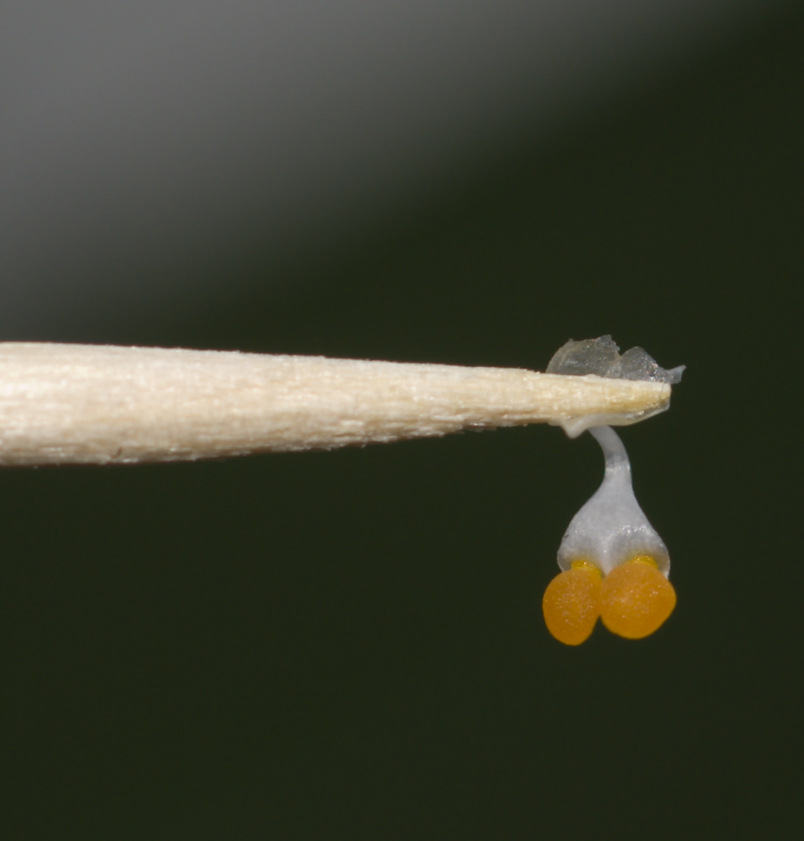
Thanks to the gluey viscidium, a flower visitor that touches the pollinarium is likely to fly away encumbered with a pollen load. When the visitor goes to another flower, the pollinarium adheres to the flower’s female parts, so pollination is ensured.
A bee orchid (Ophrys apifera) flower with its pollinarium clearly visible © Esculapio, CC Attribution-Share Alike 4.0:

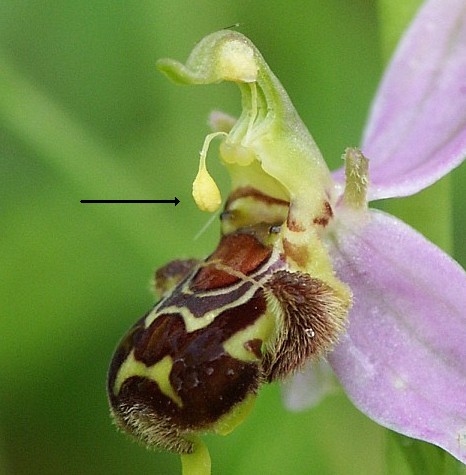
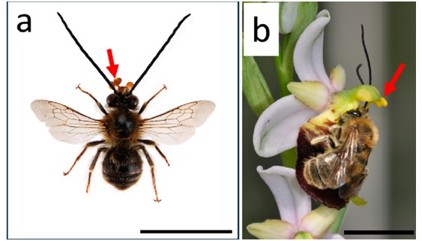
Pollen lumped together in a single package greatly reduces the wastage of loose pollen grains. It also improves efficiency: the entire pollen load is removed in one pollinator visit. That’s important in situations when plants are isolated and pollinators are scarce. Despite their species richness, many orchids are naturally rare, often widely dispersed and hidden in the canopy. But this strategy is also risky; a pollinarium lost, taken by the wrong visitor or deposited in an incorrect position would mean no pollination at all. So orchids depend on the right type of pollinator to place pollen on a precise spot of a receptive stigma. To get to the target, the pollinarium must be attached to a specific area of the pollinator’s body, such as an insect’s thorax, mouthparts, frons (‘forehead’), eyes and legs: these are smooth surfaces to which a viscidium adheres particularly well.
a: A male Japanese longhorn (Eucera nipponensis) with late spider-orchid (Ophrys fuciflora) pollinarium attached to his head. b: location of the pollinarium on the flower © Yagame & Naka, 2024:
The meticulous, highly specialised association between orchids and pollinators has been described as a ‘lock and key’ strategy: a combination of the right ‘key’ (pollen on a pollinator’s exact spot) and the right ‘lock’ (flower’s exact spot) is required, otherwise the fertilisation mechanism will not be unlocked. Few plants offer a better example of this intricate bond than the bucket orchids (Coryanthes spp.).
A bucket orchid by John Nugent Fitch, 1883. Image in the public domain:
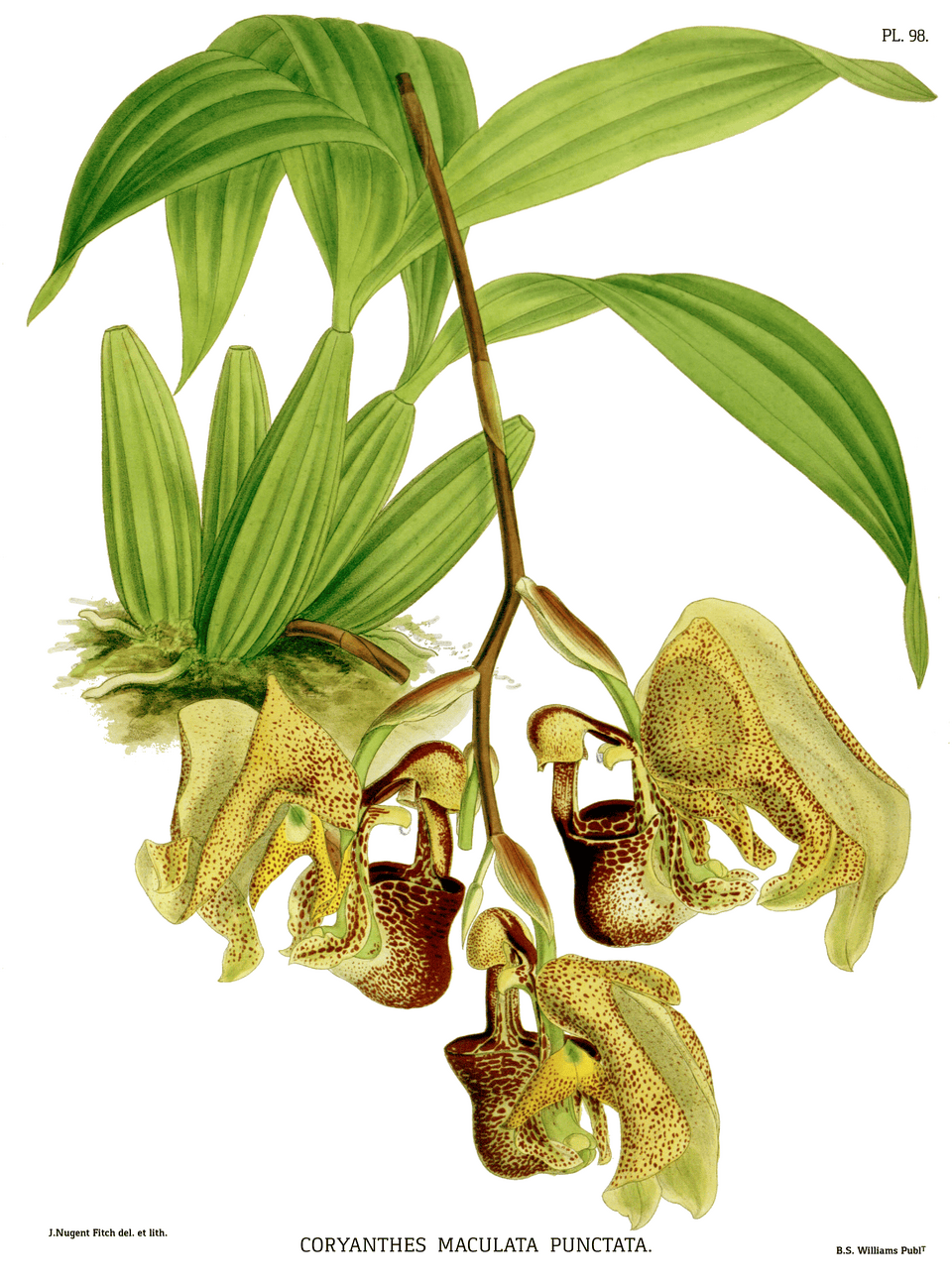
This small group (~60 species) of neotropical orchids is characterised by large, fleshy, brightly coloured flowers containing a structure analogous to a bucket or inverted helmet – the name Coryanthes was derived from the Greek corys (helmet) and anthos (flower). The column (fused male and female reproductive parts, a distinguishing feature of orchids) has two glands that secrete a watery solution that drips intermittently into the bucket, keeping it full. The column extends all the way into the bucket and sticks out at the bottom.
A fiendish contraption: parts of a helmet bucket orchid flower © Dalton Holland Baptista, CC Attribution-Share Alike 3.0:


Such odd arrangement raised Darwin’s curiosity, but it was Hermann Crüger (1818-1864), director of Trinidad’s botanical garden, who discovered bucket orchids’ cunning machinations to get pollinated.
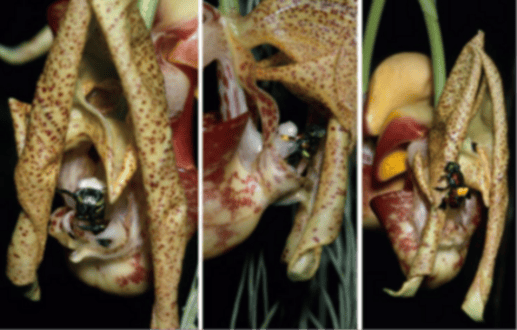
As soon as it opens in the morning, the flower starts producing fragrances that are irresistible to male orchid bees (tribe Euglossini) from the genera Euglossa, Eulaema or Euplusia. Each orchid produces a specific blend that attracts one or a few bee species, who collect and store those perfumes to be used in courtship. While scraping fragrances from the flower’s lip, a male bee may slip and fall into the bucket. With his wings drenched, the male bee tries to crawl out, but the smooth surface and downward-pointing hairs in the bucket’s inner walls prevent escape. But not all is lost: the bewildered bee can get out by squeezing along a narrow passage formed by the bucket walls and the end of the column. As the bee struggles to get through this tunnel at the bottom of the bucket, the flower’s pollinarium is pressed against his thorax. But his ordeal is not over. The pathway is tight, so the bee may need to labour for up to 45 min before breaking free. Which suits the orchid: it takes some time for the viscidium to settle, so holding up the bee for a while assures that the pollinarium is firmly stuck to the bee’s body.
You can go – in a moment. A male bee leaving a bucket orchid flower is ‘gifted’ with a pollen package on his back © Nazarov & Gerlach, 1997:
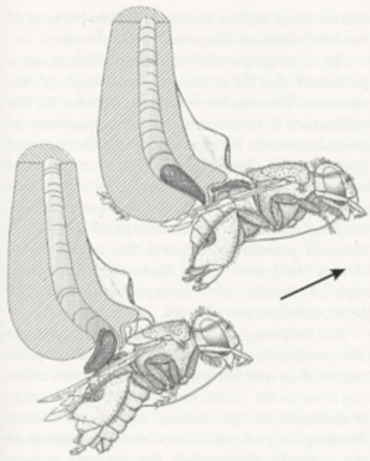
These tribulations are not going to deter our adventurous bee; after all, he still needs to collect the right type of fragrances if he wants to find a mate. So he goes after another flower from the same orchid species, where he may go through the same trouble if he falls again in the bucket. But this time the pollinarium stuck to his back gets transferred to the flower’s stigma as he skedaddles, so pollination is accomplished. Another type of bee or some other insect will not do: if it’s larger than the orchid bee, it won’t squeeze through the column and will most likely drown; if it’s smaller, the pollinarium won’t get attached to it.
Pollination of C. kaiseriana by Euglossa alleni. From left to right: a bee using his foreleg to pull out of the column; he’s nearly out, with a pollinarium stuck to his body; bee waiting to dry out before flying off © Gerlach, 2011:
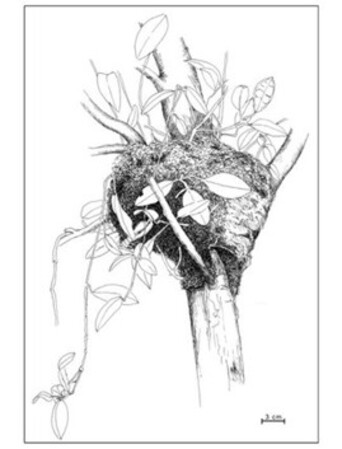
Bucket orchids and orchid bees are entwined in a remarkable mutualistic alliance, but other partners have their essential part to play. Bucket orchids grow only from ant-gardens, which are nests of arboricolous (tree-living) ants of the genera Azteca, Camponotus and Crematogaster. Their nests consist of packages of soil, litter and plant matter accumulated on tree branches. Ants defend the orchids from herbivores and snip off competing vegetation, and their nests are sources of moisture and nutrients from ant poo and decomposing matter. In return for these services, ants take nectar from orchids’ extrafloral nectaries without interfering with bee pollination. This orchid-ant interaction is so tight that orchidarium cultivation of bucket orchids is next to impossible.
An ant garden © AntWiki, CC Attribution-ShareAlike:
In the final chapter of his book on orchids, Darwin concluded: In my examination of Orchids, hardly any fact has struck me so much as the endless diversities of structure,- the prodigality of resources, – for gaining the very same end, namely, the fertilisation of one flower by pollen from another plant. He certainly would be thrilled to learn about the complexities of bucket orchids’ pollination, another splendid example of the workings of natural selection, the catalyst for the world’s biodiversity.
References
Darwin, C. R. 1862. The various contrivances by which orchids are fertilised by insects, and on the good effects of intercrossing. John Murray.
Gerlach, G. 2011. The genus Coryanthes: a paradigm in ecology. Lankesteriana 11: 253-264.
Nazarov, V. & Gerlach, G. 1997. The potential seed productivity of orchid flowers and peculiarities of their pollination systems. Lindleyana 12: 188-204.
Valencia-Nieto, B. et al. 2018. Anther development in tribe Epidendreae: orchids with contrasting pollination syndromes. PeerJ 6:e4383.
Yagame, T. & Naka, H. 2024. Sexually deceptive pollination of the non-native Ophrys fuciflora (Orchidaceae) in Japan by the native bee Eucera nipponensis (Hymenoptera: Apidae). European Journal of Entomology 121: 355-359.