Readers’ Wildlife Photos: Gulls & Eagles redux

July 20, 2015 • 8:00 am

by Grania

Reader Joe Dickinson wrote in saying:

I was surprised by Grania’s post on eagle vs. gull combat.  When we lived in Utah, we often saw gulls and eagles in close proximity at Farmington Bay, which supports one of the largest wintering populations of Bald Eagles (Haliacetus leucocephalus) in the lower 48 states.  We never saw any sign of aggression on the one hand or particular concern on the other.

That’s interesting, so I thought I should check this out in case it was a freak occurrence, however Birds Flight confirms that Bald Eagles do in fact prey on gulls.

Bald eagles are carnivores and they are opportunistic feeders. These birds of prey predominantly feed on fish, salmon, and trout across Pacific Northwest. In winter, they prefer to consume carrion. Bald eagles are also capable to devour large mammals like whales together with the carcasses of ungulates. These types of eagles also feed on garbage dumps. Other bald eagles diet includes raccoons, beavers, hares, muskrats, rabbits, lizards, and deer.

As far as avian prey is concerned, coots, egrets, ducks, grebes, alcids, gulls, and geese are mostly favored. Though occasionally, bald eagles also prey on birds in flight. These species rely on swans, reptiles, crustaceans, and amphibians. Bald eagles plunges over the water to grasp the fish at the surface with its strong talons. These birds of prey tend to eat by one claw and tearing down with the other. Other foods include foxes, coyotes, gulls, vultures, and corvids.

Nevertheless, Joe was able to supply some gorgeous photos of the two co-existing peacefully. Maybe gulls are just gullible. (Sorry). Or perhaps plentiful fish mean that gulls are not prime food source in this area.

gulls & eagles3


gulls & eagles1


gulls & eagles2


Readers’ Wildlife: The Birds & The Bees. Also, Stars.

July 19, 2015 • 9:30 am

by Grania

Regular Stephen Barnard sent us these gorgeous photos from his piece of paradise in Idaho.

As always, click through twice on a picture to see it in its original size.

Common Nighthawk (Chordeiles minor).

RT9A0485


Wilson’s Snipe (Gallinago delicata), trying to hide.

RT9A0545

Rufous Hummingbird (Selasphorus rufus), busy bullying the Black-chinned.

RT9A0597 (1)

Landscape looking North from Silver Creek toward the Big Wood Valley
and the Pioneer Mountains.

RT9A0564-RT9A0567


Just-as-regular Ben Goren sent some beautiful finches and a bee. He writes:

For the photo geeks: everything was taken with a Canon 5Ds and either Canon’s EF 180mm f/3.5 L Macro or their TS-E 24mm f/3.5 L II. Processing is minimal, limited to exposure, white balance, cropping, sharpening, and noise reduction. Color profiling is done with my new spectroscopic workflow…which has most, but not all, of the kinks worked out. That is to say, the color _should_ be very accurate, but I also know it’s not perfect.

This is a typical early morning scene at the main feeder in the Houle’s back yard: a constant flurry of several birds of various species. At times, quail will gather below to eat what falls to the ground. There’s another feeder to the right that Mike puts peanuts in for the jays. I’ve no clue of species, but I know there’re readers (including Mike, if he sees them) who can identify them.

[ Color corrected by ArgyllCMS ]
[ Color corrected by ArgyllCMS ]

The finches get their breakfast by the driveway.

[ Color corrected by ArgyllCMS ] [ Color corrected by ArgyllCMS ]
[ Color corrected by ArgyllCMS ]

Around on the north side of the home is a bush positively exploding with honeybees. This is a 1:1 macro picture; if you make a 24mm x 36mm print of the entire frame, the bee will be actual size.

[ Color corrected by ArgyllCMS ] [ Color corrected by ArgyllCMS ]
[ Color corrected by ArgyllCMS ]
And finally, reader Tim Anderson sent this stunning shot of the South Celestial Pole – you have to click through on it to view in its enlarged glory). He writes:

This is a long-exposure photograph (15 minutes) of the sky directly south from Tumut, Australia. It shows the South Celestial Pole – the imaginary point around which the stars appear to rotate. It is, in fact, the point that is exactly parallel to the Earth’s axis of rotation, and its elevation above the horizon is therefore exactly equal to the observer’s latitude.

One of the more arcane skills required for astrophotography is being able to locate the SCP and align your telescope’s right-ascension axis to it (told you it is arcane). In the northern hemisphere, you simply point the telescope at Polaris, which is close enough to the NCP for practical purposes.

In the southern hemisphere, there is no bright star close to the pole, and you have to dance a complicated mathematical jig with a compass, magnetic declination and whatnot, or else embark upon the fearsome procedure known as “drift alignment”. In winter, this requires thermal underwear and a balaclava.

20150718063955_IMG_3008

Thanks guys, those are incredible!

Readers’ wildlife photos: sparrows & a Cedar Waxwing

July 18, 2015 • 8:30 am

WEIT regular Diana MacPherson has sent us these beautiful photographs of sparrows. She writes:

Young Sparrow (Passer domesticus) On Weigela Branch Watch for Food Opportunities.
270A2811
Young Sparrows (Passer domesiticus) On Weigela Branch Watch for Food Opportunities
270A2805
Young Sparrows (Passer domesiticus) On Weigela Branch – What squabbling. Birds are so expressive!
270A2802
Don’t Look Now, But a Bird Is Watching You (Young Sparrows (Passer domesticus))
270A2778
Young Sparrows (Passer domesticus) In the Sun
PastedGraphic-1
And finally, Stephen Barnard sent in an amazing photograph of a Cedar Waxwing (Bombycilla cedrorum) catching mayflies.
RT9A0472

Readers’ wildlife photos: flies and spiders

July 17, 2015 • 8:08 am

WEIT regular Mark Sturtevant has sent us a veritable seminar on flies and spiders. He writes:

Stilt legged fly (possibly Rainieria antennaepes). I encountered this little character strutting back and forth on some forest leaves, persistently waving its whitened front legs before it. This fly was so intent on its display that it would not be distracted from it, even after I bumped its leaf trying to hunker down on the forest floor to take pictures. It was for this reason that I thought at first that this was a male ‘strutting its stuff’ to entice a female, but I have since learned that it was likely mimicking various species of ichneumon wasps which wave whitened antennae. An example of the kind of model is here: http://bugguide.net/node/view/997201/bgimage

1StiltLeggedFly

In point of fact, this fly was a female (I could tell from other pictures), and both males and females spend a lot of time marching around waving their tiny white feet to pretend they are wasps. But sex is never far from the minds of an insect, and this female was possibly also advertising for a conjugal visit from a male. In the animal kingdom it is generally the males that have to dance and carry on for mating because females choose their males and males must vie to be chosen. This makes sense because usually it is the females that bear the higher reproductive costs. But in some animals the costs are more balanced or even reversed. In stilt legged flies both sexes have high reproductive costs, and so here we have a female who might be trying to get the attention of any passing males. This is all explained in the following short video about a tropical species of stilt legged fly, and the readers can sort out from this why mating is costly for males (it is kind of gross). I do recommend that people watch this video. Although it does suffer a bit from video quality, it is exceptionally charming in how it patiently describes the rather unusual (and kind of funny) sex lives of these little insects.

I mentioned in my previous posting that robber flies have a special talent. It is said that the preying mantis is the only insect that can turn its head, but of course that is not true. Other insects can turn their head a little, but I learned this summer that robber flies can turn their heads a lot. These pictures were taken with the wrong kind of lens, but they do show a robber fly (Laphria grossa) looking forward and then up. It also looked several times over its left and right shoulders (!) but I failed to get pictures of that. Robber flies are fearsome predators with excellent vision, and so I think that their ability to swivel their heads around like this makes it even more terrifying to be an insect.

2RobberFlyLooking

The tiny basilica spider (Mecynogea lemniscata) is about the size of a fruit fly. It builds a dome web close to the ground, and they are very common around here. The first picture shows a female and slightly smaller male.

3BasilicaSpiders

The next pictures show them mating. Male spiders store their sperm in their pedipalps, which are the swollen ‘boxing gloves’ on the head. The two loaded pedipalps are used to separately enseminate the two reproductive openings on the female, located near the base of her abomen. Here you can see the very moment when the male is first inflating the left pedipalp to pump in sperm, and then the right pedipalp is inflated to do the same.

4BasilicaMating

Readers’ wildlife photos

July 16, 2015 • 9:00 am

by Grania

Reader Jacques Hausser from  Lausanne, Switzerland sent Jerry these absolutely gorgeous photographs of hedgehogs. He writes:

Sitting in the garden enjoying the first stars and the temperature dropping under 30º C  (86º F) at least (and also a beer), I spotted three little shadows following each other across the lawn. I didn’t have my camera, but I remembered a picture of a similar scene taken some years ago – and I thought it was a good idea to send you this family of hedgehogs (Erinaceus europaeus). I add a second picture of another one, who was convinced to be well hidden under a bush.
PL335 - copie
PL1055 - copie
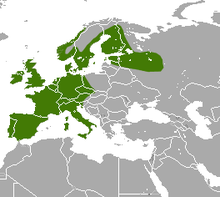
The European Hedgehog is widely distributed across Europe as the name suggests.

The European hedgehog is found across a wide range of habitat types, encompassing both semi-natural vegetation types and those areas that have been heavily modified by man. The range includes woodland, grasslands such as meadows and pasture, arable land, orchards and vineyards as well as within the matrix of habitat types found in human settlements. It prefers lowlands and hills up to 400-600m, but is also locally present on mountains, exceptionally up to and altitude of 1500-200m (e.g. Alps and Pyrénées).[23] Outside cultivated land it prefers marginal zones of forests, particularly ecotonal grass and scrub vegetation.[24]

Hedgehogs are most abundant within the gardens, parks and amenity land close to or within human settlements.[25] They are generally scarce in areas of coniferous woodland, marshes and moorland, probably because of a lack of suitable sites and materials for the construction of winter nests (or hibernacula), which have specific requirements.[7]

Readers’ wildlife photos

July 15, 2015 • 1:30 pm

by Grania

Reader Mark Otten from Ohio sent Jerry five beautiful photographs. He writes:

All of the attached photos were taken at Glenwood Gardens Park (a component of the Hamilton County Park District) in suburban Cincinnati, Ohio.

Male eastern (rufous-sided) towhee (Pipilo erythrophthalmus).

P1010125

Field sparrow (Spizella pusilla).

P1010291

Bumble bee (Bombus spp.) on gray-headed coneflower (Ratibida pinnata).  I am not sure which species of bumble bee this is, but I think it is Bombus impatiens.  Maybe one of your readers can verify the species.  The lower one is the uncropped version of the photo.

P1020204b

P1020204

Male tree swallow (Tachycineta bicolor ).  This photo was taken on a warm day soon after the young had hatched; which may be why he looks thinner than most tree swallows.

P1010844


And bonus photo from Ben Goren: spot the butterfly and grasshopper. He says nothing about nightjars, though that doesn’t mean there aren’t any.

IMG_0739


Thanks Mark and Ben, those are wonderful.

Readers’ Wildlife photos

July 14, 2015 • 11:00 am

by Grania

Jerry has forwarded on to me some of the beautiful pictures taken by readers.

WEIT regular Stephen Barnard sends us this:

Great Blue Heron (Ardea herodias) resting on a goose nest box in a light rain. Fledgling, I think — an adult wouldn’t let me get this close.
RT9A0396
 Tony Eales from Queensland sends us this photograph with this note attached,

Just back from a father-son fishing trip at Inskip Point, Queensland. Lots of rain so the photography opportunities were limited and light was poor. Still plenty of wildlife around though.

The birding at Inskip is amazing, and has been referred to the best square kilometre of birding in Australia. Along the shore there were Crested Terns (Thalasseus bergii) while in the dunes there were Dusky Woodswallows (Artamus cyanopterus), Silvereyes (Zosterops lateralis) and Little Wattlebirds (Anthochaera chrysoptera) and many others I didn’t get shots of.

On one particularly rainy day we poked around the tiny fishing villages of the Great Sandy Strait coast. Found some Eastern Grey Kangaroos (Macropus giganteus) relaxing in a playground and nearby there was a colony of Grey-headed Flying Foxes (Pteropus poliocephalus) and a miserable bedraggled Whisting Kite (Haliastur sphenurus) hanging out its wings to dry.

Eastern-Grey-Kangaroo

And last, one from Jerry in Arizona with lizard.

IMG_2567