New Zealand authors: using complexity theory is the only way to achieve equity

June 12, 2023 • 12:45 pm

Here we have another article in a science journal (Nature Human Behavior, which has published stuff like this before), which says almost nothing, but uses a lot of words to do so. I recognize some of the writers as New Zealand activists, including Priscilla Wehi, first author of a dreadful article in Journal Roy. Soc. New Zealand (JRSNZ) arguing that Polynesians made it to Antarctica in 700 A.D. This is, of course, a Māori-centered article, and Wehi was trying to “empower” her people by making a palpably false claim, one that was later refuted even by Māori scholars. (Note that a couple of authors work in other countries.)

Click to read, or see the pdf here.

I really don’t want to analyze this paper in detail (you can imagine how wearing it is to deal with this stuff for several hours a day), so I’ll sum it up in a few points.

1.) Structural racism has operated in science (indeed, is promoted) by science to keep minorities down. Here’s one sentence:

Science has been described as promoting exclusion and oppression by rewarding those who practice entrenched norms, including individualism, hypercompetition and productivism, and penalizing those who challenge them.

2.) Attempts to solve this problem by creating new organizations and dispensing grant money haven’t been successful.

3.) Of course we still need to keep boosting the Māori through affirmative action and dispensing more money,but the real solution to the problem requires “embracing complexity theory“.

The idea of interconnectedness is an important part of Māori “ways of knowing” (Mātauranga Māori, or MM), and article’s point is that making more connections between people and organizations will, in the end, bring equity.

H0w does that work? The authors give a helpful diagram, starting with the fact that birds do better when they fly in flocks than singly (this is “complexity”).The bird point is made in a) below:

(From paper): a, The ordering of birds into a flock is an example of a complex system. Triangles represent actors (for example, individuals, communities or institutions). The actors on the left are homogenous, disconnected and unable to effectively respond to interventions. The actors on the right are connected to one another; their ability to receive and respond to feedback enables rapid transitions to an ordered and collective state, such as birds flying in a shared direction of travel. In the flock example, regular switches between leading and trailing positions also share and reduce the overall energetic cost of flight. Image courtesy of Jo Bailey. b, An adaptation of the six conditions of systems change, translated into Māori by M. Kirby (Ngāti Whakaue) for Healthy Families Rotorua. This heuristic identifies six conditions required for sustained and equitable change in complex systems. Adapted from ‘The Water of Systems Change’ FSG, by John Kania, Mark Kramer, and Peter Senge, 2018.

The diagram at the bottom, which isn’t all that enlightening (and is also given in Māori, a language not customary in Nature) , argues that poor health outcomes for Māori (“health inequities”) can be solved by the complexity-theory solution diagrammed in (b) above:

In Aotearoa–New Zealand, our health system has also been unsuccessfully grappling with how to address long-standing and increasing inequities. Although these emergent outcomes have been known for decades, and despite targeted policy and resources, our underlying health systems — and thus trajectories of community health and well-being — remain largely unchanged12.

The whole-of-community systems approach (Fig. 1b) taken by Healthy Families NZ has been described as a game changer in its most recent evaluation report. The initiative makes a strategic move away from fragmented, small-scale and time-limited programmes by supporting existing local action on health, while influencing local and national funding and policies to be more responsive to communities and their diverse contexts (Box 1). Sharing success and failures across the community teams has been key to the initiative’s success, along with fostering a responsive, timely and trusting contractual relationship with the central agency funder.

If you can understand how this works (the caption supposedly will help enlighten you), please explain it in the comments.

At any rate, I’ll close giving the five lessons from “complexity theory” that, say the authors, will help bring equity:

How we act.  This is their explanation of necessary change:

We encourage scientific communities and organizations to identify their shared values and uphold contextually responsive ethical and professional principles. For instance, our approach to research at Te Pūnaha Matatini (a Centre of Research Excellence in Aotearoa–New Zealand) is guided by four principles, which are expressed through a Māori lens. Pono, or a commitment to truth and genuineness, provides the foundation principle to guide both the purpose and practice of our research, and thereby frames the following: tika is to undertake research in ways that are just or right for a given context; and tapu is to do so in ways that recognize the intrinsic value, and rights, of every person and thing. Manaakitanga is to do so in ways that enhance reciprocal relationships of care.

These are taken from MM, and include both moral and technical principles that are often fuzzy (what does it mean to undertake research “in ways that are just or right for a given context”?).

How we lead.  They call for more mentorship and respectful collaboration and trust. That’s fine, but is it either novel or an outcome of complexity theory?

How we resource. What they mean is to incorporate principles of Equity, Diversity, and Inclusion into giving money; in other words give more resources to Māori.

How we evaluate others.   The paragraph below suggests getting rid of traditional merit-based evaluation, replacing it with “community-driven approaches to research evaluation” and “narrative-style CVs”, which to me means obscuring traditional indices of scientific merit (scores, grants, publications) by telling a story. (Pardon me for being cynical):

Many institutions and funding schemes — even those designed to address complex intergenerational challenges — still rely on narrow market-based metrics such as publication productivity and journal impact factor to evaluate ‘excellence’. We support the San Francisco Declaration on Research Assessment (DORA), which promotes practical, robust and community-driven approaches to research evaluation. DORA’s recommendations have informed NSERC Canada’s recent guidelines and the widespread introduction of narrative-style CVs, including in Aotearoa–New Zealand. Initiatives such as these can be used to recognize and affirm diverse expertise, societal impact and care work (such as equity work, mentorship, teaching and peer support) in promotions, hiring and funding decisions.

How we evaluate ourselves. This seems to me to be a long-winded way of saying “adopt the principles of DEI”:

We encourage reflexivity when performing relational duties of care. We urge scientific communities, organizations and funding bodies to recognize diverse histories; to investigate how funding and authority are distributed; to attend to qualitative and quantitative data about why people enter, leave and remain in the science system; and to evaluate and adapt policies accordingly. In general, ongoing reflection on how we are situated in relation to others in the science community — including the purpose and consequences of our work — will help to navigate real-world complexity in ways that are consistent with our principles, and which support the messy work of ‘getting along’ in just ways.

When I got to this point I was getting burned out, for that paragraph (and the entire paper) looks to me like a lot of abstract language about justice and equity without any concrete proposals save “give more power to the indigenous people.”  And even if that were the solution to unequal representation, you don’t need “complexity theory” to implement it.  What the authors seem to have done is appropriate technical language as just a different way of indicting New Zealand for systemic racism, but beyond that add very little of substance. I’m again chagrined that a respectable journal would publish this stuff, but what editor would dare refuse it? What they would refuse to publish is a critique of the authors’ arguments. There is no social-justice paper about STEM so dreadful that a journal will refuse to publish it.

Oh, I forgot to put the authors’ closing challenge:

Our challenge:

Kia mau tau ki tēnā

Kia mau ki te kawau mārō

Whanake ake! Whanake ake!

Stick to that, the straight-flying cormorant!

–Maniapoto

The leading kawau (cormorant) extends its neck forward as it flies, knowing that when it tires another will move forward into its place. Maniapoto, ancestor of the people of Ngāti Maniapoto, translated this phenomenon into an effective military strategy based on coordinated, collective action: te kawau mārō.

To be responsive to the critical challenges of our time, the global science community needs to travel forward in a shared and purposeful direction — one that moves us closer to a better, more just society. We challenge the science community to harness the processes of complexity with intent and urgency to build a science system that is prepared to address the complex global challenges in which we all have a stake.

What is says to me is that “to progress we need to progress, but we should use complexity theory.”

Conor Friedersdorf questions the usefulness of DEI training

June 9, 2023 • 12:15 pm

Conor Friedersdorf, who writes for The Atlantic—not just a reputable publication but a liberal one—has been getting away with criticizing the DEI industry for some time (check hie earlier articles here, here, and here). Now he has a new piece that you can access by clicking on the screenshot below (it’s free, at least for the time being).   It’s definitely not something that the NY Times or Washington Post would publish, and I’m not sure how he gets away with fundamentally anti-woke articles in The Atlantic, but it’s good that he does.

Here Friedersdorf reiterates his claim that diversity training is largely ineffectual (though it does have a limited place), and that the tons of money spent by businesses and universities to run  DEI bureacracies is better spent helping poor people directly.

He’s also just done two podcasts about this issue, and I put the links below as well.

Click for the Atlantic piece:

It all started, we know, with the murder of George Floyd. In fact, it’s hard to find any “woke” article in a scientific journal these days that doesn’t begin with a ritualistic invocation of George Floyd, often coupled with a mention of Black Lives Matter. And Floyd’s death did galvanize a racial reckoning. What Friedersdorf wonders is whether it’s become the right sort of reckoning:

Floyd’s murder was similarly galvanizing. Arresting, trying, and convicting the police officers involved, and implementing new police training, was the most immediate response. But Floyd’s story suggested some additional possibilities. With several criminal convictions in his past, Floyd tried to turn his life around, preaching nonviolence in a neighborhood plagued by gun crime, serving as a mentor to young people, and trying to stay employed. He also struggled with drug addiction, layoffs due to circumstances beyond his control, and money problems that presumably played a role in the counterfeit bill he was trying to pass on the day that he was killed. If a callous police officer was the primary cause of his death, secondary causes were as complex and varied as poverty in America.

So how strange––how obscene, in fact––that America’s professional class largely reacted to Floyd’s murder not by lavishing so much of the resources spent in his name on helping poor people, or the formerly (or currently) incarcerated, or people with addictions, or the descendants of slaves and sharecroppers, or children of single mothers, or graduates of underfunded high schools, but rather by hiring DEI consultants to gather employees together for trainings.

Although Friedersdorf later re-emphasizes better uses for DEI money, he does note that DEI consultants may have some use given their expertise on hiring, processing trauma, and assessing discrimination. But he still argues, quoting several studies, that the vast majority of studies on the effectiveness of DEI shows it’s a nonstarter. It doesn’t work. (It’s worthwhile, if you don’t know the data, to go through his short summary.)

Why, then, is there so much investment in DEI? You guessed it: it’s an easy way to show a company or university’s virtue, though it may have a benefit in making workers feel more comfortable. At least somebody is doing something:

The DEI spending of 2020 and 2021 was a signal sent from executives to workers that the bosses are good people who value DEI, a signal executives sent because many workers valued it. Put another way, the outlays were symbolic. At best, they symbolized something like “We care and we’re willing to spend money to prove it.” But don’t results matter more than intention?

A more jaded appraisal is that many kinds of DEI spending symbolize not a real commitment to diversity or inclusion, let alone equity, but rather the instinctive talent that college-educated Americans have for directing resources to our class in ways that make us feel good.

In that telling, the DEI-consulting industry is social-justice progressivism’s analogue to trickle-down economics: Unrigorous trainings are held, mostly for college graduates with full-time jobs and health insurance, as if by changing us, the marginalized will somehow benefit. But in fact, the poor, or the marginalized, or people of color, or descendants of slaves, would benefit far more from a fraction of the DEI industry’s profits.

But I agree with Friedersdorf that DEI initiatives are largely an exercise in optics. Given that the data show they don’t really reduce bias, what other reason can there be for them? In academia, they’re becoming increasingly intrusive—to the point of seriously eroding the real mission of a university: teaching and producing knowledge. Remember, if DEI initiatives don’t do much, and given how much DEI people get paid, for every DEI worker replaced you could hire a professor, or give grants to several students. And also free up the time we spend taking surveys and reading authoritarian emails to allow us to do our teaching and research.

Friedersdorf is on a roll here; he’s fired up about the issue, and you can see this in his last paragraph. (Again, I don’t know how he gets away with this in The Atlantic):

. . . the reflexive hiring of DEI consultants with dubious expertise and hazy methods is like setting money on fire in a nation where too many people are struggling just to get by. The professional class should feel good about having done something for social justice not after conducting or attending a DEI session, but after giving money to poor people. And to any CEO eager to show social-justice-minded employees that he or she cares, I urge this: Before hiring a DEI consultant, calculate the cost and let workers vote on whether the money should go to the DEI consultant or be given to the poor. Presented with that choice, I bet most workers would make the equitable decision.

I’ve written many times about ineffectual efforts to increase diversity, when the real efforts should go not towards tearing down statues or renaming birds, which has virtually no societal effect, but to creating equal opportunities for the underclass. (That is not, by the way, best achieved by “giving money to poor people”, which is a form of reparations. It take a fundamental restructuring of American politics and social priorities.) And if there is to be a vote about hiring a DEI consultant, let that vote be anonymous, for too many people will vote for DEI if they know that others will admire them for doing so.

***************************

There are two new interviews with Friedersdorf out on the web. It’s Friday, and I haven’t yet listened to either, but I will.

One is From Tara Henley’s Substack site Lean Out, and is 27 minutes long. Click to access it, and subscribe to her site if you read it often. (h/t:Ginger K.)


The second podcast is 40 minutes long, is at Quillette, and has Friedersdorf interviewed by Jonathan Kay. Click below to access it; I’m not sure if it’s free for all.

The legality of diversity statements

June 1, 2023 • 12:00 pm

This piece in the Chronicle of Higher Education discusses an issue we’ve taken up here before: is it legal to require applicants for university jobs to submit DEI statements? The piece gives both sides of the argument, although I’ve long thought that such statements should be always be illegal on two grounds: they are irrelevant for nearly all academic jobs, and they violate the First Amendment because they’re a form of compelled speech.

When I first wrote about this, I thought that someone with standing should bring a lawsuit against a public university (such schools must adhere to the First Amendment), as diversity statements are a form of compelled speech as well as viewpoint discrimination, forcing applicants to voice certain approved political beliefs.

Now that lawsuit has been brought. As the article notes:

John D. Haltigan, the plaintiff, is being represented pro bono by the nonprofit Pacific Legal Foundation. He is arguing that the University of California system’s use of diversity statements in hiring violates the First Amendment and represents unconstitutional viewpoint discrimination. Haltigan wants to apply for a tenure-track position in the psychology department at the University of California at Santa Cruz and is asking the court, among other things, for an injunction that would allow him to apply without submitting a diversity statement. The university system has required diversity statements in applications for tenure-track positions and promotions since 2018.

As I wrote in a previous post, Haltigan didn’t actually apply for the job, because he realized that his own statement would never pass muster with the faculty. But he did write and publish the statement that he would have used had he applied. It wouldn’t have passed muster, though, because it included stuff like this:

I believe that the use of diversity, equity, and inclusion (DEI) statements in evaluating candidates for positions in higher education and academia are anathema to the ideals and principles of rigorous scholarship, and the sound practice of science and teaching.

Haltigan’s own “colorblind” statement would of course have led to his being rejected for the UCSC job, but he published it on a blog, and it was on those grounds that the Pacific Legal Foundation is representing him in a lawsuit.  Whether this gives him “standing” is not clear, but what is clear is that it will be hard to find somebody who can convince a court that they didn’t get a job because their diversity statement didn’t pass muster. That is what’s required to win such a suit.

Click to read: it’s free:

The Chronicle is fair in giving the pros and cons of requiring diversity statements.  First-Amendment arguments can be used for jobs in government, which include academic jobs in public universities, but it’s not clear whether private universities can require DEI statements if they still take federal funds. And even if they can require those statements, in my view they shouldn’t, for every college, public or private, should have policies that adhere to the First Amendment.

Three professors make the argument that diversity statements aren’t legal; one (Leiter) is my colleague at the U of C law school:

Public universities have a First Amendment right to have their own values and mission statements, said Zach Greenberg, a senior program officer with the Foundation for Individual Rights and Expression, which has warned that diversity statements could be used as political litmus tests. But colleges may not force students or faculty members to adhere to values and mission statements, Greenberg said, “if they’re in political terms.”

“So, a university may say that we are antiracist, we believe in DEI, but we also welcome those with opposing views,” Greenberg said. A university can even encourage faculty to share those views, as long as it doesn’t cross the line into compelling them, he said.

While private employers are generally allowed to practice viewpoint discrimination, public universities, like other public employers, typically cannot discriminate based on political beliefs. “A public university can’t require its faculty to have certain beliefs,” said Brian Leiter, a professor of jurisprudence and director of the Center for Law, Philosophy, and Human Values at the University of Chicago, who has been a vocal critic of diversity statements. “No matter how laudable one thinks the beliefs are, it’s not allowed. And that’s just true of any public employer. There are very narrow exceptions.” Courts have ruled that government can base hiring decisions on political viewpoints only in very limited cases, such as political appointments, Leiter added.

But do diversity statements require a particular political viewpoint? Keith E. Whittington, a professor of politics at Princeton University, said that diversity statements, as they are commonly used in academe, “definitely run afoul of these kinds of viewpoint discrimination concerns.” For example, Whittington pointed to evaluation rubrics from the University of California system that downgrade applicants who say they treat every student equally. The rubric used by the University of California at Santa Cruz, for example, gives applicants less credit if they describe “only activities that are already the expectation of our faculty such as mentoring, treating all students the same regardless of background, etc.”

But giving less credit to “color blind” applicants violates the First Amendment by privileging political statements that promise a form of affirmative action in academia. While schools can have policies for mentoring ill-prepared applicants, they cannot refuse to give jobs to professors who simply promise to afford everyone equal opportunities to learn.

There’s really only one one viewpoint given that touts the legality of diversity statements, and I don’t find this very convincing:

Brian Soucek, a professor of law at the University of California at Davis, has argued that diversity statements can be constitutional, if used correctly. He previously served as chair of a systemwide committee on academic freedom for the University of California that provided input for the university system’s latest recommendations on the use of DEI statements.

Soucek recommends that in order to avoid infringing on academic freedom, faculty members, rather than administrators, should determine how to judge applicants. In order to avoid comparisons to loyalty oaths, he recommends that colleges ask what applicants “have done or plan to do, not what they believe, when it comes to advancing diversity, equity, and inclusion in their field.”

And regarding viewpoint discrimination, Soucek argues that the central question is not whether applicants are being judged on their viewpoints, but whether those perspectives are relevant to the position in question. An immigration-asylum clinic, for example, could legitimately ask about an applicant’s views on immigration, Soucek said, but it would appear to be constitutionally problematic if a law school asked an applicant for a bankruptcy professor position about immigration.

In Haltigan’s case, Soucek said, the University of California at Santa Cruz is hiring for an assistant professor of developmental psychology to enhance the program’s “long-established strengths in studying the lived experiences of children and youth from diverse backgrounds.” According to the job posting, the department seeks candidates whose research explores areas such as “cultural assets that promote healthy development in the contexts of inequities related to gender, ethnicity/race, social class, and/or sexuality” and “conditions and practices that leverage the psychological strengths of children from historically underserved backgrounds in the U.S. or other countries.”

For that particular position, Soucek said, “it would seem especially strange for somebody to come in and say, ‘I believe in colorblindness and refuse to see people’s race or ethnicity.’”

But I think Souchek is stretching it, for he’s giving an example that has been confected so that only those with a politically correct view of DEI could even apply for the job.  The immigration-asylum clinic isn’t as relevant simply because if the hired person does the job expected, there is no reason to deny him the job because he privately holds the “wrong” views about immigration.  There are plenty of people who can keep their political views out of their jobs.  The one requirement that holds for all job is simply is that people should be treated equally and fairly regardless of immutable characteristics like race, gender, disability status, and so on.   That’s simple adherence to civil rights law.  And even in the case of the “developmental psychology” job, what they should be looking for is people who can best deal with a variety of children. Do they really need to quiz applicants about their private views on race, gender, and sexuality?

But the worst part of this “pro-statement” argument is this. If people adopted Soucek’s rationale, it would result in job descriptions being tailored to those people holding the “proper” DEI views, or, indeed, views on any political or ideological issue that the school likes. I can imagine even biology jobs being tailored this way. But that would tilt all of academia towards the currently dominant ideology—exactly what we don’t want to do in a university, where free and open discussion is the order of the day.

Required academic DEI statements challenged in court, and Wisconsin ditches them

May 21, 2023 • 11:30 am

A law school prof once told me that he thought that required DEI statements for hiring academics was illegal: a violation of the First Amendment.  As “compelled speech,” analogous to loyalty oaths, this is a violation of the First Amendment that’s less well known than “the government cannot prohibit you from saying what you want.” Instead, it’s “the government cannot force you to say things you don’t want to say” stipulation, also legally part of the First Amendment.  That’s why no schoolchild can be forced to utter the Pledge of Allegiance.

When I asked the prof if universities could be sued for requiring academic job applicant to produce a DEI statement, I was told that yes, it could, but it would probably require someone with “standing”. That is, someone who had been personally injured by the DEI-statement requirement.  And that, of course, would be hard to do: you’d have to prove, for instance, that you were not hired because your DEI statement was insufficient.  Now there may be such cases, but can you imagine anybody who sued on these grounds could have a ghost of a chance of even having an academic career? Not these days, unless you want to teach at Bob Jones University.

And so, up to now we haven’t had lawsuits against compelled speech represented by required DEI statements. We don’t require them at the University of Chicago, but of course there are ways of trying to find out where a candidate stands on DEI without having a paper record.

As a First-Amendment hard liner, I personally object to DEI statements. They don’t tell us anything about a candidate’s suitability for an academic job, any more than knowing where they stand on abortion or the war in Ukraine. They are loyalty oaths—oaths that pledge fealty to the latest form of DEI. (You can bet that an applicant who parrots Dr. King’s statement that people should be judged by their character instead of their color is simply not going to be hired.) But I didn’t see any way to get rid of these statements save via universities realizing that they violate the Constitution, standing up for free speech, and ditching them voluntarily.

But all of a sudden these lawsuits seem to be in the air, though the first one seems to come from an applicant without standing. We also have another report that the University of Wisconsin system has deep-sixed required DEI statements.  (Click on the screenshots to read; quotes from articles are indented.)

A) The University of California System; article from Higher Ed Dive:

The skinny (which is skinny):

  • A former University of Toronto psychology professor sued the University of California system Thursday over its use of diversity statements in its hiring process.
  • These statements typically detail job applicants’ commitment to diversity, equity and inclusion, or DEI, and how they have furthered these ideals in their careers. But the ex-professor, J.D. Haltigan, in court documents alleged they are “loyalty oaths,” likening them to the ones that proliferated during the Cold War.
  • A UC spokesperson declined to comment Thursday, saying the system has not yet been served with the lawsuit.

Critics like Haltigan argue the statements force job applicants to pledge to progressive views. His lawsuit, alleging constitutional violations, is being backed by a conservative nonprofit, the Pacific Legal Foundation.

Specifically, he is suing UC President Michael Drake, as well as officials at the University of California, Santa Cruz, where Haltigan applied for a job.

“The University administration ensures conformity and compliance by promulgating detailed rubrics and guidelines that tell applicants exactly what to say and what not to say in their Statements,” the lawsuit states.

Haltigan may have standing if he can make a reasonable case that he was denied a job at UC Santa Cruz because his diversity statement was insufficient. But the next article suggests that this isn’t the case:

Another article, from the Santa Cruz Sentinel, says that Haltigan’s statement was targeted not just at the UC System but at this particular campus (UCSC):

An excerpt:

Haltigan, who earned his doctorate in developmental psychology at the University of Miami, is currently an independent scientist and Pennsylvania resident and is being represented by Sacramento-based attorney Wilson Freeman with the Pacific Legal Foundation.

“We’ve been keyed into the issue of DEI statements for a couple of years,” said Freeman. “We think it’s an important issue propagating, what we see as, a sort of orthodoxy throughout the academy. We think it’s a threat to the First Amendment and academic freedom. We think it’s especially bad at the University of California.”

While searching for jobs earlier this year, Haltigan came upon an opening he felt he was qualified for at UCSC. After reviewing the university’s requirement to include a diversity, equity and inclusion statement with the job application, Haltigan wrote about it on an online blog with the viewpoint that DEI statement requirements for academic job applicants have, “contributed to creating a corrosive and hostile environment that is intolerant of viewpoint diversity and is anathema to high-quality research and teaching.”

If you read his diversity statement linked above, you’ll see it’s actually called “Against the use of DEI Statements in Faculty Job Searches”, and includes stuff like this:

However, I believe that the use of diversity, equity, and inclusion (DEI) statements in evaluating candidates for positions in higher education and academia are anathema to the ideals and principles of rigorous scholarship, and the sound practice of science and teaching—all of which public universities were created to uphold. DEI statements have become a political litmus test for political orientation and activism that has created an untenable situation in higher academia where diversity of thought—the bedrock of liberal education—is neither promoted nor tolerated. Public trust in our universities has been severely diminished as a consequence. As the noted American sociologist and sociocultural scholar Philip Rieff noted decades ago in relation to the vogue for politically engaged teaching and scholarship “inactivism is the ticket.”

But then the possibility of him being hurt in this process is nil, for Haltigan hasn’t yet applied for the job. Apparently he wants to, and wrote the statement above in anticipation that he would. But without palpable damages, can he really sue? Bolding below is mine.

The lawsuit states that Haltigan is “committed to colorblindness and viewpoint diversity. He objects to DEI orthodoxy and believes individuals should be considered based on individual merit.” and also that, “If Dr. Haltigan were to apply for this position, he would be compelled to alter his behavior and either remain silent about the many important social issues addressed by the DEI statement requirement or recant his views to conform to the dictates of the university administration.”

Freeman said that Haltigan, who has not yet applied for a job at UCSC, just wants to be able to without a DEI statement attached.

“All that he wants is to be considered with respect to his qualifications for the position,” said Freeman. “So, an ideal outcome would simply allow him to be considered on his merit. We think that the First Amendment academic freedom demands that outcome, and hopefully we’ll get that.”

Freeman and the legal team with the case are preparing to move for a preliminary injunction in the coming weeks and anticipate the university’s response. According to Scott Hernandez-Jason, assistant vice chancellor of communications and marketing at the university, because the defendants have not yet been served with legal papers, UCSC officials did not have a comment about the lawsuit.

I guess he doesn’t want the job, and perhaps is simply trying to gin up a test case.  Apparently the suit has been filed, but the defendants haven’t seen it yet. It’s all deeply weird.

B) The University of Wisconsin eliminates required DEI statements (from Wisconsin Public Radio):

I may have mentioned this before, but the UW system is getting rid of DEI statements because the Republican state legislature is refusing to fund the state universities if they require such statements:

The University of Wisconsin will no longer require diversity, equity and inclusion statements from job applicants, UW System President Jay Rothman announced Thursday.

The move comes after Republican Assembly Speaker Robin Vos has threatened to cut state funding to Wisconsin’s public universities. Specifically, Vos has criticized DEI programming at UW as an attempt to “indoctrinate” students with taxpayer dollars.

It’s common for universities to ask potential faculty to submit statements describing how they’ve used their work to further diversity, equity and inclusion. Rothman did not provide an estimate of how many UW positions have previously required such statements, but described the number as “limited.”

“We remain absolutely committed to the principles of DEI,” Rothman told reporters Thursday. “But when some people believe mandatory diversity statement in employment applications are political litmus tests, then we are not being inclusive.”

That’s almost funny: the President of the UW system declaring that DEI statement are NOT INCLUSIVE.  Well, he has a point in that if you have ideological views opposed to the most “progreessive” version of those statements, and what you say doesn’t really bear on your qualifications as a faculty member, then yes, you’re excluding people with certain ideological views.

Rothman made another statement that sounds sensible (my emphasis):

Lawmakers are currently in the process of drafting the state’s next two-year spending plan, after the Legislature’s Republican-led finance committee scrapped almost all of the budget proposed by Democratic Gov. Tony Evers. The new fiscal year takes effect July 1. In the meantime, the Republican-controlled Committee on Colleges and Universities has been holding a series of hearings on what conservatives charge is liberal bias and a lack of intellectual diversity on UW campuses.

Rothman used the final hearing Thursday to express support for academic freedom and free speech at UW. He also took the opportunity to announce to lawmakers the planned elimination of DEI statements.

UW officials have no plans to back budget cuts for positions or programming dedicated to DEI, Rothman told reporters Thursday. He also said the elimination of DEI statements would not preclude university officials from asking about the promotion of diversity and inclusion during job interviews. And, he said, that definition of diversity should be broad.

“It is time to expand what we think of inclusion to include issues around veterans, disability status, socioeconomic status, first generation students status, and viewpoint diversity, in addition to dealing with underrepresented groups in our society,” Rothman said. 

Yes, by all means foster diversity, which is, as the Bakke case ruled, an inherent good in a university. But ethnic diversity is only one type of diversity, and if diversity is an inherent good—as opposed to being done for reparations to minority groups—it must be so because it fosters viewpoint diversity, which is surely be the main form of diversity you seek in a student body.

At any rate, no school should require DEI statements. They are unconstitutional and, in the end, inimical to the functioning of a university.  This is why the Foundation for Individual Rights in Education (FIRE), while not opposed to efforts to increase diversity, strongly opposes any such efforts that impede academic freedom and freedom of speech. Those include DEI statements in hiring and promotion of academics.

Another science kerfuffle in which a biology journal pushes ideology and denies the binary nature of sex

May 7, 2023 • 10:30 am

One by one, biology journals—and other science journals, as noted in our new “merit” paper—are placing at the top of their priority list “progressive” authoritarian Social Justice, often presenting misguided science because it comports better with progressive ideology.

Here we see another journal voluntarily leaping down the rabbit hole: BioScience, published by the American Institute of Biological Sciences.  I found this out because a colleague and I wrote a perfectly civil letter to the editor in response to a big paper about how to present “inclusive” biology in the classroom. The editors accepted and published our letter, and I thought that would be the end of that. A normal scientific exchange.

Oy, was I wrong: nothing is “normal” when sex and gender ideology are at stake.

First, the editors allowed the authors of the original paper to respond, which is perfectly normal in the literature—except they gave them twice as much space as they allowed us.  Well, that’s okay, too; I’m not going to beef much. But THEN three of the journal’s editors—the editor-in-chief, the senior editor, and then the “past editor in chief” (?)—wrote a joint op-ed opening the journal, whose purpose was not only to flaunt virtue and show how devoted the journal was to inclusivity, but also to spank my coauthor and me for what we said in the very letter that the journal accepted.  Talk about overreaction! But it’s in the interest of the journal and its associated society to assert ideological purity, so the editors just had to weigh in.

Fortunately, all the papers, letters, and op-eds are online and accessible below, so you can judge for yourselves.  I’ll put each step in the sequence of four publications:

a.)  Zemnick et al. wrote a long paper about how to teach biology in college in a way that would “embrace gender and sexual diversity” among the students. Their outline of teaching rules (I’ll mention only one) was intended to convince students who were either trans or of diverse genders that their behavior was not “unnatural.” To do this, they recommended to begin biology courses by teaching the diversity of sexuality in the animal kingdom so that gender diverse students could be heartened by seeing that they weren’t something outside of nature.

Click on the paper below to read it, or get the pdf here. 

The main problem with the piece, which of course was motivated by empathic concerns, is that the authors propose a teaching method that relies on the naturalistic fallacy, the idea that if something is natural is must be “good”. (I use “good” here in the sense of the sexual identity of a student, which is to be buttressed by the authors’ pedagogy.) But then they vehemently deny that they’re using the naturalistic fallacy.

Their aim:

In the present article, we focus on teaching approaches aimed at inclusivity related to gender and sexual minorities. Broadly, we include lesbian, gay, bisexual, transgender, queer, intersex, asexual, and two spirit people, as well as identities that do not fit neatly into those labels (LGBTQIA2S+) to fall under the umbrella of gender and sexual minorities, and the needs of this population are the focus of this article. We acknowledge that LGBTQIA2S + students are not a homogenous group and that the students’ needs will also depend on race, class, disability status, and other identities.

Despite advancements in recent decades, sexual and gender minorities face considerable obstacles and inequities in scientific culture. Undergraduate students belonging to sexual minorities are less likely to complete their STEM degrees than their heterosexual peers (Hughes 2018). Many LGBTQIA2S + scientists consider quitting their jobs because of harmful workplace climates (Gibney 2019) and are more likely to intend to leave STEM altogether than are their peers (Cech and Waidzunas 2021).

I’d urge you to check out the references. For example, Hughes 2018 says this:

This interaction term was significant: sexual minority men’s expected probability of retention in STEM was lower than that for heterosexual men (0.45 versus 0.54), whereas sexual minority women’s expected probability exceeded that of heterosexual women (0.39 versus 0.32).

That is, being a sexual minority woman actually increases your probability of staying in STEM—just about as much as it lowers men’s probability. This isn’t mentioned, nor does the original study control for other variables, like psychological issues, that may influence dropping out of STEM independent of any bigotry or lack of inclusivity.

But I digress. The teaching method proposed by Zemenick et al. has six components. Here’s the first one.

. . . For many topics, instructors must make decisions about how to simplify biological complexity so that it can be understood by students. A common strategy is to focus on a simple and general biological “rule” first, and then, if time allows, discuss “exceptions to the rule” only after the basic pattern has been established. For example, when discussing sex determination, educators might begin and end with a simplified discussion of developmental pathways in humans and animals with XY determination systems. Intersex and other developmental pathways (e.g., Bachtrog et al. 2014), if they are discussed, are presented as deviations from the norm, and, in humans, are often unnecessarily pathologized.

We propose presenting diversity within and across species first as opposed to last. This can help avoid the misconception that the average or most common phenotypes in one taxa, species, or population is what is “natural” or “normal” among all populations or species. By presenting diversity first, students learn that variation and diversity in sexual reproduction strategies, sex determination systems, and sex-associated behaviors is vast and normal; in other words, diversity the biological rule, not the exception!

. . . Presenting diversity in the class can have three main benefits. First, it can help normalize human diversity in the classroom. Students may be more able to understand why there is so much variation in humans and that there is nothing fundamentally “unnatural” about not fitting into narrow cultural norms of gender identity, behavior, or sexuality.

. . . Biology classrooms represent powerful opportunities to teach sex- and gender-related topics accurately and inclusively. The sexual and gender diversity displayed in human populations is consistent with the diversity that characterizes all biological systems, but current teaching paradigms often leave students with the impression that LGBTQIA2S + people are acting against nature or “basic biology.” This failure of biology education can have dangerous repercussions.

If that isn’t the naturalistic fallacy (or the related appeal-to-nature fallacy), I don’t know what is. Now the authors do claim that they’re not adumbrating either fallacy, but this seems to be a confusion on their part. By teaching “diversity first”, their explicit aim is to show LGBTQIA2S+ students (lesbian, gay, bisexual, transsexual, queer, intersexual, asexual, and everything else under the “+” ) that their diverse sexuality is not at all unnatural, because animals show similar “diversity” (they don’t, of course; see below).

Here’s their caveat, which we found unconvincing:

A second potential concern is that this principle, if it is simplistically applied, will perpetuate the appeal-to-nature fallacy—that is, the argument that anything found in nature is inherently good (Tanner 2006). This is problematic, because it can suggest that students need examples of specific behaviors or biologies in nature to validate human experiences or, alternatively, that anything found in nature is justified in humans. We emphasize that presenting diversity first should only demonstrate that we should expect diversity, including among humans, but this does not present a value argument. Rather, it combats the incorrect assumption that nonbinary categorizations, intersex characteristics, same-sex sexual behavior, transgender identities, gender nonconforming presentation and behavior, and so on are unnatural, which is, itself, often used against LGBTQIA2S + people in an appeal-to-nature argument (e.g., Newman and Fantos 2015).

This seemed to me and my colleague Nelson Fagundes deeply confused. The authors say it’s not a value argument, but then assert that showing biological diversity tells students that their behavior is “natural,” and combats arguments against diverse sexuality based on its supposedly being “unnatural.” This is cognitive dissonance, and of course I’ve battled this kind of argument for years, as you can see in one paragraph I wrote below.

b.) A colleague and I write a response in BioScience. Nelson Fagundes, a Brazilian biologist, was also concerned by this paper, and asked if I wanted to collaborate with him on a letter to BioScience. I did, and so we wrote a letter to the journal, reproduced in indented form below the screenshot. Click on the screenshot to see it, or find the pdf here.

Here’s our published letter (493 words; we were told not to exceed 500 words). Note the paragraph in bold, which came from a review I did of Joan Roughgarden’s book Nature’s Rainbow.

Few sentences capture so aptly the awe biologists feel toward nature as does the final passage of On the Origin of the Species (Darwin 1859): “From so simple a beginning, endless forms most beautiful and most wonderful have been, and are being, evolved.” Indeed, biologists are trained to study—and wonder at—the almost infinite diversity of life forms. In a recent essay, Zemenick and colleagues (2022) discussed how we should promote a more inclusive and welcoming environment for biology teaching, including LGBTQIA2S+ students, and suggested six general principles for achieving this goal. Although we agree with most of their principles, we would like to add one: Teach the naturalistic fallacy first.

Zemenick and colleagues (2022) stated that many students may feel uncomfortable if their bodies, gender, or sexual orientation are depicted as “unnatural.” Even though the authors seem to recognize the perils of the naturalistic (or appeal-to-nature) fallacy—the idea that what is natural is inherently good or should dictate our behavior—they suggest instead that we should teach “diversity first,” giving students a broad array of biological examples to show that there is nothing “unnatural” about not fitting traditional cultural norms about sexuality or gender.

Well intentioned as this suggestion may be, our opinion is that it actually caters to the naturalistic fallacy by promoting positive “natural models” of sexual or gender behavior. But most philosophers and rationalists have recognized that nature is incapable of providing a moral guide or role models for humans (Tanner 2006). For example, whether or not animals have gender is irrelevant to a moral discussion about human gender roles. In addition, lethal aggression, sexual coercion, and infanticide not only exist in nature but represent adaptive strategies. Surely, we cannot just pick out the “good” diversity of nature as a model while ignoring the equally adaptive “bad” forms of diversity. Furthermore, if ethics or rights depend on observations of nature, then those values become susceptible to change if our understanding of nature changes.

Culture, rights, ethics, and moral equality are phenomena unique to our species. As one of us wrote about the perils of using nature to draw lessons about human behavior,

“Given the cultural milieu in which human sexuality and gender are expressed, how closely can we compare ourselves to other species? In what sense does a fish who changes sex resemble a transgendered person? The fish presumably experiences neither distressing feelings about inhabiting the wrong body nor ostracism by other fish. In some baboons, the only males who show homosexual behavior are those denied access to females by more dominant males. How can this possibly be equated to human homosexuality?” (Coyne 2004)

Emphasizing the problems of the naturalistic fallacy would show students that they do not need to find examples in nature to affirm their genders or sexual identities. Instead, their identities should be respected based on human rights (OHCHR 2019). Nature cannot be—and should not be—any guide to human rights and morality.

This shows the profound fallacy of trying to buttress people’s identities, sexual or otherwise, by showing them the diversity of nature. For some of that diversity could be used to show that all kinds of nefarious behavior in humans is also “natural”, including infanticide, murder, necrophilia, and theft. Here’s another paragraph from my review that we didn’t reproduce.

But regardless of the truth of Darwin’s theory, should we consult nature to determine which of our behaviours are to be considered normal or moral? Homosexuality may indeed occur in species other than our own, but so do infanticide, robbery and extra-pair copulation.  If the gay cause is somehow boosted by parallels from nature, then so are the causes of child-killers, thieves and adulterers.

Do Zemenick et al. want to teach that kind of diversity? I don’t think so. They want to teach only the kind of diversity that buttresses their ideology [and own sexual identities, see the postscript below]. This is not biology instruction, but ideologically-motivated propaganda.

I thought this exchange was pretty anodyne, and that our letter would be the end of it. But that doesn’t seem to be the case when biologists promote “progressive” views, and so. . . .

c.) The authors respond to our letter. Click screenshot below to see it, or read the pdf here.  The authors got 973 words to respond, just about twice what we were allowed. So be it.

Their main point is to assert that they took care to prevent raising the naturalistic fallacy, quoting the caveat in their original paper. They then go ahead and reprise that same fallacy by reiterating what they said in their original article:

Therefore, our article is in alignment with the need to avoid the naturalistic fallacy, which we argue can be effectively done in conjunction with a diversity-first model of teaching. Second, Fagundes and Coyne misunderstand our article as arguing that educators should make moral arguments based on the natural world in an effort to combat the perception that LGBTQIA2S+ students are morally wrong. In fact, we argue that educators should use a diversity-first model not to combat the perception that sexual and gender diversity is morally wrong but the perception that it is “unnatural.” We are concerned that traditional biology education models can lead students to infer their bodies or experiences are not part of the natural world, that they are an anomaly or something biological science cannot explain. As such, biology education should aim to impress on students that diversity and variation are the norm in biology, not to teach them about “good” (or “bad”) diversity.

As we state in our original article, in biology, course content provides opportunities to challenge harmful preconceptions about what is “natural” while avoiding the notion that anything found in nature is inherently good (the appeal-to-nature fallacy). A risk in biology education is that LGBTQIA2S+ students will feel unnatural, erased, or invisible or that they will be unable to align their realities with their understanding of biology (Amarati Casper et al., 2022).

. . . Finally, although students may not need to find examples in nature to understand their own biology—they are already valid because they exist—they can benefit from such examples. We have found that, without relying on the naturalistic fallacy, showing students examples from biology can give some students comfort, curiosity, and joy by illustrating they are part of a universal pattern of biological diversity.

Translation: “Students don’t need examples from nature to buttress their sexuality, but it’s way better if they get the examples, and we recommend providing them.” To me this bespeaks a deep confusion on the part of Zemenick et al. And of course if this is your aim, then it helps determine what kind of biological examples you’ll use.

But that response was apparently insufficient for the journal’s editors (who accepted our letter).

d.) Three BioScience editors decided to double down and publish an editor’s op-ed at the beginning of the journal, taking us to task and giving us an editorial potsch in tuchas.  You can read the Big Editorial below by clicking on the screenshot, or get the pdf here. This response amused me, except for the editors’ denial (see below) that sex is binary in nature. Here we see a blatant distortion of the facts in the service of ideology, and it’s made by the editors themselves.


I’ll be brief. They reiterate Zemenick’s claim that we got the original paper wrong because Zemenick et al. denied using the naturalistic of appeal-to-nature fallacy. Ergo our criticism was misguided. I’ll give one quote and then a corrective:

Although Zemenick and colleagues were clear to place diversity as the primary reason and method to make the classroom more inclusive, rejecting nature-based arguments as moral guides, it seems that Fagundes and Coyne failed to see this message. It is worth reiterating that the key point of contention is that natural models cannot serve as or provide “moral guides or role models for humans.”

No, the main point is that you should not look to nature to buttress human identities or behavior, for that is a slippery strategy—a two-edged sword.  Zemenick et al. did in fact use natural variation as a form of moral guidance: a way to show students that their behavior wasn’t wrong or immoral because, after all, we see it in the “diversity of nature.” (If you can show me a natural analogue of gender dysphoria leading to medical sex change in nature, let me know.)

But the most disturbing part of the editors’ screed comes right after the bit above, and it’s this (bolding is mine):

We do believe that we can learn much about ourselves through the study of related animals. Humans are products of evolution. Evolution works on variation. The binary concept of sex and sexual behavior is counter to the variation we see around us.

No, sexual behavior is not binary, but it’s bimodal in general, with males being promiscuous and females choosy. The bad part is the editors’ palpably false assertion that “The binary concept of sex is counter to the variation we see around us.” Really? Have they looked around themselves?   So here’s another incipient letter to the editors:

Dear BioScience editors:

Sex in animals and nearly all vascular plants is binary: males with the equipment to make mobile gametes and females with the equipment to make large immobile gametes. Are you denying this? If not, then please publish a correction, for your statement is damaging the public understanding of biology.

Sincerely,
Jerry Coyne

Yes, sex is binary, and it does no credit to the editors of this journal to deny that in the interests of ideology. And make no mistake about it: this editorial is buttressed by ideology. Here’s the ending:

Although the study of nature may not provide moral direction, as scientists or science facilitators, we cannot escape the higher obligations of knowledge discovery to which we knowingly commit. Embracing all aspects of moral excellence, including the ways that we treat others, is an essential standard of science. Third, if the American Institute of Biological Sciences has made inclusiveness and diversity the foundation of its organizational blueprint, then we can surely embrace higher diversity concepts in our classrooms. We encourage you to thoughtfully read and consider implementing the suggestions found in Zemenick and colleagues’ original article, and we look forward to reading about the effectiveness of such endeavors, hopefully in the pages of BioScience

Here they explicitly place MORAL OBLIGATIONS as not only an “essential standard of science,” but also assert that “inclusiveness and diversity” is “the foundation of [The American Institute of Biological Science’s] organizational blueprint.”  Whatever happened to making the main purpose of biology organizations to teach and promulgate biology?

*******
POSTSCRIPT:  After I finished this draft, I looked up who the authors of the original paper were (they’re at the end of the references in the pdf file, so I hadn’t seen them). And, lo and behold, here are the authors’ “positionality statements”.  They don’t affect my arguments at all, but may explain the thrust of the original paper and the doubling-down by the editors.

Author Biographical

Ash T. Zemenick is a nonbinary trans person who grew up with an economically and academically supportive household to which they attribute many of their opportunities. They are now the manager of the University of California Berkeley’s Sagehen Creek Field Station, in Truckee, California, and are a cofounder and lead director of Project Biodiversify, in the United States. Shaun Turney is a white heterosexual transgender Canadian man who was supported in both his transition and his education by his university-educated parents. He is currently on paternity leave from his work as a non–tenure-track course lecturer in biology. Alex J. Webster is a cis white queer woman who grew up in an economically stable household and is now raising a child in a nontraditional queer family structure. She is a research professor in the University of New Mexico’s Department of Biology, in Albuquerque, New Mexico, and is a director of Project Biodiversify, in the United States. Sarah C. Jones is a disabled (ADHD) cis white queer woman who grew up in a supportive and economically stable household with two university-educated parents. She is a director of Project Biodiversify, and serves as the education manager for Budburst, a project of the Chicago Botanic Garden, in Chicago, Illinois, in the United States. Marjorie G. Weber is a cis white woman who grew up in an economically stable household. She is an assistant professor in Michigan State University’s Plant Biology Department and Program in Ecology, Evolution, and Behavior, in East Lansing, Michigan, and is a cofounder and director of Project Biodiversify, in the United States.

I don’t think these positionality statements are either necessary or relevant unless you’re into politics or psychology. Authors’ arguments, whether about pedagogy or science, should be judged on their own merits, regardless of the arguers’ identities.

Finally, this post represents my own views, not those of Dr. Fagundes, though I suspect he’d agree with many of them!

Loury and McWhorter on Diversity

April 24, 2023 • 8:30 am

Here’s a short segment from Glenn Loury’s Substack site showing him and John McWhorter discussing the claim that minorities are made uncomfortable by going to institutions, like colleges, where people “don’t look like them.” (This refers, of course, to superficial traits associated with race, though those traits are often taken to be tightly associated with ideological and political views.) If you click on the screenshot below, you’ll go to Loury’s site, which has a transcript, but you can also listen to the 13-minute video embedded below the title. The YouTube notes say this:

In this excerpt from a live event in New York sponsored by the University of Austin’s Mill Institute and moderated by Ilana Redstone, Glenn Loury and John McWhorter discuss why seeking out “people who look like you” undermines what college—and indeed the world—has to offer.

Redstone, as expected for someone who encourages this kind of discussion, does have heterodox credentials:

Ilana Redstone is a visiting fellow with the Mercatus Center’s Program on Pluralism and Civil Exchange.Dr. Redstone is also an Associate Professor of Sociology at the University of Illinois at Urbana-Champaign. She is the founder of Diverse Perspectives Consulting and a co-founder of The Mill Center. She is the co-author of “Unassailable Ideas: How Unwritten Rules and Social Media Shape Discourse in American Higher Education” and the creator of the “Beyond Bigots and Snowflakes” video series. She is also a faculty fellow at Heterodox Academy

Voilà: the meat of the discussion. Here’s the question posed by Redstone:

One of the questions around affirmative action or one of the arguments has to do with this idea of, well, I guess two things. One is diversity being a good on its own and having a value on its own. And the other idea with representation is that there’s a benefit to people seeing other people in positions of power and authority that look like they do.

And so I’m wondering if you can speak to that idea that people need to see people who look like them in order to feel inspired or accepted or motivated or whatever. How do you think about that?

Loury first takes up the question of “what does ‘looks like me’ really mean?”  He suggests several answers: people of your ethnicity, privileged college students, Americans, and so on. But he gets what the question really means: it’s about race.  Both he and McWhorter are, frankly, baffled at the notion that to be comfortable you must be among people of your own race, or see people of your own race.  I’m baffled that they’re baffled, as this notion is so common, and later Loury tries to take it apart and explain it. But in the end both men agree that he notion is harmful to students and harmful even to racial progress.

A few excerpts:

Loury: And I think the reflexive answer [is], it’s a bean count. “I’ve seen enough black lesbian women that I know, as a black lesbian woman, that I’m in a place of belonging” trivializes the great questions of, who are we? Which is what you come to a university to learn how to explore.

McWhorter: I never understood that line. I never got it. That you need to see teachers who look like you, you need to have other students who look like you. I had to be taught that that was the way I was supposed to feel. I know what I look like. I can look in the mirror. I had parents. They were black, too. Had a family, had friends, mostly when I was a kid, black friends. I didn’t need to see black people in my books. You looked at TV and by the 70s there were enough black people. Probably not as many as now. Definitely not. But I didn’t miss it, because if I look somewhere, I don’t wanna see me. I wanna see the world. I wanna see something else. I don’t go on a walk in the woods in order to see blackness. I go in order to see a squirrel or a creek or something. I don’t look at TV thinking I want to see people doing things that I’ve seen my relatives do it. You want to see something else.

. . .Of course, it’s better to have the representation that we have now. But that idea that you’re being deprived by not seeing yourself in your education, in your popular culture.

I’m reading a book right now where there’s this wonderful chapter on Du Bois. He would’ve been horrified. He’s learning German, he’s talking about Kant, et cetera. Nobody told him that he wasn’t black enough. That didn’t come up. The only people who said that to him, frankly, were white people. And yet here in our post-1966 age, you have that line.

. . . Or if we’re that afraid of white people, we can’t be comfortable until we see one of our own? Again, nobody was told to think that way until 1966. Here, Glenn, I think it’s a pose that we’re encouraged to take. “White people make me nervous. I need to see black people.” No white people don’t make you that nervous. In 2023, you’re told that you’re supposed to say that they do, because it gives you a sense of identity. But it’s an act, and it’s a dangerous one because it stanches curiosity, and curiosity is what makes a human being human.

Loury gives one explanation for the “look like me” trope: if you’ve been a victim of mistreatment at the hands of other groups, then seeing people who belong to your group (he uses black lesbian as his example), makes you relax more, makes you more comfortable and able to enjoy college. That can’t, of course, be rejected out of hand.

McWhorter doesn’t pull any punches in his response: if you’re that freaked out by those “who don’t look like you,” , he says, you need “compassionate help”, i.e., therapy of the cognitive behavioral sort:

McWhorter: But if you really are balling up your fist, if you’re really that uncomfortable when you don’t see people like you around you—in our times, as opposed to a distant day—if you’re that uncomfortable, then there’s something dysfunctional going on, and you need to find some kind of compassionate help.

Now these days, we’re supposed to feel that when it comes to race and identity issues, I’m not supposed to say that. I’m not supposed to say that you need to be trained out of that reflexive crouch. But no, I see no exception at all in the twenty-first century, given the sorts of things that you are likely to face, or I should really say not face, I don’t see that you need to be that nervous about not seeing yourself in this setting. And given that you’re going to go out into the world and find that people like you are rare in many settings that you’re going to go into, I think you should be prepared. Life is not always comfortable, and that’s part of what college is for.

So with all compassion, I say, if you’re that nervous, then you need cognitive behavioral therapy that will make you happier. Because you’re not always gonna be surrounded by people like you.

I can imagine how well that will go down with the nervous people! “Upset by not seeing enough people of your ethnicity? You need therapy.”  But, you know, he might be right, at least in extreme cases where a person’s function is inhibited by feeling left out. This is the claim, which I most often reject, that people are “harmed” by not seeing enough people who look like them.

And Loury distills the issue to this:

In other words, bottom line, suppose your goal is to advance the wellbeing of the race of people who look like you. You inhibit yourself from realizing fully your potential to advance that goal by restricting your attention to the doings of people who look like you.

But they both agree that restricting yourself to associating with those of your race, or concentrating on reading or studying only works by those of your race, is a form of intellectual constriction. Yes, that activity might reduce your ability to “advance the wellbeing of the race of people who look like you,” but is that the main point? This kind of constriction prevents you from apprehending the whole of the human condition, reducing that experience only to the “condition” encountered by people who look like you. Even if advancing your race is your goal, don’t you want to know your enemy—your presumed enemy?

McWhorter give his distillation:

McWhorter: And so a modern black person is supposed to only read Alice Walker and Walter Mosley, even though they read Tolstoy. They were old fashioned.

That doesn’t cohere. That doesn’t make sense. The only way that would make sense is if racism is worse. Now, what is it that we know now that Ralph Ellison didn’t? I think only a serious partisan would deny racism is not as bad now as it was in 1950, so we can afford even more than them to read Joyce Carol Oates as well as Gayl Jones, et cetera, not less. And so if W.E.B. Du Bois read all over the place, we can even more. Lynching was legal in the prime of his life. We live in very different times. So we can’t reject those people because the photos are black and white. It’s better now. We have a widened opportunity.

There are those like Kendi who claim that racism now is worse than it’s ever been, but I don’t think you can find any metric showing that.

By all means we should ensure equal opportunity for all Americans, a hard task that will take decades—if it can be done at all—but in the meantime the claim that you’re “harmed” if there aren’t enough people who look like you in your environment doesn’t sit well with most, for it’s an unconvincing claim of victimhood. The harm is not palpable, and is said to be psychological—which is why McWhorter recommends therapy for those crippled by this syndrome.

And of course, the statement can also be taken to mean that you want to be around people who think like you, for people of a given group are supposed to share a homogeneous set of ideas. (McWhorter and Loury are often criticized for not thinking is the way black people are supposed to think.) But how can you learn, or grow as a person, if you surround yourself or seek out only those people who think like you?

One issue that neither man addresses, but I’d love to see addressed, is that of historically black universities (HBUs) like Howard or Spelman College.  Back in the old days, they existed because black students simply couldn’t get into white colleges. Now, however, there’s a land rush in nearly all colleges to snap up qualified minorities, and the rationale for HBUs must now be that these entities are self-segregating because they increase the comfort level of students, as nearly everyone “looks like them,” (I’m just guessing here.) But isn’t that exactly the attitude that McWhorter and Loury find harmful?

Black DEI director fired for being too conciliatory

April 3, 2023 • 12:00 pm

I don’t know the Compact site, but it looks like it’s antiwoke judging from the authors and articles. Here’s one of their articles that was sent to me by several readers. The author, Tabia Lee, was the faculty director for the Office of Equity, Social Justice, and Education at Anza Community College in Cupertino, Californa. Her story is how her more extreme colleagues managed to get rid of her for a variety of sins (including jealousy from a colleague who was passed over for Lee’s job.  I’ll let you read it for yourself, but there is one telling slide that I’d like to show.

Click to read:

One or two excerpts:

My crime at De Anza was running afoul of the tenets of critical social justice, a worldview that understands knowledge as relative and tied to unequal identity-based power dynamics that must be exposed and dismantled. This, I came to recognize, was the unofficial but strictly enforced ideological orthodoxy of De Anza—as it is at many other educational institutions. When I interviewed for the job in August 2021, there was no indication that I would be required to adhere to this particular vision of social justice. On the contrary, I was informed during the interview process that the office I would be working in had been alienating some faculty with a “too-woke” approach that involved “calling people out.” (After I was hired, this sentiment was echoed by many faculty, staff, and administrators I spoke to.) I told the hiring committee that I valued open dialogue and viewpoint diversity. Given their decision to hire me, I imagined I would find broad support for the vision I had promised to bring to my new role. I was wrong.

Even before any substantive conflicts came to a head, warning lights started flashing. Within my first two weeks on the job, a staff member in my office revealed he had also been a finalist for my position and objected to the fact that I had been chosen over someone who had been there for years “doing the work.” I would have a rough ride ahead, this person told me—and, indeed, I would. It also soon became clear that my supervising dean and her aligned colleagues were attempting to prevent me from performing my duties.

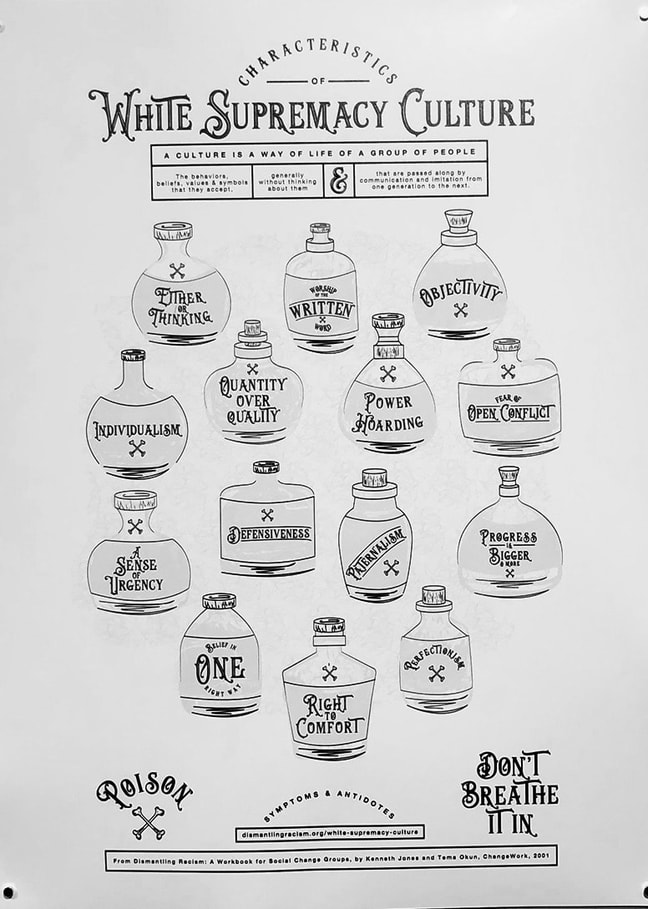
From the beginning, efforts to obstruct my work were framed in terms that might seem bizarre to those outside certain academic spaces. For instance, simply attempting to set an agenda for meetings caused my colleagues to  accuse me of “whitespeaking,” “whitesplaining,” and reinforcing “white supremacy”—accusations I had never faced before. I was initially baffled, but as I attended workshops led by my officemates and promoted by my supervising dean, I repeatedly encountered a presentation slide titled “Characteristics of White-Supremacy Culture” that denounced qualities like “sense of urgency” and “worship of the written word.” Written meeting agendas apparently checked both boxes.

Voilà, the slide mentioned.

Have a look at that slide. The jugs are labeled “poison”, and include individualism and objectivity. Yes, some of the traits are bad ones, but are they really characteristic of “white supremacy culture”? After all, “worship of the written word” is the way that a lot of antiracism spreads.

More from Lee about the slide:

You may have encountered this graphic or similar ones before. Derived from Kenneth Jones’s and Tema Okun’s 2001 book, Dismantling Racism, it has appeared in different forms on many institutional websites, sometimes provoking controversy. After all, doesn’t the statement that “objectivity” and “perfectionism” are “white” qualities seem kind of, well, racist? On these grounds, the National Museum of African American History eventually saw fit to remove a “White-Supremacy Culture” page from its site in 2020. But if you are wondering whether this document is still circulating and being cited inside publicly funded educational institutions, the unfortunate answer is yes.

For something equally offensive, go to this post and have a look at the two posters showing “Aspects and assumptions of whiteness & white culture in the United States,” mentioned above, which were briefly on display at  National Museum of African American History & Culture, a museum in Washington, D.C. that’s part of the Smithsonian Institution. Eventually people realized the racism of those posters, like that of the one above, and they were removed. And indeed, all three of these are racist in that they make unwarranted and invidious generalizations about ethnic groups. And imagine if you took the opposite of each of these characteristics, put them on the posters, and labeled it “characteristics of black culture.” That makes the racism palpable.

Her further crimes against DEI were multifarious: refusal to swallow whole hog Ibram Kendi’s antiracism doctrines, attempts to find common ground between different varieties of antiracism, and—worst of all—she tried to include Jews into a multifaith attempt to create solidarity:

The conflicts were not limited to my tenure-review process. At every turn, I experienced strident opposition when I deviated from the accepted line. When I brought Jewish speakers to campus to address anti-Semitism and the Holocaust, some of my critics branded me a “dirty Zionist” and a “right-wing extremist.” When I formed the Heritage Month Workgroup, bringing together community members to create a multifaith holiday and heritage month calendar, the De Anza student government voted to support this effort. However, my officemates and dean explained to me that such a project was unacceptable, because it didn’t focus on “decentering whiteness.”

When I later sought the support of our academic senate for the Heritage Month project, one opponent asked me if it was “about all the Jewish-inclusion stuff you have been pushing here,” and argued that the senate shouldn’t support the Heritage Month Workgroup efforts, because I was attempting to “turn our school into a religious school.” The senate president deferred to this claim, and the workgroup was denied support.

G-d forbid! As we know, Jews are demonized by the progressive Left, all called “Zionists” and assumed to be colonizers and genocidal maniacs.  But Lee, though she was given her pink slip, ends on a hopeful note:

As my experience shows, questioning the reigning orthodoxies does carry many risks. But the alternative is worse. Authoritarian ideologies advance through a reliance on intimidation and the compliance of the majority, which cowers in silence—instead of speaking up. Engaging in civil discourse and ensuring that multiple perspectives are presented are crucial, if we want to preserve the components of education that ideologues are seeking to destroy.

There is some reason to hope. Since my firing, I have been contacted by scores of people who have said that they are attempting to resist similar pressures. As bleak as things may seem, there are many who still believe in academia as a space where divergent viewpoints can and must be explored.

The question, of course, is whether “the many” can resist the few, for it is the vocal few who push these programs through and, though being loud, make everyone else feel guilty for not adhering to The Program.