Readers’ wildlife videos

June 22, 2026 • 8:15 am

Today we have two videos from Tara Tanaka, who has been absent a while due to a drought Florida that dried up much of the wetlands on the family property, creating an absence of wading birds that she used to feature. Fortunately, as she writes below, the drought may be over.  In the meantime, we have a kayaking video and a video featuring a BOBCAT.

Tara also has a Vimeo site and a  Flickr site.  Her narration below is indetned:

In 2024 when we had a swamp full of water, we got a sit-on-top kayak that I could use to shoot from and that my husband could use to get out into the swamp to manage exotic plants.  I chose this one because it’s incredibly stable, and I wanted an open deck to be able to paddle without having the camera in front of me.   This kayak has a seat that swivels 360 degrees, allowing me to mount my tripod with a 500mm lens in the stern, and then just pivot around between paddling and videoing.  This was the maiden voyage in our Nucanoe kayak. 

I was able to make quite a few trips out during the 2024 nesting season, and after a relatively dry winter and then one good rain, made a few trips out in 2025.  I stopped going out not because there wasn’t enough water to float the kayak, but because it was getting so shallow and our alligators that patrol the rookery for raccoons and snakes are so big that I didn’t feel comfortable paddling right over one with just a couple of feet between us.  It wasn’t long after that that a couple in a canoe in Lake Kissimmee paddled over an 11’ gator in 2’ of water causing the gator to thrash and overturn the canoe, with a tragic ending. 

The swamp has been dry for at least 9 months, with only a few pools of water, and now that it’s really starting to rain I’m hoping that the water level will return to normal and the birds will return to nest next spring. 

A 5-minute YouTube video, narrated by Tara, showing the maiden voyage of the canoe (sound up.)  You can see there are still birds around. Can you identify them?

And here’s a Vimeo video with an animal encounter. Enlarge this as you can see a lot more detail on full screen.

We had seen one or two coyotes around 9:30 the last two mornings. Hoping they would return for a third day. I got my camera ready in the living room to try to record them. About 9:00 my husband said he saw one, so I made some final adjustments for the lighting and began to search for something moving in the distance. When I finally centered the subject in the viewfinder, I said “I think I’m looking at a bobcat.” Almost immediately the cat stood up and as I panned with it I was shocked when two coyotes ran into the frame, one on each side of the cat. Enjoy the interactions between the two species and between the very bonded pair of coyotes. I believe the female is pregnant.

After I finished filming I just sat in disbelief that I had had the opportunity to record something so unique – and from my living room! I feel like I could have gone to Yellowstone and spent a month in the field and not witnessed an encounter like this. Because of the dramatic temperature difference between the thawing ground and the sun heating the brown grass, the waves of heat shimmer intensified as the sun got higher and you can see them rippling across the screen. Despite the extreme conditions, I was thrilled that I was able to record the interaction so clearly from 1000’ away, and through a double-paned window.

We should have a pond full of water with waders arriving to nest right now, however due to a severe drought that started over a year ago the entire swamp is dry. Without water to allow our large alligators to patrol under the nests and protect them from predators, I’m afraid that our hundreds of waders that nest here every year will not feel safe and will likely nest elsewhere.

Filmed with a Panasonic GH6 + Nikon 500mm f2.8 lens. Since I filmed it from inside the house, I used the audio from a video I shot from the yard last year.

Readers’ wildlife photos

June 19, 2026 • 8:30 am

For many of you it’s been a three-day weekend; have you considered sending me photos? This is the last batch I have.

And today’s batch comes from reader Jan Malik. Jan’s captions and IDs are indented, and you can enlarge his photos by clicking on them.

My home state of New Jersey is, for the most part, nothing to write home about, but it does have a few redeeming features, and one of them is the spring migration of birds (the fall migration is also good). Cape May, on the Delaware Bay side of the peninsula, is a particularly good spot to observe birds migrating from far south toward the Arctic. During my visit at the end of May, I took a few pictures of common bird species. I did my best to identify them, but small shorebirds can be difficult to pin down exactly to a species.

First, a pair of Willets (Tringa semipalmata), which may not be migrating too far but are rather already on their nesting grounds—they breed in Atlantic coastal marshes. Their calls are quite similar to those of oystercatchers, but a little less piercing:

Next, a Dunlin (Calidris alpina) in breeding plumage. They are fairly widespread in North America and may fly as far as Greenland or Nunavut. The spring coloration is far more striking than it is in winter;

A Red Knot (Calidris canutus) with its unmistakable cinnamon-orange breast and belly. These are long-range migrants; American birds winter in Tierra del Fuego and fly up to 9,000 miles to breed in the High Arctic. A good portion of their lives is spent along migration routes:

This is what Cape May beaches can look like during the peak of Red Knot migration. I think I took this picture in 2013. There was a fear that Red Knot numbers would decrease drastically, even to zero by some extrapolations (meaning complete extinction). Lately, their numbers seem to have stabilized, but their future is not secure. They rely heavily on horseshoe crab eggs in the Delaware Bay area, and these interesting animals are also under a lot of pressure—a perfect example of the ecological dependence of one species on another:

A Ruddy Turnstone (Arenaria interpres) in full breeding plumage. They also travel to the High Arctic but winter closer to home, in South America or the southern US states:

A Semipalmated Sandpiper (Calidris pusilla). It is a small American bird that spends its winters primarily along the northern coast of South America, as well as the Caribbean:

A Sanderling (Calidris alba) in full breeding plumage. These are cosmopolitan birds, present everywhere except Antarctica:

I suspect this is also a Sanderling, but still in winter plumage. Transitional plumage is exactly what makes shorebird identification tricky:

Coastal marshes had several nesting Seaside Sparrows (Ammospiza maritima). I think I could only see the males, who were singing from conspicuous perches, while the females stayed low. I consider these sparrows to be honorary shorebirds—they also probe mud for invertebrates with their large, sharp bills:

A local resident, an American Oystercatcher (Haematopus palliatus):

Another local, a Laughing Gull (Leucophaeus atricilla), eating a cluster of horseshoe crab eggs (together with a few beach pebbles). These “crabs” play an oversized role in the New Jersey coastal ecosystem:

Here, I suspect a Short-billed Dowitcher (Limnodromus griseus), almost identical in bill length to its “long-billed” cousin. Their bills are sensitive and tactile, allowing them to probe mud and sand fast, relying entirely on the sense of touch and feeding even in darkness:

During the peak of the spring migration, the birds continue their flight well after sunset. Living in the ‘Armpit of America’ has its moments:

Readers’ wildlife photos

June 14, 2026 • 8:15 am

Again we have the last batch of wildlife photos on hand.  Send yours in, please!

Today’s group of photos come from reader Ephraim Heller; it’s the second part of a two-part series (part 1 is here). Ephraim’s text is indented, and you can enlarge his photos by clicking on them.

Little St. Simons Island is an 11,000-acre barrier island on the coast of Georgia. Much of it is salt marsh, with a few islands in freshwater ponds for wading bird rookeries. I was lucky to spend a week there in April during the nesting season. My last post focused on the wading birds; this one focuses on other species.

A well camouflaged American alligator (Alligator mississippiensis) lurking in the rookery pond:

American oystercatchers (Haematopus palliatus) are obligate specialists on intertidal invertebrates that feed in two ways: finding a mussel or oyster with its shell slightly ajar, the bird inserts the bill and severs the adductor muscle before the shell can close; alternatively, it hammers the shell directly to fracture it.

I took these photos on the shore where the oystercatchers were nesting. The sustained 40 mph winds whipped the beach into an abrasive sandstorm, which bothered me much more than it bothered the birds:

Royal terns (Thalasseus maximus) are among the larger terns on the Atlantic coast:

Boat-tailed grackles (Quiscalus major) have a mating system I have not previously encountered: females aggregate in colonial nesting groups while dominant males compete for access to the entire group. Although the dominant male at a colony performs the majority of observed copulations, genetic analysis shows he sires fewer than 40% of nestlings. Females regularly copulate with other males outside the colony and return to lay eggs that are not the dominant male’s offspring.

The long toes of the common gallinule (Gallinula galeata) allow it to walk atop floating vegetation.

Red-bellied woodpeckers (Melanerpes carolinus) drum on resonant surfaces to broadcast their territories and for mate attraction. The tree cavities they excavate and abandon become nests for other species, such as owls, bluebirds, and flying squirrels. They often cache food in bark crevices.

The common garter snake (Thamnophis sirtalis). Garter snakes are viviparous, giving birth to live young rather than laying eggs, with typical litters of 15–40 babies.

Readers’ wildlife photos

June 12, 2026 • 8:15 am

Voilà: my last batch of photos, this time a small selection from Norm Gilinsky, including two species we have in Botany Pond.  Norm’s captions are indented, and you can enlarge his photos by clicking on them.

All of these photos were taken with an ordinary iPhone on June 1 on the eastern shore of Lake Washington just east of Seattle.

Extravaganza:

Here in the Pacific Northwest, the poikilotherms have come back to life, finding homoiotherms by their sides. This picture, and the others, are from the Kirkland side (east side) of Lake Washington. Mallard ducks (Anas platyrhynchos) and Red-eared Sliders (Trachemys scripta elegans) living the lush life:

Red-eared Sliders close-up:

Red-eared Sliders (Trachemys scripta elegans), ebullient in the late spring warmth. Red-eared Sliders have driven our Western Pond Turtle (Actinemys marmorata) almost to the brink of extinction, but we love them nonetheless:

Afternoon snooze:

We came across this sleepy bunch of Mallards (Anas platyrhynchos) just off a walking path in the Lake Washington nearshore wetland. People were gawking at them and photographing them, but they didn’t care. Maybe they even liked the attention:

Lounging Cottontails:

June 1 was a warm one in western Washington this year, and these Eastern Cottontail bunnies (Sylvilagus floridanus) were taking dust baths and lounging. Living life to the max.

Nootka Rose:

One of our native roses (Rosa nutkana). As with all the life form in this set, this Nootka was all puffed up at its showy best:

Readers’ wildlife photos

June 10, 2026 • 9:30 am

I got two new batches of photos!  So hooray for the readers! Today’s photos come from Ephraim Heller, whose captions and IDs are indented. You can enlarge the photos by clicking on them.

Little St. Simons Island is an 11,000-acre barrier island on the coast of Georgia. Much of it is salt marsh, with a few islands in freshwater ponds for wading bird rookeries. I was lucky to spend a week there in April, during the nesting season. This post focuses on the wading birds, and my next post will focus on other species.

I got up before sunrise every day to bicycle to the rookery:

Like flamingos, roseate spoonbills (Platalea ajaja) cannot synthesize pink pigments on their own. Instead, the carotenoid pigments accumulated from shrimp, crayfish, and other invertebrates eaten over a lifetime are deposited directly into growing feathers. Young birds have pale, nearly white plumage; the color deepens progressively with age, so a deep magenta spoonbill is also an older one.

The distinctive, flattened, spatulate bill is a swept laterally through shallow water with the mandibles slightly open, detecting prey by touch rather than sight, necessary in turbid water.

During courtship, male and female spoonbills initially interact with some aggression, then settle into ritualized exchanges: perching close together, presenting sticks to each other, and clasping bills.

Anhinga (Anhinga anhinga) lack waterproofed outer plumage that repels water. While enabling the birds to pursue fish underwater, they must subsequently dry their feathers before they can fly efficiently. Hence, the familiar spread-winged posture seen on sunny perches. Wing-spreading also serves thermoregulatory functions, helping the birds warm up after a cold swim.

Stick-carrying by the male is pair bonding behavior: the male begins nest construction before he has a mate, placing large sticks in tree forks, and continues to supply material while the female does most of the actual building.

During breeding, the bill of the tricolored heron (Egretta tricolor) shifts to a brilliant blue with a black tip, the loral skin becomes cobalt blue, and the iris turns scarlet red. The individuals I saw must not yet have been in their breeding plumage.

The prehistoric-looking wood stork (Mycteria americana) is the only stork species that breeds in North America. The species was listed as federally endangered in 1984 after its population dropped more than 75% from 1930s levels, primarily due to habitat alteration in the Florida Everglades. It was downlisted to threatened in 2014 following population expansion northward into Georgia and the Carolinas. Georgia is now a stronghold. In 2026, the federal government removed the species from the threatened list, reflecting a breeding population estimated at 10,000–14,000 nesting pairs across roughly 100 colonies.

Wood storks require falling water levels at foraging sites. As water recedes, prey concentrates in shrinking pools, providing the density of fish that a nesting pair needs to raise chicks. A pair with active nestlings requires approximately 400 pounds of fish over a breeding season.

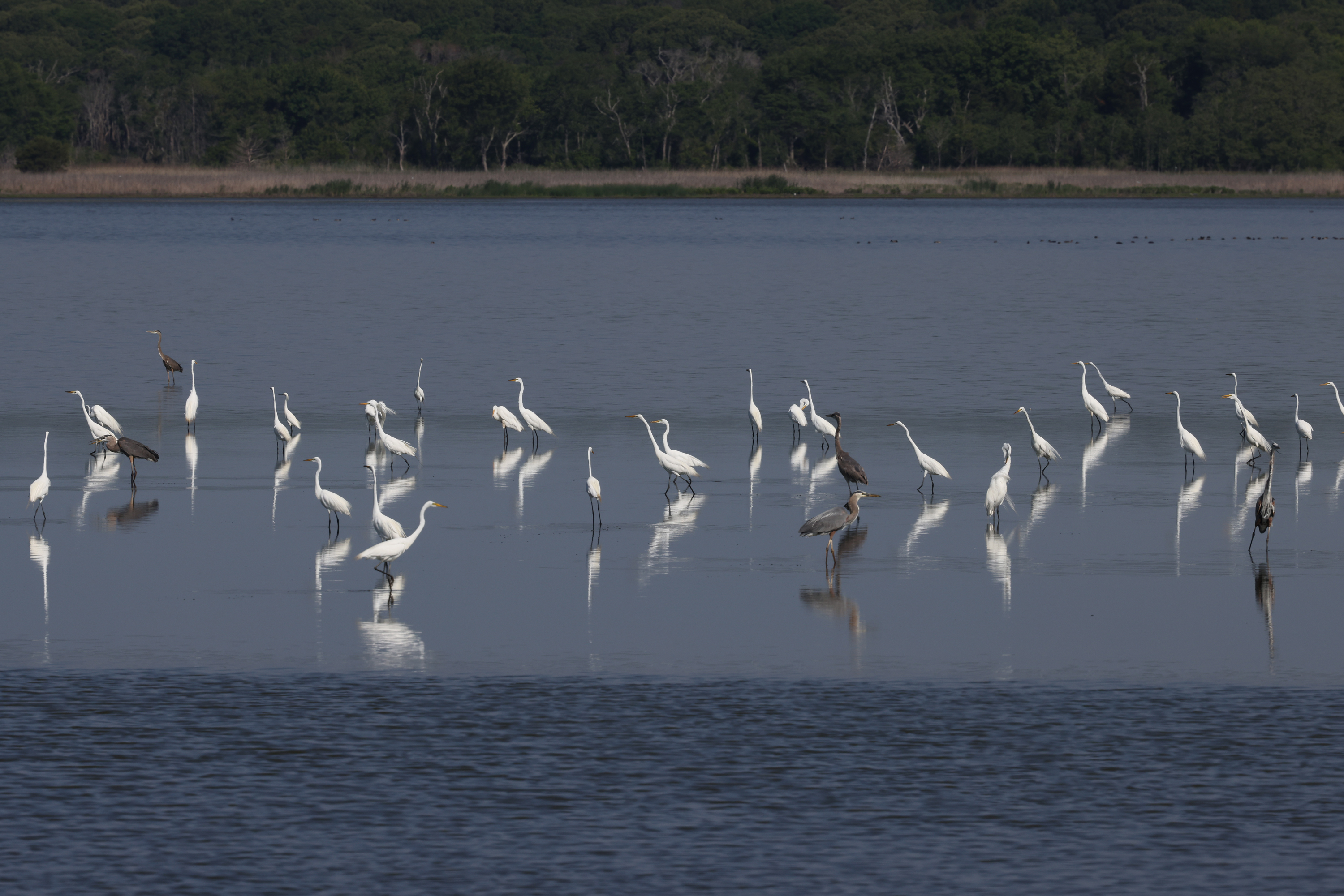
The great egret’s (Ardea alba) breeding plumage almost drove the species to extinction. In spring, the loral skin shifts from yellow to a vivid lime green, and long, filamentous plumes (aigrettes, from the French for egret) grow from the shoulder region, trailing over the back. Each aigrette consists of approximately 35 strands of slim feathers. These plumes develop for the breeding season and are shed afterward.

In the late 19th century, the aigrettes for the millinery (hat-making) trade commanded prices per ounce that were twice that of gold, and hunters shot entire breeding colonies in a single event. The resulting public backlash was instrumental in forming the early conservation movement in the United States. In 1896, Harriet Hemenway and her cousin Minna Hall organized Boston society women into a boycott of feathered hats, which led directly to the founding of the Massachusetts Audubon Society and eventually the National Audubon Society. The Massachusetts Audubon Society, in turn, helped pass the 1897 Massachusetts law prohibiting the feather trade, the 1900 Lacey Act, and eventually the 1918 Migratory Bird Treaty Act. The great egret is now the symbol of the National Audubon Society.

10-12. In the colony, the male selects a nest territory and then displays: calling, performing circular flights, and stretching the neck upward with the bill pointed skyward. Males bring sticks to females sitting on nests for pair-bond reinforcement.

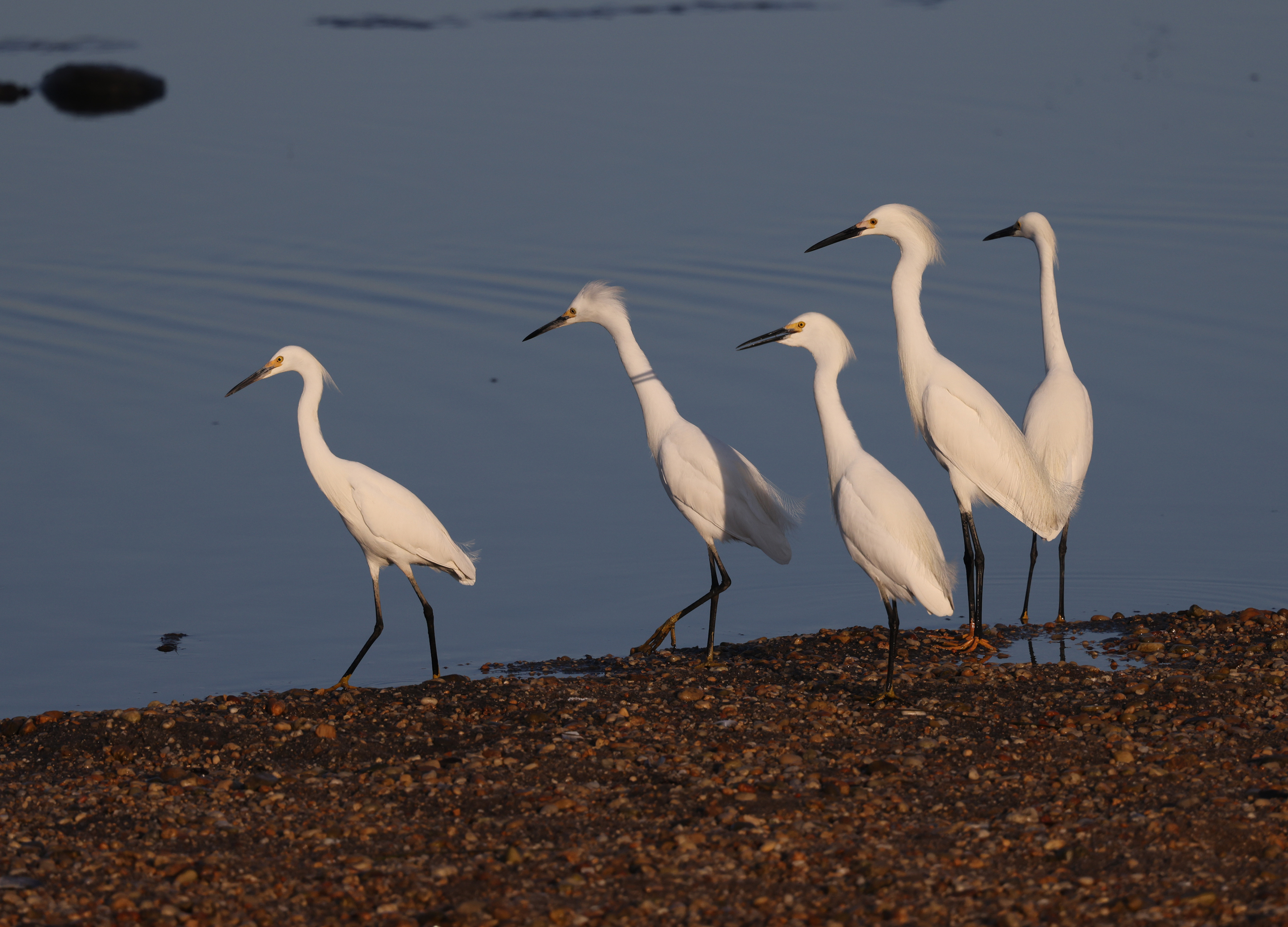
The aigrettes of the snowy egret (Egretta thula) were even more valuable to plume hunters than those of the great egret, and by around 1900 scientists estimated that as few as 250 snowy egrets remained in North America. Numbers recovered rapidly once hunting stopped, but habitat loss remains an issue. In these photos you can see that the loral skin of some birds is yellow (non-breeding plumage) and in other birds it is pink (breeding plumage).

Readers’ wildlife photos

June 4, 2026 • 8:15 am

Reader Mark Joseph, inspired by my post on leucistic Australian ducks, went in an example and some other photos. Mark’s captions and IDs are indented, and you can enlarge the photos by clicking on them.

Your post this morning coincidentally arrived as did this photo from a person in our birdwatching group; it’s a leucistic house finch (Haemorhous mexicanus):

And, to give you a small set instead of a singleton, here are a couple of my feeble efforts, all taken with an iPhone in suburban southwestern Michigan. Hopefully, you can use them. I know even less about flowers and insects than I do about birds, so all identifications are courtesy of Gemini.

A zinnia (This specific variety is likely a Zinnia elegans, such as the ‘Canary Bird’ or ‘Benary’s Giant Yellow’ cultivar”) with a bumblebee (“specifically consistent with the Common Eastern Bumblebee, Bombus impatiens). I have enjoyed taking photos of flowers and insects together:

Spotted Knapweed (Centaurea stoebe, sometimes classified as Centaurea maculosa). Unfortunately, it is invasive:

A crabapple tree and a closeup.  This closeup helps narrow it down to a Sargent Crabapple (Malus sargentii) or a Siberian Crabapple (Malus baccata).

Sargent Crabapple (Malus sargentii) or a Siberian Crabapple (Malus baccata):

This is a Big Brown Bat (Eptesicus fuscus) or a Little Brown Bat (Myotis lucifugus).These two species look nearly identical from a distance and are the two most common bats found roosting on residential brick walls across North America.

Brown marmorated stink bug (Halyomorpha halys).When we first moved here and I decided to take some pictures, I got all excited because I was able to get a really good picture. Then I found out it was a stink bug, and invasive to boot. So, not a new species of peacock. But, it’s one of the things evolution has produced. Order Hemiptera, the “true bugs.”

A Shaggy Inkcap (Coprinus comatus), commonly known as a Shaggy Mane or Lawyer’s Wig. The next day the cap is just black goo, and the day after, nothing is left but the stem:

Readers’ wildlife photos

June 3, 2026 • 8:30 am

Leucism, the absence of pigment in all or parts of the body in animals, is a genetic condition often mistaken for albinism (leucistic animals havenormally pigmented eyes).  It’s found in all sorts of animals, from reptiles to mammals, and Scott Ritchie has spotted it in Australian ducks.  Scott sent some pictures, which you can enlarge by clicking on them, and his captions are indented:

The leucistic Plumed Whistling Duck (Dendrocygna eytoni), is back at Hasties Swamp, Queensland, the white one in in middle.  We  have seen it for at least 2 years running. And “he/she” appears to have busy, with at least one (several white light feathers head and breast), and perhaps 3 (2 based on “forehead” feathers) individuals showing leucicism traits. It’s interesting that they were hanging together at the log to the left of the hide.

This last picture is of normal-type duck: