
Readers’ wildlife photos

June 1, 2026 • 8:15 am

Today we have pictures from the shore of New Jersey taken by Jan Malik.  Jan’s captions and IDs are indented, and you can enlarge the photos by clicking on them.

Here are a few pictures from my walks on Cape May and Sandy Hook, taken this April.

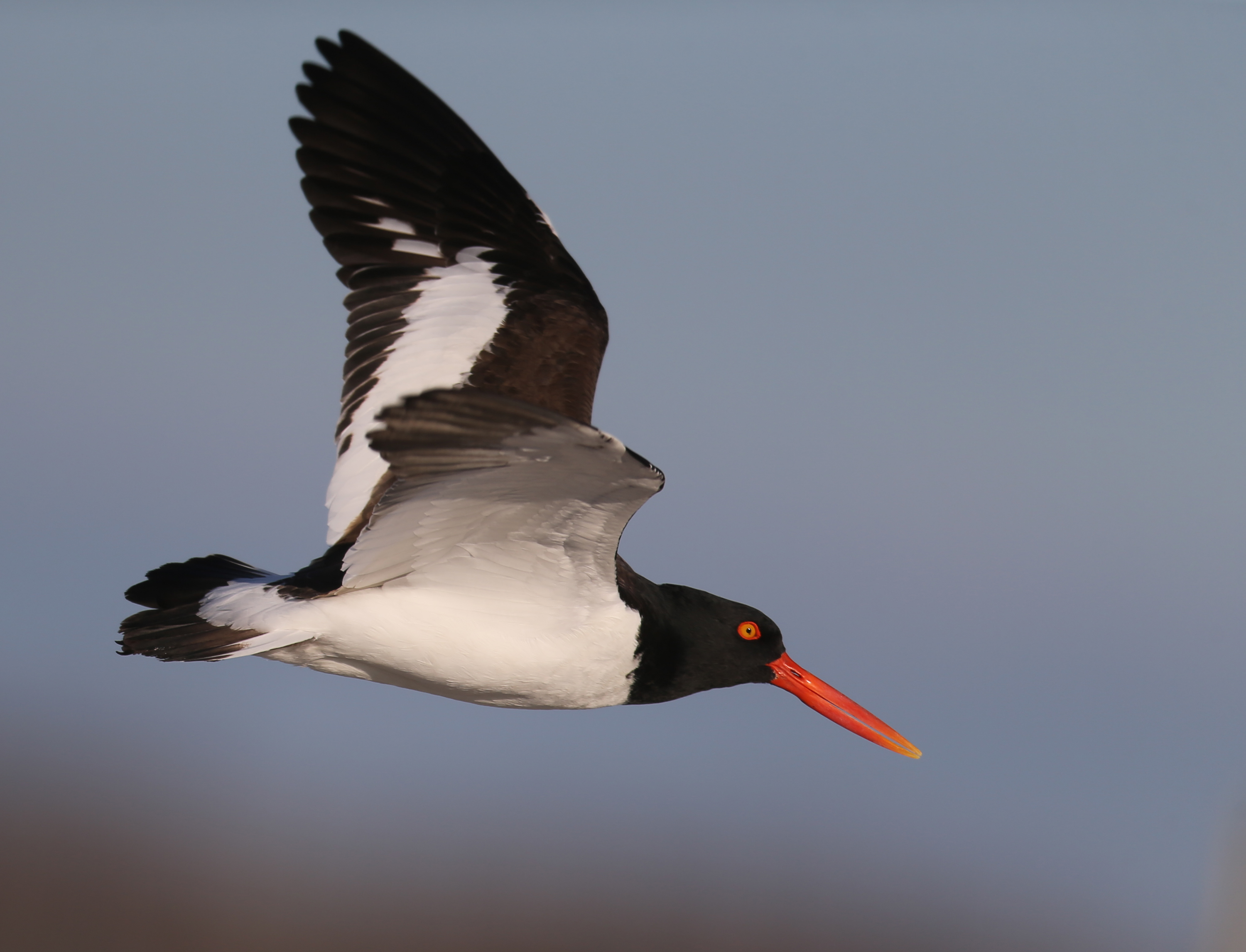
Starting from the Atlantic Ocean (eastern) shore on Cape May, I met this pair of American Oystercatchers (Haematopus palliatus). In Cape May, a section of the beach is fenced off to protect nesting sites for them and for Piping plovers. They are feisty birds and every spring there is a competition for nesting sites; the bird on the right is calling at another Oystercatcher:

The pair took off to drive out the intruder:
The place where I found that pair was littered with the remains of Sand fleas (possibly Emerita talpoida). These fossorial crustaceans normally stay buried in the sand, exiting only when the sand is awash with the shallow tide, but Oystercatchers’ bills are well adapted to dig them out. I think the birds ate only the soft and juicy parts of their telsons, leaving the crustaceans mortally wounded and unable to move:

These Sand fleas are small and difficult to catch alive. That’s what their front end and first pair of legs look like. These crabs dig backwards, starting from their telson, and the front pair of legs is used as a sand anchor:

Another arthropod – the Horseshoe crab (Limulus polyphemus), came ashore, atypically for it, on the Atlantic Ocean side of the peninsula. These are treacherous waters for these spiderlike creatures, for they are easily flipped over by ocean waves and become stranded. They are an interesting part of the Delaware Bay ecosystem and I may share more pictures of them later:

On the Delaware Bay shore of Cape May, there were already many Laughing gulls (Leucophaeus atricilla), which mostly move south in winter but return to their breeding grounds in the spring. They are quite similar to the Eurasian Black-headed gull:

Terns also made their appearance. I think this may be a Forster’s tern (Sterna forsteri) because of the lack of black tips on its primaries and its pure white underbelly, but they are difficult to tell apart from Common terns (Sterna hirundo):

The terns landed on old quay pilings and started courting. There’s no way to tell females from males other than by their courting behavior; males can be slightly larger, but the difference is less than 5%, which is hardly discernible to the human eye:

The courting consists of the two mates trying to look “smug”, with wings drooped, necks extended, and bills pointed toward the sky:

Then there’s the courtship dance and ritual feeding. Here is a fragment of it, taken from a large distance, so I’ve compensated for the lack of pixels by cobbling together this composite. The male presents a fry to the female and then, if she accepts (which is not a given), circles around the female while stomping his feet:

On my way home, I stopped at Sandy Hook, a sand spit where shore gun batteries protecting New York Harbor were once located. It is now a prime nesting site for Ospreys (Pandion haliaetus):

The former Army garrison required many houses for the officers, and these are now excellent nesting sites for Ospreys. Standing in the center of Officers Row (as the area is called), I counted four nests on top of chimneys:

The meadow below the houses was full of American robins (Turdus migratorius) fattening up for the nesting season by preying on earthworms. I know little about annelids, but I’m going to go out on a limb and say it is the common earthworm (Lumbricus terrestris), since it is a favorite prey for robins:

Finally, moving to the class Mammalia, here are Sandy Hook’s harbor seals (Phoca vitulina), congregating on rocks exposed by low tide (the tide was rising so, one by one, the seals were forced to slip back into the water). There are eight seals in this picture, but I counted 15 in total. Their population around the New York inlet has increased in recent years, which may soon put them on a collision course with the fishing industry:

Readers’ wildlife photographs

May 29, 2026 • 8:15 am

I’m starting to get some new batches of wildlife photos, and I encourage readers to submit their good photos for consideration.

Today’s installment features the photos of UC Davis ecologist Susan Harrison, who recently went birding not too far from Chicago:

Birding in the Upper Midwest

Minnesota and Wisconsin may not be at the top of everyone’s list of nature travel destinations, but do they have darned nice birding?  You betcha!   On a late May work trip to Minneapolis, it was my good fortune to visit some of the Upper Midwest’s riparian forests, wetlands, and restored prairies during spring migration. Friendly people and well-tended parks and nature reserves helped make it delightful.

Large birds….

Sandhill Crane (Antigone canadensis):

Trumpeter Swan (Cygnus buccinator) on a nest:

Great Horned Owlet (Bubo virginianus) in a nest:

Common Loon (Gavia immer):

Common, medium to small birds….

Rose-breasted Grosbeak (Pheucticus ludovicianus):

Baltimore Oriole (Icterus galbula) bathing:

Eastern Kingbirds (Tyrannus tyrannus):

Brown-headed Cowbird (Molothrus ater):

Eastern Towhee (Pipilo erythrophthalmus):

Yellow-bellied Sapsucker (Sphyrapicus varius):

Rarer small birds that were new (a.k.a. “lifers”) for me….

Kirtland’s Warbler (Setophaga kirtlandii), a specialized inhabitant of young Jack Pine (Pinus banksiana) forests, only recently removed from the endangered species list:

Louisiana Waterthrush (Parkesia motacilla), a warbler that lives on the banks of crystal-clear headwater streams in forests:

LeConte’s Sparrow (Ammospiza leconteii), a secretive marsh dweller that sings in the dark and scurries around on the ground:

Henslow’s Sparrow (Centronyx henslowii), a stealthy bird of the region’s much-diminished grasslands  (historical note: it was named by John James Audubon in honor of Darwin’s mentor John Stevens Henslow):

Other exciting Midwestern firsts for me included seeing Greater Prairie-chickens (Tympanuchus cupido) dancing at their lek, and hearing the weird nocturnal songs of Yellow Rails (Coturnicops noveboracensis), Eastern Whippoorwills (Antrostomus vociferus), and American Woodcocks (Scolopax minor).

Readers’ wildlife photos

May 27, 2026 • 8:15 am

Today we have some intertidal photos taken in California by UC Davis math professor Abby Thompson. Abby’s captions and IDs are indented, and you can enlarge her photos by clicking on them.

May is a great month on the California coast, with extreme high and low tides.   Here are some photos from the most recent, excellent, set:

Pollicipes polymerus (Gooseneck barnacles). I’ve shown these, and some relatives, several times before, but they’re amazing animals. In case you think it’s too many barnacles, Darwin spent eight years looking at barnacles.   “Originally planning a brief month-long study to establish his credentials in invertebrate zoology, he became deeply immersed and cataloged every known living and fossil species.”  (Google AI).  I’m not sure what the green is doing here, presumably just growing on top of the animals.   Some relatives of the nudibranchs stay green from what they eat, and retain bits with the ability to photosynthesize, most famously the adorable leaf sheep:.

Dendronotus venustus (nudibranch):

Paciocinebrina lurida (a snail):

Tonicella lokii (flame-lined chiton):

Genus Tegula (maybe) (another snail). There was a hermit crab living in the shell- I didn’t get a good photo of him.    I’m not sure the genus is correct, but the shell was so pretty I wanted to post it:

Nucella ostrina (Northern striped dogwinkle). About the common name—well, it has stripes.   And it’s a “winkle” (a word you have to love), or “little whelk”.  The dog part, I dunno.   They’re very common, and voracious. Some species of Nucella (not sure about this one) can be used to make a deep purple dye, which used to be hard to come by.  There’s a fun account of making the dye here, although I’m afraid many snails must have been sacrificed in the process:

Paradialychone ecaudata (worm):

Limpet, probably Lottia pelta (shield limpet). The little lacy edge is tentacles: “Pallial tentacles are tiny, sensory structures lining the mantle margin (pallium) of limpets. . . The tips and shafts of these tentacles are covered in dense tufts of non-motile cilia, which act as sensory receptors.” (Google AI):

Seagulls at sunset:

As always, thanks to experts on inaturalist for help with some IDs.   Camera is an Olympus TG-7.

Readers’ wildlife photos

May 26, 2026 • 8:30 am

News is pretty scant as it’s just the same-old same-old, but I have a few stray wildlife photos to exhibit today. I’m all out of photos excerpt for these, so please send in your good wildlife snaps. In all the photos below, readers’ captions are indented and, as always, you can enlarge the photos by clicking on them.

First, from Scott Ritchie, his favorite photograph of Australia’s golden-shouldered parrot (Psephotellus chrysopterygius), an endangered species and the world’s only parrot that lives in termite mounds.

Bob Jochums sent two photos of Barred owls (Strix varia) taken outside Atlanta, Georgia.

A family “portrait” (minus Papa) on the “veranda” of the nest box.

An earlier photo of Mama leaving the nest box to get a little time to herself … or to hunt for food or nuzzle with Papa.

From Claudia Baker:

Red-headed woodpecker (Melanerpes erythrocephalus), picking at the rail fence along the front of my property, in Eastern Ontario,  in July 2023. I have never seen one around here before, so was quite excited to get pictures of it. Can’t tell if it’s male or female, as the sexes are similar. It is the only eastern woodpecker with an entire head that is red. Their range is East of the Rockies from southern Canada to the Gulf states. They apparently will hide foot in crevices of wood and return for it later, so maybe this is what it was doing. In any case, it dug around in this rail fence for awhile, long enough for me to get several pictures.

It will hide insects and seeds in cracks in wood, under bark, in fenceposts, and under roof shingles. Grasshoppers are regularly stored alive, but wedged into crevices so tightly that they cannot escape. It has many nicknames, including half-a-shirt, jellycoat, flag bird and the flying checker-board. I read that the Red-headed woodpecker was the “spark bird” (bird that starts a person’s interest in birds) of legendary ornithologist Alexander Wilson in the 1700s.

I did not know that there are worms in my rail fencing. Or maybe this worm was hidden by this gorgeous bird earlier and it came to claim its lunch.
Red-headed woodpeckers are fierce defenders of their territory. They may remove the eggs of other species from nest and nest boxes, destroy other birds’ nests and even enter duck nest boxes and puncture the duck eggs. (!)  Quite mean for so beautiful a bird!

I have not seen another since this one in 2023. The oldest Red-headed woodpecker on record was banded in 1926 in Michigan and lived to be at least 9 years, 11 months old.

My friend Cate, to her surprise and wonder, found white leucistic squirrels (a genetic variant of the Eastern Gray SquirrelSciurus carolinensis) living around her summer house in Michigan. There are several more photos in this thread, including the famous white squirrels of Olney, Illinois. which are albinos.

From Peggy Mason in Canada (see location at bottom):

These harbour seals (Phoca vitulina) were lying around on the rocks of Poise Island in Porpoise Bay in Sechelt, BC, Canada. There were five of them. They ranged from silvery white (the smallest, a baby I think) to black with some white markings.

This is the silvery white baby:

This is the very black one:

Here is the silvery white baby, possibly with its mother. That is what I thought – basically from their proximity and size difference – although I received no confirmatory data one way or the other on this:

Bonus pictures are a beautiful bald eagle (Haliaeetus leucocephalus), a juvenile judging by its coloring and some pretty pink flowers on Poise Island.:

And Peggy’s location:

Readers’ wildlife photos

May 24, 2026 • 8:10 am

Once again I’ve stolen some photos (with permission) from the Facebook page of Scott Ritchie of Cairns, Australia. Scott has documented a trip to Queensland, and his text and IDs are indented. You can enlarge his photos by clicking on them.

Artemis Station, Cape York Peninsula, Queensland, Australia. The name that signifies excellence in Australian birding. This past weekend, I went on a wonderful camping trip with the Cairns Birders, led by Shane Kennedy and Doug Herrington, to Artemis Station. Doug then led us on a drive past Musgrave Roadhouse to Marina Plains. The last time I went up the Cape with Doug, we saw an adult Southern Cassowary with its chick at the top of the Kuranda Range. Well, lightning did strike twice.

Up the cape. It was magic. The weather was great, the sunsets so beautiful. The night sky was full on Milky Way. The sunrises were full of bird song. And the key “lifers”, the iconic Golden Shouldered Parrot (GSP) and the Red Goshawk, were on show. Here are some of my favourite photos from this trip.

My hat goes off to the staff of Artemis Station. Not only for hosting us, but for their heroic conservation efforts to save the last of the “termite” parrots in Queensland. Thank you Sue and Tom Shepherd, who own the station and tend to the parrots.

Adult Southern Cassowary (Casuarius casuarius). Great way to start the trip!:

And his chick!:

May be an image of cassowary and limpkin

Galahs (Eolophus roseicapilla) were common, flying around in noisy flocks at dawn and dusk:


Galahs, in the outback!:

Patrick of Artemis Station shows us the ant (termite) mound used by Golden-Shouldered Parrots (Psephotellus chrysopterygius). They dig a tunnel in the mound. An electric fence barrier us used to keep out marauding snakes and monitor lizard. Great lengths are taken to maximise survival and production of these critically endangered birds.

The ant hill also has interesting camouflaged invertebrates, such as this cicada:

Female and male Golden-Shouldered Parrots (GSP) at a feeding station. Wild birds are provided with a feeding station of grass seeds to enhance survival:

An immature male GSP flies past a trail camera at the feeding station. They keep an eye out for predators, and to monitor bird health and numbers:

Another critically endangered bird, the Red Goshawk (Erythrotriorchis radiatus), also lives in Cape York. A male goshawk keeps a sharp eye on his partner:

. . .who is building a nest for the seasons brood:

“What do you think, is it sturdy enough?”:


We were greeted at the campsite by an Australian Boobook (Ninox boobook):

This cute owl kept a close eye on us for 2 nights.:

An Australian Hobby (Falco longipennis), a species of falcon, was seen regularly at a nearby pond:

Its long wings enable it to really crank it up!:

Readers’ wildlife photos

May 20, 2026 • 8:15 am

Pratyaydipta Rudra is back with part 2 of his duck photo series (part 1 is here), which of course features DUCKS. Pratyay’s IDs and comments are indented, and you can enlarge the photos by clicking on them:

Here is the second part of the series of photos that I took while spending time with a group of breeding Wood Ducks (Aix sponsa).

A couple of males doing their things:

A duckling floating by:

Mother showing kiddo how to search for food on/under the floating logs:

The duckling tries some on its ownL

A few more ducklings join in:

Like mother like baby. Part 1: The sweet call!:

 Like mother like baby. Part 2: The wing flaps!:

A couple of ducklings resting on the rock:

There were four in total. I think at this time they were aware of me taking photos and got slightly alert:

Duckling swimming in…

 Checking the “mirror”? Not an ugly duckling for sure:

Father was close by floating on the reflective water of the pond:

Readers’ wildlife photos

May 19, 2026 • 8:15 am

This is the last full batch of photos I have save a few singletons and doubletons. But I ain’t too proud to beg. . .

Today we have some lovely photos by Ephraim Heller on, of all things, herring. Ephraim’s captions and IDs are indented, and you can enlarge the photos by clicking on them.

Pacific herring (Clupea pallasii) spend most of the year dispersed across the open North Pacific, but each spring they converge on Sitka Sound to spawn. The 2026 spawning biomass was estimated at roughly 233,000 tons of mature herring. This attracts commercial fishermen, fishing birds, Steller sea lions, gray whales, humpback whales, and. . . me. My last post featured humpback whales.

Today’s post features the mayhem taking place off the coast of Sitka on the opening day of commercial herring season. The fishing boats employ purse netting, a form of seine netting, in which a school of fish are surrounded by a net which is pulled tight around them. As the net closes and the herring are forced to the surface, a buffet is created for glaucous-winged gulls (Larus glaucescens) and bald eagles (Haliaeetus leucocephalus).

A commercial fishing boat hauling in a seine net filled with Pacific herring:

The herring are forced to the surface by the seine:

Glaucous-winged gulls at the buffet:

It was impressive to watch the gulls catch a herring, quickly reposition the squirming fish in their bills, and swallow them in flight in a matter of seconds:

Such speed seems necessary because kleptoparasites abound:

Now for the bald eagles:

Air traffic control is kept busy: