
Welcome to another damn week: it’s Monday, July 27, 2026, and National Scotch Day. Although I’m not much of a Scotch drinker, when I do have one it’s the single-malt from Scotland highlighted below:
It’s also, appropriately, Bagpipe Appreciation Day, National Chicken Finger Day, and National Crème Brûlée Day.
Here again are my mother’s brothers Bernie and Mo, honoring Aunts and Uncles Day, which was yesterday. My sister sent me this and added, “As you can see, Morley’s zipper is down. In almost every picture of these two, one of them has an unzipped zipper. It was a family joke!” Moe is on the left (the unzipping in the photos was accidental):

Readers are welcome to mark notable events, births, or deaths on this day by consulting the July 26 Wikipedia page.
Da Nooz:
*In a NYT article called “Trump seems trapped by Iran War, even though he wields the world’s biggest hammer” (archived here), we learn about Trump’s frustration at being in a war that he can neither escalate nor back out of.
President Trump often celebrates his unpredictability, declaring that it keeps allies and adversaries alike off balance.
By his telling, his willingness to bomb Iranian nuclear sites 13 months ago, and send Delta Force commandos in to snatch President Nicolás Maduro of Venezuela from his bed in early January, reflected his determination to execute military operations that would have made his predecessors blanch. He told The New York Times he was limited only by “my own morality,” as he wielded the world’s biggest hammer.
But in recent weeks, he has seemed trapped, his presidency gradually consumed by a war he cannot find his way out of.
He has discovered limits on his power that he could have scarcely imagined as he began full combat operations on Feb. 28, when he set out goals for a swift end to Iran’s nuclear program and the overthrow of the country’s government.
Five months later, those goals remain almost entirely unaccomplished. And Mr. Trump, once confident that overwhelming force would enable him to pursue in Iran what he proudly called the “Venezuela model” — a change of government to one amenable to U.S. control — is now hesitant to plunge back into major combat operations that his intelligence agencies assess are unlikely to work as well in Tehran.
He has been unable to control surging oil prices, or their effects on the stock market. The shipping that crawled to a stop in the Strait of Hormuz, then was opened for a few short weeks, is back to a trickle, with a second choke point, between the Red Sea and the Gulf of Aden, now threatened. And while the president has threatened to take Kharg Island, where Iran ships oil, or to seize its underground stores of enriched uranium, he has said publicly that he knows there is no appetite for sending in ground troops.
Those limits have left him deeply frustrated, his aides say, and have made him more erratic, even by Trumpian standards. Last week alone, Mr. Trump’s energy secretary signed a historic pact with Saudi Arabia to provide civil nuclear power to the kingdom, before the president undercut the deal less than 24 hours later, stunning the Saudis by declaring that the agreement, negotiated over 18 months, was dead unless the country joined the Abraham Accords and recognized Israel.
Aaron David Miller, a former U.S. diplomat with long experience in the Mideast, said that Mr. Trump again “alienated the Saudis, delighted Benjamin Netanyahu and gave Iran strong talking points as to why cutting deals with U.S. is a fool’s errand, bound to be betrayed.”
. . .Not all of Mr. Trump’s frustrations, people close to the president say, are driven by the war, now so unpopular that only 29 percent of Americans polled by The Washington Post and Ipsos approved of his handling of the conflict. But much of it is. And the angst is clear as he promises to stop Iran’s nuclear program at any cost, while his allies at home want out.
“We got to wrap it up,” Speaker Mike Johnson said last week, voicing a sentiment heard increasingly from Mr. Trump’s most enthusiastic supporters.
But the president does not have a clear way to accomplish that goal. Having entered the conflict with little strategy for victory, he now is struggling for a face-saving way to exit.
This is a “news analysis” piece, which is why it sounds like an op-ed, and it’s clearly designed to show Trump’s ineptness at handling the war. But it’s not far off, either. Winning the war definitively would seem to require boots on the ground, and the American people won’t tolerate that. I have no solution as I’m no strategist or pundit, but I wonder how many of the 71% who don’t approve of his handling the war would suggest that he do. Presumably many Democrats, “progressive” or otherwise, would tell him just to get the hell out of Iran, and stop bombing. But then, when Iran controls access to the Red Sea and the Strait of Hormuz, what would they suggest? (see the next item).
*The WSJ describes how the vast oil supplies of Saudi Arabia are beginning to depend on only a single exit route, through the Suez Canal. And the Canal itself is threatened by the Houthis, an arm of Iran.
Saudi Arabia’s vast oil exports increasingly depend on one last narrow exit.
Since the Iran war began, the kingdom has ramped up exports across the country to its Red Sea coast, bypassing the Strait of Hormuz, and shipped them through the Bab al-Mandeb Strait to Asian customers. Now, threats from Houthi militants—and several attacks against Saudi vessels in recent days—risk choking off that workaround, forcing more Saudi barrels onto a longer, costlier and technically challenging journey through Egypt’s Suez Canal and around Africa.
This week, at least four tankers carrying Saudi crude abruptly reversed course before reaching Bab al-Mandeb at the southern end of the Red Sea to head north toward Suez, while Saudi Arabia has begun offering more crude cargoes for loading from Egypt’s Mediterranean ports, according to ship-tracking firm Vortexa. In the first three weeks of July, seaborne oil transit via the Suez Canal ran at its highest volume in 2½ years, while imports to the Sumed pipeline—which runs parallel to the canal—were up 50% from the previous month, Vortexa data showed.
The diversions mark the latest redrawing of global oil flows after months of war have forced producers, traders and shipowners to abandon familiar routes for ever costlier detours. Gulf producers from the United Arab Emirates to Kuwait have been racing to build routes bypassing the Strait of Hormuz. On Saturday, Iraq said it would sign an agreement with Syria to build a pipeline project to carry Iraqi oil to the Mediterranean Sea.
The stakes for the global economy are high: Persistent risks to regional shipping could push oil well above $100 a barrel, analysts say, stoking inflation and straining an already fragile global economy.
Here’s the current route, which still goes through the narrow 2-mile-wide shipping channel of Bab al-Mandeb. If the Houthis close that one off, presumably under Iranian orders, the alternative pathway to China (or anywhere, really), shown in orange, is a LOT longer. If Iran tries to block off both straits, or impose tolls for transit, somebody has to stop it. (Photo credits at bottom.)

*Over at It’s Noon in Israel, Amit Segal explains that the narrative of “settler violence” in the West Bank can be exaggerated or even completely erroneous.
The “settler violence” narrative has a template. Settlers instigate, IDF forces arrive to back them, and trigger-happy Israelis, now with military cover, are unleashed on defenseless Palestinians. But consider what happened near Havat Gilad on Friday morning.
By the end, two Israelis were dead. Benayahu Melet, 32, a father of two from the outpost’s emergency squad, was murdered rushing to defend a group of hikers; Maj. Yuval Ezra, 27, an artillery battery commander, later succumbed to his wounds. The group—some 60 in all, a number of them minors accompanied by armed adults—had set out from Har Bracha before dawn on what was meant to be a hike. But they walked into Area B, where Israelis are not meant to enter without prior coordination. The army later confirmed the entry had not been cleared.
The first attack came around 7:05 a.m. as they passed the village: Palestinians throwing stones and swinging clubs, with one hiker struck in the face. Rather than escalate, the group fired warning shots in the air and withdrew toward Havat Gilad.
An hour later, dozens more surrounded them from three directions. Here the template says the soldiers arrive and the shooting starts. Instead, by the hikers’ account, armed civilians fired in self-defense while the first soldier on the scene refused to fire; when more troops arrived, they too “did nothing.” The video shows the IDF hesitant and trying to deescalate. Only when one of the attackers wrested a rifle from a civilian guard and opened fire—killing two Israelis—did the soldiers finally return fire.
The group should not have been in the area without IDF coordination. But the punishment for trespass is not death. Yet the international framing treats the mere existence of Jews beyond the Green Line as an implicit acceptance of that consequence—as if presence itself is provocation and violence its inevitable answer. This is not a story of settler violence. It’s an example of Palestinians treating the presence of Jews itself as an act of aggression—and answering that “aggression” with violence.
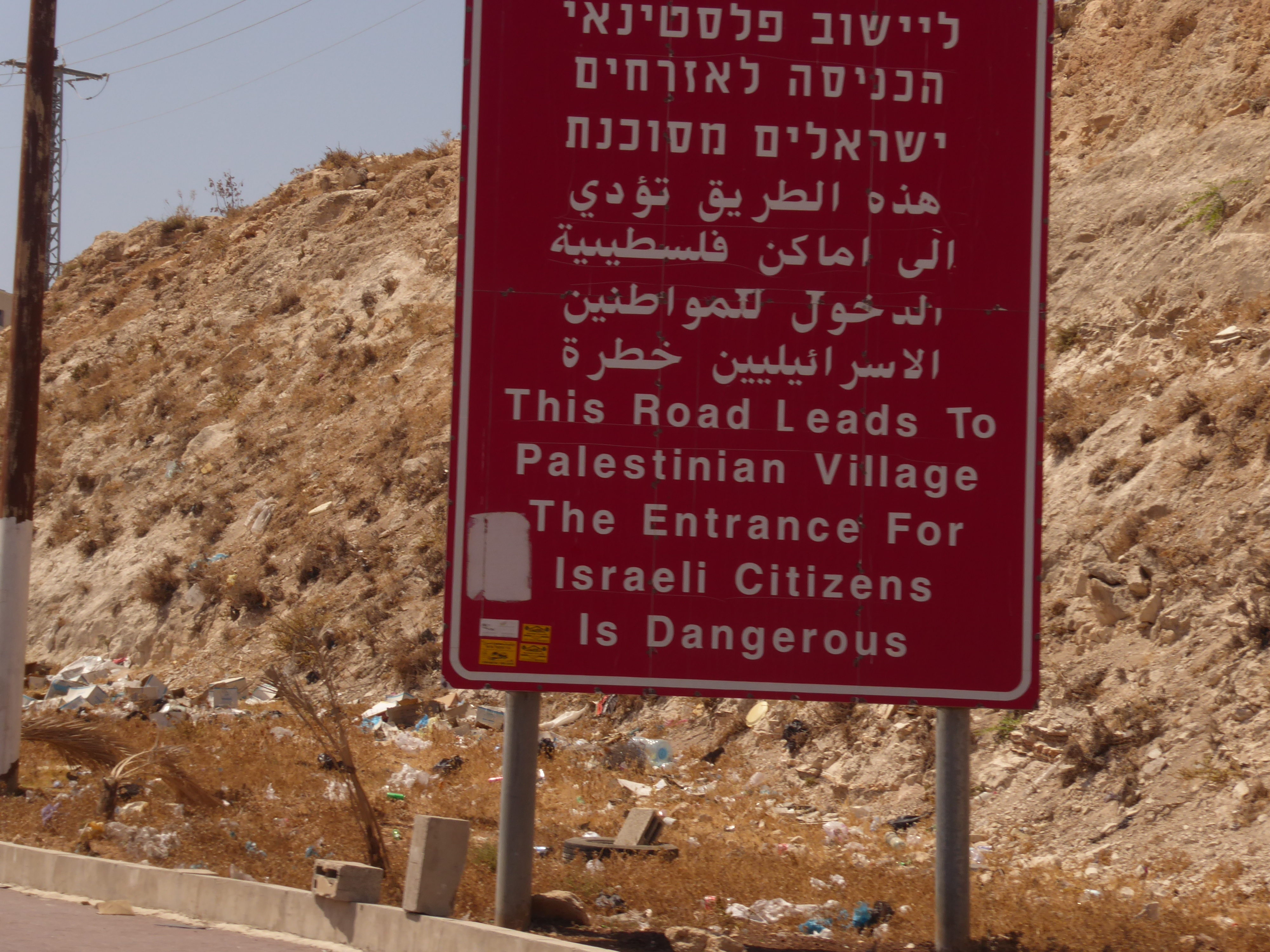
The question is how often the “international framing” episode takes place. I haven’t written much about the West Bank situation because I haven’t followed it nearly as closely as I’ve followed the conflict in Gaza, and the West Bank is a complicated issue. Undoubtedly the “settlers” have behaved badly with dire consequences for Palestinian residents. But as we see the opposite as well. In 2013 I was driven to the border of the West Bank, to an area which theoretically allows Jews and even Israeli Jews to enter, but I didn’t enter because this sign scared me. “Dangerous”!
*In an article called “Hoot and shoot,“The Washington Times reports that the mass slaughter of barred owls, in a misguided government attempt to save spotted owls, has begun,
It may be hard to imagine the federal government paying hunters to shoot and kill owls, but that is exactly what has begun in the Pacific Northwest and California, where the destruction of up to 450,000 barred owls is underway in a desperate bid to save spotted owls.
After years of planning and despite public backlash, objections from Congress and animal rights organizations, and an ongoing lawsuit, the shooting of thousands of barred owls has started.
The Yakama Nation Tribe in Washington, using grant money provided by the federal government, is hunting and killing up to 1,500 barred owls on reservation land. The Hoopa Valley Tribe in Northern California, operating off a $4.5 million federal grant, has started removing barred owls from area forests.
A team from the University of Wisconsin has been participating in the shotgun culling of barred owls for several years.
The UW team has helped destroy 3,373 barred owls in California — about a third of the state’s population — as part of a key study that researchers say shows that removing the brown-and-white raptors slowed the decline of the threatened California spotted owl.
“Removals stabilized spotted owl populations and halted the establishment of barred owls,” researchers wrote in Conservation Letters. “Our work provides direct support for the federal strategy to address this pressing issue and highlights general strategies to maximize conservation while minimizing invader killing.”
Opponents, including animal welfare groups, biologists and environmentalists, have tried to stop government-sanctioned massacres, arguing that the removal will not increase the spotted owl population and is inhumane and a waste of taxpayer dollars.
“We’re going to be picking winners and losers in nature,” said Wayne Pacelle, president of Animal Wellness Action, which seeks to prevent animal cruelty and is suing to stop the plan. “Natural movements of animals are going to be judged as trespassing, and we are going to try to kill off these other animals to put our thumb on the scales for northern spotted owls. And it’s not going to work.”
Yes, the higher population of barred owls reflects a “natural” movement, as they weren’t imported to the area. It may be due to human effects, like global warming, though I don’t know. But I don’t think the solution is killing the barred owls to save the spotted ones. Whatever caused the incursion of barred owls will continue, and, like Pacelle says, I doubt that this mass slaughter will work. STOP KILLING THE OWLS!
*Martha Lillard, as this WaPo story describes, spent 73 years in an iron lung after contracting polio at age 5. What a horrible fate! When I was young polio, and the iron lung to which many victims were doomed, were much more common, and we all had to avoid swimming pools during epidemics. But soon thereafter there were vaccinations (the first ones when I was six), and polio is no longer much of an issue. But Ashely Alker, identified as “an emergency medicine physician and the author of 99 Ways to Die: And How to Avoid Them, tells us “What could die with the last person using an iron lung” (archived here).
In 1955, just two years after Lillard contracted the virus, the first polio vaccine became available, and by 1979, the disease was eliminated in the United States.
But when it comes to vaccine-preventable diseases in the U.S., society can be a victim of its own successes. As public health efforts such as vaccines eliminate the suffering caused by a disease, collective memory of the illness fades. Contemporary health information is often gathered from personal networks, the internet and the media, none of which is compelled to cover seemingly obsolete vaccine-preventable diseases, such as rubella, diphtheria and polio. The paucity of accurate information leaves a gap for profiteers, who may sensationalize vaccine skepticism in the hopes of going viral. This has proven especially concerning when supported by the leader of the Department of Health and Human Services, Robert F. Kennedy Jr.
Polio, or poliomyelitis, was once a feared childhood viral infection in the U.S., with 58,000 reported cases in 1952. Common symptoms include fever, sore throat, nausea and vomiting. The virus may spread through the bloodstream to the brain stem and spinal cord, where it attacks motor nerves, causing paralysis known as paralytic polio and often called infantile paralysis in children. Polio is still present outside of the U.S., with 52 cases confirmed last year, and most commonly affects children under age 5. Among those paralyzed, up to 10 percent will die once paralysis affects the breathing muscles. The disease is highly contagious: Patients can spread the virus for several weeks, which is how it killed or paralyzed over half a million people a year globally before the vaccine.
. . .Over the past 50 years, global immunizations have saved the equivalent of six lives a minute, an estimated 154 million lives — most of them infants. There is no effective cure for polio, or for most other vaccine-preventable diseases. Without adequate vaccine coverage in the population, outcomes may resemble those of the pre-vaccine era.
And vaccines do more than save lives; they protect economies and safeguard future generations — and ensure military readiness. In April, Defense Secretary Pete Hegseth rescinded the U.S. military’s influenza vaccine mandate. Late last month, an influenza outbreak occurred at Lackland Air Force Base in Texas, with initial reports of more than 280 ill, four hospitalized and one young man dead. Shortly after — by coincidence, said one Pentagon official — the Defense Department’s influenza vaccine mandate was partially reinstated.
Science may offer the most up-to-date information on vaccine-preventable disease, but history is an indispensable public health tool, too. On March 11, 1918, one of the first reported cases of the flu pandemic occurred at Fort Riley, Kansas, where overcrowding and poor sanitation led the virus to spread to more than 500 men within a week. This strain of influenza was more devastating than World War I, infecting one-third of the world and killing an estimated 50 million people. In 1945, when the influenza vaccine was licensed, it was immediately mandated by the Defense Department for active-duty service members, a decision that was informed by the memory of violent illness.
Likewise, Lillard’s story is an essential piece of American history. Understanding the risk posed by a vaccine-preventable disease is essential to the success of future public health initiatives. If Americans forget what vaccines fight against, then neither will they understand the importance of maintaining defenses.
Meanwhile in Dobrzyn, Hili and Andrzej are discussing biology. I would have said “maybe ants,” but termites evolved well before ants did.
Hili: Who invented an artificial environment first?
Andrzej: I would guess termites, but I’m probably wrong.

In Polish:
Hili: Kto pierwszy wymyślił sztuczne środowisko?
Ja: Podejrzewam termity, ale prawdopodobnie jestem w błędzie.
*******************
From Cats Doing Cat Stuff:

From Bad Spelling or Grammar on Signs and Notices:

From The English Language Police:

From Masih, who goes off on Mamdani; English translation below:
Masih Alinejad, the Iranian human rights activist, in a live television program directly addressed New York City Mayor Zohran Mamdani, saying, “I oppose your hypocrisy, Mr. Mayor.” She accused Mamdani of loudly taking stances on Netanyahu and Palestine, but remaining completely silent about the Islamic Republic’s crimes against the Iranian people—the same regime that executes protesters, tortures political prisoners, and exports terrorism across the region.
This is not just a political clash, but an exposure of a pattern among Western politicians who wear “human rights” like a theatrical costume, only when it suits their interests and never when they must confront Tehran head-on.
🔴#فوری | مسیح علینژاد خطاب به ممدانی، شهردار نیویورک
مسیح علینژاد، فعال حقوق بشر ایرانی، در یک برنامه زنده تلویزیونی مستقیم خطاب به شهردار نیویورک، زهران ممدانی، گفت «من مخالف ریاکاری تو هستم، آقای شهردار.» او ممدانی را متهم کرد که با صدای بلند درباره ی نتانیاهو و فلسطین…
— Nima Far (@nima__far) July 23, 2026
From Luana via Maarten Boudry, who notes that Cofnas is “problematic” because he’s considered a hereditarian (and has also behaved badly, which led to his demonization at Cambridge University). But the story of this Cambridge professor, who appears to be both a fabulist and a plagiarist, is disturbing, for Cambridge seems to be covering up the facts (read the story here).
Every time you think academia has hit rock bottom, you read something like this, from the prestigious @Cambridge_Uni. If you’ll excuse me now, I need to go pick my jaw up off the floor.
(Please bracket whatever you think about @nathancofnas and his views on IQ & race, which are…
— Maarten Boudry (@mboudry) July 26, 2026
The Number Ten Cat makes a bad pun. In English: “An attack on you is an attack on all of us.”
Ein Angriff auf dich ist ein Angriff auf uns alle. pic.twitter.com/JlZG3VWpo3
— Larry the Cat (@Number10cat) July 26, 2026
Ricky Gervais has a cartoon called “Alley Cats” coming up:
Nine Lives, Zero Fucks!
Alley Cats on Netflix August 7 pic.twitter.com/RVKGQS8ZC5— Ricky Gervais (@rickygervais) June 22, 2026
One from my feed; Larry apparently battled a fox!
🇬🇧 Larry the Cat just reminded a fox who actually runs these streets… Downing Street, that is.
Come to think of it, this may be why new PM Andy Burnham has decided on a “No. 10 North.”
Larry can be an intimidating presence 😂
Writers: Samuel, Michaelpic.twitter.com/Uvd7pgLQ1a
— Mario Nawfal (@MarioNawfal) July 26, 2026
One I reposted from The Auschwitz Memorial:
This French Jewish girl was gassed to death as soon as she arrived in Auschwitz. She was seven years old. https://t.co/aa9fWXvCYi
— Jerry Coyne (@Evolutionistrue) July 27, 2026
And two from Dr. Cobb. First, an amazing pitch (behind the back!)
Kerry Wood, Behind-The-Back Eephus 😮
— Codify Baseball (@codifybaseball.bsky.social) 2026-07-26T01:00:43.876Z
I wouldn’t mind having this, but it’s a lot of dosh!
This pretty perspex model of the double helix, from 1953, was just sold for $614,400. It was made at the Cavendish by Tony Broad, the ace technician who also ran the X-ray crystallography set-up. I think they cost around £50 each at the time (a lot, back then!). Watson’s copy is in the CSHL archive.
— Matthew Cobb (@matthewcobb.bsky.social) 2026-07-25T19:05:19.179Z
In the mnemonic I had to look up “lough” because I wasn’t sure how to pronounce it. I believe I’ve only encountered it in the English town name Loughborough, where it is pronounced, unhelpfully, “luff”.
Yes, there is something decidedly ghoti-y about English pronunciation.
The story is told of a tourist looking to find his way to the town who stopped in at a shop to ask for directions to “Looga-Barooga”.
Regarding “boots on the ground”: i may have mentioned this before but if so, it is worth repeating. Years ago, I was in a meeting with one of the aircraft design branches in the Pentagon, pitching some NASA stability and control research developments…maybe even micro air vehicles before the word drone had even entered the general vocabulary…and what new air capabilities would be allowed. After sitting quietly and listening for a good while, this grizzled retired marine, pretty much out of central casting, put down his coffee mug and said something along the lines of: “I don’t care what you say, you don’t win the hearts and minds of the enemy until you put a grunt with a gun on a hill in the middle of them”.
Sadly, Trump is a coward. You don’t commit American troops and armaments without the will to win. Securing a deal is not a win. Surrender is a win. Remember, Trump chickened out of Afghanistan.
For all the crap he spouts about Bush, W won his war. Iraq isn’t perfect, but that nation, the region and the world no longer is threatened by Saddam and his sadistic regime and sons.
Mr. President, when it comes to Iran, you’re the biggest loser.
Time to buy some $4.59 gas.
As far as I’m aware (and correct me if I’m wrong), Cofnas has not “also behaved badly”, he was demonized purely for the hereditarian views.
His own account of it is here.
Boudry’s article has nothing to do with hereditarian views, it has to do with Cofnas’s serial lying and blatant plagiarism, and the defense of his DEI hiring by Cambridge.
I’m not sure I follow. Did you mean “it has to do with Jason Arday’s serial lying and blatant plagiarism, and the defense of his DEI hiring by Cambridge”? And did you mean the article by Cofna? Or did Boudry also write an article about Arday?
You’ve mixed people up. The article is by Cofnas, Boudry just linked to it. The lying, plagiarism and absence of scholarship is by Arday. The relevance of “hereditarian views” is that Cofnas was effectively sacked from Cambridge for expressing them.
Quite right, sorry.
The person Cofnas was writing about, Jason Arday, was the plagiarist.
Too bad Ricky Gervais isn’t funny.
Ah, a first post expressing not just negativity, but unawareness that this is a subjective and not an “objective” view. To many of us, Gervais is not only funny, but a scriptwriting genius, as evidenced in “After Life.”
Agreed! He’s also an unabashed animal lover, which I greatly admire. (I first came across him in the original “Office” tv series, which was based in Slough, UK, just a few miles from my own office nearby. As a newly arrived American working in the UK, the show was a hilarious education in the psychology of my new colleagues.)
Gervais is rude and sweary but also funny.
Slough is pronounced “sloo” here in the Pacific Northwest, where a slough is a channel of water. I always thought that this was an incorrect, and merely local, (mis)pronunciation, thinking that the correct pronunciation would be “sluff.” But, no, “sloo” is apparently correct, as in “through.”
And speaking of confusion, we have the war in Iran. Yes, Trump’s on-again, off-again prosecution of the war telegraphs ambivalence or weakness directly to the Iranians who, for their part, continue to harass and incite. I would like to see the U.S. take a more muscular posture here, applying some of the many options outlined by John Spencer in his recipe book of possible actions: https://spencerguard.substack.com/p/what-options-does-the-united-states.
Trump’s indecision may end well in the end if Iran out of money, but that’s a long shot. I don’t like where we’re at right now, but war has a way of thwarting prediction.
Don’t forget that the blockade is still on, so eventually they’ll run out of money. Unless Trump lifts it again.
You probably have not heard about this incident, but the tweet by Larry the Cat probably refers to this attack on the Berlin CSD parade by an Islamist with a transporter, one woman died, several people wounded:
https://edition.cnn.com/2026/07/25/europe/berlin-pride-car-intl-latam
And today’s terror attack by Muslims in the West happened in Paris where several women were stabbed in the street by a man screaming “Allahu Akbar”. Civilized countries need to be more careful as to who they let in and who they let stay.
The radical feminist movement in the West (including MeToo) has been completely discredited by its intersectionality with the anticolonial dogma. The failure to condemn rape, FGM, forbidding education to women, and enforced religious attire for women, as long as the perpetrators are Islamic fanatics, or part of the “oppressed”of the world, has revealed its hypocrisy and moral blindness. The Israeli victims of Oct.7, the Iranian, Afghan, and Sudanese women are unlikely to see the Western “feminist” virtue signalers as anything other than the worst hypocrites, concerned more with pronouns than with actual abuse.
The unwillingness to deal with plagiarism when committed by DEI hires is something that will besmirch the names of elite universities until it is corrected—which I don’t see being likely to happen in the foreseeable future. The fear of being labeled as racist silences faculty who know very well that they have allowed people who would not even be considered academically mediocre to join their ranks. And the mediocrity has nothing to do with race, gender, or any other group.
Speaking of groups, Springbank malt whisky is very different form most other malt whiskies, as it comes form a distinct region of Scotland (Campbeltown), as opposed to the usual Highland, Lowland, and Islay regions. It has a unique taste, which I have demonstrated in several blind tastings over the years, in which I have been able to pick the Springbank out of a lineup of whiskies from other regions.
Professor Arday’s output perfectly illustrates the entire field of DEI scholarship.
Unfortunately, the evasiveness of Cambridge educrats on this matter epitomizes their field as well—within what used to be called higher (sic) education.
Arday is Cambridge’s version of Claudine Gay, who was the perfect intersectional DEI hire for President of Harvard – a black woman whose last name is literally gay!
Gay’s appointment is a far more serious case than that of Arday. It’s one thing to be a professor in a woke department, and another to be president of a university.
Keep in mind that Gay still holds a professor’s position, despite her proven plagiarism. In that, she is no different than Arday.
One really wonders what these universities have in mind. After all, there is no lack of serious minority scholars, with solid c.v.s, well respected by their colleagues. So why appoint someone with a laughable c.v.? And a simple vetting process (necessary, and easy these days) would reveal the plagiarism. The professorships are relatively easy to understand: when a candidate for promotion comes up, no one wants to fight the DEI infrastructure and be tagged with accusations of racism, which, unlike plagiarism, can get one fired. But positions like president are another matter: such appointments are not done by small faculty committees.
Isn’t the issue that there is indeed a big lack of scholars with the right identity and solid track records? That’s not “minority scholars”, there are indeed lots of good Chinese-Americans, for example, but if you know of lots of black researchers with solid track records in STEM, suitable for tenured faculty jobs, then lots of appointment committees would love to hear from you.
There are some, yes, but not nearly enough to meet demand, and not nearly enough to attain “equity” (numbers in line with the wider population).
Besides the new series from Ricky Gervais, Diane Morgan is coming out with a new dark comedy series where she plays the part of an off-kilter android. So far only available thru BBC channels. https://www.youtube.com/shorts/O-HBPDfLegc
On the positive side on the academic front, here’s psychology professor Michael Inzlicht confessing to p-hacking to get the results he wanted to fit the story he wanted to tell. He references Carolyn Rouse’s actions in his post as well, saying that her view is that “Evidence that agrees with her is fact; evidence that disagrees with her is contested” (his words about her, not her personal statement).
I hope that this starts a trend and that others will adopt a similar stance to avoid mixing science with activism, but I’m not going to hold my breath.
https://www.speakandregret.michaelinzlicht.com/p/my-p-hacking-felt-like-truth?r=2scefo&utm_campaign=post&utm_medium=web&triedRedirect=true