
Today we have pictures from the shore of New Jersey taken by Jan Malik. Jan’s captions and IDs are indented, and you can enlarge the photos by clicking on them.
Here are a few pictures from my walks on Cape May and Sandy Hook, taken this April.
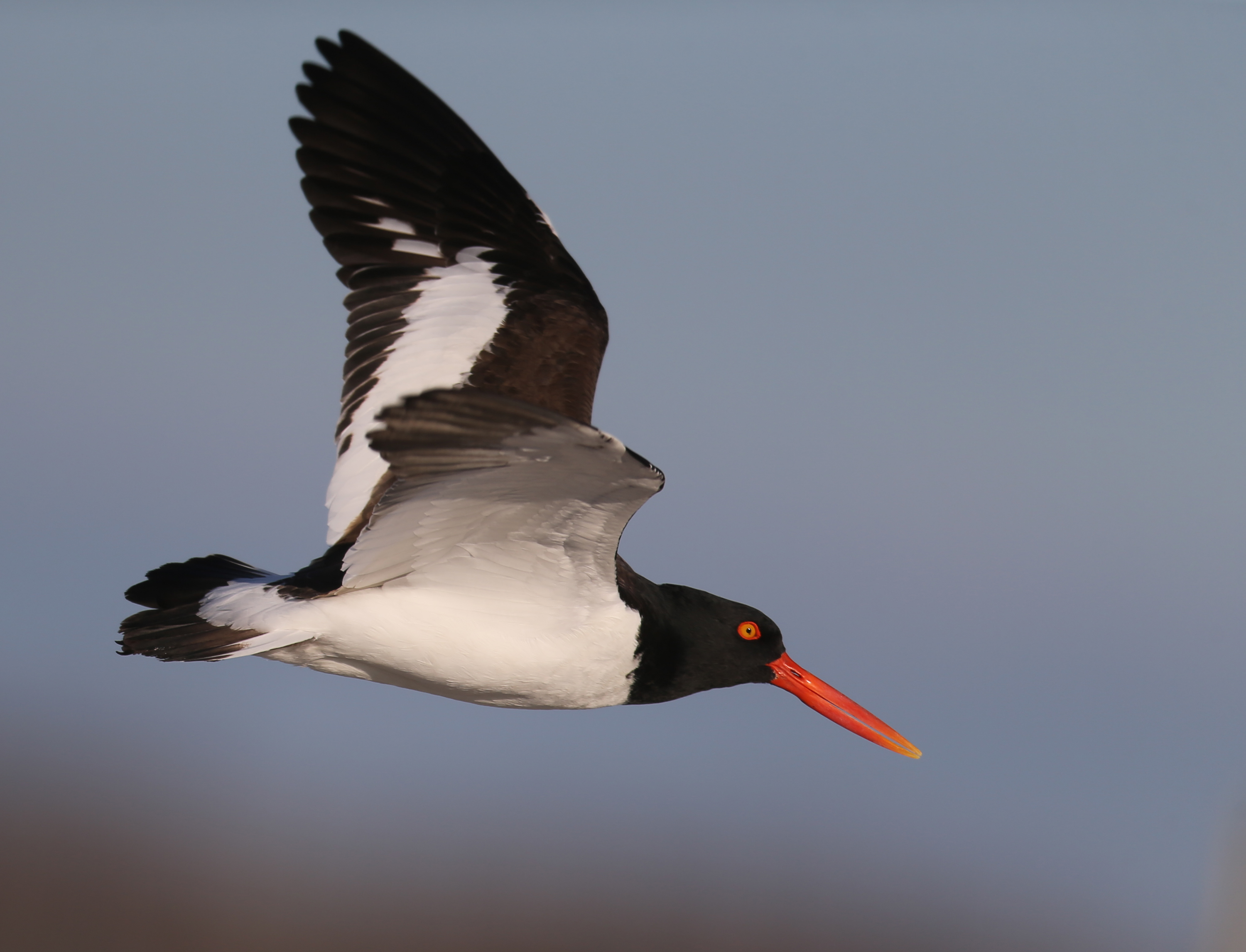
Starting from the Atlantic Ocean (eastern) shore on Cape May, I met this pair of American Oystercatchers (Haematopus palliatus). In Cape May, a section of the beach is fenced off to protect nesting sites for them and for Piping plovers. They are feisty birds and every spring there is a competition for nesting sites; the bird on the right is calling at another Oystercatcher:

The pair took off to drive out the intruder:
The place where I found that pair was littered with the remains of Sand fleas (possibly Emerita talpoida). These fossorial crustaceans normally stay buried in the sand, exiting only when the sand is awash with the shallow tide, but Oystercatchers’ bills are well adapted to dig them out. I think the birds ate only the soft and juicy parts of their telsons, leaving the crustaceans mortally wounded and unable to move:

These Sand fleas are small and difficult to catch alive. That’s what their front end and first pair of legs look like. These crabs dig backwards, starting from their telson, and the front pair of legs is used as a sand anchor:

Another arthropod – the Horseshoe crab (Limulus polyphemus), came ashore, atypically for it, on the Atlantic Ocean side of the peninsula. These are treacherous waters for these spiderlike creatures, for they are easily flipped over by ocean waves and become stranded. They are an interesting part of the Delaware Bay ecosystem and I may share more pictures of them later:

On the Delaware Bay shore of Cape May, there were already many Laughing gulls (Leucophaeus atricilla), which mostly move south in winter but return to their breeding grounds in the spring. They are quite similar to the Eurasian Black-headed gull:

Terns also made their appearance. I think this may be a Forster’s tern (Sterna forsteri) because of the lack of black tips on its primaries and its pure white underbelly, but they are difficult to tell apart from Common terns (Sterna hirundo):

The terns landed on old quay pilings and started courting. There’s no way to tell females from males other than by their courting behavior; males can be slightly larger, but the difference is less than 5%, which is hardly discernible to the human eye:

The courting consists of the two mates trying to look “smug”, with wings drooped, necks extended, and bills pointed toward the sky:

Then there’s the courtship dance and ritual feeding. Here is a fragment of it, taken from a large distance, so I’ve compensated for the lack of pixels by cobbling together this composite. The male presents a fry to the female and then, if she accepts (which is not a given), circles around the female while stomping his feet:

On my way home, I stopped at Sandy Hook, a sand spit where shore gun batteries protecting New York Harbor were once located. It is now a prime nesting site for Ospreys (Pandion haliaetus):

The former Army garrison required many houses for the officers, and these are now excellent nesting sites for Ospreys. Standing in the center of Officers Row (as the area is called), I counted four nests on top of chimneys:

The meadow below the houses was full of American robins (Turdus migratorius) fattening up for the nesting season by preying on earthworms. I know little about annelids, but I’m going to go out on a limb and say it is the common earthworm (Lumbricus terrestris), since it is a favorite prey for robins:

Finally, moving to the class Mammalia, here are Sandy Hook’s harbor seals (Phoca vitulina), congregating on rocks exposed by low tide (the tide was rising so, one by one, the seals were forced to slip back into the water). There are eight seals in this picture, but I counted 15 in total. Their population around the New York inlet has increased in recent years, which may soon put them on a collision course with the fishing industry:

Great pics today, I love the variety of predator and prey!
Great pictures! I once came upon a beach (either in New England or on Long Island) that was populated by hundreds of Horseshoe Crabs. They seemed to have been in good shape—not washed up by a storm. I wonder if it could have been a mating congregation.
An interesting set! Perhaps the horseshoe crab is an early or late arrival to when they do this to spawn.
Beautiful photos Jan! Thanks for sharing these. The posture of the seals is hilarious. Don’t want to get the flippers wet! Not yet anyway!
I’m not much of a birder, but the last field expedition I was involved in (2007) was an hour or so N of Bergen, with the objective of collecting jellyfish – HQ was a charming little cottage, one corner of which was actually IN a fjord, that had been converted into a lab.
There were oystercatchers in the lagoon of the fjord that the back porch looked out over. I had never seen such birds, but I readily found them in a bird book in the lounge. Norwegian for oystercatcher is tjeld. We had no internet there, so I had to wait until we went back to Bergen to learn that tjeld = oystercatcher.
Wonders to see, appreciate your sharing the photos