Why Evolution is True is a blog written by Jerry Coyne, centered on evolution and biology but also dealing with diverse topics like politics, culture, and cats.
I have about three batches left, so if you have wildlife photos, please send them in.
Today’s photos is the second installment of photos from Texas contributed by Damon Williford (part 1 is here). Damon’s narrative and captions are indented, and you can enlarge his photos by clicking on them. Here’s his introduction to the set.
I took these photos at Brazos Bend State Park on June 23 of this year. Brazos Bend State Park is located about 45 miles south of central Houston and 45 miles north of Bay City where I live. The park contains a variety of habitats, including prairie, woodlands, marshes, swamps, and lakes. The Brazos River forms the eastern boundary of the park.
A Question Mark Butterfly (Polygonia interrogationis) feeding on a severed crayfish claw. I was aware that some species of butterflies will feed on carrion, but this was the first time I have personally observed it:
Mushrooms in the genus Chlorophyllum(maybe). That is the best I could do with the identification:
I used iNaturalist to help me identify the organisms in photos 14-22 because my ID skills become progressively worse as the list moves from amphibian (average) to plants (poor) to fungi (non-existent).
Camera information: I used a Canon EOS R7 mirrorless camera body for all photographs. I used the Canon RF800mm f/11 IS USM lens for photos 1-8, and the Canon RF100-400mm f/5.6-8 IS USM lens for the remaining photos.
A giant salamander—and by “giant” I mean about 2.5-4 meters long—equipped with teeth and wicked fangs was found in Namibia, dated at about 270 million years ago, and just reported in Nature. Its significance is that it is early, but is considered a “stem” tetrapod, meaning that it has some of the characteristics of modern amphibians, which are tetrapods (four-legged animals that could move around on land). The authors, according to this CBS News story, suremise that it “was considerably longer than a person, and it probably hung out near the bottom of swamps and lakes”. It was also an apex predator, meaning that it ate other animals, but there was nothing around that could eat it.
Its was found in an area that, 270 million years ago, was at high latitude, ergo cold and partly glaciated. This beast is the first suggestion that there was a tetrapod fauna in cold-ish climates at that time.
Click below to see the article, or download the pdf here:
The researchers recovered a skull that was about 60 cm (2 feet long), as well as the front part of the postcranial skeleton. The authors don’t give a size estimate, but with a two-foot head it was probably large, and could have been 12 feet long: the longest salamander known yet. (The largest living salamander, the Japanese giant salamander (Andrias japonicus), can attain a length of about 5 feet. This puppy could have been twice as long.
Two skull fragments were known of this animal before, but it hadn’t been named and there were no remains of the skeleton. The authors named this one Gaiasia jennyae, after the Gai-As formation in which it was found, and also after Jenny Clack (1947-2020), who studied early tetrapods. (This, of course, will anger the pecksniffs who think that animals shouldn’t be named after people, but they can jump in the lake.) It is the only species in the genus Gaiasia.
The sample in the field (from the Supplementary information):
(From paper): B. Reassembling the ex situ type specimen of Gaiasia jennyae (F 1528)– a dorsal up skull with lower jaw and most of the articulated axial skeleton. C. In situ dorsal-up Gaiasia jennyae skull (F 1522) at locality shown in A. panorama. D. Type specimen of Gaiasia jennyae (F 1528) shown in B. after preparation. Note the differential compression of the skull roof. There is no evidence of pre-burial breakage or subaerial weathering. Scale bar =10cm.
Here’s the skull in dorsal (a,b) and ventral (c,d) views, and reconstructions.
From the paper: a,b, Skull in dorsal view. a, Photograph. b, Interpretative drawing. c,d, Skull in ventral view. c, Photograph. d, Interpretative drawing. e, Reconstruction of the articulated specimen in lateral view showing preserved elements of the skeleton. adsym, adsymphysial bone; an, angular; anf, angular fenestra; c1, anterior coronoid; c2, middle coronoid; caf, carotid artery foramen; chf, chordatympanic foramen; d, dentary; ept, ectopterygoid; exo, exoccipital; f, frontal; it, intertemporal; j, jugal; l, lacrimal; mx, maxilla; n, nasal; p, parietal; par, prearticular; pfr, prefrontal; pl, palatine; po, postorbital; pof, postfrontal; pp, postparietal; pospl, postsplenial; psph, parasphenoid; pt, pterygoid; qj, quadratojugal; sa, surangular; spl, splenial; sq, squamosal; st, supratemporal; t, tabular; v, vomer. Scale bars, 50 mm (a,c).
And a reconstruction of the skull and postcranial skeleton they found. Because we don’t have the posterior skeleton, length estimates are guesses.
Here are photos and a reconstruction of the lower jaw. The white circles show the fangs, which are indicated in the upper drawing. There were three on each side, and interlocking fangs on the top mandible as well. It ate by both suction and biting:
(From the paper): e, f. Photographs of the right hemimandible. e, Ventral view of the posterior half. f, Dorsal view of the symphyseal area. adsym, adsymphysial plate; an, angular; anf, angular fenestra; c1, anterior coronoid; c2, middle coronoid; chf, chordatympanic foramen; d, dentary; par, prearticular; pospl, postsplenial; sa, surangular; spl, splenial. Dotted white circles show the position of the symphysial fangs. Scale bar, 50 mm.
. . . and a reconstruction of the front of the animal from the paper. Remember, that fearsome head was about two feet long!
Now this is unlikely to be any kind of ancestor of reptiles, but it’s likely that this is one of several species occurring when tetrapods had already evolved from fish and one of its relatives probably gave rise to modern amphibians, while another gave rise to all modern reptiles (and after followed the evolution of birds and mammals). Its importance is not only the “gee whiz” factor, but also the indication that there was a thriving ecosystem at high latitudes about 270 myr ago. After all, this is an apex predator, and it had to eat something aquatic (fish or, perhaps, other early amphibians). So if these creatures existed, there must also have been many other animals living at high latitudes at that time.
It’s World Frog Day! Give some love to our slimy green friends! World Frog Day celebrates all anurans, so toads are included. Here’s a nice big American Toad (Bufo americanus) from Will County, Illinois.
American Toad (Bufo americanus), front, Will County, IL, July 13, 2023.
American Toad (Bufo americanus), back, Will County, IL, July 13, 2023.
American Toad (Bufo americanus), habitat, Will County, IL, July 13, 2023.
Today we’ll have a mélange of photos that have accumulated over the past months from readers who sent in just a couple of pix. The captions are indented, and click on the photos to enlarge them.
From Jon Alexandr:
I’m not a biologist, but I do occasionally like to take photos of plants and animals, including “bugs.” Because I favor its handy small size, I’m still using an old, first-generation iPhone SE (2016 or 2017), so it’s not “professional” photography. Still, I think the attached impromptu photo of a “grasshopper” in a wood pile next to my house has a certain presence, which is maybe amplified by the lighting, shapes, and textures.
The grasshopper’s body was just slightly more than an inch long, I estimate, not counting the extremities. Location is San Francisco East Bay, Contra Costa County.
From Bryan Lepore, sent October 29:
I spotted what I think is a tree frog, genus Dryophytes, today. Middlesex county, MA.
She is about the size of my thumbnail and has a very long jump span. Usually, I see what I think are Leopard frogs (genus Lithobates) jump like that but they’re green. Maybe she’s a brown variant, or a differeny frog.
Two animals photos and an architecture photo from reader joolz:
Two of my photographs from the Oceanographic Museum, Monaco 2023. Taken through glass.
Lion fish [Pterois sp.]. Oceanographic Museum, Monaco 2023. Didn’t take a photo of the info.
Longspined Porcupine Fish – Diodon holocanthus. Info on sign: “At the slightest danger it inflates its body, pushing its spines outwards to protect itself. The fish of the Diodontidae family are toxic and unfit for human consumption. In Japan, where they are eaten in sushi, a special licence is needed to cook them.”
Queen Hatshepsut‘s Temple at Deir El Bahri, Egypt. Taken from a hot air balloon decades ago.
Hatshepsut was very powerful and took on the role of Pharoah. She wore the pharaonic regalia, which includes a false beard, so trans activists claim she was transgender, but there is no basis for this assertion. She just wore the standard regalia that all pharaohs wore. Her stepson Thutmose III had her name erased from monuments and she was unknown for centuries. Thankfully her legacy as a female Pharoah was restored when the hieroglyphs at this temple were translated in the 1800s.
Photos of the solar eclipse that occurred on October 14. The first is from Don McCrady:
Thought I’d send you a hot-off-the-press shot of this year’s annular solar eclipse, this one from Winnemucca, Nevada.
An annular solar eclipse is a total eclipse of the sun by the moon, where the moon is far enough away from the earth that its disk does not fully cover the sun’s, creating a “ring of fire” effect such as this one. I took this with a Canon EOS R5 with an RF 100-500 x1.4 extender, for a total focal length of 700mm.
From Avis James:
Bill and I went to a field half way between Ruidoso and Roswell New Mexico in the path of the annular eclipse this morning. We took a colander- it is has the Star of David pattern:
Here is the shadow it made at full angularity! The dot in the middle of each circle is the moon in the middle of the sun!
From John Runnels, “Unknown mushroom species, Baton Rouge, Louisiana.” (Readers: can you ID?)
Finally, a weird giraffe from Bob Wooley of Asheville, NC:
I know you don’t usually do zoo photos, but if you feel like making an exception for an exceptional animal, you’re welcome to use these. You featured a story about this amazing unspotted baby giraffe the other day. I live about 90 minutes from Brights Zoo in eastern Tennessee, where she was born, so today I went there to see her for myself. It’s very difficult to get good pictures of her because her enclosure has a tight-mesh fence that you have to shoot through (unless you have a 12-foot-long photo stick). That’s why most of the news stories just use pictures and videos given to them by the zoo. But I got several that I think are worth sharing, and hold up to on-screen embiggening. She’s a seriously beautiful creature.
Today we have insect photos by regular Mark Sturtevant. Mark’s captions are indented, and you can enlarge his photos by clicking on them.
Here are more pictures from the previous summer. All were photographed near where I live in eastern Michigan, and most come from a single park about a two-0hour drive to the south of me.
In the woods of this park, there were many of these interesting caterpillars on the ground vegetation. I believe they are the larvae of the Red Admiral Butterfly (Vanessa atalanta), which has been a challenging species to photograph. On a return visit, I would like to bring some back to raise since I’ve never been completely satisfied with my pictures of the adults:
The woodland trail followed a lovely river, and periodically the woods would open up into a meadow. At one such riverside meadow was a stand of interesting flowers (maybe wild mint?) being worked over by the large black butterfly shown in the next 2 pictures. This was for me one of the most exciting finds of the whole summer! This, people, is the melanistic form of the Eastern Tiger Swallowtail Butterfly (Papillio glaucus). I swear this is the same species as the familiar black and yellow swallowtail! This dark form is always female, identified by the splash of blue on the hind wings. The melanistic Tiger Swallowtail is not recorded where I live, but it becomes more common to the south, via natural selection, because there it starts to overlap with the toxic Pipevine Swallowtail which it resembles. But only females can pull off the mimicry trick for some reason. Anyway, I was pretty much hyperventilating while taking these pictures. From the ventral view you can still see the faint Tiger Swallowtail stripes:
JAC: Species in which females mimic another toxic form but males keep the ancestral pattern are far more common than the reverse. Can you guess why males don’t evolve to change their pattern? I’ll put the answer in the comments later.
Turning up tree leaves hanging over a forest trail will commonly reveal something of interest. One leaf along this riverside trail had this weird Derbid Planthopper (Anotia uhleri). I am sometimes asked about the yellow thingies below the eyes of this insect. Those are the antennae, which tend to be oddly distinct in this group of planthoppers:
Another thing that one can find under leaves are insect eggs or recently hatched insects. Here is a group of Leaf-footed Bug hatchlings (Acanthocephala sp.), staying close together to amplify their colorful advertisement that they are chemically protected. Whenever I find these groups, I have to take a deep breath and just do my best. Step to one side, prepare the camera for an extreme close-up, and do some test shots on a random leaf to figure out the correct exposure. Then lift up the leaf again and frantically fire away as the nymphs scamper off:
Along the river bank of the park were some sandy areas, and on the sand were quite a few of these well camouflaged insects. This is a young Big-eyed Toad Bug (Gelastocoris oculatus), which are aptly named predatory Hemipterans that are entirely invisible until they hop:
Here are a couple more finds. This tiny beetle, about the size of a sesame seed, is the Basswood Leaf Miner, Baliosus nervosus:
And the unsavory face in the next picture actually belongs to a rather cute and mild-mannered Two-spotted Tree Cricket, Neoxabea bipunctata:
I’m not always sure which critter in this set was from that distant park that I mentioned. But this one sure was! There, I was delighted to find this large katydid known as the Common True Katydid (Pterophylla camellifolia), which is another insect that does not occur in my area. Despite their large wings, True Katydids are flightless. At dusk, this male will begin its song; with some imagination, it is described as sounding like: “Katy did! Katy did !! She didn’t! She did !!!” Readers who live in its range will know it well, as they can be fairly deafening. Here is one singing. If it doesn’t hurt your ears a little, you aren’t playing it loud enough:
And finally, for the heck of it, here is what I believe is a Northern Leopard Frog (Lithobates pipiens) although there is also the similar species called the Pickerel Frog. The two differ in the form of their spots plus some other details. We see some colorful frogs from far-off places on this website, but this domestic one is still quite lovely, I think:
I’m going to try to post some of my own wildlife photos while Jerry is not in a position to post readers’ wildlife photos. (We can look forward to Jerry’s posts of Galapagos wildlife photos, which we eagerly await!) To start, here are some pictures from a field trip I took to Vilas County, Wisconsin, last summer with colleagues from the University of Wisconsin Zoological Museum in Madison. These pictures are from our visit to Escanaba Lake, where the Wisconsin Department of Natural Resources has a small field office that conducts careful surveys of the fish in the Lake.
Escanaba Lake, Wisconsin, 23 July 2022.
We went out with DNR fisheries biologist Greg Sass, who showed us some of the research being carried out by the DNR. Greg got his PhD at Madison, where he is affiliated with the Center for Limnology.
Escanaba Lake, Wisconsin, 23 July 2022.
Part of the DNR’s research involves fyke net surveys:
Escanaba Lake, Wisconsin, 23 July 2022.
Here are some of the fish found in the Lake. My ichthyological expertise is minimal, so the IDs will be to family only; feel free to volunteer species IDs in the comments. [Added: see species IDs by Mark R in comment #2.] Centrarchidae:
Measuring the big one– about 44 inches, total length:
Escanaba Lake, Wisconsin, 23 July 2022.
Sometimes, the big and little hung out together:
Escanaba Lake, Wisconsin, 23 July 2022.
The biggest ones were under and around an overturned boat:
Escanaba Lake, Wisconsin, 23 July 2022.
The snakes were so common, I told Greg it would be a great place for someone to do a thesis on their population biology and behavior. Some more water snake photos:
Escanaba Lake, Wisconsin, 23 July 2022.Escanaba Lake, Wisconsin, 23 July 2022.Escanaba Lake, Wisconsin, 23 July 2022.
This being Wisconsin and all, we had dinner the night before at a supper club, accompanied, for most of us, by brandy old fashioneds:
Brandy old fashioneds (mostly) at Marty’s Place North, now sadly closed.
As I’ve described before, I collected the first specimen of Atelopus coynei, a small tropical frog that now has its own Wikipedia page. I collected it in the late 1970s on a field trip to Ecuador with my grad-school bestie, the late Ken Miyata, a man who’s sorely missed (he died in a fishing accident in 1983). As I had loaned Ken $500 to help him pay for rent and food, he did me the honor of naming the frog after me.
As it was rare, and first found in coastal Ecuadorian wet forests, which have largely disappeared, I eventually assumed that my frog was extinct, a metaphor for my own life. But, mirabile dictu, it was rediscovered by the great naturalist and photographer Andreas Kay on February 7, 2012 at Chinambi, Carchi, Ecuador. This was far from the sea, in the rain forest of the Andes foothills near the Colombian border, and the frog was still listed as “critically endangered.”
Then, in 2017, I got an email from naturalist Lou Jost, who reads and contributes to this site, telling me that A. coynei had been found on land close to the EcoMinga Foundation’s Dracula Reserve (Lou co-directs the foundation).
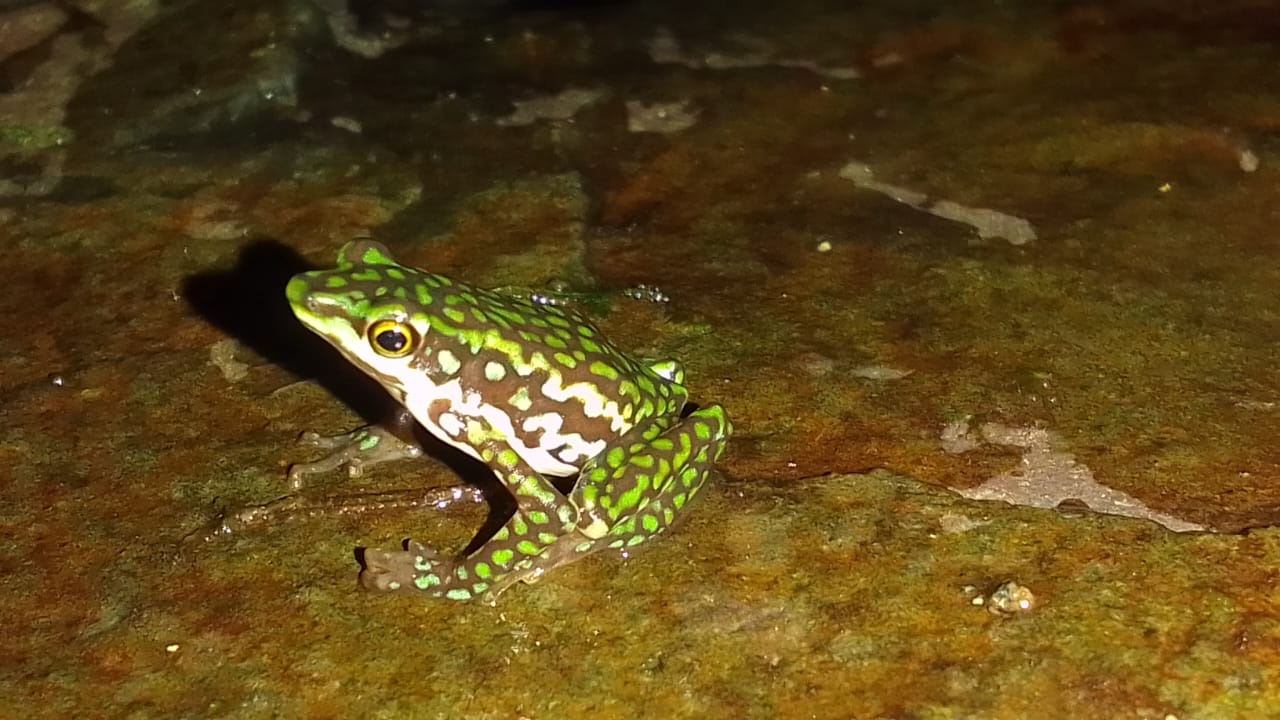
. . . . in December 2017, Javier and our herpetologist and reserve manager Juan Pablo Reyes organized an expedition to explore land we hoped to buy to expand the Dracula Reserve. The expedition included Mario Yanez, a well-known herpetologist from Ecuador’s National Institute of Biodiversity. They were thrilled to discover a good population of Atelopus coynei on one of the properties we were considering!!!! They also discovered another species that had been lost in Ecuador, Rhaebo colomai, though that species was known from a population in nearby Colombia. To top it off they discovered a dramatic completely unknown frog species, yellow with blue eyes!!! This is an amazing area and saving it has become a high priority for us. We are being helped by the Orchid Conservation Alliance, the University of Basel Botanical Garden, and the Rainforest Trust.
The three species mentioned above:
Atelopus coynei, photo by Juan Pablo Reyes and Jordy Salazar/EcoMinga. Isn’t it a beaut?
dav
Rhaebo colomai (photo by Mario Yanez):
The new yellow species with blue eyes (photos by Juan Pablo Reyes and Jordy Salazar/EcoMinga). I don’t know if it’s been described in the literature yet:
But now the story of A. coynei has been supplemented, as workers at the Dracula Reserve have made the first sighting of its tadpoles! As Lou wrote me on July 28:
We have a monitoring program for Atelopus coynei, and during that monitoring, our sharp-eyed reserve guards found the world’s first-ever A. coynei tadpoles! This is really nice to see, as an indicator of breeding and also as a new piece of the species’ biology. I’ll send pictures to you as soon as I receive them (I haven’t seen them yet). Yippee!
Of course I begged for photos, and yesterday Lou sent some of an adult and several tadpoles along with this note:
Here are the adorable tadpoles and an adult, taken in our Dracula reserve. We are carefully monitoring the population and it looks very healthy. We’ve managed to significantly expand the Dracula Reserve, thanks to grassroots campaigns by the Orchid Conservation Alliance, Reserva: Youth Land Trust, and Rainforest Trust. The photographers of the tadpoles, Milton Canticuz and Luis Micanquer, are local residents who were hired by us as reserve wardens and have become passionate conservationists. I hope you can come and visit them some day!
I surely will. This name is forever, as the scientific names of animals cannot be changed PLUS I’ve never done anything that would make me be canceled. Here is the gorgeous A. coynei and its tadpoles sent by Lou and photographed by Canticuz and Micanquer:
My beautiful, beautiful frog:
And the first photos of its tadpoles:
Note the developing legs:
Of course I asked if Lou was 100% sure that these were A. coynei tadpoles, and he replied:
No, I’m not 100% sure; it is their deduction based on their knowledge of the patterns of local frogs, and our herpetologist experts (who know the local fauna well) concur.
Atelopus coynei, the Rio Faisanes stubfoot toad, is a species of toad in the family Bufonidae endemic to Ecuador. Its natural habitats are subtropical or tropical moist lowland forests, subtropical or tropical moist montane forests, and rivers. It is threatened by habitat loss.
Description
Atelopus coynei can be differentiated from other similar species by its ventral patterning, thick fleshy finger webbing that covers its first finger, and from its long hind limbs that cause its heels to overlap when the legs are positioned perpendicular to the body (Miyata 1980).
Range and habitat
Atelopus coynei formerly ranged across the northwestern Andes foothills in Carchi, Imbabura, Pichincha and Santo Domingo provinces of Ecuador, where it lives along stream banks in primary and secondary montane forest between 500 and 2,000 meters elevation.
It currently found in only four disjunct areas in Carchi Province, including two locations in Dracula Reserve and Río Chinambi.
Adults are diurnal, active on rainy days on the rocky banks of river and streams. They rest at night on the leaves of streamside vegetation. They lay eggs on rocks in flowing streams. Tadpoles are typical of Atelopus, remaining attached to rocks. [See photos above for tadpoles on rocks.]
Conservation
The conservation status of Atelopus coynei is assessed as critically endangered. It has a very small population which is continually declining from loss and degradation of its habitat, chiefly from agricultural activities. The population is estimated at fewer than 250 mature individuals.
Stay alive, my frog, and please outlive me! I know that Lou, his colleagues, and the EcoMinga Foundation are doing their best.