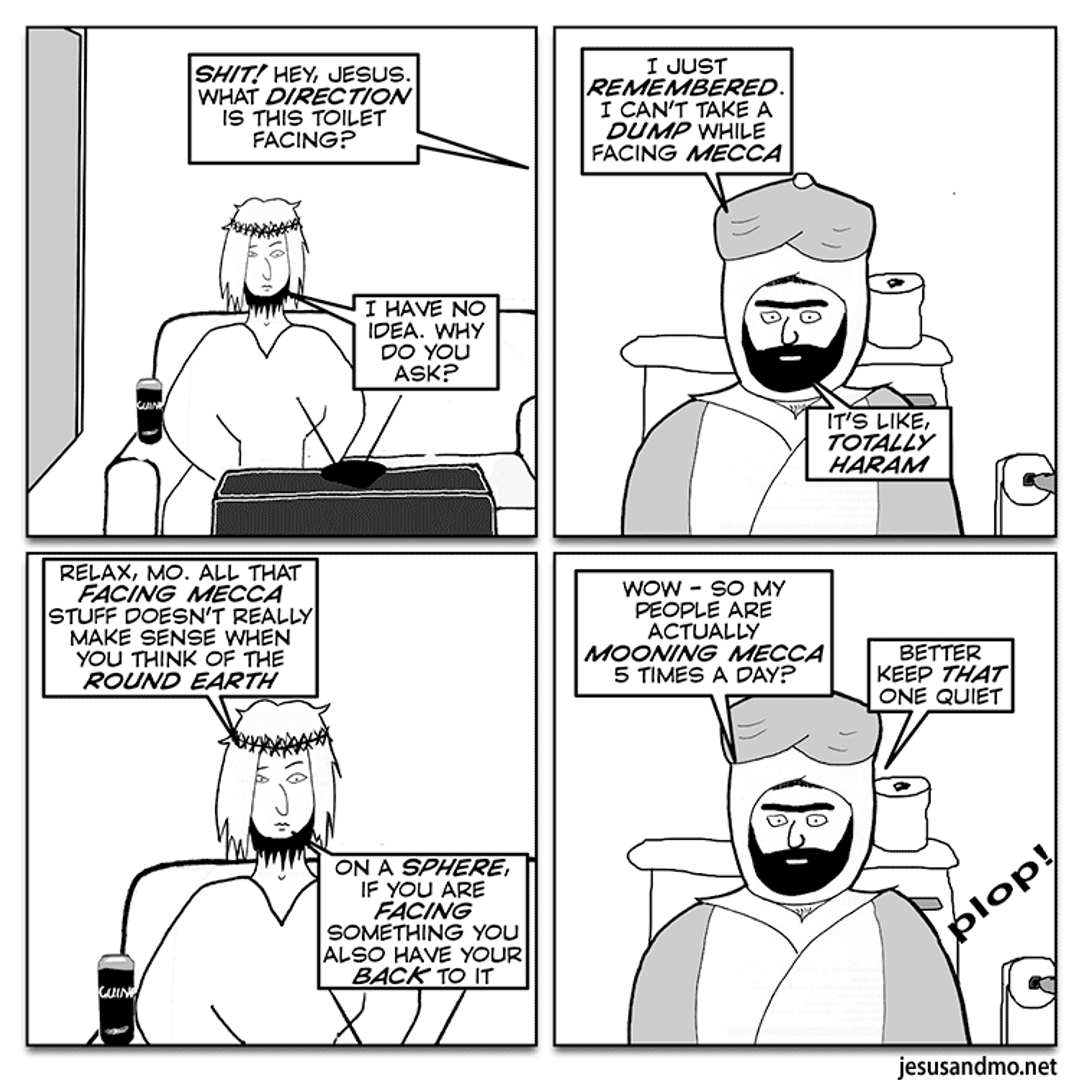
A message from the Jesus and Mo artist about this week’s cartoon, called “dump2”:
A slightly scatological resurrection from 2006 today. Normal service will be resumed next week.
Religion vs. science!
Why Evolution is True is a blog written by Jerry Coyne, centered on evolution and biology but also dealing with diverse topics like politics, culture, and cats.

A message from the Jesus and Mo artist about this week’s cartoon, called “dump2”:
A slightly scatological resurrection from 2006 today. Normal service will be resumed next week.
Religion vs. science!
This is it for photo contributions (save for singletons), so please send in your good wildlife photos. Many thanks!
Today’s photos feature DUCKS, and come from reader Jan Malik. (There are other bird’s too.) Jan’s captions and IDs are indented, and you can enlarge the photos by clicking on them.
Here are a few common birds from Cape May (the peninsula where the namesake town is located) taken last week. The area with marshes, sand dunes and freshwater ponds at the southern tip of the peninsula next to the lighthouse is called The Meadows. Spring migration has just started but animal traffic was rather light.
Mallard drake (Anas platyrhynchos) viewed from a blind. Hens stayed farther away, in reeds thicket:

A bromance? In the past I have observed and photographed mallard drakes courting one another, so this would be nothing unusual:

No, this is just one male running off a competitor from the pond:

Gadwall (Mareca strepera), hen and drake. This is a cosmopolitan duck species, widespread in Eurasia’s and America’s temperate zone. “Strepera” in Latin presumably means “noisy”, but these remained quiet; I suppose a drake can be quite vocal when courting:

The Gadwall drake is less flamboyant than males of other dabbling ducks, but they are patterned with fine gray and brown streaks in breast feathers and black rump patches. That, plus overall neat and symmetrical plumage, speculum visible when flying and vigorous behavior when courting, is perfectly sufficient for a hen to select a mate. I think this humble plumage evolved due to drakes’ staying longer near the nest than many dabbling ducks. For some time – until incubation starts – they do guard it. Thus there must be some pressure to evolve inconspicuous coloration:

Gadwall hens are difficult to tell apart from mallards. All I can spot is the lack of a dark band across the eye and a dark bill, unlike yellow in mallard:

An American species, a blue-winged teal (Spatula discors) male. Contrary to the name, not much blue shows on this drake – blue feathers are mostly revealed in flight:

Blue winged teal, hen. Dark bill and light coloration just behind the bill allow us to tell it is not a mallard, but from a distance these signs are easy to miss:

The teal swam a little too close past the mated gadwalls and the drake let the teal know, not very aggressively but unambiguously, that he was trespassing:

A red-winged blackbird (Agelaius phoeniceus) was announcing the extent of his territory by his “cankaree” call. There were many males in the marsh but I didn’t see any females – they might not have arrived yet, and even if they did, they prefer to stay out of sight. Males are highly territorial and fiercely defend their territories. Later in the season it is not unusual for a male redwing to attack a human passerby if a nest happens to be too close to a path. I’ve also seen redwings ride a hawk or an eagle, like a cowboy on a bull:

A flock of Snowy Egrets (Egretta thula) descending on a coastal march at sunrise. They are gregarious compared to the Great Egret, can feed together as a group form dense nesting colonies:

Welcome to a Hump Day (“Jum il-Ħotob” in Maltese): Wednesday, April 29, 2026 and National Zipper Day. It’s time to think about the marvelous zipper: an invention that many of us use daily. Here’s a short introduction to the zipper. It didn’t really become practical until 1916:
Here’s a gif of how it works:

It’s also Denim Day (read the link to see why it’s today), International Rugelach Day, and National Shrimp Scampi Day.
Readers are welcome to mark notable events, births, or deaths on this day by consulting the April 29 Wikipedia page.
I have not yet gotten over the loss of my duck brood, and posting may be desultory, splenetic, or lame for a while. Is anybody reading this any more?
Da Nooz:
*It’s Noon in Israel reports that “Iran is Drowning in Oil“. (See this similar article in the WSJ.)
It’s Tuesday, April 28, and Iran is beginning to crack. Vindicating Donald Trump’s Saturday claim that Iranian officials could “come to us, or they can call us,” Iran has reportedly presented a new proposal, offering to “reopen” the Strait of Hormuz and end the current hostilities, provided that U.S.-Iran nuclear negotiations are postponed to a later date.
Iran’s inability to export its oil is strangling the regime financially, and keeping that oil onshore is posing a growing existential threat. According to a recent report by The Wall Street Journal, the U.S. blockade has pushed Tehran to the brink of desperation, forcing officials to stockpile crude in makeshift “containers” and disused oil tanks in poor condition. This reporting aligns with an April 12 estimate indicating that Iran had only about 13 days of onshore storage capacity remaining. Once that critical threshold is crossed, Tehran will have no choice but to initiate the drastic step of shutting down domestic oil production entirely.
Shutting down an oil well is far worse than merely pausing operations or stranding valuable resources; it is a death sentence for the industry. When a well is “shut in,” the delicate pressure required to push crude to the surface permanently dissipates. Worse, stagnant oil cools and solidifies, permanently clogging the porous rock, rendering it inaccessible. Oil production is strictly a game of “use it or lose it.”
Loss of future production isn’t the only risk. Around one to two percent of the Iranian workforce is directly engaged in oil extraction, with an even larger number employed in downstream petroleum products and related industries. Lose the wells, and you immediately have that many more angry, desperate and unemployed Iranians on the streets.
All this is to say: time remains on Trump’s side.
From the WSJ:
The blockade has sharply reduced the amount of oil that Iran, a net energy exporter, has been able to load on tankers, commodity analytics firm Kpler said. Iranian crude oil and condensate loadings averaged 2.1 million barrels a day between April 1 and April 13. Only five cargoes have been observed since the blockade, bringing the average down to 567,000 barrels a day between April 14 and April 23.
In February, before the war, Iran exported on average 2 million barrels a day.
We have a game of global economic chicken: will the U.S. and the West demand economic relief before Iran makes major concessions so it can restart oil exports? Don’t ask me—I’m not a pundit.
*Tired of the restrictions imposed on their oil production, the United Arab Emirates are going to quit OPEC.
The United Arab Emirates said it would leave OPEC, dealing a heavy blow to the oil cartel as the war in Iran scrambles alliances and investment priorities among the world’s top oil producers.
The sudden departure of OPEC’s third-biggest producer further weakens a bloc that despite producing up to four out of every 10 barrels of oil pumped worldwide has been hobbled by internal disunity and the rise of American oil output.
The war in Iran has piled on more pressure by exacerbating rifts among the Arab countries at the core of the group and by closing the Strait of Hormuz, through which the group’s biggest producers export most of their oil, making it impossible for the group to influence the market during its biggest supply shock.
The U.A.E. is in a relatively privileged position with the ability to circumvent the blockade in the strait by routing more than half of its oil exports across the country. Withdrawing from OPEC will give it more freedom to make investments to expand its output and adjust to the uncertain future of the waterway.
. . . “Its departure therefore removes one of the core pillars underpinning OPEC’s ability to manage the market,” said Jorge Leon, head of geopolitical analysis at consulting firm Rystad Energy and a former energy demand analyst at OPEC. “Losing a member with 4.8 million barrels a day of capacity, and the ambition to produce more, takes a real tool out of the group’s hands.”
Of course we’re all asking, “What does this mean about how we pay at the pump?” Don’t ask me—I’m not an oil pundit (or any other species of pundit). If you know economics, weigh in below.
*Both Donald and Melania Trump have asked ABC to fire Jimmy Kimmel for a tasteless remark he made while pretending to be a speaker at the White House Correspondents’ Dinner. Remember that Kimmel was suspended previously for remarks about Charlie Kirk’s assassination.)
She was seemingly referring to Thursday’s episode of “Jimmy Kimmel Live!” in which Kimmel parodied the upcoming White House correspondents’ dinner and noted that Donald Trump would be attending for the first time as president.
“And of course, our first lady, Melania, is here,” Kimmel said, pretending to be the host of an “alternative” correspondents’ dinner. “Look at — so beautiful. Mrs. Trump, you have a glow like an expectant widow.”
President Trump called for the comedian to be axed in a post on Truth Social on Monday.
“I appreciate that so many people are incensed by Kimmel’s despicable call to violence, and normally would not be responsive to anything that he said but, this is something far beyond the pale,” the president wrote. “Jimmy Kimmel should be immediately fired by Disney and ABC.”
Here’s the joke, for which Kimmel has an explanation not involving assassination, but death due to poor health and/or old age. Regardless, it’s pretty tasteless, though many anti-Trumpers will like it. It’s sort of funny, but I still wouldn’t have said it myself:
Kimmel has said that this reference didn’t have anything to do with assassination, but only with the age difference between the President and First Lady. And that rings true; after all, nobody guessed that there would be an assassination attempt at the dinner. At any rate, this is free speech—mockery of our leadership—and in my view there should be no punishment of Kimmel. But of course ABC doesn’t want to alienate some of its viewership, so, as a profit-making corporation, it’s ultimately their call.
*The Free Press has a profile of Dartmouth College’s President Sian Beilock, a hard-hitting, plain-speaking administrator whose college was the only Ivy League institution not to be investigated by the Trump Administration for antisemitism. The title: “Can Dartmouth Save the Ivy League?”
Beilock, now 50, didn’t choke this time. Two hours after Dartmouth students pitched an encampment on the Green in May 2024, she called in the police. Eighty-nine people were arrested.
In an interview earlier this month in her office overlooking the same spot, Beilock told me without even a hint of equivocation, “Setting up an encampment on a shared space and declaring it for one ideology, where certain people can’t be or walk through—that’s disrupting someone else’s free speech.”
While other university presidents were preoccupied with campus agitators and either fending off or capitulating to investigations by the Trump administration, Beilock used her power to keep the peace at Dartmouth. That has given her the credibility to articulate a vision of reform for American colleges and universities that she hopes will restore the public’s trust in them.
As other university leaders are sounding the alarm about what they see as a federal assault on higher education, Beilock is focused on what colleges can do to fix themselves.
She has railed against “groupthink” and a lack of “ideological diversity,” complained that university presidents “lost our mission,” and accused Wesleyan University’s president of “name-calling” the Trump administration. In a January op-ed in The Wall Street Journal, Beilock wrote that colleges “must demonstrate to students and families—and to the broader public—that we’ve heard their criticisms and will address them.” She proposed five major changes, from ending “political posturing” to emphasizing “equal opportunity, not equal outcomes.” The essay went viral.
“I really believe in American higher ed,” Beilock told me. “If we as leaders can’t take responsibility for what we’re doing and be held accountable for outcomes, I worry someone else will try and do it for us.”
For the most part, the Dartmouth campus seems to reflect Beilock’s vision. The Foundation for Individual Rights and Expression ranked Dartmouth highest in the Ivy League for free speech—and up from one of the 10 worst colleges in the entire U.S. in 2023, when Beilock started as president. Students in the government and Middle Eastern studies departments told me that their professors do a good job teaching multiple viewpoints and staying neutral. A program called Dartmouth Dialogues, launched by Beilock, has spent hundreds of thousands of dollars bringing in high-profile speakers with a wide variety of political views.
It also helps that Dartmouth has an atmosphere that is less progressive and less confrontational than, say, Columbia’s Barnard College, where Beilock was president for six years. “I’m sure you’ve noticed the difference,” she said. At Dartmouth, “you can’t yell at someone and disappear into the city. You have to see them at the dining hall.”
Bravo for Dr. Beilock! Her WSJ essay is very good (archived here) and includes this:
Third, re-center higher education on learning rather than political posturing. Too often, colleges and universities have participated in the culture wars. The result is an environment in which students and faculty feel they must toe an ideological line rather than explore ideas that fall outside prevailing norms.
Dartmouth was also one of the first schools that reinstated SAT tests for applicants after many schools, worried about equity, made them option or prohibited scores from being submitted. It’s even better than the University of Chicago, which waited a week before dismantling the encampment, didn’t punish students or faculty who violated university regulations, and since 2018 has been “test optional,” with the stipulation that they will use SAT/ACT scores only if they help your admission. So it goes.
*It is ironic that the NYT hired Peter Beinart, a Jewish writer, as a columnist specializing in Israel, for the man is an anti-Zionist who wants the Jewish state to disappear. “What Tucker Carlson means when he talks about Israel.”
Wikipedia says this about him:
As of 2012, Beinart lives in New York City with his wife and two children. He keeps kosher, regularly attends an Orthodox synagogue, and has sent his children to a Jewish day school.
And when I asked Grok about his views on Israel, I got what I already knew:
He has been explicit and public about this for years. In a widely discussed 2020 New York Times op-ed (and a longer piece in Jewish Currents), he declared: “I no longer believe in a Jewish state” and advocated a one-state solution in which Israel as a Jewish-majority state with special obligations to Jews would end in favor of a single binational state granting full equality to Jews and Palestinians.
He has reiterated this view repeatedly, including in his 2025 book Being Jewish After the Destruction of Gaza, arguing that Jewish ethics and safety require rejecting Zionism as currently practiced. He is editor-at-large of the left-wing, anti-Zionist magazine Jewish Currents and frames his position as coming from within Jewish tradition and concern for both Palestinians and Israelis.
Bret Stephens, it’s turned out, is the only pro-Israel columnist at the NYT, whole Beinart regularly disses Israel, it’s “genocide, and its right to exist, as he does in the new column about Tucker Carlson. Beinart’s take:
Now, as many Americans sour on Israel, [Tucker Carlson] in the vanguard once again. Over the last year or so, he’s become a leading champion on the right for abandoning America’s long-held support for the Jewish state. “Hopefully the first thing we do when and if this war is resolved is detach from Israel,” he told his audience in early April.
Mr. Carlson’s worldview hasn’t fundamentally changed. Like other prominent figures on the anti-Israel right, he still sees the West as menaced by alien civilizations bent on its destruction. He has just turned his attention towhat he sees as the alien civilization that populates the Jewish state. And he’s done so with the same penchant for conspiracy theories that has long marked his public commentary. Now he is using a destructive, ill-defined and unpopular war to give those theories even greater reach.
While some of Carlson’s conspiracy theories are deemed ridiculous, Beinart seems to agree with this one:
[Carlson] is at the forefront of a cohort of right-wing commentators who don’t merely condemn Israel’s manifold crimes against the Palestinians and others in the Middle East. They also suggest something far more troubling: that Israel’s crimes stem from its Jewishness, which they claim threatens the Christian West.
And s0, while Beinart says that we can’t attribute Israel’s perfidies to Jewishness, we can still attribute them to—Israel.
Combating the anti-Israel right’s conflation of Israel and Jewishness is made harder by pro-Israel American Jewish organizations that have conflated those two things as well.
But progressives must not blur the distinction between viewing Israel as a state, which practices forms of oppression and aggression that can occur in states of every ethnic and religious type, and viewing Israel as the product of a peculiarly Jewish pathology. It is understandable that some progressives, who are rightly eager to end America’s support for Israel’s human rights abuses, might be tempted to see figures like Mr. Carlson as allies. But the struggle for Palestinian freedom should not indulge bigotry of any kind. That includes the bigotry of figures like Tucker Carlson, who blame Israel’s crimes on its Jewishness so they so they can pretend that America and Christianity are morally pure.
Here we have a man who emphasizes Israel’s crimes (e.g., opposing the “struggle for Palestinian freedom”) and says that we should not indulge in bigotry while at the same time favoring a “one state solution” that would result in war and the death of gazillions of Jews. I remember Malgorzata used to dismiss Beinart as a “self-hating Jew.” I wouldn’t go that far, but it’s palpably clear that he’s an “Israel-hating Jew.” But is there a difference?
*The WaPo reports that former war correspondent Jonathan Ledgard is setting up bank accounts for wild gorillas to help pay for their conservation (both species are critically endangered).
Fixing this has become the mission of former war correspondent and novelist Jonathan Ledgard. He now works as a financier opening bank accounts in the name of nonhumans.
His nonprofit Tehanu recently gave bank accounts to gorillas to spend on their own survival. Ledgard ultimately wants to give far more plants and animals financial safety nets of their own to safeguard their future and the ecosystems that sustain all of us.
“It’s truly insane that we’ve built these economic systems without … understanding that we also have to reward nature for its services,” Ledgard told me in a video interview from his home
In August 2024, Tehanu logged its first interspecies transaction, a payment of 5,000 Rwandan francs ($3.42) to a local ranger for removing a snare from Gisubizo, one of the roughly 350 mountain gorillas in Volcanoes National Park, Rwanda, according to the digital receipt. Other micropayments followed, including for tree planting, path clearance, anti-poaching patrols and veterinary observation. The gorillas’ spending was funded by the Rwandan government and private donors
For the first time, the primates weren’t a charity case, but paying clients.
Wild gorillas and other nonhuman species can’t tell us exactly what they need. But wildlife biologists, combined with artificial intelligence trained on hundreds of peer-reviewed scientific papers on mountain gorilla biology and behavior, identified the animals’ priorities.
Whenever someone took action to advance the gorillas’ interests, they were eligible to receive micropayments in Rwandan francs via their mobile phone. (All actions were verified by human experts, but Tehanu plans to automate this with AI and cameras in the future.)
Each gorilla in the project received a digital identity based on their unique set of nose wrinkles, known as “nose-prints,” and was tracked through the park using motion-activated camera traps.
This is a great idea–if it works. It’s working for gorillas, but Ledgard wants to extend it to other endangered species, including plants. Who would fund that? Well, there’s an interview with Ledgard where he explains where the dosh will come from, and it’s something to be considered!
Meanwhile in Dobrzyn, Hili offers a corrective to Szaron’s optimism:
Szaron: The world is beautiful.
Hili: Yet it can be dangerous.

In Polish:
Szaron: Świat jest piękny.
Hili: Ale bywa groźny.
*******************
From Stacy:

From Things With Faces; a happy loo:

From The Dodo Pet:

From Masih; a protestor wiping his eyes with cuffed hands. He’s already been executed.
With his hands cuffed, he wipes his own tears…Because he was forced to confess to a crime he never committed. And then, they hanged him in Iran for protesting against Islamic Republic.
His name was Erfan Kiani.
But we only heard his name after his execution.His family stayed… pic.twitter.com/oqFZG1AXp8
— Masih Alinejad 🏳️ (@AlinejadMasih) April 27, 2026
Part of a conversation between Bill Maher and comedian David Cross. Cross, a liberal, has been captured by gender activism. There’s a video at the bottom.
Bill Maher: “You need to hear that other side. You need to be checked. People need to be checked. Including your little girl.”
David Cross: “F*ck that b*tch. F*ck that little b*tch with her black friends and tr*ns friends and not even understanding.”
Bill Maher: “Tr*ns? Wait,… pic.twitter.com/vBd4nzdSoo
— RedWave Press (@RedWavePress) April 27, 2026
From Larry, the #10 Cat. Do Brits steal wine from gatherings?
Not a single British person would bat an eyelid at this. Just hope they thought to take a corkscrew too. https://t.co/wkBoniarJR
— Larry the Cat (@Number10cat) April 26, 2026
Two from my feed. First, some Tanzanians say their names, which are long and have those hard-to-make clicks:
The children from the Hadza tribe in Tanzania probably have the most difficult names to pronounce in the world.
In addition to vowels and consonants, their unique language contains clicking and guttural sounds, which also have specific meanings. pic.twitter.com/txfYqQuxRD
— Massimo (@Rainmaker1973) April 28, 2026
Orange cat wins!
So your game is more important than me huh? pic.twitter.com/ZQ1Pur0yOR
— Cat 🐈 (@CuteCatsMagic) April 27, 2026
One I reposted from The Auschwitz Memorial:
This Dutch Jewish girl was gassed to death as soon as she arrived in Auschwitz. She was ten years old. She’d be 92 today if she’d lived. https://t.co/DYRiQhlWhT
— Jerry Coyne (@Evolutionistrue) April 29, 2026
Two from Dr. Cobb, still in Chile. The first includes his photos from the Atacama Desert:
Went to the salt lagoons near San Pedro de Atacama (an hour on a v bumpy and dusty desert road). The first lagoon you are allowed to float in (I didn’t). Amazing lunar landscape. Traces of life – dried plants that emerged last time it rained, a fly we probably brought with us, and a lost dragonfly!
— Matthew Cobb (@matthewcobb.bsky.social) 2026-04-28T12:36:46.590Z
And this gets an “Awww!”:

I’m a sucker for lists like the NYT’s 100 Best Books of the 21st Century (also archived here), though the list may be a bit premature given that the century is barely one-quarter over. The article notes that the list was compiled by “votes from 503 novelists, nonfiction writers, poets, critics, and other book lovers—with a little help from the staff of the New York Times book review.”
From the intro:
Many of us find joy in looking back and taking stock of our reading lives, which is why we here at The New York Times Book Review decided to mark the first 25 years of this century with an ambitious project: to take a first swing at determining the most important, influential books of the era. In collaboration with the Upshot, we sent a survey to hundreds of literary luminaries, asking them to name the 10 best books published since Jan. 1, 2000.
Stephen King took part. So did Bonnie Garmus, Claudia Rankine, James Patterson, Sarah Jessica Parker, Karl Ove Knausgaard, Elin Hilderbrand, Thomas Chatterton Williams, Roxane Gay, Marlon James, Sarah MacLean, Min Jin Lee, Jonathan Lethem and Jenna Bush Hager, to name just a few. And you can also take part! Vote here and let us know what your top 10 books of the century are.
Sarah Jessica Parker? Jenna Bush Hager? Are those literary luminaries? I don’t think so. Well, there were many real luminiaries and real critics, so we’ll let it pass.
Is it a good list? Well, I’ve heard of many of the books, and the 18 I’ve read (see below) have been good ones. But seriously, there’s no mention of All the Light We Cannot See? (2014; it won the Pulitzer Prize for Fiction and is perhaps the best book I’ve read written in this century). Or A Little Life (2015)? Where is Hamnet (2020)? And for medically related nonfiction, I’d add Bad Blood: Secrets and Lies in a Silicon Valley Startup (2018), about Elizabeth Holmes and the Theranos scam, and Empire of Pain: The Secret History of the Sackler Dynasty,(2021), about the Sackler family’s relentless pushing of opioids. And where, oh where is Rebecca Skloot’s The Immortal Life of Henrietta Lacks (2010), a book I enthusiastically reviewed?
I’d also kvetch because there’s only one nonfiction book about science (The Emperor of All Maladies; 2010), though two others are tangentially related to science. This likely reflects the NYT’s general neglect of the wonders of science.
But I’m sure everyone will find lacunae, and if I thought hard I’d find others. But it doesn’t matter: use the list for suggestions of books to investigate. At least you can tick off the books you’ve read and the paper conveniently compiles a list—and a photo—of the ones you’ve read. Here’s my own list:
I’ve read 18 books on the list. . . .
The Warmth of Other Suns ● The Known World ● Austerlitz ● Never Let Me Go ● The Year of Magical Thinking ● The Road ● The Amazing Adventures of Kavalier & Clay ● The Overstory ● Atonement ● H Is for Hawk ● A Brief History of Seven Killings ● The Vegetarian ● The Looming Tower ● Demon Copperhead ● The New Jim Crow ● The Passage of Power ● The Emperor of All Maladies ● The Sympathizer
Again, it biggest gap on their list is “All the Light We Cannot See,” a masterpiece of a book.
And it makes a photo you can use for bragging rights, though I don’t have many:

Some of the best books I’ve read have hyst missed this century, including A Gesture Life (1999) and Troubles (1970). As always, recommend books you like written recently, particularly ones not on this list.
Welcome to the Cruelest Day: Tuesday, April 28, 2026, and Great Poetry Reading Day. Here’s Dylan Thomas’s “Light Breaks Where No Sun Shines,” written when he was only nineteen. He died at 39 of lung ailments exacerbated by alcoholism.
Light breaks where no sun shines;
Where no sea runs, the waters of the heart
Push in their tides;
And, broken ghosts with glow-worms in their heads,
The things of light
File through the flesh where no flesh decks the bones.A candle in the thighs
Warms youth and seed and burns the seeds of age;
Where no seed stirs,
The fruit of man unwrinkles in the stars,
Bright as a fig;
Where no wax is, the candle shows its hairs.Dawn breaks behind the eyes;
From poles of skull and toe the windy blood
Slides like a sea;
Nor fenced, nor staked, the gushers of the sky
Spout to the rod
Divining in a smile the oil of tears.Night in the sockets rounds,
Like some pitch moon, the limit of the globes;
Day lights the bone;
Where no cold is, the skinning gales unpin
The winter’s robes;
The film of spring is hanging from the lids.Light breaks on secret lots,
On tips of thought where thoughts smell in the rain;
When logics dies,
The secret of the soil grows through the eye,
And blood jumps in the sun;
Above the waste allotments the dawn halts.
Here’s Thomas’s simple grave in Wales, which I photographed in 2010:

It’s also National Blueberry Pie Day, and National Kiss Your Mate Day.
Readers are welcome to mark notable events, births, or deaths on this day by consulting the April 27 Wikipedia page.
Da Nooz:
*Iran has offered to reopen the Strait of Hormuz if the U.S. agrees to peace under certain conditions, which include no stipulations about nuclear enrichment or weapons.
Iran has offered to end its chokehold on the Strait of Hormuz if the U.S. lifts its blockade on the country and ends the war in a proposal that would postpone discussions on the Islamic Republic’s nuclear program, two regional officials said Monday.
U.S. President Donald Trump seems unlikely to accept the offer, which was passed to the Americans by Pakistan and would leave unresolved the disagreements that led the U.S. and Israel to go to war on Feb. 28.
With a fragile ceasefire in place, the U.S. and Iran are locked in a standoff over the strait, through which a fifth of the world’s traded oil and gas passes in peacetime. The U.S blockade is designed to prevent Iran from selling its oil, depriving it of crucial revenue while also potentially creating a situation where Tehran has to shut off production because it has nowhere to store oil.
Oy, how many times have I heard that 20% of the world’s oil passes through the Strait? Doesn’t everyone know that by now? But I digress.
The Iranian proposal would push negotiations on the country’s nuclear program to a later date. Trump said one of the major reasons he went to war was to deny Iran the ability to develop nuclear weapons.
The two officials with knowledge of the proposal spoke on condition of anonymity to discuss the closed-door negotiations between Iranian and Pakistani officials this weekend. Iran’s proposal was first reported by the Axios news outlet.
The offer emerged as Iran’s foreign minister visited Russia, which has long been a a key backer of Tehran. It’s unclear what, if any, assistance Moscow might offer now.
Clearly Iran is a bit desperate, but given that Trump made the non-production of nukes the prime object of America’s war with Iran, this offer is a non-starter. And I can’t imagine what kind of offer would be.
*The WSJ reveals how ridiculously easy it was for people to gain access to the venue where Trump and other government officials were present at the White House Correspondents’ Dinner.
At the same hotel where then-President Ronald Reagan was shot 45 years ago, it was remarkably easy for a shooter to charge toward a ballroom where President Trump—along with his cabinet members and the reporters who cover his administration—were dining Saturday night.
The sprawling Washington Hilton, located about 1½ miles north of the White House, for decades has been home to the White House Correspondents’ Dinner because of its capacity to host a large crowd and the Secret Service’s familiarity with securing it. More than 2,500 people attended the event, including five of the top six officials in the presidential line of succession. Hundreds more gathered for parties that media outlets hosted on site before the main festivities began.
Despite a visible security perimeter and warnings of tight security, guests said they could enter the hotel through checkpoints on the surrounding streets by simply showing a dinner ticket or a copy of an invite to one of several predinner receptions. The tickets were reviewed by staff but weren’t scanned and there were no identification checks, attendees said.
“Upon entering nobody asked to visibly INSPECT my ticket nor asked for my photo identification. All one had to do was flash what appeared to be a ticket and they were fine with that,” said Kari Lake, a former Republican gubernatorial and Senate nominee in Arizona now serving as senior adviser for the U.S. Agency for Global Media, in a social-media post.
Guests were able to access the Hilton’s lobby and lower levels without going through security scans, and only passed through magnetometers before they entered the ballroom where the dinner was held. It was easier to get into the dinner than many big sports events and concert venues.
With 1,107 guest rooms and suites, 47 meeting rooms and four on-site dining venues, the facility in the heart of the nation’s capital can’t be fully sealed off for a high-security event.
One of those rooms was booked by the 31-year-old gunman, who checked in the day before the shooting, law-enforcement officials said, giving him an even deeper awareness of the Hilton’s contours.
“He didn’t beat the security plan the night of the dinner. He beat it the day he made the reservation,” said Jason Pack, a former FBI official. “They built that perimeter to stop an army. Turns out all he needed was a room key.”
I wonder if the dinner will be held there in future years. If so, you can bet that security will be way amped up. I’m wondering whether the suspect could have killed Trump if he had some kind of super-weapon, like a grenade launcher. (I’m not wishing that Trump had been killed, of course, but I’m also surprised that I haven’t seen people wishing that he was.) One could get all the way to the ballroom entrance without being checked for weapons (the shooter is accused of having a shotgun, a pistol, and several knives).
*Apropos, the suspect appears to have been compelled to travel across the country with an assassination plan out of hatred of Trump and his administration. It does not look like a set-up planned by Trumpites, as some blockheads have argued.
Before he embarked on a cross-country journey, Cole Tomas Allen offered the people in his life a series of explanations for his absence, according to writings that the authorities say he left behind.
He had a personal emergency, he told his colleagues and the students he was tutoring. He told his parents simply that he had an interview.
But Mr. Allen appears to have had a much different and much darker plan when he set out on a train from California to Washington, according to two senior law enforcement officials who say he is now in custody, accused of charging through security outside the White House Correspondents’ dinner, setting off a flurry of gunfire.
. . .The suspect, who the authorities have not publicly named but who was identified by the two officials as Mr. Allen, 31, of Torrance, Calif., is expected to be charged with multiple crimes in a court appearance on Monday.
The writing the authorities attributed to Mr. Allen bounced between remorse for the deception of friends and family and gratitude for a lifetime of love and support. In it, he displayed outrage at the policies put in place by the White House, and alluded to allegations of sexual misconduct, saying that he is “no longer willing” to allow a “traitor to coat my hands with his crimes” — an apparent reference to President Trump, though the writing does not mention him by name.
. . . The writing said the suspect had come to the Washington Hilton looking for members of the Trump administration.
“Administration officials (not including Mr. Patel): they are targets, prioritized from highest-ranking to lowest,” the writing reads, apparently referring to Kash Patel, the F.B.I. director. It was not clear from the writing why Mr. Patel was mentioned by name.
. . . The suspect is initially expected to be charged with two counts of using a firearm and one count of assault on a federal officer using a dangerous weapon, Jeanine Pirro, the U.S. attorney for the District of Columbia, said on Saturday. He is scheduled to be arraigned on Monday in Federal District Court and additional charges are expected, she said.
Frankly, I’m surprised that, given that Allen shot a law enforcement officer (who luckily survived thanks to a bulletproof vest), he wasn’t himself killed by security. Or perhaps he was also trying to commit “suicide by cop.”
*Hezbollah has declared that it won’t disarm, which of course puts a serious wrench in the negotiations between Israel and Lebanon, besides violating UN Security Council Order 1701.
The Lebanese militant group Hezbollah declared on Monday that it would not lay down its weapons, a day after the authorities in Lebanon said 14 people were killed in Israeli attacks on Sunday, one of the deadliest days since a truce was declared this month.
Naim Qassem, the leader of Hezbollah, an Iranian-backed group, said in a written statement that it would not “relinquish its weapons or its defenses.” Israel has demanded Hezbollah’s disarmament as a precondition for ending its invasion of southern Lebanon.
But it is still far from clear whether the Lebanese government can rein in Hezbollah, whose devoted Shiite Muslim supporters and battalions of fighters have long made it Lebanon’s dominant military power.
In another sign of strains on the truce, the Israeli military said on Monday that it had attacked the Bekaa Valley in eastern Lebanon. Those strikes were some of the deepest since President Trump declared a cease-fire in the country earlier this month.
Israel and Hezbollah have continued to trade attacks almost daily, although the fighting has mostly been confined to southern Lebanon. Israeli forces are razing Lebanese border towns there, part of an effort that could lay the groundwork for a longer occupation in southern Lebanon.
Hezbollah has also fired rockets and explosive drones at Israeli communities, as well as at invading Israeli forces. On Sunday, the Israeli military said a soldier had been killed in Lebanon, raising the death toll in Israel’s ranks in the current conflict to at least 16.
Lebanon’s Health Ministry said the 14 people killed in the Israeli attacks on Sunday included two women and two children, but did not give many other details, state media reported.
Benjamin Netanyahu, the Israeli prime minister, accused Hezbollah on Sunday of “essentially disintegrating the cease-fire.” But while Israel has repeatedly bombarded south Lebanon, it has refrained from attacking Beirut, the Lebanese capital.
Were Israel to buck the truce entirely, it could run afoul of Mr. Trump, who personally announced the agreement and says he wants to invite both Mr. Netanyahu and Joseph Aoun, the Lebanese president, to Washington for further talks.
Let’s face it: Lebanon has no control over Hezbollah, and Hezbollah has no taste for disarming. As with Iran vs. the U.S. and Israel, it looks like an impasse. I wonder what things will look like a year from now. Of course I asked that same question when Russia attacked Ukraine, and things are pretty much the same.
*A while back the Trump Administration based on advice of the CDC’s new “vaccine advisors,” dropped a recommendation that infants be vaccinated against hepatitis-B within 24 hours after birth. Two new studies now predicts that this dumb recommendation, part of RFK Jr.’s anti-vax crusade, will lead to a rise in infections and a substantial number of deaths. The paper, in JAMA Pediatrics, can be found here and here.
Federal vaccine advisers to Health Secretary Robert F. Kennedy Jr. voted in December to replace the universal birth dose with a recommendation to delay the first shot until at least two months of age for infants born to mothers who test negative for the virus — a change later approved by the then–acting director of the Centers for Disease Control and Prevention.
Pediatricians and dozens of medical groups strongly opposed the move, saying it was not based on evidence, and warned it could harm children and their families. Although medications can control hepatitis B, there is no cure for chronic infection.
The JAMA studies are the first to model the policy’s potential impact. One estimated that delaying the first hepatitis B vaccine dose by two months for babies born in a single year to mothers who tested negative — about 80 percent of the 3.6 million U.S. births annually — would increase lifetime health-care costs by at least $16 million.
“These 2 studies were exceptionally well done and rigorous in their approach, assumptions, calculations, and conclusions,” wrote Arthur Reingold, emeritus professor of epidemiology at the University of California at Berkeley’s School of Public Health, in an email.
Reingold and other public health experts said the federal vaccine advisory committee should have considered this type of evidence before making its decision in December.
Instead, the panel departed from well-established standards, according to an accompanying editorial in JAMA Pediatrics. The committee failed to weigh key evidence, focusing on “theoretical risks of vaccines” while omitting data on the benefits of preventing chronic disease and death, the editorial said.
Eric Hall, an assistant professor of epidemiology at Oregon Health and Science University and a co-author of the cost study, said researchers shared a preliminary version of their findings in public comments ahead of the December meeting so committee members could review the data.
“We noticed that the committee did not have the evidence they needed to inform their decision,” Hall said. “But this group kind of blew past all that and didn’t make any effort to fill the evidence gaps that they might have had. They just went ahead anyway.”
Yes, these figures are based on data. I’ve been vaccinated against Hep-B for various overseas travels, and I am a firm believer in immediate vaccination after birth for this disease. I don’t understand why the CDC doesn’t favor that at-birth vaccination—do they want people to die or something? Do they have hidden data that contradicts the results of these new papers?
Meanwhile in Dobrzyn, Hili seems to be becoming a “progressive”:
Hili: We are all oppressed.
Andrzej: I’m afraid you’re creating a critical theory of oppression.

In Polish:
Hili: Wszyscy jesteśmy uciskani.
Ja: Obawiam się, że tworzysz krytyczną teorię ucisku.
*******************
From Stacy:

From Terrible Maps:

From CinEmma:

From Masih. The English translation of the Farsi is this:
Every time I talk about the regime’s crimes, either I cry afterward, or I get a severe feeling of nausea, and from the psychological pressure, I start trembling. Lately, I have trouble breathing, and someone next to me has to remind me to take deep breaths. Sometimes I lose my words, especially in English, and I keep repeating to myself: Be strong! If you get so psychologically overwhelmed just from recounting these crimes, imagine how the victims must feel. Be strong and keep going for the voiceless ones whose hopeful eyes are on us. When I spoke behind the scenes of the Fox News interview about Salohe and Ahmad, 3-4 women from the news team cried and were shocked by the horrific scale of this crime. I was invited to a university to speak to students about Iran. Just this one crime was enough for the audience in the hall to realize, with wide-eyed and tearful stares, the dire and emergency state of the Iranian people. #Iran #DigitalBlackOutIran
هر بار كه در مورد جنايات رژیم حرف ميزنم يا بعدش گريه ميكنم و يا حالت تهوع شديد ميگيرم و از فشار روانى شروع به لرزيدن ميكنم. جديدا نفسم ميگيره و كسى كنارم بايد بهم يادآورى كنه نفس عميق بكش. گاهى كلمات رو گم ميكنم مخصوصا انگليسى ومدام به خودم تكرار ميكنم قوى باش!
اگر تو با بازگو… pic.twitter.com/DJcqjDLjE6— Masih Alinejad 🏳️ (@AlinejadMasih) April 27, 2026
From Luana, who says that this is the future of Left media:
A photo of the summer 2025 interns at the Los Angeles Times should look relatively familiar to those of you who have seen similar photos of interns at other legacy media outlets.
Zero white males. pic.twitter.com/LpwwnMXbDq
— i/o (@avidseries) April 27, 2026
From Malcolm; cat chaos (I can’t guarantee its reality):
Cats are chaos.. 😂 pic.twitter.com/NAONAHOhOZ
— Buitengebieden (@buitengebieden) March 7, 2026
Two from my feed. First, a stupendous voice:
Snow Raven is a member of the shamanic Sakha people from Arctic Siberia.
Her amazing voice takes its breath from traditional Sakha culture and is truly an instrument. pic.twitter.com/zkGCLILfX0
— Massimo (@Rainmaker1973) April 27, 2026
A playful orphaned elephant:
I will never tire of watching this beautiful video ❤️.
There is always one child that can’t behave!
Happiness is remembering when a baby Elephant tickled reporter Alvin Maunda with his trunk during a piece to camera for a report from Elephant ophanage @SheldrickTrust for a… pic.twitter.com/Q4fgiB6HTk
— PROTECT ALL WILDLIFE (@Protect_Wldlife) April 27, 2026
One I reposted from The Auschwitz Memorial.
This Dutch Jewish girl was gassed to death as soon as she arrived in Auschwitz. She was 11 years old. https://t.co/v6uYHKp4iJ
— Jerry Coyne (@Evolutionistrue) April 28, 2026
And two from Dr. Cobb, soon to return from Chile. The butterflies below are astounding; I had no idea they existed. Matthew says this is an example of sexual selection, but Wikipedia says that “the sexes are alike” except for a slight color difference.
This is NOT AI. These are green dragontail butterflies (Lamproptera meges), native to S & SE Asia.They compensate for undersized wings with long 'swallowtails' to generate lift.Butterflies that fly in cursive, swimming like fish through the air.(📷: Center for Biological Diversity)
— c0nc0rdance (@c0nc0rdance.bsky.social) 2026-04-23T23:58:51.052Z
And Matthew made the New Scientist crossword (5 down). Now this is fame!
This week’s New Scientist crossword. 5 Down
— Matthew Cobb (@matthewcobb.bsky.social) 2026-04-19T11:57:49.356Z
I heard this song yesterday on Facebook, where the melody was used as background for a video of a man walking two kimono-clad cats in Kyoto. I hadn’t heard “Sukiyaki” in many years (it came out in the U.S. when I was 13), but I remembered the tune instantly, though the words of course are in Japanese. The Japanese title was changed for play in other countries, but changed into the name of a dish, for crying out loud. And I didn’t know how popular the song was (see below).
It’s a song of loneliness, though it inspired by politics. The details below are from Wikipedia.
Ue o Muite Arukō” (Japanese: 上を向いて歩こう; “I Look Up as I Walk”), alternatively titled “Sukiyaki“, is a song by Japanese crooner Kyu Sakamoto, first released in Japan in 1961. The song topped the charts in a number of countries, including the U.S. Billboard Hot 100 in 1963. The song grew to become one of the world’s best-selling singles of all time, selling over 13 million copies worldwide.
Sakamoto died at 43 in a plane crash.
“Ue o Muite Arukō” (pronounced [ɯeomɯiteaɾɯkoꜜː]) was written by lyricist Rokusuke Ei and composer Hachidai Nakamura. The lyrics tell the story of a man who looks up while he is walking so that his tears will not fall, with the verses describing his memories and feelings. Ei wrote the lyrics while walking home from participating in the 1960 Anpo protests against the U.S.–Japan Security Treaty, expressing his frustration and dejection at the failed efforts to stop the treaty. However, the lyrics were purposely generic so that they might refer to any lost love
In the US, “Sukiyaki” topped the Billboard Hot 100 chart in 1963, one of the few non-English songs to have done so, and the first in a non-European language. It was the only single by an Asian artist to top the Hot 100 until the 2020 release of “Dynamite” by the South Korean band BTS. “Sukiyaki” also peaked at number eighteen on the Billboard R&B chart, and spent five weeks at number one on the Middle of the Road chart.
Can you name an American chart-topper in a European language? I can!
Here’s “Sukiyaki,” which has both the Japanese words written in English transliteration as well as the English translation.
Here we have Bill Maher kvetching about people who say that the rich don’t pay taxes, and about “progressives” who say that multimillionaires and billionaires should be taxed much more heavily. In this tirade against “progressives,” Maher also argues that the U.S., despite the plaints of Bernie Sanders and his ilk, already has a lot of socialism, including Medicare, Medicaid, Social Security, unemployment compensation, and so on.
His point is a bit obscure to me, but seems to be that there’s too much income inequality in America, so that a few people make a lot, while many make bupkes. And prices continue to rise, putting stuff like concerts and Disneyland, not to mention Lego kits, out of reach of the middle class. And don’t even mention healthcare! So what’s new?
The guests last week were Governor Wes Moore (Democratic Governor of Maryland), Chris Cuomo (NewsNation Host), and Sarah Isgur (ABC News Analyst and Contributing Editor at The Dispatch). Cuomo and Isgur show up in this clip.
All in all, Maher seems to be complaining both about the super-rich and their failure to help the poor (beyond paying taxes), and also about income inequality. What is he asking for?
Out of curiosity, I asked Grok what Maher’s net worth is. The answer is below: he’s about one-seventh of a billionaire:
Bill Maher’s net worth is estimated at $140 million.
This figure is consistently reported across reliable sources as of late 2025 and into 2026, including Celebrity Net Worth (the primary reference used by most outlets) and recent articles from TV Insider, Yahoo Entertainment, and others.
A big part of his wealth comes from his long-running HBO gig: he reportedly earns about $10 million per year as host of Real Time with Bill Maher (which he’s done since 2003, after earlier runs hosting Politically Incorrect).
Another major boost was a smart 2012 investment: he bought a minority stake (roughly 4%) in the New York Mets for around $20 million and sold it in 2020 when the team changed hands, netting an estimated $80 million profit.
His earnings also include stand-up tours, comedy specials, acting roles, producing projects (like the documentary Religulous and the series Vice), and his podcast Club Random. He’s known for being relatively frugal with his spending despite the high income.
Keep in mind that celebrity net worth estimates are approximate—they’re based on public data about salaries, investments, real estate, and other assets, minus expenses and taxes—but $140 million has been the stable consensus for several years with no major contradictory reports.