
I arrived in Amsterdam a week from yesterday, and left yesterday, so I had six days of work+vacation, two of which were occupied by work. It was certainly an eventful week, tooling around Amsterdam when the weather was mostly beautiful and warm, making lovely new Dutch friends, giving a talk, and being deplatformed for the first time, which I intend to write about for another venue. (Stay tuned.) I also had good Dutch food, went to a great concert by the Royal Concertgebouw Orchestra, and met Toon, a black cat who drinks by putting his head, back, and paw under running water and then licking off the drops. Today’s installment will report on my final adventures.
First, though, I want to thank my hosts—now my new Dutch friends—who put me up, fed me, took me around, made arrangements for my talks and ran interference for The Great Deplatforming. They were a great bunch! Given the Cancel Culture of Amsterdam, I won’t name them or show their photos (save for the ones with whom we re-enacted our deplatformed discussion on video), but they know who they are.
First, Toon, the only Dutch cat I know, a friendly fellow with that weird way of drinking water. Because he’s black with thick fur (he’s part Maine Coon, I’m told), he likes to keep cool by lying on this shaded chair in the garden:

Toon’s owners have a collection of old Dutch tiles. These four have a cat painted on them, and it’s not a very good likeness of a cat. Look at the horizontal whiskers, the teeth sticking out, and, above all, the human-like face. These were probably about 200 years old, and you’d think that they would have learned to paint cats by then!

Here is a genuine pair of wooden shoes actually used by a human: one of my hosts. I did not try them on. These, windmills, and tulips are the archetypal symbols of Holland.

Beginning spot for a walk downtown. This is the Central (railroad) Station of Amsterdam, the way to go anywhere and the terminus of many tram and bus lines as well. There were tons of boat tours going on (tourist season in Amsterdam is now all year long), and the canals were clogged with these boats.

“Our Lord in the Attic” (Dutch original name below ) is a hidden Catholic church constructed in the upper three stories of an Amsterdam home. It was built at a time when the city was Protestant but when Catholic services were still allowed—so long as they were not out in the open. As Wikipedia notes, the church. . .
is a 17th-century canal house, house church, and museum in the city center of Amsterdam, The Netherlands. The Catholic Church was built on the top three floors of the canal house during the 1660s. It is an important example of a “schuilkerk”, or “clandestine church” in which Catholics and other religious dissenters from the seventeenth century Dutch Reformed Church, unable to worship in public, held services. The church has been open as a museum since 28 April 1888, and has 85,000 visitors annually.
It apparently functioned as a church for about two hundred years. This is the sign in the entry, which also shows the church itself (better photo below):

The church is located on the top three floors on the building at the extreme right; photo was taken from the other side of the canal. As you can see, there’s no sign of a church.

Before you climb up to the church, you go through the regular house downstairs, owned by the guy who gutted the top three floors to build the church. There’s thus a slice of upper-class Dutch life to see as well. Here’s the kitchen stove with a cooking “burner” on top of it.

The kitchen has many of the original tiles, including skating (I think), kite-flying, and cats. Here are some examples:


I think this is skating but I’m not sure:

Is this a cat?

The owner’s “box bed”. I was told that the Dutch slept sitting up back then, fearing that lying down while sleeping could lead to death:

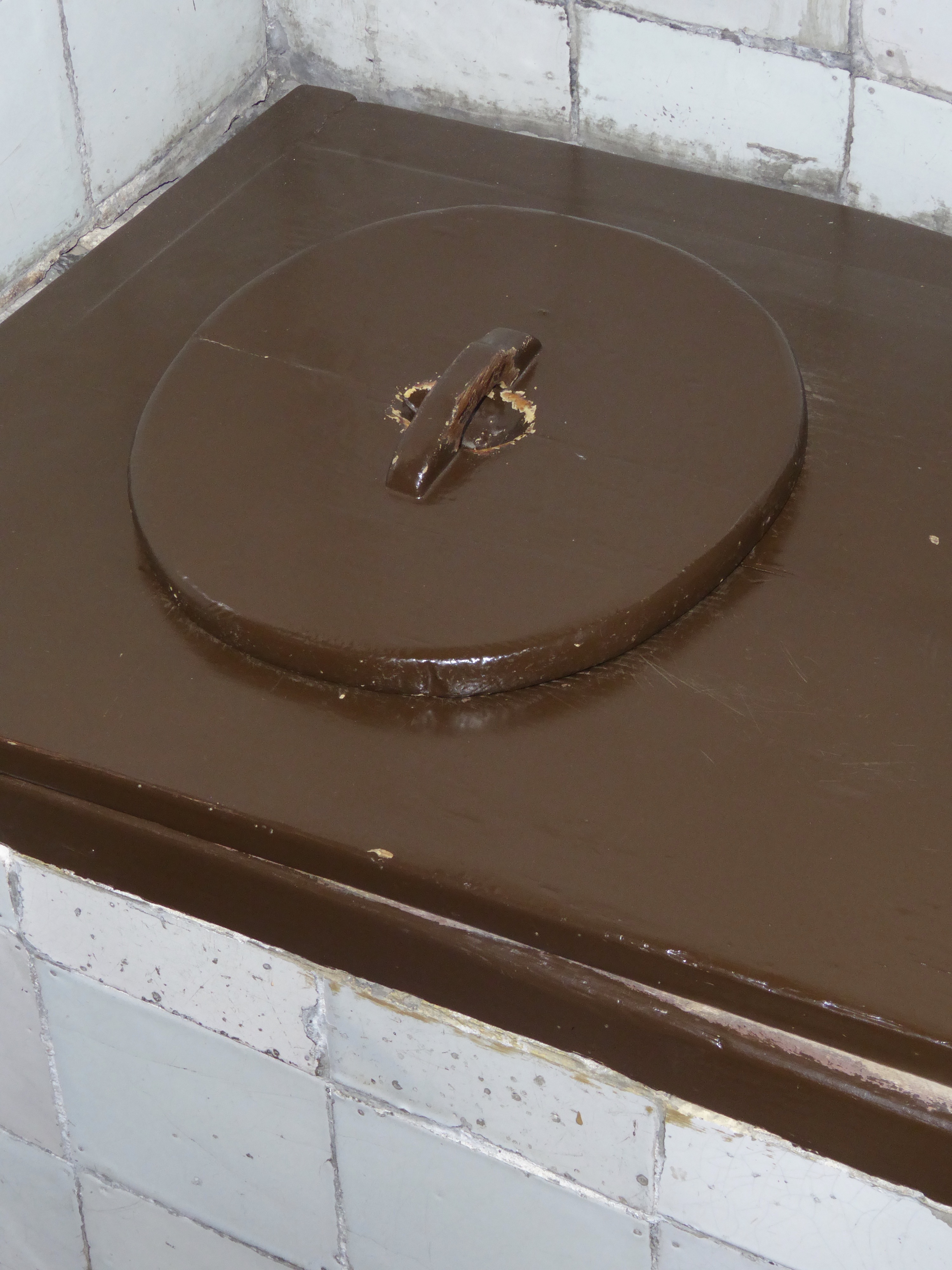
The toilet for the regular house. If you lift the lid there’s a hole, but I don’t know where it goes (probably down to the canal).
The interior of the church, which occupies the top three floors. It’s a complete Catholic church, with one altar room (with a Mary statue), a confessional, and a room for the priest to change clothes.
It’s not large, of course, and you can see the vertical beams and crossbeams necessary to hold the whole thing up, since gutting three floors would cause serious weakening of the structure. Hidden in the altar is also a clever fold-out lectern from which the priest could expound after the services.

The confessional. You would kneel in the right room, and talk to the priest in the left room through a wooden screen:

Two views of the church organ:


The priest’s bed, also a box bed:

On the walk home there was not one but TWO stores that sold rubber ducks. It’s very curious but they were doing big business. Here’s one of the two stores:

There were ducks representing all avocations and professions; you can see business ducks, German ducks in lederhosen, academic ducks, chef ducks, and so on.

The interior, with a myriad of quackers:

This must be a John Lennon duck, but touting geese. (BTW, we passed the old Amsterdam Hilton, when John and Yoko had their “bed-in” right after they were married in 1969, using the even to promote world piece.

There was also a “Cannabis Museum”, and I think I went into a similar one on my last visit to Amsterdam. They don’t sell weed there; for that you must go to a coffee shop. If you’re looking for the stuff in Amsterdam, I’m told that any “Coffee Shop” in which “Coffee” uses the English spelling, also has cannabis. (“Coffee” in Dutch is spelled “koffie”.)

And of course these are ubiquitous. Even if you don’t think you’d like french fries the Dutch way, served with mayonnaise, give it a try. I now like them even better that way than with catsup:

Nearby was the famous Dam Square, one of the few large open squares in the downtown. This year it was filled with protests—not only pro-Palestinian protests but Tamil protests from Sri Lanka, Falung Gong folks from China, and even vegans. Here’s one anti-Israel display. Note the Star of David with a skull in it and the misspelled “westers imperialism”:

We stopped at a small cafe outside of town for a beer and lunch. I was told that if I wanted something really local, I should try “Bitterballen,” which Wikipedia says are actually pretty complicated to make. They are. . . .
. . . . a Dutch meat-based snack, made by making a very thick stew thickened with roux and beef stock and generously loaded with meat, refrigerating the stew until it firms, and then rolling the thick mixture into balls which then get breaded and fried. Seasonings in the base stew usually include onions, salt and pepper, parsley and nutmeg.
You dip them in mustard. The outside is crispy but beware: the inside is piping hot. Inside is a beefy mixture with the texture of mashed potatoes. They were very good, especially with a beer.

And an appropriate picture taken the day before I winged my way home. This is a beautiful Eurasian Magpie (Pica pica) hanging around the cafe, perhaps hoping for a snack.

So it’s farewell to the Netherlands, though I’m sure I’ll return. Thanks again to all my friends who took a lot of trouble to show me around and introduce me to Dutch (and Balinese) cuisine, arrange for my talks and for a video re-do of The Deplatformed Discussion, take me to hear fine music, show me signt of touristic interest, and let me meet a cat who drinks weirdly.
All around a great trip!
I wonder if the rubber duck stores are so tourists can send ducks down the canals.
Is it just me, or is the “Israel born of…” sign actually great PR? Lose the skull in the Star of David and you have an actual tangible benefit of colonialism and imperialism: Israel! The “terrorism” isn’t quite right but we could work on that. “Armed struggle” maybe? But not bad that what is intended as a condemnation of Israel can be so easily turned into an endorsement of the means that birthed her.
Yes, I was thinking, they say “born of British colonialism” as if it were a bad thing.
Not noticing the benefits of Colonialism and especially settler colonialism is the first principle of postcolonial studies.
Apart from that I doubt whether Israel was born of British Colonialism. British Machiavellian help to dismantle the Ottoman empire, then in fact a constitutional monarchy with a fully democratically elected parliament, but itself born of Ottoman colonialism, is more like it. Even without the British mandate (which was not classic colonialism), the Yishuv would have done what it did after Ottoman power was gone. The Arabs weren’t much of a hindrance.
Fearing that sleeping lying down would cause death seems like a weird fear. Surely they knew that in other countries people didn’t sleep sitting up and weren’t dying off like it was “Nightmare on Elm Street”?
All new parents place their babies on the back to sleep now and avoid blankets even though the difference that makes to the risk of SIDS (itself very rare) is small. If it’s received opinion among doctors, you do it. I think it was something like that.
Sleeping in a semi-sitting position does have proven benefits for the health of the lower respiratory tract (prevention of pneumonia in people who are relatively immobile.)
I was thinking it likely reduces the risk of death for those with sleep apnea, which is worsened by sleeping on your back.
The bitterballen look and sound excellent.
Ah, this is wonderful, thank you PCC(E)!
Personally I see the “deplatforming” as a badge of honor –
“And yet it moves”
(Paraphrase attributed to Galileo)
What a great adventure!
I’m surprised there was an organ in the hidden church. Organs are VERY loud.
I must say I like the look of the bed boxes! If I could sneak into one without my toddlers seeing I think my quality of life could go up significantly. Can you lock them from the inside?
And that anti-Zionist sign! Could you imagine being able to demonstrate so much stupidity/lack of historical knowledge in so few words? It’s actually quite impressive.