Readers’ wildlife photos

December 13, 2024 • 8:15 am

Well, folks, this is the penultimate batch of photos I have, so if you don’t contribute, the feature will die. Don’t make me beg.

Today, though, we have a contribution from reader Lukas Konecny, who has provided some introductory notes (indented). You can enlarge his photos by clicking on them.

Some of these nature shots are quite old and I have never had a good camera, but I tried to pick some good ones (some of the grasshopper photos may need zooming in and cropping but when I tried to do that, my software always distorted the photos). The cicada is from Greece (it sits on a wire rope), the rest are from Slovakia, the mushroom was in a forest and the dragonfly in my university dormitory in Bratislava while others (owls, hummingbird hawkmoth, cat, grasshopper) are all from a garden.  The autumn owl (in a cherry tree) is from the same year (2015) as the spring owlet (in an apricot tree) so it might be the same bird. The grasshopper and the cat are from this summer – the cat watched me while I was releasing the grasshopper that had made its way to my room during the night and to my relief didn’t immediately attack it but let it fly away in peace. Maybe nature finding its way into human spaces is the common theme (except for the mushroom, that’s just autumnal feeling).

Amanita muscaria:

Cat:

Cicada:

Dragonfly:

Grasshopper photos:

Macroglossumm a hummingbird hawkmoth:

Owl, autum:

Owlet, spring:

Readers’ wildlife photos

November 25, 2024 • 8:15 am

Today’s batch features fall colors of both plants and birds, with the photos taken by UC Davis ecologist Susan Harrison. Susan’s captions are indented, and you can enlarge the photos by clicking on them.

Fall colors, and a different kind of travelogue

As the events of November unfolded, I went off on an alternative type of nature appreciation trip:  that is, I availed myself of Oregon’s opportunity to legally consume psilocybin mushrooms (Psilocybe cubensis) in a safe and guided therapeutic setting.   Michael Pollan’s recent book had made a good case for the value of “changing your mind” via taking such a journey (as its practitioners call it).

Ineffability, or the sense of meaningfulness far beyond words, is one of the hallmarks of psychedelics.  So all I’ll say about my journey – since it’s relevant to a Reader’s Wildlife post – is that it engendered all-consuming feelings of appreciation for these things:  the world’s astonishing beauty, the sharing of beauty with others, gratitude, and laughter.

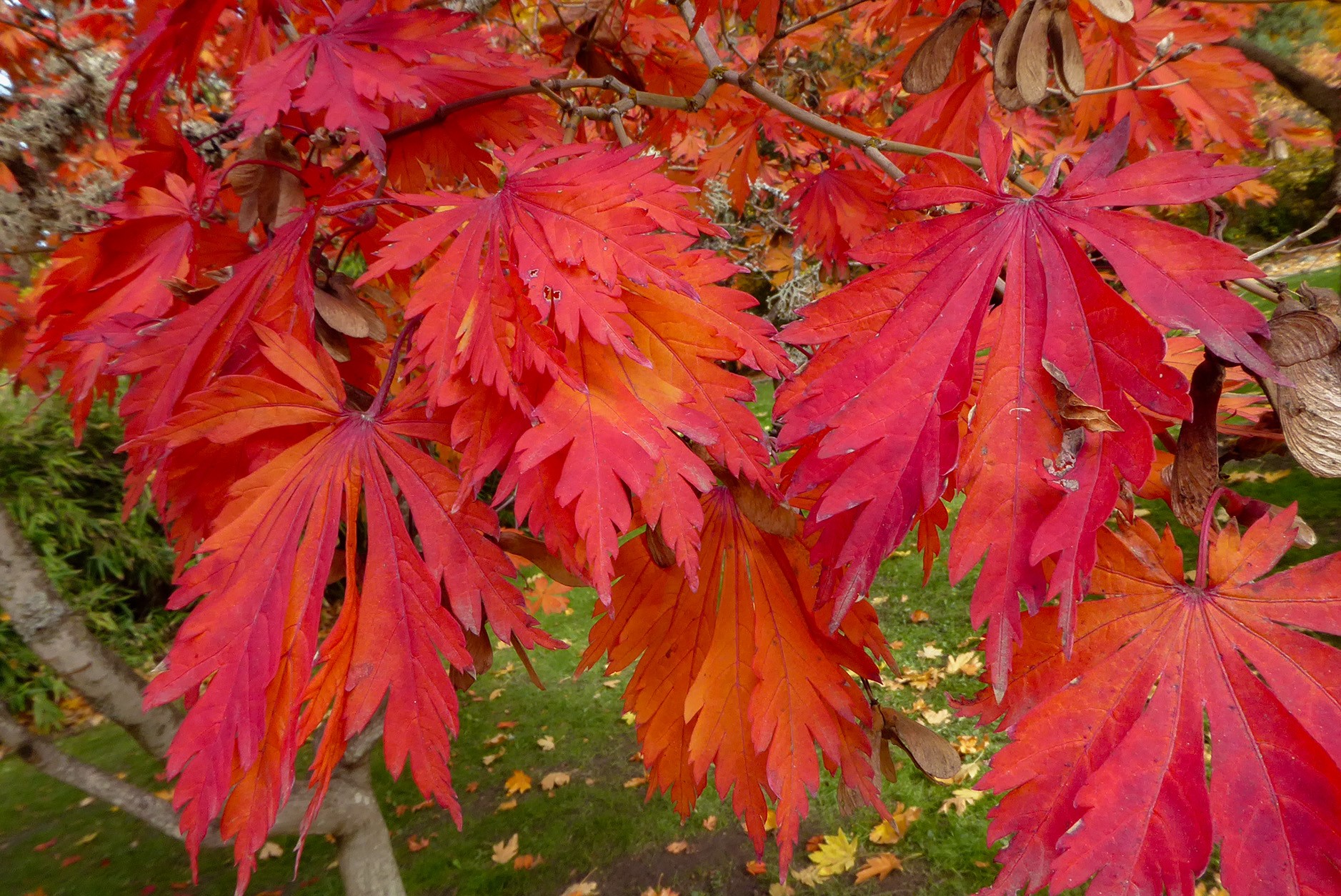
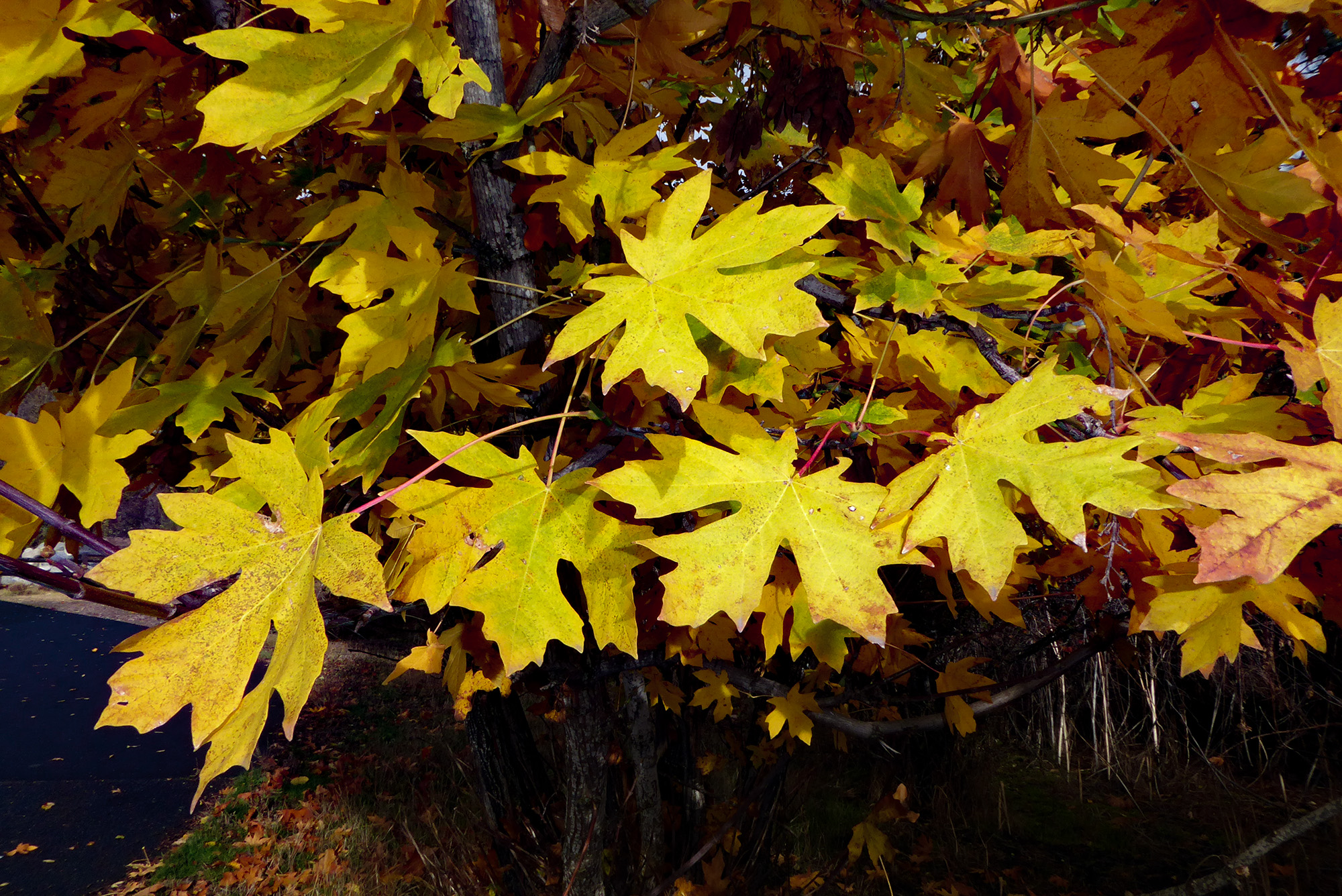
In the ensuing days, what better way to nurture such thoughts than to wander around in the fall colors with a camera?   Here is some of the beauty that I’m grateful for the chance to share, mainly from Ashland’s Lithia Park (the last two are from North Mountain Park).

The red foliage is various ornamental maples (Acer), the large yellow leaves belong to the native bigleaf maple (Acer macrophylla), the tall conifers are coast redwoods (Sequoia sempervirens), and there’s a late-blooming azalea (Rhododendron):

The birds are courting Wood Ducks (Aix sponsa), a Fox Sparrow (Passerella iliaca) and a Red-Shouldered Hawk (Buteo lineatus):

Readers’ wildlife photos

November 9, 2024 • 8:15 am

I have only two wildlife contributions after this one, so the feature is moribund.  If you have wildlife photos, please send them in.

Today’s photos are a diverse set, but all were taken in Utah by reader Michael Buckner, whose notes are indented below. You can enlarge the photos by clicking on them.

Only one of these is a “wildlife photo” in the strictest sense, but our host’s recent trip out there reminded me of what a beautiful place Utah is. I’ve been there several times myself, including in April 2014 and again in October 2019. (I tend to like traveling in spring or fall, sometimes in conjunction with some convention or meeting, and sometimes not.) The cameras I used were Nikon digital cameras; not cell phone cameras, but nothing extremely elaborate or “professional”.

While Utah is most notable for its great natural beauty, the state’s human geography is also quite interesting and photogenic. Salt Lake City is a very appealing city (and sort of the exact opposite of Las Vegas, I suppose). I don’t think Mormonism is worth anything as a system of truth claims, but it has made for some very fine looking buildings, as in this picture of the Salt Lake Temple, taken in April 2014 when I was at the American Atheists national convention in Salt Lake City. (I couldn’t go inside, as you literally have to have a special ID from the Mormon Church to do that):

From that same trip, a classic American state capitol building, the State Capitol Building of Utah, nicely situated on a hill overlooking the city:

The interior of the state capitol building, all gleaming white marble:

Bryce Canyon is absolutely stunning; our host already shared a number of beautiful landscapes, but I’ll include this picture from October, 2019 (the sole time so far I have attended CSICON, as it happens). to emphasize that not only are the shapes delightfully weird, but the colors are stunningly vibrant.

And also this picture from Bryce Canyon National Park, of this quite handsome corvid. Alas, I didn’t think to get a picture of anything to give a good sense of scale (the bird was perched on a sign, quite close to me) so I’m not sure if this is an American crow (Corvus brachyrhynchos) or the larger common raven (Corvus corax), both of which I believe can be found in the park:

From Arches National Park in April 2014. From the landscapes you find in Utah, you can almost see why the Mormons would come up with theories of lost prehistoric civilizations:

From the same trip to Arches National Park, I think this one looks like the remains of same ancient fort (even though it isn’t of course):

This rock formation in Arches National Park looks like an elephant!:

One of the nice things about traveling in spring is that you can see lovely wildflowers (from Arches National Park). I think these are especially poignant given the backdrop of the harsh red desert soil. [JAC: Can anybody identify these?]

Also from April 2014, the landscape of Canyonlands National Park, seen from the Green River Overlook:

From Grand View Point in Canyonlands; including more “ruins”, in this case what looks like the remains of some impossibly huge wall (presumably to keep out giants):

This is not even a park, just a “view area” (the Spotted Wolf View Area by the side of the Interstate 70), taken on the October 2019 trip:

Finally, this last picture is more Arizona than Utah, from Monument Valley (a Navajo Nation tribal park which straddles the border between those two states). It’s a magnificent landscape, and also iconic—if you’ve ever seen a Western movie, there’s a good chance you’ve seen this place. Taken in April 2014:

Readers’ wildlife photos

October 12, 2024 • 8:15 am

Oh no, we’re running low. That’s a poem, but it’s true. Please send in your wildlife photos if you have good ones. Where, for example, has Athayde Tonhasca, Jr. gone with his instructive biology + photo stories.

Well, today we do have photos—a group contributed by ecologist Susan Harrison from UC Davis. Her captions are indented, and you can enlarge the photos by clicking on them.

A hunt for red in October

Here on the West Coast, autumn foliage seldom gets more chromatically intense than yellow to rusty orange.   But the arrival of fall around Davis, CA, is heralded by piles of brilliant red tomatoes along the roads. These fruits have struck asphalt upon falling off of trailer-truck bins 10 feet high traveling at highway speeds, and yet many of them remain unbroken.  For this miracle we can thank the crop scientists who, in the wake of 1960s farmworker shortages, created a mechanically harvestable tomato that transformed the farm landscape. You wouldn’t want these tough beauties on your salad, but they are cannery fodder:

Contemplating the annual tomatocalypse made me wonder if equally vivid reds could be found in nature at this time of year, when most flowers, fruits, and bright-plumaged birds are gone from northern California and southern Oregon. It took both some searching outdoors and some resurrecting of past photos, but here’s what I found.

Acorn Woodpeckers (Melanerpes formicivorus) on a granary tree:

Lewis’s Woodpecker (Melanerpes lewis), a species that often looks black, and is surprisingly hard to catch flashing its full colors in the sunlight:

Northern Flicker (Colaptes auratus):

Red-Breasted Sapsucker (Sphyrapicus ruber):

Spotted Towhee (Pipilio maculatus) with devilish eyes:

Red-Eared Sliders (Trachemys scripta elegans); the large female was being courted by the smaller male, who kept swimming in front of her and waving his claws in her face:

California Fuchsia (Epilobium canum), a fall-blooming favorite of hummingbirds and gardeners:

Manzanita (Arctostaphylos manzanita) stem, with live bark surrounding a lichen-covered dead patch, illustrating how the slippery red bark may be effective at preventing the attachment of other organisms (lichens, insects, fungi…):

Manzanita berries, the bright color of which seems puzzling since the seeds are thought to be mainly dispersed by mammals, which have monochromatic vision; I’ve spared you the ubiquitous sight of berry-packed coyote droppings:

Black-Tailed Deer (Odocoileus hemionus) fawn, eating admittedly non-native apples:

Readers’ wildlife photos

September 28, 2024 • 8:15 am

Today we have part 2 of Chris Taylor’s journey to Queensland (part 1 is here). His captions are indented, and you can enlarge the photos by clicking on them.

In this part I will show some of the wild life around the reserve at Yourka.

Yourka is a Bush Heritage Australia reserve in the Einasleigh Uplands bioregion in Far North Queensland, not far from Cairns. Its 43,500 Ha covers the region from the Wet Tropics of Queensland World Heritage Site in the east down to the Herbert River valley in the west, and protects a range of habitats. There are a number of endangered species on the reserve, including a population of Mareeba Rock Wallaby.

We took the bus up to Atherton, where we were met by reserve staff who drove us the rest of the way to the reserve, where we arrived in the lovely tropical twilight:

There had been a quite intense and long-lasting Wet Season this year, and so the billabong on Sunday Creek, just 100m from the accommodation, had plenty of water in it.

I went for a walk around the billabong. With plenty of water, there were also plenty of birds

A Great Egret, White-faced Heron, Egretta novaehollandiae, and a Royal Spoonbill, Platalea regia, hunted in the water among the waterlilies:

Further around was a White Ibis, Threskiornis molucca, next to another Heron:

A Great Egret, Ardea alba, was feeding amongst the waterlilies in the shallows. This is quite a big bird, standing up to 1m tall:

One of the Royal Spoonbills took off and landed in a Eucalypt tree:

I tried to get a photo of the bird’s remarkable beak. The bird stirs up the bottom of the pond and then swings the broad end of the bill through the water, detecting any arthropod or fish prey which it will then capture and swallow:

A Forest Kingfisher, Todiramphus macleayii, was diving from a tree branch to take small fish from the water. This photo was taken at Innisfail, not at Yourka, but I just wanted to show the glossy blue plumage of this bird!:

There was plenty to see around the Blue Waterlilies Nymphaea gigantea:

Many dragonflies were active.  This is an unidentified species, probably a female:

This is the male of the Blue Skimmer, Orthetrum caledonicum:

Readers’ wildlife photos

September 21, 2024 • 8:15 am

Today we have Part One of reader Chris Taylor’s photos from Queensland. His captions are indented, and you can enlarge the photos by clicking on them.

After having been unable to travel for the last five years, I was at last able to get away again, so my partner and I decided to escape the cold of Canberra’s winter and travel up to tropical North Queensland. We had arranged to go out to the Bush Heritage Australia reserve at Yourka again, but before going there we had some time to visit the rainforest near the coast. After flying in to Cairns, we drove up to our first campsite in Mossman.

Above the town, the pristine Mossman River flows through a steep sided gorge.

The rainforest here is said to be the oldest on earth. Many ancient plant families are preserved here, including cycads, ferns and primitive conifers. We had a couple of short walks along the paths into the rainforest.

Our campground was on the banks of the Mossman River. A sign in the site was slightly alarming!

I’m not sure how often the crocodiles get up into the town.

But a few days later we travelled the few kilometres further north to the Daintree River, and there were plenty of crocodiles to be seen. There are two species of crocodile found in Australia, the smaller Freshwater Crocodile, and the larger Saltwater species.

This is a Saltwater Crocodile, Crocodylus porosus:

On the Daintree River, a dominant male will rule a territory of many kilometres of the river, and will keep a harem of females. The male will also tolerate a number of juvenile males until they are three or four years old, at which time they will be driven out of the area. Once fully grown they may return to the river to challenge the resident male for his territory and females.

This is a young male. He was only about 2.5m in length.

This is a female of breeding age. She is regulating her body temperature by entering the water, and gaping her mouth to the wind. There are many blood vessels in the roof of the mouth and this cools the blood going to her brain.

There is some concern in Queensland that climate change is having a big adverse effect on the crocodiles. The sex of the hatchling is determined by the temperature:  less than 32oC produces males, but over 34oC the litter is predominantly female. This warming, together with the effects of the flooding caused by Tropical Cyclone Jasper, has led to no young crocodiles surviving in the Daintree for two years.

We also saw the dominant male of this part of the river, a 5m long, 500kg animal known as Scarface.

He is thought to be at least 70 years old, and carries witness to many fights he has had to retain his kingdom. He has lost most if not all of his teeth, but is still able to feed, often on carrion that is carried down the river.

Lining the river banks are stands of Mangrove trees of different species. Here the mangroves are combining to form an island in the river. There are three different forms that the roots take to enable the tree to live in the brackish water.  All three can be seen in this picture.  Most obvious is the prop or stilt root system, where many roots branch off from the trunk of the tree and spread out to form a strong supporting network.  Then there are some that have Buttress roots flaring out from the trunk. These sometimes bend up above the surface before returning to the mud, and are called knee roots. Lastly there are the roots that stick up pencil-like structures known as pneumatophores. All of these are mechanisms that help the plant to regulate oxygen, salt and water intake and removal, and all help to stabilise the mud around the plant, as well as providing a habitat for fish and invertebrates to breed.

In amongst the mangroves were other creatures. This is a Little Pied Cormorant, Microcarbo melanoleucos, a very common bird around Australia.

Further upstream in one of mangroves was a Scrub Python, Simalia kinghorni:

This is Australia’s largest snake, growing to 5m and 20kg., but it is quite at home in the trees. It was resting in the sun when we first encountered it, but soon began to move around in the tree tops. This one was probably approaching the 3m mark. It was fascinating to see how it was able to span the gaps in the branches.

Back at Daintree we saw this White-Lipped Tree Frog, Litoria infrafrenata. This is the largest tree frog in the world. There are other larger frogs but these are unable to climb:

Back at Mossman, we photographed a Giant Orb Weaving spider, Nephila pilipes. This individual had a span across her legs of about 150mm, and a body of 25mm. Her web was rather more that 1m across!

Also in the campground were a number of Orange-footed Scrub Fowl, Megapodius reinwardt. These birds belong to the Megapodidae, along with the Brush Turkey that I will describe later:

There were also Olive-backed Sunbirds, Cinnyris jugularis, flying around the site. This one is a female emerging from the hanging nest made from woven grasses fibres and bark. It is the female who does most of the work of raising the two eggs laid in the nest:

There was also a spectacular display of Red Jade Vine, Mucuna bennettii. Introduced into Australia, this member of the Legume family is a native of Papua New Guinea:

Returning to Cairns for a night we were able to go for a swim in a nearby rainforest stream at the (crocodile free) Crystal Cascades:

Next morning, while waiting to board the bus to Atherton, we went to a café for breakfast. A cheeky Willie Wagtail, Rhipidura leucophrys, decided to join us in the hope of getting crumbs of food from the table.

Continued in Part 2.

 

Readers’ wildlife photos

August 1, 2024 • 8:15 am

Today we have a collection of photos from several readers. All of their captions and IDs are indented, and you can click on the photos to enlarge them.

First, three from Martin Riddle:

I take lots of nature photos around the campus of Brooksby Village, a retirement community in Peabody,Ma.

Ruby-Throated Hummingbird  (Archilochus colubris):

Hummingbird hawk-moth (Macroglossum stellatarum). [JAC: this is a great example of convergent evolution when taken together with hummingbirds]

American Painted Lady butterfly (Vanessa virginiensis):

From Norm Gilinsky:

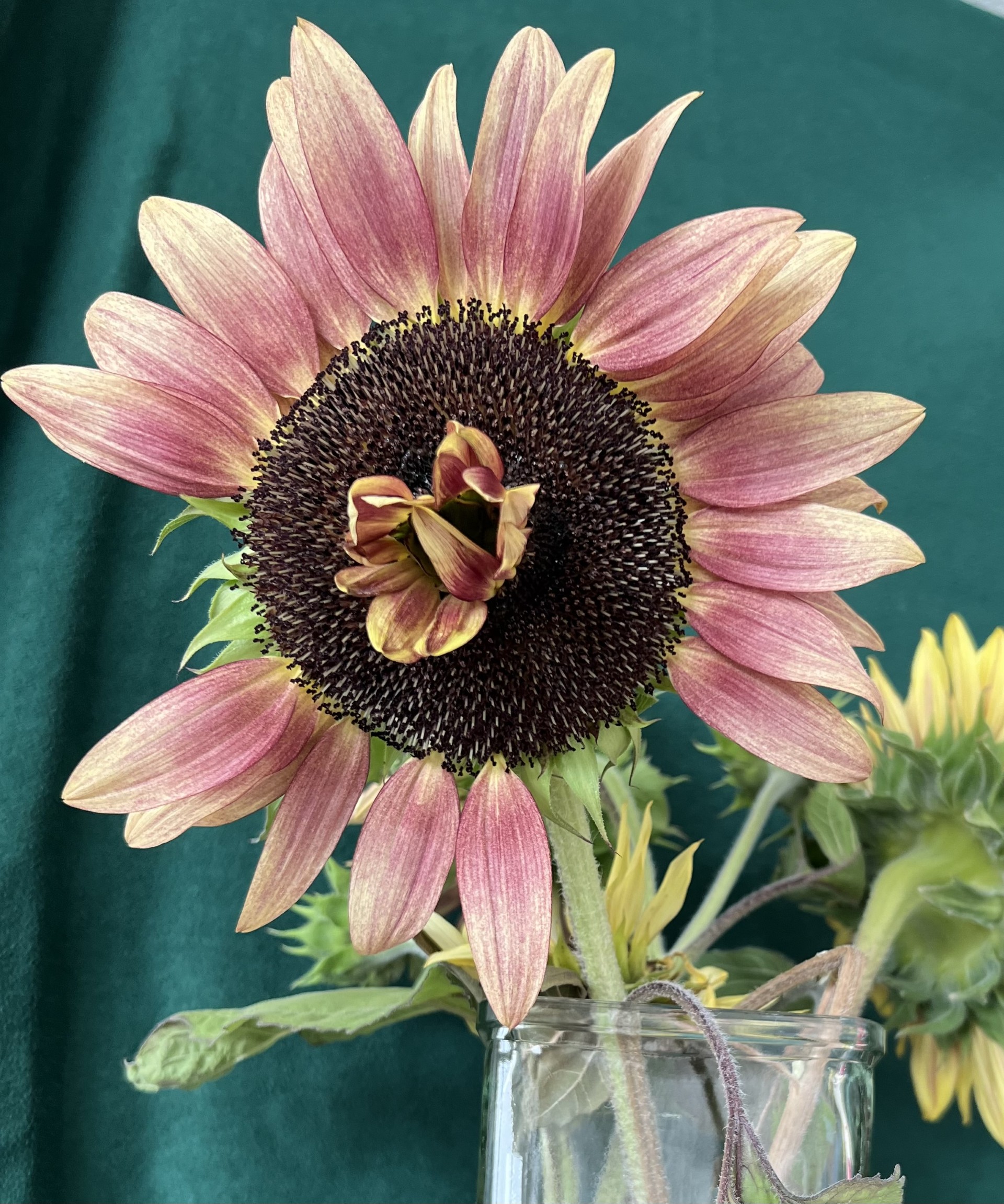
This is perhaps more of a conversation starter than an actual wildlife photo, but we found this seemingly unique sunflower in a field of sunflowers. This one is from a farm in Woodinville, Washington. It’s a cultivar of the Common Sunflower (Helianthus annuus).

What’s up with that? It’s a well-formed flower within the main flower. Since sunflowers are in the Asteraceae (Formerly the Compositae), it’s a composite within a composite. Strange and interesting:

From Simon Badderley:

Lin was walking down Democracy Street in our village when she saw this on the step of a derelict house in the middle of Ano Korakiana, Corfu.It’s a Giant Peacock Moth (Saturnia pyri), the largest moth in Europe, having a wingspan close to five and a half inches (140mm). It’s often thought to be a bat when flying at night. This is the female without the male’s feather-like antennae. The adult moth does not feed, but the caterpillar feeds on various deciduous trees including fruit trees and is regarded as a nuisance by fruit tree owners. These moths are active from March to late June. This one was almost inert, willing to be touched.

From Bryan Lepore:

 A photo of a green burgundy stink bugWikipedia says it’s Banasa dimidiata, the green burgundy stink bug, is a species of stink bug in the family Pentatomidae.”  Photo details: Taken in mid-Massachusetts: Middlesex county, July, 2024 – i.e. just a couple weeks ago. Mid-day, sunny, dry… on the recycle bin lid. iPhone 13 mini; enhanced photo:

And a lovely mountain from Larry Zelenak:

Not a wildlife photo, but maybe you can use it anyway, perhaps in a new series of best views from commercial plane flights.  This is Mt. Rainier on the morning of July 9 from an Alaska Airlines flight from SEA to RDU, taken with an older iPhone.