Caturday felid quadrifecta: How to meet street cats; why cats should sleep on their left side ; Cat Video Fest; Matt Damon’s Schwarzenegger cat; and lagniappe

August 2, 2025 • 9:30 am

We have four—count them, four—cat items this week as one arrived when I was writing this. Plus there are two items of lagniappe.

If, like me, you’re into meeting street cats as part of a trip (I sometimes carry cat food in my daypack and always try to pet a cat I encounter),  The Washington Post describes a new book that can help you. (click headline to read archived link, or go here if you can access the Post):

An excerpt:

Before a foreign trip, Jeff Bogle will learn a few key phrases in the country’s official tongue. For the Philadelphia writer, one term is as essential as please, thank you and bathroom.

The word he can’t travel without is “cat.”

“If I’m planning on asking people where the cats are or where I can find cats, I definitely put that in the arsenal,” said Bogle, who can say “cat” in French, Spanish, Italian, Arabic, Turkish, Croatian and Japanese.

For several years, Bogle has been doggedly searching for street cats around the world: in parks, medinas and open-air markets, on islands and cafe chairs, atop ancient ruins and garbage cans. More than a cat dad who likes to travel, he’s a tabby tourist, a subject he explores in his new book, “Street Cats & Where to Find Them,” available Aug. 19. Over some 200 pages — and in an interview with The Washington Post — he recommends his favorite spots for hanging with community cats on five continents, plus tips on dining, attractions, transportation and helping strays.

“The second I see a little cat in my peripheral vision, I’m like, ‘Okay, whatever, ancient Greece, I’m just going to follow this cat for the rest of the day,’” said Bogle, 49. “As I traveled, I would just spend all my time with cats.”

Yep, that’s me. Here I am feeding the resident cat “Gli” in the Hagia Sophia mosque (I had cat food in my backpack). She lived 16 years, dying in 2020.

More:

Bogle, a father of two daughters and four cats, frequently communed with felines on vacations and work assignments. Then, in 2023, he visited Istanbul, the promised land for cat lovers. He returned home from the “City of Cats” with thousands of cat photos on his phone, a sincere apology to his pets for his infidelity and the idea to write a guidebook about “feline-friendly” destinations.

“The book incorporates my two favorite things: cats, obviously, and traveling with an open heart and an open mind,” Bogle said. “I hope to help people understand what it’s like, not necessarily to be a cat there, but to be a human eating the food, talking to people and having, with any luck, a warm cat on your lap.”

Bogle highlights more than 20 places where visitors can interact with street cats in the Americas, Europe, the Middle East, North Africa and Asia, including respectfully observing them in Matera, Italy, and full-on cuddling with them in Lima, Peru. He also includes a sampling of cat cafes and other themed attractions, such as cat museums, a cat festival in Belgium and famous hotel cat ambassadors. Scores of photos illustrate cats being cats in extraordinary settings — not that they care.

. . .His favorite spot is Lima, where he said he would want to live if he were a cat. It’s a great place to be an ailurophile, too. In his “cat cuddle rating,” he awarded the Peruvian city five toe beans. Two other places — Istanbul, also known as Catstanbul, and Old San Juan in Puerto Rico — share this top honor.

“There’s fresh mulch and flowers, and the cats — there’s so many of them. They’re bouncing around, climbing up trees, sitting in trees,” he said of Lima’s Miraflores area. “There are hundreds of people — a great mix of locals and tourists — in this park day and night, and 1 out of every 3 people had a cat on their lap. They’re so loved.”

I don’t remember a lot of cats when I was in Lima, but perhaps it’s changed in the past couple of decades. Bogle also carries treats:

In many of the places he recommends, such as Parque Kennedy in Miraflores, Houtong Cat Village in Taiwan and Old Town in Paphos, Cyprus, volunteers set up feeding stations. Even so, he will still fill his pockets with treats purchased at a corner shop. He prefers dry food because of its portability and longer shelf life, though, on a trip to Lima, he and his wife brought packets of Churu, ambrosia for cats.

I had to look up Churu, but it’s here, and comes in little packets, just right for a cat treat.

Click below to get Bogle’s book on Amazon; it comes out on the 19th of this month:

*************************

There’s now a Cat Video Fest going on around America–and the world. It appears to be a recurring thing, and the AP reports about it:

The best of the internet’s cat videos are coming to the big screen this weekend. Cat Video Fest is a 73-minute, G-rated selection of all things feline —silly, cuddly, sentimental and comedic—that’s playing in more than 500 independent theaters in the U.S. and Canada.

A portion of ticket proceeds benefit cat-focused charities, shelters and animal welfare organization. Since 2019, it’s raised over $1 million.

The videos are curated by Will Braden, the Seattle-based creator of the comedically existential shorts, Henri, le Chat Noir. His business cards read: “I watch cat videos.” And it’s not a joke or an exaggeration. Braden watches thousands of hours of internet videos to make the annual compilation.

“I want to show how broad the idea of a cat video can be so there’s animated things, music videos, little mini documentaries,” Braden said. “It isn’t all just, what I call, ‘America’s Funniest Home Cat Videos.’ It’s not all cats falling into a bathtub. That would get exhausting.”

Now in its eighth year, Cat Video Fest is bigger than ever, with a global presence that’s already extended to the UK and Denmark, and, for the first time, to France, Spain, Japan and Brazil. Last year, the screenings made over $1 million at the box office.

In the early days, it was a bit of a process trying to convince independent movie theaters to program Cat Video Fest. But Braden, and indie distributor Oscilloscope Laboratories, have found that one year is all it takes to get past that hurdle.

“Everywhere that does it wants to do it again,” Braden said.

Current theatrical partners include Alamo Drafthouse, IFC Center, Nitehawk, Vidiots, Laemmle and Music Box. The screenings attract all variety of audiences, from kids and cat ladies to hipsters and grandparents and everyone in between.

Here’s the official trailer:

You can see where the videos are playing, read more about them, and buy your tickets here.

************************

An article in Current Biology (click headline below to read, or find the pdf here, Cats, like humans, tend to sleep on one side (I sleep on my right side, always), but the article wonders why there should be this directionality.

About two-thirds of cats prefer to sleep on their left side. Pictures of cats from unsplash: left cat courtesy of Noah Dustin von Weissenfluh (@noah_dustin), right cat courtesy of Gleb Kuzmenko (@badfantasy).

Here are the data compiled from YouTube videos of 408 sleeping cats: 65% of the moggies sleep facing leftward, though it looks to me that the directions are reversed in the photos below. Isn’t the “leftward facing cat” actualoly facing towards its right?

About two-thirds of cats prefer to sleep on their left side. Pictures of cats from unsplash: left cat courtesy of Noah Dustin von Weissenfluh (@noah_dustin), right cat courtesy of Gleb Kuzmenko (@badfantasy).

The cat on the left is indeed sleeping on its left side, but what does “rightward” mean?

Why should sleeping position be directionally lateralized? According to the authors, sleeping this way, which alerts the right side of the brain (they have the same visual/brain crossover that we do), is better because the right side of the brain is more specialized at detecting predators. (This leaves aside the question of why the brain should have any specialization of its sides, but they also deal with that, too.)  Here is the abstract, which is a bit science-y, but you should see which side your cat sleeps on and report in the comments:

Both vertebrates and invertebrates show a multitude of left–right asymmetries of brains and behaviors. For example, cats, dogs, and many other species have a preferred paw when handling food.   But why should humans and other animals have lateralized brains? Based on a large comparative approach, it is likely that asymmetries serve several purposes. First, by specializing on one limb or one side of its sensory system, the contralateral hemisphere goes through life-long cycles of motor and perceptual learning, thereby increasing the speed of processing and motor efficacy, decreasing reaction time, and enhancing discrimination ability. Second, by having two complementary, specialized hemispheres, neural processes are computed in parallel, thereby reducing cognitive redundancy. For example, the right hemisphere excels in processing threat-related stimuli, providing the left visual field an advantage in reacting to a predator approaching from the left.  Here, we report that two-thirds of cats prefer a leftward sleeping position, giving their left visual field and thus their right brain half a privileged view of approaching animals without being obstructed by their own body.

The conclusion:

. . . . we are inclined to believe that the significant leftward bias in sleeping position in cats may have been evolutionarily driven by hemispheric asymmetries of threat processing, but additional factors cannot be excluded. Although this finding is subject to debate, it could provide an excellent opportunity to study the emergence of asymmetries at the population level, while also helping us to learn more about the nature of one of our favorite pets.

My remaining question is why ANY cats sleep facing the “wrong” way. Is it because domestication has eliminated the threat of predation, so now each cat sleeps the way it finds most comfortable? And what about truly wild cats like lions and cheetahs. Sadly, the authors missed a golden opportunity here: go to zoos and look at truly wild cats only a couple of generations removed from the wild.  If they show the same hemispheric bias—and they should—then the directional bias should be even stronger. (You could even observe sleeping lions in the wild.) Why didn’t they do this?

************************

Here’s a video in which Matt Damon recounts how he adopted a domestic cat they found in the Costa Rican jungle and went to extreme lengths to save his life when the cat got a brain tumor. It seems to have worked!

***************************

Lagniappe: a cat makes a big jump into its owners arms. Look how it extends its front paws before it lands:

Extra lagniappe showing the sculpture of an ancient Egyptian cat and her kitten. It’s the god Bastet! It’s from Facebook; click on the sculpture to go to the original.

h/t: Nicole, Loretta

Readers’ wildlife photos

August 2, 2025 • 8:15 am

Today we have some lovely tidepool photos from Intellectual Heros Abby Thompson at Davis. Her captions are indented, and you can enlarge the photos by clicking on them. Thanks to her and other people who sent in photos yesterday. They will all eventually appear.

Some pictures from the late May northern California tidepools, starting with an Anthopleura artemisia (moonglow anemone). I’ve posted several of these; they have strikingly different colors and patterns. This one seemed particularly photogenic:

Anthopleura sola (Sunburst anemone). These are common, large, and occasionally this spectacular, almost fluorescent, green (they all fluoresce under UV light).

Lissothuria nutriens (Dwarf sea cucumber). This looks like a stray chunk of starfish (it was about 1” long).   You can see a few of its tube feet sticking out of the side.   If caught at the right time of day, or tide, the pinkish area on the left side would expand into frilly tentacles (see the next picture from a few years ago).

Lissothuria nutriens (from 2020) showing the tentacles:

Genus Caprella. The caprellid shrimps are everywhere, like a Greek chorus for the rest of the sea life.     This one is pregnant- you can see the eggs in her belly:

Eubranchus rustyus (homely aeolid) nudibranch:

Epiactis handi. This is an uncommon species of Epiactis, named after the biologist Cadet Hand, who was a Director of the Bodega Marine Lab: There is (only) one cluster of these that I’ve found in a cave-like bit of the coast.   It’s distinguished by the beautiful swirling pattern on its disk, and the way sand and other debris adheres to its column, unlike other Epiactis species:

Velutina velutina (velvet shell, a snail):

Geitodoris heathi (Heath’s dorid, nudibranch):

Tonicella lokii (flame-lined chiton) One of the loveliest chitons on our coast, with its snappy pink and blue zig-zag:

Saturday: Hili dialogue

August 2, 2025 • 6:45 am

Welcome to the first CaturSaturday in August: it’s Saturday, August, 2, 2025, shabbos for Jewish cats, and National Ice Cream Sandwich Day.  Here’s a rating of ice cream sandwiches, including many new brands. If you want to skip the palaver, the winners comprise the fairly new ice cream sandwiches made by Pop-Tarts, known already for its toaster pasteries.

It’s also Dinosaurs Day, National Mustard Day, International Blues Music Day, Mead Day, and National Jamaican Patty Day.

Readers are welcome to mark notable events, births, or deaths on this day by consulting the August 2 Wikipedia page.

Da Nooz:

*The Washington Post, a big booster of Kamala Harris in the last election, is now beefing that she’s making a return to the political spotlight. Apparently they realized too late that she was not someone who can help the Democrats, and want her to go away at all costs. (They go after Biden, too, but he’s no longer a force in elections.)

Former vice president Kamala Harris is promoting a book about her losing 2024 presidential campaign, leaving the door open to another White House bid in 2028 and building a group that would enable her to hit the trail for fellow Democrats in the midterms.

Former president Joe Biden told a gala of judges and lawyers Thursday night that President Donald Trump’s administration was “doing its best to dismantle the Constitution.” Such sparring with Trump, combined with congressional hearings and campaign books, has kept Biden in the news, along with questions about his health and acuity in the White House.

Democrats are eager to turn the page on their 2024 losses — but their central figures from the last election keep stepping back into the spotlight, complicating their efforts to forge a new identity. Many in the party are wary of elevating the people who led them to defeat in 2024 and exasperated to see the drama of that election repeatedly relitigated when they want to keep the focus on pushing back against Trump’s second-term agenda and identifying new leader=

. . . . “The shadow of 2024 is long, and I think all perspectives in the mix believe we need something fresh,” said longtime Democratic consultant Donna Bojarsky. Many Democrats do not blame Harris for what went wrong last cycle, she said, “But nobody’s saying, let’s go back to 2024.”

Plenty of other Democrats are building their profiles and making moves to lead the party forward. Governors such as Andy Beshear of Kentucky and JB Pritzker of Illinois and members of Congress such as Sen. Ruben Gallego (D-Arizona) are taking their pitches around the country in early jockeying for 2028. A little-known state lawmaker, Zohran Mamdani, has emerged as a prominent new voice for the left after winning an upset victory in the New York City mayoral primary.

She plans to dive into the 2026 midterm elections and travel the country to campaign on behalf of Democrats in tough races as she shapes a political organization of her own, according to aides and confidants familiar with her plans who spoke on the condition of anonymity to discuss projects that are still in formation. Though some Democratic strategists and candidates are eager for Harris to help them in midterms, there is more skepticism about her running for the White House again in 2028 — an option she has not ruled out.

“I think most Americans are grateful for the service and contributions of the last generation of officeholders,” said Cooper Teboe, a Silicon Valley-based Democratic strategist. “But the core reason the Democratic Party is in the position it is in today is because no new figures, no new ideas, have been allowed to rise up and take hold.”

That’s absolutely right. We need leaders, and we don’t need Harris. Remember when she was touted as a figure of JOY by Democrats in the last election, while I was beefing about her word salads and seeming inability to think straight about anything? And yes, I was told to shut up about her because I was enabling Trump. It was a sad time when Democrats should have been finding a figure that actually had more savvy and was able to beat Trump.  Harris should stay as far away from the midterms and 2028 election as she can. But even if she throws her hat in the ring, it will be thrown right back out again.

*Thank goodness Nellie Bowles is back! Nobody can do the TGIFs at The Free Press nearly as well as she. Her column this week is called, “TGIF: My jeans are blue,” and I will steal the usual three items from it (indented):

→ Candace Owens has her Alex Jones moment: After spending more than a year trying to convince the world that Brigitte Macron is a man—which she’s now being sued for—Candace Owens is doubling down. “You were born a man and you will die a man,” she said, pointing to the camera. “That’s the point I’m making. . . . We are revolting against this. We’re revolting against the perverts that run the world, and I want to be very clear here, I count you among them. I think you’re sick. I think you’re disgusting. And I am fully prepared to take on this battle on behalf of the entire world. Okay? That’s what I’m gonna say. On behalf of the entire world, I will see you in court.” I mean, this is what I say every time I go to the doctor’s office and they tell me that I might benefit from less stress. Candace is lit up!

I’m always open-minded, so I studied the pictures. For hours. Zoomed in on places that I shouldn’t have. And I’m sorry, but Brigitte is obviously female. I know everyone thinks that trans tech has gotten so good, and it has, but… I don’t mean to be offensive, but it’s not that hard to determine these things. You can use your intuition. So after examining shoulders and posture, gait and facial expressions, mood swings and a hankering for cheese that tracked with world events, well, this broad? I can guarantee you for sure, Bob, this one’s a female woman.

Candace Owens is the most entertaining spectacle right now: She’s hot, she’s bonkers, she hates me specifically, and she’s about to go through massive litigation. Will there be discovery? Please, oh please, oh please. The French seem to think they can face down a true American loon. But they can’t handle our loons. The craziest person a French government official knows is the local drunk, or maybe an immigrant who did a one-off honor killing (which isn’t really insanity so much as just different cultural norms). Our loons, sober and confident, will break them. Our loons have never met a camera that they didn’t want to point their finger right at. They have never known doubt. They know their angles. The Bulwark says Candace is in real trouble, but I don’t know.

→ Professor, is that you? I love professors on social media, because they really make you understand why we need to burn down higher education (including my wife’s “university” that doesn’t even pay us anything, which shows lack of scamming skill on her part). This week we have a University of Toronto professor of religion telling writer and friend of The Free Press Jesse Singal that he should kill himself. Before you defend him, you should know that Jesse Singal sometimes writes moderate takes about issues like pediatric gender transition. But he’s not a radical, I guess? Here’s the professor, apparently explaining why Jesse’s death would be a good thing: “Hey Jesse, it’s likely because you’re a piece of stinking hot trash and your loss would be a major W for humanity. Maybe stop being a fucking human stain, and see what happens. Fucking clown.” This is a niche and sort of random item, except that all the cool leftists this week are celebrating the murder of a Blackstone executive. It’s odd how normal this all has become. In debating whether to cut this item, our copy editor said: “Jesse gets comments like that 20 times a day, really.” And that’s true. But the glee over the slaughter of the Blackstone exec makes me realize: These people actually, honest-to-god want guillotines. It’s not a figure of speech. Be careful out there, Jesse! The religion professor is going to claw your eyes out, literally!

→ City-funded nonprofit grocery store update: Amid New York City mayoral candidate Zohran Mamdani’s calls for government-run grocery stores, reporters have been exploring a nonprofit-operated, government-supported grocery store in Kansas City, Missouri. The reporters found what you might expect if you’ve ever imagined a communist grocery store: The shelves are almost completely bare; what food remains is rotten, and there was rampant theft. “A rotten smell comes through the door, and anywhere you turn, you’ll see products that need to be restocked. No hot food or deli.” I’ve said it before, but we at TGIF cannot wait for Mamdani grocery. In this house we eat rotten acorn squash.

There is a photo, but I cannot vouch that it’s the Kansas City store:


*Here’s a good idea. South Africa is starting to inject rhino horns with radioactive material to stop the killing of rhinos for their supposedly medically-valuable horns. From the BBC:

South African scientists have launched an anti-poaching campaign in which rhino’s horns will be injected with a radioactive material.

The group, from the University of the Witwatersrand, said the process is harmless to rhinos but will allow customs officers to detect smuggled horns as they’re transported across the world.

South Africa has the largest rhino population in the world, and hundreds of the animals are poached there every year.

The university’s venture, called the Rhisotope Project, cost around £220,000 ($290,000) and involved six years of research and testing.

“At least one animal a day is still being poached,” James Larkin, a Wits University professor involved in the project, told the BBC.

“I think the figures are only going to go one way if we don’t watch out…. this is a significant tool to help reduce the numbers of poaching, because we’re proactive rather than being reactive.”

Prof Larkin added that the pilot study, which involved 20 rhinos, confirmed that the radioactive material was “completely safe” for the animals.

The Wits University researchers, who collaborated with the International Atomic Energy Agency, found that horns could even be detected inside full 40-foot (six-metre) shipping containers.

Jamie Joseph, a prominent South African rhino campaigner, said the Rhisotope Project was “innovative and much needed”.

“It’s not the endgame – only better legislation and political will can bring an end to the rhino crisis. But it will certainly help disrupt the flow of horns leaving the country and help experts better map out the illegal channels by providing reliable data,” Ms Joseph, director of the Saving the Wild charity, told the BBC.

Note that this is supposed to work not by stopping the rhinos from being killed directly, but indirectly—by taking away the profitability associated with killing and smuggling. And the efficacy of that, of course, depends on whether the majority of smuggled horns can be detected. I hope so!

*A new paper in Cell, summarized by the NYT, reveals through genetic analysis that modern potatoes appear to result from hybridizatopn 8-9 million years ago between wild potatoes that lack tubers and tomatoes.  Actually, tomatoes and potatoes are not that distantly related:

According to a study published on Thursday, potatoes may have arisen nine million years ago through the combining of genetic material from Etuberosum, a group of potato-like plants from South America, and wild tomato plants. According to the study, this hybridization event led to the origin of the potato plant’s distinctive feature, the tuber, an underground structure that stores nutrients and, as humans eventually discovered, is edible.

“A potato is the child of tomato and Etuberosum,” said Zhiyang Zhang, a researcher at the Chinese Academy of Agricultural Sciences and the lead author of the study, which was published in the journal Cell. “We did this analysis and we found, ‘Oh, he’s a child of two plants.’”

Scientists have long noted that, aboveground, modern potato plants closely resemble the subgroup of South American species called Etuberosum. But Etuberosum plants do not bear tubers. And genetically, potatoes appear to be more closely related to tomatoes; both fall under the shared genus Solanum. This was confounding: Why did potatoes resemble one plant but share kinship with another?

To solve this enigma, a team of international scientists analyzed 128 genomes from the three sister lineages (tomatoes, Etuberosum, and potato plants and their wild relatives), plus three eggplant species as an outside group. The researchers found that the modern spud had a mixed ancestry, which arose from a hybrid tomato and Etuberosum lineages eight million to nine million years ago and led to the origin of tubers. This hybridization may have enabled subsequent potato species — there are more than 100 today — to diversify and expand their range across the high Andes, where colder climates prevailed.

“It was a very well-done study,” said Esther van der Knaap, a plant geneticist at University of Georgia who was not involved in the research. “It provides a model of how this could happen in many other cases.”

At first, the combination of two different plants may not have yielded anything noteworthy. “There’s some ancient mixing of genomes, and there’s some miserable plants coming out of that,” Dr. van der Knaap said. But over time — tens of thousands to perhaps millions of years — natural selection led to “a whole new species complex,” she said.

Now this hybridization was clearly not done by humans, as we hadn’t even diverged from the lineage leading to chimpanzees and bonobos that long ago.  But the hybridization event and attendant tubers are said by the authors to have allowed the proliferation of the petota group of plants, which includes the potato. (In the parlance, the evolution of tubers opened “a new adaptive zone”.)  Ergo, nascent spuds were already around when humans came on the scene.

*The Washington Post describes how humanitarian aid sent by the UN to Gaza was overwhelmed by the chaos of people demanding food, looting (it’s not clear by whom) and, implying Israel was responsible, IDF firing over the heads of the chaotic scene:

Shortly after 5 p.m. local time Wednesday, trucks carrying food from the U.N. World Food Program passed an Israeli checkpoint and entered the rubble-strewn no-man’s-land of northern Gaza. Immediately, they were overwhelmed.

“Hundreds of thousands” of aid seekers who had been waiting for hours surged to within 100 meters of the checkpoint, and Israeli troops began to fire rifle and artillery rounds, according to an internal WFP missionsecurity report seen by The Washington Post.

Soon, the U.N. convoy was overrun. Within three hours, all 47 trucks were ransacked. The convoy had barely traveled several hundred meters.

Israeli military officials confirmed troops fired warning shots to keep the crowd away and said they were not immediately aware of any casualties; a U.N. official and the security report said more than 50 people were killed and more than 600 people were injured during the mission.

The chaotic scenes on al-Rashid Street on Wednesday exemplified the desperation inside the besieged enclave and the challenges facing relief efforts. Even though Israel — under mounting international pressure — on Saturday announced looser restrictions on food entering Gaza, looting, shootings and bureaucratic impediments continue to plague aid delivery efforts almost daily. And despite Israeli promises that it would create secure corridors for aid deliveries this week, U.N. officials say the operational realities on the ground remain unchanged.

The result, according to humanitarian officials, is that conditions for vulnerable residents who live inside Gaza remain dire — with little of the aid being sent in ever reaching those who need it most, while injuries and deaths are rising during attempts by the United Nations to distribute food — because Israeli troops open fire to keep swelling crowds away from the convoys and from Israeli checkpoints.

Now I don’t believe the Gaza Health Ministry’s estimate of deaths in these scenes, but it’s clear that these chaotic scenes are taking place, but also that the IDF is not shooting to kill civilians. Rather, the IDF is trying, fruitlessly, to instill order.

What is the solution? I don’t know, but I suggest that they take the IDF out of the mixture.  The UN has its own army (UN soldiers are supposed to be keeping order in Lebanon), so why doesn’t Israel hand the whole food-distribution issue over to the UN, with UN soldiers instead of the IDF trying to keep order? Since the UN hates the IDF, and this chaos is always blamed on Israel, let the UN sort out how to do it.  There has to be a way, though I can’t think of one now, especially if Hamas is stealing some of the food. And yes, Israel should keep giving humanitarian aid, but funnel it through the UN.

Meanwhile in Dobrzyn, Hili again gives a long report on the doings of The Administrator:

Hili: I need to settle on a style for this month. John Stuart Mill is too serious, Alan Sokal too sneaky. Erasmus? In Praise of Folly? Looks like I don’t need to search any further. “People drug and delude themselves with many things in order to feel happy, such as alcohol and religion. People who brag about their wisdom and titles are stupid because it is silly to enjoy self-praise. It’s also a bad idea to brag about where you were born, who you’re related to, or your ethnicity. To be wise, one must examine the underlying realities, and those who boast about their knowledge are fools.”

That’s Erasmus. He showed that sometimes fools are wise, and the wise are fools.

We cats know how to combine modesty with genius – and that’s what I have to stick to.

In Polish:

Hili: Muszę sobie wypracować jakiś styl na ten miesiąc. John Stuart Mill zbyt poważny, Alan Sokal zbyt podstępny, Erazm? Pochwała głupoty? Chyba nie muszę dłużej szukać.

„Ludzie odurzają się i łudzą różnymi rzeczami, by poczuć się szczęśliwymi – takimi jak alkohol czy religia.
Ci, którzy przechwalają się swoją mądrością i tytułami, są głupi, bo czerpanie radości z samouwielbienia jest śmieszne.
Równie niedorzeczne jest przechwalanie się miejscem urodzenia, pochodzeniem czy przynależnością etniczną.
Aby być mądrym, trzeba przyglądać się temu, co kryje się pod powierzchnią, a ci, którzy chełpią się swoją wiedzą, są głupcami.”

To Erazm. On pokazywał, że czasem głupi są mądrzy, a mądrzy są głupi. My, koty, umiemy łączyć skromność  z geniuszem i tego muszę się trzymać.

*******************

From Masih, with the English translation being this:

In the hellish torture chamber of #QezelHesar, under fists, torture, and threats, the hands and feet of innocent prisoners have been bound, their heads covered with sacks, and their wounds have been attacked; the prisoners have reached out for help to the people. Let us not allow their breath to be buried forever within the walls of QezelHesar… #SpeakOfQezelHesar

Ghezael Hesar is Iran’s largest prison, and Wikipedia says this:

The Ghezel Hesar prison is infamous for its conditions. In March 2011, it made headlines when, according to official reports, 14 people were killed and 33 wounded during a prison revolt. The actual number of victims may have been higher. Former prisoners report torture and physical abuse by the staff, catastrophic hygiene conditions, and a lack of medical care. There are reports that clashes inside Karaj Ghezel Hesar Prison began when some prisoners protested against the execution of dozens of other prisoners. One hundred fifty people are said to have suffered serious injuries, and several dozens to have been killed. Sources close to the government have announced that 47 people have been killed or injured in this incident, yet this number differs dramatically from similar reports from independent sources.

May 2015 has seen mass executions of prisoners: between May 6 and June 10, 2015, at least 77 inmates, all charged with drug offenses, were executed in Ghezelhesar prison. The execution wave started after prisoners had gathered in the prison’s yard to ask Ali Khamenei for forgiveness.


From Luana.  The solution is not to abolish the bar exam, but have preparations in case someone has a heart attack during the exam (read the whole tweet). The tweeter is called “Ms. Free Palestine” because that’s how she identifies herself on her site.

Rowling smokes cigars! (This is the second time she’s mentioned celebrating by smoking one!). Lovely! She turned 60 yesterday.

From Malcolm, who says “beautiful”. I agree. This song is associated with Andrea Bocelli, but I love hearing a soprano hit the high notes. The singer is Ellen Williams, and you can hear the full YouTube version here.

From my feed. LOOK AT THIS CHONK!

One I reposted from The Auschwitz Memorial:

Two posts from Dr. Cobb. Unity Mitford was a British aristocrat who moved to Germany and turned Nazi. When she heard that the UK had declared war on Germany, she shot herself in the head. She died from that, but nine years later.

Unity Mitford – not only a horrible Nazi but also a terrifying example of nominative and locative determinism (again from @nybooks.com)

Matthew Cobb (@matthewcobb.bsky.social) 2025-08-01T08:56:58.417Z

Two posts  from mammoth expert Tori Herridge, who, along with Matthew and I, think that Colossal Bioscience’s “de-extinction” scheme is a crock:

Are we settled on No-a for the neo-Moa?

Tori Herridge (@toriherridge.bsky.social) 2025-07-09T21:19:43.029Z

🐺 and I submit Tire wolf, because it’s all just exhausting really

Tori Herridge (@toriherridge.bsky.social) 2025-07-09T21:43:37.028Z

Bonus: I reposted this one from Matthew helping him defend the critics of “de-extinction”:

Cui bono indeed. These critics happen to have the truth on their side; "de-extinction" is completely misleading, as there is no technology to bring back an extinct animal (much less several of them) with all their original genes.The proposed "wooly mammoth", says Tori, is an elephant in a fur coat."

Jerry Coyne (@evolutionistrue.bsky.social) 2025-08-01T11:54:41.413Z

Science-Based Medicine has its knickers in a twist about Krauss’s new edited volume—without having read it

August 1, 2025 • 10:45 am

Yes, Science-Based Medicine (SBM) used to be a respectable place, and, indeed, still has some good articles. But it also went “progressive”, as evidenced by its cancellation of the late Harriet Hall’s favorable review of Abigail Shrier’s book Irreversible Damage, its commissioning of a negative review to replace it (progressives aren’t allowed, you see, to deal with gender dysphoria in a rational manner), and then pushing upthe dumb claim that sex isn’t binary in humans or other species (see my post about the site and its views here).

SBM is back again with a woke-like and, frankly, blinkered and misguided take on a new collection of essays edited by Lawrence Krauss, The War on Science, which I describe here (note: Luana  Maroja and I have a joint essay as one of the chapters). Here it is, click the cover to go to the Amazon page.

The book, which has been over a year in the making, largely describes the inimical effect of the “progressive” Left on science. The point, of course, is to keep science as pure as possible by keeping it unpolluted by ideology.

But the SBM take on our book, highly negative, is below; click the screenshot below to read it.

And that’s the rub for SBM.  They have their knickers in a twist because it’s about the damage done by the Left, and, author Howard argues, we should have given all of our our attention to  the palpable damage that the Right is doing to science. In other words, he wanted both-sideism and didn’t get it.  As I wrote in my description of the new volume, it’s pretty clear that, right now, Trump and his minions are indeed doing more serious damage to science, though that will hopefully be undone when we finally (fingers crossed) get a Democratic administration. But the Left also continues to damage science, and that is what the book is about.

And it’s not that we have neglected Trump’s depredations on science either (just see my Nooz this a.m. for one of many examples in which I’ve gone after Trump’s attacks on science!) It’s just that the book is about what the Left is doing to science (the authors, by the way, come from all parts of the political spectrum.   And we can’t have that.

The most curious thing is that the author of the SBM screed—neurologist and psychiatrist Jonathan Howard—didn’t even read the damn book! He’s going by the table of contents alone as well as by the authors, whom he seems to despise en masse. Not only that, but he adds that he doesn’t think that other people should read the book, either. As he says.

So no, I wont [sic] read The War on Science. Even if contains some valid points, they are completely irrelevant, like being warned about a broken taillight as my car careens over a cliff. There is no reason why anyone should care about the flaws of DEI trainings, real or imagined, in 2025. None of it matters.

And though I don’t think anyone should read this book, its mere existence has great value. It both explains and memorializes how we got to this sad moment. Many renowned scientists and scholars, some of whom should have been valuable allies, were blind to the real danger until it was too late.

As if our criticism could have stopped Trump! But yes, plenty of us have criticized what Trump has done; it’s just that we didn’t put that stuff in the book assembled a year ago–before Trump did the heavy blackmailing.

At any rate, did Dr. Howard even contemplate that reading this book might teach him something, even if only to hone his arguments? Nope.  He just thinks we needed to write about something other than what we wrote about. Granted, had I been editor I would have not chosen every single essay for publication, but a lot of them are pretty damn good. Pity that Howard won’t read them and tries to dissuade others from doing so.  Check out the table of contents here and decide for yourself if it’s worth reading—or if parts of it are worth reading.

Here are some of Howard’s criticisms of our “one-sideism”:

The War on Science is best thought of as a work of science fiction, dispatches from a parallel universe where MAGA doesn’t exist, Wokism is all-powerful, and science was obliterated by DEI and trans people. It’s a complete inversion of what’s actually happening.

. . .However, it’s not just that these renowned scientists and scholars created a fantasy world, their imaginations provided fuel and ammunition to the people who are currently taking a wrecking ball to things in the real world. Many key Trump officials, past and present, got into power by portraying themselves as woeful victims of censorship and cancel culture (Marty Makary. Vinay Prasad,JayBhattacharya, and Kennedy). These Trump officials weaponized their perceived victimhood to distract from their disinformation, attack respected scientists, and bash the institutions they are now trashing.

Predictably, these renowned scientists and scholars were happy to lend their legitimacy to this feigned victimhood. Jordan Peterson and Gad Saad recorded podcasts with future Trump officials about “silencing the opposition” about “academic freedom“. Now that they are in power, these same Trump officials are leading the way, purgingcensoring, and defunding scientists. Saad’s chapter is titled Universities as Dispensers of Parasitic Ideas. As Trump crushes universities, Saad wants people to think these ticks, leeches, and mosquitoes deserve their fate.

. . .As Christina Pagel wrote in her article Donald Trump’s ‘War on Woke’ is Fast Becoming a War on Science. That’s Incredibly Dangerous:

Donald Trump’s attacks on diversity, equality and inclusion (DEI) initiatives since his January inauguration have been intense, indiscriminate and escalating. A tragic plane crash was baselessly blamed on DEI. All DEI programs within public bodies have been ended and private contractors face cancellation if they also don’t comply. Webpages that defend religious diversity in the context of Holocaust remembrance have been taken down.

Science and academia have been particularly targeted. Universities are threatened with losing federal funding if they support DEI. Government reports and government-funded research are being held back if they include prohibited terms such as “gender”, “pregnant person”, “women”, “elderly”, or “disabled”. Grants funded by the National Institutes of Health are being cancelled if they address diversity, equality or inclusion in any form.

This is what these renowned scientists and scholars enabled.

Sorry, but what Howard is arguing is what comes out of the south end of a cow facing north. We didn’t enable Trump; we criticized a threat coming from the other end of the political spectrum, and a threat that may be more permanent since much of it comes from scientists themselves.  This book, which hasn’t yet appeared, did nothing to facilitate Trump’s election, nor did our previous writings.  Howard is peeved because we didn’t write the book he wanted, and so, like a petulant two-year-old, he not only refuses to read it, but tells other people not to read it, either. Perhaps he should at least read it himself before he warns off others!

In a discussion about this with colleagues today, I got this reaction from Richard Shweder, a professor here in cultural anthropology and psychology:

It is a curious review seemingly assuming that the only threat worth attending to is the most salient one of the moment.  The threat can come from the State. It can come from the administration of a university.  And, with due respect to the founders of the AAUP who believed academic freedom would be well-served by a system faculty governance,  the threat can also come from the faculty itself.

And my colleague Dorian Abbot in Geophysical Sciences added this:

In the context of this book, “War on Science” really refers to epistemological attacks on the scientific method, rigor, and merit. A society deciding it doesn’t want to provide as much funding for science as it used to is not a war on science in this sense.  To deal with that problem we need to show the people that we are generating value for them, not political actors, and not discriminating.

Once again SBM proves itself misguided and censorious. It’s gotten too progressive for its own good, to the point where it tells people not to read books that they think are critical of what progressives are doing.  So it goes.It may pay Dr. Howard to read Alice Dreger’s new piece at the Heterodox Academy Substack site, “Why should those on the left care about open inquiry in higher ed?” It describes a panel at the recent HxA meetings I attended. Two quotes from Alice:

Despite a long-running – and troubling – stereotype among some that intellectual freedom is solely a right-wing cause, many of us who think and vote on the left have cared about threats to open inquiry for a long time. While more on the left may now be getting active in this area due to new threats from the right, left-of-center scholars have long been concerned about restrictions on research, teaching, and expression, including those originating on the left.

. . .In the lively Q&A period, challenged by an audience member who raised the concern that too much intellectual humility could lead to doubting obviously real things, Studebaker reiterated his commitment to being open to different ideas, saying we must “leave open the possibility that some idea could emerge in a room like this subsequently in time that initially might be unimaginable to us but could lead us somewhere genuinely valuable.”

“I don’t think that that’s an abdication of a commitment to human values,” Studebaker concluded. “I think it is an affirmation of human potential.”

It’s not yet time to throw John Stuart Mill in the dumpster.

Saving Ecudadorian land for wildlife (including my frog)

August 1, 2025 • 9:25 am

Reader Lou Jost, a naturalist and evolutionist who works at the Dracula Reserve of Ecuador’s EcoMinga Foundation, just sent me this Facebook post put out by an Ecuadorian province a few years ago. It features MY frog, Atelopus coynei (it’s got a Wikipedia page, too), so it’s a bit self-aggrandizing of me to post this, but in fact the species is critically endangered and I want it saved.  There are surely other undescribed and endangered species on the property (here’s a new tree frog discovered and described by the tem on the reserve.)

The story of the frog, how it got my name, and how it seemed to have gone extinct, but, Lazarus-like, was discovered by Andreas Kay decades later in Chinambi, Carchi, Ecuador, can be seen here.

Isn’t it a beaut? I suspect that its colors indicate that the frog is aposematic, i.e., toxic or dangerous to eat or touch. (The photo is by the late Andreas Kay courtesy of Wikimedia Commons.)

Click photo below go to the FB post:

Lou adds this:

The province is proud to be the only place in the world where your frog survives. It is one of the fruits of our work trying to raise awareness for the rare species of our reserves.

Our  president, Noboa, is firing massive numbers of public employees from ministries he doesn’t like, and closing or re-organizing them so he can do what he wants. Last week he placed the ministry of the environment into the ministry of energy and mining, and this is expected to make it harder for us to fight our main threat in the Dracula Reserve, mining.

There is at least one population of A. coynei outside our reserves. It was the first one that Andreas Kay found. We tried to buy it but the property was apparently involved in drug trafficking and arms dealing, and this scared us too much to deal with it. Maybe someday we or others will be able to protect this population too. We also continue to search for more populations using eDNA. Meanwhile we are monitoring our own populations and they are doing well. Each individual can be identified by their back pattern, so we can keep track of many of them.

If you want to donate to the reserve to save not only the frog, but tons of rainforest wildlife, Lou gave me this information:

Thanks Jerry, the Orchid Conservation Alliance is a US charity that can accept donations for us, and give tax credit for the donations. Donors should specify that their support goes to EcoMinga’s Dracula Reserve (which protects your frog)

I hope some readers can cough up a few bucks for the Reserve!  Any amount will help.

photo by Juan Pablo Reyes and Jordy Salazar/EcoMinga

Readers’ wildlife photos

August 1, 2025 • 8:15 am

This is my last batch of reader photos. If you have any, please contribute or the feature goes kaput! Thanks.

Today we have some anthropology photos from reader Jim Blilie. Jim’s captions are indented, and you can enlarge the photos by clicking on them.

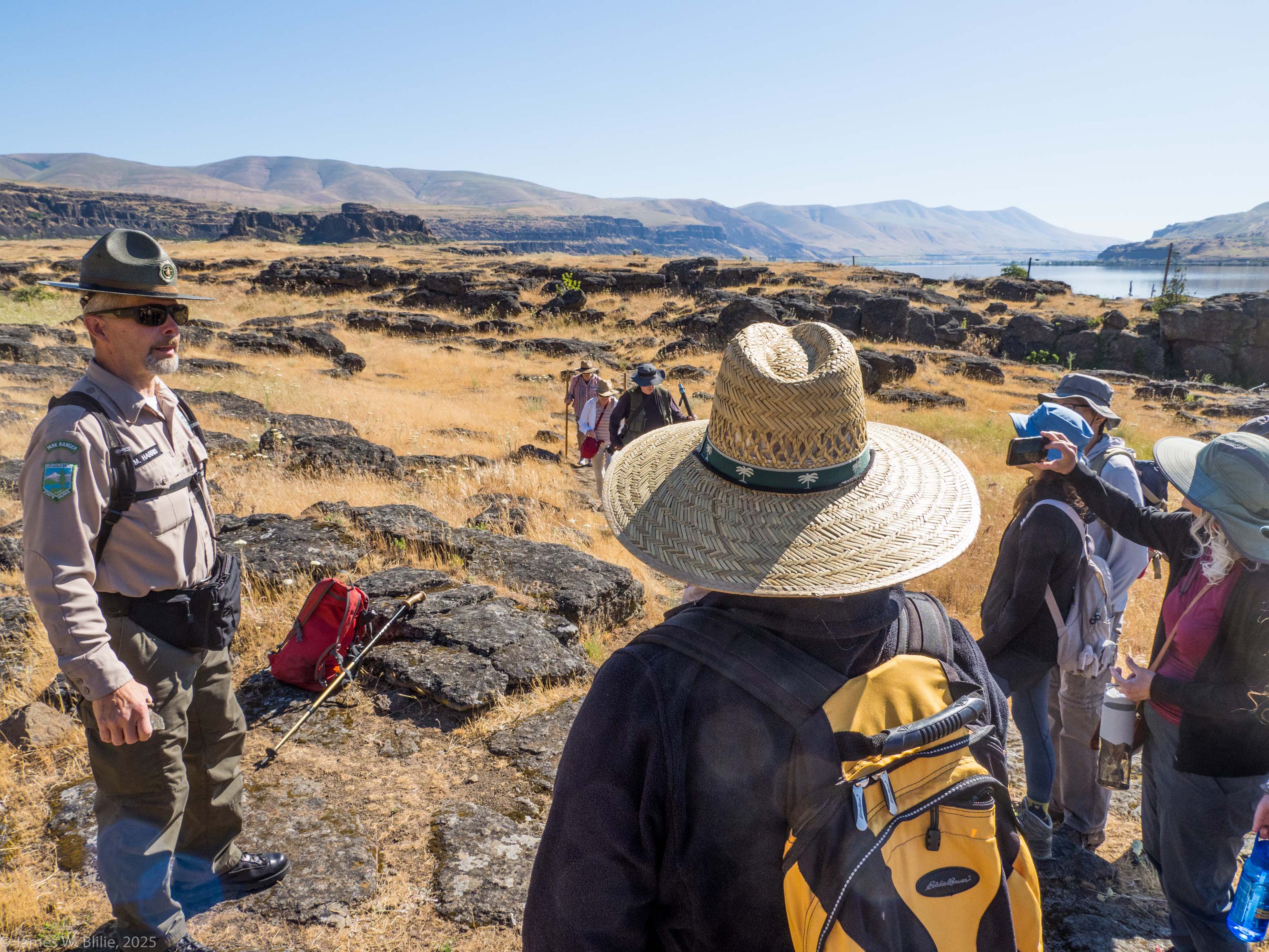
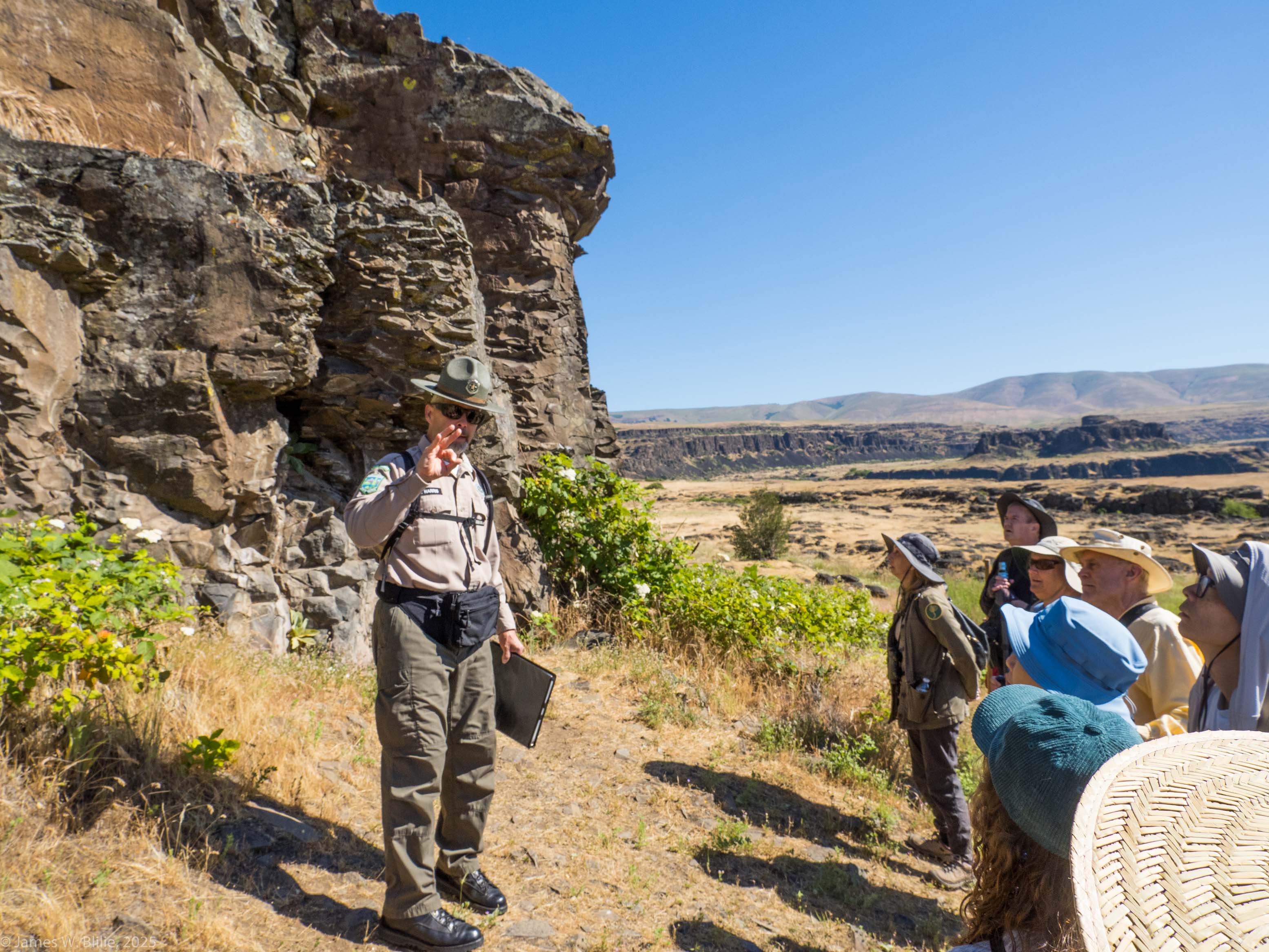
I hope that your readers find this set interesting.  These photos were taken yesterday (30-May-2025) on a tour of petroglyphs and pictographs in the Columbia Hills Historical State Park near Dallesport, Washington.  The area where we live has a profusion of petroglyphs and pictographs.  In my very extensive travels and hiking in the American West, I’ve found that almost any likely flat rock surface will have petroglyphs or pictographs on it.  This state park is near where important Native American villages existed along the Columbia River, so the stone images are concentrated here.  In cooperation with the YakimaWarm SpringsUmatilla, and Nez Perce tribes, the state park offers guided tours of these images.

Not so many years ago, one could hike the area freely with a state park pass.  However, recent vandalism has forced the tribes and the state to close the area to all except tribal members and guided tours.  Unfortunately, we saw direct evidence of this need (vandalism).  The vandalism has taken the form of markings on the images (people trying to do rubbings and leaving marks over the images – we saw this) and gun shots to the images (we saw this too, see photos).

The tour is called the She-Who-Watches tour after the eponymous and most spectacular of the images.  There’s high demand for these tours and you will want to book months (!) or at least weeks in advance.  But the tour is well worth it.  The walk is short (about a mile, total, I estimate) and pretty flat; but does cover some rough and uneven ground; and it gets hot (carry water and protect yourself from the sun).  Most of the people, including the guide, used walking sticks for stability.

I highly recommend this tour.

First are some general images of the area.  This park is in the Columbia River Gorge and these are typical scenes from the Gorge.  The geology is dominated by the Columbia Plateau flood basalts and, of course, the Columbia River.  (I highly recommend Professor Nick Zentner’s videos on the geology of the Pacific Northwest.)

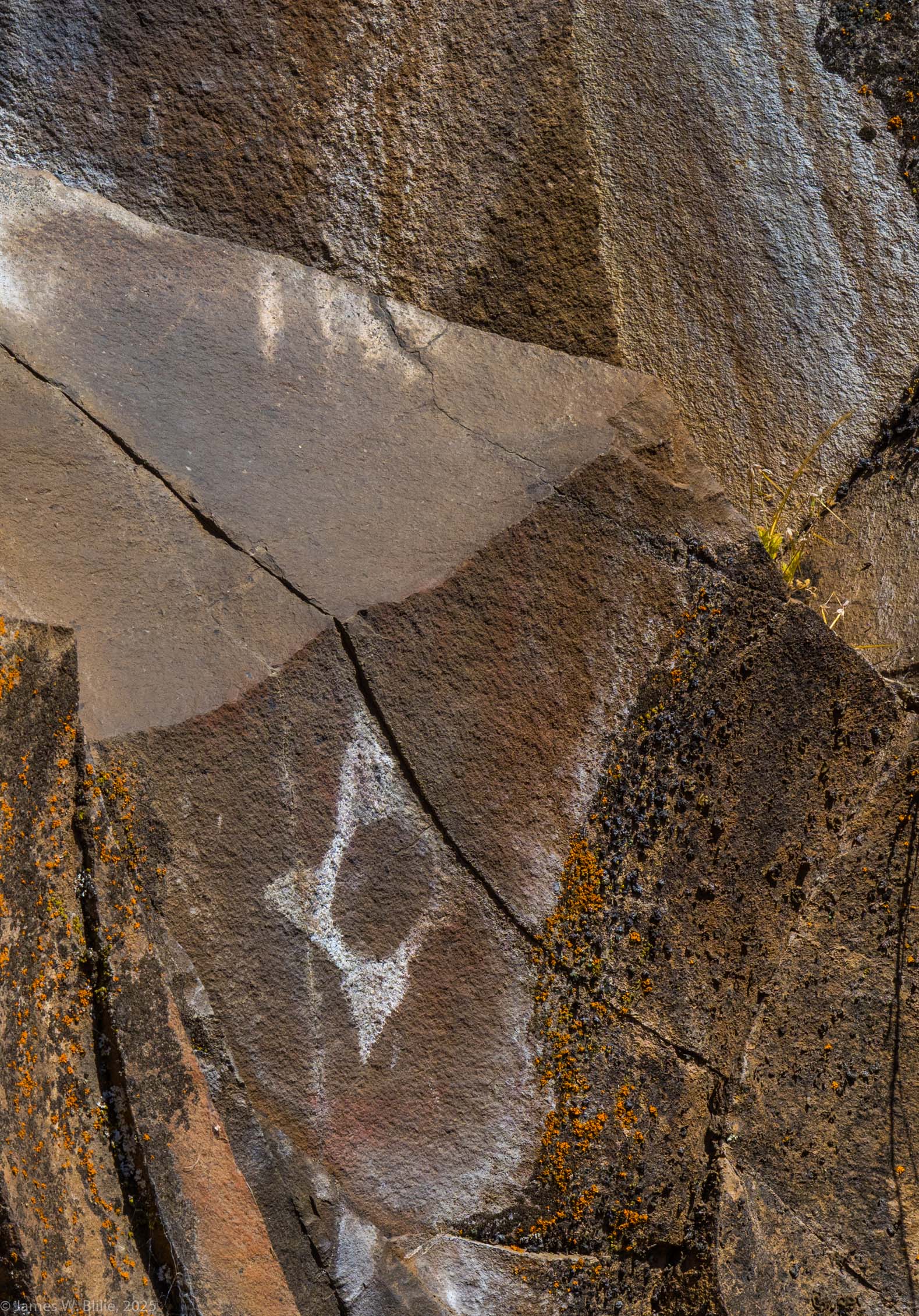
Next are photos of some of the smaller images in the park.  All these images are incised into the hard basalt rock (petroglyphs) or painted on the rock (pictographs) in white, red, and black pigments.  These images have survived centuries in a harsh environment, exposed to an intense sun all summer.  It’s still uncertain what was used as binder(s) to apply the pigments.

Now the main event, the She-Who-Watches image, which is a shallow petroglyph also painted with pigments (pictograph).  Please look closely at the most magnified image.  See the fresh pits in the image?  These are gunshot impacts, made by some hooligan.  People’s idiocy and disrespect is sometimes mind-boggling. We are lucky that basalt is so hard and resistant to impact damage.

The next image shows a small “altar” just below the She-Who-Watches image.  This area is an active sacred site for the local tribes noted above.  I took these photos from about 15 feet away and I did not go closer out of respect.  (Some people went right up to the “altar” with their phones.  Obviously, I’m not religious; but still.)  Back at the parking lot, there was a large family group of Native Americans preparing to visit the site.

Lastly are photos of a fairly large number of petroglyphs displayed at the parking lot.  These were moved from their original sites when The Dalle Dam was constructed (1952-1957) and its impoundment would have inundated the images.  Also shown as some informational signs about these images.  These images can be viewed without a tour (just a state parks pass).

JAC: The one below looks like a wildcat!

Friday: Hili dialogue

August 1, 2025 • 6:45 am

It’s August! It’s August! Yes, today is August 1, 2025, and Homemade Pie Day.  But I’ll take any pie: homemade or commercial. The only pie I abide eat is strawberry-rhubarb pie because they put sour, gritty VEGETABLES in it! Oy! Here’s one of these toxic desserts from Wikipedia (I also learned that pure rhubarb pie is common in the UK, but I can’t believe that the human palate could stomach such a thing.)

Cameron Nordholm, CC BY 2.0, via Wikimedia Commons

It’s also International Albariño Day, International Beer Day, National Raspberry Cream Pie Day, National Spritz Day, and Yorkshire Day. Here are four Yorkshiremen:

Since it’s August, here’s the depiction of August in the wonderful manuscript Très Riches Heures du Duc de Berry.  It shows falconry taking place at the Château d’Étampes.

Limbourg brothers, Public domain, via Wikimedia Commons

Readers are welcome to mark notable events, births, or deaths on this day by consulting the August 1 Wikipedia page.

Da Nooz:

*A professor of Constitutional law at Harvard Law School, Adrian Vermeule, reports that there’s a revolt among lower courts against the Supreme Courts. His op-ed in the NYT is called “Someone is defying the Supreme Court, but it isn’t Trump” (article archived here).

The issue of defying court orders is still with us — but it has taken a twist. Now the defiance is coming from inside the judicial branch itself, in the form of a lower-court mutiny against the Supreme Court. District Court judges, and in some cases even appellate courts, have either defied orders of the court outright or engaged in malicious compliance and evasion of those orders, in transparent bad faith.

In the past decade or so, increasing judicial overreach has caused harm to our constitutional order by limiting the ability of the executive branch to implement the program it was elected by the American people to pursue. It has been a scourge for both recent Republican and Democratic presidents, and it may provoke extreme measures to restore order. The recent defiance goes even further, threatening to damage the internal integrity of the judiciary, which ultimately relies on lower courts to follow the Supreme Court’s direction.

Consider Judge Brian Murphy of the Federal District Court in Massachusetts. Judge Murphy issued a preliminary injunction against the transfer of removable aliens to third countries, in cases in which the transfer was expressly permitted by federal law. So far, this was just an ordinary example of judicial overreach.

But after the Supreme Court issued an order to stay — that is, to stop — the preliminary injunction while litigation proceeded (over a dissent by Justice Sonia Sotomayor), Judge Murphy went beyond overreach. He decided that his order enforcing the injunction that the court had stayed nonetheless remained in effect — a proposition for which his only cited authority was the dissent from Justice Sotomayor. This seemed to be malicious, whether or not it counts as “compliance” at all. The Supreme Court, with the notable concurrence of Justice Elena Kagan, then had to stay this second order and explain that Judge Murphy’s renewed effort was also illicit.

Lots of similar examples are given; read the article.

Several factors conspire to produce these episodes. The plaintiffs, often activist organizations, who bring the cases carefully select the districts in which to proceed, maximizing their chances of having the case heard by ideologically aligned judges. Under President Joe Biden, liberals harshly criticized this tactic, known as forum or judge shopping.

This year, it is no accident that the incidents of lower-court defiance have taken place in a few areas of the country — the Federal District Courts in the District of Columbia, Massachusetts, Northern California, Maryland and other blue areas. Under President Biden, Texas and other red states served the same purpose.

District Court judges have almost no accountability; they are like feudal lords who lay down the law in their local courts. If they are reversed, at least they will have stymied for some time the implementation of presidential policies they find objectionable.

Vermeule’s suggestion is an obscure procedure called “departmentalism”:

The final recourse in the system — a controversial and rarely used fallback — is what is described in constitutional theory as “departmentalism”: The president may ignore a judicial order that, on the president’s independent interpretation of the law, exceeds the scope of judicial power, as when a District Court were to purport to bar the president from granting a pardon or vetoing a bill. As my Harvard colleague Jack Goldsmith recently wrote, the theory has “a long pedigree in American history.”

“The basic theory of departmentalism is that while the Supreme Court has the authority to exercise its Article III ‘judicial Power’ in cases or controversies before it,” Mr. Goldsmith wrote, “the President’s Article II duty to ‘take care that the law be faithfully executed’ gives him an independent power to determine what ‘the law,’ including the Constitution, means, for purposes of exercising executive power.”

This doesn’t sound like much of a solution to me, for it gives the President the right to overrule the Supreme Court, and we know how what is construed as “the law” can be stretched.

*The Trump administration is trying to water down the scientific consensus on global warming (article archived here):

Sea level rise is not accelerating. More carbon dioxide in the atmosphere will be good for plant growth. The computer models used to predict global warming tend to exaggerate future temperature increases.

These arguments, routinely made by people who reject the scientific consensus on climate change, were included in an unusual report released by the Energy Department on Tuesday. The report, which is meant to support the Trump administration’s sweeping efforts to roll back climate regulations, contends that the mainstream scientific view on climate change is too dire and overlooks the positive effects of a warming planet.

Climate scientists said the 151-page report misrepresented or cherry-picked a large body of research on global warming. Zeke Hausfather, a climate scientist at Berkeley Earth​ and the payments company Stripe, called the document a “scattershot collection of oft-debunked skeptic claims​” that “are not representative of broader climate science research findings.”

The report demonstrates the extent to which President Trump is using his second term to wage a battle against climate change research, a long-held goal of some conservative groups and fossil fuel companies. While the first Trump administration often undermined federal scientists and rolled back more than 100 environmental policies, officials mostly refrained from trying to debate climate science in the open.

This time, Trump officials have gone much further.

How so? The article goes on to describe how the EPA is already using the report to repeal a declaration that greenhouse gases are a threat to public health.  Here we have yet another example of the erosion of science by ideology–this time from the Right. And it will be our grandchildren who will pay the price (thank Ceiling Cat I will have none).

*Very few people ever get out of the notorious Terrorism Confinement Center in El Salvador (where the U.S. is sending many of its deportees), but the Washington Post interviewed 16 who did get out. And it’s about as horrible as you can imagine.

The matching firsthand accounts across multiple interviews offer the most complete view yet of conditions inside the mega prison, where inmates are denied access to lawyers and almost all contact with the outside world — and where about 14,000 Salvadorans remain incarcerated. Few detainees have ever left CECOT, and fewer have spoken publicly of their experience there.

The Washington Post interviewed 16 of the more than 250 men who were deported by the United States to CECOT, held there for four months and then released this month to Venezuela as part of an international prisoner swap.

The Venezuelans, rounded up in President Donald Trump’s mass deportation campaign, told The Post they were subjected to repeated beatings that left them bruised, bleeding or injured. They said prison staff restricted medical care for detainees suffering from diabetes, high blood pressure or kidney failure.

The men slept on metal bunks — usually with no cushions — in group cells where overhead lights blazed 24 hours a day. They were expected to bathe and relieve themselves using a water tank and toilets that offered no privacy from cellmates. They were rarely allowed out of their cells.

CECOT, opened by Bukele in 2023 as part of his crackdown on Salvadoran gangs, was designed to terrify the most violent of criminals. His government hailed it as the largest prison in the Americas, initially announcing a capacity for 20,000 detainees and later doubling it. The imposing fortress outside San Salvador sprawls across more than 280 acres, surrounded by an electrified perimeter fence and 19 watchtowers. The roof of each pavilion is made of diamond-shaped mesh with sharp edges.

The Venezuelans were placed in cells, up to 20 men in each. The concrete walls showed sweat stains, drops of dried blood and what appeared to be scratches from human nails, one detainee recalled.

Each cell held 80 metal beds stacked closely together in tiers of four, according to detainees and images of CECOT previously shared by Bukele’s government. Use of the water tanks and toilets was controlled by the guards and restricted to certain times of day. With no windows or fans, the detainees lived and ate amid the stench of their own sewage.

The detainees could gauge the time only by the heat that made them sweat during the day and the cold that chilled their metal beds at night. They couldn’t see the sun, they said, but sometimes could hear the rain.

CECOT “seemed like it was for animals,” said detainee Julio Fernández Sánchez, 35. “It was designed for people to go crazy or kill themselves.”

Here’s a short visit, and yes, it looks like hell on earth:

*From the AP: Now it’s social-nedia posts that grossly misrepresented figures from the war in Gaza, and of course the false facts indict Israel. As a reader points out, the misrepresentations always go in only one direction—against Israel.

As the number of Palestinians killed in the Israel-Hamas war continues to rise, social media users are falsely claiming that a Harvard University study has determined that hundreds of thousands in the Gaza Strip are also missing.

“Israel has ‘disappeared’ nearly 400,000 Palestinians in Gaza since 2023,” reads one X post that had been shared and liked more than 35,700 times as of Thursday. “Harvard has now confirmed what we’ve been screaming into a deaf world: This is a holocaust — and it’s still happening.”

But Harvard did not publish the report in question. Moreover, these claims misrepresent data from the report that was intended to address an entirely unrelated topic.

Here’s a closer look at the facts.

CLAIM: A Harvard University study found that nearly 400,000 Palestinians in the Gaza Strip are missing as a result of the Israel-Hamas war.

THE FACTS: Harvard published no such study. This estimate misrepresents a map included in a report by a professor at Israel’s Ben Gurion University that shows the distance between new aid distribution compounds in Gaza and three main populations centers. Using spatial analysis, the report determined that these compounds are inadequate and also does not address how many people in Gaza are missing.

. . . . “If anyone had asked me about these numbers I would have set things straight right away,” said the Yaakov Garb, a professor of environmental studies who authored the report. “Instead the number was circulated and recirculated by people who had not read the report or stopped to think about it for a moment.”

The inaccurate estimate comes from a post on the blogging site Medium. In the post, the author uses a map from Garb’s report showing how many people live in what are currently Gaza’s three main population centers — Gaza City, central refugee camps and the Muwasi area — according to estimates from the Israeli Defense Forces, to determine how many Palestinians are allegedly unaccounted for. The author subtracts the former number — 1.85 million — from the population in Gaza before the Israel-Hamas war began — 2.227 million — for a total of 377,00 missing people.

Why do the distortions always go against Israel?  I think you can guess.

*The NYT’s Christine Chung tried two apps and their associated kits (they ain’t free) designed to beat jet lag, testing each one on a flight halfway around the world. The results? Not impressive. (Article archived here.)

The two apps to which I ceded control of my daily rhythms, Flykitt and Timeshifter, are personalized programs based on scientific approaches to jet lag. Both directed me when to sleep, get light exposure, drink caffeine and take supplements. But they took different approaches: Flykitt featured a heavy vitamin regimen, while Timeshifter focused on preparing for jet lag days before flying.

First up, for the New York-to-Seoul trip, was Flykitt. Its starter pack, $99 for a round trip, includes glasses that filter blue light to minimize light exposure and packs of supplements meant to target inflammation. The program, which promised to curb jet lag in just three days, began on departure day. I put my flight details into the app and answered a few questions about my caffeine intake and sleep patterns, and the app promptly churned out a detailed schedule.

. . .At first, popping handfuls of pills was novel and funny, until it wasn’t. The regimen had me taking about three dozen vitamins over three days, starting on the day of the flight.

I also experienced mysterious, intense thirst. I couldn’t be sure, but I suspected the vitamins were to blame. Addressing my unquenchable thirst resulted in a need to use the bathroom approximately every hour. I spent roughly equal time sightseeing as I did finding public toilets in Seoul.

While I wouldn’t say my jet lag was zapped by Day 3, I slept well and felt energized. I felt fully adjusted after five days, shortly before flying to Taiwan. Flykitt’s app told me that unassisted, this time zone alignment would generally take a little over a week.

And the other one:

After about a week in Taipei, I returned to New York using Timeshifter’s guidance. This app was cheaper than Flykitt, $25 for a year’s subscription. No blue-light glasses, which I honestly enjoyed wearing. The only recommended supplement was melatonin, which I was to take for my first four nights back home to help with the adjustment.

While Flykitt instructed me when to avoid light, Timeshifter alerted me about times to seek it out. When I couldn’t be outside, I turned on as many lights as I could. Standard room light is about half as effective as daylight, Dr. Zeitzer of Stanford said.

. . . . Tt took me about five days to feel back to normal.

The bottom line: Neither program markedly shaved time off my jet lag, but I did feel more clearheaded during and after my trip and I didn’t get sick. The severe dehydration I felt may have been anomalous, but it was a pretty big minus for me. Perhaps the biggest benefit the apps offered was confidence; science was on my side.

There are three big problems with this anecdotal study. First, it’s anecdotal: just two trips. Second, there’s the placebo effect, as suggested by the last sentence.  Finally, related to the second issue, THERE IS NO CONTROL.  Perhaps a couple of vials of water and some wonky instructions would have made Chung feel more “clearheaded.”  We won’t know because the NYT doesn’t care whether these results are even replicable. It would be funny except that they are pushing two for-profit regimens not shown to be effective.

Meanwhile in Dobrzyn, Hili has a long report on Andrzej’s doings “The Administrator,” of course, is Andrzej.

Hili: The Administrator is reshaping his world, neglecting the kitchen and leaving dishes unwashed. He can’t wait to sit down and write. He hurriedly takes care of matters standing between him and the possibility of working. At dawn, he went out to sort out new hearing aids. He says he needs to regain the ability to hear people. He jokes that he used to hear more when he was deaf. Małgorzata is gone; he says he must now face the world without intermediaries. Still, a partner is necessary. Danka is his greatest hope. He browses through her books, reads the sentences, learns things he already knew. They think alike, so working together will be a joy. He’s acting like some kind of Swede. The most important thing now is preparing the tools needed for action.

When I asked who “Danka” was, Andrzej replied:

Danuta Szulczyńska-Miłosz, a writer. She knows my books, she knows everything I write, and the publisher suggested her as the editor of the book. She stayed with me for two days, and now I know that with her help, the first volume will come out this year. I bought new hearing aids (17,000 zlotys), I’m buying a laptop with the best camera and the best microphone so we can stay in daily contact. A friend who’s choosing and installing all of it for me, along with AI tools, has instructions that price is not an issue. We already have a few side projects related to promotion. With her help, the whole project is gaining momentum. Danka lives near Szczecin, which means far away. But our cats have already settled things between themselves.

Very good. I presume the book is Andrzej’s autobiography.

In Polish:

Hili: Administrator zmienia swój świat, zaniedbał kuchnię nie zmywa po jedzeniu. Nie może się doczekać, kiedy siądzie do pisania. Pospiesznie załatwia sprawy, które dzielą go od możliwości pracy. Od świtu pojechał załatwiać nowe aparaty słuchowe. Mówi, że musi odzyskać możliwość słyszenia ludzi. Żartuje, że jako głuchy słyszał więcej. Małgorzaty nie ma, mówi, że teraz musi zmierzyć się ze światem bez pośredników. Wspólniczka jest jednak potrzebna. Danka jest jego największą nadzieją, Zagląda do jej książek, czyta zdania, dowiaduje się tego, co już wiedział, myślą podobnie, więc wspólna praca będzie radością. Zachowuje się jak jakiś Szwed, Najważniejsze jest teraz przygotowanie narzędzi potrzebnych do działania.   

*******************

From The Language Nerds, National differences in phrases:

From CinEmma:

From The Dodo Pet:

This is insane. Supporters of Palestine are vandalizing the NYT building because they retracted a lie! (h/t Luana)

From Barry, who adds, “I like the ones near the end of the video that give up. ‘Screw this. Why are we following this duck anyway? I’m outta here’.”

It's just a “swarm of fish" following a duck.

Insta Science (@instascience.bsky.social) 2025-07-30T14:04:25.098Z

From Malcolm. Crikey–look at those insects!!!!

From my site: three posts on the dangerous North Sea (there are 20!) I put the last one in.

From the Auschwitz Memorial, one that I reposted.

Two posts from Dr. Cobb. First, my return home from Iceland:

When u are returned to Chicago

Robert McNees (@mcnees.bsky.social) 2025-07-26T20:44:05.143Z

The answer is not that difficult; I just like to show pictures of skunks.  DO NOT HURT THEM!

🦨 Ever wonder how skunks decide where to live in urban landscapes like Chicago?New research from @masonfidino.bsky.social, @lizalehrer.bsky.social, & @sbmagle.bsky.social from @lpzoo.org used nearly a decade of data to find out! 🦊🌍🧪A 🧵

Stacks Journal (@stacksjournal.bsky.social) 2025-07-09T15:14:21.110Z