Readers’ wildlife photographs

May 22, 2024 • 8:15 am

If you have good wildlife photos, don’t forget to send them in!  Thanks.

Today’s theme is astronomical phenomena, and we have two contributors. Both contributors’ words are indented, and you can enlarge the photos by clicking on them.

First, Bryan Lepore sends two photos and a video.

I submit two photos of the geomagnetic storm on Friday, 10 May, 2024 as viewed from latitude ~42 N ~71 W (Massachusetts), at about 10 PM.

Bryan adds this figure, which comes from a tweet by AuroraAlerts:

One more item occurred to me that should fit with the aurora photos : a map from Aurora Alerts on 10 May :

… you can see it goes down to New England. So I saw that indoors, and immediately stepped outside. Readers can scroll through Aurora Alerts to see the info, and I recommend subscribing.  I think there is supposed to be more solar activity than usual in the next so many months – some cyclic activity of many years length (I’d need a refresher).

Bryan also made a short video for YouTube showing the International Space Station flying by during the aurora:

Our second contributor is Rik Gern, who sent photos taken the day of the eclipse:

Here is a small batch that represents all the remaining pictures I currently have processed and ready to go. They are of varying quality, but there is a theme running thru them; they were all taken in my yard in Austin, TX on April 6th, the day of the full eclipse.

Where I live the totality lasted for about 90 seconds and I didn’t bother to try to photograph the eclipse itself because a lot of people who know a lot more about photography than I do were setting up to take and share some nice pictures of the corona and other great effects. Instead, because I was fascinated by the rapidly changing light, I took pictures of plant life around the yard as the early afternoon light got steadily darker and everything started to look like evening time, but without the long shadows. It was subtly disorienting.

The first picture is of one of my favorite volunteer plants, the false dayflower (Tinantia anomala).  I love the “face” in the flower! This species initially made an appearance in the yard about ten years ago and at first there weren’t many, but when I discovered what a good looking plant it is I let it grow pretty much wherever it made an appearance and now it dominates the back end by the compost pile.

This next plant, common hedge parsley, aka spreading hedge parsley or tall sock-destroyer (Trills arvensis), wasn’t fully in bloom at the time. Even when it does bloom the flowers are very tiny and easy to overlook. The leaves remind me of carrot tops, though I don’t know if they’re related.

The tufted yellow woodsorrell (Oxalis priceae) was growing at the base of a cactus plant. For the longest time I confused woodsorrel with clover and they do look similar, but their flowers are different and unlike clover, woodsorrel in not a nitrogen-fixing plant and livestock shouldn’t graze on it. Both are bee friendly though. You can learn more about the similarities and differences here.

It was too early in the year to observe flowers on this spineless prickly pear cactus (Opuntia ellisiana), but the new pads that appear every year are intriguing in their own right.This picture was taken just a few seconds before the eclipse reached totality.

Despite a light cloud cover at the time, the total eclipse was dramatic and picturesque, and I can understand why people travel a great distance to observe the phenomenon. The eclipse’s totality inspired the hours of photoshop processing that transformed the cactus picture into this personification of nature.

SpaceX Starship launch this morning: 8 a.m. Eastern time, 7 a.m. Central (now delayed by about an hour)

March 14, 2024 • 5:30 am

Big Rocket Launch this morning: a test of the SpaceX Starship. It will launch from Texas, test the firing of two boosters and the payload door, and then (fingers crossed) a splashdown planned in the Indian Ocean. The flight time will be one hour and 4 minutes, and this time the rockets, though designed to be recovered, apparently won’t be recovered.

Set your alarm for 8 a.m. if you’re on the East Coast, 7 a.m. Central or corresponding times in other places. But the livestream begins half an hour before those times. You can watch the prep and launch either site given below.

This site gives information about the vehicle and launch, and also links to the SpaceX video.

From Jon and Bat, we hear of a SpaceX launch this morning.

This from Bat:

According SpaceX and news outlets, the big launch is on for a 110 minute window commencing at 0700 central time Thursday morning.  Launch is from SpaceX launch complex in Texas. The rocket is over 400 ft tall.  She’s a big ‘un!  Live Coverage begins at SpaceX website 30 minutes before scheduled launch so that would be 0630 Central Time.

This is the big rocket that Elon Musk is developing for big Moon mission payloads and on to Mars. He claims that they are using an “engineering approach”:  test often and learn from failure: you really don’t want failure but when you get it, you use it to improve the vehicle and its control.

A video of the launch should be at the site below (click to go there, and then click on “watch”; there’s another launch video site below):

Here’s the official announcement:

The third flight test of Starship is targeted to launch Thursday, March 14. The 110-minute test window opens at 7:00 a.m. CT.

You can watch the live launch webcast at SpaceX.com/launches or on X.com/SpaceX starting approximately 30 minutes ahead of liftoff.

The third flight test aims to build on what we’ve learned from previous flights while attempting a number of ambitious objectives, including the successful ascent burn of both stages, opening and closing Starship’s payload door, a propellant transfer demonstration during the upper stage’s coast phase, the first ever re-light of a Raptor engine while in space, and a controlled reentry of Starship. It will also fly a new trajectory, with Starship targeted to splashdown in the Indian Ocean. This new flight path enables us to attempt new techniques like in-space engine burns while maximizing public safety.

This rapid iterative development approach has been the basis for all of SpaceX’s major innovative advancements, including Falcon, Dragon, and Starlink. Recursive improvement is essential as we work to build a fully reusable transportation system capable of carrying both crew and cargo to Earth orbit, help humanity return to the Moon, and ultimately travel to Mars and beyond.

Excitement guaranteed!

Here’s a YouTube site:

Uncrewed Moon landing this afternoon

February 22, 2024 • 9:15 am

A “soft” landing of an uncrewed vehicle, built by NASA in conjunction with a commercial company, will take place this afternoon: 5:30 4:24 p.m. EST Jim Batterson gives the details and links where you can watch/hear it live.  This landing has hardly been in the news, but it certainly deserves our attention.

NASA/Intuitive Machines -1 Landing on the Moon Thursday Afternoon

by Jim Batterson

NASA, in collaboration with Intuitive Machines, is scheduled to soft-land an uncrewed payload near the Moon’s South Pole at 5:30 4:24PM EST this afternoon [RESCHEDULED].  If successful, this will be the first U.S. soft landing on the moon since the final Apollo mission of the early 70’s.

The mission was launched last week on a Space-X Falcon rocket from Cape Kennedy and, after several successful mid-course maneuvers is, as of this morning, orbiting the moon just 57 miles above the Lunar surface.  About an hour before the planned landing, a series of onboard rocket motors are scheduled to fire and take it out of orbit to a steady one meter/secpmd touchdown on the Lunar surface. The lander will take photographs, make soil measurements, and carry out scientific experiments.  In carrying out this mission, U.S. capabilities in space are extended to a commercial company as a part of NASA’s efforts to support more robust launch and landing capabilities by the private sector and to test and validate—on uncrewed missions—new technologies that can be used in the Artemis human crews to the moon program.

As a part of NASA’s return to the moon for a planned permanent presence, the NASA Artemis Program is developing a heavy, crew-rated launch system.  Many of us watched a major uncrewed launch in that program a bit over a year ago as a huge rocket sent an Orion capsule, which will be used to fly and land a human crew on the moon in the next few years, around the moon and back to Earth with a successful splashdown and recovery.  It is my understanding that a post-flight review of the capsule’s heat shield showed excess sublimation (melting and conversion to gas) over what was expected and that resolution of this issue and other abnormalities may delay the crewed Artemis 2 launch and circumlunar trajectory currently planned for Fall 2025, which of course would impact the crewed Artemis 3 launch—one that will carry a crew and soft-land them on the Moon in Fall of 2026.  A Wikipedia listing of the currently planned Artemis Program missions through the mid-2030’s can be seen here.

This current mission, IM-1 (Intuitive Machines 1) is the second in a series of uncrewed Commercial Lunar Payload Services (CLPS) missions that support the development of technologies to be incorporated in the Artemis crewed missions.  CLPS is a NASA program that, as its name implies, enlists commercial vendors to build, integrate, and operate compact, uncrewed space missions to prepare hardware on a fast pace parallel with the development of the main Artemis Mission crewed landings on the moon.  The idea is that using several commercial vendors creates capacity and know-how more quickly and cheaply than doing in situ testing of new space technologies.

The first of the CLPS series, Peregrine One, experienced a failure after launch last month.  The next scheduled launch after IM-1 will be in the Fall of this year and will be operated by commercial vendor, Firefly Aerospace.  This current mission, operated by the commercial vendor, Intuitive Machines was launched early last Thursday morning and is scheduled to soft-land near the South Pole of the Moon this Thursday afternoon.

As of 0830 EST this morning, the vehicle is in a circular orbit 57 miles above the moon. About an hour before the planned 1730 EST landing on Thursday afternoon, retrorockets will elongate its orbit to 67mi x 6 mi with the 6 mile high point being just above the landing site.  When the orbit reaches the 6 mi altitude point, another retrorocket firing and braking will be started and the vehicle will drop down to a soft landing in the region of the South Lunar Pole with touchdown expected at 1730EST. . . if all goes well!  Live updates are provided at the Intuitive Machines mission website, where there’s a nice write-up and link to live coverage of landing, coverage that should start about one hour before the expected 1730EST touchdown on Space.com at the site below:

One last thought:  One factor prompting this U.S. project is a bit different than the main cold-war driver of the Apollo program in the 1960’s.  Then we had a single competitor, the USSR, but that was seen as a competition for technological success of a democracy versus a Communist dictatorship.  After World War II, nobody else had the economy and technology to attempt a feat like a manned moon landing.  Today there are five nations that have hit the moon: China, Russia, Japan, India, and the U.S.  (Only the U.S. has actually landed humans on the Moon.) It turns out that there are concerns about any of these nations claiming possession of locations and minerals via landing there.

Here’s Wikipedia’s rendering of the Nova-C lander on the surface of the Moon (from Wikipedia and the Smithsonian Institution)

The Navajo Nation tries to prevent human ashes from being sent to the Moon

January 8, 2024 • 11:30 am

Here’s an example of how indigenous peoples, on the basis of their superstitions and religion, try to control modern technology or how it’s used and science. In this case, reported by CNN (click on screenshot below), a commercial enterprise is taking some small amounts of human remains (presumably ashes, though it’s not clear) to the Moon, in violation of no Earthly statute. But because this presumably pollutes the moon, sacred to the Navajos, the tribe would like it stopped. And the White House, which isn’t in charge of this mission (it’s a private commercial venture), is holding a meeting to deal with this vexing problem. (They are not, of course, on the side of the rocketeers).

Click to read:

An excerpt:

The White House has convened a last-minute meeting to discuss a private mission to the moon — set to launch in days — after the largest group of Native Americans in the United States asked the administration to delay the flight because it will be carrying cremated human remains destined for a lunar burial.

If successful, the commercial mission scheduled to launch Monday — dubbed Peregrine Mission One — will be the first time an American-made spacecraft has landed on the lunar surface since the end of the Apollo program in 1972. But Navajo Nation President Buu Nygren said that allowing the remains to touch down there would be an affront to many indigenous cultures, which revere the moon.

“The moon holds a sacred place in Navajo cosmology,” Nygren said in a Thursday statement.  “The suggestion of transforming it into a resting place for human remains is deeply disturbing and unacceptable to our people and many other tribal nations.”

How can you respond to this except to say, “Sorry, too bad. Those aren’t even Navajo remains being sent to the Moon, and why should we cater to your superstition?”

And, in fact, and amazingly, that’s how the company responded (bolding here and below is mine):

The private companies providing these lunar burial services, Celestis and Elysium Space, are just two of several paying customers hitching a ride to the moon on Pittsburgh-based Astrobotic Technology’s Peregrine lunar lander. The uncrewed spacecraft is expected to lift off on the inaugural flight of the United Launch Alliance’s Vulcan Centaur rocket from Florida’s Cape Canaveral Space Force Station.

Celestis’ payload, called Tranquility Flight, includes 66 “memorial capsules” containing “cremated remains and DNA,”which will remain on the lunar surface “as a permanent tribute to the intrepid souls who never stopped reaching for the stars,” according to the company’s website.

“We are aware of the concerns expressed by Mr. Nygren, but do not find them substantive,” Celestis CEO Charles Chafer told CNN.

“We reject the assertion that our memorial spaceflight mission desecrates the moon,” Chafer said. “Just as permanent memorials for deceased are present all over planet Earth and not considered desecration, our memorial on the moon is handled with care and reverence, is a permanent monument that does not intentionally eject flight capsules on the moon. It is a touching and fitting celebration for our participants — the exact opposite of desecration, it is a celebration.”

But of course the Biden Administration has its knickers in a twist, as the Navajos are indigenous peoples and therefore sacred. And they’ve objected before, again without fruit:

This isn’t the first time Navajo Nation has expressed concerns about burials on the moon. In a December letter to NASA Administrator Bill Nelson and Transportation Secretary Pete Buttigieg, Nygren referred back to NASA’s Lunar Prospector mission, which in 1999 deliberately crashed a spacecraft into the moon carrying the remains of former astronaut Eugene Shoemaker.

“At the time, Navajo Nation President Albert Hale voiced our objections regarding this action. In response, NASA issued a formal apology and promised consultation with tribes before authorizing any further missions carrying human remains to the Moon,” Nygren said.

I didn’t know about Eugene Shoemaker, but the “remains,” described by Wikipedia, were some of his ashes:

On July 31, 1999, some of [Shoemaker’s] ashes were carried to the Moon by the Lunar Prospector space probe in a capsule designed by Carolyn Porco.  Celestis, Inc. provided the service—at NASA’s request—commercially, making Shoemaker’s ashes the first private delivery to the lunar surface.

But NASA isn’t in charge of this mission; it’s described as “one customer among many paying to put technology and cargo on Astrobiotic’s lunar lander.” So NASA can grovel all it wants before the Navajos, but they lack authority.  And believe me, NASA is groveling. For example,  Joel Kearns, NASA’s deputy associate administrator for exploration, said this:

“American companies bringing equipment and cargo and payloads to the moon is a totally new industry — a nascent industry — where everyone is learning,” Kearns said. “We take concerns expressed from the Navajo Nation very, very seriously.”

That is virtue signaling of the first water. Would they take concerns about the Vatican if any of those ashes belonged to former Catholics?  Again, Celestis brushed off the concerns about the sacredness of the Moon:

“No one, and no religion, owns the moon,” Celestis’ CEO told CNN. “If the beliefs of the world’s multitude of religions were considered, it’s quite likely that no missions would ever be approved. Simply put, we do not and never have let religious beliefs dictate humanity’s space efforts. There is not and should not be a religious test.”

But the Navajos deny below that they own the Moon. Of course, what they think they own is control of what gets sent to the Moon:

Ahasteen argues that Navajo Nation’s intent isn’t to claim the moon.

“We’re saying be respectful. We’re turning the moon into a graveyard and we’re turning it into a waste site,” Ahasteen said. “At what point are we going to stop and say we need to start protecting the moon as we do the Grand Canyon?”

The last point is the only one worth considering: what kind of stuff are we allowed to dump on the Moon? But whatever concerns enter into such a discussion, religion should not be one of them. Worry about ecology, spying, polluting a not-fully-explored planet, yes, of course. But do not stifle technology in the name of nonexistent gods or “sacredness”. For religion worships fictions, but science tells us what is real about the world. Yes, I “respect” people’s desire and ability to practice their own religion, but they don’t have the right to foist their faith on others. And that’s what the Navajos are doing when trying to prevent ashes from being sent to the Moon.

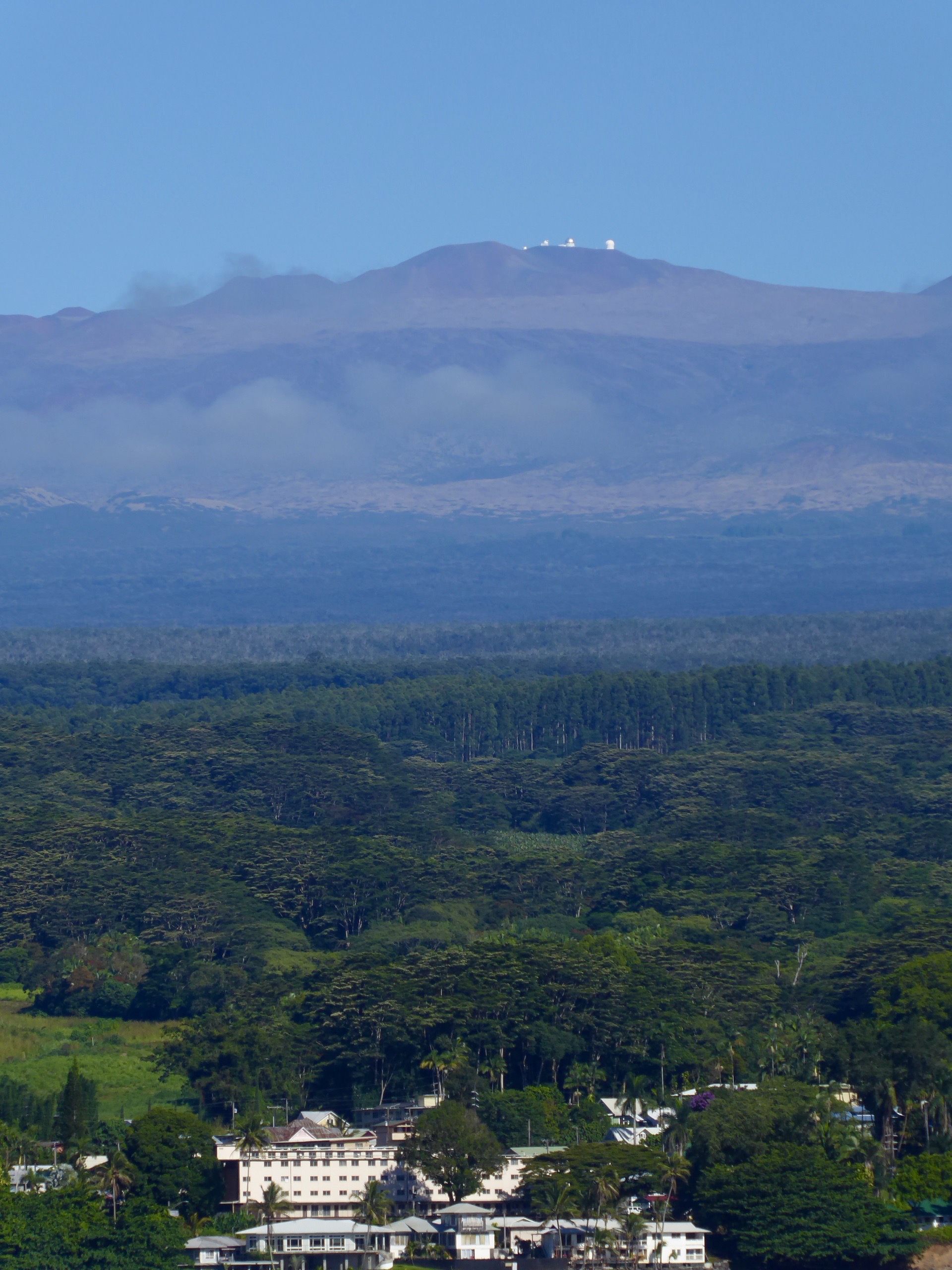
It’s especially pernicious to use religion to try to block scientific knowledge.  Mauna Kea, a mountain on Hawaii’s Big Island, is perhaps the best place in the world to place telescopes, as it’s high and clear, but the indigenous Hawaiians have for years tried to block, with some success, the placement of scopes on the mountain. Your opinion may differ, but mine is that the mountain isn’t really sacred, and if it doesn’t formally belong to the native people but to the government or state, science should take precedence over sacredness, particularly in a such a great site for science like Mauna Kea. After all, they’re not proposing to put a telescope on the spire of Notre Dame!

Here’s a photo I took of Mauna Kea with its telescopes in 2019:

Five minutes until Starship’s second flight test

November 18, 2023 • 6:53 am

You can watch it at the tweet below (but enlarge it), or here. A bit of background:

SpaceX’s Starship spacecraft and Super Heavy rocket – collectively referred to as Starship – represent a fully reusable transportation system designed to carry both crew and cargo to Earth orbit, the Moon, Mars and beyond. Starship is the world’s most powerful launch vehicle ever developed, capable of carrying up to 150 metric tonnes fully reusable and 250 metric tonnes expendable.

Of course this is Elon Musk’s company, and the first flight test failed.

h/t: Bat

Building a rocket with indigenous knowledge

August 22, 2023 • 12:15 pm

It might seem churlish of me to discuss a federally-funded program for young people to integrate “indigenous values” into space exploration, but I discussed a similar aim before with respect to New Zealand, and the article below, from Nature, applies the same aims to an American program. And both programs wound up convincing me of the same three points:

a. “Indigenous values” and “indigenous knowledge” don’t really add much of scientific value to a modern program such as space exploration,

b. The truly “indigenous” aspects of this supposedly salubrious combination of indigenous and non-indigenous knowledge are often superstitious-add ons

c.  Dividing up knowledge and researchers in this way serves only to validate race and indigeneity as the defining traits of one’s persona, and makes science, supposedly a worldwide unifying endeavor, divisive.

Click the screenshot to read the Nature piece:

The gist of the article is that a Native American (Oglala Lakota) student at MIT, Nicole McGaa, entered a NASA-sponsored contest that was limited to Native Americans, who were tasked with designing a rocket that not only “incorporated indigenous values” into the design, but also flew went to the highest altitude. Already you can sense that the “indigenous values” won’t be of much value in overcoming gravity, but here’s the task:

McGaa, who is Oglala Lakota, is entering her fourth year of undergraduate studies in aeronautics and astronautics at the Massachusetts Institute of Technology (MIT) in Cambridge. In April, she led MIT’s all-Indigenous rocket team to the 2023 First Nations Launch National Rocket Competition, an annual contest organized by NASA. The competition, held in Kenosha, Wisconsin, provides a platform for Native American students from universities across the United States and Canada to demonstrate their engineering skills through rockets that use high-powered motors. McGaa tells Nature about how she and her team incorporated Indigenous values into their work, why they smudged their rocket before launching it into the skies and her dreams to help astronauts to stay healthy in space.

Somehow something rubs me the wrong way about limiting this competition to Native Americans (why not make it a competition for everyone?) and about “incorporating indigenous values into the work”. That’s already divisive, assuming that Native America values can change the way you design rockets, and perhaps the performance of the rockets themselves. This is in contrast with the assumptions of modern physics and engineering, though I’m willing to admit that perhaps there are some indigenous values that might help. I just don’t know what they are, and rarely are any of them specified.

McGaa describes three, but I find none convincing. Two are not truly “indigenous values”, and the other one is pure superstition.

The first involves cooperation:

Our team operates in a unique way. We have a distributed leadership structure that prioritizes relationship building and taking care of each other. Even during intense periods and crunch weeks, we created a culture of community in which people felt supported and free to declare their other commitments, so that their teammates could accomodate them. We bring snacks to writing sessions, and sometimes go out together to get brunch during the day.

It’s not clear whether this really is unique (except for the snacks and brunch-going), as my reading of how teams building the Mars Rover or the Mars helicopter operate seems to have also been very close and cooperative. Further, it’s not clear that this “culture of community” really does improve the design of rockets, as there’s no control group.

And of course empathy towards your co-workers is not a trait limited to Native Americans. Women, for example, seem to be more empathic and cooperative than men, and I can imagine an all-women team saying the same stuff about their “culture.” But again, no control. In general I don’t think that these competitions should be divided by race or gender. After all, in contrast to sports, there’s no inherent advantage of any group who gets into MIT at building rockets.  If some group of friends who share an ethnicity want to form a team, that’s fine, but I’d say “engineering and science belong to everyone, so let everyone compete against each other.”  Why have a separate contest for any ethnic group of gender if it involves simple engineering?

The second “indigenous value” involves conservation of materials for weight.

Efficiency was inherent in our design: we minimized the material used, and our rocket was low weight. Such efficiency is a feature of care and avoiding excess — key Indigenous principles.

Well, they are also principles for building rockets in general.  And of course there are examples of indigenous excess as well, like driving a gazillion bison over a cliff when you can eat only a few.

The last “indigenous value” resembles some problems with Māori “indigenous knowledge” because it involves superstition:

Our rocket was named MIT Doya. Doya means ‘beaver’ in the Cherokee language; the name was suggested by team member Hailey Polson, who is from that nation. After the rocket was completed, we performed a smudging ceremony, a blessing and purification ritual that typically involves burning sage and which is an important cultural practice for us, by Lake Michigan before the competition. At the contest in April, we successfully blasted our rocket into the sky, and it reached a height of 1,290 metres. We won second place in the competition.

What does the smudging ceremony and building the rocket mean to the team?

The smudging ceremony signifies sending the rocket to the sky with good intentions and the smell of sage. The rocket, propelled by flames, is visiting Father Sky. Everyone on the team comes from different Indigenous tribes and nations. But this ceremony is deeply rooted in our Indigenous identity. For us, having an Indigenous team is not just about building rockets for the sake of it. It will have a lasting impact on Indigenous students at MIT.

I don’t care if they do this, but of course it’s pure superstition, like a Christian team saying a prayer before the launch. It may perpetuate indigenous acts and culture, but there can be no pretense that it makes the rocket fly higher.

At the end, they ask McGaa “what hurdles do you face as an Indigenous student”? and McGaa, who is surely privileged as an MIT student, lets loose with a veritable laundry list of oppression:

There are few Indigenous students at MIT. This means that it’s hard to find mentors and people that can understand and relate to your background and cultural values. People feel uncomfortable when you speak about the specific needs of Indigenous students; it’s as if they don’t want to hear it. And, until 2021, MIT had no Indigenous faculty members. So, there’s almost no one to speak for us. This places a crushing responsibility on us as students to advocate for ourselves and by ourselves. It feels exhausting and lonely, but I am proud to be here. I want to continue to inspire and forge pathways for Indigenous students at MIT.

I wish people would be able to accept and benefit from mentors who didn’t “look like them”. With the new ban on affirmative action, it will be a long time, if ever, until there is equity in university faculties, and there are plenty of professors willing to help Indigenous and other minority students. I’m not sure what “special needs” Indigenous students have: do they involve making up academic deficiencies, or something that’s missing in the psychology and behavior of mentors?. It seems to be the latter based on the assertion above of “crushing responsibility”. But if the needs are purely academic, they can be taken care of by academics. If they’re psychological, they can be taken care of by therapy.  What distresses me is the assumption that, to prosper, a student needs a mentor who “looks like them” because only those of the same ethnic group can truly meet their needs.  I appreciate that faculty should not all be white or male, and I don’t dismiss the value of role models, but I also wish that we could create diverse faculties by hiring on the basis of merit alone.

The indigenization of New Zealand’s Space Policy

June 4, 2023 • 1:00 pm

The other day I forgot to mention that New Zealand has a “National Space Policy” that you can read about here.  Here’s an excerpt from the brief announcement:

The next ‘giant leap’ in New Zealand’s space journey has been taken today with the launch of the National Space Policy, Economic Development Minister Barbara Edmonds announced.

. . . “With the launch of our National Space Policy, we’re presenting a clear and connected picture of New Zealand’s space interests to the world.

“The policy identifies stewardship, innovation, responsibility, and partnership as key values for New Zealand in space. Harnessing these values will inform space-related engagements, policy creation and strategies across government.

The National Space Policy is led by robust objectives of:

  • Growing an innovative and inclusive space sector
  • Protecting and advancing our national security and economic interests
  • Regulating to ensure space activities are safe and secure
  • Promoting the responsible use of space internationally
  • Modelling sustainable space and Earth environments

“This is an important milestone in our space journey as it provides an overview of New Zealand’s values and objectives to guide future space-related policies and regulation.

“This is an ongoing conversation. We will continue to engage with stakeholders and industry,

That sounds good unless you’ve been immersed in New Zealand’s politically correct efforts to indigenize science. This is ultimately based on the view that the indigenous people (Māori) are entitled, via the 1840 Treaty of Waitangi (“Te Teriti”) to coequal participation in science, not just as workers but also entitled to teach their traditional lore, Mātauranga Māori (MM), as coequal in schools to what they call “Western science”.  There is some empirical knowledge in MM, but also a heap of legend, oral tradition, religion, morality, and rules for life. MM, on the whole, is not equivalent to science, but contains science, just as the Bible contains some real history. Yet the interpretation of the Treaty as making all things Māori almost sacred is holding back science in a big way.  So the words “stewardship” and “stakeholders” are, to me at least, code words that this endeavor too will be “decolonized.”

I’ve seen little analysis of the Treaty vis-à-vis education, but it needs to be discussed. The English and Māori versions differ, not all Māori chiefs signed it, and it’s an agreement, not a constitution. Basically, it guarantees the Māori the rights to keep and hold their land, gives Britain sovereignty over the country, but also guarantees that all Māori have full rights as British subjects. Here’s the important part: Article 3 of 3 (English translation on a NZ government site):

In consideration thereof Her Majesty the Queen of England extends to the Natives of New Zealand Her royal protection and imparts to them all the Rights and Privileges of British Subjects.

That’s all well and good, but it’s not clear to me how the “rights and privileges” of British subjects guarantees the Māori the right to have their “way of knowing” taught in government-run science classes. But of course even debating that issue is taboo in New Zealand. (As always, I think MM is an important part of local culture that should be taught as sociology, anthropology, or even religion, but not as science.)

But I have digressed big time. In the link above is another link to the whole government space policy, which is here.

And here’s the interesting bit:

Obligations which apply to all New Zealand space policies

All space policies must also be consistent with New Zealand’s existing commitments, including. . .

  • Te Tiriti o Waitangi: a commitment between the Crown and Māori which provides the basis for ongoing partnerships between the government and Māori on space, including on the implementation of these values and objectives. The Crown is committed to recognising and reflecting Māori interests, including those embodied in the Treaty principles of partnership, active protection, and participation.

Modelling sustainable space and Earth environments

Encouraging inclusive, sustainable space collaborations within New Zealand

Mātauranga Māori and space are deeply connected, with space representing whakapapa (genealogical links to the beginning of the universe), wairuatanga (the spiritual connection between Earth and the universe, derived from Māori cosmology), and tātai arorangi (Māori knowledge of astronomy). The New Zealand government encourages inclusive collaborations with individuals or groups who are currently underrepresented in the space sector (including, but not limited to, Māori); and for these collaborations to work toward sustainable outcomes. The New Zealand government will also strive to further understand and assess representation across the space sector, to best direct inclusive collaboration opportunities.

The treaty is quoted again, and this means that not only will equity apply to the whole policy, but indigenous people will get piles of money to give their take on the policy. More distressing is the dissimulation of the last paragraph, which simply lies when it says that “Mātauranga Māori and space are deeply connected”.  What they’ve done here, as usual, is make an analogy between science (space exploration) and aspects of Māori society that have almost nothing to do with space (whakapapa and wiruatanga are spiritual and moral concepts). The one exception, tātai arorangi, involved learning enough about the positions of celestial bodies to navigate across the south Pacific and, later, judge the seasons for planting or hunting.  But the space bit of MM is no longer a pressing concern to anybody in the country except those whose ancestry may help them get jobs or money.

This is from a discussion of the subject by two academics:

David Perenara-O’Connell

Māngai, Tāwhaki Joint Venture

The knowledge is very clear with regard to how our people came to be here, and that it wasn’t by mistake, and it was through a deep understanding of the stars and the Sun and the Moon and the weather and the birds – all of those things that they were able to harness to get from one place to the next without necessarily knowing where that next place was.

For us at Taumutu and Wairewa – Ngāi Tahu hapū – we are inherently eeling, fishing villages, so we spend a lot of time at night out gathering our kai, and through that, the importance of the Moon, the time of the year when we gather the tuna, which we call the hinapōuri, the time of the dark nights through to the timing of the sky and the constellations that guide us in those mahinga kai activities.

So when you’re gathering tuna on the banks of the river or on the gravels of Kaitōrete with your tamariki and your kaumātua, there’s an exchange of that knowledge about the stars constantly moving overhead.

In the following, “kūmara” is a Polynesian type of sweet potato. Bolding in the text is mine.

Dr Pauline Harris

For Māori, a lot of our knowledge is passed on through word of mouth, but there’s lots of different forms for that. All sorts of information is carried in things like our pūrākau, our stories, our waiata, our songs, our whakataukī. They all carry messages, knowledge, history, information, data.

I’d like to use the example Whānui. Whānui is a star called Vega. Whānui was the father of the kūmara. And his wife and him had these kūmara children, and his brother Rongo-maui wanted to bring the kūmara to Earth. And so he went up there and he asked for the kūmara. Whānui said, “No you can’t have that. You’re not allowed to take my children.” And Rongo-maui stole the children and brought them down to Earth. Whānui was very angry with the fact that his children were taken, and he sent down his other children, which were like caterpillars and stuff, and they were sent down to Earth to destroy the crops of the kūmara so that they couldn’t use them.

There’s lots of different messages in there. There’s messages around the wrongdoing of stealing things but also about the relationship between kūmara and the star Vega or Whānui itself. And when that star rises, it indicates the time of the year, around about March, which is when you have some practice associated with the kūmara.

You can be the judge of whether this knowledge, which was indeed of use to the Polynesian ancestors of the Māori as well as to the early Māori themselves, should now also be deeply integrated into modern space exploration and the policy that guides it.