Readers’ wildlife photos

February 17, 2025 • 8:15 am

Today we have volume IV of Robert Lang’s 13-set series of photos from his recent trip to the Pantanal, today featuring birds. Robert’s captions are indented, and you can enlarge the photos by clicking on them.

Readers’ Wildlife Photos: The Pantanal, Part IV: Birds

Continuing our mid-2025 journey to the Pantanal in Brazil, by far the largest category of observation and photography was birds: we saw over 100 different species of birds (and this was not even a birding-specific trip, though the outfitter also organizes those for the truly hard core).

Not all of what we saw was so gracious as to pose sufficiently close, still, and well-lighted to get a good photo, but the Pantanal still offered much better photo opportunities than did the Amazon a few years ago, where most of the birds presented as a tiny black silhouette high in a distant tree. Although I usually try to say a few words about each photo in my RWP contributions, there’s just to many here, so in most, I’ll just give the name and species and move on, proceeding alphabetically by common name. (Species identification are courtesy of our guide, augmented sometimes by Merlin Bird ID. Corrections gratefully accept.)

A female anhinga (Anhinga anhinga), in its characteristic holding-out-the-wings-to-dry pose:

Bare-faced curassows (Crax fasciolata), male on the left, female on the right:

And a female with its crest up:

A bare-faced ibis (Phimosus infuscatus):

Black-backed water tyrant (Fluvicola albiventer). Quite a scary name for such a small, unassuming bird

Black-bellied whistling ducks (Dendrocygna autumnalis):

Black-collared hawk (Busarellus nigricollis), this one flying:

A black-crowned night heron (Nycticorax nycticorax):

A black-fronted nunbird (Monasa nigrifrons):

And that’s all for this installment. We’re not even out of the B’s. (Heck, we’re not even out of the “black-“s!) More to come soon!

Readers’ wildlife photos

February 11, 2025 • 8:30 am

Today we have another photo-plus-text contribution from Athayde Tonhasca Júnior; the subject is mangoes, my favorite fruit (and flies, my favorite group of insects). Athayde’s text is indented, and you can click on the photos to enlarge them.

The king and its flies

Germany has its Pumpkin Festival, Canada celebrates a Cranberry Festival, Spaniards go wild hurling over-ripe tomatoes at each other at the Tomato Festival, while Italians savour their winemaking heritage during the Marino Grape Festival. But among the many fruit- and produce-themed events around the world, few have the cultural magnitude of The International Mango Festival, held annually in Delhi.

Delhi’s mango festival: activities include mango eating competitions, mango quizzes and slogan-writing, mango carving, mango tasting and varieties contests, dances, plays and crafts © India’s Ministry of Tourism.

Mango (Mangifera indica) has been a cultural and religious symbol in India for millennia: grown for over 4,000 years, its earliest references date back to around 2,000 BC from ancient texts and scriptures. The fruit is associated with fertility, prosperity and devotion in Hindu and Buddhist mythologies and traditions. Mangoes symbolise the arrival of summer, appearing in folk songs, literature and art, and are used in religious ceremonies and offerings to the gods. When summer comes, Indians give mangoes to family, friends, customers and employees. The fruit’s flavours, juiciness and texture make it an effective tool for diplomatic relations: mangoes have been routinely offered to foreign dignitaries and were sent as gifts for the coronation of George VI.

The mango is more than an Indian icon: it is one of the most important fruits in tropical and subtropical areas around the world. Mangoes are a main source of vitamin A in Africa and Asia, and the tree’s bark and leaves have been used in folk remedies for centuries. The fruit is mainly eaten in natura, green or ripe, but is also liberally used in chutneys, pickles, curries, preserves, juices, ice-creams and a variety of dishes throughout Asia and Central and South America. Mangoes are grown commercially in more than 100 countries, and 65 of them produce over 1,000 million tonnes each a year. And there’s no problem selling all those fruits: mangoes are rapidly gaining in popularity in temperate countries, so demand is increasing. The cultural, nutritional and economic importance of the mango more than justify its title of ‘the king of fruits’.

The king of fruits. Mangoes sold in Britain don’t do justice to the fruit’s flavours © Obsidian Soul, Wikimedia Commons:

Mango trees produce panicles (branched inflorescences) bearing tiny flowers – and lots of them. A mature tree may have 200 to 3,000 panicles, each with 500 to 10,000 flowers. This abundance may suggest ample opportunities for pollination, but that’s not so. Depending on growing conditions and crop variety, 30 to 80% of flowers are staminate, that is, they lack functional pistils. These flowers are functionally male, therefore incapable of being fertilized. The remaining fertile flowers are vulnerable to a range of environmental stresses such as excessive rain and extremes of temperature that prevent fertilisation. To make things worse, each flower produces little nectar, relatively few pollen grains (200-300), and its stigma (the part that receives the pollen) is too small to be of great efficiency. As a result, up to 60% of the flowers receive no pollen, and a panicle may produce up to three fruits at most.

A mango panicle © Delince, Wikimedia Commons:

A single mango flower is not particularly rewarding, but massive numbers of them entice lots of non-specialised visitors. A range of flies, bees, wasps, butterflies, moths, beetles, ants, bugs and bats drop by for a small sip of nectar from each flower. By hopping from flower to flower, visitors greatly increase the chances of cross pollination – although the wind also plays a part.

Among all the flower visitors, one group makes up some of most efficient pollinators of mango varieties grown around the world: flies, especially blowflies, carrion flies, bluebottles (family Calliphoridae), flesh flies (family Sarcophagidae), hover flies (family Syrphidae), and the house fly (Musca domestica). Except for hover flies, they are not seen in a good light by the public. That’s understandable, since most of what we know about them relates to their roles as agricultural pests and vectors of human and animal diseases. But that’s a narrow take on their comings and goings. These flies, often categorised as “filth flies”, are enormously important as decomposers and recyclers, and are vital for food chains: numerous birds, bats and fish depend on them. Another role is becoming increasingly understood: their contribution to myiophily (or myophily), that is, pollination by flies (Orford et al., 2015).

The unappealingly named oriental latrine fly (Chrysomya megacephala) is an important mango pollinator © portioid, iNaturalist:

Blowflies, flesh flies and the like are relatively large and their bodies are covered with ‘hairs’ (setae), which are important pollen-carrying structures. These flies are abundant and persistent flower visitors throughout the blooming season, all desirable qualities for efficient pollination. Besides mango, blow flies, flesh flies and the house fly are known or suspected to pollinate avocado, blueberry, Brussels sprout, carrot, leek, macadamia, onion and strawberry (Cook et al., 2020). The common greenbottle (Lucilia sericata) and the bluebottle (Calliphora vomitoria) are reared commercially for the pollination of seed crops and vegetable crops, respectively (L. sericata is also reared for medical uses: because their maggots preferentially eat dead tissue, they have been used for the treatment of diabetic ulcers, bedsores and other chronic wounds).

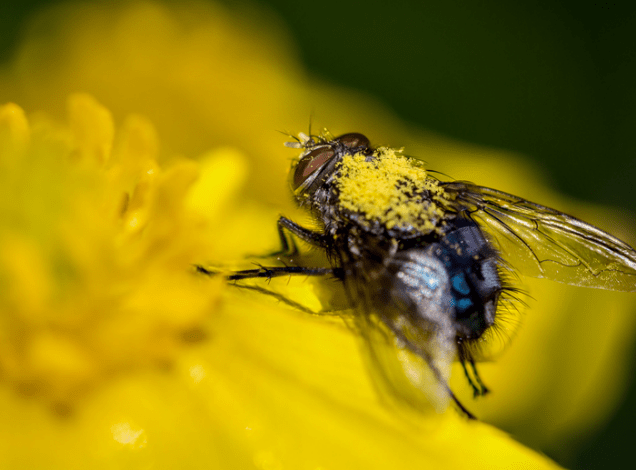
A fly with pollen attached to its back © ninfaj, Maryland Agronomy News:

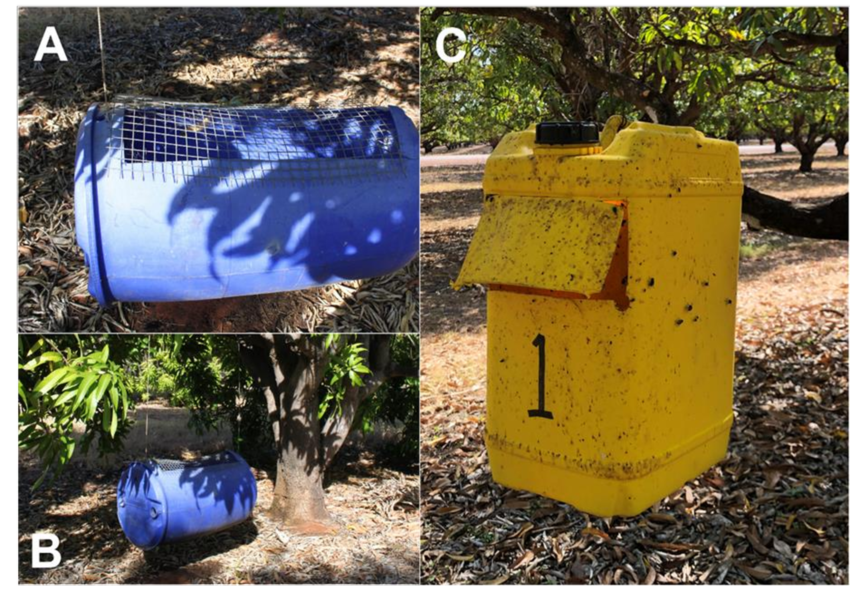
Mango farmers in Northern Australia hold blow flies in such esteem that some growers have installed ‘stink stations’ in their orchards, a practice also used by avocado farmers in Peru. Each station consists of a plastic container filled with fish or chicken carcasses, a concoction guaranteed to attract flies. It’s not clear whether these contraptions improve yields (Finch et al., 2023), but at any rate, farmers see foul-smelling orchards as a small price to pay for the possibility of bumper crops of juicy, fragrant and profitable mangoes.

‘Stink stations’ used by mango growers in the Northern Territory, Australia © Finch et al., 2023:

The mango is a case study of the ‘other’ pollinators, that is, those outside the better known and celebrated club of bees, hover flies and moths. We may be unenthusiastic about flies that are the happiest on carrion and dung, but that’s a reflection of our aesthetic prejudices. Farmers around the world who deal with the mango’s finicky floral biology are very grateful for those unloved insects that help them produce better and more of the king of fruits.

The Guimaras Mango Festival in the Philippines wouldn’t be so lavish without the contribution of some flies of ill repute © Ranieljosecastaneda, Wikimedia Commons:


Readers’ wildlife photos

February 10, 2025 • 8:15 am

Today we have installment three of Robert Lang’s photos of the family trip to the Pantanal in Brazil. Robert’s IDs and captions are indented, and you can enlarge his photos by clicking on them.

Readers’ Wildlife Photos: The Pantanal, Part III: Reptiles and Invertebrates

Continuing our mid-2025 journey to the Pantanal in Brazil, while most of the wildlife were mammals and birds, reptiles and invertebrates did not entirely escape our notice. Among the latter, we found this nymph shell of a cicada (family Cicadidae) on a tree trunk. I have no idea what the species was; to my untrained eye, it could have been one of the Magicicadas we picked off the trees when I was growing up in Georgia and Ohio:

Night-time brought out some shy critters. This tarantula was spotted by one of our guides as we drove back to camp after dark. No idea what species it is. (I have a note that says it’s a “curly-haired tarantula,” but the rest of my notes from that trip are now contributing to global warming.):

The most common animal we saw anywhere there was water was the caiman (subfamily Caimaninae). Because we were well into the dry season, the water holes were drying up, and caimans congregated massively in the few shrinking pools that were left:

Sometimes so dense that it looked like you could walk across the water on them without getting your feet wet (a la a memorable scene from the James Bond movie Live and Let Die.):

Here’s a close-up of one. A toothy grin:

We also saw a few red-footed tortoises (Chelonoidis carbonarius), one swimming across a river (!), another just plodding along beside the road:

Also kids, when a Daddy Tortoise and a Mommy Tortoise love each other very much, he gives her a special kind of hug, and soon the Tortoise Stork brings little baby tortoises! Or something like that:

A black and white tegu lizard (Salvator merianae):

And finally, a yellow anaconda (Eunectes notaeus), which was curled up under the dock where were embarked on our boat trips:

Next: lots of birds.

Readers’ wildlife photos

February 2, 2025 • 8:15 am

Today’s photos are the continuation of John Avise‘s series of photographs of North Ameerican butterflies. The IDs and intro are captioned, and you can enlarge the photos by clicking on them.

Butterflies in North America, Part 8 

This week continues my 18-part series on butterflies that I’ve photographed in North America.  I’m continuing to go down my list of species in alphabetical order by common name.  Now we’ve come to some of the G’s and H’s.

Greenish Blue (Icaricia saepiolus), male topwing:

Greenish Blue, male underwing:

Greenish Blue, female:

Gulf Fritillary (Dione vanillae), male:

Gulf Fritillary, female:

Gulf Fritillary, underwing:

Gulf Fritillary, larva:

Hackberry Emperor (Asterocampus celtis), topwing:

Hackberry Emperor, underwing:

Hedgerow Hairstreak (Satyrium saepium), male:

Hedgerow Hairstreak, female:

Hoary Comma (Polygonia gracilis), topwing:

Hoary Comma, underwing:

Readers’ wildlife photos and video

January 29, 2025 • 8:20 am

We have a small set of photos today taken in Florida by Bill Dickens. And there’s a video (also by Dickens) at the bottom. Bill’s captions are indented and you can enlarge the photos by clicking on them.

An Osprey (Pandion haliaetus) has taken to dropping by weekly to my backyard on the Banana River in Cocoa Beach Florida.

Here’s some photos and a video of it eating a live Hardheaded Catfish (Ariopsis felis). It’s somewhat gruesome as it starts by eating the gills on one side, so it takes a while for the unfortunate fish to succumb.

The Osprey is still wet from having been in the water.

It takes around 20 minutes to consume most of the fish – they’re around 12-inches long. It messily leaves some of the carcass behind on the lawn. There’s a possum living in a brush pile in my yard that has learned to scout around under the tree at night to clean up the remains.

A video:

Readers’ wildlife photos

January 2, 2025 • 8:15 am

Today we have a second batch of underwater photos from reader Peter Klaver (first batch here). Today we have underwater wildlife (corals). Peter’s captions are indented, and you can enlarge the photos by clicking on them.

Here is the second batch of photos from scuba diving around San Pedro, Belize earlier this month.

Apart from many animals, the coral reefs there also have a rich abundance of underwater vegetation.

Most of the sea floor in the reefs is covered with various kinds of soft corals.

There are also some hard corals:

. . . including brain corals:

. . .And there are various cylindrical or tubular species whose names I don’t know.

Readers’ wildlife videos: Andrew Berry treks in northwest Nepal

November 4, 2024 • 7:45 am

My friend Andrew Berry, who teaches and advises biology students at Harvard, has long had the bug that infected me when I was younger: the desire to trek in Nepal, where the mountains are impossibly high. This summer he took a long guided trek into little-visited parts of Nepal (guides are required for these places), producing a great 37-minute video (bottom) accompanied by music and sound. (For further mountain adventures, see Andrew’s one-hour video of his 2023 trek to Dolpo and the fabled Kingdom of Mustang, featured in these pages.)  The notes below are his:

Limi Valley Trek, June ’24

Like Jerry, I’ve spent a lot of time over the years in Nepal, most often on a trail, trekking. It’s hard to beat a high altitude encounter with the mightiest mountains on earth.  I’m on an academic schedule, which means that I have plenty of opportunity to go travel over the summer, but unfortunately trekking, Nepal, and the summer don’t really go that well together.  The most pressing of my university responsibilities cease around the beginning of June.  The monsoon typically arrives in Nepal in the middle of that same month, veiling the mountains in banks of cloud, soaking the trekker (and everyone else), and delighting/stimulating/exciting the voracious leeches that inhabit the montane forests.  In short, monsoon trekking is pretty dismal.

There are however some regions of Nepal that are less affected by the monsoon than others.  Specifically, the further west and north you go, the less the impact.  It is, after all, the Bay of Bengal branch of the monsoon that inundates Nepal, so it is coming from the east.  Heading north is to take advantage of the rain shadow imposed by the main cordillera of the Himalaya.  Some regions of Nepal are north of the range — they’re politically Nepal but geographically, culturally, and linguistically Tibetan.  In summer ’23 I went to Dolpa and Mustang, this summer to Simikot, the main town in the NW corner of Nepal.  This kind of trekking is a far remove from the kind of ‘teahouse’ trekking that Jerry and I are accustomed to: you walk from village to village and stay in local accommodations, meaning that you can get away with carrying little more than a sleeping bag.  To visit the more remote areas, you’re required to have expensive permits and to be accompanied by officially recognized guides.  In addition, because these routes take you beyond inhabited areas, it’s necessary to camp and to be self-sufficient in food and other supplies.  The result of these joint requirements is a logistically complex undertaking — thank goodness for the excellent outfitter I work with in Kathmandu, Raj Dhamala of Himalayan Trekkers.

I’ve always wanted to go to Simikot.  After spending six months in Nepal before going to university, I had a map of the country on the wall of my room for all three years of college.  As I stared at it, Simikot came, for me, to symbolize the remote, inaccessible Nepal that had been out of bounds for me the year before (for financial and permitting reasons).  It’s taken a few years actually to convert that fixation into an actual visit (42, if you insist on asking!), but I’m happy to report that Simikot didn’t disappoint.  The town is clustered around a Twin Otter landing strip, a slice of the horizontal — well, a slice of gentle slope — in a world of plunging verticals.  The mighty Karnali river crashes through its gorge far, far below.  Plenty of trekker-tourists come through (for many, it’s a jumping off point for a visit to Buddhism’s holy mountain, Kailash, in Tibet), but Simikot remains primarily an administrative and trading center.  Google Translate’s influence has not apparently extended to Simikot (or at least it hadn’t when this sign was painted)


Our route started — initially in a Jeep — and finished in Simikot.  Two weeks.  Its main focus was the Limi Valley, which runs W-E just south of, and parallel to, the Chinese/Tibetan border.  An upside of the timing is that this is the time of year that livestock — cattle, sheep, goats, yak — are moved up to high altitude summer pastures, meaning that we frequently encountered people and their animals undertaking the same seasonal migrations that their ancestors (both human and animal) have done for aeons.  It truly is a privilege to spend time in such spectacular country, and to meet so many people living lives so far removed from ours.  With Raj in Kathmandu, I had discussed the possibility of tacking on a (minor) peak ascent on to the trek, but I ended up wimping out.  Just a hike for me: 5000m (16,400′) over passes is plenty high enough for me.  I think Ang Dawa, one of three wonderful Sherpa guides with me, was a little disappointed by this lack of serious climbing (he’s summited Everest five times, so he’s entitled to his disappointment)

Here’s a video montage from the trip.  I like to take panoramic photos in country like this, and I think a slow pan across images like these is the best way to appreciate the scenery.  Also, I can’t resist shooting plenty of video too.  So much to see!

Be sure to enlarge the video: