
Today we have another photo-plus-text contribution from Athayde Tonhasca Júnior; the subject is mangoes, my favorite fruit (and flies, my favorite group of insects). Athayde’s text is indented, and you can click on the photos to enlarge them.
The king and its flies
Germany has its Pumpkin Festival, Canada celebrates a Cranberry Festival, Spaniards go wild hurling over-ripe tomatoes at each other at the Tomato Festival, while Italians savour their winemaking heritage during the Marino Grape Festival. But among the many fruit- and produce-themed events around the world, few have the cultural magnitude of The International Mango Festival, held annually in Delhi.
Delhi’s mango festival: activities include mango eating competitions, mango quizzes and slogan-writing, mango carving, mango tasting and varieties contests, dances, plays and crafts © India’s Ministry of Tourism.

Mango (Mangifera indica) has been a cultural and religious symbol in India for millennia: grown for over 4,000 years, its earliest references date back to around 2,000 BC from ancient texts and scriptures. The fruit is associated with fertility, prosperity and devotion in Hindu and Buddhist mythologies and traditions. Mangoes symbolise the arrival of summer, appearing in folk songs, literature and art, and are used in religious ceremonies and offerings to the gods. When summer comes, Indians give mangoes to family, friends, customers and employees. The fruit’s flavours, juiciness and texture make it an effective tool for diplomatic relations: mangoes have been routinely offered to foreign dignitaries and were sent as gifts for the coronation of George VI.
The mango is more than an Indian icon: it is one of the most important fruits in tropical and subtropical areas around the world. Mangoes are a main source of vitamin A in Africa and Asia, and the tree’s bark and leaves have been used in folk remedies for centuries. The fruit is mainly eaten in natura, green or ripe, but is also liberally used in chutneys, pickles, curries, preserves, juices, ice-creams and a variety of dishes throughout Asia and Central and South America. Mangoes are grown commercially in more than 100 countries, and 65 of them produce over 1,000 million tonnes each a year. And there’s no problem selling all those fruits: mangoes are rapidly gaining in popularity in temperate countries, so demand is increasing. The cultural, nutritional and economic importance of the mango more than justify its title of ‘the king of fruits’.
The king of fruits. Mangoes sold in Britain don’t do justice to the fruit’s flavours © Obsidian Soul, Wikimedia Commons:
.jpg)

Mango trees produce panicles (branched inflorescences) bearing tiny flowers – and lots of them. A mature tree may have 200 to 3,000 panicles, each with 500 to 10,000 flowers. This abundance may suggest ample opportunities for pollination, but that’s not so. Depending on growing conditions and crop variety, 30 to 80% of flowers are staminate, that is, they lack functional pistils. These flowers are functionally male, therefore incapable of being fertilized. The remaining fertile flowers are vulnerable to a range of environmental stresses such as excessive rain and extremes of temperature that prevent fertilisation. To make things worse, each flower produces little nectar, relatively few pollen grains (200-300), and its stigma (the part that receives the pollen) is too small to be of great efficiency. As a result, up to 60% of the flowers receive no pollen, and a panicle may produce up to three fruits at most.
A mango panicle © Delince, Wikimedia Commons:


A single mango flower is not particularly rewarding, but massive numbers of them entice lots of non-specialised visitors. A range of flies, bees, wasps, butterflies, moths, beetles, ants, bugs and bats drop by for a small sip of nectar from each flower. By hopping from flower to flower, visitors greatly increase the chances of cross pollination – although the wind also plays a part.
Among all the flower visitors, one group makes up some of most efficient pollinators of mango varieties grown around the world: flies, especially blowflies, carrion flies, bluebottles (family Calliphoridae), flesh flies (family Sarcophagidae), hover flies (family Syrphidae), and the house fly (Musca domestica). Except for hover flies, they are not seen in a good light by the public. That’s understandable, since most of what we know about them relates to their roles as agricultural pests and vectors of human and animal diseases. But that’s a narrow take on their comings and goings. These flies, often categorised as “filth flies”, are enormously important as decomposers and recyclers, and are vital for food chains: numerous birds, bats and fish depend on them. Another role is becoming increasingly understood: their contribution to myiophily (or myophily), that is, pollination by flies (Orford et al., 2015).
The unappealingly named oriental latrine fly (Chrysomya megacephala) is an important mango pollinator © portioid, iNaturalist:

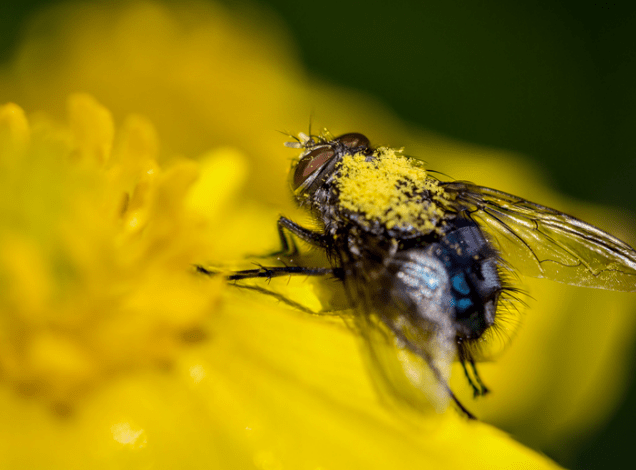
Blowflies, flesh flies and the like are relatively large and their bodies are covered with ‘hairs’ (setae), which are important pollen-carrying structures. These flies are abundant and persistent flower visitors throughout the blooming season, all desirable qualities for efficient pollination. Besides mango, blow flies, flesh flies and the house fly are known or suspected to pollinate avocado, blueberry, Brussels sprout, carrot, leek, macadamia, onion and strawberry (Cook et al., 2020). The common greenbottle (Lucilia sericata) and the bluebottle (Calliphora vomitoria) are reared commercially for the pollination of seed crops and vegetable crops, respectively (L. sericata is also reared for medical uses: because their maggots preferentially eat dead tissue, they have been used for the treatment of diabetic ulcers, bedsores and other chronic wounds).
A fly with pollen attached to its back © ninfaj, Maryland Agronomy News:
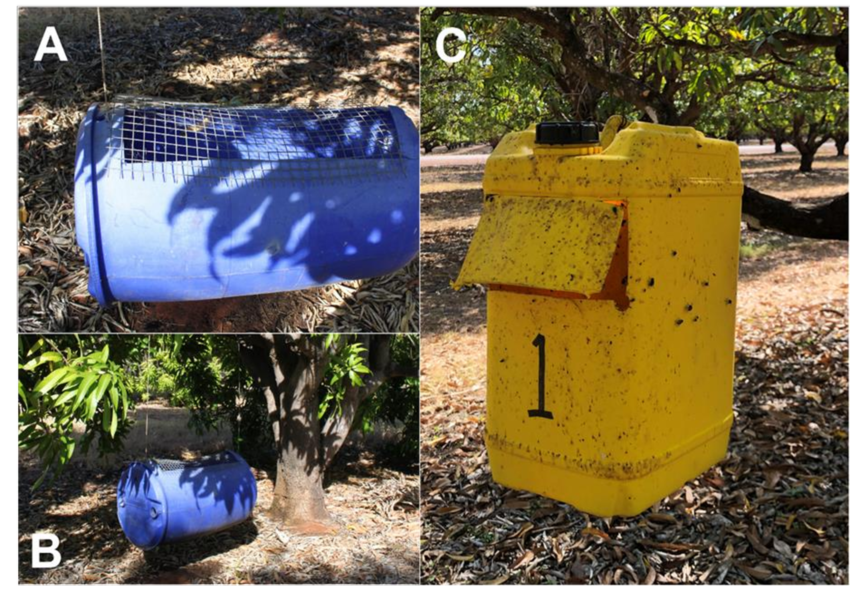
Mango farmers in Northern Australia hold blow flies in such esteem that some growers have installed ‘stink stations’ in their orchards, a practice also used by avocado farmers in Peru. Each station consists of a plastic container filled with fish or chicken carcasses, a concoction guaranteed to attract flies. It’s not clear whether these contraptions improve yields (Finch et al., 2023), but at any rate, farmers see foul-smelling orchards as a small price to pay for the possibility of bumper crops of juicy, fragrant and profitable mangoes.
‘Stink stations’ used by mango growers in the Northern Territory, Australia © Finch et al., 2023:
The mango is a case study of the ‘other’ pollinators, that is, those outside the better known and celebrated club of bees, hover flies and moths. We may be unenthusiastic about flies that are the happiest on carrion and dung, but that’s a reflection of our aesthetic prejudices. Farmers around the world who deal with the mango’s finicky floral biology are very grateful for those unloved insects that help them produce better and more of the king of fruits.
The Guimaras Mango Festival in the Philippines wouldn’t be so lavish without the contribution of some flies of ill repute © Ranieljosecastaneda, Wikimedia Commons:


Indeed! The mango tree is a central element in at least one Birbal story, and mangoes appear regularly in them!
Lovely pictures of a lovely fruit – that yellow is really gorgeous. In fact, my brother once painted a still life of a mango that his MIL liked so much that she insisted on hanging it over her fireplace.
Unfortunately, I’m not so fond of mangoes in real life. We had mango trees all over my neighborhood in HI growing up. Not only was I allergic to the sap, but when they were fruiting there were more than anyone could eat or give away, so most of them wound up unattractively splattered all over the ground.
Always great! Always appreciated!
Mangoes are awesome. It’s interesting that they sometimes depend on stink stations for pollination.
I also adore mangoes, but knew virtually nothing about their origins, biology or cultivation until now -so thanks for all this!
In my experience, the quality of mangoes in UK supermarkets is now very good, although I imagine we may not get the full range of varieties accessible in the countries where they grow. Before the early 1990s they were virtually unknown in Britain (at least in the places where I lived) and when they did appear on the shelves I remember the flesh was often so “stringy” that it was impossible to eat them without getting fibres stuck in your teeth. The mangoes we get now are soft and fibre-free. I’ve often wondered whether in the early years the growers could get away with shipping their sub-standard mangoes to the UK, knowing that we Brits would be too ignorant to know what we were getting!
David:
I think the problems with your early mangoes was the variety of mango rather than being sub-standard.
My local greengrocer (northern California) sells different varieties of mango at different times of the year, as they come into season in the countries in which they are grown (US-Hawaii, Mexico, Peru, Chile). Of the larger ones, Kent seem to me to be the least fibrous.
Mangos! Yum! Flies! Ummm, good job! Thanks for posting.
Great, as always! I’m always so amazed with the complexity and interconnectedness of the natural world.