
The Kiffness, a South African musician whose real name is David Scott, has a Wikipedia page, where, believe it or not, there is no mention of his cat songs like the new one below. They do mention his “They’re Eating the Cats” video, which I’ve also put below.
The title of this song is “Oh Yeah Oh Yeah (Cat Singing Duet)”:
The video below is described on Wikipedia:
In September 2024, Scott produced a video satirising a claim made by Republican presidential candidate Donald Trump in that month’s presidential debate. Trump repeated unverified reports that Haitian immigrants in Springfield, Ohio, were eating cats and dogs kept as pets by members of the local community. The claim was subsequently denied by the mayor of Springfield, Rob Rue, and widely ridiculed in the media. Scott’s video, “Eating the Cats”, went viral on social media and was viewed over one million times on X within 24 hours of its posting. Scott pledged to donate all proceeds to the Clark County SPCA in Springfield, raising over $20,000 for the organization.[24] On 18 September, the Kiffness performed “Eating the Cats” live in Munich, Germany, and he has continued to play it at subsequent concerts.
Here’s his satire of Trump, “Eating the Cats”:
*********************
Whisker Theory gives us the story of Defib the Cat, a rescue cat who lived at an ambulance station in London, was named after a defibrillator, and was facing eviction. There are two videos below. First, a 2024 story in the Independent (click headline to read) before Defib was saved.

A rescue cat that has lived at a London ambulance station for 16 years is being threatened with eviction.
The feline, named Defib, was rescued as a kitten by staff at Walthamstow Ambulance Station in 2008 and has lived there since.
But the cat’s days at the station look to be numbered as London Ambulance Service want to rehome the animal.
The service says some staff cannot use the station due to allergies and that the cat’s slow reactions mean it is at risk from moving vehicles.
However, more than 60,000 people have signed a petition against the cat being moved.
Local Labour MP Stella Creasy has even come to Defib’s support, urging health secretary Wes Streeting to intervene.
“Defib the cat facing a no fault eviction from Walthamstow’s ambulance base – hard to see why given he’s lived there for 16 years happily and helps staff cope with a stressful job,” she wrote on X.
“Perhaps Wes Streeting if you are feline the staff’s pain you could have a word with the London Ambulance Service.”
And the petition worked! Defib was not evicted! Sadly, he died in January of this year.
From Whisker Theory:
Defib, the cat who lived at Walthamstow Ambulance Station in east London, had a petition to keep him pass 12,000 signatures within 48 hours of the first report in October 2024, and it later passed 62,000.
He had arrived as a stray kitten that staff rescued, and by October 2024 he had lived at the station for about 16 years. He was named for the defibrillator. He sat on top of ambulances, and he had a meow that people said sounded like an ambulance siren. Staff described him as a little bit needy and fond of cuddles. He had a small hut in the back garden, and people came to the station specifically to see him.
That October, London Ambulance Service planned to rehome him. The reasons reported were his age and slowed reactions, several near misses with ambulances at the busy station, and severe allergies among some staff. ESN Report said a new station manager made the decision.
A staff member started the petition and stayed anonymous. They told the Waltham Forest Echo they had expected a few thousand signatures in a week. They also called the allergy worry “nonsensical”, said no one had died of a cat allergy in Defib’s years there, and noted that he stayed mostly indoors because of his age. Those are the petition starter’s views, and the starter also said managers bring dogs to work.
They gave a longer account too. Several years earlier, they said, management had tried to rehome him, and he was allowed to stay on condition that the public not know about him. This time, they said, management suggested Battersea Dogs and Cats Home as a last resort if staff did not house him before Christmas. [JAC: Battersea is where 10 Downing Street procured Larry, the Chief Mouser of the Cabinet Office.]
Stella Creasy, the MP for Walthamstow, shared the petition and called the move a “no fault eviction”. She said he had lived there happily for 16 years and helped staff cope with a stressful job, and Hello Rayo reported that she urged the health secretary to intervene.
On 17 October 2024, London Ambulance Service chief executive Daniel Elkeles wrote on X that “Defib can remain at Walthamstow Ambulance Station”. The service said it had listened to staff and the public.
Defib died in January 2026. Station staff began raising money through the London Ambulance Charity’s London Heart Starters Campaign for public-access defibrillators in his memory. BBC London quoted a description of him as “very friendly and therapeutic”. A cat named for a lifesaving machine is now being remembered with more of them.
Has a workplace, a street or a building near you ever had a cat that everyone there would have fought to keep?
Sources: Waltham Forest Echo / Hello Rayo / ESN Report / BBC News
A short video of Defib:
A longer news report on Defib, recounting the aborted eviction:
The announcement of Defib’s death:
*********************
This report appeared on my “News” app on the iPhone, and you can link to it by clicking on the headline (alternatively, you can go to the I Heart Cats website):

A few excerpts:
Captain Jack was once a feral cat living near farmland behind a woman’s home, but his growing friendship with her would eventually change life for an entire colony of cats. What began with one cautious visitor slowly turned into a remarkable relationship, with Jack becoming comfortable enough to accept affection and even enjoy some indoor comforts. But he didn’t keep his newfound safe place to himself. Before long, he began bringing other cats along, and the woman’s garden became a welcoming refuge for 24 feral cats.
Today, Captain Jack remains an outdoor cat who enjoys visiting his favorite person, sleeping in his special spot, and occasionally causing trouble among his feline companions. His caregiver would love to welcome him indoors permanently, but Jack has made it clear that he still prefers having the freedom to come and go.
The woman first noticed signs of a feral cat colony living on farmland behind her house. Captain Jack was among the cats who began appearing near her property, and she gradually developed a connection with him.
After Jack started visiting regularly, she arranged for him to be neutered. That was only the beginning of what would become a much larger effort to care for the neighborhood’s outdoor cats.
As Jack grew more familiar with his caregiver, something unexpected happened. He started bringing other cats to her garden, and the number of regular visitors continued to grow.
There are now 24 feral cats living around the garden, where they have access to food, shelter, and a person who looks after them. The woman has provided several outdoor cat houses filled with straw to help keep them warm and dry.
She also leaves her kitchen door open during the day, giving the cats opportunities to become more comfortable around people without forcing them into unfamiliar situations.
Although Jack is still an outdoor cat, he has developed a fondness for certain indoor comforts. One of his favorite activities is curling up on a bed placed on a chair, where he can relax while staying close to his caregiver.
However, Jack has one important rule about visiting the house. He doesn’t like having the door closed behind him.
His caregiver explained that they have managed to keep the door shut for approximately two seconds before Jack begins to panic. Despite enjoying his cozy resting place, he still needs to know he can leave whenever he wants.
. . .Perhaps the most remarkable part of Captain Jack’s story is the influence he has had on the other cats. His caregiver believes that watching Jack accept affection has helped some of his companions become more comfortable with human interaction. Of the 24 cats in the garden, approximately eight now allow her to stroke them. She credits Jack with helping them feel safe enough to approach her.
By seeing Jack interact comfortably with her, the other cats have had opportunities to observe a familiar companion receiving attention without anything frightening happening. For cats that previously avoided close human contact, allowing someone to touch them is a meaningful change.
The colony has also received important veterinary support. Thanks to a charity that covered the appointments, all 24 cats have been spayed or neutered. Since then, the caregiver reports that no new kittens have been born within the colony. Instead of watching more litters arrive, she now enjoys seeing the adult cats playing and spending time together.
Here’s a photo of Captain Jack taken from YouTube, followed by a video of Captain Jack, his staff, and his feral companions:
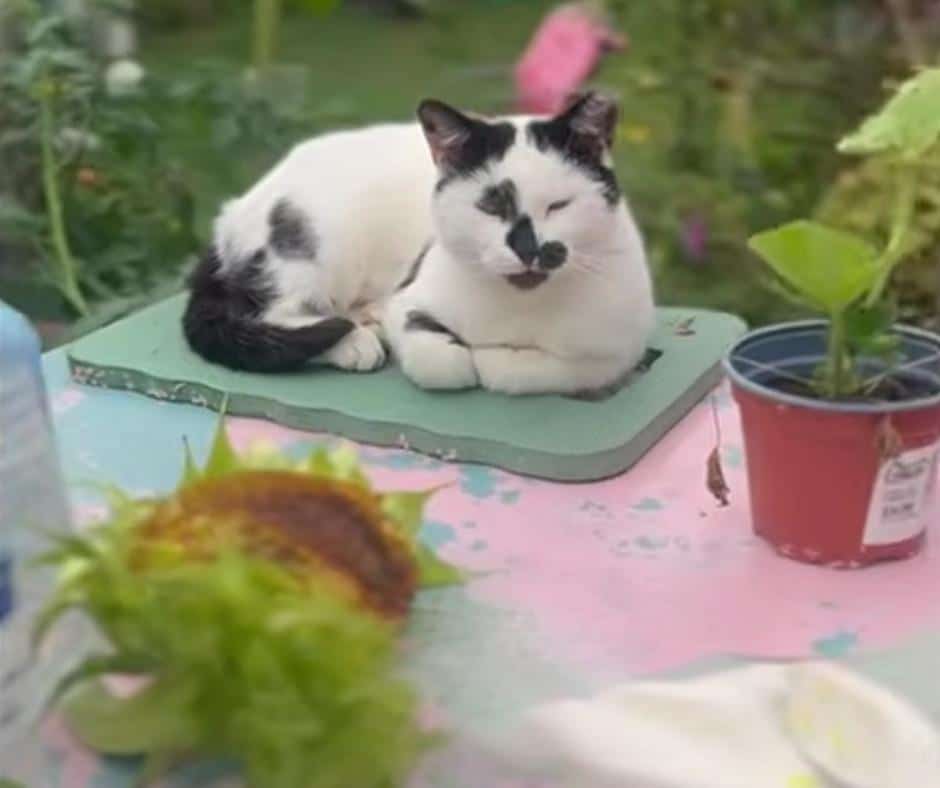
Be sure to hear Captain Jack’s owner, especially about how Jack demands his pets first:
**********************
Lagniappe: A VERY spoiled moggy!
A photo of a cafe sign that is labeled accurately:
A video evincing proof that cats know their names: