Why Evolution is True is a blog written by Jerry Coyne, centered on evolution and biology but also dealing with diverse topics like politics, culture, and cats.
I’m pretty much out of photos, so please send some in. Thanks!
Today’s photos comr from Jan Malik and were taken in New Jersey. Jan’s captions and IDs are indented, and you can enlarge the photos by clicking on them.
Here are a few pictures from my walk on the first day of spring in the New Jersey Botanical Garden in Ringwood, NJ. The quality isn’t the best (long distance, heavy cropping, fast‑moving subjects, and, let’s be honest, a mediocre photographer), but the series gives a sense of what early spring feels like for the birds.
Tree Swallows (Tachycineta bicolor) have arrived in the Northeast from their wintering grounds in the Caribbean. The first task for the males is to secure a nesting site. A natural tree cavity will do well, but those are scarce, so human‑made nest boxes are highly prized:
There are no property rights in the swallow world. A box is yours only if you can defend it, and a challenger usually appears sooner rather than later:
Both birds are males, judging by their metallic blue sheen and their persistence in aerial combat;
Outside the breeding season, Tree Swallows can be quite social, but securing a nesting site takes precedence over chivalry. No swallow lady is going to elope with a nestless beau:
Nest boxes are fitted with metal predator guards meant to deter squirrels and rat snakes. This one, however, wouldn’t slow down a determined squirrel for long:
Sometimes these fights end badly. Not because one bird actually kills the other, but because a damaged wing is effectively a death sentence:
The combat pauses briefly when a Red‑shouldered Hawk (Buteo lineatus) appears, circling in the thermals to gain altitude on its northward migration. Both swallows take shelter in a nearby tree until the danger passes:
Once the hawk moves on, the duel resumes, with both birds circling around the prize they’re fighting for:
Their Latin name suits them well — they are indeed “fast‑moving, two‑colored” birds. Their high airspeed is a challenge for inexperienced photographers. It doesn’t help that they’re smaller than an average sparrow and weigh only about 20 grams. No way they could tow a coconut, even in tandem:
I’ve had better luck photographing them during nesting season, when they fly more predictably while hunting insects on the wing. In this aerial melee, though, their flight is wildly erratic:
Eventually, the winner of this round inspects his real estate. The duel lasted a little under an hour, with both birds spending most of that time in the air and burning a lot of energy:
Abby Thompson of UC Davis has sent in some pictures of California tidepool organisms, as well as a video. Abby’s captions are indented and you can enlarge her photos by clicking on them.
Late January-early March tidepools, plus an octopus.
Bryozoans:
Lepas anatifera (pelagic gooseneck barnacle). Usually found clinging to something drifting around in the open ocean (the “pelagic” part of their name), these were on a large log washed up on shore:
Intertidal zones, illustrated. A well-placed vertical rock face, like this one, exhibits the idea of the different intertidal “zones”, each of which has its own specific collection of inhabitants. You can see mussels and barnacles clustered at the top (in the “high intertidal”), exposed to the air as soon as the tide goes out even a little. There are smaller colonial anemones next, beneath them the orange and purple ochre stars, and below those, arriving at the low intertidal level, some giant green anemones. If you peer into the water under the open giant green anemone, you’ll see a crab, probably a rock crab. There’s some back and forth- there are a few giant green anemones pretty high up in this photo- but the general idea holds.
This reflects each animal’s differing tolerance for specific conditions- time out of the water as the tide goes out, harshness of wave actions, etc. The nudibranchs (next few pictures) are usually in the very low intertidal:
Doto amyra (nudibranch). Visible through the translucent skin on its back are lobules of the “ovotestis” (thanks inaturalist expert! ). From google AI: “Ovotestes in nudibranchs are specialized, hermaphroditic reproductive glands that produce both male (sperm) and female (oocytes/eggs) gametes simultaneously”:
More eggs, this time from a snail in the genus Amphissa. I like the pointy egg casings, like wizards’ hats:
And here’s an adult of the genus- almost certainly Amphissa versicolor, but it’s an unusual color (they’re usually shades of orange or brown/tan):
In honor of Ghost the octopus, and also because I’ve finally figured out how to include videos, below is a clip from 2021 of an East Pacific red octopus (Octopus rubescens), cruising around the rocks (out of the water!) at low tide. I’ve only seen one twice, probably because they’re too cleverly camouflaged (possibly just too clever) for me to spot. This guy was about the size of a human hand, a miniature compared to the 50 pound Ghost.
Today Athayde Tonhasca Júnior is back with one of his patented text-and-photo posts, which have always been very informative. Today he talks about palms and their pollinators in one area of Brazil. Athayde’s captions are indented, and you can enlarge his photos by clicking on them.
Beneficial saboteurs
It’s approaching midday somewhere in the caatinga, northeastern Brazil’s hinterland, and the temperature will soon hit the 40o C mark. All is quiet, as most animals are sensibly sheltering from the sizzling sun. The vegetation looks dead and stunted, but it is in fact quiescent, in a state of dormancy that helps plants endure the heat and drought until the rainy season arrives.
Fig.1. The caatinga vegetation in northeastern Brazil looks dead during dry season, but palm trees are green year round:
One palm tree, however, known locally as licuri (Syagrus coronata), doesn’t seem bothered by the harsh climate; it is verdant and in full bloom. The plant is monoecious, that is, it produces separate male and female flowers in the same individual. Male flowers grow at the end of large (~90 cm long) inflorescences, while the female flowers are at the base. Anthesis (the stage at which a flower is open and functional) is asynchronous: male flowers open first, releasing pollen and scent for 7 to 10 days. These flowers then shrivel and fall off. In about two weeks, it’s the female flowers’ turn; they are open for 10 to 15 days. Plants also bloom asynchronously, so at any given time of the year there are licuri flowers.
These flowery details may seem like too much information, but they are important for understanding the plant’s relationship with one of its most important flower visitors, the weevil Anchylorhynchus trapezicollis.
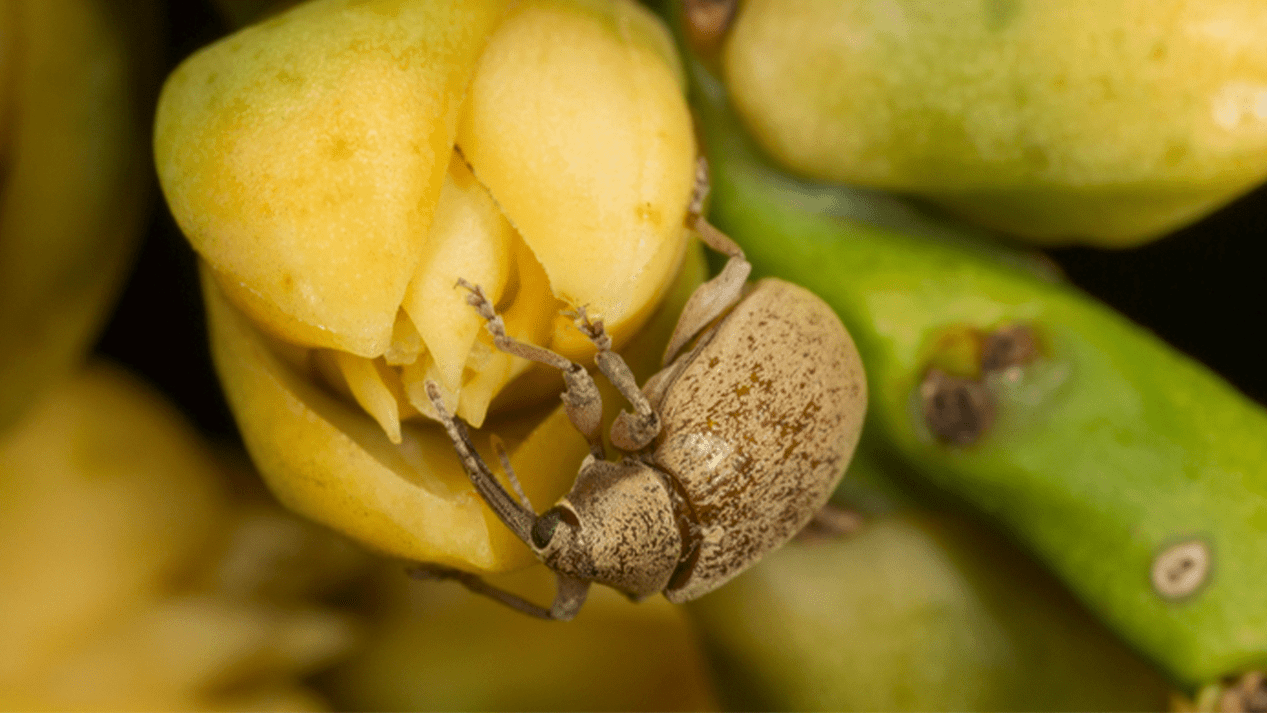
Like the overwhelming majority of the ~83.000 known species of weevil (family Curculionidae), A. trapezicollis feeds on plant tissues. Attracted by the scent of male flowers, a beetle uses its big schnozzle (in fact its rostrum, the snout-like projection from the head) to pry flowers open and take their pollen. While feeding, the beetle ends up with pollen grains attached to its body. As male flowers open at different times, there’s isn’t much food to be consumed in one sitting. The beetle is then encouraged to move to another plant, taking with it pollen that will result in cross pollination if the insect lands on a receptive female flower.
After feeding, a female beetle looks for female flowers to lay her eggs between the petals and sepals. The resulting larvae are cannibals: one larva will eat any competitor in the same flower. As they grow older, the little darlings shift their attention to developing fruits, which are aborted and fall off. Because it destroys forming fruits to complete its life cycle, A. trapezicollis is a seed predator. But for the cost of a portion of its fruits, the licuri palm is pollinated. This form of mutualism is known as brood-site pollination or nursery pollination, a trade-off association that has evolved for the yucca and the yucca moth, figs and fig wasps, and several other plant-insect partnerships.
Other weevils and bees also pollinate licuri, but A. trapezicollis seems to be the most important agent (Medeiros et al., 2019). This tight relationship has profound ecological consequences.
It is said that everything from a pig can be used except the oink, but licuri is not far behind in relation to its usefulness to humans. Its apical meristem (palm heart) is edible; the leaves are the source of a high quality wax, building materials, hats, baskets, sleeping mats and other handicrafts; ground-up leaves are fed to livestock in times of food scarcity; the tasty seeds (endosperm or nuts) are eaten raw or roasted, or added to confectionery and local dishes; oil extracted from seeds is used for lighting and the manufacture of soap, perfumes and other products.
Humans are not the only creatures to benefit from licuri: many animals take the wholesome fruits. Among them, the Lear’s macaw (Anodorhynchus leari), an endemic and endangered species, for which licuri nuts represent the bulk of its nutrition.
There you have it: a palm tree of unordinary value, from people’s welfare and economy to endangered macaws and wildlife in general, is greatly dependent on pollination provided by unassuming weevils. And this is not an isolated case. More than 200 palm species (family Arecaceae) are pollinated by weevils, and so are many other plants from different lineages (Haran et al., 2023). The ‘million dollar weevil’ (Elaeidobius kamerunicus) illustrates well the relevance of these insects as pollinators. This beetle was introduced from Africa to Asia to help improve pollination of cultivated African oil palm (Elaeis guineensis), resulting in considerable increase in yields.
When we think of pollinators, bees, flies and moths are most likely to come to mind, as they contribute to the reproduction of crops and wildflowers familiar to us. Adding weevils to this select club may sound peculiar: after all, many weevils are pests capable of inflicting enormous damage on cultivated plants, trees and stored products (you may have had your pantry invaded by weevils). But that would be a parochial view. For millions of people in tropical and subtropical regions, palm trees are more than props in holiday brochures: they are crucial for wildlife food chains, human nutrition, building materials and commodities such as medicines, industrial products and fibre. A great deal of these benefits depends on a range of poorly known, frequently dismissed and often vilified weevils.
Drumond, M.A. 2007. Documentos, 199. Embrapa Semi-Árido.
Haran, J. et al. 2023. Most diverse, most neglected: weevils (Coleoptera: Curculionoidea) are ubiquitous specialized brood-site pollinators of tropical flora. Peer Community Journal 3: e49.
Medeiros, B.A.S. et al. 2019. Flower visitors of the licuri palm (Syagrus coronata): brood pollinators coexist with a diverse community of antagonists and mutualists. Biological Journal of the Linnean Society 126: 666-687.
In the absence of much of a backlog, I’ve stolen some gorgeous photos from reader Scott Ritchie of Cairns, Australia (his FB page is here). Scott’s captions and IDs are indented, and you can enlarge his photos by clicking on them.
Recently I visited my friends, Karen and David Young in the Crater Lake cabins near Lake Eacham, Atherton Tablelands, west of Cairns. This area is a mega for birds and they did not disappoint. In particular, we got great up close and personal views of our local bird of paradise, bird of prayer, paradise, the Victoria rifle bird.
The male of the species has jet black feathers. However, in just the right light you get a lovely iridescent reflection. The other thing these birds do is dance. It’s an amazing shuffling of the wings while top of stump while throwing their head out and flashing your lovely iridescent blue throat. The immature riflebird is a beautiful brown/rufous color, and they can’t help to practice their dance moves. And of course dad’s gotta come along and join in the festivities.
Also, here’s a few photos of some other creatures that I saw on my little five hour trip to the table lands. I hope you enjoy them.
Male Victoria’s Riflebird (Ptiloris victoriae),in full dance pose. Note the jet black feathers:
Swishes wings sideways, like a flying saucer. Peering above the wings:
But in the right light, iridescent rainbows appear:
I love the cooper and purple sheen on his back:
Meanwhile, youngster, an immature male, practices his dance moves. He leans back, showing off his wild yellow throat:
“Peek-a-boo” Stands up, and swishes his wings back and forth, hiding his head behind them:
Then stands proud:
And then the adult male shows up. I’ll show you who’s boss:
Has he lost his mind?
I’m definitely King of the Stump:
Off youngster goes, only to be replaced by another male!:
And a few other local birds made an appearance. Pacific Emerald Dove (Chalcophaps longirostris):
It’s time for a duck report. Things have been erratic, duckwise, over the last couple of weeks, with the weather going nuts. On some days it’s been 70°F (21°C), on others it’s been below freezing, with snow or driving rain. Through it all the ducks have been here, though in the last week or so Vashti makes only sporadic appearances.
Usually Vashti (the hen) has been absent in the mornings, leaving Armon (the drake) to sit disconsolately on the rocks, staring into space. It’s clear he wants to be with his boo, and only Ceiling Cat knows where she goes. I suspect she’s building a nest somewhere and perhaps laying eggs (1 per day until they’re all laid). But she can’t be incubating eggs yet, as she returns in the afternoon for hours, much to the delight of Armon, who begins eating again. This is a true duck romance.
It’s a bit early to incubate eggs, as the weather in April may be cold and rainy for ducklings. But I can’t control wild birds.
The breeding goes like this. First, Vashti will build a nest. They’ve almost always been on the window ledges of the building to the east of Botany Pond (Erman Hall), but I see no nest there, and if she were breeding there Armon would be in the water under the nest. Nor is she nesting under the tree where Esther nested last year. I have no idea where the nest is, and of course I can’t follow her.
As I said, hens lay one egg per day, but don’t start incubation until all the eggs are laid, whereupon she sits tight on the entire clutch, ensuring that all the embryos begin development at the same time and that they will hatch within a day of each other. The incubation period is 28 or 29 days, so when Vashti disappears, I begin the countdown. (I’ve already ordered a big stock of duckling food.) During incubation she may come to the pond every day or so for a very short period to have a bath and a feed (if I’m lucky enough to see her). But she won’t leave the eggs for very long.
During incubation, wild mallards can lose up to 30% of their body weight as they neither eat nor drink. Vashti, though, is pampered and can get fed during incubation. My intention is to feed her up so she has plenty of mass and energy to incubate the eggs, and, when she begins incubation, to watch the pond from my office to run down and feed her if she makes a short appearance. This will ensure that when the babies arrive, mom will be in good condition to tend them. That worked well for Esther last year, though she nested on the ground under a tree.
But I’m jumping the gun. Here are some photos and video I took over the last couple of weeks. Since the weather has been miserable, the sunny-day photos were all taken about the middle of March when it was warm.
Here’s a panorama of Botany Pond. Can you spot the pair? The answer is at the bottom. Erman is the building to the left, and you can see the two pond-watching benches. There is a narrow channel of water behind where I stood to take this photo.
Armon and Vashti having luncheon:
Their main diet is Mazuri Waterfowl Chow, which provides a complete diet for ducks. New ducks usually must learn that what I throw them is what they should eat. (At first they are frightened.) But this pair learned quickly, which made me suspect that they are familiar with Botany Pond and the feeding ritual. Perhaps they were here in previous years, and one or both of them may be the offspring of Esther and Mordecai from last year. I whistle to them at feeding time, and they swim to me when they hear me or see me (they knew this from the outset). This again constitutes evidence that these ducks are familiar with Botany Pond.
Here’s a video of them having noms (Mazuri pellets):
After the pellets they get dessert: freeze-dried mealworms, their favorite. Mealworms are pricey but I don’t stint on them at this stage, since Vashti needs to be fattened up, and mealworms are a good source of protein.
Butt view of the pair swimming away:
Mallards on the rocks (a good name for a drink):
They are a handsome couple, no?
Lately they have actually been coming out of the water to greet me when I call. But I let them go back into the pond before I feed them, as they need to sip water during and between bouts of eating pellets and mealworms:
One day I watched Vashti foraging on the ground after lunch. I have no idea what she’s finding to eat in all the dirt and mulch, but she was very busy and clearly finding noms. Worms, slugs, whatever:
Here’s a video of Vashti foraging on the ground. Armon is of course nearby (they are never separated by more than a couple of feet when they’re in the water). Armon peeks over the ledge to see that his hen is okay. Notice her full crop!
And, ladies and gentlemen, comrades, brothers and sisters, here is Vasthi in all her mallardly glory. She’s pretty plump, which is how I want her when she starts incubating her eggs:
And we can’t neglect the handsome Armon, all decked out in his breeding plumage:
I will of course keep you updated, though I wish I knew where the nest was!
Finally, here are the ducks in the pond panorama, circled:
Send ’em in if you got ’em. The photo situation is dire.
But today we have whale photos by reader Ephriam Heller. His captions and IDs are indented, and you can enlarge his photos by clicking on them.
The best whale watching I have experienced is observing gray whales (Eschrichtius robustus) in the San Ignacio Lagoon on the Pacific coast of the Baja peninsula in Mexico. These whales are curious and “friendly,” often swimming up to boats to observe their occupants and even allowing themselves to be touched. Here is an example of an interaction between two species that each appear to exhibit curiosity and intelligence:
They engage in numerous photogenic behaviors, such as rolling, riding the surf, waving their flippers and flukes in the air, and spyhopping to observe their surroundings.
The gray whale has longitudinal double blowholes. People claim that they form a heart shape, but think a heart with this shape needs immediate treatment:
When the sunlight hits their spray just right, one sees “rainblows”:
The gray whale has the most parasites of any whale, carrying up to 180 kg. At birth, babies have no barnacles or sea lice, but quickly acquire them from their mothers. The older the whale, the more barnacles and lice they collect. The whales rub along the seabed and piers to try to rid themselves of the parasites.
The whales carry one species of barnacle and four species of whale lice. The barnacles are Cryptolepas rhachianecti (whale barnacles) which are specific to gray whale hosts (i.e., they rarely occur on any other species), and they die when the whale dies.
There are four species of “whale lice,” which are not true lice (which are insects) but are amphipods in family Cyamidae: Cyamus scammony (the most common), Cyamus kessleri, and Cyamus eschrichtii are all found only on gray whales. Cyamus ceti is found on gray and bowhead whales. These cause minor irritation to healthy whales. Researchers view cyamid coverage and distribution (e.g., heavy clusters near blowhole, mouthline, genital slit) as indicators of stress, nutritional status, and chronic skin disease rather than as a primary cause of these problems.
There are two populations. The larger Eastern North Pacific population migrates along the continental coast between its breeding grounds in Baja, Mexico and its feeding grounds in Alaska. The small Western North Pacific population migrates along the Pacific coast of Asia. Gray whales hold the record for the longest migration of any mammal, with typical round-trip distances of about 20,000 km annually (although this isn’t close to the 70,000 km migration of the arctic tern).
Whales fall into two suborders: baleen (Mysticeti) and toothed (Odontoceti). Gray whales are in Mysticeti and use their baleen to feed on amphipods and plankton on the seafloor. During the six month summer feeding season, adults consume over 1 ton of food per day. They then fast for the remainder of the year, including the migration and winter birthing / breeding season. They exhibit “handedness,” in that most gray whales feed by scooping up sediments from the seafloor with the right side of their heads, resulting in their right sides having fewer adhering barnacles and sea lice.
They live up to ~70 years. Biggs transient killer whales (orcas) kill up to 35% of the calf population annually. Based on scarring, researchers speculate that almost every gray whale has been attacked by orcas. Most attacks occur as the young calves migrate north through Monterey Bay, California and Unimak Pass, Alaska.
The Eastern North Pacific population dropped to ~1,000 individuals around 1885 due to whaling, but has since recovered to ~27,000 in 2015-2016. The Western North Pacific population is tiny, comprising just a few hundred individuals. North Atlantic populations were extirpated (perhaps by whaling at the end of the medieval warm period) on the European coast in the 12th to 14th centuries, and on the American and African Atlantic coasts around the late 17th to early 18th centuries. Remains of gray whales from the time of the Roman empire have been found in the Mediterranean Sea, and they are still rarely seen there in modern times.
The gray whale has a dark slate-gray color and is covered by characteristic gray-white patterns, which are scars left by parasites that drop off in its cold feeding grounds. Individuals can be identified by their pigmentation patterns and their scars. I got this great photo of a whale’s tail; but it was just a fluke:
In case you are the kind of person who is interested in this sort of thing, this is what it looks like when whales mate:
Anyone with a younger brother will recognize this as the “head butt” greeting, a conserved behavior across all mammal species:
And this is the view when you saddle up a gray whale (I use a western saddle):
The eyes of gray whales are unlike the eyes of any other mammal I have seen, with what appear to be tangled filaments. My AI friend assures me that this is not the case and that they do not have any “extra” organs in their eyes: “The ‘tangled filaments’ you’re seeing are structures in the gray whale’s iris and surrounding tissues that become visible because the eye is small, very dark, and strongly three‑dimensional, so you are effectively looking across folded, ridged iris and ciliary tissues rather than through a flat, open pupil as in most mammals you see up close.”
Today we have some travel and wildlife photos from reader Jan Malik. Jan’s captions are indented, and you can enlarge the photos by clicking on them. (Don’t miss the Taiwan barbet!)
Here are a few pictures I took during my short stay in Taipei, Taiwan (Republic of China) in 2016. Business trips usually allow very little time for sightseeing — the familiar, morbid cycle of airport → hotel → conference room → hotel → airport — but on this occasion I had a few free hours in the afternoon. Naturally, I decided to explore the nearby Taipei Botanical Garden with a birding lens that mysteriously strayed into my suitcase:
On my way to the Botanical Garden, I visited the National Chiang Kai-shek Memorial Park and Hall, the latter built in the late 1970s after the President’s death. I include it here for documentary reasons — who knows how long it is going to survive, given the volatile political situation.
Inside stands a larger‑than‑life sculpture of the Generalissimo. Taiwan’s history is typical of right‑wing dictatorships which, like South Korea, Spain, or Portugal, began as oppressive authoritarian regimes and then evolved into genuine democracies. Conversely, left‑wing dictatorships typically resist fundamental change and persist until their eventual collapse:
Onward to wildlife. The entrance to the Mausoleum was guarded by a lion (Panthera leo var. lapideus):
Already in the Botanical Garden, I encountered a cat, doing what cats do best – contemplating:
In one of the alleys I came upon a sizable crowd — people were observing local celebrities, a pair of nesting Oriental magpie‑robins (Copsychus saularis). The birds seemed completely unfazed by the attention, the male singing and standing guard at the nest;
These birds are bold and well adapted to human habitats. The female does most of the feeding; here she brings an unidentified moth to her chicks in a rotted‑out branch stump:
At a nearby pond I spotted a duck. It was likely a domestic bird, possibly with a dash of wild Mallard (Anas platyrhynchos) ancestry:
The pond was full of lotus plants, which provided excellent habitat for the Common moorhen (Gallinula chloropus). Like all rails, these birds have relatively small wings and strong feet, well suited to foraging on land as well as in water. They swim well despite lacking webbing between their toes. These traits help explain why, when rails successfully colonize remote predator‑free islands, they often evolve reduced flight or complete flightlessness;
Moving further along the park alleys, I spotted a Taiwan barbet (Psilopogon nuchalis) looking out of its nest cavity. As an endemic species, it was a special find for me. Barbets vary widely in sexual dimorphism — in the Taiwan barbet the sexes are practically indistinguishable, in others (like the Coppersmith barbet) the differences are subtle, and in still others (such as the Red‑and‑yellow barbet) they are striking. I wonder why, in this species, bright coloration in females is not maladaptive. Perhaps the fact that they are obligate cavity nesters shields incubating females from predators. The same logic applies to woodpeckers, whose sexes are also similar aside from modest red patches in males:
Shortly after the barbet, I hit another jackpot in my endemics count — the Taiwan blue magpie (Urocissa caerulea). Like other corvids, it is social and omnivorous, and like Taiwanese barbets, it is sexually monomorphic. Corvids also evolved cooperative breeding: fledglings often remain with their parents and help raise the next brood. This likely evolved through kin selection. Why does it work so well in corvids and not in most other birds? Perhaps in environments with limited resources, young birds have better reproductive success by helping relatives than by attempting to breed independently?:
Having spent some time observing the magpie, I moved on — my remaining time before the flight was getting short. Soon I saw another first for me, though a common sight in Southeast Asia: the light‑vented bulbul (Pycnonotus sinensis). An omnivorous bird, here it was about to snatch a ripe fig:
Moving on, I photographed a dragonfly, which I believe is a male Crimson Marsh Glider (Trithemis aurora). These insects are sexually dimorphic, with olive‑colored females. This male appears to be orienting its abdomen toward the sun to reduce the surface area exposed to solar radiation and prevent overheating — a behavior known as “obelisking”:
Near the Botanical Garden exit I saw the last animal in this series, the Eurasian tree sparrow (Passer montanus). They always bring a smile to my face. Unlike many other sparrows, the sexes are alike. In 1958 they were targeted during China’s “Four Pests” campaign, a fine example of how ideology can override basic biological understanding:
While driving toward the airport that evening, I saw a Buddhist temple by the roadside, adorned with a symbol that, in European cultural circles, evokes entirely non‑religious sentiments. It was adopted in the 1920s by the National‑Socialist German Workers’ Party, but in Asia it is an ancient religious emblem. It is not identical to the Hakenkreuz — it “rotates” counterclockwise — and its meaning here is entirely benign: