Athayde Tonhasca Júnior has returned with one of his patented text-and-photo stories of biology. Athayde’s captions are indented, and you can enlarge his pictures by clicking on them.
Gone with the wind
As the sun rose on the morning of 28 October 2013, a painted lady butterfly (Vanessa cardui) came out of nighttime torpor, spread its wings to warm up and start a busy day. Were the butterfly to be conscious and self-aware, it would know right away it had gone through a rough patch. Its wings were worn out and ragged in places. If the butterfly looked around, it would see it had company: other painted ladies, all equally battered, mingled nearby. They were on a beach fringed by unfamiliar vegetation and, curiouser and curiouser, the sea seemed to be on the wrong side. It didn’t look at all like West Africa, from where they took off 5 to 8 days before. The perceptive butterfly would be right: they had ended up in French Guiana, over 4,200 km away from home across the Atlantic Ocean.
The painted lady is one of the most cosmopolitan of all butterflies, absent only from Antarctica and South America © Muséum de Toulouse, Wikimedia Commons:

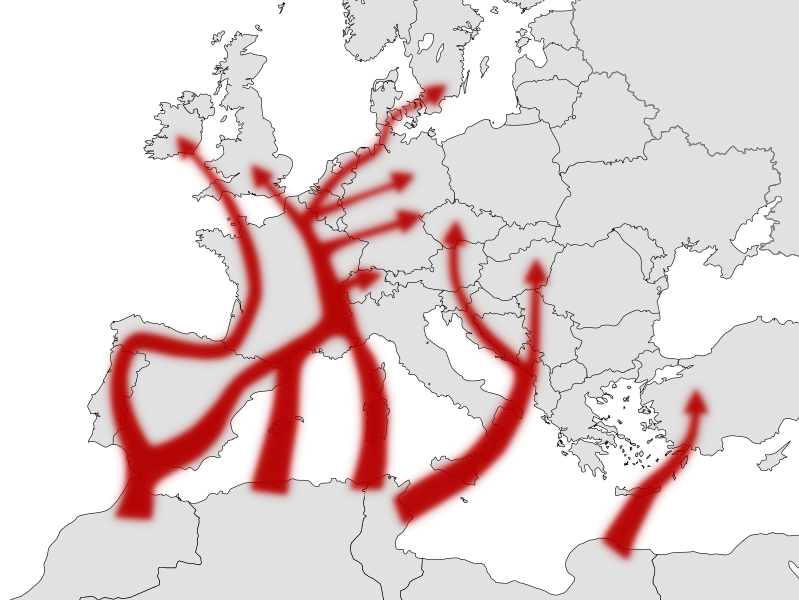
Painted ladies are committed frequent flyers, constantly on the move to keep up with seasonal food plants. Every spring they set out from tropical Africa to Europe across the Sahara Desert and the Mediterranean Sea, only to go back in the autumn. The 15,000-km round trip of successive generations between Africa and Europe is the longest migratory flight recorded for butterflies. But crossing the Atlantic Ocean, as registered by Suchan et al. (2024), is a much tougher challenge altogether: no stopovers for feeding, no respite from the weather. How did the painted ladies make it through the gruelling journey alive?
Routes of painted lady spring migration from North Africa to Europe © Sémhur, Wikimedia Commons:

A fellow traveller, the monarch butterfly (Danaus plexippus), may offer some clues. Every year, monarchs depart from their breeding grounds in southern Canada and northern USA in September and October, arriving at their overwintering sites in Central Mexico in November. Migrating monarchs cruise at energy-saving speeds of about 9 km/h, slower than a person jogging (although there’s a quite a large variation in butterflies’ speed estimates), so they have to slog away to manage distances of over 4,000 km.
Monarch butterfly southbound migration patterns © U.S. Forest Service:

For some insects such as dragonflies and damselflies (Odonata), flight is bimotoric, that is, controlled by forewings and hindwings. Others such as grasshoppers, crickets and related species (Orthoptera) have posteromotoric flight (driven by hindwings). Butterflies and moths (Lepidoptera) are anteromotoric fliers: their flight is controlled primarily by the forewings (Dudley, 2002). But hindwings don’t have a secondary role in butterflies’ locomotion: they are exceptionally well-developed and are coupled with the forewings to flap in synchrony, so that butterflies in general have the largest wing area relative to body mass of all flying insects and perhaps all flying animals, a feature of great help for migrating species.
An efficient flying machine: a female monarch © Kenneth Dwain Harrelson, Wikimedia Commons:

Still, flapping their wings alone would not do: fat reserves would soon be depleted. So, monarchs use skills familiar to aircraft pilots; they glide, taking advantage of air currents and thermals. By holding their wings motionless, their fore- and hindwings overlapping to form a single aerodynamic surface, monarchs gain altitude by soaring in rising air currents, just like birds do. This technique is the most energy-efficient travelling method regarding distances travelled. With good weather and tail winds, monarchs can soar to at least 300 m above the ground and glide for very long distances (Gibo & Pallett, 1979).
Monarchs, birds and glider pilots fly towards a cliff or building to be carried over the top of the obstacle by the deflected air and rise to a higher altitude © Aerospaceweb.org:

Suchan et al. (2024) estimated that painted ladies’ travel would be limited to about 780 km without refuelling. Even if they could feed and despite favourable winds, they wouldn’t go beyond 1,900 km by flapping their wings. Painted ladies must have glided along the northeasterly trade winds, the prevailing winds from West Africa to northwestern South America – the same winds that helped the Portuguese and Spanish to colonize the New World. Based on what has been observed for monarchs, painted ladies must have glided about 85% of the time taken for their trans-continental flight. This dispersal ability could explain the sudden appearance of gaggles of them in places as diverse as the French Riviera, Gaza, Madagascar, the Caribbean, Pacific Islands, and in Siberia, above the Arctic Circle (Shields, 1992):
A model of wind trajectories 48 h before painted ladies were observed in French Guiana © Suchan et al., 2024:

Big and conspicuous wings allow butterflies to travel far, but they also attract hostile characters such as hungry birds. To reduce their chances of ending their lives as juicy morsels, butterflies must take evasive actions. Their well-developed hind wings allow them to make abrupt turns with just a couple of wing flaps, giving them outstanding manoeuvrability. Most butterflies fly erratically, often zig-zagging with no discernible patterns. If you ever tried to catch a butterfly in the air, you know how expertly they evade pursuers. Irregular, chaotic flight patterns can frustrate and discourage the most relentless predator, who quite likely would give up the chase by pragmatically convincing itself in a sour-grapes fashion that the intended prey is ‘mostly wrapper and little candy’ (Jantzen & Eisner, 2008).
A gentleman failing to impress the ladies with his hunting skills. Catching butterflies in Venetian canal, 1854 © Antonio Rotta, Wikimedia Commons:

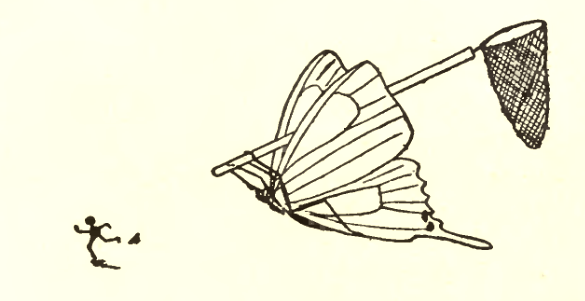
Butterflies elicit feelings of vulnerability and tenderness, but aesthetics are not good ecological yardsticks. These insects are well-adapted to the vagaries of life, including inclement weather, food deprivation and threat of predation. Some species are perfectly capable of travelling – voluntarily or not – distances that would defeat tougher-looking creatures. These feats of endurance must be relevant for the dispersal and colonisation of hitchhiking propagules such as spores and pollen, but such effects are yet to be extensively investigated. Meanwhile, we may carry on appreciating butterflies’ beauty, knowing that their perceived fragility is deceiving.
Butterflies are not the delicate creatures of our imagination © Samuel Hubbard Scudder, 1881, Wikimedia Commons: