Readers’ wildlife photos

September 11, 2025 • 8:15 am

Thank Ceiling Cat we have a few new batches of photos. (I’m always amazed that they do come in!) Today’s contribution are tidepool invertebrates from UC Davis math professor and Hero of Intellectual Freedom Abby Thompson. Abby’s captions are indented, and you can enlarge her photos by clicking on them.

Some final tidepool pictures from the summer.   Excellent low tides will start up again in November.    Thanks as usual to experts on inaturalist for some of the IDs.

The first three pictures illustrate, somewhat graphically, the sex life of mussels (who knew).   Something triggers the simultaneous release of sperm (the white stuff, picture 1) and eggs (the orange stuff, picture 2) into the water (picture 3).    Water temperature is one of the triggers.

Google AI assures me that this event does *not* usually happen at a low tide, but, you know, here we are.    Low tide seems like a not-bad moment to me, since the eggs and sperm can find each other in a small pool, but apparently mostly they are released into open water to meet up as best they can.

Hermissenda opalescens (nudibranch):

Rostanga pulchra (nudibranch):

Superfamily Paguroidea- hermit crab. I’m not sure of the species.    Most hermit crabs move into an empty shell; this one seems to be living in an abandoned worm tube.    There aren’t too many types that can straighten out enough for a tube like this:

Ophiolis aculeata (tentative ID – daisy brittle star). A small-but-lively creature, about an inch across:

Ancula pacifica (nudibranch):

The next three are through a microscope, starting with the favorite food of Ancula pacifica, the nudibranch above, who was munching on it:

Phylum Entoprocta. Each stalk-plus-cup is a separate animal:

Paradialychone ecaudata. A tiny tube worm, very common, but tricky to get a good picture of:

Phylum Bryozoa. Every “flower” is a separate animal. This kind appears as a small patch of white crust on a piece of seaweed:

The beach at around 5:30 in the morning (in July):

Readers’ wildlife photos

September 3, 2025 • 8:15 am

Here are some photos by Peggy Mason, a colleague working away (and kayaking) in British Columbia. Her captions are indented, and you can enlarge the photos by clicking on them. She did not identify all the species, so figure those out yourselves:

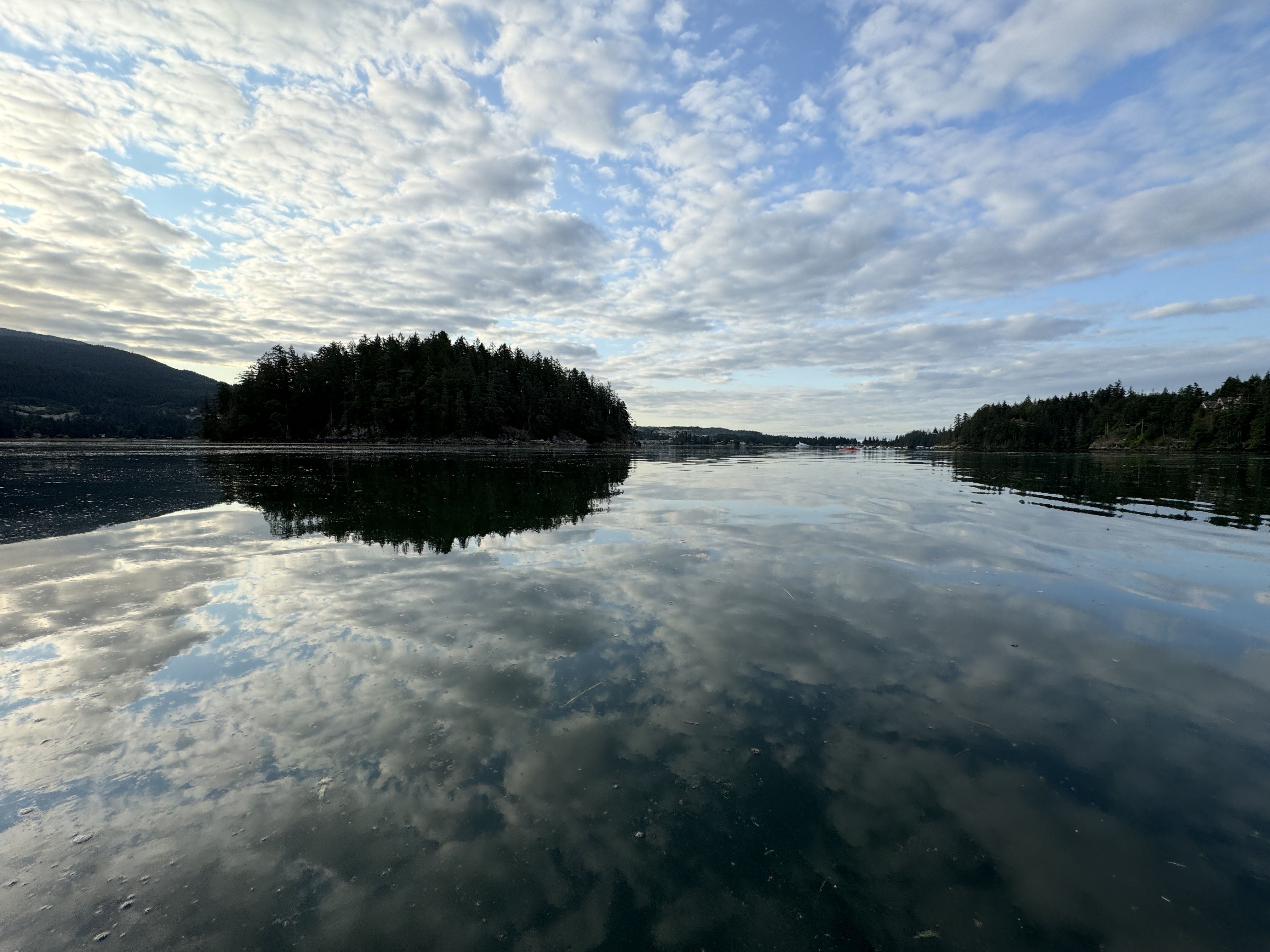
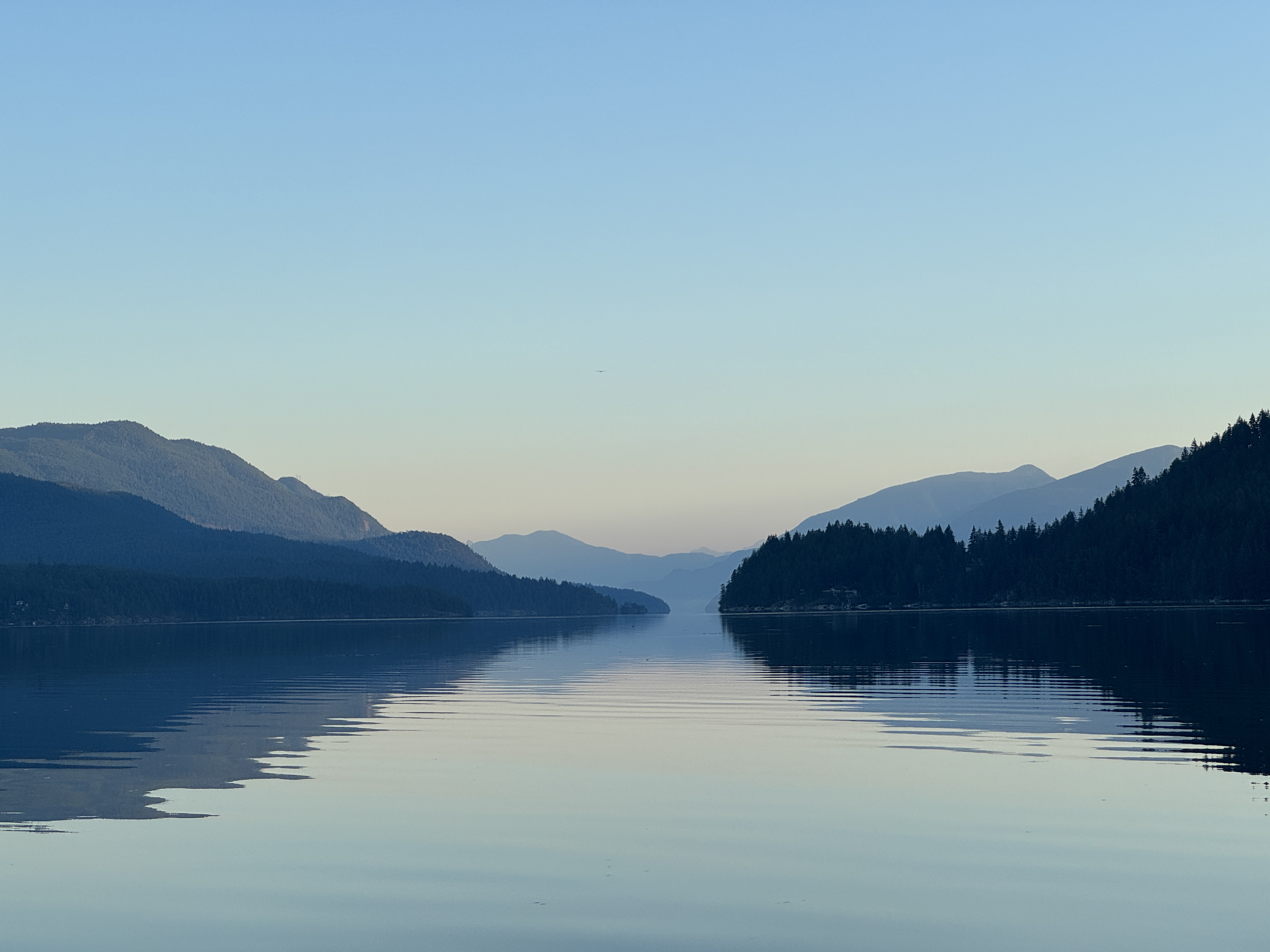
Here are a couple of views of Porpoise Bay. The first is looking south at the town of Sechelt, BC and the second is looking north toward Eggmont and the entrance to the Bay.

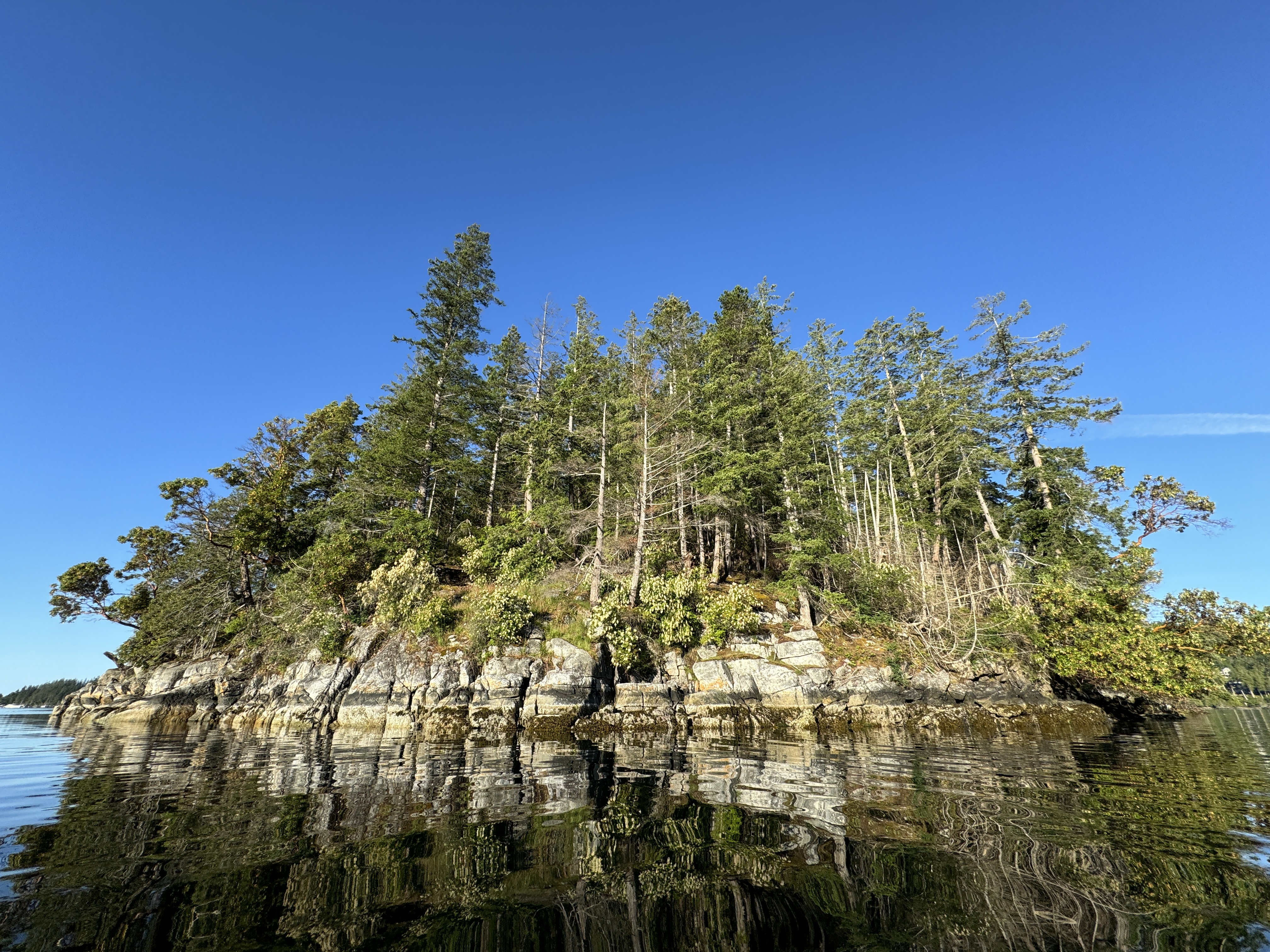
This is Poise Island which has no primates. Only seals, birds, sea stars. Once we saw a deer on Poise, but luckily she swam off the next day:

Egg yolk jellyfish is what we call these. They are big:

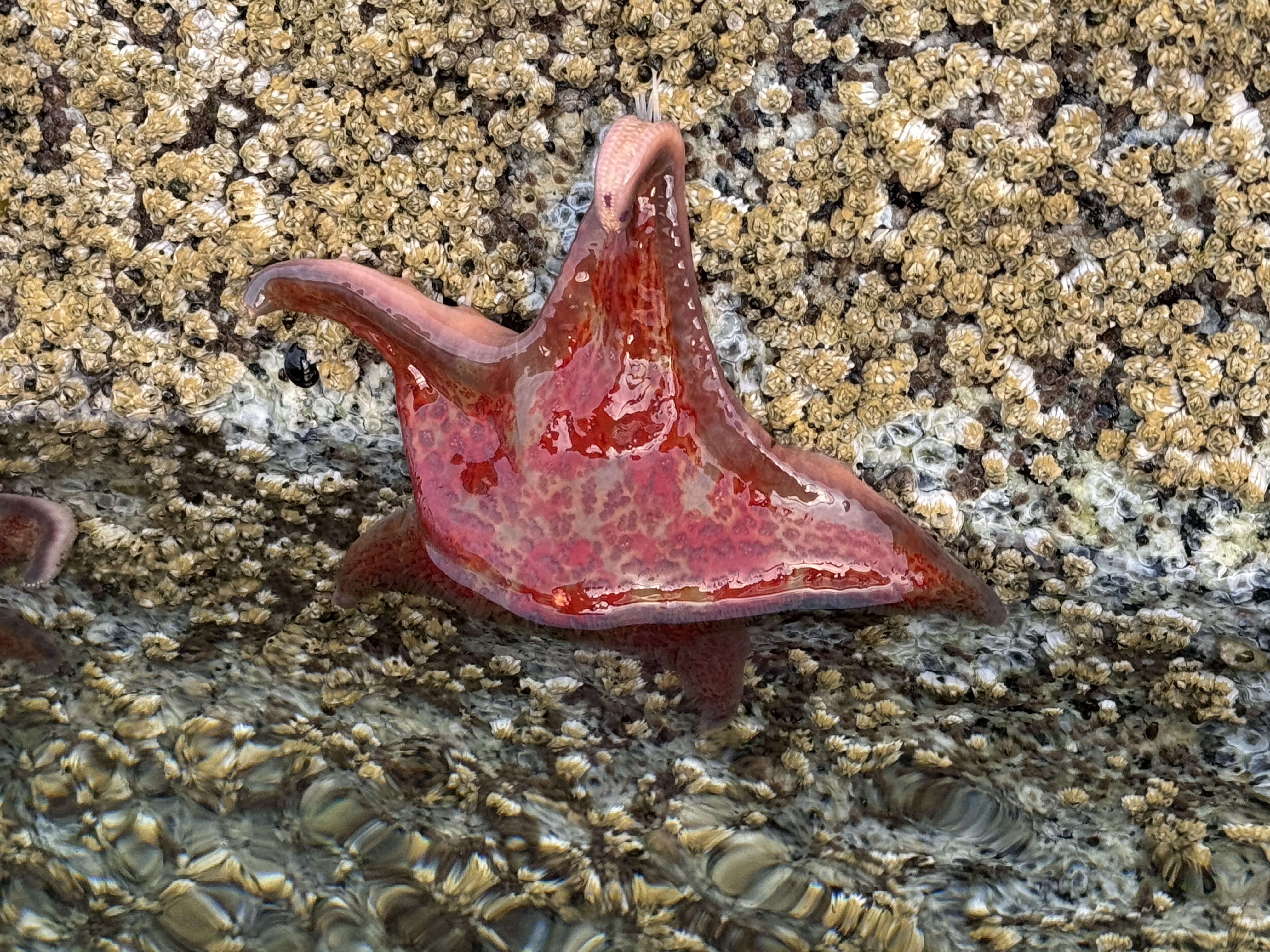
Sea stars abound. It is really common for the ones out of the water to hang an arm or two:

On to the birds. Bald Eagles (Haliaeetus leucocephalus) are everyday birds except in late August and early September when they fly off to the creeks to chow down on salmon:

We hear and see Kingfishers flying every day but they rarely sit still long enough to be photographed, as this one did:

A Great Blue Heron (Ardea herodias), of course:

A Great Blue Heron, flying off, beautiful silhouette:

And finally a seagull. Common and gorgeous:

To the Arctic, part 4. Walruses and icebergs

August 30, 2025 • 9:00 am

This post occupies one day of our trip, again traveling around the big island of Spitsbergen, where’s there is a lot to see.  And it was one of those lovely days when we had activities both in the morning and the afternoon. Morning: a heap o’ walruses; and afternoon: a flotilla of icebergs.

First, a map of the Big Island of the archipelago showing our travels. Spots 1 and 2 mark where we were on this day: St. Jonsfjorden (where we Zodiac’ed around a glacier the previous day), and Poolepynten, Walrus Heaven, both about 78º N latitude:

When I woke up that morning, this was the view outside my cabin window. The iceberg was a harbinger of a good day. Click on the photos to enlarge them.

The Arctic and Antarctic trips have a preplanned schedule, but it always changes depending on weather, wind, waves, and whether there are animals about.  This day’s schedule began with animals, as they excitedly announced on the intercom before breakfast that we’d zodiac to a headland, for they’d spotted a bunch of walruses (I estimate 30-50) hauled out on the beach.  I’d never seen a walrus in the wild, of course, so I was “in a state”.   We took Zodiacs to the shore, and came first upon some seaweed:

Almost every time we went ashore in Spitsbergen, we had to stay close to a guide with a gun. Why? Polar bears, of course, the world’s largest land carnivore, usually hungry, and mean as hell.  Here’s our guide for the walrus viewing.  It was a large-gauge rifle with hollow-point bullets, and all the guides knew how to use it. I think they are not allowed to first at polar bears until they’re 15 meters away and charging (they don’t carry cash). Nobody wants to shoot these magnificent animals and I didn’t meet a guide who had, especially because they are classified as “vulnerable.”

We walked silently and in single file, having been told not to make any noise as walruses have sensitive hearing and are easily disturbed. Voilà: a haul-out with the ship in the background:

Atlantic walruses (Odobenus rosmarus rosmarus) at Poolepynten.  There is only one species but two subspecies. From Wikipedia:

The walrus (Odobenus rosmarus) is a large pinniped marine mammal with discontinuous distribution about the North Pole in the Arctic Ocean and subarctic seas of the Northern Hemisphere. It is the only extant species in the family Odobenidae and genus Odobenus. This species is subdivided into two subspecies: the Atlantic walrus (O. r. rosmarus), which lives in the Atlantic Ocean, and the Pacific walrus (O. r. divergens), which lives in the Pacific Ocean.

Adult walrus are characterised by prominent tusks and whiskers, and considerable bulk: adult males in the Pacific can weigh more than 2,000 kilograms (4,400 pounds) and, among pinnipeds, are exceeded in size only by the two species of elephant sealsWalrus live mostly in shallow waters above the continental shelves, spending significant amounts of their lives on the sea ice looking for benthic bivalve molluscs. Walruses are relatively long-lived, social animals, and are considered to be a “keystone species” in the Arctic marine regions.

They weigh as much as a car.  My camera beeped when it took a shot, but a guide showed me how to turn off the sound, as even a faint “beep” might disturb these beasts. Some walrus snaps:

We weren’t allowed to get too close. Above all, the guides and naturalists are concerned about the animals and the environment, which is great.

Apparently they were cooling off; they do not huddle to stay warm, as they’re encased in blubber. We were told that they simply like to huddle in groups and are comforted by touching each other:

Nice pair of tusks!

After hiking back to the Zodiacs, hovering some distance away, it was already time for lunch. Here are the menus (two for each meal):

Mains: Chicken and spanakopita (there was often foreign food:

Dessert: cassis sorbet and some kind of custard:

After about two hours of rest, it was time for part II of the day: a Zodiac cruise in the bay among the icebergs. You might think that would be boring, but it’s fascinating. All the bergs are different, have different shapes and colors, and often have different patterns from tumbling around in the water. I could easily stay out for several hours, but i think we had an hour and a half. It wasn’t that cold, either. Some bergs (remember, most of them are underwater):

A Zodiac exploring the ice:

The striated patterns in some bergs, we were told, are the results of air bubbles moving upwards when the berg is turned on its side. And yes, they are that blue:

It is an eerie sight, enhanced when the weather is overcast:

Moar:

Every one is different. This one has birds flying by:

Closeup of the previous berg. The patterns and colors are mesmerizing:

There was one very weird berg with rectangular holes in it. Don’t ask me how they got there:

A closeup:

Birds. I can’t identify them; can you?:

More birdies flying around a berg:

The Zodiac driver asked us if we wanted our photos taken in front of an iceberg. I demurred as I don’t like doing such things, but everybody else did, and I was wheedled into doing it:

And then back for another rest followed by dinner. I already was eating too much, so I had a salad (notice the lox):

But I never passed up desserts, and usually had three, these including my favorite: bread pudding with vanilla sauce.

Next episode (in a week): ashore with plants and flowers.

Readers’ wildlife photos

August 27, 2025 • 8:15 am

Today’s photos come from reader Kevin Krebs, who sent in photos from a trip in British Columbia (part 1 is at the first link below). Kevin’s captions and IDs are indented, and you can enlarge his photos by clicking on them.

The Crowsnest to Osoyoos – Part 2

Princeton to Osoyoos

My previous post left off with a photo of the incredible geology around Hedley, BC on the way to Osoyoos.

Before we get back on the road, let’s talk a little about Osoyoos and why I am drawn to it as a destination every spring.

When most people think of British Columbia, they envision old-growth forests, our rugged coast, and our mountains (and, of course, the incredible Burgess Shale!). Many people, even British Columbians, are unaware we have a xeric shrubland biome only a few hours drive away.

I love the coast — it’s where I cut my teeth as a birder—but the antelope and sagebrush grasslands in the southern BC interior are akin to visiting another country. The flora and fauna are so different that I’m engulfed in a nebula of discovery and confusion. Maybe it’s a way of meditating, of striving to see and hear and smell what is really there.

Grasslands are one of the most threatened ecosystems on our planet, yet receive scant attention: old-growth forests are easy to comprehend, but few of us think about old-growth grasslands. Our primate brains and maniacal culture see only empty fields to be cleared for parking lots and big-box stores. As a result, grassland birds have seen terrible declines for decades, as I’m sure other grassland species have as well.

With that scene set, let’s continue our excursion…

The next stop on the route is the village of Keremeos, the “fruit stand capital of Canada,” where I can find several families of (ridiculously cute) California Quail (Callipepla californica). This male was perched on a branch to keep a keen eye on me.

On the outskirts of Osoyoos is the incredible Nighthawk Hill Grasslands. This year was the first time I explored it. I often return there in my mind when I’m stuck on a crowded bus.

While there, I was lucky to spot three birds I rarely see…

A Brewer’s Sparrow (Spizella breweri) — unfairly described as a “small, drab sparrow” (ok… maybe it’s true, but I always find myself annoyed by our human judgments of other beings) with a complex song. Named after Tomas Brewer, a 19th-century naturist and ornithologist.

Here’s a Lark Sparrow (Chondestes grammacus) that I also spotted at Nighthawk Hill Grasslands. A larger, beautiful sparrow that is the only species in the genus Chondestes. It also has a distinctive song.

A Clark’s Nutcracker (Nucifraga columbiana)! I was absolutely elated to find this bird — I’d never found it before, and it was one of the species I hoped to see on this trip. Closely related to crows and jays, these birds are the primary seed disperser for whitebark pine (Pinus albicaulis). Not a great photo, but it was the best I got without disturbing the bird too much.

This was the second year I saw a Blacked-backed Woodpecker (Picoides arcticus) while visiting Kilpoola Lake Road just outside of Osoyoos. These woodpeckers specialize in foraging in recently burnt forests and bogs with dead trees — their black back helping to camouflage them against the burned trunks.

Uncommon on the coast, Red-naped Sapsuckers (Sphyrapicus nuchalis) are somewhat more common in the interior of British Columbia. Unlike more well-known woodpeckers, sapsuckers drill rows of holes into trees, feeding primarily on the sap that is exuded by the tree in defense.

Continuing with woodpeckers, I was pleased to spend some time with this Hairy Woodpecker (Dryobates villosus). While easy to confuse with the smaller Downy Woodpecker (Dryobates pubescens), a close look at the size of the bill will help pick them apart.

A Calliope Hummingbird (Selasphorus calliope) — the smallest bird native to North America, weighing 2-3 grams (0.071 to 0.106 oz) and measuring 7-10cm (2.8–3.9 in) in length. Breeding from British Columbia to Colorado, they migrate to southern Mexico for the winter.

Simultaneously curious and suspicious, this Yellow-pine Chipmunk (Neotamias amoenus) spent a while checking in on me as I rested by the side of the path.

Another bird that was on my wish-list: a Pygmy Nuthatch (Sitta pygmaea). A small and ridiculously cute bird.

And last, a weirdo bird — the Yellow-breasted Chat (Icteria virens). While quite widespread across North America, Yellow-breasted Chats tend to be shy and difficult to spot. Once thought to be a type of warbler, as of 2017 it was moved to the monotypic family Icteriidae .

That wraps up this post. I hope you enjoyed it, and with a little luck maybe I’ve inspired you to travel somewhere new and to care about landscapes and ecosystems that have been ignored by too many of us.

Readers’ wildlife photos

August 15, 2025 • 8:15 am

Today we have photos from Montana taken by Gregory Zolnerowich (there are two exceptions; see below). Gregory’s captions are indented, and you can enlarge the photos by clicking on them.

I recently spent 10 days in Livingston, Montana, visiting a friend and meeting some fellow Kansans for a bit of rafting and camping on the Yellowstone River south of Livingston. Attached are some wildlife photos that might be suitable for WEIT. Another person in our group took the photos of the bald eagle and sandhill cranes but I have permission to share them.

The marvelous scenery of the Paradise Valleyl; the Yellowstone River flows north through it. We camped one night alongside this small side branch of the river. There were small American black bear (Ursus americanus) tracks in the mud so we had to store our food away from the tents:

Hello, do you have a minute to hear about the good news from our lord and savior, Bambi?:

This is the same mule deer (Odocoileus hemionus) as in the previous photo. I stepped out on the deck and it was quite unafraid of me. The friend I was visiting has a number of raised garden beds and grows a variety of vegetables. Her active gardens have deer fencing around them to protect the plants. Possibly the same deer would come around in the early evening and eat apples that had fallen from her apple tree:

This is probably a mountain cottontail (Sylvilagus nuttallii): there were many of these around our cabin. They are the real marauders of the garden and will chew through the plastic deer fencing to graze and raze the garden veggies:

Montana has at least four species of chipmunks. I think this is the least chipmunk (Neotamias minimus). It would skitter and scurry about and was entertaining to watch:

We watched this bald eagle (Haliaeetus leucocephalus) glide in and land on the shore acrossfrom our campsite. It then waded into the water, caught a fish, and flew away. I’ve never seen a bald eagle do that:

Sandhill cranes (Antigone canadensis) are large and majestic. We could hear them calling during the early evening. Their call is quite unique:

Along with bald eagles, ospreys (Pandion haliaetus) also were abundant. We floated right under this one, I was surprised it did not fly off. Look at that hooked beak!:

There are a number of ready-made nesting platforms along the river to keep the ospreys and eagles from nesting on the power poles. This one has ospreys but sometimes we would see an eagle using the platforms:

I was suprised to see this caterpillar out and about on a chilly morning. It appears to be Glover’s silkmothHyalophora gloveri (Saturniidae):

The closest ID I’ll give for this caterpillar is perhaps Arctiinae:

Readers’ wildlife photos

August 13, 2025 • 8:15 am

This is our last full wildlife contribution though I have some singletons and doubletons that I can combine. Please send in your good photos. Thanks.

Today we have some additional photos of Alaska taken by ecologist Susan Harrison. (This is the last of a set of four.) Her captions and IDs are indented, and you can enlarge the photos by clicking on them.

Alaska, part 4:  Anchorage and surrounding area

This post is the last from my June 2025 bird and wildlife trip to Alaska.   Between excursions northwest to Nome, north to Utqiagvik, and south to the Kenai Peninsula, we stayed in Anchorage as it’s the hub of all within-Alaska travel.

We visited Hatcher Pass near the towns of Palmer and Wasilla (remember Sarah Palin??).  The pass lies above elevational treeline in a panorama of tundra and jagged peaks.  We hiked to the pass and scrambled up a scree pile to find the White-tailed Ptarmigan (Lagopus leucura).   While looking for this uncommon bird we saw other alpine-arctic denizens, the Collared Pika (Ochotona collaris) and Hoary Marmot (Marmota caligata).

Hatcher Pass:

White-tailed Ptarmigan:

Collared Pika:

Hoary Marmot:

We also saw the common yet mysterious phenomenon of patterned ground found in the far north.  The best-accepted explanation is that when subsurface freezing causes ground uplift, large rocks become concentrated in the centers of uplifted patches, while finer materials accumulate around the edges.  The finer materials hold more water and thus undergo more extreme freezing and thawing, making plants unable to colonize them.  Millenia of freeze-thaw cycles turn these patches into arrays such as the ones in these photos.

Patterned ground at Hatcher Pass:

At a fish hatchery in Anchorage, we had closeup views of Harlequin Ducks (Histrionicus histrionicus), Common Mergansers (Mergus merganser), and other piscivores jockeying for position at the hatchery’s outlet.

Harlequin Ducks snorkeling for fish and doing a pair-bonding display:

Common Merganser showing its toothy predatory beak:

In the fine system of parks and trails around Anchorage, we saw many other birds and some mammals.

Red-necked Grebe in breeding plumage (Podiceps grisigena):

Arctic Tern (Sterna paradisaea) posing calmly on a park signpost:

Short-billed Gull (Larus brachyrhynchus) guarding its nest:

Sandhill Cranes (Antigone canadensis) baby trying to reach its parents as they stroll on a railroad track:

Muskrat (Ondatra zibethicus), carrying nest material and showing its paddle-shaped tail:

Moose (Alces alces) mother and calves, standing between me and where I needed to go to depart for the airport, a perilous situation due to their deadly kicking defenses:

Readers’ wildlife photos

August 6, 2025 • 8:15 am

Ecologist Susan Harrison has graced us with her third batch of photos from Alaska. Her captions and IDs are indented, and you can enlarge her photos by clicking on them.

Alaska part 3:  Kenai Peninsula

This post is the third in a series from a recent bird and wildlife trip to Alaska.  Unlike part 1 (Nome) and part 2 (Utqiakvik), part 3 takes place well below the Arctic Circle, along the Kenai Peninsula south of Anchorage.  The photos are from two boat trips, one that explored the rugged Kenai Fjords and another that meandered across Kachemak Bay.  Please bear with the less-than-perfect results of wielding my camera on moving boats in mixed weather.

Raft of Common Murres (Uria aalge) in front of a seabird nesting island:

Common Murre closeup:

Mixture of Common Murres and Thick-billed Murres (Uria lomvia; also known as Brünnich’s Guillemot) on a nesting cliff.  Jerry recently showed us photos of the latter species in Iceland.   It’s distinguished from Common Murres by the thin white line along the mouth:

Tufted Puffins (Fratercula cirrhata):

Horned Puffins (Fratercula corniculata) at their nest burrow:

Red-faced Cormorant (Urile urile), a rare and perhaps slightly misnamed North Pacific species:

Pelagic Cormorants (Urile pelagicus) at their nests; they are much more widespread than the Red-faced Cormorant, as well as seemingly redder-faced:

Rhinoceros Auklets (Cerorhincha monocerata):

Parakeet Auklets (Aethia psittacula):

Kittlitz’s Murrelets (Brachyramphus brevirostris), a rare seabird considered the “poster bird for global warming” because it breeds next to tidewater glaciers in the North Pacific and Arctic Oceans:

Black Oystercatchers (Haematopus bachmani) and Surfbirds (Calidris virgata) enjoying a rich rocky intertidal zone:

Starfish (or sea stars; Pisaster ochraceus and others) looking healthy and abundant, a welcome sight since their relatives farther south have been decimated by a wasting disease:

Steller Sea Lions (Eumetopias jubatus), a beast in which the male weighs about one ton, twice the size of the female:

Harbor Seals (Phoca vitulina):

Sea Otters (Enhydra lutris) in Kachemak Bay with the town of Homer in the background:

Mountain Goats (Oreamnos americanus) in the Kenai Fjords, where they are most easily seen from a boat. This is the only part of the US where they still occur naturally rather than being reintroduced: