Readers’ wildlife photos

July 10, 2024 • 8:45 am

I have about three batches left, so if you have wildlife photos, please send them in.

Today’s photos is the second installment of photos from Texas contributed by Damon Williford (part 1 is here).  Damon’s narrative and captions are indented, and you can enlarge his photos by clicking on them. Here’s his introduction to the set.

I took these photos at Brazos Bend State Park on June 23 of this year. Brazos Bend State Park is located about 45 miles south of central Houston and 45 miles north of Bay City where I live. The park contains a variety of habitats, including prairie, woodlands, marshes, swamps, and lakes. The Brazos River forms the eastern boundary of the park.

Eastern Cottontail (Sylvilagus floridanus):

A juvenile American Alligator (Alligator mississippiensis) hanging out near a footbridge:

Blanchard’s Cricket Frog (Acris blanchardi):

A male Eastern Pondhawk (Erythemis simplicicollis):

A Question Mark Butterfly (Polygonia interrogationis) feeding on a severed crayfish claw. I was aware that some species of butterflies will feed on carrion, but this was the first time I have personally observed it:

Black-eyed Susan (Rudbeckia hirta):

Violet Ruellia (Ruellia nudiflora):

American Lotus (Nelumbo lutea):

American Lotus:

Water Hyacinth (Pontederia crassipes):

Mushrooms in the genus Chlorophyllum (maybe). That is the best I could do with the identification:

I used iNaturalist to help me identify the organisms in photos 14-22 because my ID skills become progressively worse as the list moves from amphibian (average) to plants (poor) to fungi (non-existent).

Camera information: I used a Canon EOS R7 mirrorless camera body for all photographs. I used the Canon RF800mm f/11 IS USM lens for photos 1-8, and the Canon RF100-400mm f/5.6-8 IS USM lens for the remaining photos.

The wonders of wasp flight (and parasitism)

July 9, 2024 • 12:45 pm

This video came from FYFD (fyfluiddynamics.com), which has the introductory note:

Personally, I’ve had some bad encounters with wasps, but Dr. Adrian Smith of Ant Lab feels the insects receive short shrift. In this video, he shows many species in the order — most of which are venomless and stingless. In high-speed video, their flight is mesmerizing. Wasps have separate fore- and hindwings, but during flight, they move them like a single wing. Velcro-like hooks on the edges of the wings hold the two together.

From a mechanics perspective, I find this fascinating. Aerodynamically, I’d expect much greater benefits from one large wing over two small ones, but outside of flight, separate wings are more easily tucked away. It’s so neat that wasps have a way to enjoy the benefits of both, enabled by a simple but secure line of hooks. (Video and image credit: Ant Lab/A. Smith)

As I recall, but can’t be arsed to check, insects evolved with four wings at the start, and two-winged insects evolved later, with some converting their wings into balance organs (halteres, as in Drosophila) or wing covers (elytra, like the wing covers of beetles). That’s why wasps had to evolved a velcro-like structure to keep their wings together.

The photography here is marvelous. Try to figure out how some wasps can detect a the larvae of a wood-boring insect inside a tree, and then use their ovipositors to inject an egg into the hapless insect through the wood. They have to be accurate, and do this through a substantial thickness of wood.

h/t: Erik


Readers’ wildlife photos

July 9, 2024 • 8:35 am

As usual, we’re running low, so send in your good wildlife photos.

Today’s selection comes from reader Ruth Berger. Her ID’s and captions are indented, and you can enlarge her photos by clicking on them:

Here is a jumble of pictures taken with a little automatic camera with an 28mm lens in wild-growing greenery in and around industrial areas in Frankfurt, Germany.

My first is of a creature much beloved by me, Trichius cf. gallicus, an unusual-looking beetle:

Trichius spp. belong to the Scarabaeidae whose European members really like Rosaceae plants (but also Asteraceae and many others), so it’s no coincidence I caught this specimen sitting on a Rubus flower. Here is another, better known beetle of the same group, the beautiful and bigger Cetonia aurata, called rose chafer in English; I think the plant is meadowsweet (Filipendula cf. ulmaria), again from the Rosaceae group.

And here are two rose chafers copulating in a hawthorn tree (also a Rosaceae plant). On this very hawthorn tree, about a hundred beetles from several Scarabaeidae species were milling about on that day, while all the other hawthorn trees in the vicinity and in the wider area were blooming away with hardly any visitors. I returned to that same tree a few days later, and again it was buzzing with beetles, as if it had been designated an official meeting point. Do any of the other insect lovers among the readers have any comments about this phenomenon?

Here is a smaller and more homely beetle from the same tree, a male Valgus hemipteruscalled stumbling beetle in German. On its left is the backside of a bee, on which more below:

The bee half visible in the previous picture must be some Andrena (mining bee) spp., and here is one of the species it might be (not at all sure about that), a female Andrena haemorrhoa, with its characteristic red thorax plus a fringe of red hair on the end of the abdomen, feeding on a daisy at one of the places where the municipal greenery crew likes to mow whenever a blooming plant other than a daisy opens its petals”

Many Andrena are very versatile and survive that kind of treatment, other genera, not so much. There used to be Ceratina and Hylaeus species on this site, among others, and they are all gone solely due to needless destruction of either their brood or their feeding plants or both over several years.

And now to something completely different, a bumble bee supposedly very frequent but which I see only rarely, Bombus pratorum, the early bumblebee. From both the Latin and the German name (Wiesenhummel), this should be a meadow species, but I saw this one in wooded terrain:

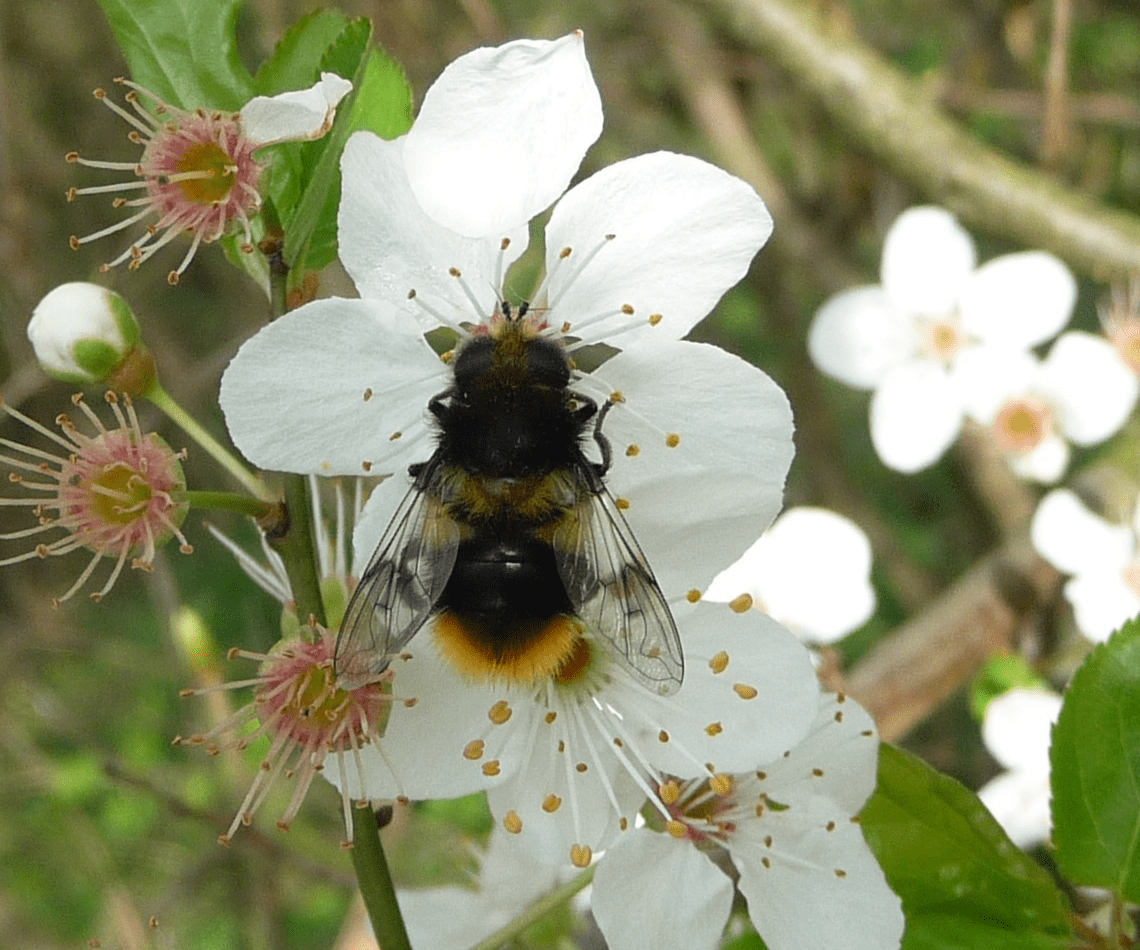
The following is a rare species (“endangered“ according to the German local red list), Mallota fuciformis, a hoverfly posing as a bumble bee, with some similarities to the early bumble bee shown above:

Many hoverflies have obvious mimicry elements in their looks, and one, the hornet mimicry hoverfly, Volucella zonaria, even in behavior: They show the same darting movements as a hornet on the prowl. In flight, they are hard to distinguish from a hornet. Here is a hornet mimicry hoverfly, sitting on the backside of the fence of a garden plot used to raise geese:

Does anyone know the reason why mimicry evolved in hoverflies, but not (to my knowledge) in other families of flies? Here is another hoverfly, Heliophilus trivittatus, a big species I find beautiful (I love the light pastel yellow), sitting on a widow flower, Knautia arvensis, near a river. Heliophilus spp. like it wet. This river meadow was full of widow flowers last year when I took the picture; this year, there isn’t a single one, but lots of clover instead:

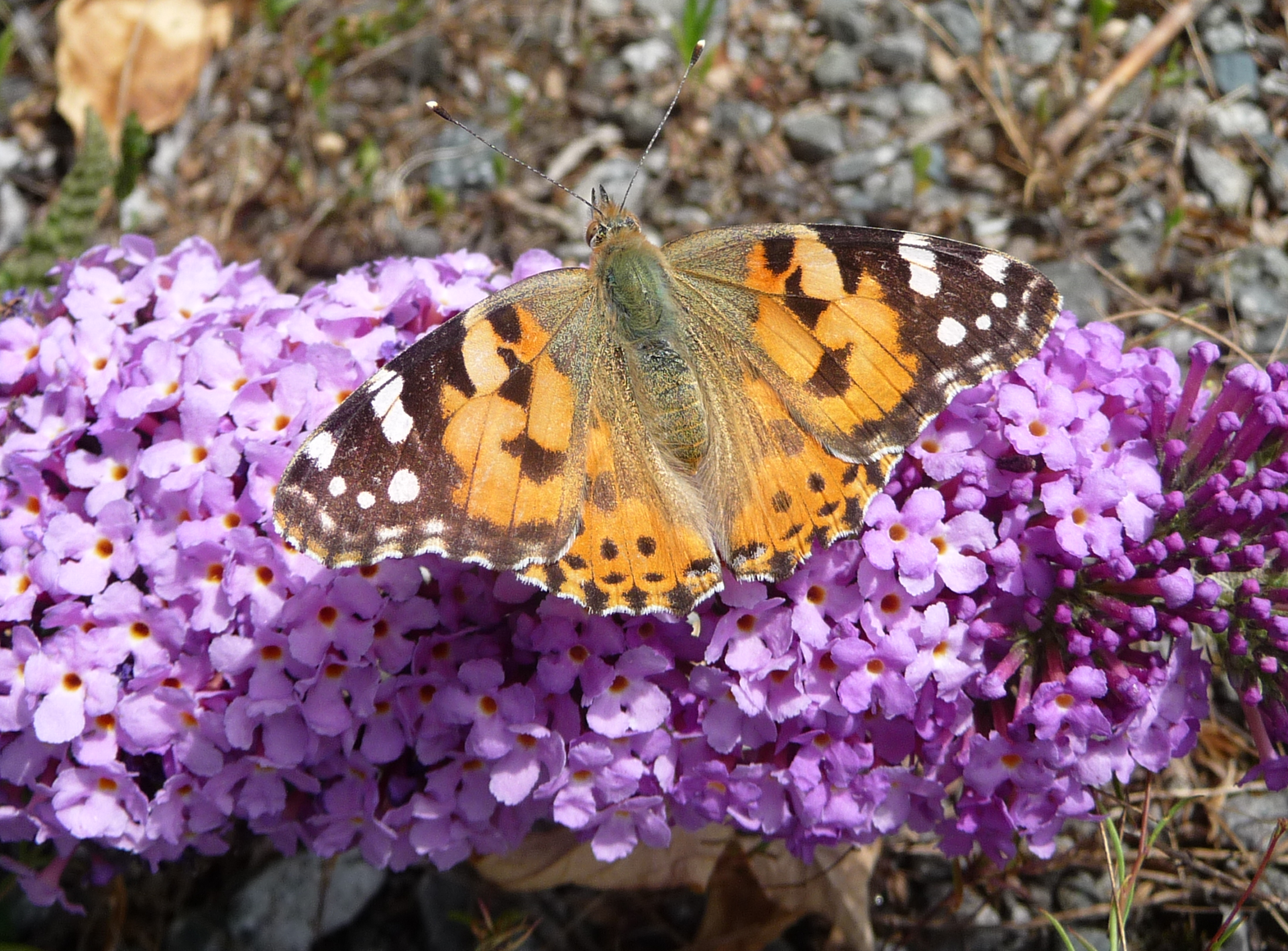
As we were recently talking about Vanessa cardui, the Atlantic-crossing painted lady, I herewith present the only semi-decent picture I have of the species (which isn’t that frequent locally), showing it sitting on Buddleja davidii, a plant that is colloquially called butterfly bush because of its attraction to butterflies, although many other pollinating insects love it just as much:

Here is a small tortoiseshell (Aglais urticae) that was right beside it:

The butterfly bush is a neophyte from East Asia that is said to provide only nectar and no pollen, and it isn’t a typical feeding plant for caterpillars either, so it’s considered an invasive pest, although I personally don’t have the impression that it’s outcompeting indigenous flowering plants where I live. Here, it was part of a late-stage ruderal vegetation.

The next picture shows another plant non-native to central Europe (or Britain), the poppy. For reasons unclear to me, poppy flowers seem to be a favorite perching place for larvae stages of long-horned grasshoppers (Tettigoniidae). The one you see here I’d guess is Tettigonia spp. cf. viridissima. The blurry thing on the left is a hoverfly, Episyrphus balteatus, visible in flight towards the poppy.

Poppies are considered archaeophytes in Central Europe (and by extension also Britain and France), as they arrived 8000 years ago with the first farmers who had poppy mixed with their cereal seed. But despite their long presence here, and despite being part of lots commercial flowerseed mixes, they never really went native, or at least that’s my impression: The poppy in the photo grew at the edge of a rapeseed field, and most of the places where I see poppies are either fields and their close vicinity or plots that were used as fields or gardens in the past.

Readers’ wildlife photos

June 13, 2024 • 8:15 am

Mark Sturtevant has returned with some lovely insect photos. His captions and ID’s are indented (he also provided links, as he always does), and you can enlarge the photos by clicking on them.

I took these pictures of local insects from various locations last summer, either in area parks or in a staged setting.

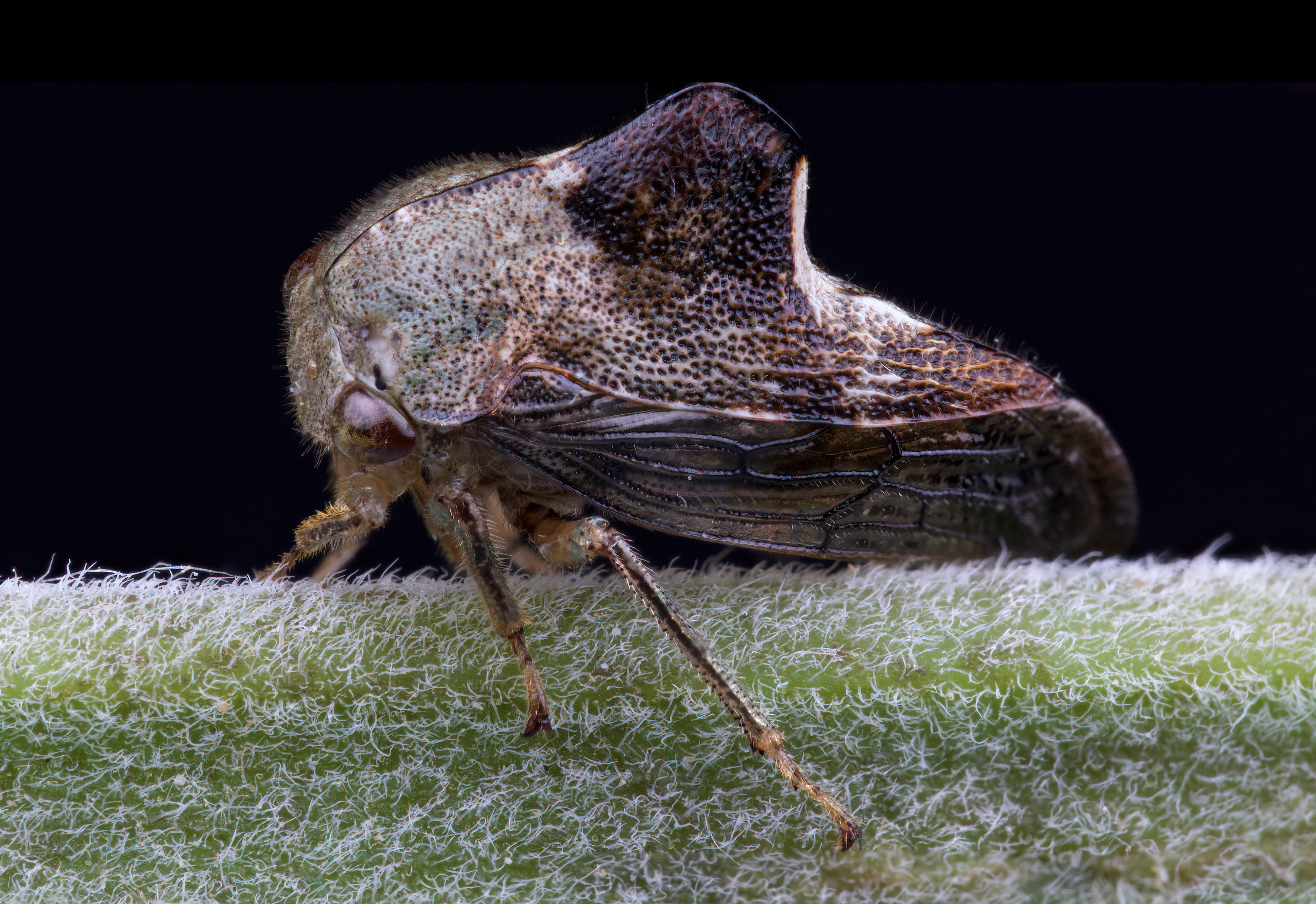
First are a pair of Buffalo Treehoppers, beginning with Stictocephala sp., followed by Stictocephala diceros:

Next up is another treehopper, Telamona sp. As a group, treehoppers are of course distinctive with that enlarged “helmut’ that covers much of the body. There had been some debate about the homology of this novel structure to the general insect body plan, with the rather exciting interpretation that the helmet is serially homologous to insect wings, only they are considerably re-purposed in treehoppers. But that view has been largely discarded now. The helmet is as it seems — a very expanded part of the first thoracic segment:

The small moth shown next is one of the plume moths, which is a large family of cryptic moths with wings that are deeply split into feathery plumes. This can be better seen here. The one I show here is the Rose Plume mothCnaemidophorus rhododactyla:

Next up is our Red Admiral ButterflyVanessa atalanta. These butterflies are exceedingly common, but they are super wary and so I find them to be difficult to photograph. This one was surprisingly calm, though, as it sunned itself on my shed. So the laws of physics made me trot back to the house to get the long lens:

While visiting an area park, I was a little surprised to see this Northern Paper wasp nest (Polistes fuscatus) in a bush. Aren’t these supposed to be attached to human structures?:

I was quite happy to find this interesting beetle, which has the ghastly name of Twice-stabbed Lady Beetle Chilocorus stigma. All readers will be more familiar with the Asian Lady Beetle — which is the ubiquitous orange and black species that was introduced into Europe and North America. I bring this up because the Asian Lady Beetle comes in different color morphs, and surprisingly one of the variants is a close match to the Twice-stabbed species, as shown here.  I have no idea why:

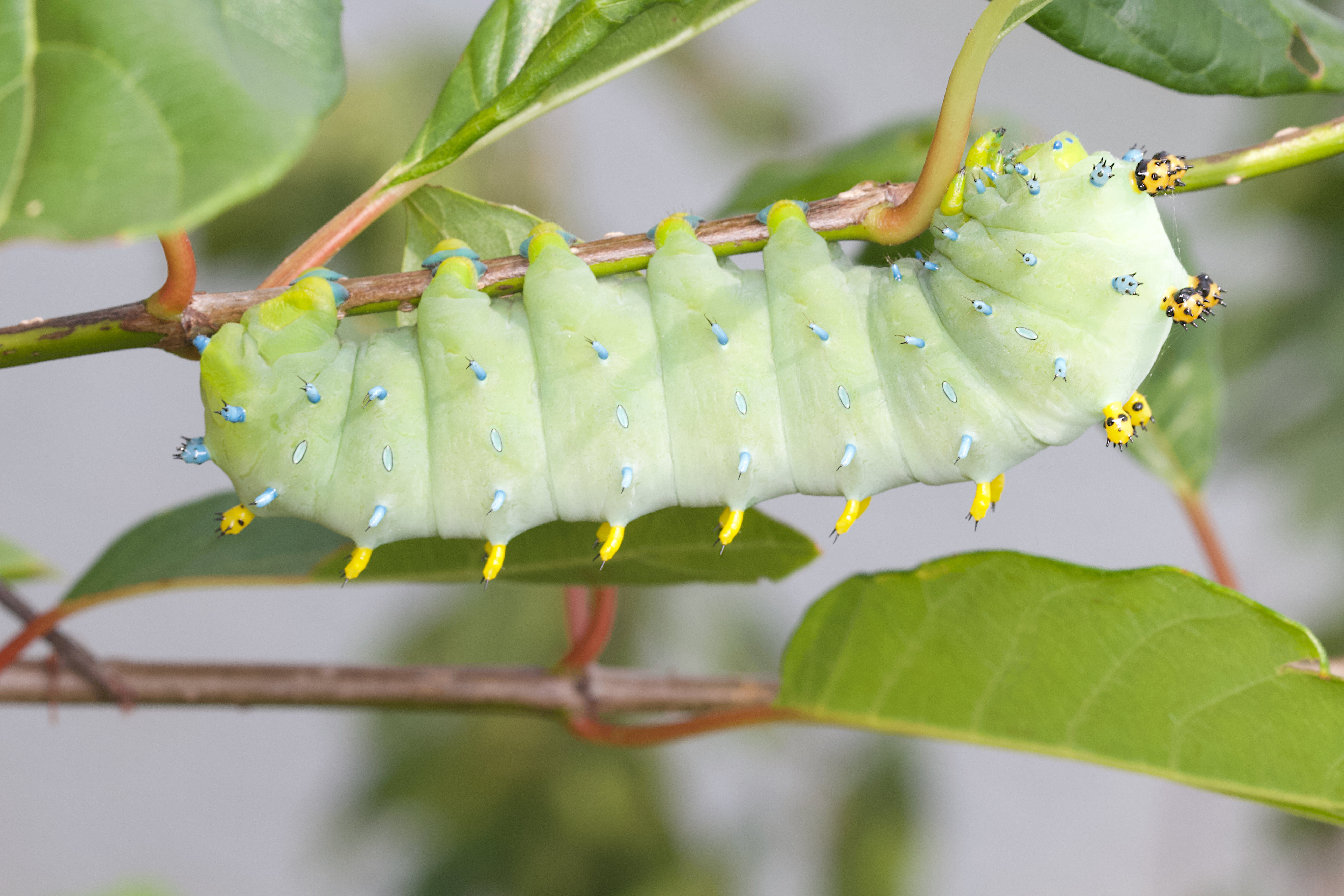
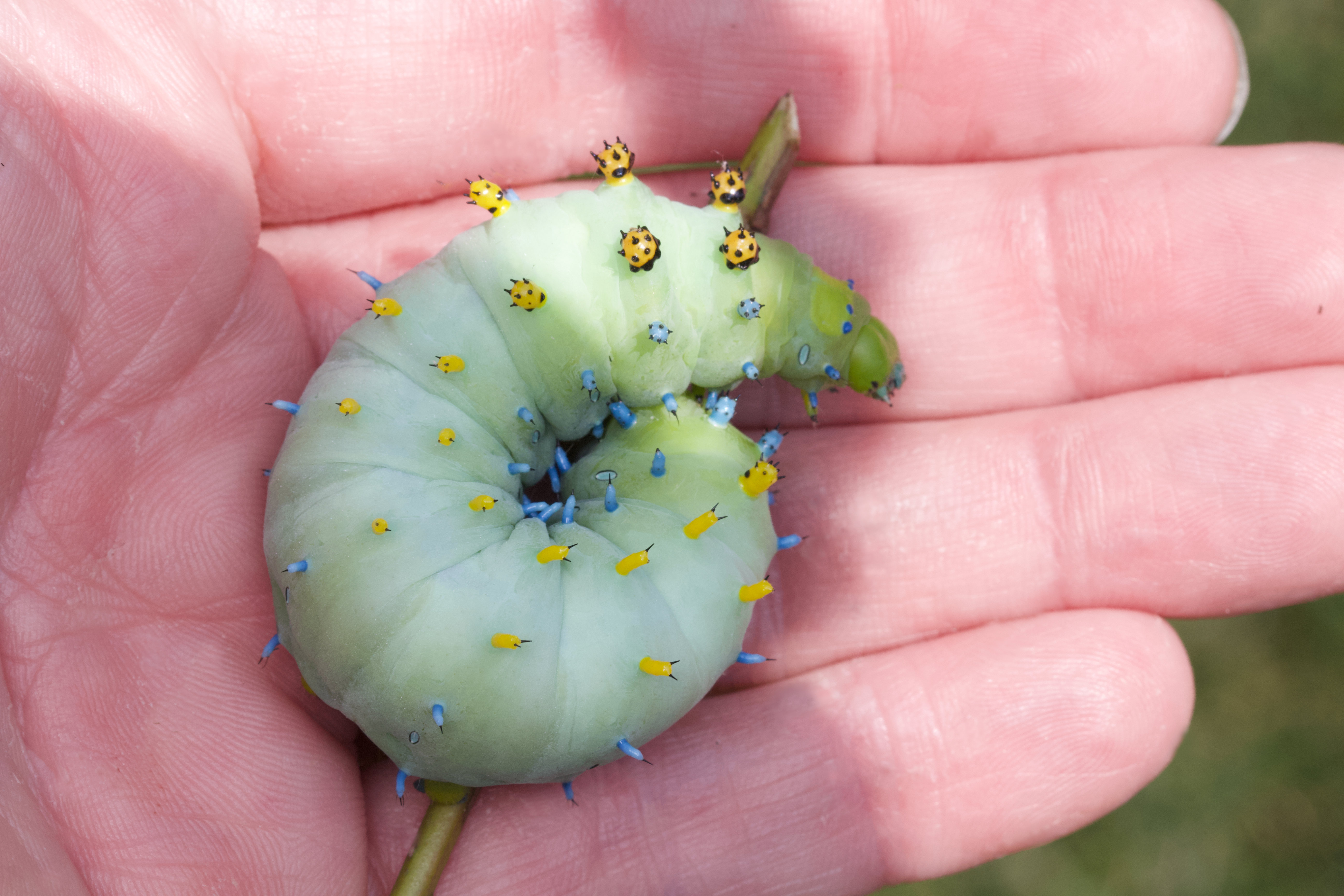
Lastly, I was pretty darn ecstatic to find several large Cecropia Moth (Hyalophora cecropia) caterpillars that were stripping down some snowberry bushes at a park. Not quite fully grown here, they will soon grow up into a bratwurst-sized caterpillar before spinning cocoons, and this season, the survivors will emerge as our largest moth. I took one caterpillar home to raise up, and the last picture shows it in its grumpy “Harrumph” pose, being annoyed that I had briefly stopped it from feeding. The cocoon had over-wintered with me, and it is now sitting where I can keep an eye on it. The adult will be released after the necessary pictures, of course. An enjoyable video showing the adult is at the link:

Readers’ wildlife photos

May 30, 2024 • 8:15 am

Please send in your good wildlife photos; there’s always a need, and it’s beginning to press. . . .

Today’s photos come from our most regular regular, Mark Sturtevant, insect photographer par excellence. Mark’s captions and narrative are indented, and you can enlarge the photos by clicking on them.

Here are more pictures of insects (and one spider) from last summer. All were taken near where I live which is in eastern Michigan. I shoot with Canon cameras, mostly with the manual Laowa 2.5-5x super macro, and the Canon 100mm f/2.8L macro (often with a Raynox diopter to boost the mag). All but the last of these pictures are focus stacks, as I have become addicted to additional post-processing.

Let’s start with ants. We have a large Cottonwood tree in our backyard that is steadily infested with black Carpenter Ants. One day I saw that there was a small swarm of these smaller red ants carrying pupae, larvae, and eggs INTO the tree as well. Perhaps they were moving to higher ground after being flooded out. I am not good with ant identification, but at this time the good folks at BugGuide had tentatively identified them as being Aphaenogaster sp. Despite the some-what controlled conditions of a staged setting (a dish of water that prevented the ants from running off) I needed to take about 200 pictures to get a few keepers. Ants hard!:

Next up is one of the Soldier Flies, Solva pallipes. Soldier flies visit flowers and seem to mimic wasps. The description in Wikipedia mentions that they are rather inactive, and come to think of it, that is true. This is once again from a staged setting, but the fly just sat there:

Here is an exceptionally poofy moth that came to the porch light. Although I often ignore plain-looking moths, this one was such a floof that it had to be photographed. It turns out to have an odd name: the Arcane Grass Tubeworm MothAcrolophus arcanella. The group gets their name because the larvae live in leaf litter, where they hide in silken tubes:

The small beetle shown in the next picture was a bit of a puzzle in that I really had no idea what family it belonged to, but I would see a lot of them. One day, by chance I stumbled upon its ID. So this is one of the Soldier Beetles, and in particular it is Trypherus frosoni. I suppose its colors are a warning that it is toxic. Soldier beetles are herbivores, and many species stay on flowers where they eat pollen. But I see this species only sitting out on leaves. Interesting that its forewings are shortened but the hind wings are not.

Next up is a large Ground Beetle which I think is Scarites vicinus, although it could be a couple other species. I am going with some tiny details like the length/width ratio of antennal segments. Ground Beetles are predatory, as one might guess with those jaws. I just had a neighbor stop by to show me one of the same beetles that they had squished (I am known in the ‘hood as the person to go to for bug information), so I gave her admonishments about how they are beneficial:

It’s time for some dragonflies. First up is one of our Baskettail Dragonflies, Epitheca sp. One cannot easily identify these to species except after very close inspection of genitalia.

Next is a nearly-new species for me because it’s been about 7 years since I’ve seen one. This is a Four-spotted SkimmerLibellula quadrimaculata. Occasional vagrants do appear in my area, but they normally range farther south, which is where this picture was taken:

One of the most common of our dragonflies is the Twelve-spotted SkimmerLibellula pulchella. Males like this one develop white spotting as they age:

An always exciting find is the DragonhunterHagenius brevistylus, what is pretty much our largest dragonfly in the area and as far as I know they are the largest of the Clubtail dragonflies anywhere. With a length up to 90mm (~ 3.5 inches)  and those extra heavy legs, they are not dragonflies that are “good for controlling mosquitoes!”  Their common name refers to their well-above-average interest in eating other dragonflies. This female is as I usually see them, weighing down their favorite twig as they face out over the water:

An unusual spider wraps up this set. This is our Featherlegged OrbweaverUloborus glomosus. There are several different spider families that spin orb webs, with the most familiar being spiders in the family Araneidae. But there are other spider families that also practice this craft, and I don’t know if this is a case of convergent evolution or what. But here we have an orb-weaver spider from one of the “other” families, Uloboreidae, and they are a bit different for a couple reasons. One is that they don’t produce sticky silk but instead use finely meshed silk that entangles prey. Another little detail about these spiders is that they have no venom. This one is eating an unidentifiable prey, and the mass to her rear is an egg sac. This is focus stacked while I was sitting somewhere deep in the woods:

Readers’ wildlife photos

May 27, 2024 • 8:15 am

“Wildlife” today means the intersection of humans in Sardinia with insects, and the narrative and photos come from Athayde Tonhasca Júnior. His captions are indented, and you can enlarge the photos by clicking on them.

Giving bees a hand, the Italian way

Cagliari, the capital of the island of Sardinia, an autonomous region of Italy, shares the plight of many old European cities: most of its 154,000 residents live in tightly packed buildings crisscrossed by a maze of narrow streets and alleys. Cities like Cagliari are on the far end of the urbanisation scale, where natural habitats have been mostly eliminated or severely reduced to suit human occupation. At a first approximation, such landscapes are inhospitable to wildlife.

And yet, species’ success hinges on adaptation. Some bees take advantage of city perks such as lower pressure from pesticides and higher diversity and abundance of flowers when compared to agricultural areas, and are happy to share urban spaces with human residents. Many Cagliari citizens, perhaps even unknowingly, have done their part by creating miniature bee-friendly environments in their homes and business.

Small gardens, flower strips and even flowerpots are islands of pollinator habitats. These spaces may look tiny to us, but could supply bees and other insects with lots of pollen, nectar and possibly nesting and hibernating sites. Habitat fragmentation, the almost inevitable byproduct of habitat depletion, has negative consequences for an array of animal and plant species in which survival depends on large, continuous and pristine areas. But for many bees, flower patches work as stepping stones of interconnected networks (Hinners et al., 2012).

Females of six common European wild bee species fly from 70 to 120 m in search of food in urban gardens (Hofmann et al., 2020). The larger the species, the longer its range; the large scissor-bee (Chelostoma florisomne), with a mean body length of 5.5 mm, has a maximum foraging distance of 150 m; the violet carpenter bee (Xylocopa violacea), with a body length of 24 mm, can reach up to 1,200 m (Gathmann & Tscharntke, 2002). Bees hardly ever find themselves isolated in a city street, and a flower bed on a balcony is just one stopover to be explored.

Bees can fly for relatively long distances, but they maximise energy efficiency by keeping foraging expeditions short. This has management implications: as a general rule, based on results from a number of bee species, flower patches are best placed within a few hundred metres of each other to facilitate foraging and reduce the risk of bees running out of nectar, their fuel (Zurbuchen et al., 2010).

Small is ok: small, isolated flower patches may not attract many pollinators because the amount of food available may not be worth the effort of flying to them. But insects that take their chances may be compensated by less competition and greater energy efficiency, as they are less likely to come across flowers depleted of nectar and pollen by a previous visitor. Being in a small group can be good for plants too: each has a better chance of being visited and pollinated.

The size of a flower patch is not the main determinant of the volume of nectar available to pollinators: what matters most is the quality of plants. A variety of plant species also assures nectar availability throughout the season. For example, willows (Salix spp.) and ivy (Hedera helix) are great providers of nectar during early and late seasons, respectively, when other sources are scarce (Tew et al., 2022).

Prendergast et al. (2021) reviewed 215 studies about bees’ responses to urban landscapes and concluded that some cities with moderately disturbed areas and rich floral resources can support exceptionally diverse and abundant bee assemblages. It all depends on pollinator-friendly management of domestic gardens, parks, allotments, cemeteries, road verges, brownfield sites and other spaces.

The Mediterranean Basin is one of the ‘hot spots’ for bee diversity, and Sardinia is no exception: 336 species have been recorded on the ~24,000 km2 island, although the true number is likely to be higher because the bee fauna is not well known (Nobile et al., 2021). Many of these wild bees must take advantage of sympathetic urban spaces.

A great number of bee species, particularly from the families Andrenidae and Halictidae (solitary, mostly ground-nesting bees), are oligolectic, that is, they gather pollen from only a few plants, typically from the same genus or related genera. Oligolecty may sound like a poor strategy because pollen specialists may go hungry even if surrounded by flowers, if flowers are of the wrong type. But as oligolectic species make up about half of all bees in some habitats, being a fussy eater must have selective advantages. Pollen specialists may compensate for their narrow diet by gathering more pollen and faster than polylectic species (those that collect pollen from many unrelated flower species); they may have become adapted to plants’ chemical defences, thus getting resources not available to their rivals; or they may suffer less from the effects of direct competition with other flower visitors. Whatever their causes, oligolecty and polylecty have practical consequences: to help the bee fauna, we need to provide them with an array of flowers, so that even the pickiest visitor is likely to find the food it needs.

Urban areas are spatially heterogeneous mosaics of niches such as walls, fences, wooden posts, derelict structures, bare soil and road embankments. Several bees readily occupy cavities in man-made structures and patches of exposed earth to construct their nests.

The remarkable levels of resilience and adaptation of some bees to city-living may give the impression that urbanisation is benign or neutral to wildlife. By and large, it’s neither. Urban growth and agriculture expansion are among the greatest threats to global biodiversity and natural habitats. These anthropogenic effects are inevitable, but we have tools to mitigate their impact. Creating and protecting bee-friendly urban spaces is one of them, with the added advantage of helping other types of wildlife. We too reap the benefits: a city or town that’s hospitable to wild bees is likely to be a healthy and pleasant human habitat.


Readers’ wildlife photos

May 4, 2024 • 8:15 am

Mark Sturtevant has answered the call for photos with some lovely pictures of insects and plants. Mark’s notes are indented, and you can enlarge the photos by clicking on them.

We begin with the tail end of a trip to Ohio last summer.

There is a terrific bog at a park there which I shall always visit when “bugging” in that state. I don’t often photograph flowers, but these Showy Lady’s Slipper Orchids Cypripedium reginae were abundant, and they are rather special since this species of Lady’s Slipper is generally rare. Visitors are not allowed to stray off of the boardwalks in the park, so my long lens came in handy here. That rule was frequently broken by others, btw, and it really ticked me off:

Next up is a new species of spider, the Western Lynx Spider (Oxyopes scalaris). Lynx spiders are ambush predators that sit up high on plants. Despite its common name, this species is widespread in the U.S., although it was new to me:

At a prairie location, these Soldier Beetles were abundant on various flowers where they were feeding on pollen. Their bright colors are a warning that they are not palatable. I thought they were two species, but it turns out they are both Margined LeatherwingsChauliognathus marginatus, a species that comes in different color morphs:

Back we go to my resident state of Michigan. At a park some hours to the south of me, there were these mini-swarms of beetles that were feeding and mating on low shrubbery. Another new species. It turns out they are Clay-colored Leaf BeetlesAnomoea laticlavia, and they have an interesting biology in that their larvae live underground where they are tended by ants:

While on the subject of beetles having sex, here are a pair of Asian Ladybird Beetles (Harmonia axyridis), a species that has a number of other common names. They are an introduced and hugely dominant species of “ladybug”, and I worry that they have displaced some native species:

But now we get into some very special items. Near where I live is a park that has several wetland areas with “fens”, or at least that is what our park service calls them. I am told they also have features for “bogs”, however. The different types of wetlands are based on chemistry and water movement, plus the presence of various indicator plants.

Anyway, I call my favorite one “Sturtevant’s Fen” since its location is well off any trail and no one else goes to it. So it is a great place and it is all mine. One of its best features is that it harbors a healthy population of our smallest dragonfly, called the Elfin Skimmer (Nannothemis bella), is a species that is very fussy about the wetland conditions upon which it depends. Ever since I’ve known of these amazing little dragonflies, I’ve had a vision to photograph them in hand in order to convey how incredibly small they are. Catching them with a net was super easy. First, here is a male. I promise he is not being harmed. Next is the very different looking female. She had recently emerged, and so was not inclined to fly. This picture is one of my favoritest pictures I’ve ever taken! Elfin Skimmers are the 2nd smallest dragonfly in the world, and the smallest is a close relative found in China:

Sturtevant’s Fen also has orchids. The most common are these lovely grass pink orchids (Calopogon tuberosus). I believe this is a bog and not a fen indicator, but they are still very nice. The strange yellow thingies up top are lures that are meant to fool bees into foraging upon them since they look like anthers. The weight of the bee then causes the petal to tip down to the central column below, where sticky pollen sacs await to attach onto the hapless bee. Darwin would have appreciated the contrivances of these orchids: