
Mark Sturtevant has returned with some lovely insect photos. His captions and ID’s are indented (he also provided links, as he always does), and you can enlarge the photos by clicking on them.
I took these pictures of local insects from various locations last summer, either in area parks or in a staged setting.
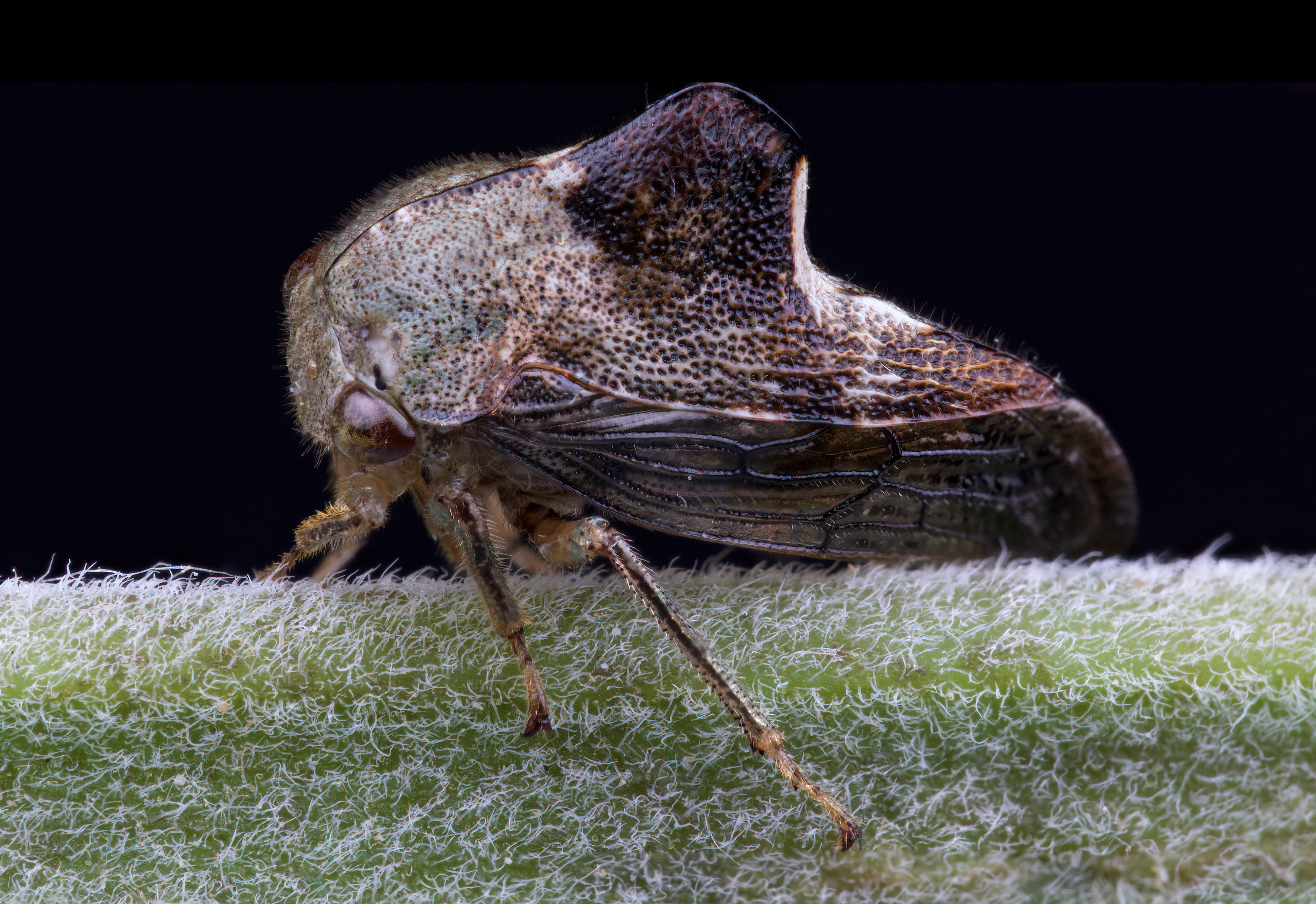
First are a pair of Buffalo Treehoppers, beginning with Stictocephala sp., followed by Stictocephala diceros:


Next up is another treehopper, Telamona sp. As a group, treehoppers are of course distinctive with that enlarged “helmut’ that covers much of the body. There had been some debate about the homology of this novel structure to the general insect body plan, with the rather exciting interpretation that the helmet is serially homologous to insect wings, only they are considerably re-purposed in treehoppers. But that view has been largely discarded now. The helmet is as it seems — a very expanded part of the first thoracic segment:
The small moth shown next is one of the plume moths, which is a large family of cryptic moths with wings that are deeply split into feathery plumes. This can be better seen here. The one I show here is the Rose Plume moth, Cnaemidophorus rhododactyla:

Next up is our Red Admiral Butterfly, Vanessa atalanta. These butterflies are exceedingly common, but they are super wary and so I find them to be difficult to photograph. This one was surprisingly calm, though, as it sunned itself on my shed. So the laws of physics made me trot back to the house to get the long lens:

While visiting an area park, I was a little surprised to see this Northern Paper wasp nest (Polistes fuscatus) in a bush. Aren’t these supposed to be attached to human structures?:

I was quite happy to find this interesting beetle, which has the ghastly name of Twice-stabbed Lady Beetle Chilocorus stigma. All readers will be more familiar with the Asian Lady Beetle — which is the ubiquitous orange and black species that was introduced into Europe and North America. I bring this up because the Asian Lady Beetle comes in different color morphs, and surprisingly one of the variants is a close match to the Twice-stabbed species, as shown here. I have no idea why:

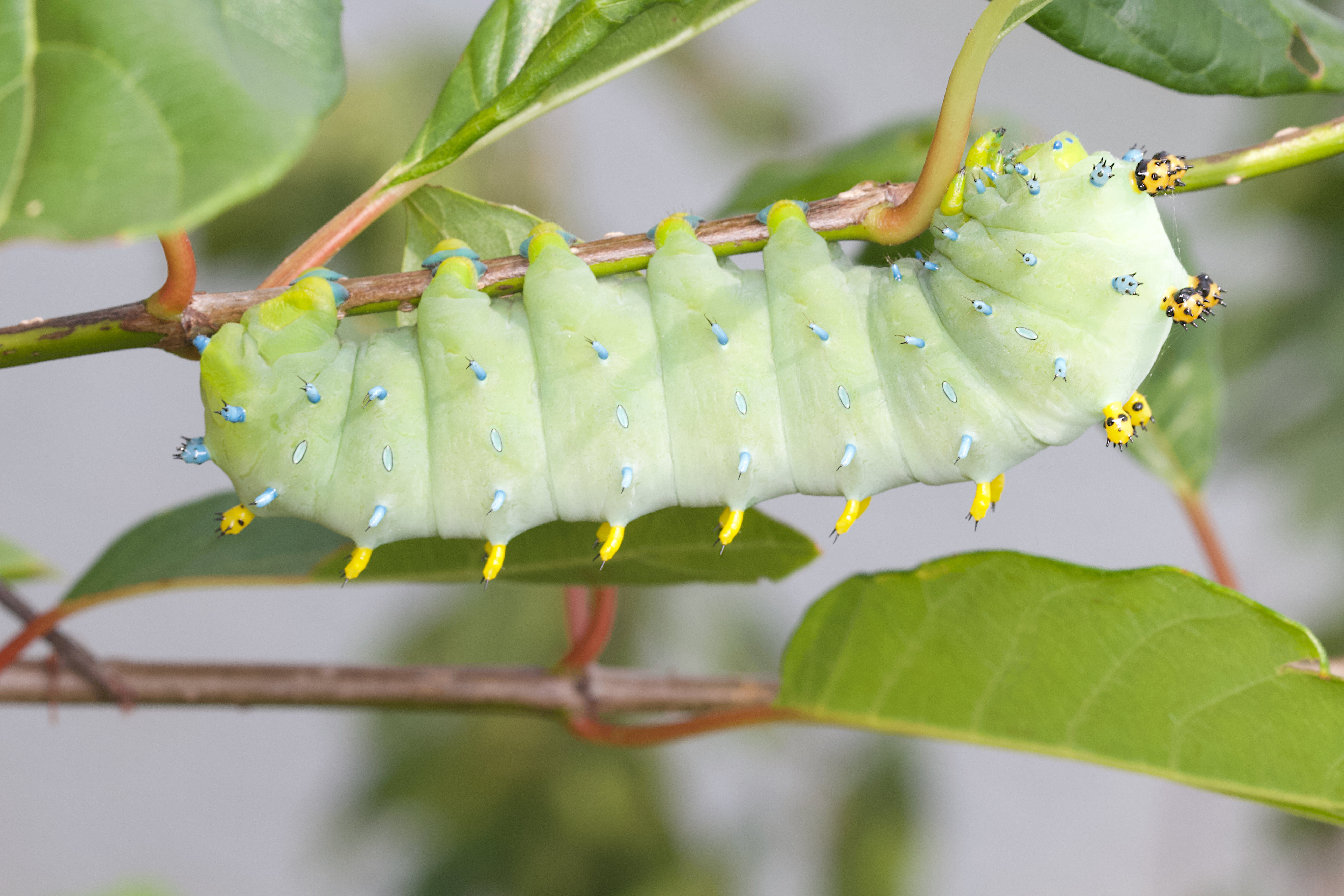
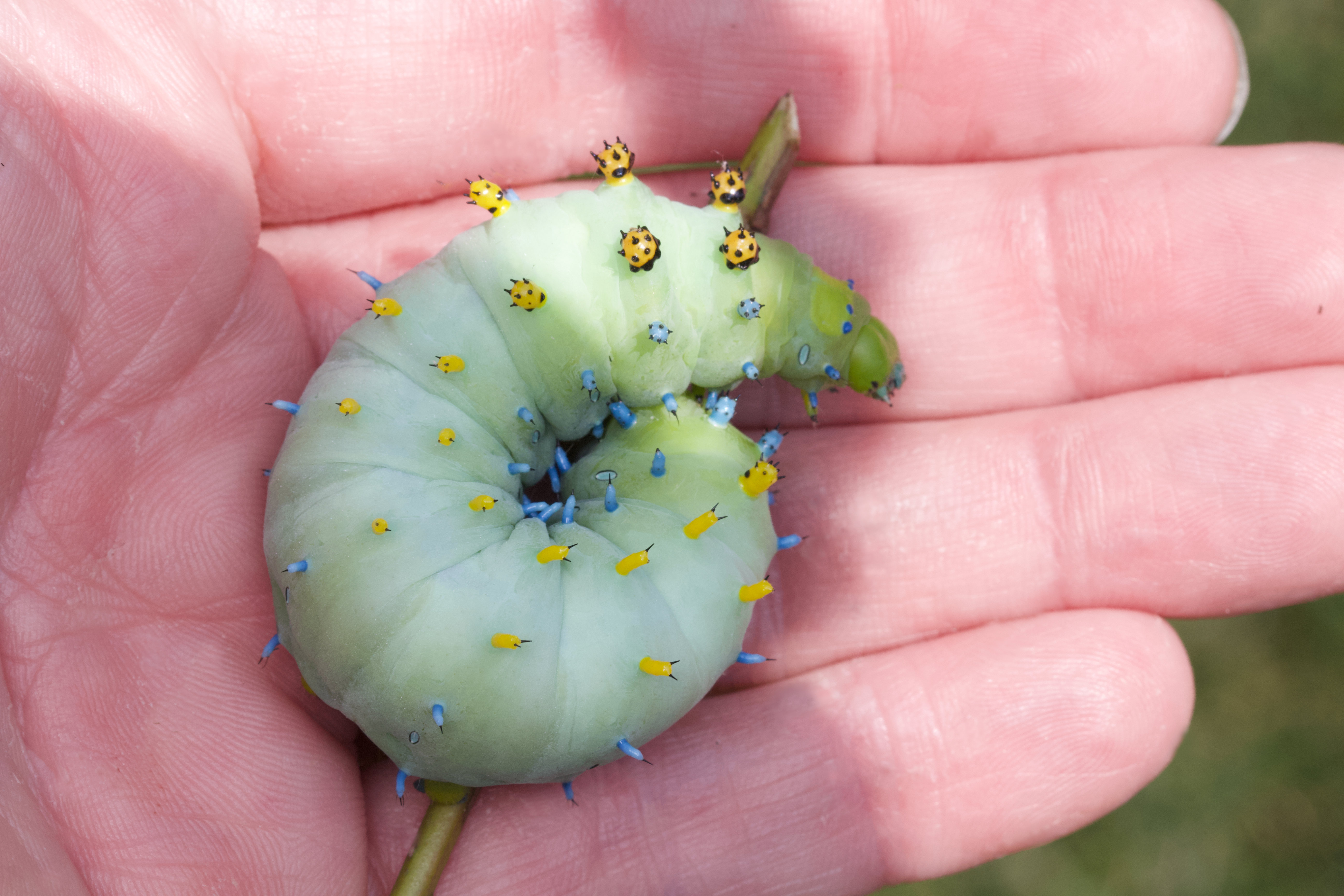
Lastly, I was pretty darn ecstatic to find several large Cecropia Moth (Hyalophora cecropia) caterpillars that were stripping down some snowberry bushes at a park. Not quite fully grown here, they will soon grow up into a bratwurst-sized caterpillar before spinning cocoons, and this season, the survivors will emerge as our largest moth. I took one caterpillar home to raise up, and the last picture shows it in its grumpy “Harrumph” pose, being annoyed that I had briefly stopped it from feeding. The cocoon had over-wintered with me, and it is now sitting where I can keep an eye on it. The adult will be released after the necessary pictures, of course. An enjoyable video showing the adult is at the link:

That last photo takes the cake!
I’ve had small paper wasp nests on the house near my front door, but the hugest nest I’ve ever seen–about 15″ vertically and 15″ horizontally–was in the arborvitae of a neighbor, about 8′ up. When the neighbor asked whether they should call an exterminator, I suggested they just leave the nest since it was in a place where no one was disturbed by the activity of the wasps (they left the nest).
Very exciting photos! I’m looking forward to seeing your photos of the caterpillar turning into the Crecropia Moth. It’s such an incredible transformation it’s almost unbelievable.
Great photos, Mark. Thanks. I particularly liked the Red Admiral Butterfly. What area of the world do you live in?
Thank you! Eastern Michigan.
Wonderful photos, illustrating such diverse solutions to “how to eat plants, survive, and reproduce.”
Who gave the creepy name to that Lady Beetle?!!
Wonderful expert photographs, is there any surprise that we mere snappers feel inhibited about submitting ours?
More seriously, I am interested in the comment about Red Admirals being wary. In my (UK) garden they approach closely and sometimes perch on me.
The Stictocephala is a cutey. I love the pale green color of the caterpillar. One of the most painful stings I’ve ever experienced was from a caterpillar. I don’t know what kind it was, but it was big, fat and lime green with big “horns” I call them. I’d accidentally stepped on it in a park. I guess I’d “sting”, too. Was it a sting or a bite?
Great photos, Mark. Recently I found a small paper wasp nest with a couple wasps tending to it under a patio umbrella. The nest wasn’t much larger than the one in your photo above. But the next time I looked a day or two later, the nest was gone. Then I found what looked like the same nest resting on a patio table about 10 feet away, perhaps blown there by the wind.
It looked like some of the cavities had been filled, but I assumed that the grubs(?) were no longer viable. I thought my wife might like to use the nest in a collage. (She’s a glass mosaic artist who sometimes branches out into art with bits & pieces of nature.) I left the nest on our kitchen counter overnight.
The next morning I spied several ants going into and out of the nest. Uh oh. I can deal with a few loose ants, but I decided to put the nest into a small glass jar. But ants kept coming out of the nest, and I kept taking them out of the jar. (I’m sorry — I also squished them.) It was like a clown car. How did they all fit in that nest? And if they were eating remnants of wasp grubs, how much wasp food could there be? All told nearly three dozen ants came out of the nest.
The next day a most astonishing thing happened — a wasp crawled out of the nest. And later in the day another one came out. And then another one in the evening. One was slightly deformed, but the others looked relatively healthy. But it was night again, and I left the jar on the counter.
By the next day all the wasps had died. Would they have lived had I left the nest alone to be scattered by the wind? Should I have placed it among some foliage? Would the wasps that came out of the nest have lived had I set them free? (I live in the San Francisco Bay Area.)
What a story!
Who knows what might have happened if you had left it alone? But you wouldn’t have been able to document so much.
🐜🦟 It was definitely fascinating. Glad you liked the story!
Thanks for sharing your photos and the great information!