
As usual, we’re running low, so send in your good wildlife photos.
Today’s selection comes from reader Ruth Berger. Her ID’s and captions are indented, and you can enlarge her photos by clicking on them:
Here is a jumble of pictures taken with a little automatic camera with an 28mm lens in wild-growing greenery in and around industrial areas in Frankfurt, Germany.
My first is of a creature much beloved by me, Trichius cf. gallicus, an unusual-looking beetle:

Trichius spp. belong to the Scarabaeidae whose European members really like Rosaceae plants (but also Asteraceae and many others), so it’s no coincidence I caught this specimen sitting on a Rubus flower. Here is another, better known beetle of the same group, the beautiful and bigger Cetonia aurata, called rose chafer in English; I think the plant is meadowsweet (Filipendula cf. ulmaria), again from the Rosaceae group.

And here are two rose chafers copulating in a hawthorn tree (also a Rosaceae plant). On this very hawthorn tree, about a hundred beetles from several Scarabaeidae species were milling about on that day, while all the other hawthorn trees in the vicinity and in the wider area were blooming away with hardly any visitors. I returned to that same tree a few days later, and again it was buzzing with beetles, as if it had been designated an official meeting point. Do any of the other insect lovers among the readers have any comments about this phenomenon?

Here is a smaller and more homely beetle from the same tree, a male Valgus hemipterus, called stumbling beetle in German. On its left is the backside of a bee, on which more below:

The bee half visible in the previous picture must be some Andrena (mining bee) spp., and here is one of the species it might be (not at all sure about that), a female Andrena haemorrhoa, with its characteristic red thorax plus a fringe of red hair on the end of the abdomen, feeding on a daisy at one of the places where the municipal greenery crew likes to mow whenever a blooming plant other than a daisy opens its petals”

Many Andrena are very versatile and survive that kind of treatment, other genera, not so much. There used to be Ceratina and Hylaeus species on this site, among others, and they are all gone solely due to needless destruction of either their brood or their feeding plants or both over several years.
And now to something completely different, a bumble bee supposedly very frequent but which I see only rarely, Bombus pratorum, the early bumblebee. From both the Latin and the German name (Wiesenhummel), this should be a meadow species, but I saw this one in wooded terrain:

The following is a rare species (“endangered“ according to the German local red list), Mallota fuciformis, a hoverfly posing as a bumble bee, with some similarities to the early bumble bee shown above:
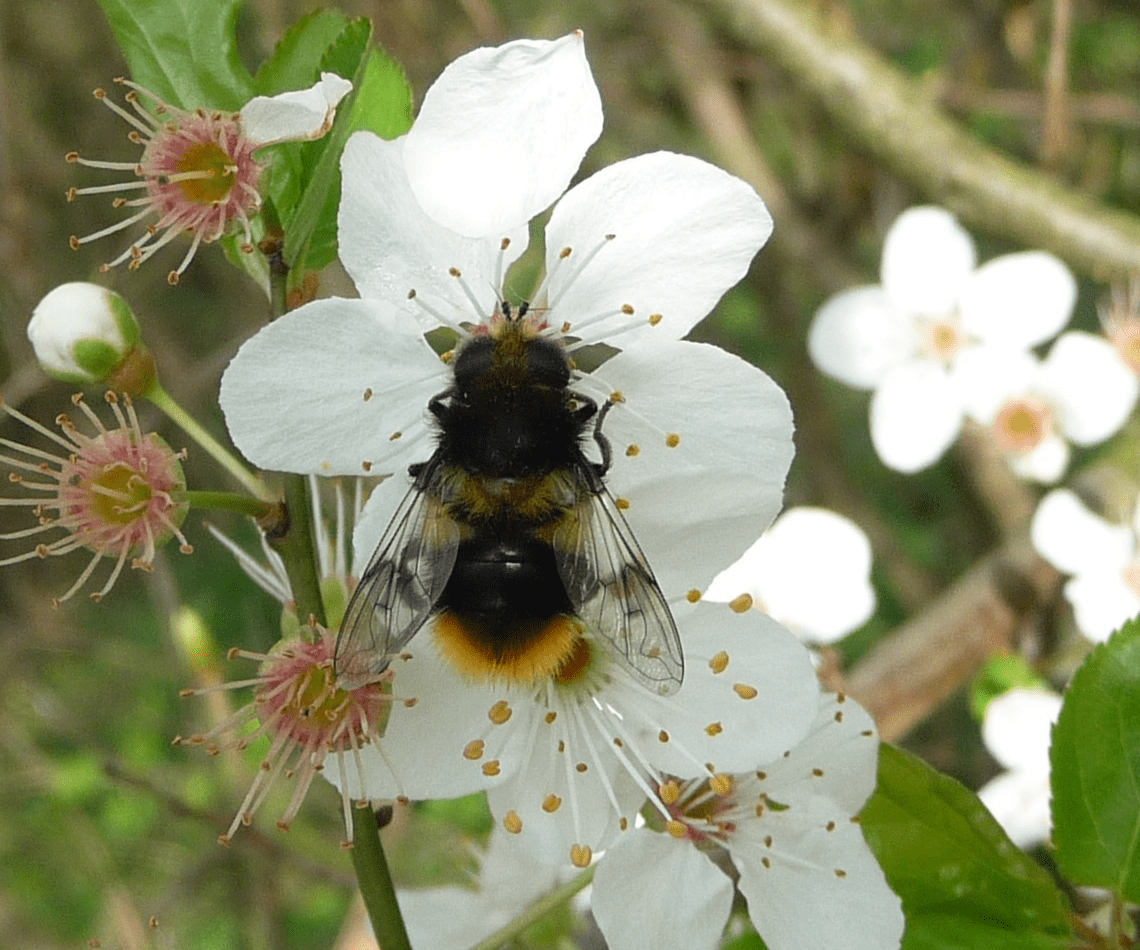
Many hoverflies have obvious mimicry elements in their looks, and one, the hornet mimicry hoverfly, Volucella zonaria, even in behavior: They show the same darting movements as a hornet on the prowl. In flight, they are hard to distinguish from a hornet. Here is a hornet mimicry hoverfly, sitting on the backside of the fence of a garden plot used to raise geese:

Does anyone know the reason why mimicry evolved in hoverflies, but not (to my knowledge) in other families of flies? Here is another hoverfly, Heliophilus trivittatus, a big species I find beautiful (I love the light pastel yellow), sitting on a widow flower, Knautia arvensis, near a river. Heliophilus spp. like it wet. This river meadow was full of widow flowers last year when I took the picture; this year, there isn’t a single one, but lots of clover instead:

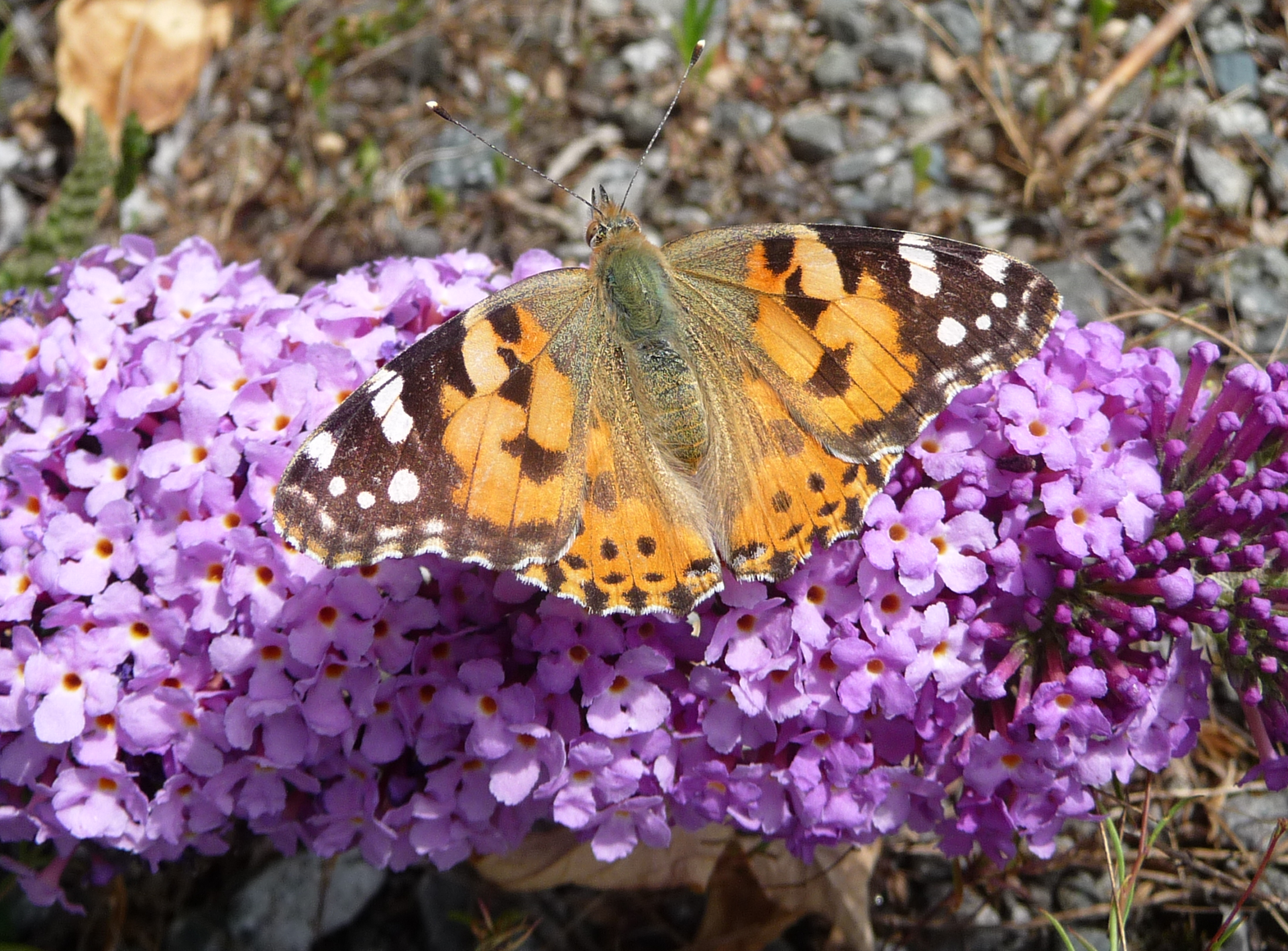
As we were recently talking about Vanessa cardui, the Atlantic-crossing painted lady, I herewith present the only semi-decent picture I have of the species (which isn’t that frequent locally), showing it sitting on Buddleja davidii, a plant that is colloquially called butterfly bush because of its attraction to butterflies, although many other pollinating insects love it just as much:
Here is a small tortoiseshell (Aglais urticae) that was right beside it:

The butterfly bush is a neophyte from East Asia that is said to provide only nectar and no pollen, and it isn’t a typical feeding plant for caterpillars either, so it’s considered an invasive pest, although I personally don’t have the impression that it’s outcompeting indigenous flowering plants where I live. Here, it was part of a late-stage ruderal vegetation.
The next picture shows another plant non-native to central Europe (or Britain), the poppy. For reasons unclear to me, poppy flowers seem to be a favorite perching place for larvae stages of long-horned grasshoppers (Tettigoniidae). The one you see here I’d guess is Tettigonia spp. cf. viridissima. The blurry thing on the left is a hoverfly, Episyrphus balteatus, visible in flight towards the poppy.

Poppies are considered archaeophytes in Central Europe (and by extension also Britain and France), as they arrived 8000 years ago with the first farmers who had poppy mixed with their cereal seed. But despite their long presence here, and despite being part of lots commercial flowerseed mixes, they never really went native, or at least that’s my impression: The poppy in the photo grew at the edge of a rapeseed field, and most of the places where I see poppies are either fields and their close vicinity or plots that were used as fields or gardens in the past.
Beautiful photos, Ruth😻
Love these. Specially the bees. Thank you Ruth.
🐝 🐝 🐝 🐝 🐝 🐝 🐝
Great pictures and descriptions! I felt like I was there.
Why Scarabeids would swarm on one tree and not another may be because the one tree has a couple females in it.
Syrphid flies do go for bee and wasp mimicry, but there are some other families. The small-headed flies are bee mimics, and there are robber flies that are either bee or wasp mimics. The latter may employ this mimicry in order to not advertise to passing insects that they are about to be murdered.
Thank you, Mark! I couldn’t be here yesterday, sorry for the late reaction.
Very nice. Loved the beetles especially.
Much appreciated. May your summers stay full of such wonders
These are just gorgeous!
Thanks!
Very nice pictures and commentary, thanks!
What tremendous photos, and great commentary too. Thank you!
Love all the beetles and bees and colorful commentary. Very nicely put together. Thanks for sharing. (I’ve witnessed the identical thing where one tree gets all the visitors and had the very same questions. Mark’s answer is interesting)
Thanks, Debi, for letting me know this wasn’t a singular chance occurrence. Mark’s answer still leaves open the question why females of several species would happen to be concentrated in one tree. With the help of both of you, my hypothesis is now that maybe the algorithm is to decide to stay where other, similar beetles already are, which increases the chance of the sexes meeting.
Yesterday, in a rural town, I witnessed many Amphimallon solstititiale meet up for a flight show late in the evening. A similar phenomenon I guess.