A stay among the Cape Flora: the Fynbos

August 8, 2024 • 12:30 pm

We took off from Capetown yesterday, and after several hours of driving through farmland, we stopped at what in local argot is called a “farm stall,” but it’s really a combination restaurant, snack shop, food store (they sell all kinds of frozen meat), and preserves, teas, and snacks. Here’s a farm stall (click on all photos to enlarge them; twice to make them really big):

. . . and its chalkboard motto, which immediately made me think of ecology because it’s wrong: flowers do compete with their neighbors if they’re of the same species. This is an ideological statement that ignores biology in favor of aesthetics. (Yes, I’m joking, but not 100%!)

This is the menu (1 South African rand is worth about 6 American cents, so you can see things are cheap. Martim told me that Roosterkoek (no, it’s not pronounced “rooster cock”) was a local item: a sandwich made on a special kind of bread. And he recommended the Boerwars Roosterkoek, made from a local sausage. So that’s what I had, with a soda.

Here’s the sausage sandwich. The bread (“Roosterkock,” or grilled bread) is delightful: thick and chewy. It wold be ideal for hamburgers or other juicy fillings.

The inside of the sandwich:

This is a cape weaver (Ploceus capensis), which weaves nests. A lovely yellow bird, with the males being especially yellow.  They hopped around skittishly hoping for crumbs from the rooster cock.

A nest that the males weave, with the photo taken from Wikipedia. The species is polygynous, with a male weaving a group of nests at the rate of about one a week, and the quality of the nest is what attracts the females. A male with mate with all the females that are attracted to the nest he builds.

JMK, CC BY-SA 3.0, via Wikimedia Commons

Rita studies the sociable weaver (Philetairus socius) found further north. It’s a fascinating species which builds large group nests that can have up to several hundred birds. She and her team band each one and take blood samples, so they know the relatedness of every bird. Curiously, they have “helpers at the nest” during breeding time, and not all the helpers are relatives, which is an unsolved mystery. Here’s a sociable weaver nest on a power pole; photo from Wikipedia:

Photograph by Mike Peel (www.mikepeel.net)., CC BY-SA 4.0, via Wikimedia Commons

Local endemic squash plants (probably the Kalahari Melon) that are, I think, eaten by antelopes. I’m not sure of the plant species. There are several antelopes in the area.

And so we enter the fynbos, a small but important and diverse vegetation zone, one of the six “floristic kingdoms” of the world, and the smallest one. Here from Wikipedia is a diagram of all the kingdoms, and you can see that “capensis” (the fynbos, or “Cape Floristic Region“) is the smallest. As Wikipedia notes, the Region  “is home to over 9,000 vascular plant species, of which 69 percent are endemic.”

Dietzel, CC BY-SA 2.5, via Wikimedia Commons

We are staying in a fancy “hut” (more like a hotel) a long drive into the Cederberg Mountains over dirt roads. It’s located on the Driehoek Farm, which not only rears animals, but takes in tourists for hiking and exploring the fynbos, and also harbors the highest vineyards in South Africa, which means the highest vineyards in Africa.

This is a fancy “hut”, as you can see from the appearance of my bedroom:

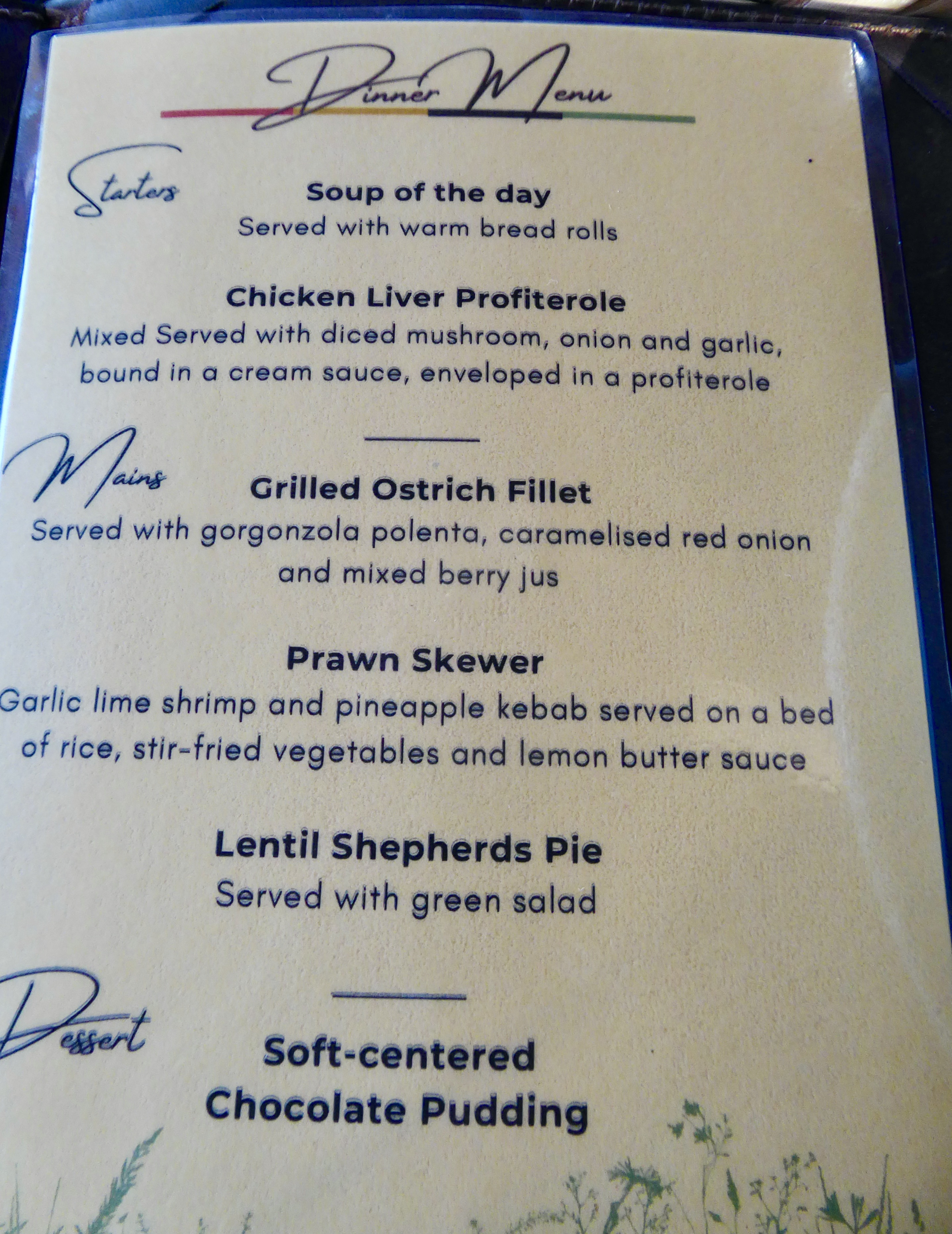
Last night we had a fancy dinner in our fancy hut, accompanied by the farm’s wine, in this case a 2023 Syrah. It was very good. They also make a white wine and a pinotage.

The adults shared three ostrich filets (my first ostrich), while the two daughters had pasta. These look like beef filets, and I asked for Rita to cook mine rare.

Dinner: potatoes, ostrich filets, young broccoli stems, and bread, washed down with a syrah.

The farm-y part of the farm, but all around are trails that go up to the mountains, with waterfalls, climbing, and vegetation.  Pig and horse below.

The pig, which was very wart-hoggy with bristles and fangs, a precursor of what I’ll see when I meet Ozy in a week.

And a backlit horse:

What I was told were baboon tracks, and the only species here is the chacma baboon (Papio ursinus). They can be quite aggressive when going after tourists’ food, and we’re told to keep our doors shut lest they invade the kitchen.

Martim thought these may have been mongoose tracks:

. . . and two sets of antelope tracks, probably made by small antelopes like common duikers (Sylvicapra grimmia), or perhaps the Cape grysbok.

I was told that this hole was where a local porcupine dug up a tuber:

Views from the farm:

Prickly purple gorse (Muraltia heisteria):

Some of the most striking plants in the fynbos are those in the genus Protea, also called “sugarbushes” because of their sugar-rich nectar. (The national flower of South Africa is the King Protea (Protea cynaroides). Go have a look at the flower at the link. It’s not exactly flowering time here yet, but we could see old flowers on this species (there are several dozen, 92% of them endemic to the Cape Floristic Region.

This is the Grey Sugarbush (Protea laurifolia):

Another view of the prickly purple gorse:

Where there’s a niche, there’s a plant. Here we have a Babiana, probably of the species ambigua (see below), growing out of a moss

Purple gorse and unidentified plant:

Grey sugarbush:

Cape Snow (Syncarpa sp.)

An open flower of the gray sugarbush:

Cone bush (Leucadendron sp.):

Grey sugarbush flower at its peak:

More fynbos:

Baboon cabbage (Othonna quinquedentata):

Carwilliam True-Eye (Euryops speciosissimus):

View to the North. I had the Southern Cross pointed out to me last night (the stars are fantastic here since there is no light pollution), and the Milky Way spread across the sky like a huge cloud. When I looked at it through 8X Swarovski binoculars, you could see that the cloud actually comprised billions and billions of stars.

Professor Ceiling Cat in the fynbos; photo by Rita. It is cold here today!

Sour Fig (Carpobrotus edulis):

Vygie, Possibly Lampranthus:

A panorama of a small waterfall with one of Martim and Rita’s daughters. The next two photos absolutely require enlargement.

Another panorama:

Paintbrush lily, genus Haemanthus. Young leaves that will produce a shoot and a beautiful red flower. The leaves are flat against the ground.

Babiana, probably of the species ambigua.

Rita by a termite mound (yes, there are termites inside) I’m told they are much larger in Kruger:

Tomorrow we’re on our way to another locale on the Great Circle Tour.

Corrections welcome if you’re an expert.

Thanks to Martim for the identifications.

Lunch and a book in the USA

August 7, 2024 • 8:00 am

While staying at my sister and brother-in-law’s house near Dulles Airport, I encountered a few things of interest. The first is an arrival lunch at Willard’s BBQ near Dulles, and it was crowded, understandable in view of how good the BBQ was, especially for this area. Here’s my lunch of “burnt beef ends” (hard to find, a mixture of crunchy and juicy parts from brisket), along with two “vegetables” (mac and cheese and a fantastic potato salad), BBQ sauce (not needed) cornbread and, of course, sweet iced tea. I’d recommend this place if you are in the area.

And I had a look at the Virginia History textbook that my brother-in-law had when he was about 13.  He remembered it as having grossly distorted the horrors of slavery, which it did in a big way.

My sister found a copy of the book online, and I was appalled to see how slavery was described: as a great benefit to slaves, who got vocational education and had kindly masters and good working conditions. It was disgusting. Have a look at how, as kids, we were taught about slavery in Virginia.

The book:

An arriving enslaved person with his family, all decked out in fancy clothes and greeting his new “master” with glee. The family, too, is all happy and spiffy. The reality, of course, was far different, with slave families packed into the holds of the ships, with those who survived sold off soon after being kidnapped from Africa to the U.S., and families often being separated.

Part of the propaganda; read it!

Amsterday 6

May 20, 2024 • 11:15 am

I arrived in Amsterdam a week from yesterday, and left yesterday, so I had six days of work+vacation, two of which were occupied by work.  It was certainly an eventful week, tooling around Amsterdam when the weather was mostly beautiful and warm, making lovely new Dutch friends, giving a talk, and being deplatformed for the first time, which I intend to write about for another venue. (Stay tuned.) I also had good Dutch food, went to a great concert by the Royal Concertgebouw Orchestra, and met Toon, a black cat who drinks by putting his head, back, and paw under running water and then licking off the drops. Today’s installment will report on my final adventures.

First, though, I want to thank my hosts—now my new Dutch friends—who put me up, fed me, took me around, made arrangements for my talks and ran interference for The Great Deplatforming. They were a great bunch! Given the Cancel Culture of Amsterdam, I won’t name them or show their photos (save for the ones with whom we re-enacted our deplatformed discussion on video), but they know who they are.

First, Toon, the only Dutch cat I know, a friendly fellow with that weird way of drinking water. Because he’s black with thick fur (he’s part Maine Coon, I’m told), he likes to keep cool by lying on this shaded chair in the garden:

Toon’s owners have a collection of old Dutch tiles. These four have a cat painted on them, and it’s not a very good likeness of a cat. Look at the horizontal whiskers, the teeth sticking out, and, above all, the human-like face.  These were probably about 200 years old, and you’d think that they would have learned to paint cats by then!

Here is a genuine pair of wooden shoes actually used by a human: one of my hosts.  I did not try them on. These, windmills, and tulips are the archetypal symbols of Holland.

Beginning spot for a walk downtown. This is the Central (railroad) Station of Amsterdam, the way to go anywhere and the terminus of many tram and bus lines as well.  There were tons of boat tours going on (tourist season in Amsterdam is now all year long), and the canals were clogged with these boats.

Our Lord in the Attic”  (Dutch original name below ) is a hidden Catholic church constructed in the upper three stories of an Amsterdam home. It was built at a time when the city was Protestant but when Catholic services were still allowed—so long as they were not out in the open. As Wikipedia notes, the church. . .

is a 17th-century canal house, house church, and museum in the city center of Amsterdam, The Netherlands. The Catholic Church was built on the top three floors of the canal house during the 1660s. It is an important example of a “schuilkerk”, or “clandestine church” in which Catholics and other religious dissenters from the seventeenth century Dutch Reformed Church, unable to worship in public, held services. The church has been open as a museum since 28 April 1888, and has 85,000 visitors annually.

It apparently functioned as a church for about two hundred years. This is the sign in the entry, which also shows the church itself (better photo below):

The church is located on the top three floors on the building at the extreme right; photo was taken from the other side of the canal.  As you can see, there’s no sign of a church.

Before you climb up to the church, you go through the regular house downstairs, owned by the guy who gutted the top three floors to build the church.  There’s thus a slice of upper-class Dutch life to see as well. Here’s the kitchen stove with a cooking “burner” on top of it.

The kitchen has many of the original tiles, including skating (I think), kite-flying, and cats. Here are some examples:

I think this is skating but I’m not sure:

Is this a cat?

The owner’s “box bed”. I was told that the Dutch slept sitting up back then, fearing that lying down while sleeping could lead to death:

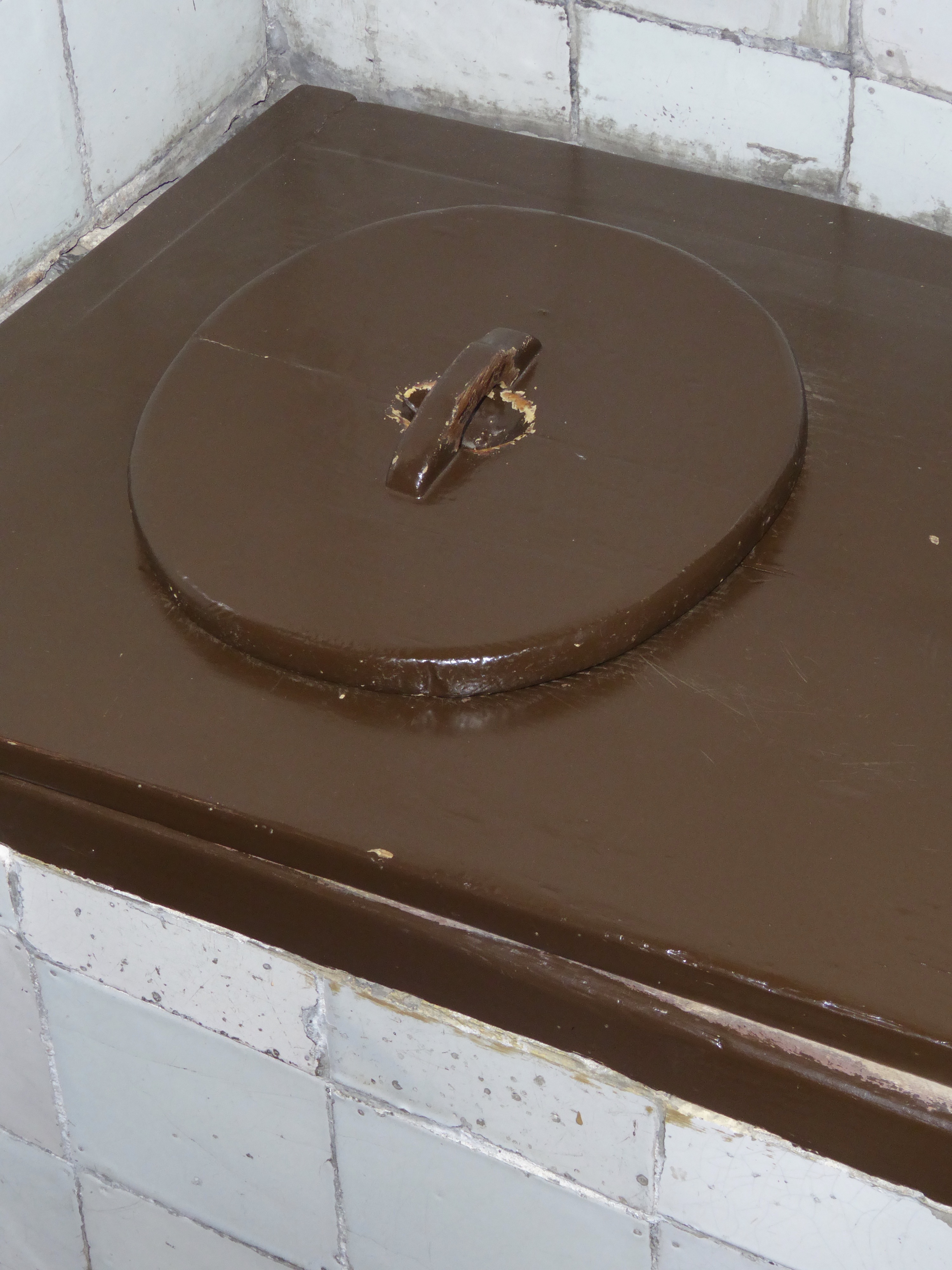
The toilet for the regular house. If you lift the lid there’s a hole, but I don’t know where it goes (probably down to the canal).

The interior of the church, which occupies the top three floors. It’s a complete Catholic church, with one altar room (with a Mary statue), a confessional, and a room for the priest to change clothes.

It’s not large, of course, and you can see the vertical beams and crossbeams necessary to hold the whole thing up, since gutting three floors would cause serious weakening of the structure. Hidden in the altar is also a clever fold-out lectern from which the priest could expound after the services.

The confessional. You would kneel in the right room, and talk to the priest in the left room through a wooden screen:

Two views of the church organ:

The priest’s bed, also a box bed:

On the walk home there was not one but TWO stores that sold rubber ducks. It’s very curious but they were doing big business. Here’s one of the two stores:

There were ducks representing all avocations and professions; you can see business ducks, German ducks in lederhosen, academic ducks, chef ducks, and so on.

The interior, with a myriad of quackers:

This must be a John Lennon duck, but touting geese. (BTW, we passed the old Amsterdam Hilton, when John and Yoko had their “bed-in” right after they were married in 1969, using the even to promote world piece.

There was also a “Cannabis Museum”, and I think I went into a similar one on my last visit to Amsterdam. They don’t sell weed there; for that you must go to a coffee shop. If you’re looking for the stuff in Amsterdam, I’m told that any “Coffee Shop” in which “Coffee” uses the English spelling, also has cannabis. (“Coffee” in Dutch is spelled “koffie”.)

And of course these are ubiquitous. Even if you don’t think you’d like french fries the Dutch way, served with mayonnaise, give it a try. I now like them even better that way than with catsup:

Nearby was the famous Dam Square, one of the few large open squares in the downtown. This year it was filled with protests—not only pro-Palestinian protests but Tamil protests from Sri Lanka, Falung Gong folks from China, and even vegans.  Here’s one anti-Israel display. Note the Star of David with a skull in it and the misspelled “westers imperialism”:

We stopped at a small cafe outside of town for a beer and lunch. I was told that if I wanted something really local, I should try “Bitterballen,” which Wikipedia says are actually pretty complicated to make. They are. . . .

. . . . a Dutch meat-based snack, made by making a very thick stew thickened with roux and beef stock and generously loaded with meat, refrigerating the stew until it firms, and then rolling the thick mixture into balls which then get breaded and fried. Seasonings in the base stew usually include onions, salt and pepper, parsley and nutmeg.

You dip them in mustard. The outside is crispy but beware: the inside is piping hot. Inside is a beefy mixture with the texture of mashed potatoes. They were very good, especially with a beer.

And an appropriate picture taken the day before I winged my way home. This is a beautiful Eurasian Magpie (Pica pica) hanging around the cafe, perhaps hoping for a snack.

So it’s farewell to the Netherlands, though I’m sure I’ll return.  Thanks again to all my friends who took a lot of trouble to show me around and introduce me to Dutch (and Balinese) cuisine, arrange for my talks and for a video re-do of The Deplatformed Discussion, take me to hear fine music, show me signt of touristic interest, and let me meet a cat who drinks weirdly.

Readers’ wildlife photos

March 4, 2024 • 8:15 am

Contributor and reader Athayde Tonhasca Júnior has a batch of themed photos and an informative narrative. The topic: coffee, otherwise known as java, joe, or mud. Athayde’s words are indented, and you can enlarge his photos by clicking on them.

But first, coffee

Charles II (1630-1685), king of England, Scotland and Ireland, had a reputation for benevolence and learning – the Royal Society came to be thanks to his auspices. But the good king wasn’t happy at all about the gossiping happening in coffeehouses. Londoners from all walks of life would get together in one of the city’s dozens of coffee establishments to socialise, enjoy their pipes, comment on the news and, alarmingly, discuss theology, social mores, politics and republicanism. The king, anxious about potentially seditious blabber, issued a proclamation in 1672 aiming to ‘Restrain the Spreading of False news, and Licentious Talking of Matters of State and, Government’ because some folk  ‘assumed to themselves a liberty, not only in Coffee-houses, but in other Places and Meetings, both publick and private, to censure and defame the proceedings of State, by speaking evil of things they understand not, and endeavouring to create and nourish an universal Jealousie and Dissatisfaction in the minds of all his Majesties good subjects.’

Nobody paid much attention to the king’s gripe, so two years later he came down hard on the miscreants with another proclamation: merchants were forbidden to sell ‘any Coffee, Chocolet, Sherbett or Tea, as they will answer the contrary at their utmost perils.’ But Charles had underestimated how much his subjects cherished their coffee: the proclamation triggered a huge outcry, and there were signs of public disobedience. Perhaps thinking of his father, who lost his head (literally) for being inflexible, the king quickly backpedalled. The proclamation was abolished within two weeks, and Londoners could go back to their chatting, reading, and sipping strong, bitter coffee.

Charles II, who was concerned about Fake News. Portrait by John Riley, The Weiss Gallery, Wikimedia.

Coffee made its way to Europe from Turkey in the mid-1600s, and the new drink quickly became popular and fashionable. The first British coffeehouse was opened in Oxford in 1652, and soon others popped up all over the realm. No alcohol was served, so sober and caffeine-boosted patrons could exchange and debate ideas or do business: Lloyd’s of London and The London Stock Exchange trace their origins to coffeehouses. In Oxford, they became known as penny universities: for one penny, the cost of a cup of coffee (the admission fee), any man – women’s presence was not encouraged – could rub shoulders with learned patrons and find out the latest on science, literature and philosophy. John Dryden, Isaac Newton, Samuel Pepys, Alexander Pope and Christopher Wren were some of the famous coffeehouse fans.

A 17th century London coffeehouse. Image in the public domain, Wikipedia.

Eventually, as the British empire expanded through the East India Company‘s endeavours from 1720 onwards, tea became the country’s most popular hot beverage. Coffee began to make its way back to the top position in the late 1990s and early 2000s, helped in part by the arrival of mass-market coffee chains. Britain is not alone: coffee has become one the most popular drinks around the world, and consumption is increasing.

The expanding coffee market is good news to millions of small farmers and land holders in about 80 countries, who supply the bulk of the internationally traded coffee. Brazil accounts for ~40% of the global trade, followed by Vietnam, Colombia, Indonesia and Ethiopia. Coffee is the most valuable crop in the tropics and a significant contributor to the economies of developing countries in the Americas, Africa and Asia. Arabica coffee (Coffea arabica) makes up 75-80% of the world’s production, and the remainder comes mostly from Robusta coffee (C. canephora), which is easier to cultivate than Arabica but produces an inferior beverage.

The Brazilian Empire (1822-1889) showed its gratitude to the two addictive drugs that sustained the county’s economy by displaying them on its flag: coffee (on the left) and tobacco © Almanaque Lusofonista, Wikimedia Commons.

Arabica coffee has long been understood to be an autogamous plant, that is, it fertilises itself. This reproductive mechanism has the obvious advantage of doing away with pollinating agents such as insects. On the other hand, self-fertilising plants lose out on genetic diversity, so that they are more susceptible to unpleasant surprises such as novel pathogens. And autogamy does not guarantee fertilisation for species as finicky as C. arabica. Plants bloom a few times during the season, but flowers come out all at once and don’t stick around: they wither and drop off in 2-3 days. And if it’s too hot, too cold, too dry or too wet, flowers don’t even open. A coffee plant produces 10,000 to 50,000 flowers every time it blooms, but almost 90% of them fall without being fertilised. So, Arabica coffee bushes could use a little help with their pollination.

Coffee plants in bloom ©FCRebelo, Wikimedia Commons.

It turns out that the autogamous label is not quite correct for Arabica coffee. A growing body of observations and research have shown that fruit size and overall yield increase when flowers are visited by insects, especially bees. The proportion of well-formed, uniform berries also increases, resulting in a better-quality beverage. These results demonstrate that Arabica coffee relies on a mixed mating system: some flowers are self-fertilised, others are cross-fertilised by insects. And the data support this view. On average, insect pollination increases fruit set by about 18%. The naturalised European honey bee (Apis mellifera) is one of the most important contributors to this service, but several other native bees visit coffee flowers, attracted to their abundant nectar and pollen.

The stingless bee Partamona testacea is one of the many coffee pollinators in Central and South America © John Ascher, Discover Life:

There could be more to the pollination of Arabia coffee than the abundance of bees. Some studies suggest that having lots of bee species around also helps, possibly because a range of pollinators provide greater temporal and spatial flower coverage, thus reducing the chances of a receptive flower going without pollen transfer. If it’s proven to be the case that bee diversity makes a difference (the jury’s still out), the conservation of forest remnants that typically border coffee fields would be a judicious crop management practice, as they are home for many native bees.

Shaded coffee plantation, a habitat favourable to native bees © John Blake, Wikimedia Commons.

When you are in the queue for your over-priced double espresso, long macchiato or cortado, you may have a negative thought about greedy coffee barons. In fact, for a £2.30 cup of coffee, the retailer keeps £1.70; five pence (~2%) goes to the grower. Fairtrade estimates that 125 million people depend on coffee for their livelihoods, but many of these small growers can barely scrape a living (World Economic Forum). Boosting productivity is one sure way of increasing farmers’ income, and here bees have much to contribute. Higher productivity also reduces the pressure on natural habitats, as  coffee is often planted in areas previously occupied by native forests.

Typical coffee plantation in low or mid-elevation areas adjacent to native forest remnants © CoffeeHero, Wikimedia Commons.

The Arabica coffee story exemplifies the reach of pollination services. The income of small farmers, revenues of developing countries, the conservation of tropical forests and related matters such as carbon storage and global temperatures, let alone your morning caffeine kick, are all linked in different degrees of relevance to the diligence of bees, some of them poorly known. Keep that in mind while you enjoy your next cup of coffee.

Ad for A Brasileira, Lisbon’s oldest coffee house. Selling Brazilian coffee since 1905. Image in the public domain, Wikipedia.

A Persian dinner

January 20, 2024 • 9:30 am

Last night we went to an unusual restaurant: Stand Up Kebab, located in South Davis. It’s open only on Friday and Saturday nights, and the rest of the time the owner runs a car-repair garage (attached to the restaurant) as well as a used-car lot.

It’s an unprepossessing place. You order outside and they bring you your food inside.

The long table below had three people who were either tired, drunk, or dead. They may have been workers at the garage, but they eventually returned to life and left.

But the food was good, and here’s what we ate.  Beers first, of course:Persian (Iranian) ones:

We started with an unusual Persian soup called Ash e Reshteh. I discovered the ingredients from Wikipedia:

Ash reshteh or ash-e-reshteh (Persian: آش رشته) is a type of āsh (Iranian thick soup) featuring reshteh (thin noodles) and kashk (a sour dairy product, made from cooked or dried yogurt) commonly made in Iran.

It was absolutely delicious:

This was followed by a typical Iranian meal: kebabs. We had both chicken kebabs and lamb/beef kebabs, served with sauce, pickle, and plenty of rice. I’m not sure why there was a pat of butter on my plate

Lamb and beef kebabs:

And for a postprandial treat, we repaired to a store in downtown Davis that sells boba tea and mochi donuts. We had green-tea donuts; specimen below:

A Burmese dinner in Davis

January 19, 2024 • 8:45 am

Last night I took my host out for Burmese food, since there’s a fairly new Burmese restaurant in Davis called “My Burma“. And of course since neither of us had had Burmese food (there isn’t a single Burmese restaurant in Chicago, though there’s one in the suburbs), we had to go.

It turns out that Burmese food resembles a hybrid between Indian and southeast Asian food, with some unique items like tea leaf salad. We had a largish meal, and I’ll show it below. (The menu is here.). It’s a modest restaurant but the food is excellent. Here’s the interior:

The appetizer: Platha and coconut chicken curry dip, described as “handmade multilayered bread served with coconut chicken curry.” With a couple of good beers, this was an excellent start.  You can either dip the bread into the chicken curry or pour the curry over the bread and eat it with a fork. I oped to use my hands.

The restaurant’s most famous dish is the tea leaf salad, described as “fermented tea leaf dressing, lettuce or cabbage, peanut, fried garlic, tomato, sunflower seeds, fried yellow chickpeas, jalapenos, sesame seed, and lemon.  They bring it to the table looking like this, with the green tea leaves on top (picture from the website)

. . . and then mix it thoroughly until it looks like what’s below (I would have preferred to sample it unmixed).  Our version seemed to lack the tomatoes and jalapenos.

It was very good, with a melange of flavors, but the flavor of the tea leaves wasn’t evident, which was disappointing.

Then two main dishes, the first being chili lamb, described as “diced lamb tossed with chili sauce, garlic, onion, basil, jalapenos, and chili flakes.” The server asked us how hot we wanted it on a scale of 1 (mild) to 5 (fiery), and I said “3.2”.  It turned out to be a tasty dish but not very hot, with the scale probably ratcheted down for the American palate:

Second main: Burmese eggplant curry, described as “Burmese curry made with garlic, onion, tomato, and tender eggplant.” It was very good, and yes, the eggplant, while keeping its form, was tender and delicious, in a lovely sauce.

With it I ordered Basmati rice. Rice should really come with the meal rather than requiring a separate order, and I eat a LOT of rice with a dinner like this. Sadly, we got only a small dish that was grossly insufficient. It was good rice, but I needed a HUGE bowl of white rice to sop up all the sauce.

All in all, it’s a good restaurant, especially considering that Davis, for a college town, has a dearth of decent places to eat. If you go, see if you can get a huge portion of white rice, and eat Chinese style, putting the ingredients atop a bowl of the rice. (They don’t use chopsticks, and I guess they don’t in Burma, but I would have preferred them.)

After dinner we went to the David Food Coop, a hippie-ish grocery store that’s been going her since 1972. Like Austin, Davis is an island of Sixties-ness surrounded by a desert of agriculture, and many old hippies are still to be found shambling along the streets of town. (There are also a fair number of homeless people, something I haven’t seen here before.)

And in this cool town, heavily invested in recycling and other green efforts, the Food Coop is the epicenter. It has pretty much everything you want, from loose grains to Dr. Bronner’s soaps, although prices are high because most stuff is organic, and the coolness surely exacts a surcharge.  Here are three characteristic items.

In a place like the Food Coop, sugar is demonized. When I did my postdoc here and my parents came to visit (this was probably about 1980), I took them for brunch to a hippy-ish organic restaurant, now defunct, called the Blue Mango. My father ordered coffee with cream, and noticed that there was no sugar on the table. He asked for some. The waiter looked at him with a stinkeye and said, in all seriousness, “Sorry, we don’t have White Death. But we might be able to dig up some honey in the kitchen.” My father, an old-school Army guy, took a pass on the honey.

At the food coop, the Satanic nature of sugar is clear. All items in bins have a four-number numerical code, but it used to be just three numbers. At that time, white sugar was given the Devil’s Number: 666. Now that they have to use four numbers, they simply expanded it, keeping its Satanic qualities:

And they also had this. WTF? What was it recycled from?

One thing that’s always bothered me about the food coop, which prides itself on selling healthy and organic food, is that it also has a whole aisle of homeopathic products, which of course is pure quackery: high-priced water containing not a molecule of the “curative” substance. They should stop selling this useless stuff. Here, ladies and gentlemen, comrades and friends, is a big scam:

But we took a pass on the fraudulent cures because we were there for dessert, and bought bean-curd-filled mochi covered with sesame seeds. They were great (no photo attached).

Paris: Day 8

November 20, 2023 • 11:00 am

I had to leave Paris before I could post about my final day, which consisted largely of lunch and packing. I’ve one more post to go—about the antisemitism and antiracism demonstration—so be patient.

The photos of the dishes of our final meal are unsatisfactory as I used my point-and-shoot camera, but it was so dark in the restaurant that I had to use shutter speeds as slow as 1/8 of a second, which makes for blurry photos. I should have used my iPhone. But so be it.

Three of us dined at one of Paris’s most famous restaurants, Chez Dumonet, sometimes called Joséphine or Joséphine Chez Dumonet: it’s in a house owned by a woman named Joséphine, but the owners were Dumonets.  It’s an upscale bistro, perhaps the most expensive of the ones we dined at, but it’s absolutely worth it.  We had reservations at the front of the house, as sometimes foreigners get exiled to Siberia, in a small two-table alcove walled off from the rest of the diners off the kitchen. That is unsatisfactory, for a large part of the eating experience in Paris is watching the other diners, seeing what they order, and often speaking to them. In Paris you don’t dine before you go out for entertainment; eating is the entertainment.

As you can see from the many reviews of Chez Dumonet (see for example here, here, here, and here), it’s universally lauded, and I have never had a meal less than superb here.

Here’s the restaurant from the outside; many treats wait within (it’s a short walk from the Duroc Métro stop):

The menu in the window (click to enlarge). Some dishes you can get in half portions, and I’d recommend that for the famous boeuf bourguignon with fresh homemade noodles. Portions are large:

A view looking towards the rear; I’ve put an arrow pointing to the table where we sat. This photo was taken from Our French Impressions:

And our view of the front of the restaurant:

A gratis amuse-bouche: cauliflower puree:

A really bad photo of one appetizer not on the menu: sauteed morels (mushrooms). Oy, am I ashamed of this photo!

My appetizer: a half portion of the house-prepared smoked salmon (i.e., LOX) with a little pot of crème fraîche and ample bread on the side. I put the salmon on the bread with a tad of the crème. It was terrific, and filling.

Winnie’s entrée: roasted langoustines with lemon butter. I turned down an offer of one but now much regret it:

Winnie and her friend Marie both had the same plat, and it sure looked good: Millefeuille de pigon et ses cuisses confites, or a layered “pastry” (made of potatoes) containing rare-ish pigeon breast with its legs (preserved in fat) on the side. Both ladies affirmed that it was delicious:


There was a d*g at the table next to us (they are permitted in French restaurants), and it looked up hopefully as Winnie ate her pigeon:

I was starved, so I had the cassoulet maison—the only cassoulet I ate this trip. It was of course huge, with tons of beans, sausage, fatty pork, and duck confit. I managed to finish all the meat, but the beans defeated me:

The ladies were too full for dessert, but I ordered the restaurant’s most famous dessert, which has to be ordered with your entrée and main course so they can prepare it in advance: soufflé with Grand Marnier. I don’t know how they time it so it arrives after you’re finished, but they must watch the table to see what stage your dinner is at.

The soufflé, which is light but delicious, comes with a glass of the orange liqueur Grand Marnier. You simply make a hole in the soufflé and pour in the booze.  An excellent dessert!

A little plate of treats comes after dessert, including a madeleine, a chocolate, and some other unknown but tasty goodies. Tasting the madeleine immediately conjured up remembrances of my childhood.

And so endeth our Big Feed in Paris.  Will Paris remember me? I think not, though I’ll remember it.  Once again I quote Karen Blixen’s Out of Africa, because it always reminds me of Paris when I leave it:

“If I know a song of Africa, of the giraffe and the African new moon lying on her back, of the plows in the fields and the sweaty faces of the coffee pickers, does Africa know a song of me? Will the air over the plain quiver with a color that I have had on, or the children invent a game in which my name is, or the full moon throw a shadow over the gravel of the drive that was like me, or will the eagles of the Ngong Hills look out for me?”

And so I strolled back to the Métro, pleasantly sated, passing along the way the café Au Chien Qui Fume (“At the dog who smokes”):

There will be one more installment of the trip, with photos of the demonstration. À la prochaine!