A mountain of greenhouse gas (and housekeeping)

March 14, 2013 • 10:12 am

I have a big backlog of stuff to write about—more about ways of knowing, les folies de Templeton, accommodationism, penguins, cat hotels, and the like—but final exams are looming and I have to write one.  So for today I’ll just make a few announcements,  present a disturbing video, and then make up challenging questions for my undergrads.

Housekeeping:

1. By now everyone who donated to Doctors Without Borders should have received their book with a cat drawing.  Although few people acknowledged receiving one (ingrates!), if you haven’t gotten yours by next week let me know.

2. I’ll soon be auctioning off (again for DWB) a multiply-autographed copy of my book, complete with my cat drawing, Ben Goren’s notation with a genuine pawprint from his cat Baihu, and, of course, all those signatures of the luminaries at the Moving Naturalism Forward conference. I’m happy to report that Official Website Artist™ Kelly Houle has the book now, and is adding some of her splendid artwork to it as well. This is going to be a keeper, full of nice stuff (and I don’t mean my writing!). Here’s a screenshot before Kelly’s artwork, with autographs, slogans, and diagrams from every participant at the conference (note Steven Weinberg’s Feynman diagram producing a Higgs boson):

Wouldn't this look nice on your shelves?
Wouldn’t this look nice on your shelves?

I want someone to bid a lot of money for this, as it’s a one-of-a-kind item (especially when Kelly’s artwork is added), and the money goes to a great cause. Start thinking about what you can afford!

Finally, the environmental news is this disturbing video of how much carbon dioxide is emitted over time by New York City.

Remember, this is just one of many cities. Is it any wonder the Earth is going to hell?

h/t: Matthew Cobb

House cats as predators

January 29, 2013 • 3:01 pm

by Greg Mayer

It’s long been known that house cats, which are introduced to most of the places they occur (the wild members of the species are found in Europe, North Africa, and western Asia), can wreak havoc on native wildlife, perhaps the most infamous case being that of the Stephens Island Wren (Xenicus lyalli). It has often been said that the wren was exterminated by the lighthouse keeper’s cat, but the story is both a bit more complex, and much more tragic: many cats were involved, not just one, and not just the Wren, but the entire Stephens Island land bird fauna was decimated.

Stephens Island Wren (from Ibis, 1895).

A new study by Scott Loss, Tom Will and Peter Marra in Nature Communications makes new estimates of total mortality of wildlife due to house cats, and they are quite high: median estimates of 2.4 billion birds and 12.3 billion mammals annually in the United States. Money quote:

We estimate that free-ranging domestic cats kill 1.4–3.7 billion birds and 6.9–20.7 billion mammals annually. Un-owned cats, as opposed to owned pets, cause the majority of this mortality. Our findings suggest that free-ranging cats cause substantially greater wildlife mortality than previously thought and are likely the single greatest source of anthropogenic mortality for US birds and mammals. Scientifically sound conservation and policy intervention is needed to reduce this impact.

They are particularly incensed by programs that trap feral cats, but then return them to the wild after neutering them. I must say this seems to be a crazy idea– why in the world would you put the offending predators back into the ecosystem?

The most striking thing to me was their estimate that well over 2/3 of the mortality was due to “un-owned” (i.e. feral or some slight variation thereof) cats, so that cat owners taking steps to insure that their pets do not become destructive predators, while helpful, would leave most of the problem unaddressed.

Media coverage of the study can be found at the New York Times and the BBC.

______________________________________________________________

Buller, W.L. 1895. On a new species of Xenicus form an island off the coast of New Zealand. Ibis 7:236-237.

Galbreath, R. & D. Brown. 2004. The tale of the lighthouse-keeper’s cat: Discovery and extinction of the Stephens Island wren (Traversia lyalli). Notornis 51:193-200. (pdf)

Loss, S.R., T. Will & P.P. Marra. 2013. The impact of free-ranging domestic cats on wildlife of the United States. Nature Communications (pdf)

Medway, D.G. 2004. The land bird fauna of Stephens Island, New Zealand in the early1890s, and the cause of its demise. Notornis 51:201-211. (pdf)

50 years on: Rachel Carson’s “Silent Spring”

September 27, 2012 • 4:37 am

by Matthew Cobb

Over at The Guardian, Leo Hickman reminds us that 50 years ago today, Rachel Carson’s seminal book “Silent Spring” was published, with an amazing first print run of 150,000 copies.  Carson’s dramatic ecological warning of the effects of insecticides on bird populations played an important part in bringing the problems of population, and the complexity of ecology, into the public domain.

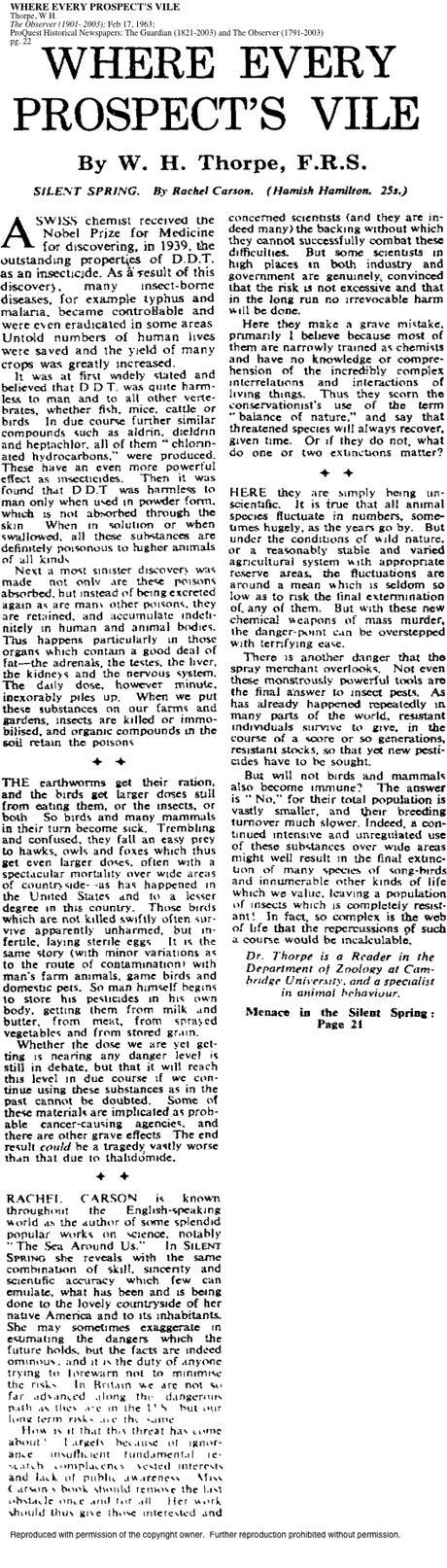
Hickman has asked the great and the good to send him their views of the influence of the book, which makes for pretty interesting reading. He also has some telling and perceptive contemporary reviews, including this one from a personal hero of mine, W. H. Thorpe, one of the early pioneers of animal behaviour, and in particular of the studies of insects.

So, readers of WEIT: what are your memories/knowledge of Silent Spring? At home we had one on our shelves, which my mother must have bought (my father died in 1961). I never spoke to her about why she bought it, and she’s too old to remember now. To my childish mind, it formed part of the catastrophic sci fi literature of the 1950s and 1960s (Day of the Triffids, Earth Abides, On the Beach, Canticle for Leibowitz etc), which I read and devoured. The difference was, this was real. And 50 years on, we can see the consequences, at least in the UK, where once-plentiful birds like sparrows and starlings have become rare, at the same time as many insects have declined. Correlation is not necessarily causation, but this link seems pretty compelling.

Rachel Carson herself I am amazed to learn, died in 1964, at the amazingly young age of 57 (she had a heart attack, but had been suffering from breast cancer). She was a marine biologist, who wrote popular books on conservation, and can be seen here doing field work in 1952:

File:Rachel Carson Conducts Marine Biology Research with Bob Hines.jpg

Carson was also a cat person, as this great pic from 24 September 1962 shows. The cute kitteh is called Moppet.

The book – which had an amazing print run of 150,000 copies – is still in print, though bibliophiles might prefer to pick up a first edition, which go for upward of $700. The top price on Abebooks.com (keep away from the website if you want to keep your bank balance) is $5500 for this copy, complete with signed card:

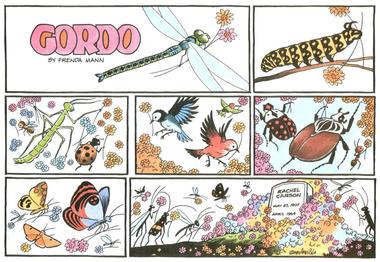
A Sunday newspaper cartoon marked Carson’s passing in a touching way in 1964:File:Gordocarson.jpg

Info and pics from Wikipedia, with the exception of the Moppet pic and the book pic (abebooks).
h/t to Bernard Leikind who pointed this out to Jerry, who asked me to post.

We’re screwed (maybe)

September 22, 2012 • 12:54 pm

Just passing this on from an article in The Guardian: “Arctic expert predicts final collapse of sea ice within four years.” At least one respected expert predicts that the North Pole is done for:

In what he calls a “global disaster” now unfolding in northern latitudes as the sea area that freezes and melts each year shrinks to its lowest extent ever recorded, Prof Peter Wadhams of Cambridge University calls for “urgent” consideration of new ideas to reduce global temperatures.

In an email to the Guardian he says: “Climate change is no longer something we can aim to do something about in a few decades’ time, and that we must not only urgently reduce CO2 emissions but must urgently examine other ways of slowing global warming, such as the various geoengineering ideas that have been put forward.”

. . . Wadhams has spent many years collecting ice thickness data from submarines passing below the arctic ocean. He predicted the imminent break-up of sea ice in summer months in 2007, when the previous lowest extent of 4.17 million square kilometres was set. This year, it has unexpectedly plunged a further 500,000 sq km to less than 3.5m sq km. “I have been predicting [the collapse of sea ice in summer months] for many years. The main cause is simply global warming: as the climate has warmed there has been less ice growth during the winter and more ice melt during the summer.

“At first this didn’t [get] noticed; the summer ice limits slowly shrank back, at a rate which suggested that the ice would last another 50 years or so. But in the end the summer melt overtook the winter growth such that the entire ice sheet melts or breaks up during the summer months.

“This collapse, I predicted would occur in 2015-16 at which time the summer Arctic (August to September) would become ice-free. The final collapse towards that state is now happening and will probably be complete by those dates”.

And then things just get worse:

“As the sea ice retreats in summer the ocean warms up (to 7C in 2011) and this warms the seabed too. The continental shelves of the Arctic are composed of offshore permafrost, frozen sediment left over from the last ice age. As the water warms the permafrost melts and releases huge quantities of trapped methane, a very powerful greenhouse gas so this will give a big boost to global warming.”

Goodbye, polar bears.

It’s not funny!

Why global warming is real and we’re causing it

July 30, 2012 • 9:19 am

Today’s New York Times Op-Ed section has a must-read piece by an erstwhile climate-change skeptic who has been converted, Richard Muller, a professor of physics at the University of California at Berkeley.  His piece, “The conversion of a climate-change skeptic,” is a must read (it’s short), and links to five technical papers on the phenomenon by the Berkeley Earth Surface Temperature project. According to Muller, the data are nearly incontrovertible: global warming is real, and we’re the cause.  He is properly cautious, but the case is strong. It’s a good, well-written piece that carefully explains the science behind the conclusions.

Muller first explains his conclusion:

My total turnaround, in such a short time, is the result of careful and objective analysis by the Berkeley Earth Surface Temperature project, which I founded with my daughter Elizabeth. Our results show that the average temperature of the earth’s land has risen by two and a half degrees Fahrenheit over the past 250 years, including an increase of one and a half degrees over the most recent 50 years. Moreover, it appears likely that essentially all of this increase results from the human emission of greenhouse gases.

And then he shows how it withstands common criticisms:

Our Berkeley Earth approach used sophisticated statistical methods developed largely by our lead scientist, Robert Rohde, which allowed us to determine earth land temperature much further back in time. We carefully studied issues raised by skeptics: biases from urban heating (we duplicated our results using rural data alone), from data selection (prior groups selected fewer than 20 percent of the available temperature stations; we used virtually 100 percent), from poor station quality (we separately analyzed good stations and poor ones) and from human intervention and data adjustment (our work is completely automated and hands-off). In our papers we demonstrate that none of these potentially troublesome effects unduly biased our conclusions.

What is the basis of his conclusion? Note how he leaves room for other explanations, as unlikely as they may be:

What has caused the gradual but systematic rise of two and a half degrees? We tried fitting the shape to simple math functions (exponentials, polynomials), to solar activity and even to rising functions like world population. By far the best match was to the record of atmospheric carbon dioxide, measured from atmospheric samples and air trapped in polar ice. . .

How definite is the attribution to humans? The carbon dioxide curve gives a better match than anything else we’ve tried. Its magnitude is consistent with the calculated greenhouse effect — extra warming from trapped heat radiation. These facts don’t prove causality and they shouldn’t end skepticism, but they raise the bar: to be considered seriously, an alternative explanation must match the data at least as well as carbon dioxide does. Adding methane, a second greenhouse gas, to our analysis doesn’t change the results. Moreover, our analysis does not depend on large, complex global climate models, the huge computer programs that are notorious for their hidden assumptions and adjustable parameters. Our result is based simply on the close agreement between the shape of the observed temperature rise and the known greenhouse gas increase.

He then warns us not to go whole hog:

It’s a scientist’s duty to be properly skeptical. I still find that much, if not most, of what is attributed to climate change is speculative, exaggerated or just plain wrong. I’ve analyzed some of the most alarmist claims, and my skepticism about them hasn’t changed.

Hurricane Katrina cannot be attributed to global warming. The number of hurricanes hitting the United States has been going down, not up; likewise for intense tornadoes. Polar bears aren’t dying from receding ice, and the Himalayan glaciers aren’t going to melt by 2035. And it’s possible that we are currently no warmer than we were a thousand years ago, during the “Medieval Warm Period” or “Medieval Optimum,” an interval of warm conditions known from historical records and indirect evidence like tree rings. And the recent warm spell in the United States happens to be more than offset by cooling elsewhere in the world, so its link to “global” warming is weaker than tenuous.

Read the papers (link above); he notes that four of them have already been peer-reviewed. They conclude that global temperature over land will increase by 1.5 degrees overthe next five decades, or even two decades if China keeps growing and using coal.

We must do something about this. But we won’t.  Such is the tragedy of the commons.

Too windy for you?

April 3, 2012 • 8:16 am

Last week Matthew Cobb put up a nice animated map of the world’s ocean currents. Today, courtesy of alert reader Ken, we have a cool real-time map of where and how strongly the winds are blowing in the U.S. at this moment:

Animated wind map here.

You can click on any point to enlarge the map and find out the local wind-speed reading.

Right now it’s blowing gusts down the central U.S., but things are pretty calm in Chicago.

Grasses, live oaks, pines

January 15, 2012 • 3:14 pm

by Greg Mayer

There are some interesting comments on live oaks, their distribution, and resistance to hurricanes in the discussion (see #5) of my post on Long Beach, MS and its cuisine. One thing I’ve noticed is the striking zonation of the vegetation on the Mississippi Gulf Coast. Just a few miles inland, the live oak forest along the coast gives way to a forest strongly dominated by pine. Here’s a pine forest, less than two miles north of the water.

Pine forest, Long Beach, MS

This pine forest continues considerably far inland, becoming mixed with broadleaved deciduous trees around Hattiesburg.

Mixed deciduous/pine forest, Rte. 49, Mississippi

The live oaks dominate in a narrow strip along the coast.

Live oaks along Beach Blvd. (the coast highway); note white sandy soil.

And the beach itself supports grasses.

The beach, Long Beach, MS.