Why Evolution is True is a blog written by Jerry Coyne, centered on evolution and biology but also dealing with diverse topics like politics, culture, and cats.
No, yesterday wasn’t the “official” Pi Day (March 14), but slap an “e” on the end and you have something better: Hyde Park’s annual “South Side Pie Challenge.” Entrants submit two copies of what they think is their best pie, and judges taste them all in the morning. (I want to know how I get to be a judge!) After the morning’s appraisal and awarding of distinctions to bakers, the pies are put out on a big table, with the public let in to buy slices.
There were well over a hundred pies on tap, with two copies of each. The winners were labeled, so if you wanted you could choose only those (it’s $5 a slice, with the profits going to hunger program charities). But my tastes were also conditioned by the look of the pies, and I anted up $20 for four slices. I brought a container to carry them back to the office, intending to consume one on the spot and then one for breakfast over the next three days. I have always maintained that pie is one of the best breakfast foods available in America.
And here’s what you’re confronted with when you go into the school where the pies were set out:
The tables are divided up by type of pie (“nut pies”, “fruit pies”, “cream pies,” “pumpkin and squash pies”, etc.) What largesse! Below are nut pies (each one said “contains nuts” on the label):
This year meringue pies were not allowed, probably because they contain uncooked egg white. What a pity. . .
The first slice I ate, when I got back to the lab, was this beauty. I thought it was chocolate cream pie, but the thick layer of thick, luscious chocolate on top hid a layer of real pistachio cream below. The crust was fancy and full of butter (as a crust should be), and I have to say that this was among the best pies I’ve ever eaten. You can see the pistachio at about 11 o’clock below. The crust was a dessert in itself.
This morning I had a slice of blueberry pie, which is perfect for a morning pie as it wasn’t too sweet. It was of course washed down with my customary latte. It too was fantastic:
I have two slices left: a coffee cream pie and a Key lime pie (I hope they used real Key limes). I was one of the first in the door, as I wanted the best selection (pies have only a finite number of slices). After I grabbed my four choices, I scuttled away with my prize, and by that time the line was out the door.
NPR reports on one of my favorite weeks of the year: Fat Bear Week, which extends from September 23-30. (see Wikipedia article here). As you may know, the bears at issue are those in Katmai National Park, and Wikipedia tells us how the ursids qualify:
In order to qualify for Fat Bear Week, brown bears of the Katmai National Park must have been spotted catching sockeye salmon at the Brooks River. A 1.5-mile (2.4 km) section of the river, which has webcams, is used to choose eligible bears. Bears must be seen not just in the fall but also in the summer season as well.[27]
The subjective contest is a single-elimination tournament. Each day, two bears are presented in a match-up, identified by numbers. The bear with the most votes advances to the next round. In order to evaluate which bears have gained the most weight in preparation for hibernation, the public is able to view before and after photos of specific bears, watch them on livestream feeds, and read their biographies. The biographies include information on their feeding habits, personality traits, and physical features. The winner of the final match-up is named the tournament champion.
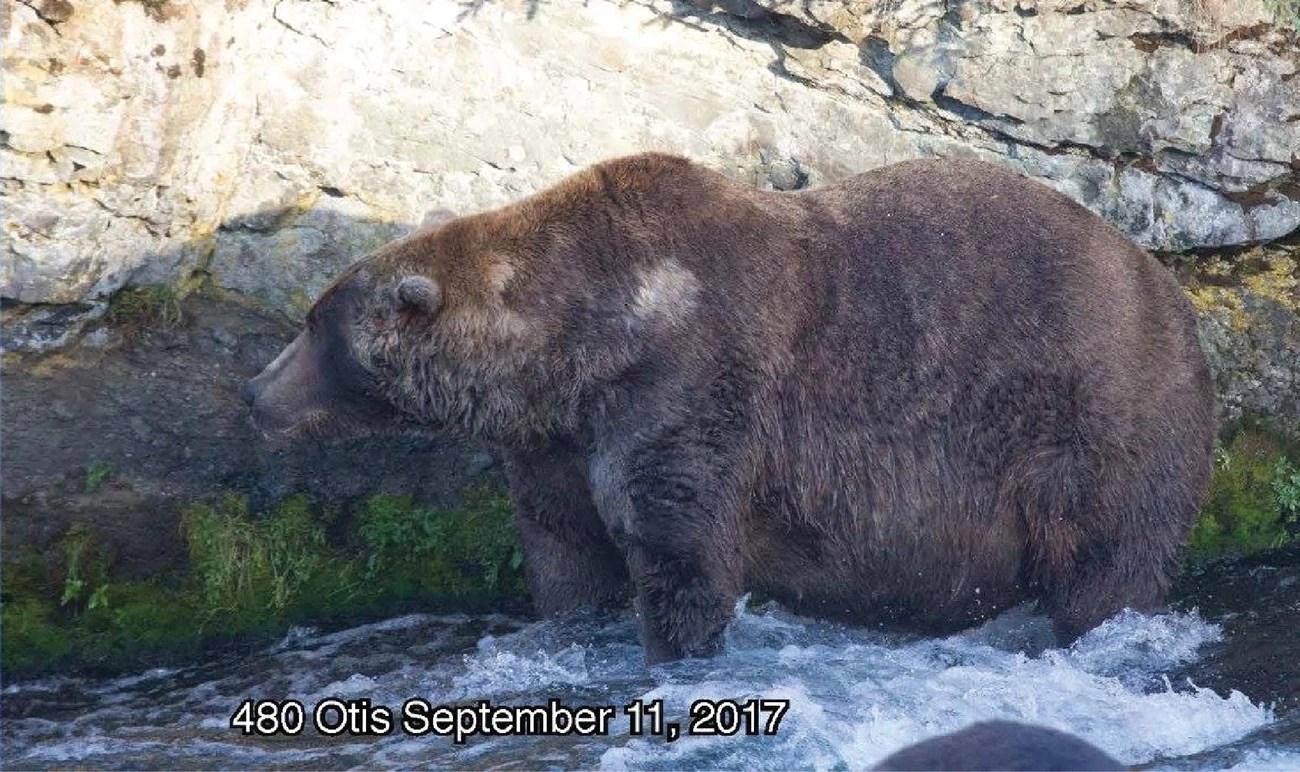
The contest was started in 2014, and Otis has won three times, while Grazer won twice. (Otis wasn’t there last year and he may have crossed the Rainbow Bridge.
The bears are brown bears (Ursus arctos), sometimes known as grizzly bears or “grizzlies”: a subspecies from further south. The only larger land predator is a close relative, the polar bear, which you saw in the last post.
Click below to read more about the contest:
An excerpt:
Fat Bear Week, when people get to pick their favorite Alaskan brown bear bulking up for hibernation, is coming early this year. The annual online competition that normally starts in early October will instead start on Sept. 23. Katmai National Park and Preserve officials say the bears are magnificently plump ahead of the tournament.
“This year’s salmon run was extraordinary, with salmon numbers surpassing anything seen in recent memory,” Matt Johnson, the park’s interpretation program manager, told NPR via email. “As a result, the brown bears of Katmai are well-nourished and looking for other things to do besides scrap[p]ing with each other for food.”
The bracket for Fat Bear Week 2025 will be revealed on Sept. 22, when fans will see where familiar names of past champions, such as 128 Grazer, 480 Otis and 747— aka Bear Force One, estimated to weigh a whopping 1,400 pounds — stack up against new challengers. The single-elimination tournament starts on Sept. 23 and runs through Sept. 30, when a new champion will emerge. Fat Bear Junior, for bear cubs, started on Thursday.
Organizers expect votes to come from across the planet.
“Over one million votes were cast for the bears in 2024 from one hundred countries,” the park said as it announced this year’s dates.
The brown bears of Katmai occupy the rarest strata of celebrity: captivating and oblivious, thanks to the “bearcams” that beam their activities in the scenic Brooks Falls and other areas to online viewers around the world.
. . .The abundance of salmon in Katmai National Park and Bristol Bay in southern Alaska is contributing to a drop in conflict among the bears this year compared to the 2024 competition, which was delayed when one large bear killed another. Voters then propelled Grazer to a landslide win over the massive 32 Chunk, a bear that, months earlier, had killed one of Grazer’s cubs.
“This year there was less congregating at Brooks Falls, less fighting, and — astonishingly — noticeably more playtime with each other,” Johnson said.
Here’s a photo of Otis, four-time winner for gaining the most weight. Photo from the National Park Service:
And the Explore Live livecam of the bears fishing. Right now they’re showing highlights, which are awesome enough by alone, but wait until it goes live!
I suggest that when September 23 rolls around, you go to the Fat Bear site below (click on icon) to see the contestants and cast your vote. (There’s already been a fat cub contest, in which yearlings compete for weight gain. The winner is unnamed.) Here are Da Roolz for Bearz:
Matchups are open for voting September 23-30 between 12 – 9 p.m. Eastern / 9 a.m. – 6 p.m. Pacific.
This is a single elimination tournament. For each match-up, vote for the bear you believe best exemplifies fatness and success in brown bears. The bear with the most votes advances to the next round. Only one will be crowned Fat Bear Week champion. Meet the bears, fill out your bracket, predict your fat bear winner, and campaign for your candidate.
The contestants aren’t up yet, so have a look on September 23 between noon and 9 p.m. Eastern U.S. time. It’s enormous fun to vote, and of course the fatter bears have a better chance to make it through the winter.
I hope Otis shows up this year: he was a fatty, but may not have made it through the year.
Two Americans, Gary Ruvkun of Massachusetts General Hospital and Harvard University, and Victor Ambrose of the University of Massachusetts Medical School, have split this year’s Nobel Prize in Physiology or Medicine for the discovery of microRNAs (miRNAs), single-stranded bits of RNA that do not code for proteins but act to regulate other genes. The Nobel organization’s press release explains the significance of the discovery, but you can read the whole thing, which is much longer than this:
This year’s Nobel Prize honors two scientists for their discovery of a fundamental principle governing how gene activity is regulated.
The information stored within our chromosomes can be likened to an instruction manual for all cells in our body. Every cell contains the same chromosomes, so every cell contains exactly the same set of genes and exactly the same set of instructions. Yet, different cell types, such as muscle and nerve cells, have very distinct characteristics. How do these differences arise? The answer lies in gene regulation, which allows each cell to select only the relevant instructions. This ensures that only the correct set of genes is active in each cell type.
Victor Ambros and Gary Ruvkun were interested in how different cell types develop. They discovered microRNA, a new class of tiny RNA molecules that play a crucial role in gene regulation. Their groundbreaking discovery revealed a completely new principle of gene regulation that turned out to be essential for multicellular organisms, including humans. It is now known that the human genome codes for over one thousand microRNAs. Their surprising discovery revealed an entirely new dimension to gene regulation. MicroRNAs are proving to be fundamentally important for how organisms develop and function.
And here’s how it started: as so often, with a seemingly minor observation that blew up big time, leading to generalizations about control of gene expression in all organisms—even viruses (but not bacteria).
In the late 1980s, Victor Ambros and Gary Ruvkun were postdoctoral fellows in the laboratory of Robert Horvitz, who was awarded the Nobel Prize in 2002, alongside Sydney Brenner and John Sulston. In Horvitz’s laboratory, they studied a relatively unassuming 1 mm long roundworm, C. elegans. Despite its small size, C. elegans possesses many specialized cell types such as nerve and muscle cells also found in larger, more complex animals, making it a useful model for investigating how tissues develop and mature in multicellular organisms. Ambros and Ruvkun were interested in genes that control the timing of activation of different genetic programs, ensuring that various cell types develop at the right time. They studied two mutant strains of worms, lin-4 and lin-14, that displayed defects in the timing of activation of genetic programs during development. The laureates wanted to identify the mutated genes and understand their function. Ambros had previously shown that the lin-4 gene appeared to be a negative regulator of the lin-14 gene. However, how the lin-14 activity was blocked was unknown. Ambros and Ruvkun were intrigued by these mutants and their potential relationship and set out to resolve these mysteries.
After his postdoctoral research, Victor Ambros analyzed the lin-4 mutant in his newly established laboratory at Harvard University. Methodical mapping allowed the cloning of the gene and led to an unexpected finding. The lin-4 gene produced an unusually short RNA molecule that lacked a code for protein production. These surprising results suggested that this small RNA from lin-4 was responsible for inhibiting lin-14. How might this work?
Here’s the announcement, which I always find exciting:
AND THE TWO CONTESTS:
1.) Guess who will win the other two Nobel Prizes in science: Physics and Chemistry. One guess per discipline, and the first person who guesses both winners gets one of my trade books, autographed per their choice (including cat drawings).
2.) Alternatively you can choose the other contest: Guess who will win these two prizes: Literature and Peace. Same rules as above, and same prize.
You can guess in only one of these two competitions.
In previous years, people have failed miserably in these contests, but someday someone will win. . . .
The Washington Post has published some winners of the 2023 Nikon Photomicrography Contest (you can see a lot more entries here), and I present a selection of the pictures in lieu of readers’ wildlife, which will resume tomorrow. (Send in your photos!) Photo captions come from the Post site.
Fourth place, venomous fangs of a small tarantula. (John-Oliver Dum/Courtesy of Nikon Small World)
Image of distinction, cabbage butterfly eggs. (John-Oliver Dum/Courtesy of Nikon Small World)
Sixth place, Comatricha nigra, extreme close-up of two developing fruiting bodies cultivated in a moist chamber. (Timothy Boomer/Courtesy of Nikon Small World)
Honorable mention, carpenter bee (Xylocopa violacea) head and antenna. (Ángel Navarro Gómez/Courtesy of Nikon Small World)
Image of distinction, cleared mouse embryo. (Arthur Chien/Courtesy of Nikon Small World)
11th Place, crystallized sugar syrup. (Diego García/Courtesy of Nikon Small World)
12th Place, “Cuckoo wasp” standing on a flower. (Sherif Abdallah Ahmed/Courtesy of Nikon Small World)
Image of distinction, feeding bryozoan colony zooids. Bryozoans are microscopic aquatic invertebrates that live in colonies. (Charles Krebs/Courtesy of Nikon Small World)
Two more from Nikon’s contest site:
Image of Distinction: Maturing Mouse cortical neuron in culture; Nadia Efimova:
Images of Distinction: Marine organism (Pyrocystis lunula, Dinophyceae); Frank Fox:
If you didn’t vote yet in Fat Bear week, you’ve missed two rounds of voting, both involving choosing the fattest bear in each of two pairs. Here are the results so far, with Bears 806 Spring Cub., 901, 128, and 164 winning their rounds (you can read about each of the bears here).
Today, starting at 9 a.m. Pacific time (noon Eastern time and 11 a.m. Chicago time), you can vote for two more matches on the Fat Bear Contest site linked above. All you have to do is tap on your favorite bear of each of the two pairs, enter your email address, and press “enter”. Remember, though, that it’s 1½ hours until the games begin!
Here are the matchups. Both of the bears I voted for made it through!
CONTEST #1
CONTEST #2
You can read about all the bears here. I won’t tell you how to vote, of course, but would like to point out that 806 Spring Cub, a first year, has had a tough life so far. Further, 480 Otis has already won more Fat Bear Titles than any other ursid, while 901, a mom, had a tough go last year, having reared THREE cubs, lost a lot of weight, and then lost one of the three cubs. How sad!
There will be another chance to vote on Monday, and then on Tuesday there’s the final matchup, with the winner again determined by popular vote.
Speaking of bears, Fat Bear Week at Katmai National Park in Alaska begins tomorrow and runs through October 10, when the Champion Fat Bear will be declared. You can go to the main site by clicking on the first screenshot below. The voting starts tomorrow with two matchups, and then two more on Wednesday. After that the matchups will be determined by the earlier winners. (There’s apparently been some preliminary voting, as you can see below, perhaps by the rangers). Each day you can vote for at least one of the bears in a pairwise matchup, and tomorrow there are two.
A summary:
Choose the fattest bear of the year! Some of the largest brown bears on Earth make their home at Brooks River in Katmai National Park, Alaska. Brown bears get fat to survive and Fat Bear Week is an annual tournament celebrating their success in preparation for winter hibernation.
Fat Bear Week 2023 is October 4 – October 10. Your vote decides who is the fattest of the fat. Matchups will be open for voting between 12 – 9 p.m. Eastern (9 a.m. – 6 p.m. Pacific). Download your bracket to predict your own fat bear winner.
This is a single elimination tournament. For each match-up, vote for the bear you believe best exemplifies fatness. The bear with the most votes advances to the next round. Only one will be crowned champion of Fat Bear Week. Learn more about the history of Fat Bear Week.
The overview (click to read):
You can meet and learn about all the contestant bears here.
Here’s the schedule:
And here are the first two matchups. Go to this site and vote (starting tomorrow) by clicking on your favorite Fat Bar in each pair. Spring Cub, a youngster, had a rough life
THE FIRST MATCHUP:
428
Identification
This is a pudgy 3.5-year-old subadult bear. Bear 428 has blond ears and grizzled, light brown fur. She is difficult to differentiate from her same-aged sister, 429.
Biography
Bear 428 is the offspring of 128 Grazer, a perennial presence at Brooks River. As a dominant mother bear, Grazer provided her cubs with consistent access to productive fishing spots at Brooks Falls. As a yearling and 2.5-year-old cub, 428 followed her mother’s lead. She took to the lip of the falls to practice fishing in a location that many bears compete for and that younger bears are often displaced from by larger bears.
As an independent bear in 2023, she navigated the river without mother’s guidance for the first time. Easy access to the lip of the falls and other productive fishing spots were no longer something she could count on. She navigated these new challenges by utilizing opportunity as it came even if opportunity came inconsistently.
*********
806 Spring Cub
Identification
This male first-year cub has long, shaggy brown fur and a short, pointed muzzle.
Biography
There are perils and advantages of fishing near Brooks Falls. Many mother bears with young cubs shy away from the vicinity of the waterfall, but 806 did not avoid this area in 2023. She knew that Brooks Falls provides bears with their very first opportunities to fish for salmon in early summer. Coming so close to other bears at the falls, however, increased the risk to her cub’s safety.
In his efforts to remain safe, 806’s spring cub attempted to stay close to mom even if that meant entering the swift and cold river. On several occasions, he was swept downstream or over the waterfall. In a notable event in late July, his mother fell off the falls as she caught a fish, which left the cub alone momentarily. A nearby adult male then pursued and attacked the cub. Thankfully, 806 was able to return and successfully defend her offspring. Mother and cub returned frequently to the falls afterward and throughout August. With salmon abundant in mid-summer, 806’s cub grew rapidly. His story showcases the risk and reward that bears find at Brooks Falls.
Again, you can read about all these bears here. Read about them before you vote!
THE SECOND MATCHUP:
402
Identification
Bear 402 is a large adult female. She has medium brown fur, tan-colored claws, and crescent or apostrophe-shaped ears when viewed from front or back. During years when she is not caring for cubs, she is also quite fat in late summer and fall.
Biography
Few bears can rival 402’s maternal experience. She is the mother of at least eight litters, more than any other bear currently at Brooks River. This includes two litters of four cubs apiece. While 402 has weaned many cubs, some of which still visit Brooks River, she’s also experienced the loss of entire litters. When a mother bear loses her litter in spring or early summer, it can trigger her to become receptive to mating once again. This explains why 402 bore litters in back-to-back years such as 2007 and 2008.
Although female bears need ample fat reserves to support gestation, birth, and milk production in the den, fat is only part of the equation for maternal success. Cubs are ravenous and mothers must provision them with milk and other foods during their active seasons. Bear 402 is a skilled angler especially on the lip of Brooks Falls and often brings her cubs there. She is also an efficient scavenger of dead and dying salmon in the lower Brooks River. Even experienced mother bears experience loss, though. One of the cubs from her most recent litter disappeared in 2022. This summer, she continues to care for her single yearling. Her life illustrates the triumphs and difficulties of a long-lived mother bear.
***************
901
Identification
This is a medium-sized adult female. Bear 901 has blond-rimmed, triangular ears. Her fur is golden brown in early summer and grizzled-brown in late summer.
Biography
Bear 901 was first identified as a 2.5-year-old in 2018. At the end of Fat Bear Week 2022, with 901’s body fat providing the buoyancy that raised her to the final match, many people wondered if 901 would return to Brooks River with cubs in 2023. The answer came in early summer when she arrived with three spring cubs. Bear cubs are born in mid-winter while mom hibernates. Female bears with too little body fat at the start of hibernation are unlikely to give birth, so 901’s savings account of ample body fat last year positively influenced her reproductive success.
With a family to care for, 901 expressed caution throughout much of the summer. She most often used the river mouth area where fewer bears are present instead of making frequent trips to Brooks Falls, likely to provide her cubs with more safety. In mid-September, though, one of her cubs disappeared while 901 fished in the lower Brooks River. Raising cubs is difficult for mother bears, and first-time mothers are particularly challenged to provision the family with food while keeping them safe.
I’m plumping (excuse the pun) for 806 Spring Cub, because he had it rough when he was young, and for 901, who had to take care of three babies and lost one of them.
We’re at Thanksgiving CatSaturday: November 26, 2022: National Cake Day. My favorites in the genre are carrot cake with cream-cheese frosting and pineapple upside-down cake.
Recipe here. Decorative carrots on icing not necessary.
It’s also Good Grief Day, celebrating the creator of “Peanuts”, Charles Schulz, born on this day in 1922, and Small Business Saturday. And that’s it: a thin day for celebrations.
Readers are welcome to mark notable events, births, or deaths on this by consulting the November 26 Wikipedia page.
Da Nooz:
*The BBC reports that a letter by Charles Darwin, signed with his full signature, is going on auction at Sotheby’s, and is projected to go for at least a million British pounds (the previous record for a Darwin letter was £400,000). The high value is because the letter (a bit shown below) is in pristine condition, because it’s signed with Darwin’s full name, which is rare, and because it defends his theory of evolution. (h/t: Christopher)
Here it is, signed by “Charles Darwin” (he usually used “C. Darwin” or “Ch Darwin”):
From the BBC:
. . . The item is likely to fetch more than £1m – a world-record price for a Darwin manuscript.
He’d produced the document so it could be copied in what, in 1865, was a celebrity magazine.
Darwin didn’t make a habit of archiving his paperwork and so little original material survives.
. . .Prof John van Wyhe, who curates the scholarly collection known as Darwin Online, says it’s extra special because of what the great man had chosen to put on the page along with his signature.
“He includes a passage that appears in the third edition of On the Origin of Species,” the senior lecturer at the National University of Singapore explained.
“It’s a really favourite passage, because he’s trying to make the point that people might find his theory unbelievable and outlandish, but they said the same about Newton and gravity, and nobody doubted the existence of gravity anymore.
“The same, he says, would be true eventually with evolution and natural selection,” the prof told BBC News.
The document was produced for The Autographic Mirror.
Its publisher, Hermann Kindt, printed facsimiles of the handwriting or the autographs of famous people along with their biographies.
When he asked Darwin if he’d contribute, the scientist jumped at the chance. It was an opportunity to hit back at his doubters.
At the time, six years after the first-edition release of On the Origin of Species, it was a common criticism that he couldn’t explain the origin of life itself.
Darwin conceded this was the case but that it was irrelevant to his observations of how life on Earth evolved and diversified. As with gravity, its “essence” might not be understood but Newton’s equations certainly worked.
And here’s Darwin’s text, which dates from 1865 (The Origin was published in 1859):
I have now recapitulated the chief facts and considerations, which have thoroughly convinced me that species have been modified, during a long course of descent, by the preservation or the natural selection of many successive slight favourable variations. I cannot believe that a false theory would explain, as it seems to me that the theory of natural selection does explain, the several large classes of facts above specified. It is no valid objection that science as yet throws no light on the far higher problem of the essence or origin of life. Who can explain what is the essence of attraction of gravity? No one now objects to following out the results consequent on this unknown element of attraction; notwithstanding that Leibnitz formerly accused Newton of introducing “occult qualities & miracles into philosophy”. – Charles Darwin.
Compare this to the last paragraph of the origin of species, where Darwin makes an analogy to the laws of physics (gravity) with his ‘law” of evolution by natural selection:
Thus, from the war of nature, from famine and death, the most exalted object of which we are capable of conceiving, namely, the production of the higher animals, directly follows. There is grandeur in this view of life, with its several powers, having been originally breathed into a few forms or into one; and that, whilst this planet has gone cycling on according to the fixed law of gravity, from so simple a beginning endless forms most beautiful and most wonderful have been, and are being, evolved.
*Yesterday was Nellie Bowles’s news summary on Bari Weiss’s Substack: “TGIF: Thanksgiving Edition“. Here are a few items showing her patented snarky humor:
→ If you hate fun, go to Mastodon: Speaking of tsk-tskers, a wonderful thing has happened. Furious about Elon Musk’s acquisition of their favorite platform, a group of major pro-censorship Twitter personalities have decided they need to leave the place altogether. They’ve gone en masse to a new platform called Mastodon. And there they are (what else) yelling at each other. As the pollster Nate Silver put it: “Mastodon seems like a honeytrap for hall-monitor personality types. Honestly if Elon gets all the hall monitors to migrate to Mastodon that might be his greatest contribution toward the betterment of humanity.” Unfortunately it’s hard to imagine they’ll stay away for long. CBS got big applause after saying they’d be getting off Twitter, only to quickly return: “After pausing for much of the weekend to assess the security concerns, CBS News and Stations is resuming its activity on Twitter as we continue to monitor the situation.”
I’m not a big fan of Elon Musk, but I’m staying on Twitter for the time being. That’s where all the fun is—and cat pictures!
→ Black Hebrew Israelites hold a huge rally that goes ignored: Hundreds of black supremacists marched through Brooklyn this week chanting: “It’s time to wake up. I’ve got good news for you, we are the real Jews.” Videos here and here. They were marching to support basketball player Kyrie Irving who was briefly suspended after promoting a movie that argues the Holocaust is fake. Kanye West, meanwhile, was spotted in Miami with white nationalist Nick Fuentes, a proud antisemite. I hate to say it, but you should watch a Fuentes video to understand how extreme his beliefs are and how alarming this moment is. Here’s one. Here’s another.
→ The brave Iranian soccer team: At the World Cup, as their nation’s anthem played, the Iranian soccer team did not sing it. It’s another sign of how deep the rebellion is going in Iran. And it’s unbelievably brave, since there’s a good chance those young men join the tens of thousands imprisoned (or far worse) when they get home. Remember their courage next time the Biden administration insists we need to make a deal with their oppressors.
You go, Nellie! Biden is an invertebrate with respect to Iran.
The United States and England played to a scoreless tie at the World Cup on Friday, a result that the Americans could be proud of but which has left them with a simple and high-stakes task: They must beat Iran on Monday to avoid elimination from the tournament.
England heard boos from its fans after the final whistle but walked off with a valuable point: With four now, it leads the group, ahead of Iran (three), the United States (two) and Wales (one). The English are in the driver’s seat, needing only a tie in their final game against Wales, but after a performance that had them on their heels for long stretches they will see work ahead if they are to live up to their pretournament billing as a title contender.
Other scores: Iran beat Wales 2-0, Senegal beat the home team Qatar 3-1, and Ecuador outscored the Netherlands 3-1. What with several upsets, this is going to be an interesting World Cup. Would readers care to venture any guesses who the winner will be? That leads to. . .
A CONTEST! Pick the final two teams and the final score giving the winner of the World Cup. If you get the teams and the winner right but not the score, I’ll randomly pick a winner who will get an autographed copy of any of my books (except Speciation!) with the animal of your choice drawn in it
*The Washington Post published a paean to both the World Cup and soccer, which has become my favorite sport (pity I don’t have a way to watch the good games). The piece, by Henry Olsen, is called “Watch the World Cup—and experience something infinitely enthralling.” An excerpt:
The World Cup is not soccer at its best, but it might be soccer at its finest. With 32 national teams converging in one place, the sheer spectacle is unmatched by anything except the Olympics. It has the quality of an all-star game, as each team has its country’s finest players, who are brought together only for brief interludes each year. And the short-term competition makes for stunning upsets, just as college basketball’s March Madness does. Japan’s 2-1 upset over perennial power Germany this week is the global equivalent of a 16 seed knocking off a No. 1.
If that doesn’t whet your appetite, consider the winner plays, loser stays element. All 32 teams are currently in the group stage, where four teams play one another once each to determine which two advance. After that, it’s like the NFL playoffs. It doesn’t matter where you’re seeded in the FIFA rankings: You either win or go home. Each game has the intensity that makes college bowl games so exciting.
The final itself is an event that easily dwarfs the Super Bowl. It won’t have a halftime show, but it doesn’t need one. More than 1.1 billion people worldwide tuned in to part of the 2018 final — roughly 1 in 7 on the planet. The Super Bowl dominates American viewership but attracts little attention elsewhere, with a total global viewership of less than 200 million. Outside the United States, the exploits of Cristiano Ronaldo and Kylian Mbappé, not Tom Brady, are on everyone’s lips.
And this paragraph links to three good videos:
This alone is reason to join the fun now. It takes time to pick up the game’s intricacies, but even novices can appreciate the sheer individual brilliance that can make or break a game. You might see something akin to Gareth Bale’s famous bicycle kick or Son Heung-min dribble the length of the pitch to score. Or perhaps you’ll watch a historically controversial play, such as Diego Maradona’s “Hand of God” goal against England in 1986. It’s like watching the NBA’s greats put on a show — once you see jazz in sporting form, you’re hooked.
*Finally, Iran’s victory over Wales brought out rancor between protestors of the Iranian government’s actions and supporters of the regime. And the team actually sang the Iranian national anthem this time; they were probably given the word: “Sing like a canary of you’ll wind up in Evin.”
Tensions ran high at Iran’s second match at the World Cup on Friday as fans supporting the Iranian government harassed those protesting against it and stadium security seized flags, T-shirts and other items expressing support for the protest movement that has gripped the Islamic Republic.
Some fans were stopped by security guards from bringing in Persian pre-revolutionary flags to the match against Wales at the Ahmad Bin Ali Stadium. Others carrying such flags had them ripped from their hands by pro-government Iran fans, who also shouted insults at fans wearing T-shirts with the slogan of the protest movement gripping the country, “Woman, Life, Freedom.”
Unlike in their first match against England, the Iran players sang along to their national anthem before the match as some fans in the stadium wept, whistled and booed.
The national team has come under close scrutiny for any statements or gestures about the nationwide protests that have wracked [sic] Iran for weeks.
Shouting matches erupted in lines outside the stadium between fans screaming “Women, Life, Freedom” and others shouting back “The Islamic Republic!”
Mobs of men surrounded three different women giving interviews about the protests to foreign media outside the stadium, disrupting broadcasts as they angrily chanted, “The Islamic Republic of Iran!” Many female fans appeared shaken as Iranian government supporters shouted at them in Farsi and filmed them up close on their phones.
Here’s an AP photo of a protestor holding up the name of the woman beaten to death by Iranian authorities simply because she didn’t wear her hijab in the proper way. Amini’s death was the fuse that ignited the present explosion of protest against the theocratic regime.
(From the AP) An Iran team supporter cries as she holds a shirt that reads ‘Mahsa Amini’ prior to the start of the World Cup group B soccer match between Wales and Iran, at the Ahmad Bin Ali Stadium in Al Rayyan, Qatar, Friday, Nov. 25, 2022. (AP Photo/Alessandra Tarantino)
Here’s Shappi Khorsandi, Vice-President of the Humanists UK and a stand-up comedian, on the situation in Iran. (To see Shappi in full comedy action, go here. I’m a big fan.)
Meanwhile in Dobrzyn, it’s bedtime:
A: Enough of playing, we are going to sleep.
Hili: I’m sleeping already.
In Polish:
Ja: Koniec zabawy, idziemy spać.
Hili: Ja już śpię.
*****************
From Nicole, a useful hint for the holidays. (You’ll have to go inside to put and get the presents):
God’s still writing bad poetry at Mastodon, so let’s have two tweets from Masih. The regime’s Men in Black are beating up civilian dissidents:
This scene looks like straight from a horror movie. Islamist regime’s security forces are beating up Balouch protesters from #Zahedan on a rooftop and piling up their injured bodies on the corner.
A salacious but sarcastic tweet from Ken, who notes, “Looks like there’s no doubt about what Twitter has become under the SpaceX Oddity (apologies to David Bowie); there is only haggling over the price.”
Tweets from Matthew. This one was so good that I retweeted it with my own caption. Watch the whole thing: it’s 2 minutes and 20 seconds of mesmerizing group flight. (Matthew and I share a love of murmurations, and we’re still not sure why birds do this: here they swoop about for more than two minutes.