Mount Holyoke College blatantly violates free speech: mocking a policy now becomes a reportable offense

September 7, 2024 • 9:00 am

Speaking of violations of freedom of speech by colleges, here’s a letter to the “faculty community” of Mount Holyoke College (a high-class women’s liberal arts school), telling professors that they have to report certain types of speech. Note that these violations, however, are apparently in line with the Biden Administration’s recent rewriting of the Title IX guidelines, so federal money could be withheld from schools who don’t comply. In that sense, it’s the Biden administration itself who is responsible for policing “hate speech” and creating these new—and in my view mostly harmful—regulations (Note that as a private school, Mt. Holyoke needn’t abide by the First Amendment, but, like all nonreligious and nonmilitary schools, it certainly should.)

The new rules are laid out in this email sent to the Mount Holyoke faculty by the College President and another administrator, with the text taken from a tweet by Steve McGuire (bolding is mine):

Dear Faculty Community,

Welcome to the start of another academic year at Mount Holyoke College! As you may have learned in President Danielle R. Holley’s email communication on August 20th, the College has created a new compliance department as of this past summer. To ensure that Mount Holyoke is a safe and inclusive campus for our community as well as compliant with ever-changing regulations, two new positions were created: Assistant Vice President for Compliance and Director of Civil Rights and Community Standards.

Some of you recently heard from the Assistant Vice President for Compliance, Shannon Lynch, regarding your responsibilities as Mandated Reporters at the College. Per our Sex Discrimination and Sex-Based Harassment Policy, all College employees who are not designated as Confidential must disclose to the Title IX Coordinator when they have information that may reasonably constitute a violation of the Policy.

On August 1, Title IX Regulations expanded to include misgendering, deadnaming, and mispronouning as prohibited acts and thus expanded the set of prohibited activities of concern to mandated reporters. Because faculty have a unique role in creating classrooms as spaces of mutual trust, respect, and concern—a role that lives alongside their responsibilities under Title IX—we would like to provide some guidance regarding faculty observations of misgendering in their classrooms. It is the expectation of the College that faculty report when misgendering occurs in the following ways:

  • when the misgendering has created a hostile environment;

  • when there is open mocking of our Pronoun Policy or an individual’s choice of pronouns;

  • or when a student reports being misgendered, deadnamed, or has been subject to incorrect use of their pronouns.

Shannon will follow up with all parties named in a report, offering resources and support, as well as procedural options if the policies’ definitions and standards have been met.

The scope of Title IX has shifted, but Mount Holyoke’s overarching commitment to education, care, and support of our gender diverse community of students, faculty and staff remains unchanged. Faculty can continue to look to the Office of Diversity, Equity, and Inclusion, as well as the Teaching and Learning Initiative (TLI) for additional resources and support. We also want to highlight the upcoming TGNC10 programming, which will provide opportunities for education, discussion, and community related to our 10 years as a gender diverse campus. [Although Mt. Holyoke is a women’s school, about a decade ago they decided to allow transgender women to enroll.]

Additional resources related to our Title IX policies can be found here. You may also visit the College Title IX webpage to learn more about our policies and procedures, as well as support and resources available to our campus community.

Should you have any questions or concerns regarding your responsibilities listed above, please contact Shannon Lynch at shannonlynch@mtholyoke.edu for more information.

Thank you and we wish you a successful semester ahead! =

Shannon Lynch
AVP for Compliance

Lisa M. Sullivan
Provost and Dean of Faculty
Mount Holyoke College

You can see how Title IX has changed for the worse under Biden, which, beyond changes highlighted above, also removed protections for students accused of sexual harassment or assault when their cases were being adjudicated by colleges. These protections, like the right to cross-examine witnesses, are inherent in the legal system when sexual harassment or assault is judged in the courts, and were reinstated by Betsy DeVos, but dismantled again by the Biden administration. The protections afforded students when they are judged in college hearings are far weaker than when they’re judged in the courts.

And there’s more, but they’re saving these changes until after the election, presumably because they’ll be unpopular:

Absent is a proposal on transgender participation on specific men and women athletics teams, which is anticipated after the November election.

You can read about that rule at the link to the WaPo article above, which describes a proposal apparently applying to all secondary schools through high school:

[The rule] would outlaw blanket state bans but gives schools a road map for how they can bar transgender girls from competing in certain circumstances, particularly in competitive sports.

But allowing transgender females to compete against biological women isn’t a popular view, and so the administration, in an act of duplicity and mendacity, put it off:

. . . . Nonetheless, issuing such a rule risks injecting the issue into an election year in which President Biden faces a close contest with former president Donald Trump, who has promised to ban trans women from women’s sports if reelected.

“Folks close to Biden have made the political decision to not move on the athletics [regulation] pre-election,” said one person familiar with the administration’s thinking. “It seems to be too much of a hot topic.”

Seriously, how is it okay to adopt a policy that’s unpopular with the public, but not publicize it or put it into force until the three-month period between the election and the inauguration of a new administration?

At any rate, I agree with Mt. Holyoke’s first point above: misgendering should not be allowed to create a hostile climate for a given student by repeatedly harassing that student directly, although criticizing the general notion of going along with someone’s pronoun preference is simply freedom of speech to criticize compelled speech.

Ditto for “open mocking of our pronoun policy”, which again prevents someone from criticizing a policy that is debatable. That mockery, too, is in line with the First Amendment.  Finally, deadnaming or pronoun “misuse” not used to harass a student directly seems to me in line with the First Amendment as well. (Still, if a student simply hears about it and reports it, that too has become a violation.) I suspect that if this issue gets to the courts, some of the provisions of the new Title IX provisions will be struck down.

Here’s a tweet about this from Nicholas Christakis, who along with his wife Erika had their own speech run-in at Yale University:

The pro-Hamas protests resume big time at Columbia

September 4, 2024 • 11:50 am

I am not being hyperbolic by saying the protestors are “pro-Hamas” rather than “pro-Palestinian,” as they themselves extol Hamas (see below). What kind of student would glorify muderous terroristic thugs? Columbia ones, of course.

You didn’t have to be a rocket scientist to predict that pro-Palestinian protests which violate campus regulations, as well as the law, would start up again as soon as fall classes resumed. And so they have at Columbia, which is one hot mess of a campus, and whose leadership can’t seem to control the skirmishes, hate, and anti-Semitism that pervades the campus.

Click below to read the article at the World Israel News, apparently written by Jessica Costescu, at The Washington Free Beacon:

Remember, right now access to Columbia’s campus is strictly limited to Columbia students with IDs or approved visitors. The vandalism below, then, is likely done by Columbia students themselves.

An excerpt.

Anti-Israel students brought chaos to Columbia University on Tuesday morning, returning the campus to its new normal: dozens of keffiyeh-clad protesters blocked the entrance to the school, praising Hamas, vandalizing a statue, and clashing with police.
At least one group involved aims to bring violence to America, while others called on their followers to help shut down the university.
Agitators with Columbia University Apartheid Divest (CUAD) and the school’s Students for Justice in Palestine chapter prevented students from entering campus, promising that “this is just the beginning.”
A flyer posted to social media advertising the protest encouraged attendees to “wear a mask,” “bring noisemakers,” and to “shut it down.”
Columbia’s Students for Justice in Palestine chapter released a statement praising Hamas founder Ahmed Yassin and the terrorist group’s current chairman, Yahya Sinwar.
.“Sheikh Yassin was assassinated by the Zionists in 2004, but even in death, his legacy of unrelenting resistance in the face of oppression lives on,” the group wrote on Telegram.
“He lives on in his students, which includes the current head of Hamas, Yahya Sinwar—the man who fooled the Zionist entity—and all the Palestinian fighters who embody the steadfastness that Yassin taught.”
On X, the Students for Justice in Palestine chapter said protests will continue.“
As we begin our new semester, students in Gaza have no universities to return to. Instead of listening to the student body, Columbia University is doubling down. We will not stop & we will not rest until @Columbia divests from apartheid and genocide. This is just the beginning,” the group posted to X.“
We refuse to trade in the blood of Palestinians, and until Columbia commits to full financial disclosure and complete divestment from Zionist apartheid, occupation, and genocide — we do not deserve a first day of school,” a statement by CUAD said.“In the belly of the beast, we have the highest responsibility to crush the gears of this cold and unloving death machine and to build something new. For us and for Palestine, the only option is revolution.”

Two tweets showing vandalism, both of which I retweeted, and one showing the protestor’s risible demands:

More:

Unity of Fields, a self-described “militant front against the US-NATO-zionist axis of imperialism,” formerly known as Palestine Action US, took credit for the vandalism.

Campus access is restricted to Columbia ID holders, suggesting the perpetrator was affiliated with the university.

“The first day of classes at Columbia University are drenched in blood,” the group posted to X

“We act in full support of the Palestinian resistance. This action is first & foremost an effort to extend the successes of the Palestinian resistance to the heart of the empire itself, to translate their resilience in Gaza to unrest & violence in America.”

“Divestment is not an incrementalist goal. True divestment necessitates nothing short of the total collapse of the university structure and American empire itself,” the group wrote in a follow-up post listing its demands.

“It is not possible for imperial spoils to remain so heavily concentrated in the metropole and its high cultural repositories without the continuous suppression of all populations that resist the empire’s expansion; to divest from this is to undermine and eradicate America as we know it.”

Their demands in full (click to enlarge):

Note that these hate-filled morons argue, as others have noted, that destruction of Israel is only an incremental goal: the true goal is to bring down America itself. Will these students like living in a country ruled by Hamas? I doubt that at least women and gays will!

The protestors can’t write well, either.

This makes me ill: a bunch of supposedly educated people whose moral compass is turned 180° the wrong way, supporting a bunch of terrorists who hate Jews and want to kill them all (ergo the students must feel the same way).

Call these students out for who they are: morally obtuse, Jew-hating idiots who might as well be worshiping Hitler. Fot no longer bother to hide the fact that they’re not just supporting Palestine, but are supporting Hamas.

And the lesson for parents is clear: don’t send your kids to Columbia.

Anti-Israel protests begin on first day of class at Cornell

August 31, 2024 • 12:00 pm

I’m back in Cape Town, and preparing Kruger Post #1. In the meantime, have another read about college miscreants:

See below. I told you so, but this isn’t rocket science. Anybody with two neurons to rub together could have guessed the protest engine would rev up when classes begin again, for, especially at elite schools, students are more interested in enforcing what they consider Social Justice on others than engaging in learning.

The article below (click to read), written by Judy Lucas four days ago, was published in The Ithaca Voice, the local paper. Click headline to read:

An excerpt:

The spring semester at Cornell University ended with protests, as students erected an encampment on the Arts Quad to oppose the university’s ties to institutions supporting the Israeli state. The war in Gaza raged on through the summer, with reports of thousands of more lives lost. Cornell’s fall semester started much like its last one ended.

A crowd of about 150 student protestors at Cornell University marched into a campus dining hall Monday, the first day of classes, where speakers renewed the call for the university to divest from any institutions supplying weapons and support to the Israeli military in the war against Hamas, among a set of other demands first released earlier this year.

Have a look at the list of demands, especially the “land return” demand (#1) and the usual “and-of-course-we’re-not-to-be-punished” demand (#8).

Twenty minutes into the rally, seven university police officers entered the atrium of Klarman Hall and stood guard near the protestors. At the instruction of lead organizers, students joined arms to form a chain in order to resist interactions with police.

And the kicker: no IDs proferred when asked, and no punishment (bolding is mine, and it’s all bolded because it shows the cowardice of the Cornell administration).

Officers asked protesters to hand over their student identification cards to refer them to the university’s conduct office for potential disciplinary action. None of the protestors followed orders but no arrests were made. 

Have a tweet; this one has three videos and it’s just like the bawling we heard so often last year.

The unions, by and large all anti-Israel (are there any pro-Israel unions?), were part of the demonstration:

The Coalition for Mutual Liberation (CML), which represents the university’s activist organizations and the group responsible for organizing and maintaining the pro-Palestinian encampment on Cornell’s Arts Quad in April, planned Monday’s demonstration.

They were joined by representatives of the United Auto Workers Local 2300, the union representing about 1,200 university employees, including custodians, cooks and food service workers, who are currently on strike demanding an increase in wages and improved working conditions.

As usual, there’s illegal vandalism:

The morning of the demonstration, graffiti reading “Israel bombs, Cornell pays” and “Blood is on your hands” was found, spray-painted in red, on the front facade of Day Hall, the university’s administrative building. The front door was also shattered.

Cornell’s Vice President for University Relations Joel Malina released a statement on behalf of the university Aug. 26. Malina wrote the administration was “appalled by the graffiti spray painted.”

“Acts of violence, extended occupation of buildings, or property damage (including graffiti) will not be tolerated and will prompt an immediate response from public safety,” Malina wrote. “Cornell Police are conducting a thorough investigation, and those responsible will be subject to suspension and criminal charges.”

Joel Malina is Cornell’s Vice President for University Relations, and if you think that anybody will be suspended or subject to criminal charges, I have some land in Florida to sell you.

Finally, the interim Provost and President sent out an email with dire warnings about what would happen to students who engaged in encampments:

Students involved in encampments would first receive a warning of their violation of the university’s policy. On a second violation, the student would receive a “non-academic temporary suspension.” After a third violation, a student would receive “temporary academic suspension.”

I guess to get a “permanent academic suspension,” you have to shoot someone.

This is only the very beginning. When asked for a comment, the University said bupkes. 

Cornell University has not released a statement or comment regarding the specific demonstration Monday evening during which university police officers were involved.

In response to an email from The Ithaca Voice requesting a statement regarding the protest, a media representative for the university said “We don’t have anything specific regarding yesterday afternoon’s protest.”

Have another tweet with two videos:

There are more invertebrates in Cornell’s administration than there are in one square meter of the bottom of Cape Town’s Harbour. But there’s one consolation. While Cornell’s administration is demonstrating its spinelessness, I seriously doubt that it will give in to any of the student demands.

h/t: Debi

FIRE poll has good news and bad news

June 21, 2024 • 11:30 am

A new poll by the Foundation for Individual Rights and Expression (FIRE) has some good news and some bad news. I’ll highlight what I see are the important results, but you can read the whole thing by clicking below.


The poll was conducted by NORC at the University of Chicago (formerly the National Opinion Research Center), and their results are generally solid.  The sample, says the page, “The

.. . . was conducted May 17-19, 2024, using NORC’s AmeriSpeak® probability-based panel, and sampled 1,309 Americans. The overall margin of error for the survey is +/- 4%.

Here are some graphs:

While some of these protest actions are regulated on campuses (ours, for example, regulates the times when you can use amplified sound), the poll is simply about whether it’s okay for college students to engage in these activities. No “time, place, or manner” restrictions are discussed.

Given that, and looking at the dark and light red bars as indications of “not very acceptable”, we see pretty much what we expect. What’s surprising is that a huge majority of Americans (these are not just students) find burning an American flag unacceptable (about 70% “never acceptable and 12% “rarely acceptable”), despite the fact that burning an American flag is protected as free speech by the First Amendment!  (So is holding signs.) Americans either don’t know or don’t care about that interpretation of flag-burning by the courts. As the FIRE site notes:

“It’s no shocker that Americans tend to disapprove of illegal and illiberal conduct by student protesters,” said FIRE Chief Research Advisor Sean Stevens. “But it’s alarming that a third of Americans say constitutionally protected and non-threatening activities like sign-holding or petitions are only ‘sometimes’ or ‘rarely’ acceptable. Nonviolent protest should always be acceptable on college campuses.”

But I disagree with FIRE in part here as there are time, place, and manner restrictions that apply even to nonviolent protests. Blocking access to campus or impeding classes with megaphones and shouting are nonviolent forms of protest, but prevent academia from operating propetly. In my view, FIRE is simply wrong that these should always be acceptable.  Much of the time, yes, but not always. 

Encamping is also of interest, and 43% of American think that establishing them is “never acceptable” while about 22% see them as “rarely acceptable”. About 25% see encampments as “sometimes or always acceptable”, with the “sometimes” outnumbering “always’ here.  Whether universities consider encampment acceptable, of course, depends on the school and the form of encampment.  Williams College, for instance, had a small, out-of-the-way encampment and nobody was bothered.

Here are the consequences that the American public thinks should fall onto students participating in encampments.


FIRE’s summary:

Nearly three-fourths of Americans (72%) believe that campus protesters who participated in encampments should be punished, but only 18% believe they should receive the harshest penalty of expulsion. Other responses ran the gamut from suspension (13%), to probation (16%), to written reprimand (12%), to community service (13%). Only 23% believe the students should receive no punishment at all.

LOL; I think more than 23% of colleges themselves believe that encamping students should receive no punishment at all. At least that’s my guess based on the number of students who seem to be getting of scot-free for encamping.  As for punishment, there’s roughly equal sentiment in faor of a written reprimand, community service, probation, suspension, or expulsion.  Perhaps a written reprimand would be okay for students who are first-time violators, but the penalty should go up if there are previous violations on a student’s record, and also on how much warning they were given by the university, as well as whether they engaged in any harassment of individuals during the encampment.

There’s a bit more:

“Public colleges and universities can usually ban encampments without violating the First Amendment, so long as the ban serves a reasonable purpose, enforcement is consistent and viewpoint-neutral, and students maintain other avenues for expressing themselves,” said FIRE Director of Campus Rights Advocacy Lindsie Rank. “Universities can’t disproportionately punish students just because administrators don’t agree with the viewpoint being expressed at the encampment.”

Agreed!

And I’ve saved the good news for last:

FIRE’s summary:

Almost two-thirds of Americans (63%) said that the campus protests had no impact at all on their level of sympathy for Palestinians in Gaza, and respondents were as likely to say that the campus protests made them sympathize less with the Palestinians (17%) as they were to say they made them sympathize more (16%).

In other words, the net effect of campus protests—and they surely mean “pro-Palestinian protests”—is ZERO: as just as many people become more sympathetic as become less sympathetic, while most people don’t change their minds at all. In other words, the protests are performative, at least with respect to American opinion. They could, of course, hearten or disappoint Hamas, but again the net effect would be nil.  What the protests do accomplish is reduce America’s confidence in colleges and universities, which seems to be continuously slipping. And yes, that’s bad news:

FIRE’s poll also shows that American confidence in colleges and universities continues to slip. Only 28% of respondents said that they have either a “great deal” or “quite a lot” of confidence in U.S. colleges and universities. By comparison, 36% of Americans told Gallup in summer 2023 that they have a “great deal” or “quite a lot” of confidence in higher education in the U.S.

The FIRE summary concludes with more bad news: a pessimistic take of Americans on whether institutions of higher education protest free speech

Colleges received middling grades in particular on the issue of protecting speech. Almost half of Americans (47%) say that it is “not at all” or “not very” clear that college administrators protect free speech on their campus. Roughly two-in-five Americans (42%) said that it is “not at all”or “not very” likely that a school administration would defend a speaker’s right to express their views during a controversy on campus.

McGill University faced with harboring an enclave of Hamas

June 18, 2024 • 9:30 am

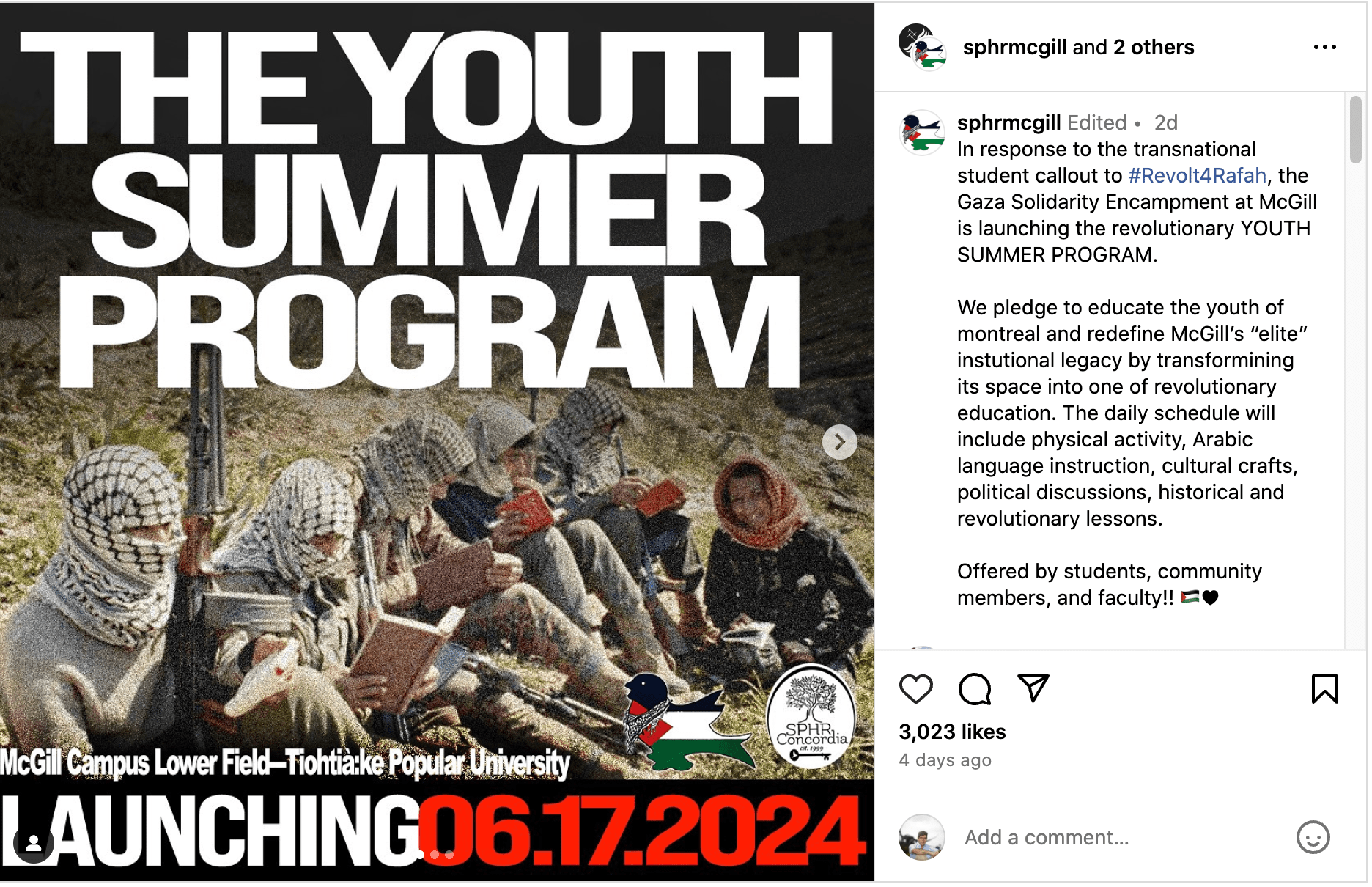
Reader Alan Garcia-Elfring, a recent Ph.D. graduate of Montreal’s McGill University (he didn’t have qualms about my using his name) sent along an email from the university President about a rather disturbing Instagram post from the Solidarity for Palestinian Human Rights [SPHR] McGill Instagram site.) The first link goes to the post itself, but I’ve put a screenshot below in case they take it down. Have a gander:

I haven’t dug much further, but it looks as if there’s an encampment at McGill and they’re holding a summer program that seems to turn the encampment into a branch of Hamas.  This has caused a kerfuffle promoted by both the press and the understandably disturbed Jewish community of Montreal. For example, here’s one report from CTV News in Montreal (click to read):

An excerpt:

Pro-Palestinian activists who have been encamped on McGill University’s downtown campus since April launched what they call their own summer school on Monday, despite controversy over photos of armed fighters used to promote the program.

The encampment’s youth summer program promises “revolutionary lessons” and political discussions over the next four weeks, including a series of lectures on Palestinian history, the resistance movement and the role of the media since the Oct. 7 Hamas attack on Israel.

But on Friday, federal and provincial politicians called for the encampment to be dismantled after posters for the summer program were published online featuring photos of Palestinian resistance fighters wearing kaffiyehs and holding rifles. The photos date from around 1970, and the militants appear to be reading copies of Chairman Mao Zedong’s “The Little Red Book.”

“Enough is enough, this is hate speech and incitement to hate, pure and simple!” federal Immigration Minister Marc Miller posted on X. “De-escalation at McGill has clearly failed. This needs to end!”

Quebec Higher Education Minister Pascale Dery said the poster was tantamount to “provocation, explicit incitement to violence, even indoctrination.”

Insp. David Shane of the Montreal police told reporters Monday that while the poster doesn’t target any particular group, “it’s clearly in very poor taste and it’s likely to make people feel unsafe.” He said police have opened an investigation and have “been in contact with the RCMP.”

. . .As of Monday morning, online registration for the summer program had closed. Karim said 50 to 80 people have signed up for the first week of lectures, which will take place every afternoon. Organizers, she added, were surprised by the number of registrants, and may open up more spots in the weeks to come.

Most of the attendees will be students, Karim said. ” 1/8They 3/8 were really interested in the idea of being able to come here and get educated on Palestine.”

Members of the encampment have said they will not leave until McGill ends its investments in companies tied to the Israeli military and cuts ties with Israeli institutions. The university has made offers to protesters, the most recent of which included to review its investments in weapons manufacturers and grant amnesty to protesting students. Members of the encampment rejected that offer, calling it “laughable.”

I don’t know how much of this is considered “free speech” (Canada doesn’t have a First Amendment), nor whether the encampment itself violates university rules. At any rate, the poster and press response got sufficient attention that McGill’s President had to write the following letter to the university community (click to read, though I’ve transcribed the letter below):

Dear McGill community,

On the evening of June 12, a group called Solidarity for Palestinian Human Rights (SPHR) published a notice on social media platforms featuring masked individuals holding assault rifles, which called for participation in a “revolutionary youth summer program” on the lower field next week. Their stated aim is to “educate the youth of Montreal.”

This is extremely alarming. It has attracted international media attention, and many in our community have understandably reached out to share grave concerns – concerns that I share.

It should go without saying that imagery evoking violence is not a tool of peaceful expression or assembly. This worrying escalation is emblematic of the rising tensions on campuses across North America, where we have seen many incidents that go well beyond what universities are equipped to manage on their own.

As such, today we have reached out to municipal, provincial, and federal public safety authorities, flagging this social media post and other recent activities as matters of national security, and requesting all appropriate interventions to ensure the safety of our community.

I want to emphasize that this is only the latest escalation in SPHR’s longstanding strategy of intimidation and fear. This is the same group that described the October 7 Hamas assault and taking of hostages as “heroic.” SPHR has invoked offensive antisemitic language and imagery, and claimed responsibility for the harassment of McGill community members. Their incendiary rhetoric and tactics seek to intimidate and destabilize our community.

In recent months, some members of the McGill community have chosen to advocate for their views through open dialogue and peaceful protest. Regrettably, SPHR is not among them.

Next Steps

  • In addition to our appeals to public safety authorities at all levels of government, we will further increase the presence of security staff near the encampment and elsewhere on campus.
  • We continue to pursue legal action to bar SPHR from using the McGill name on social media platforms and elsewhere, and we are working with legal counsel to explore a range of additional measures.
  • We will pursue internal disciplinary processes.
  • We have called upon the Students’ Society of McGill University (SSMU), the independent student union that includes all undergraduate students as members and lists SPHR as an affiliated “club,” to publicly condemn this “summer program,” sever their relationship with SPHR, cease any disbursement of funds to them, and affirm SSMU’s commitment to the well-being and success of McGill students of all identities, beliefs, and lived experiences. We have indicated that, should SSMU fail to take these steps, this will be interpreted as their endorsement of SPHR’s activities.

As a campus community, we need not all share the same views, but it is imperative that we share a common respect for the limits of acceptable behaviour. SPHR’s actions have far surpassed that threshold. We will continue to deploy any and all measures available to us, within the bounds of the law, to keep our community safe.

Sincerely,

Deep Saini

President and Vice-Chancellor

The President is threatening to remove SPHR from being what we at Chicago call a “recognized student organization,” which here gives a group the rights, among other stuff, to use the University name, hold events at the University and get funding. I’m not sure whether that applies at McGill, nor whether the poster above constitutes some kind of violation. But if the encampment violates University rules, blocks off space and creates an atmosphere of exclusion and threat, then McGill might take action. They say they’re pursuing “internal disciplinary processes,” implying that University restrictions have been violated.

There’s a large Jewish community in Montreal (Steve Pinker was part of it and went to McGill as an undergraduate), so of course this is bound to create a fracas. Stay tuned.

In the meantime, the poster by itself seems to me free speech (though unwise speech). But there are those other activities as well as the encampment itself. . . . Weigh in below.

Some sensible views of David French on college protests

April 29, 2024 • 9:30 am

Here are a few misconceptions about college protests being bandied about the internet (in bold) with my responses below them (all text is mine)

a.) If the protests are “peaceful”, then colleges shouldn’t do anything about them

The criterion for colleges to allow free speech, as construed by the courts for state universities, are that speech much be expressed in a “time, place, or manner” in which it doesn’t interfere with the functions or operations of a university (the speech, of course, is not regulated; this rule is ‘content neutral’).  Thus state universities can restrict how, when, and where speech can be expressed given the limitations above. Private universities can do the same if “time, place, and manner” regulations are part of their own policy.  Note that illegal demonstrations can be peaceful but still prohibited, as when there is loud shouting that disturbs classes or sit-ins that occupy university buildings. Many people who should know better, like AOC or Ilhan Omar, seem to think that peaceful protests on campus must be allowable protests.

AOC instantiates this view below, especially because the protestors were warned but refused to leave. Apparently she wants chaos on the campus. Columbia has already gone to all-hybrid classes, and I suspect that they will cancel graduation, an important time in the life of all students.

This same kind of error is made by many faculty when they sign petitions defending illegal and disruptive demonstrations, like those at Columbia. Here they are prioritizing social justice over the function of their own university. As Jon Haidt would put it, they want to work at Social Justice University, not Truth University.

b.) If the protests are legal under the First Amendment, then colleges must allow them

Again, protests that are legal in public may still be illegal in government institutions like state universities if they interfere with university functions.

c.) Under no circumstances should cops or security people be called to remove protestors

If a disruptive protest is prohibited but protestors refuse to leave, they may and should be gently removed by security or police. Universities don’t like this, but what other way is there to break up an illegal protests that interferes with University function?

d.) Because protestors are practicing “civil disobedience,” they should neither be asked to leave nor be punished with suspensions or arrests

Civil disobedience, as discussed by David French in the article below, means deliberately violating a law that you consider immoral, doing so peacefully, and being willing to accept the punishment. The paradigm for such demonstrations are the civil rights marches and sit-ins of the Sixties.  They worked because, by taking their punishment, be it jailing, water hoses, or police dogs, the protestors moved the U.S. morally, showing Americans graphically how segregation was illegal and its proponents immoral. It’s thus almost funny that one of the demands of current protestors, who say they’re engaged in civil disobedience, is that they not be punished for their behavior. Further, what “immoral” law are they violating? Only the “time, place, and manner” restrictions of colleges, though of course they are protesting what they see as Israel’s so-called genocide in Gaza. (And of course they’re protesting their college’s supposed investments in “genocide”.) But they are removed by police not for these things, which constitute free speech, but for illegal and obstructive disruption of a university. The same holds for deplatforming speakers, which is usually not a First-Amendment violation but can be so in government institutions, or for colleges that have a “free speech” policy and take it seriously.

All of these matters are discussed in a new op-ed by NYT writer David French.  The NYT original is here, but if you click on the headline below, be able to read it.

French has had a varied career. He grew up in a small town in Kentucky but then went to Harvard Law school and became a lawyer, first a private litigator, then a constitutional lawyer, and finally serving as an Army lawyer. He adds this:

My most recent book, “Divided We Fall: America’s Secession Threat and How to Restore Our Nation,” outlined the dangers of polarization and the need to engage with people who have opposing viewpoints. I’m an evangelical conservative who believes strongly in a classical liberal, pluralistic vision of American democracy, in which people with deep religious, cultural, and moral differences can live and work together and enjoy equal legal protection and shared cultural tolerance. In both my personal and professional life I strive to live up to the high ideals of Micah 6:8 — to act justly, to love kindness, and to walk humbly before God.

We’ll leave aside the God bit as it’s not relevant here. What is relevant is his new piece, which should be sent to every college president, provost, and chancellor in America.  If you subscribe you can read it here, but I’ve put an archived version as the link to the headline below, so click on that if you want to read it.

The upshot is that French thinks that universities must observe three principles during this time of protest.

a. Universities must protect free speech
b. Universities must respect peaceful civil disobedience, but
c. Universities must “uphold the rule of law by protecting the campus community from violence and chaos. Universities should not protect students from hurtful ideas, but they must protect their ability to peacefully live and learn in a community of scholars.”

You may notice a bit of conflict between principles b. and c.  That means that breaking the rules may be permitted unless it leads to violence and chaos; I interpret “chaos” as the kind of disruption that’s going on at Columbia University. An example of peaceful civil disobedience on campus is the existence of a small encampment of a few tents at Vanderbilt University, the place where Chancellor Diermeier had students expelled and arrested for both sitting in in a campus building and also for injuring a worker as they stormed into the building. Clearly Diermeier (our former Provost) is respecting the right to protest, even though it violates campus regulations, by leaving the small encampment alone.

I’d quote the whole article if I could, but will limit myself to giving French’s take on the issues above. If you’re on a campus, be sure to send this articles to the Powers That Be. French’s quotes are indented. Here’s the gist of French’s “way out” of chaos on campus:

There is profound confusion on campus right now around the distinctions among free speech, civil disobedience and lawlessness. At the same time, some schools also seem confused about their fundamental academic mission. Does the university believe it should be neutral toward campus activism — protecting it as an exercise of the students’ constitutional rights and academic freedoms but not cooperating with student activists to advance shared goals — or does it incorporate activism as part of the educational process itself, including by coordinating with the protesters and encouraging their activism?

The simplest way of outlining the ideal university policy toward protest is to say that it should protect free speech, respect civil disobedience and uphold the rule of law. That means universities should protect the rights of students and faculty members on a viewpoint-neutral basis, and they should endeavor to make sure that every member of the campus community has the same access to campus facilities and resources.

That also means showing no favoritism among competing ideological groups in access to classrooms, in the imposition of campus penalties and in access to educational opportunities. All groups should have equal rights to engage in the full range of protected speech, including by engaging in rhetoric that’s hateful to express and painful to hear. Public chants like “Globalize the intifada” may be repugnant to many ears, but they’re clearly protected by the First Amendment at public universities and by policies protecting free speech and academic freedom at most private universities.

Note that repugnant chants must be tolerated, even if they’re anti-Semitic.  I, for one, would not want to punish students for shouting “Gas the Jews,” something that the Columbia protestors come close to. That’s offensive but allowed by the First Amendment. Of course, if the repetition of such sentiments by many create a climate of harassment on campus, that’s a different matter, and a Title VI violation.

It’s a pity that the American public, and especially Representative Stefanik, doesn’t realize that calls for genocide can indeed constitute legal speech. The Presidents of MIT, Harvard, and Penn were accurate in saying that such calls were legal “if expressed in context,” but none of those schools have explicit First Amendment-based speech codes, and the three schools had been irregular and hypocritical in violating what speech codes they do have. This is why it’s essential for all schools to adopt the Chicago Principles of Free Expression—and over 100 of them have done so. (Remember, we’re a private university, too.)

French on time, place, and manner restrictions:

Still, reasonable time, place and manner restrictions are indispensable in this context. Time, place and manner restrictions are content-neutral legal rules that enable a diverse community to share the same space and enjoy equal rights.”

Noise limits can protect the ability of students to study and sleep. Restricting the amount of time any one group can demonstrate on the limited open spaces on campus permits other groups to use the same space. If one group is permitted to occupy a quad indefinitely, for example, then that action by necessity excludes other organizations from the same ground. In that sense, indefinitely occupying a university quad isn’t simply a form of expression; it also functions as a form of exclusion. Put most simply, student groups should be able to take turns using public spaces, for an equal amount of time and during a roughly similar portion of the day.

. . . But what we’re seeing on a number of campuses isn’t free expression, nor is it civil disobedience. It’s outright lawlessness. No matter the frustration of campus activists or their desire to be heard, true civil disobedience shouldn’t violate the rights of others. Indefinitely occupying a quad violates the rights of other speakers to use the same space. Relentless, loud protest violates the rights of students to sleep or study in peace. And when protests become truly threatening or intimidating, they can violate the civil rights of other students, especially if those students are targeted on the basis of their race, sex, color or national origin.

French on the meaning of civil disobedience (his bolding below)

Civil disobedience is distinct from First Amendment-protected speech. It involves both breaking an unjust law and accepting the consequences. There is a long and honorable history of civil disobedience in the United States, but true civil disobedience ultimately honors and respects the rule of law. In a 1965 appearance on “Meet the Press,” the Rev. Dr. Martin Luther King Jr. described the principle perfectly: “When one breaks the law that conscience tells him is unjust, he must do it openly, he must do it cheerfully, he must do it lovingly, he must do it civilly — not uncivilly — and he must do it with a willingness to accept the penalty.”

. . . . There is a better way. When universities can actually recognize and enforce the distinctions among free speech, civil disobedience and lawlessness, they can protect both the right of students to protest and the rights of students to study and learn in peace.

In March a small band of pro-Palestinian students at Vanderbilt University in Nashville pushed past a security guard so aggressively that they injured him, walked into a university facility that was closed to protest and briefly occupied the building. The university had provided ample space for protest, and both pro-Israel and pro-Palestinian students had been speaking and protesting peacefully on campus since Oct. 7.

But these students weren’t engaged in free speech. Nor were they engaged in true civil disobedience. Civil disobedience does not include assault, and within hours the university shut them down. Three students were arrested in the assault on the security guard, and one was arrested on charges of vandalism. More than 20 students were subjected to university discipline, three were expelled, and one was suspended.

The students demanding amnesty are not practicing true civil disobedience.  They want to express their principles but aren’t willing to take the penalty for expressing them in an illegal way.  It doesn’t help them, either, that their claim of immorality—that Israel is practicing genocide—is not only wrong, but really does apply to the very entities they worship: terrorist groups like Hamas and Hezbollah. This blatant hypocrisy is called out all too rarely.

French on the importance of viewpoint neutrality:

The message was clear: Every student can protest, but protest has to be peaceful and lawful. In taking this action, Vanderbilt was empowered by its posture of institutional neutrality. It does not take sides in matters of public dispute. Its fundamental role is to maintain a forum for speech, not to set the terms of the debate and certainly not to permit one side to break reasonable rules that protect education and safety on campus.

Vanderbilt is not alone in its commitment to neutrality. The University of Chicago has long adhered to the Kalven principles, a statement of university neutrality articulated in 1967 by a committee led by one of the most respected legal scholars of the last century, Harry Kalven Jr. At their heart, the Kalven principles articulate the view that “the instrument of dissent and criticism is the individual faculty member or the individual student. The university is the home and sponsor of critics; it is not itself the critic. It is, to go back once again to the classic phrase, a community of scholars.”

Contrast Vanderbilt’s precise response with the opposing extremes. In response to the chaos at Columbia, the school is finishing the semester with hybrid classes, pushing thousands of students online. The University of Southern California canceled its main stage commencement ceremony, claiming that the need for additional safety measures made the ceremony impractical. At both schools the inability to guarantee safety and order has diminished the educational experience of their students.

Only about four universities beside Chicago has adopted viewpoint neutrality (Vanderbilt and UNC Chapel Hill are among them), but this principle is just as important as our Principles of Free Expression in keeping open discourse alive at Chicago. Every university should adopt Kalven as well as our principles of free expression. Colleges where I have friends who tell me that their institution refuses to adopt institutional neutrality include Williams College and Appalachian State University. There are many more: for some reason, colleges wish to retain the ability to take political, ideological, and moral stands. Believe me, there is no upside in doing so, for it sets a very bad precedent as well as chilling speech.

Our own encampment by Students for Justice in Palestine is, says the grapevine, set for Wednesday. The plans apparently call not just for setting up tents, but also occupying buildings—acts that violate campus regulations.  I hope to Ceiling Cat that our administration finally grows a spine and enforces those regulations, especially because they have arrantly refused to enforce illegal demonstrations in the past. Right now, our administration appears to be adhering to what French says is a losing strategy:

At this moment, one has the impression that university presidents at several universities are simply hanging on, hoping against hope that they can manage the crisis well enough to survive the school year and close the dorms and praying that passions cool over the summer.

That is a vain hope. There is no indication that the war in Gaza — or certainly the region — will be over by the fall. It’s quite possible that Israel will be engaged in full-scale war on its northern border against Hezbollah. And the United States will be in the midst of a presidential election that could be every bit as contentious as the 2020 contest.

But the summer does give space for a reboot. It allows universities to declare unequivocally that they will protect free speech, respect peaceful civil disobedience and uphold the rule of law by protecting the campus community from violence and chaos. Universities should not protect students from hurtful ideas, but they must protect their ability to peacefully live and learn in a community of scholars. There is no other viable alternative.

**************

Just for fun, here’s one example of how allowing chaos on campus, and demanding that universities take ideological stands, destroy their academic mission. I don’t want our university to wind up full of faculty like this USC gender-studies professor, whose tweets are now protected (h/t Anna Krylov, who’s at USC). Kessler is using the demonstrations to destroy her mission of educating by canceling their final project and promising that she’ll give all her students a good grade. She’s doing this clearly because she’s pro-Palestinian, as well as a chowderhead (see more here).

Oh, and USC has canceled graduation.

Finally, some advice to Columbia University:

a. If the protestors return, as they have, continue to arrest and suspend them. Your actions have been inconsistent, and that prolongs the demonstrations.

b. DO NOT NEGOTIATE with the protestors.

Pro-Palestinian demonstration on campus; Jewish students counter peacefully

April 28, 2024 • 9:15 am

As a warm-up for the Big Encampment planned to start here on May 1, UChicago United for Palestine (UCUP, a consortium of students including Students for Justice in Palestine) planned a big divestment rally on Friday afternoon.  It was raining, so attendance was sparse, but the protestors were determined and marched from the administration building to various other buildings on campus. Here’s the poster that advertised it.

Below videos I took.  I think this demonstration was legal since they didn’t block access to the administration building, but many demonstrators (behind me as I filmed) covered their faces, as they are cowards and don’t want to be identified. (After all, they could get arrested or suspended for civil disobedience, and they don’t really want people to know who they are.) Many are wearing keffiyehs, the hipster swastika.  And, of course, their “demonstration” consists not of arguments or real speech, but chanting over and over again. That is the only thing they know how to do.

The “Paul” this bawling protestor refers to is our President, Paul Alivisatos. I’m not sure where all the photographers came from.

Their goal is to get the University of Chicago to diverst from Israel. They will not succeed, but I guess they feel virtuous with the shouting and marching. Note the recurring references to “genocide”. Of course they mean “genocide by Israel,” but the real genocide—the avowed determination to destroy another people—is enacted by Hamas, not Israel.

The students behind me as I filmed.  “Hands off Rafah” can be loosely translated as “Let Hamas continue to rule Gaza.” That is an implicit endorsement of genocide, since Hamas’s charter and actions explicitly aim to destroy all the Jews. Perhaps these students are unwitting tools of the real genocide. Note that they’re all wearing masks. That is not because of covid!

Meanwhile, the Chicago Maroon, the student newspaper that might be called “The Voice of Hamas”, reports on the demonstrations with a photo BLURRING THE FACES OF THE DEMONSTRATORS!  That is deliberately done to help the protestors: they can’t be identified in case they were doing something illegal.  And in the Maroon the report includes only quotes from people in favor of the demonstration; there are no dissenting voices. This is why I believe the Maroon is “all the pro-Hamas news fit to print.”  An excerpt:

“As a coalition of organizing groups, we have asked several times over the years for the University to disclose and divest from these unethical investments. We are a university that still continues to invest in fossil fuels at the cost of perpetuating climate change. We are a university that continues to militarize this campus with more police rather than listening to its community,” said Sarah, an organizer with UCUP, speaking to the crowd outside of Levi Hall. “It is our duty, our moral imperative, our responsibility to stand up for the Palestinian people. It is our duty to show up, it is our duty to be here right now.”

Many students expressed uncertainty about whether the rally and protest movements on campus would spur the University to take action, but said they felt that participating in the protest was a means of expressing their dissent against UChicago’s role in the war in Gaza.

“I’m just doing my part as a student. I know that the University is complicit in the genocide that is currently taking place in Gaza, and as a UChicago student, I am mainly concerned with how UChicago is implicated in all of this,” one of the protestors, a fourth-year political science major, told the Maroon during the march. “There has never been such a large movement for Palestinian liberation in the U.S., and I’m gonna try to be part of it—whatever I can contribute.”

And so on.  Note the blurred faces below.  Do you know of any real mainstream newspaper that does anything like this? And they still haven’t come through on their promise (last November!) to publish a long piece by a pro-Israeli student. As far as I know, my op-ed in a January issue is the only opposition piece that was printed.

Meanwhile, the Jewish students erected two banners and then departed. The contrast between the angry, hateful demonstrators and the peaceful but determined counter-demonstrations, instantiated in these banners, is striking.

Another one, appropriate for Passover:

This is an announcement from the university-affiliated Hillel foundation, posted on Friday. Note the call for peace and denigration of hatred. (“Shabbat” is of course the sabbath.)


But where was my box of free matzos? I love ’em when they’re slathered with sweet butter.