Natasha Hausdorff on Israel’s “illegal” settlements and “ethnic cleansing” of Palestinians

September 17, 2026 • 9:30 am

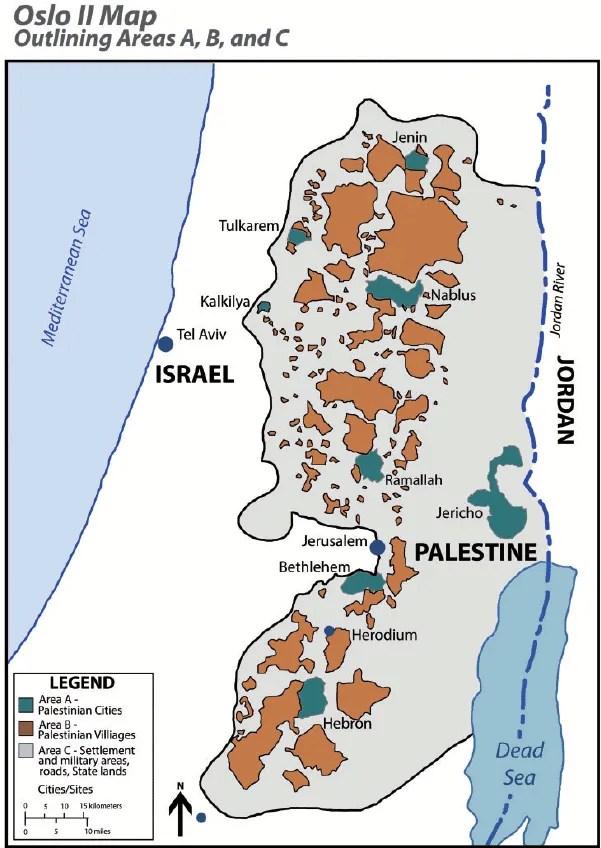
UK barrister, international law advocate, and legal director of UK Lawyers for Israel Natasha Hausdorff has argued several times on video why Israeli’s occupation of Area C of the West Bank is neither illegal nor constitutes “ethnic cleansing” of Palestinians.  Remember,  according to the 1995 Oslo II accords, Areas A and B are largely under Palestinian control, with area A under full Palestinian civil and security control, while area B is under full Palestinian civil control and joint Israeli/Palestinian security control—and Jews aren’t allowed to live in either area. Area C is under full Israeli security and civil control, and both Palestinians (about 300,000) and Israelis (about 500,000) are allowed to live in that area. The Palestinians in that area are largely descendants of people who were there pre-Oslo, and Palestinians are rarely allowed to build new houses or settlements there. Israelis are allowed to move there of their own accord.

Note that these borders are temporary, and the whole division was supposed to be settled at some time after Oslo II. But that settlement never happened. I believe the idea was that all of area C was supposed to be transferred to Palestine, but not until there was a full settlement, including apportionment of land, between Palestine and Israel. And if you think Israel won’t move its own residents out of an area to bring peace, then you’re forgetting Israel’s own “ethnic cleansing” of Jews from Gaza in 2005. Did that bring peace? You know the answer.

You can see several videos of Hausdorff’s arguments (e.g., here, here and here) which are pretty clear (the first is marred by the interviewer shouting). But in a recent article in the Spectator (click on archived link below) Hausdorff is a bit confusing, to the extent that her argument is obscured by fine points of international law and claims of those who oppose them. It’s not her fault; the situation is complicated. You can read her argument by clicking on the archived link below, but I’ve asked Grok to put her argument in simpler language.

The whole question appears to hinge on two issues:

  1. Whether the West Bank lies within Israel’s sovereign boundaries. Hausdorff argues “yes”.
  2. Whether Israel forcibly transported or deported its citizens into the West Bank or whether Israelis settled in Israeli-administered territory of their own volition. Hausdorff maintains the latter, arguing (correctly, I think) that the border of area C is an “armistice” line rather than the border of a sovereign territory.

To quote her Spectator article:

A legal rule selectively (and incorrectly) cited whenever Jews build houses across an armistice line, which is not and never was a border, is not the application of law but political posturing. Additionally, the Oslo Accords, which gave Palestinians self-government in Areas A and B of the West Bank, left Area C under Israeli administration, and deliberately reserved settlements, borders and Jerusalem for final-status negotiations.

. . . The consequences extend far beyond legal disputes. The phrase ‘illegal settlements’ is increasingly being used to mean something much more disturbing: that Jews should not live in certain places because they are Jews. Consider what is being demanded. A future Palestinian state is routinely imagined as requiring the removal of hundreds of thousands of Jews from their homes. The Jewish residence in Hebron, the cradle of Jewish civilisation, is inexplicably presented as an international crime. As is the Jewish Quarter of Jerusalem or the Jewish communities re-established after their inhabitants were expelled.

No comparable demand would be tolerated elsewhere. We would immediately recognise the ugliness of saying that peace between two peoples requires territory to be cleansed of one ethnicity. Yet once the proposition is dressed in the language of ‘settlements’ and ‘international law’, politicians repeat it.

. . . Crimea illustrates the point: Russia’s occupation does not extinguish Ukrainian title. If Ukrainian forces recover Crimea tomorrow, Ukraine will not suddenly become the occupying power just because Russia controlled the peninsula for a decade. The sovereign title comes first.

. . . International law was designed to provide rules by which disputes could be resolved. It was not created to furnish political campaigns with intimidating vocabulary. The starting point should therefore be the law itself, applied consistently: the Mandate, uti possidetis juris, the actual status of the 1949 armistice lines, the wording of the Geneva Convention, subsequent agreements, including the Oslo Accords, and state practice elsewhere.

I’m absolutely sure that about 95% of people who throw around the phrase “illegal settlers” (or “settler colonists”) and “ethnic cleansing of Palestinians” do not know the international law that applies here. They’re merely following the progressive party line.

But read for yourself (click the headline):


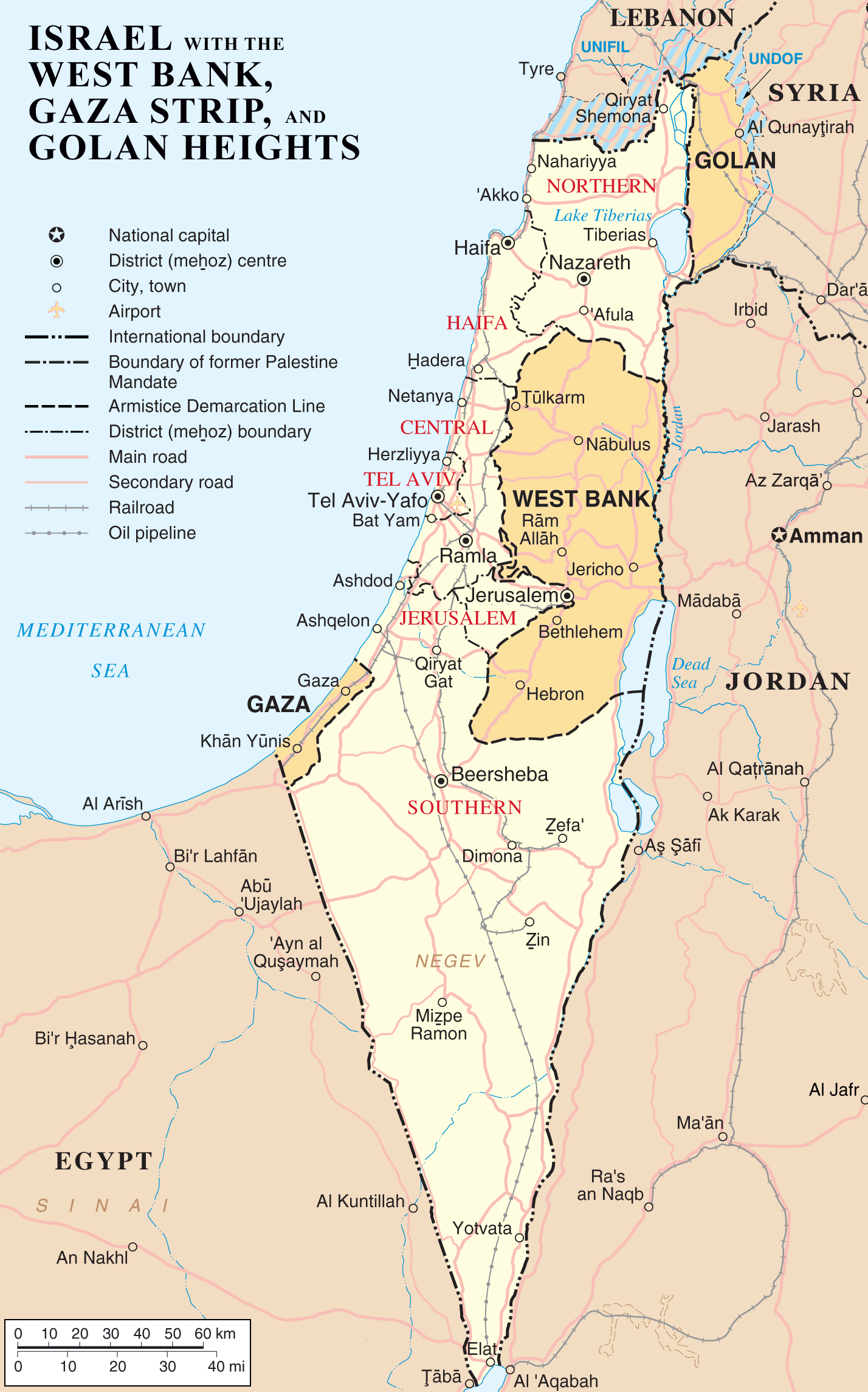
To help out with the argument, I’ll post two maps. First is the Green Line (from here). The “international boundary” indicated below—dash, two dots, dash— is the “green line” boundary that, says Hausdorff, constitute the sovereign boundaries of the state of Israel, including the West Bank.
And here are areas A, B, and C of the West Bank (map from here):
I quote the bot Grok in answer to my question: What is Natasha Hausdorff’s argument for why Israelis are not settling illegally in the West Bank, and why they are not committing “ethnic cleansing”? 

Grok’s full answer is indented, and I’ve put crucial bits of the argument in italics. I’ve left out Grok’s references supporting its answer, but I see no errors there.

Natasha Hausdorff, a British barrister and legal director of UK Lawyers for Israel, argues that claims of “illegal settlements” and Israeli “ethnic cleansing” in the West Bank rest on a misapplication of international law and invert historical facts. Her case, set out in writings such as her September 2026 Spectator article [article above] and in interviews and parliamentary evidence, has two main parts.

Why settlements are not illegal

Hausdorff starts with the status of the territory itself. She says the legal story does not begin in 1967. Under the customary rule of uti possidetis juris, a new state inherits the administrative boundaries of the preceding entity unless those boundaries are changed by agreement. When Israel declared independence in 1948 it was the only state that emerged from the remaining Mandate for Palestine west of the Jordan (Transjordan having already been separated). The Mandate’s lines therefore became Israel’s default international borders and included Judea and Samaria (later called the West Bank) and East Jerusalem. The 1947 UN partition resolution was a non-binding General Assembly recommendation that the Arab side rejected; it never displaced the customary rule.

Jordan seized the area in the 1948–49 war and held it until 1967, but occupation does not confer sovereignty. Only two states recognized Jordan’s annexation, and the 1949 armistice lines were explicitly military ceasefire lines, not borders. In 1967 Israel therefore recovered territory over which it already held title; a state cannot occupy its own sovereign land. Hausdorff uses the analogy of Ukraine recovering Crimea: no one would then call Ukraine the occupying power. The ICJ’s 2024 advisory opinion, she notes, is non-binding and simply assumed occupation without addressing uti possidetis.

Even if one treats the West Bank as occupied for the sake of argument, she says Article 49(6) of the Fourth Geneva Convention does not make civilian Jewish communities illegal. The article forbids an occupying power from deporting or transferring parts of its own civilian population into occupied territory. It was drafted after World War II to stop forced, state-organized population transfers of the Nazi type. Israeli Jews who live in the West Bank move voluntarily; some re-established communities (such as Gush Etzion) that Jordan had expelled. The provision does not create ethnically exclusive zones or criminalize private residence. Hausdorff also points to inconsistent international practice: large-scale civilian settlement in other prolonged occupations has not drawn the same legal condemnation.

She adds that the Oslo Accords left Area C under Israeli administration and reserved settlements, borders and Jerusalem for final-status talks. Much of the unauthorized construction she identifies as illegal is Palestinian building in Area C, not Israeli communities built with planning permission.

Why Israel is not committing “ethnic cleansing”

Hausdorff treats the ethnic-cleansing charge as projection. Jordan ethnically cleansed Jews from the West Bank and East Jerusalem between 1948 and 1967. Areas A and B, under Palestinian Authority control, are already free of Jews. Demands that Israel evacuate Jewish communities from Area C, she argues, amount to a call for the remaining parts of Judea and Samaria to be made Judenrein [JAC: “free from Jews”].  She has described the ICJ’s language as effectively endorsing that outcome.

On the facts, she says the Palestinian population in Israeli-administered Area C has grown, not shrunk. There is no evidence of a systematic Israeli policy of removing Palestinians from the territory; the opposite demographic trend is visible. Accusing Israel of the crime that was actually committed against Jews in the same area, she contends, inverts both history and law.

Hausdorff’s overall position is that the phrases “illegal settlements” and “ethnic cleansing” function as political slogans that apply a double standard to the only Jewish state and that they are used to justify excluding Jews from places of historic Jewish presence. She maintains that genuine international law, applied equally, does not require that result.

That is the argument which, according to Hausdorff, complies with international law. She recognizes that Israeli violence against Palestinians in area C is illegal and should be dealt with harshly, and also that this division of land is temporary, though it doesn’t look as if a two-state solution is anywhere in the offing. Until there is a final settlement, Hausdorff considers the “illegal settler/ethnic cleansing” argument to be a canard—indeed, a blood libel.

h/t: Christopher

Miliband vs. Hausdorff on England’s sanctioning of Israeli “settlers”

September 13, 2026 • 9:50 am

You may have heard that the British government has announced sanctions against Israeli individuals and settlements in Israel’s West Bank—punishing individuals and companies doing business from what is apparently Area C of the West Bank as stipulated by the Oslo II accords. While areas A and B are under Palestinian authority and jurisdiction, and Jews cannot live there, Area C is under Israeli military control. Both Jews and Palestinians live there in roughly equal numbers, but the Jews, many of whom moved in after the area was won by Israel in the 1967 war, are all referred to as “settlers”.  As for their status, Wikipedia says this:

In 2023, Area C was home to 491,548 Israeli settlers and 354,000 Palestinians. The Jewish population in Area C is administered by the Israeli Judea and Samaria Area administration, into which Israeli law is “pipelined”, whereas the Palestinian population is directly administered by the Israeli Coordinator of Government Activities in the Territories (COGAT) and is under military law. The Palestinian Authority is responsible for medical and educational services to Palestinians in Area C; however, infrastructure construction and supervision is done by Israel.

The status of the Jewish population in area C (the Jews of the West Bank) is disputed.  While the status of this area was supposed to be resolved by negotiations between Palestine and Israel after Oslo II, those negotiations never took place. Much of the world regards the Jews in area C of being illegal settler-colonialists under the fourth Geneva Convention, but international lawyer Natasha Hausdorff argues in the videos below that Jewish residence in Area C does not violate international law, nor does it constitute, as the UK has just maintained, “ethnic cleansing.”

That said, there’s no doubt that some Israelis in the area are violating civil law by attacking and harassing Palestinians. As I’ve said before, that kind of behavior is reprehensible and should be punished. But I am unwilling to call for the wholesale removal of Jews from area C, nor for sanctioning them as the British government (and other countries) called for this week.  Their fate depends on what negotiations will take place in the future to effect a peaceful settlement between Israel and the Palestinians.

But the British government under Labour (yes, the party renowned for antisemitism) has just declared not only that they’ll impose sanctions on West Bank Jewish companies, but that this is necessary to effect the ONLY and most urgent way to stop the enmity between Israel and Palestine: the “two-state solution.” First, from the NYT:

Britain, Canada and France on Tuesday announced sanctions on Israeli settlements in the occupied West Bank, a symbolic step by three once-staunch allies illustrating Israel’s deepening isolation after the devastating war in Gaza and settler violence in the West Bank. [JAC: I now believe that eight more countries have signed on to these sanctions.)

. . .Britain’s package of measures was announced on Tuesday in Parliament by Ed Miliband, who became foreign secretary in July. It represents the clearest shift in British foreign policy since Andy Burnham became prime minister that month.

“Today marks the beginning of a new approach,” Mr. Miliband told lawmakers. He said that the British government “agrees that there is ethnic cleansing of Palestinians in areas of the West Bank — perpetrated by settler terrorists.” All too often, he added, “the Israeli government has turned a blind eye to this and worse.”

In a speech with an often deeply personal tone, Mr. Miliband said that he had made his announcement as a “proud British Jew” who was “unwavering” in his support for the state of Israel. He added, however, that Britain had concluded that the occupation was unlawful in line with a ruling by the International Court of Justice.

“So I can announce today that we will introduce an import ban on goods from illegal settlements in the occupied territories,” he said, adding that the measures would also cover those who provide services to settlements, including “construction, infrastructure, financing or real estate for settlement expansion.”

You can read the full statement by Foreign Secretary Miliband to the House of Commons here. I’ll give a few extracts; note that the British government has recognized Palestine as a state, though no such state exists:

So Madame Deputy Speaker, there is a deeply painful contrast between our professed commitment to a two state solution, and the reality on the ground in Gaza and the West Bank.

. . . We should always be proud that it was a Labour government that took the historic step of recognising the State of Palestine.

What we seek today is to salvage the only course for peace and security for Israelis and Palestinians – the two state solution.

. . .Ethnic cleansing is defined by the UN as ‘a purposeful policy designed by one ethnic or religious group to remove by violent and terror-inspiring means the civilian population of another ethnic or religious group from certain geographic areas.’

The British government agrees that there is ethnic cleansing of Palestinians in areas of the West Bank – perpetrated by settler terrorists.

To advance the two state solution, we also need viable and effective Palestinian governance.

So I urge the Palestinian Authority to accelerate reform and I urge Israel to lift its withholding of revenues that is financially crippling the provision of essential services in the West Bank.

The set of measures I have announced represents a clear message to the government of Israel, to the Palestinians in the Occupied Territories, and to the world that we will not acquiesce in the destruction of the two state solution.

I have news for Secretary Miliband: the two-state solution is already gone, extinct, singing in the Choir Invisible. The Palestinians do not want two states, nor did they ever, as they’ve rejected a two-state solution many, many times, often with stipulations favorable to Palestinians. What Palestinians want is a one-state solution, a state that will be set up to contain Jews and Palestinians, but of course would soon be Judenrein due to Jews fleeing or being exterminated.

Nor does Israel want a two-state solution. October 7 killed that desire. Israelis now realize that there was a two-state solution before 2023: Gaza—right next to Israel. That didn’t work out so well, and Israel’s security concerns about terrorism have gone sky-high.  Hamas is still in control of much of Gaza, has not yet laid down its weapons, nor have Hamas or the Palestinian Authority renounced terrorism Both groups glorify martyrs, and the PA has its infamous “pay for slay” program, euphemistically named the “Martyr’s Fund”, in which Palestinians jailed or killed for attacking Jews get a monetary reward (it can go to their families). And there are no moderate, non-Jew-hating Palestinians waiting in the wings to assume peaceful governance of a Palestinian state. Certainly the Palestinian Authority is not a candidate!

Only a fool would think that Palestinian terrorism against Israel would cease if two states were created, but Miliband & Co., ignorant of history, say stuff like this:

And this is in our fundamental national interest because if there is one lesson of recent decades, it is that we will never have stability in the Middle East without a two state solution.

Is the man serious? Does he think that a version of BDS, banning goods made in area C (often by Palestinian workers who will lose their jobs), will bring on the two state solution?

If you read the whole Miliband statement, you’ll see he blames all the woes of Gaza, including its “humanitarian catastrophe” and deaths of civilians, not on Hamas but on Israel. He and the British government have swallowed whole the line of Hamas apologists like the UN.

Now the argument that these sanctions won’t achieve the UK’s aims stands by itself, but it’s interesting to see that both Hamas and Iran have praised Miliband’s statement and the upcoming UK law it portends.

This is from the Torygraph; click on the headline below, find it archived here, or see it in full on yahoo! news

A quote:

Hamas has praised Ed Miliband’s sanctions on Israel.

The terrorist group said the Foreign Secretary’s use of the term “ethnic cleansing” to describe the actions of settlers in the West Bank was a “step in the right direction”.

It called for the prosecution of Israel’s leadership for war crimes.

On Tuesday, Mr Miliband said the occupation of Palestinian territory was “unlawful” – a first for a British government minister – and accused Israel of trying to make the two-state solution unviable.

He told the Commons: “The British Government agrees that there is ethnic cleansing of Palestinians in areas of the West Bank, perpetrated by settler terrorists. And all too often, the Israeli government has turned a blind eye to this.”

Britain will sanction companies and individuals supporting the settlements with finance, infrastructure, property or construction services.

The UK will also refuse all export licences for weapons that “materially contribute to the occupation”, said Mr Miliband.

Hamas, proscribed as a terrorist group by Britain, carried out the October 7 2023 attacks on Israel, in which 1,195 Israelis and foreign nationals died.

Basem Naim, a senior member of Hamas’s political bureau, said: “The imposition of sanctions by Britain and other European countries and Canada on goods imported from the settlements of the occupied West Bank, and the London foreign minister’s use of the term ‘ethnic cleansing’ to describe the crimes of the settlers, are important steps in the right direction – but they are not enough.

“What is needed to achieve stability and peace in Palestine and beyond is the immediate implementation of the relevant international resolutions and the prosecution of war criminals in Israel in a manner similar to the Nazi trials at Nuremberg in Germany.”

Typical Hamas palaver, with not a word about the prosecution of Hamas for its real war crimes, including kidnapping hostages and indubitable targeting of civilians!

Iran has also joined the pro-Milibandwagon. From The Jewish Chronicle (click to read):


A quote (I’ve bolded one sentence):

Britain’s sanction targeting settlements in the West Bank have been greeted in Iranian state media as a step towards “the end of Israel”.

The announcement yesterday by foreign secretary Ed Miliband of a raft of measures has been broadcast repeatedly by Islamic Republic propaganda outlets.

Iranian broadcasters claimed years of activity by regime-backed “resistance groups” have succeeded in persuading the “naïve UK government” to take action against Israel.

The reports quote Miliband as branding the settlers as “terrorists” supported by Benjamin Netanyahu’s government, and accusing them of “committing ethnic cleansing in the West Bank”.

Iran Radio accused the foreign secretary of “plagiarism”, saying credit for branding “Israeli occupiers” as terrorists should go to the founder of the Islamic Republic, Ayatollah Ruhollah Khomeini.

Now you might be saying, “Well, just because Hamas and Iran have approved the UK’s new policy doesn’t mean it’s wrong.” True, but the UK’s policy is not going to bring on a two-state solution, no matter how many times Miliband says it, and Iran just said the quiet part out loud: these anti-Israel sanctions are indeed a step towards the end of Israel.

But it won’t bring on the end of Israel, as that country is determined to continue existing. As the Hebrew phrase goes: עַם יִשְׂרָאֵל חַי (Am Yisrael Chai): “The people of Israel live.”

*********************

On the other side we have is eloquent Natasha Hausdorff, international lawyer and legal director of UK Lawyers for Israel.  At 4:45 in the video below, Hausdorff explains why she doesn’t see Jewish settlements in the West Bank as illegal under international law, and why the Israelis are not committing “ethnic cleansing.” Indeed, she says, the illegal settlement in the Israeli-administered territory of Area C is being done by Palestinian Arabs, which she calls “an inversion of authority” and “projection.” The error people are making hinges on mistaking voluntary settlement of this area by Israelis with “state transfer” of Israeli populations.

I’ve rarely seen Hausdorff so exercised, but she’s clearly gobsmacked and peeved by what she sees as an anti-Jewish agenda by her own government, and an agenda based on lies. (You can see a longer explication of her views in this other video and there’s a new video with Hausdorff discussing what will happen to the firms, both Israeli and British, who will be subject to the UK boycott.)

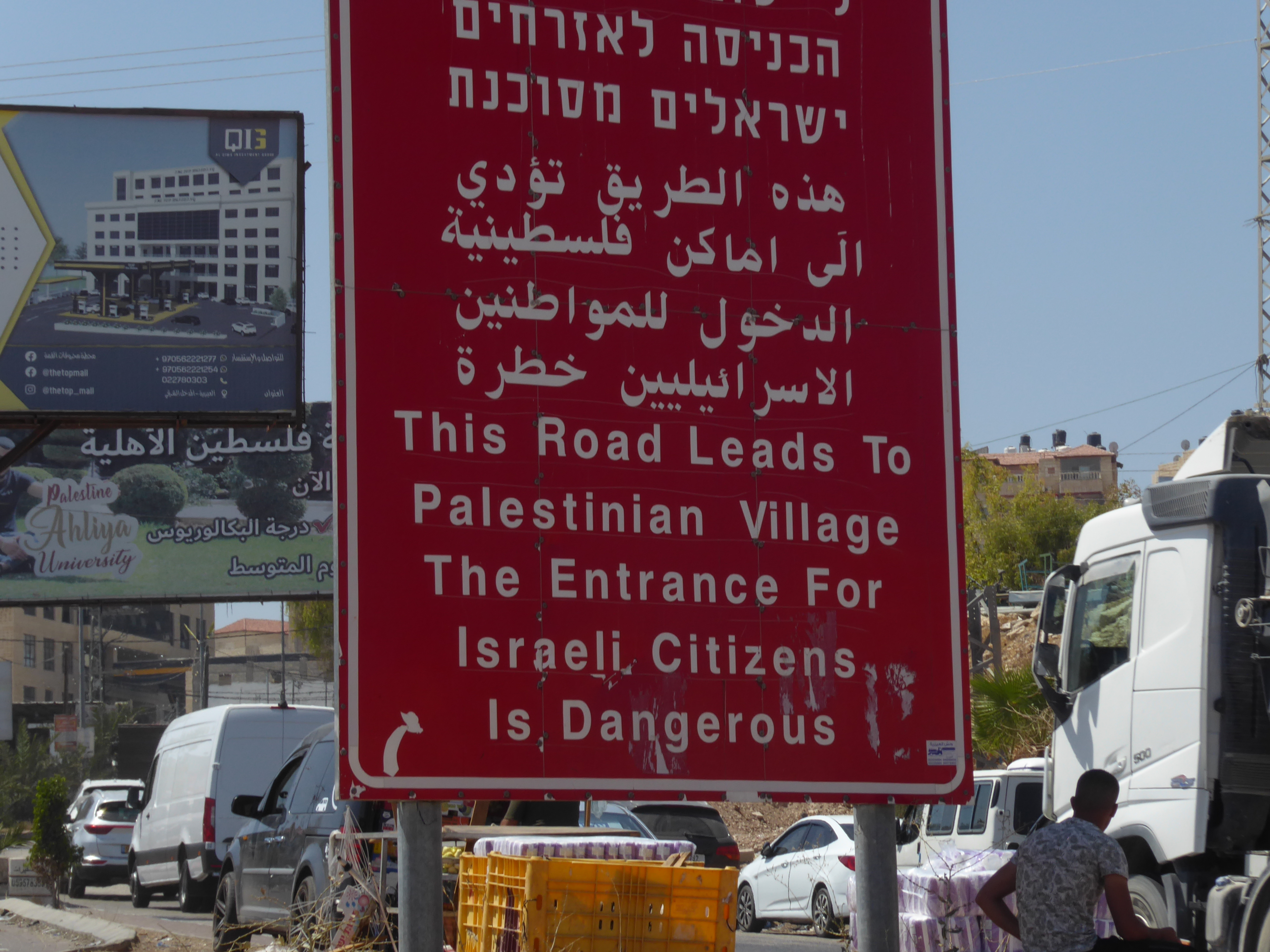
Here’s a sign to the entrance of part of area A near Jerusalem; I took the photo a couple of years ago:

h/t: Steve, Christopher

Bill Maher schools the young and the anti-Israel Democrats

September 13, 2026 • 8:15 am

At the end of September I posted about the BBC’s refusal to use the word “terrorist” when referring to Hamas. They could use it when quoting other people, but you can’t call a terrorist a terrorist when it applies to Palestinians who kill civilians for political, ideological, or religious aims. This also applies to other media outlets, as you can see in Bill Maher’s latest “Real Time” segment below. 

A reader sent me a link to the 9-minute comedy-and-news bit, which this week was more news than comedy. And the reader noted that this was one of “his best ever” and that it “should be required viewing for every incoming college freshman in America.” It is indeed, as Maher calls out the young generation for coddling terrorism, valorizing Luigi Mangione, and touting America as the worst country ever. 

The moral confusion afflicting the young and the “progressives” is most pervasive when discussing Israel’s response to terrorism emanating from Gaza, which, Maher emphasizes, is NOT a genocide but a “counterattack in a war. . . that’s been waged by Israel since 1948”.  And he quotes a poll saying that 20% of Gen Z members have a “positive view of Osama bin Laden.” Seriously?

The genocide canard is the most infuriating lie told by progressives, even though it’s easily dispelled by citing the many things Israel did to protect Palestinian civilians from harm during its counterattack. But that doesn’t matter; the chuckleheads waving the “genocide” banner ignore both vocabulary and history, so eager are they to smear Israel. (You never hear them accusing Hamas of genocide.) As Maher says, that Big Lie is not only wrong, but also promotes antisemitism:

“Gaza equals genocide is a lie—an easily provable lie.  And the fact that so many prominent Democrats get along with it is to me, the party’s worst moment since they ended Reconstruction after the Civil War.”

“This is where antisemitism is coming from.  . . because if you really think someone is committing genocide, of course you have full permission to hate them.  And history shows, for whatever reason, when it comes to hating the Jews, people don’t need a lot of permission.”

The guest whose faces and applause appear in this segment are Max Brooks, an author, actor, and historian, and Sarah Longwell:. a conservative publisher and political strategist. 

I should add that I tweeted this segment yesterday, and the antisemites came out in droves. It’s scary, but also evidence that Jew hatred is more pervasive than we—or at least I—know. Have a look at the comments on this tweet (click on it):

Sometimes I feel that these people wouldn’t be happy unless either Israel never fought back against terrorism, or in fact disappeared from the face of the Earth.

The shameful reaction of “humanitarians” to to the war in Gaza

July 22, 2026 • 9:15 am

I woke up this morning to find this Substack commentary written by my friend the philosopher Maarten Boudry.

Few things have shocked me more than the open acquiescence—or even outright support—of the international “humanitarian” community for Egypt’s decision to seal, and even reinforce, its heavily fortified border with Gaza throughout the war. Early on, Israel tried to negotiate with Egypt to allow Gazan civilians out of harm’s way so it could target Hamas more effectively. The international “humanitarian” community reacted with outrage to the very suggestion. Meanwhile, Egypt threatened to tear up its peace treaty with Israel and declared that it was “ready to sacrifice millions of lives so that nobody would approach a grain of sand [in Sinai].”

You expect that kind of cynicism toward “fellow Arabs” from a corrupt and authoritarian regime. But from self-proclaimed Western “humanitarians”? Apparently, they’d rather keep Gazan civilians trapped in an active war zone, where Hamas could exploit them as human shields, because evacuation would supposedly amount to “ethnic cleansing.” And all this while they were hurling the obscene “genocide” libel at Israel. Because that’s obviously how you would behave if you sincerely believed a genocide was taking place, right? Prevent people from escaping? It’s either callousness, mendacity, or both.

By way of analogy, imagine that Poland had sealed its border with Ukraine after Russia’s invasion in 2022, telling the world: “Why should we let in Ukrainian civilians? We don’t want a bunch of Nazis in our country.” Bad enough. Now imagine the “humanitarian” community supporting that stance—insisting that Poland bore no responsibility for Russia’s aggression, and that admitting Ukrainians would amount to “ethnic cleansing” because Moscow might never allow them to return.

In this brilliant article, my good friend Shany Mor uses a series of clever thought experiments to expose the revealed preferences of the “humanitarians” in the Gaza war. The conclusions are deeply disturbing. They reveal an astonishing level of indifference—whether intentional or not—to the very people these organizations claim to care about. If they have to chose between demonizing Israel and helping Palestinians, they always chose the latter.

I will never, ever, ever donate to any of these organizations again—even though I supported many of them regularly in the past.

I’ll mention below which organizations Maarten deems not worthy of donations. But you’ll want to read Shany Mor’s piece, which I discuss below.

Note as well that Maarten has two related articles. One, published in The Jewish Chronicle in January (Maarten is not Jewish) is called, “Europe’s silenced scholars: the forced Gaza genocide ‘consensus’,” which has this paragraph:

In reality, the accusation of genocide is as obscene as it is absurd. Netanyahu and his far-right cronies may be guilty of many things, but there’s no evidence whatsoever that Israel intends to exterminate Gazans, and abundant evidence to the contrary. The eagerness of Western intellectuals to nonetheless accuse Israel of genocide is by now depressingly familiar, as is their blindness to Hamas’s cynical war tactics and the extraordinarily difficult conditions under which Israel has had to pursue its legitimate aims of defeating Hamas and freeing the hostages. In my latest book, Het verraad aan de verlichting (The Betrayal of Enlightenment), I trace this reflex to a postcolonial ideology that casts the West as perpetual oppressor and anti-Western forces as inherently virtuous victims.

And a very nice essay on his substack site (originally published in Quillette) called “They don’t believe it either,” which is mostly about how those who accuse Israel of “genocide” don’t believe that accusation. An excerpt:

The many fabrications and distortions in the genocide case against Israel are evidence of something different from rational inquiry and truth-seeking. What explains the frantic search, from almost the first day of the war, for statements by Israeli officials that can be twisted into proof of genocidal intent? What accounts for the willful blindness to Hamas’s cruelty, to the point of erasing Hamas altogether, as if the war had only one combatant? And why is the definition of genocide gerrymandered by NGOs to implicate and condemn Israel—through inventions like “slow-motion genocide” or “incremental genocide”—even though the Palestinian population grew from 1.1 million to 5.1 million between 1960 and 2020?

Infographic: Growth of Palestine | Statista

The answer is that the “Gaza genocide” calumny has become the Left’s equivalent of the “stolen election” hoax on the American Right—a baseless accusation that signals ideological allegiance precisely because it defies logic and evidence. That is why nonsense like the Amalek verse keeps being recycled, impervious to correction—the point is not to offer evidence, but to hammer down a pre-established conclusion.

Shany Mor is described by Tablet as “an Associate Fellow at the Hannah Arendt Center at Bard College and a Research Fellow at the Chaikin Center for Geostrategy at the University of Haifa. He served as a Director for Foreign Policy on the Israeli National Security Council.” His Substack, “Roter Faden“, began in April, and you can subscribe to help get it off the ground.  The article mentioned by Maarten is otherwise free to access, and you can read it by clicking on the screenshot below.

Mor considers the “epistemic community of nongovernmental organizations, activists, experts, scholars, and even a few formal intergovernmental bodies united by loosely overlapping commitments to global and transnational justice,:” and divides what he calls these “Humanitarians” into four groups.  He then performs a thought experiment on the groups, to wit:

Take everything you know about the course of the war which began on October 7, about the capabilities and actions of the belligerent parties, about the war’s duration and casualties, and about the terms of the various ceasefires, but pretend you know nothing about the claims and calls to action of the Humanitarians. And ask yourself what you might expect them to say and do under each of the following four hypotheses about the rough overlapping consensus of their collective preferences.]

H1: Humanitarians, especially including scholars of international law regarding armed conflict, are neutral regarding the belligerent parties in the war, and the Humanitarians collectively are genuinely committed to the humanitarian needs of civilians and noncombatants among both Israelis and Palestinians.

H2: Humanitarians are indifferent to the humanitarian needs of the Israelis but genuinely committed to the humanitarian needs of the Palestinians. Operating on imperfect information in rapidly changing conditions, and limited by what is allowable in international law and what is politically or materially feasible, they seek whatever can be done to reduce or eliminate loss of life or suffering on the part of Palestinians either as a direct or indirect consequence of the war.

H3: Humanitarians are indifferent to the immediate humanitarian needs of Palestinian civilians, but they fervently wish to see Israel defeated in the war Hamas started on October 7. They fervently believe that the only moral conclusion to the war is one that is a net gain for the Palestinians and a net loss for the Israelis. To this end, they endeavor to act as force multipliers both in theatre to preserve Hamas’ power and, especially, in Western states, to push for policies that limit Israel’s freedom of action, cut it off from military supplies, and apply pressure on it.

H4: Humanitarians are indifferent to the war’s strategic outcome and prefer to see more death and more suffering on the Palestinian side, not as an end in and of itself but rather as a means to confirm beliefs in Israel’s essentially demonic nature, and as a way of mobilizing hatred and social isolation of Jews in the West. In particular, there is a preference for any rhetoric or political action which removes what are believed to be the unfair social privileges which western Jews hold due to the memory of the Holocaust.

Mor then says what one would expect from each group if the characterization were true. (Of course he’s operating with the wisdom of hindsight here, but that doesn’t negate his argument.)

Did you decide which was the most accurate characterization of the worldwide “humanitarian” response to the war? In light of what Maarten said above about the border with Egypt, and the total neglect of Hamas’s stealing of humanitarian aid to Israel, as well as the distortions about the “starvation” situation in Gaza and the push to stop Israel from taking military action, I guessed correctly. Yes, it’s H3. Here’s what Mor “retrodicted” under that scenario:

H3 would see immediate demands for Israel to forgo any military offensive against Hamas at all, effectively locking in the tactical gains Hamas made on October 7, and opening the door for future October 7-style operations as a means to securing political advances for the Palestinian cause. Humanitarians would do nothing to get Palestinians out of a war zone, and they would boycott aid mechanisms that threatened Hamas’s continued rule in Gaza. They would pressure Western governments to cut off weapons supplies to the IDF and to suspend trade relations with Israel. They would mobilize international courts to try to stay Israel’s hand on the battlefield in order to limit Hamas’ defeat. And they would use their influence to push governments to hand the Palestinians tangible diplomatic achievements that could have been secured for decades with a peace agreement for free as a reward for the war launched on October 7.

That is pretty much what happened: the calls for Israel to not retaliate, or calls for a cease-fire, began even before Israel attacked and entered Gaza to retaliate. The lack of criticism of Egypt for sealing its borders was deafening to some of us, though most people—perhaps on purpose—didn’t even consider the implications of that silence.  The pressure on Israel is obvious: Douglas Murray said something like, “Israel is the only country in the world that is not allowed to win a defensive war.” Many apologists said that Hamas’s attack was justified retaliation for Israel’s oppression of the territory, despite the fact that Israel booted the Jews out of Gaza in 2005 and handed it to Palestinians.  They had, in effect, a state, but then elected Hamas, which ruined whatever valid governance Gaza had. (Don’t forget that the Palestinians had rejected a two-state solution half a dozen times before.)

Mor’s conclusions:

The war has provoked a lot of anguished discussion about the role of international law and global civil society, to say nothing of the role of international norms and the “rules-based order.” But the epistemic community that claims for itself the role of protector of those values is due for a serious moral reckoning too.

And once that reckoning begins, it shouldn’t limit itself just to the Humanitarians’ actions following October 7. Critics of Israel’s government often point to its role in supposedly propping up the Hamas regime in Gaza in the years before October 7, supposedly as a counterweight to the more moderate Palestinian Authority operating in the West Bank. It’s a legitimate critique, voiced domestically in Israel as well. But it’s worth remembering that Israel’s role in propping up the Hamas regime was tiny compared to that of international organizations such as UNRWA, MSF, and others who took care of crucial governance functions for the de facto Hamas statelet during its two-decade reign in the Gaza Strip, freeing it to hijack all the Strip’s resources for tunnel digging and weapons smuggling and manufacture. And these were joined by the experts and agencies who invented bespoke international norms after 2007 that meant that any Israeli action that we now know could have prevented October 7 would have been decried as a war crime.

Oh, and what were the NGOs that were in group 3? Maarten got a list from Claude that you can see here; it includes Amnesty International, Human Rights Watch, and Lawyers for Palestinian Human Rights.  The question he posed to Claude was this:

Which international humanitarian NGOs or organizations have criticized the Israeli proposal early in the recent Gaza war to evacuate Gazan civilians to the Sinai peninsula, worrying that it might amount to ethnic cleansing, or arguing that Egypt has no responsibility to help Israel’s war efforts? Give me names and links please.

Maarten added, “Amnesty was appalling, as usual.”  Amnesty International has gone the way of the ACLU and SPLC: ideologically captured by “progressives.”

As for the “g-word”, I write off those who accuse Israel of genocide as either ignorant blockheads or antisemites.

A superb piece: Sam Harris explains why, though he has criticisms of Israel, he won’t debate Israel’s critics

June 7, 2026 • 9:00 am

I always find Sam Harris’s writings absorbing, but in today’s piece he’s really hit his stride, telling us why, despite his own criticisms of Israel, he won’t debate those people—he calls them “scholars, grifters, and moral lunatics”—who demonize Israel as not only morally worse than its enemies, but the worst country in the world.

In a way, the piece below is a bookend to the superb piece he posted on November 7, 2023: “The bright line between good and evil.”  In between then and now, Hamas has lost the war, Gaza has been largely wrecked because of Hamas’s tactics, and yet the terrorists are still in power. What has changed is that despite the efforts of Israel to limit civilian casualties in Gaza and Lebanon, antisemitism and hatred of Israel have ballooned.  To Sam, and to me, this spate of criticism of Jews and Israel, parading under the flag of “anti-Zionism”. shows that the “river-to-the-sea” gang has lost its moral compass. And the encampers and drum-bangers have dragged a lot of academics and journalists along with them.

What is missing in all the debate is what Sam has bookended: the moral compass that points clearly to which side in the conflict is on the side of morality and justice.  It might be salutary for you to read his 2023 piece  first (I posted about it here), but it’s imperative to read the piece he just put on his Substack. You can it for free by clicking on the screenshot below.

What shines in Sam’s analysis is his laserlike focus on the most important question—right versus wrong—and his refusal to be distracted from that focus.  This is truly a superb piece, and I recommend it highly. Today you should be reading Sam Harris, not me.  I’ll put a few quotes in indents below, but you really need to click above and spend a while pondering Sam’s views.

Excerpts:

Many readers and podcast listeners have been dismayed by my enduring support for Israel and now urge me to debate someone—really anyone—drawn from a growing cast of scholars, grifters, and moral lunatics who have made that beleaguered country their professional or psychiatric obsession. The Making Sense Community seems to have inherited this infatuation, leading to some heated exchanges in recent days. I’ve explained my position on Israel across several podcasts and in my public talks, but it might help to summarize it here.

First, my general attitude: I’m not interested in exploring all the ways that Israel has missed the mark—from Prime Minister Netanyahu’s corrupt alliance with the far right, to the many crimes committed by settlers in the West Bank, to the deaths of innocent noncombatants in several wars—because none of these failings, however grave, will alter my sense that (1) the ethical difference between Israel and her enemies remains vast, and (2) the global preoccupation with the Jewish state, as though it were the worst villain among nations, is contemptible, being the product of perennial lies and delusions.

Next, a simple heuristic: As I suggested in at least one Community thread already, if my intransigence on these matters mystifies you, it might help to understand that, for whatever reason, I think militant Islam is ten times worse than you think it is. When I talk about “jihadists” and their various groups—Hamas, Hezbollah, al-Qaeda, the Islamic State, the IRGC, etc.—I’m talking about people who I consider to be worse than Nazis (jihadists being, essentially, Nazis who are certain of Paradise). My views about the conflict in the Middle East will not fundamentally change unless my critics produce evidence that Israel has become as evil as her enemies.

However, you can rest assured that if the IDF morphs into a death cult that uses its own civilian population as human shields (and yet somehow remains widely popular), if ordinary Israelis begin to celebrate martyrdom above every earthly priority, producing generations of bright-eyed, suicidal fanatics, if the residents of Tel Aviv condone the taking of Palestinian infants, old women, and other noncombatants as hostages and then gather in crowds of thousands, baying for their blood—if, in other words, the Israelis begin to resemble the Palestinians, then I won’t care who wins this war. Short of this, there remains a world of difference between the two sides, and I believe that we should focus on how brutalizing it is for any free society to confront enemies that can sincerely claim to “love death” more than everyone else loves life—for this has been Israel’s predicament for the better part of a century.

The problem in the Middle East is not, and has never been, the existence of the state of Israel. The problem is jihadism, Islamism, Islamic extremism, Islamofascism, militant Islam—or whatever words you want to use to describe the belligerence and triumphal lunacy of those who take the most pernicious doctrines of Islam too seriously.

He then explains his unwillingness to engage in debate about the war. I’ve put a critical bit in bold:

I won’t debate the history of the Middle East because it is irrelevant to resolving the conflict there. Of course, many people insist that we must disentangle and reconsider every strand of this history, going back at least a century. The reason I’m convinced that this is a fool’s errand is simple: Palestinians and Israelis have discrepant accounts of the past, and no amount of study or debate will reconcile them.

What’s far more important to understand—and I think it really is the only thing worth considering—is what the current inhabitants of Israel, the Palestinian territories, and the surrounding Arab states want out of life now. (Not what they pretend to want or what a handful of royal families want, while their populations want something quite different.) What do the Jews and Muslims in the region really yearn to accomplish? What are they willing to sacrifice for? What are they willing to die for? And what are they willing to let their children die for?

When we focus on the present this way, if we’re being honest, we must concede that there are two very different realities on either side of this conflict: culturally, psychologically, ethically, spiritually—in every way that matters. Yes, Israel has its religious fanatics too. But they aren’t the same sort of fanatics we find in Hamas or Hezbollah, and they’re far less representative of the surrounding culture. Notwithstanding everything that can be said against Prime Minister Netanyahu, the Israeli far right, and the settlers in the West Bank—and there is much to condemn—I believe the following remains true:

If the Palestinians laid down their arms, there would be peace. There could be a two-state solution; there could even be a one-state solution; it wouldn’t matter. If the Palestinians simply stopped killing Jews and stopped building a culture that celebrates pointless murder and martyrdom as its highest values, there could be a diverse, tolerant, and prosperous society between the Jordan River and the Mediterranean Sea. There could have been one eighty years ago. But if the Israelis laid down their weapons, there would be a genocide. This was obviously true on October 7th, 2023. And for anyone who has been paying attention, it has been true on every other day since the founding of the state of Israel.

Those who demonize Israel and lionize terrorists, or those Palestinians who lionize terrorism—and there are many of them—must deal with this point, which seems palpably true.  But requiring Hamas to lay down its arms, as well as demanding that Palestinian society lay aside Jew hatred and then aspire to peace and prosperity, is a tough ask, and we won’t see it in our lifetimes. For even the younger generation of Palestinians have been brainwashed into Jew hatred, and they aren’t even teenagers yet.

There’s more, but Sam ends this way:

Why does antisemitism matter? Well, for the Jews, it’s obvious why it matters, but why should it matter to everyone else? It matters because when you look at what antisemites also hate, you find they hate everything that makes culturally rich, diverse, open societies possible. Real antisemites bring with them more than just their hatred of Jews: they bring censorship, political repression, conspiracy thinking, and the politics of dehumanization and scapegoating. So decrying antisemitism is not an act of special pleading. It is a defense of the moral and institutional architecture that free societies require.

Let me close with another general point to members of the Making Sense Community: Many of you have written to tell me that you’ve lost respect for me over this issue (or that you still value my work and are giving me “a pass” on Israel). I reject this framing, and you should too. No one should be a part of Community just because they agree with me. I’m not running a political party, and there is no line for me, or for anyone else, to toe. If I’ve fallen off a pedestal because I said something you don’t agree with, the pedestal was the problem, not the disagreement. Of course, if you think I am lying to you, or that I otherwise lack integrity, you should leave and never look back. But if you just think I happen to be wrong, even about something important—especially about something important—I encourage you to keep showing up with better evidence and argu

The first paragraph makes the point that antisemitism (aka “anti-Zionism”) is a hatred not just of Jews, but of the liberal, democratic societies built by the West.  The grifters and maniacs will never admit that, but look at what is happening to liberal European democracies like Belgium and the Netherlands—countries that have admitted floods of Muslims who have imported hatred of the very societies to which they’ve fled.

I have not lost respect for Sam: I admire him all the more, and have told him so.  Of course this piece, one of the best on the current Middle East situation, will itself be demonized and ignored, probably by invoking things Sam has said in the past. We will hear, “But he favors torture!” Or “He’s a neuroscientist, and not qualified to pronounce on politics.”  Or, “Sam has been too hard on religious people.”   Those are all distractions. Yes, I’ve had my differences with Sam—I think his view that there is an objective morality is misguided—but that is irrelevant.  Regardless of whether Israel’s morality is objectively better than that of the morality of its critics, it’s true that those of us who are rational want to live in a society based on liberal democracy than in a dysfunctional one based on jihadism and Jew hatred.  Jihad is more than a struggle to live a holy life by the lights of Islam: it’s also a struggle to destroy Western values.

A federal judge takes apart Nicholas Kristof’s controversial accusations against Israel

May 19, 2026 • 9:45 am

If you’re getting weary of the endless but necessary attacks on Nicholas Kristof for his misleading and almost antisemitic column about Israel’s “policy” of sexually assaulting Palestinian prisoners, Roy K. Altman has written in the Free Press the definitive critique of Kristof’s column—that is, until investigations by Israel reveal more information.

Wikipedia identifies Altman as “a Venezuelan-American lawyer and jurist who serves as a United States district judge for the United States District Court for the Southern District of Florida” and also identifies him as Jewish.

You can read Altman’s column by clicking below—if you subscribe to the Free Press.

The “miscarriage of journalism” is, overall, the promulgation of “fake news” by Kristof: accusations that are improperly vetted (if at all), which come from questionable sources, and which are contradicted by existing Israeli policy and behavior. Altman’s thesis is that this kind of journalism subverts the “marketplace of opinions” that, it’s been said, is necessary for the American public to judge what is true. Excerpts from Altman and others are indented; prose that is flush left is mine:

. . . we entrust our fellow Americans with the power to make these choices because we believe that a virtuous people will be equipped to make the right choices—principally because we assume that our citizens will be prepared to discern truth from fiction. And we feel comfortable in that assumption because we’ve devised a system of laws—based on evidence, burdens of proof, and a time-tested set of rules—to help us assess the veracity of contested claims. In this way, the jury system isn’t simply a means of ensuring fair trials. Rather, it’s a way of training free citizens to make difficult decisions for themselves.

Today, this whole system is being undermined by the proliferation of false information—especially on the internet. But it’s one thing to have our geopolitical and ideological enemies—whether China, Russia, or the Muslim Brotherhood—pushing unverified claims about our closest allies into our cell phones. It’s another thing entirely for The New York Times, a supposed “paper of record,” and one of its Pulitzer Prize–winning journalists to offer a story that—in its disregard of basic evidence-gathering norms, its unwillingness to investigate the opposing side’s position, and its inversion of common sense—violates the fundamental rules of fairness and due process that have, for centuries, served as the bulwark of our democracy.

In his explosive essay, Kristof accused Israel of using sexual violence against detained Palestinian prisoners as a kind of “standard operating procedure.” Kristof’s claim is thus not merely that a few rogue Israeli prison guards sometimes behave illegally—as happens in all Western democracies, including our own. It is, instead, that the Israeli government has implemented a systemic policy of deploying sexual violence against Palestinian prisoners on a massive scale.

Altman also faults the timing of the column, which came out the evening before the Civil Commission’s issued its 298-page report on sexual violence against Israelis on October 7, 2023. The Israeli Foreign Ministry says that the Commission offered this report to the paper but the paper wasn’t interested.  The paper denies this, so for the time being we have a “he said/she said” situation. Regardless, Altman avers that the “psychological doctrine of primacy” argues that “a fact finder is often most persuaded by the story he hears first”, implying that Kristof, regardless of the deficiencies of his piece, should at least have held off publishing it until the Civil Commission’s report came out.  We won’t go further into this issue, as Altman finds three major faults with the column:

On the merits, Kristof’s article violates three central precepts of our legal system: It disregards basic rules of evidence gathering; it refuses to investigate the opposing side’s views; and it ignores logic and common sense.

Within this list of three there are buried two other sub-lists, which makes the piece a bit confusing. But Altman’s claims and his accusations of Kristof are pretty clear.  I’ll number the main claims as 1, 2, and 3, with sub-lists given letters as well as numbers.

1.) The column is unfair by making uncheckable claims.  

Let’s start with fairness. One of the fundamental rules of our justice system is that a man should be permitted to confront his accuser. Whether in civil or criminal cases, we have for hundreds of years rejected the English Star Chamber’s technique of allowing anonymous witnesses to advance salacious claims in secret. This principle is so essential to any basic system of fairness that it appears repeatedly throughout our laws—from the Sixth Amendment’s Confrontation Clause and its guarantee of public trials to our hearsay rules, which preclude out-of-court statements the accused never had an opportunity to cross-examine. But Kristof’s article relies mostly on anonymous sources whose credibility—much less their political or ideological affiliations—cannot be tested and thus cannot be known.

Here we have four sub-points that expand on this claim:

Kristof justifies his reliance on anonymity by suggesting that his sources would face retribution, either from Israeli authorities or from their own communities, if they came forward. But there are at least four major problems with this excuse.

1a. There is no evidence of retribution against prisoners who claimed to be sexually assaulted, and some claims changed over time:

Kristof provides no evidence of any similar retribution against one of the men he spoke with who has publicly accused Israeli guards of sexual assault. For months now, Sami al-Sai has repeatedly and publicly claimed, including to major news outlets like NPR and the Times, that he was sexually assaulted while in Israeli detention. There are real problems with al-Sai’s claims. For one thing, soon after his detention, he filed a petition with the Israeli Supreme Court, arguing that he was wrongly detained and asking for his immediate release. In that petition, he complained about the quality of the food he was given and said that he was treated badly,but he notably never mentioned any of the sex allegations he’s now advancing.

. . . But the point here is that, far from suffering any retribution for complaining about his detention, al-Sai was later freed, and Kristof never suggests that he’s since been subject to any form of punishment.

1b. Israel has in place an often-used system for registering and adjudicating prisoner’s complains about mistreatment

Two,any cursory review of Israeli legal databases would reveal that Israeli prisons allow Palestinian prisoners to file complaints about the conditions of their confinement—and that these complaints do get filed. Indeed, since 2023, Israel has received 182 such complaints filed by Israel Prison Service detainees from the Gaza Strip. . . But the point is that Kristof offers not a single shred of evidence that any of the Palestinian prisoners who filed complaints has ever been subjected to retribution—much less that this speculation about retribution has ever been a feature of the Israeli prison system.

1c. Kristof’s insistence on anonymity makes his allegations uncheckable. 

Kristof’s reliance on anonymity ensures that no one—most especially the Israelis—can ever prove him wrong. That’s because he not only tells us very little about the accusers, he tells us nothing about the offenses. No locations. No dates. No perpetrators. Israeli prisons, like many of our own, are often videotaped, and those recordings are reviewed not just by prison guards but by prison officials and lawyers. If Kristof had conducted anything resembling a fair analysis, we would have expected him to have asked to review some of this footage. But there’s no indication that he ever did. Nor can anyone else do so now because Kristof gave us no details to check against his claims.

1d. The accused has a right to the details of accusations, which gives them a chance to defend themselves. “The accused” here include onot just IDF soldiers and prison officials, but Israel itself, which is threatening to sue the paper.

Four, we should acknowledge that it’s always hard for victims of sexual assault to advance their claims publicly. But any system committed to basic fairness recognizes that the accuser’s preference for anonymity must bend to the accused’s right to confront the claims against him. And that’s not just because we want to allow the accused to test the reliability of the accuser’s claims. It’s also because we presume that the mere act of declaring something publicly itself evinces some degree of credibility.

Kristof fails to mention, for example, that Euro-Med, one of his principal sources, is  an organization with known ties to Hamas and has made false claims about Israel before, including the blood libel that Israel harvests organs of prisoners.

On to the second major point:

********

2.) Kristof failed to investigate “the opposing side’s position”, including systemic aspects of Israeli law that would make widespread abuse improbable.  Again Altman breaks this down into a sublist of three items:

2a. Kristof doesn’t mention Israeli laws prohibiting sexual abuse of prisoners. 

First, in advancing his claim that Israel permits or encourages sexual abuse of detainees as a matter of state policy, Kristof fails even to mention that sexual offenses are strictly prohibited under Israel’s penal code. Indeed, the Israeli legal system imposes enhanced penalties when sexual offenses, including by security personnel, are motivated by race, skin color, or national origin. And Israeli military forces are bound by a host of additional directives, which further protect prisoners from state-sponsored violence, including sexual violence.

Altman implies that Kristof was trying to hide this fact.  Well, yes, probably, but shouldn’t we know that this conduct is against the law? What’s worse is that Kristof also fails to mention that similar Palestinian prisoners’ allegations of abuse have led to serious prison sentences for over a dozen Israeli abusers.

2b. Kristof fails to mention that there’s a special unit of Israeli police designed to investigate claims of prison misconduct. 

Kristof likewise fails to disclose that there’s an elite unit in Israel’s police force, called Lahav 433, tasked with investigating misconduct by the Israeli Prison Service. Now, it’s entirely possible that Israel created this unit inside what’s known as the “Israeli FBI” and filled it with elite servicemembers who do nothing but sit in an office all day, twiddling their thumbs and happily allowing misconduct to go unchecked. The far more plausible inference, I submit, is that Israel didn’t create this elite investigative unit simply to do nothing. But the point is that we don’t know—and cannot know—the answers to any of these questions from Kristof’s “opinion” piece because he never bothered to mention this unit, never thought to interview its members, and never investigated the extent to which it actually enforces Israeli law.

Well, the existence of such a unit doesn’t prove that there wasn’t misconduct, but it does show that there were quite a few deterrents to misconduct.

2c.  A quote from a former Prime Minister of Israel was presented, but a later clarification of that quote by the PM was ignored. Perhaps worse than the two omissions above is Kristof’s shoddy (indeed, slimy) treatment of a comment by a former Israeli Prime Minister. Here’s what Kristof said.

To try to make sense of what I found, I called up Ehud Olmert, who was Israel’s prime minister from 2006 to 2009. Olmert told me he didn’t know much about sexual violence against Palestinians but was not surprised by the accounts I had heard.

“Do I believe it happens?” he asked. “Definitely.”

“There are war crimes committed every day in the territories,” he added.

Of all people to ask! Olmert had been convicted of corruption and bribery as Israel’s finance minister and served 16 months of a 27-month prison sentence. Kristof doesn’t mention this, and Kristof might have added, post facto, this clarification by Olmert:

Olmert clarified, in a statement to The New York Times and obtained by The Free Press, that “Mr. Kristof’s article includes claims of extraordinary gravity: that Israeli authorities have directed the rape of children, that dogs have been used as instruments of sexual assault, that systematic sexual torture is state policy. I did not validate these claims.”

Surely this should have been an addendum to Kristof’s piece. It wasn’t, The NYT hasn’t responded directly to this clarification save to say that Olmert’s statement was tape-recorded and presented accurately “in context”. But when when Olmert later denied that he was not validating claims of sexual abuse, that was no deemed worthy of a mention or correction by the NYT.

********

3.) The “dog rape” claims is pure blood libel, in line with previous anti-Israel claims. (And there’s no evidence for it. Indeed, many have deemed the “trained dog rape scenario” to be impossible (I’m not ruling it out with complete certainty, and it will surely need investigating. But I do find it stupid.)

Which brings us to Kristof’s final departure from our fundamental precepts: his lack of common sense. The most salacious claim in Kristof’s piece is the allegation that Israel is now systematically training dogs to rape Arab Muslim men. This claim used to live only on the fringes of the wildest internet conspiracy theories. In 2010, there was a spate of shark attacks in the Red Sea, situated between Israel and Egypt. For whatever reason, most (if not all) of these attacks occurred on the Egyptian side of the border. I happened to be in Israel that summer and heard an Egyptian minister wondering whether the Mossad, Israel’s foreign intelligence service, was systematically training sharks to eat only Arab flesh. My father and I, hearing this over the radio in a cab, laughed at the absurdity of the claim.

What we’ve seen over the last few years is that wild and illogical conspiracy theories that used to reside only on the internet and in the anti-Israel Arab street now circulate in the mainstream media, brought there by irresponsible journalists who flout evidentiary standards, ignore basic notions of fairness, and disregard common sense and the truth. What kind of a society will we be if we don’t reverse this disturbing erosion in our ability to tell truth from falsehood?

Altman’s claims add up to a serious indictment of Kristof’s column, which, though presented as an op-ed piece, could easily have run as a news piece, but the paper was apparently too lazy to check its claims. To me, the most serious accusations are twofold: the failure of Kristof to document the accusations so they could be checked, even making the complainers anonymous; and also Kristof’s failure to mention the anti-Israel jostpru of some of the individuals and organizations (especially Euro-Med) making the claims.  It is a one-sided column, even for Kristof, who in the past hasn’t done due diligence in checking claims.

The more I think about this, the more I think Kristof should be fired, as the op-ed is a serious lapse in standards, even for an op-ed. If op-ed editor James Bennet could be fired (as he was) for allowing Senator Tom Cotton to write an op-ed arguing that the military might be used to quell post-George Floyd riots, surely Kristof should also be forced to resign. After all, Cotton was just giving an opinion that didn’t rest on facts, while Kristof made many allegations that he didn’t bother to either qualify or investigate.

But of course Kristof is a golden boy for the NYT, and the his column buttresses the NYT’s well known stance against Israel. The NYT is standing behind his column (it has no public editor), and don’t expect it to fact-check his claims. That will be up to Israel.

More criticism of Kristof’s allegations about Israel

May 15, 2026 • 9:30 am

By now the whole world–at least the world that reads the news–knows about Nicholas Kristof’s long NYT op-ed column accusing Israel of systemic, institutional sexual violence against Palestinian prisoners. For those who already hate Israel, his unsubstantiated allegations will serve only to reinforce their hatred and antisemitism. For those who are open-minded or sympathetic to Israel, well, they do have to admit that the allegations are unsubstantiated.  But, as the saying goes, “A lie can travel halfway around the world while the truth is putting on its shoes.”  Kristof is no dummy, and surely he knew that his claims would be snapped up by Israel haters and antisemites.

That is a good reason for Kristof to have verified all his sources and ensure that they had no history of bias (or at least the bias should have been made explicit)—something he did not do. This is in contrast to the Civil Commission on the October 7 Crimes Against Women and Children report, documenting Hamas’s sexual abuse during its invasion of Israel. The Commission has verification of all of its sources, including forensic evidence like photographs and bodies.

As most of Kristof’s critics have said, it is impossible to affirm that there was never any abuse of Palestinians by the IDF.  But if you make an accusation that the abuse was both widespread and systemic, you’d better be able to back it up with evidence. Unfortunately, the NYT sees no need for that. relying on Kristof’s two Pulitzer Prizes and his claim that he interviewed witnesses brought forth by groups or people who can hardly be said to be unbiased.  But yes, his claims should be investigated, but he would have to help the investigators by providing identities and documentation. I wouldn’t hold my breath until he does that.

In the meantime, it’s not hard to find criticisms online. I’ll just link to five new ones, showing an excerpt from each. I haven’t found people approving of Kristof’s claims, but then again I don’t read the kind of site that would do that. And those sites would have to independently try to verify Kristof’s claims, which nobody has done.

Amit Segal at It’s Noon in Israel: “Anatomy of a blood libel.

In [Kristof’s] piece, published curiously as an op-ed rather than a news investigation, Kristof accuses the State of Israel, its prison system, the IDF, and the Shin Bet of systemic rape of Palestinian prisoners—primarily men, but also women. These are serious accusations, and it is certainly possible, if not inevitable, that abuse, even sexual, occurs within the prison system, as it does in almost every prison system worldwide. Whenever there is real evidence of such acts, it must be properly investigated and the guilty punished. However, for accusations to be taken seriously, they must be backed by actual evidence. In this regard, Kristof’s column is an absolute failure.

The column falls short of almost any journalistic standard, according to [Hebrew University professor Danny] Orbach. He points out that the reporter relies on only 14 unverified and uncorroborated testimonies, lacking details that would allow for investigation, verification, or refutation, to claim that systemic sexual abuse is widespread throughout the Israeli prison system. For comparison, in 2020, approximately 16,000 complaints of sexual assault and harassment by guards against prisoners were recorded in the United States, with only a tiny fraction proven to be based on real incidents. Of Kristof’s witnesses, only two identify themselves by name or provide details that could help locate the case. One of them, Sami al-Sai, is presented by Kristof as a “journalist.” In reality, he is a Hamas propagandist who cheered the mass murders of October 7—hardly a reliable source. At the very least, Kristof owed his readers a disclosure regarding who this man is. Prominent journalists have already pointed out that the two identified witnesses provided Kristof with “reheated noodles”—versions that changed and became “more sophisticated” over time, adding new gruesome details every time they spoke to a different reporter.

If it ended there, one could dismiss Kristof’s article as merely a negligent op-ed, but Orbach stresses that from here, things deteriorate. He explains that a large portion of the anonymous testimonies come from Euro-Med Monitor, which Kristof presents as a “human rights monitor.” In reality, this is a Hamas front organization whose chairman, Ramy Abdu, cheered October 7 and spread debunked lies and conspiracy theories—such as massacres at Shifa Hospital, organ harvesting, or the claim that humanitarian aid contained only burial shrouds—claims not taken seriously even by most anti-Israel journalists during the war. Unsurprisingly, Kristof mentions nothing to his readers about this organization’s reputation. Furthermore, another “source” Kristof cited in a video interview as a “man in the know” is actually an Israeli Hamas supporter and delusional conspiracist who was dismissed from the university where he worked due to sexual offenses. A “man in the know,” indeed.

The interviewees, of course, were not found or selected by chance. This raises the question: who was Kristof’s “fixer”? Reporters who do not know the language almost always rely on local fixers, and Kristof claims he found the interviewees through “human rights organizations,” which Orbach suggests points to a pre-planned direction by Euro-Med or its ilk. In the Palestinian arena, there is a documented pattern of witness coaching and bias, a phenomenon rarely caught but exposed during the “Jenin Massacre” libel that never was in 2002.

. . . . So, what do we have here? A “respected war correspondent,” winner of two Pulitzer Prizes, accusing a state of systematic rape based on 14 testimonies—12 of them anonymous, two public but highly problematic—with zero disclosure regarding the witnesses or the biases of the organizations providing the information. Unlike the Civil Commission’s report on October 7, Orbach emphasizes that Kristof made no real attempt to cross-reference the testimonies, used no forensic evidence, and did not attempt to interview Israelis who served in prisons or civilian doctors. The only senior Israeli he did interview, Ehud Olmert, apparently never said what was attributed to him.

This is not Kristof’s first time. In the early 2000s, Kristof championed a Cambodian anti-prostitution activist, calling her a “hero” in column after column. When it turned out she was a fraud who staged the scenes that brought her fame, Kristof admitted the mistake and the paper apologized. His current column shows that his tendency to believe anyone who seems “just” to him, without critical source analysis, remains intact. He has learned nothing, Orbach concludes.

Douglas Murray at The New York Post: “Why would the NY Times make such horrific claims about Israel. The reasons are several-fold.”

Nicholas Kristof raped my dog. At least that is what I have heard, from an anonymous source. A source who is intensely hostile to the New York Times columnist. And that’s good enough for me. Now I come to think of it, my pet pug has had a strange look on his face lately.

As it happens, the rumor that I have just attempted to spread is far less lurid and fanciful than the one that the New York Times chose to spread around the world this week.

In a piece which has already been widely debunked, Kristof claimed that Israeli prison guards routinely use rape as a method of torture on Palestinian prisoners. The piece portrayed Israeli prison guards and soldiers as rapists, sadists and akin to Nazi prison camp guards. Perhaps even worse.

. . . So here we get to the true question. Why would anyone make such a claim? And why would a purportedly serious newspaper publish it?

The reasons are several-fold. The first is that the New York Times story landed just a day before an anticipated report into Hamas’ use of sexual violence on October 7, 2023.

Many of us did not need further evidence of the crimes of that day. But the release of the commission of inquiry sets out in remorseless detail the “systematic, widespread” use of rape by Hamas on that day and the way in which sexual violence was “integral” to their attack.

It lays out the calculated way in which Hamas terrorists raped men and women on the day of the attack and raped Israeli hostages — men and women — while they were held in captivity in Gaza.

The findings include descriptions from footage, first-hand, eyewitness accounts and from mortuary photographs of the way in which Hamas members gang-raped women while killing them, and even raped their victims after killing them. It is impossible to think of crimes worse than those which Hamas committed on that day.

Yuki Zeman at Quillette: “Nicholas Kristof and the pornography of accusation.”

. . . Allegations involving sexual violation by animals do not enter political discourse as neutral facts. They belong to an old repertoire of dehumanising horror. They turn the accused into something beyond cruel: a corrupter of species, a handler of filth, a director of bestial desecration, and a violator of the most basic taboos around moral and sexual hygiene. Is the claim true, false, exaggerated, mistranslated, or planted? Kristof does not know nearly enough to employ the claim in the way that he does. He treats it as a detail within a larger moral picture. A responsible and competent editor would have stopped reading right there and demanded to know what, exactly, has been established.

. . .None of this excuses abuse. The Sde Teiman case, involving alleged abuse of a Palestinian prisoner by Israeli reservists, deserved investigation so that truth could be separated from rumour and accusation. Where Israeli guards, soldiers, interrogators, or settlers have committed acts of sexual violence, they should be exposed, investigated, tried, and punished. Any attempt by Israeli politicians or mobs to shield abusers deserves condemnation. A society at war must still guard its own standards.

But it must also guard the truth. Taking rape and abuse seriously does not require us to accept propaganda dressed up as sexual horror. Nor does it require us to pretend that anonymous testimony, activist reports, and humanitarian vocabulary automatically produce truth. The harder task is to investigate abuse without surrendering judgment. A serious press should be able to do this. It should also be able to honour Israeli victims without handing their suffering to those who spent months demeaning it.

A columnist like Nicholas Kristof may even believe he is writing in defence of Palestinian victims. But when his essay relies on the same information ecology that sought to excuse, minimise, and invert the atrocities of 7 October, it risks becoming something else: a mouthpiece for those who defended the events of that day, or who needed its victims to disappear beneath a more useful accusation. This is what divides moral inquiry from propaganda.

Sherwin Pomerantz at the Times of Israel: “Nicholas Kristof’s illogical overreaching anti-Israel rant in the NYT.

there does appear to be some level of sexual violence that goes on in Israeli prisons and, similar to the rest of the world, often the perpetrators are not held accountable. The fact that this goes on in prisons worldwide does not, of course, make it acceptable practice and Israel has taken a strong policy position against such activity.

But Kristof often relies on sources that themselves have been found to be unreliable. In a series of posts on X, the pro-Israel media watchdog HonestReporting challenged Kristof’s journalism, noting that the most explosive accounts in his op-ed came from unnamed sources, while the stories of those named had grown “steadily more lurid over time, with dramatic new details added years later.”

For example, one of Kristof’s sources, Sami al-Sai, had taken to social media on October 8, 2023, to praise the Hamas onslaught one day after it occurred, and eulogized the leader of a West Bank terror cell as “our martyred prince.”

HonestReporting also noted that, about a year ago, Sai spoke to Israeli human rights group B’Tselem about his alleged assault, and did not mention several specific, graphic details that he provided to Kristof, including being sodomized with a carrot, having his genitals grabbed by a female guard, and discovering “other people’s vomit, blood, and broken teeth” in his skin.

It also pointed out that Issa Amro, who told Kristof in 2024 that he had been assaulted on the day of the Hamas attack, had earlier told The Washington Post that he had been “threatened with sexual assault” on that day, not that he had been assaulted.

None of this, of course, excuses illegal activity of prison guards or, here in Israel, members of the IDF. Nor does it give a pass to a government that drops the charges against the accused, as it did in the Sde Teman case, simply because of community pressure.

This kind of activity is certainly not in keeping with the values of a county such as ours, which promises in its Declaration of Independence: The State of Israel “will be based on freedom, justice, and peace as envisaged by the prophets of Israel; it will ensure complete equality of social and political rights to all its inhabitants, irrespective of religion, race, or sex; it will guarantee freedom of religion, conscience, language, education, and culture; it will safeguard the holy places of all religions; and it will be faithful to the principles of the charter of the United Nations.”

. . . Finally, Kristof engages in illogical overreach when he states: “Yet our American tax dollars subsidize the Israeli security establishment, so this is sexual violence in which the United States is complicit.”

Truth be told, the $3.8 billion of annual US military aid to Israel is used to purchase armaments from US defense manufacturers and, of course, has nothing to do with the prison system or its faults. A weapon used by an IDF soldier in Gaza cannot be linked to prison abuses. Actually, it is the weapons used against us on October 7th and afterwards, paid for by the Iranians and Qataris, that are more logically linked to the alleged abuses in Kristof’s piece.

The commonality of these stories is that they admit the possibility of sexual abuse of prisoners, but argue that, given the fact that interrogations are recorded and photographed, and Israel’s history of prosecuting those who violate its law, the likelihood of widespread and systemic abuse known to the authorities is low. The articles argue that Kristof’s sources are biased and that some of their stories have changed over the years. And they say that the dog-rape story is not credible.

What should happen now? Well, Israel should conduct an investigation of the allegations.  And so should the NYT, making Kristof reveal his sources and check them itself.  The former will happen; the latter won’t.

If anybody else had done this rather than Kristof, they would be fired by the NYT. Remember that editorial-page editor James Bennet was forced to resign in 2020 after a social-media outcry following the publication of an op-ed by Republican senator Tom Cotton. Cotton’s argument, that U.S. troops might be used to quell riots following the death of George Floyd, was at least worthy of discussion, but the editor who approved it became the victim of “progressive” ire.

Kristof won’t be fired, though his careless accusations were far worse than the argument made by Cotton.  But at least some of the shine is off Kristof’s Pulitzers, and the sentient world now knows him to be a crappy journalist, willing to tar an entire country on the basis of unverified claims.