Why Evolution is True is a blog written by Jerry Coyne, centered on evolution and biology but also dealing with diverse topics like politics, culture, and cats.
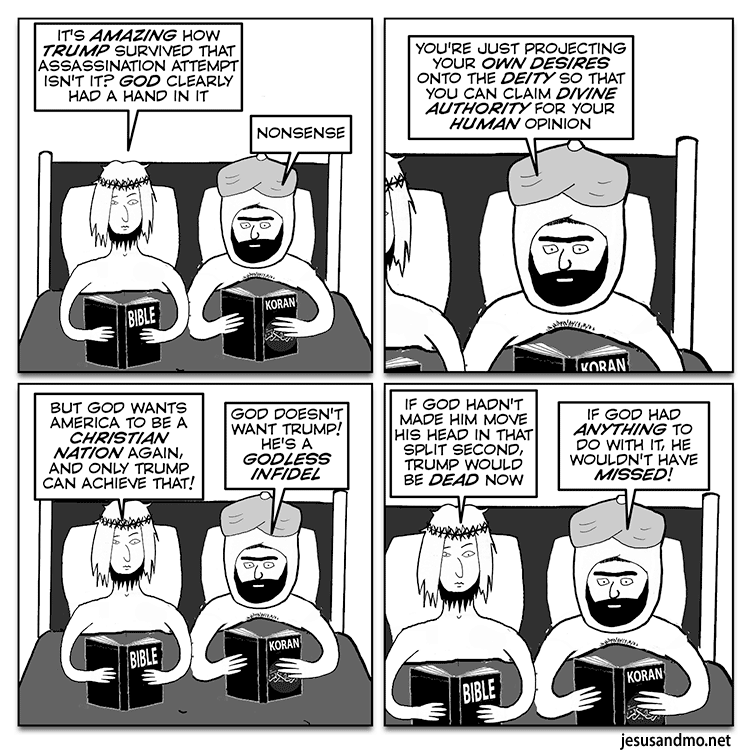
Today’s Jesus and Mo strip, called “Trump“, came with a short summary: “God wants you to stop projecting your own desires onto him.”
Clearly Mo is a Democrat! But of course, anybody who wishes that Trump had been killed is morally off the rails, though I’ve heard that from a few people.
I’ve already written at length about how corrupt the United Nations Relief and Works Agency for Palestine Refugees in the Near East (UNRWA) is: it funds schools that teach hatred of Israel and Jews; many of its members are sympathetic to Hamas (and some are members of Hamas, with a dozen alleged to have engaged in the butchery of October 7); it allows some of its facilities (hospitals, health clinics and schools) to be used by Hamas (tunnels, weapons storage, areas of hospitals used for Hamas activities); and other forms of corruption.
But wait! There’s more, at least according to this new article in the Times of London.
UNRWA is unique in two ways: it’s the only UN organization that represents refugees from only one area, with all the other refugees in the world falling under the single umbrella of UNHCR, the UN Refugee Agency. Further, Palestinian refugees are considered by the UN to be not only those who fled from Israel in 1948, but also all their descendants unto eternity, said by pro-Palestinians to have retained the “right of return” to Israel. No other refugees in the world are regarded this way.
The article is by Neta Heiman Mina, an Israeli peace activist (i.e., one who advocates peace with Palestine). It documents her disillusionment after her mother was kidnapped by Hamas on October 7. Finding out who was holding the mother was one of Mina’s disillusionments, while the other is her discover of how some of the donations given to UNRWA go directly to Hamas.
After Labour was elected in the UK, the country resumed donating to UNRWA, as did many other European countries who suspended donations after confirmed revelations that some UNRWA employees participated in the butchery of October 7 and were closely allied with Hamas. (The EU itself gave UNRWA 50 million bucks.) This, I think, occasioned Mina’s article.
The U.S. still doesn’t give money to UNRWA—one indication that our moral compass is still pointed in the right direction—but that may be only temporary. At any rate, the money is back flowing into UNRWA’s hands. And Hamas has a clever way of siphoning off some of these UNRWA donations to use for terrorism.
To read, click on the headline below or find the article archived here.
Two excerpts: First, Mina’s mom’s kidnapping:
As a member of Israel’s peace movement, I have always believed that strangers can be turned into partners. That belief remains with me today. On October 7 last year, my 84-year-old mother Ditza was kidnapped from her home in Kibbutz Nir Oz. But she was taken by Hamas, an enemy that Israelis are all too familiar with, not by strangers.
I imagined her in a deep tunnel, with angry and armed young men lurching out from the shadows. But it turns out that my mother had not been held at gunpoint in Gaza by a gang of fanatical young men. After she was released in the last hostage deal, she revealed that Hamas had handed her to a middle-aged man called Abed.
Abed had kept my mother locked in a dark room of his home, with little food and no access to medication for almost two months. He told my mother that he was a teacher at a school run by UNRWA (the United Nations Relief and Works Agency for Palestine refugees). A perfect stranger; instead of becoming one of this war’s better angels, Abed ended up as just another of its many demons.
It emerged that my mother was not the only hostage who had been kidnapped or held captive by UNRWA employees, but the ties between UNRWA and Hamas go much deeper than kidnappings alone.
Re the UK’s resumption of donations:
Last week, UNRWA opened its latest fundraising campaign at the United Nations in New York. Delegates from around the world signed a proclamation that the agency’s work is “indispensable” for Gaza, and many countries, including the United Kingdom, quickly committed to providing hundreds of millions more in funding.
Given all this, as well as what I’ll add in a second, it’s pretty clear that UNRWA should be disbanded and subsumed under UNHCR, with its “refugees” treated the same as other refugees. But Mina reveals something that I didn’t know: Hamas gets a cut of donations to UNRWA. It’s very clever (bolding is mine):
A just approach to rebuilding Gaza would be to give Palestinians the agency to solve their own problems. Despite the insistence in the declarations, UNRWA is only indispensable to Hamas. Beyond the weapons, rocket launchers, tunnels, dead hostages and server farms found in and underneath their facilities, and octogenarians held captive by their employees, UNRWA has been funnelling significant sums of cash straight from donors to Hamas for years.
The money laundering works like this: UNRWA insists on distributing cash aid to Gazans in US dollars, a currency they have to convert to shekels in order to use locally. In the West Bank, Jordan and other countries, UNRWA distributes cash aid in the local currency. Hamas, controlling the only licensed money changers in Gaza, charges Gazans a 10 to 20 per cent commission to convert their dollars to shekels. For more than a decade, over a billion dollars in cash from donations has been diverted into Hamas’s coffers.
In New York, diplomats and world leaders like Secretary General António Guterres only decried the delegitimisation of UNRWA as a partner to Hamas, and urged further donations with no end in sight. There was no attempt to counter the money laundering. No path to countering Hamas’s systematic desecration of UNRWA’s neutrality. No resolution to have UNRWA work to promote a sustainable peace between Palestinians and Israelis. By funding UNRWA as it is, we will only meet the same problems in the next generation.
That means that any country giving money to UNRWA—if that money is used for transactions in Palestine—is automatically giving 10-20% of that aid to Hamas. (UNRWA could stop this by giving the aid in shekels rather than dollars.)
You know what UNRWA does with the money. It goes for salaries of teachers, the purchase of goods and equipment for schools, direct payments to the “refugees” in Gaza, and of course many other transactions—from all of which Hamas gets a cut. The cut goes for buying weapons and paying Hamas members, i.e. fomenting terrorism. Although Islamic law forbids charging interest on money loaned out (they have devised clever ways of circumventing this), taking a cut of donations clearly doesn’t violate this religious dictum in spirit.
At the end, Mina mourns the fact that the very people who kidnapped her mother also teach hatred of Jews, and that her own children will be subject to this hatred in the future. She ends with a hope for peace and a change in UNRWA, but those hopes seem futile:
Gazans will need a lot of help to get back on their feet, and I continue to hope that one day we will live side by side in peace. The UK’s decision to continue to funnel much of that assistance through UNRWA is a mistake that will only help to bring about an avoidable repeat of this awful war.
Well, we’re down to two batches of photos, though fortunately I also have a few great videos from Tara Tanaka.
Today’s batch comes from Norm Gilinsky. His captions and IDs are indented, and you can enlarge his photos by clicking on them.
In June, my wife and I visited our old stomping grounds on Orcas Island in the San Juan Islands of Puget Sound, a far northwest outpost of the contiguous 48. We lived there for several years and went back to visit friends and to enjoy the spring bounty. Here are some photographs from our adventure, taken with an iPhone 10. Our visit coincided with the summer solstice, so I included a photo taken at the annual Orcas Island Summer Solstice Parade. People do the craziest things when they are isolated on an island that can be reached only by boat or plane.
Orcas Island has a deer problem. They are so abundant (and so beloved) that they eat everything green. When we lived there, all our many trees were pruned from ground level up to about five feet in height. They all had flat bottoms because when the deer run out of forage on the forest floor, they start eating the trees. This is a Black-Tailed Deer (Odocoileus hemionus), a subspecies of the Mule Deer. The deer on the island are diminutive, probably about 2/3 the size of deer on the mainland:
In June, the spaces along trails and roads are alive with Candy Flowers (Claytonia sibirica). These tiny flowers are native to western North America and the Aleutian Islands:
Common Foxglove (Digitalis purpurea). Probably everyone knows this showy flower. It’s a biennial that puts out a low-growing rosette of leaves the first year and a tall spike of colorful flowers the second. On Orcas, the flowering stalk continues to produce new flowers all summer. When left to their own devices, Foxglove can spread widely, even to the point of invasiveness, but we always loved seeing them. It’s not native to North America but has become widely naturalized:
Here we have a large and healthy specimen of Great Mullein (Verbascum thapsus). Like the Common Foxglove, this biennial puts out a rosette of leaves close to the ground during its first year. During the second year it sends up a tall stalk (up to six feet) with multiple “candles” of yellow flowers. It grows along roadsides and in disturbed areas and is widely distributed. This one is growing proudly on Orcas Island, but we had them on our property in rural Virginia as well:
Ocean Spray (Holodiscus discolor). This scrubby plant grows everywhere, but especially along roadsides, cliffs, and the shoreline. The flowers are bright billows of white when at their peak and become drab brown by fall. Ocean Spray is native to the Pacific Northwest:
An iconic tree along rocky coastlines in the Pacific Northwest, this is the Pacific Madrone (Arbutus menziesii). Its orange scaly bark is characteristic as are its leaves, which are somewhat sparse, which shows off the interesting branch pattern:
Another shot of the Pacific Madrone (Arbutus menziesii), this time showing its typical presentation along the coastline:
Prunella vulgaris, or the Common Self-heal, is a North American native. It grows in scrubby areas along roadsides and is a good ground cover for those who don’t like to mow their lawns:
Beware the Stinging Nettle (Urtica dioica)! This plant is so common along roadsides that it would be a good candidate for the Orcas Island official plant. I don’t know if it’s a native or not. I am told that the plant is edible when cooked, but I’ve never met anyone brave enough to try it:
I debated leaving this out, as it’s well known, but the Sword Fern (probably Polystichum munitum) is common on the island. So, I left it in:
This shrubby bramble, the Salmonberry (Rubus spectabilis), produces delicious fruit. Look for it in late spring and grab the berries while they last! Another native:
The Nootka Rose (Rosa nutkana) is a northwest native. It’s just slightly larger than the other pink native rose in the area, the Bald-hip rose (Rosa gymnocarpa). Note the robust thorns on the Nootka Rose:
The Bald-hip rose (Rosa gymnocarpa) is the other rose native to the area. The sepals fall off the hip early in the development of the flower, so the hip is characteristically “bald.” Note also how the thorns are thinner than those of the Nootka Rose, which is one way to tell the two species apart:
This unidentified creature made its appearance at the Orcas Island Solstice Parade. Our visit to Orcas Island coincided with the summer solstice so, naturally, there was a Summer Solstice Parade!:
Morning has broken. . . A view from my lab three minutes ago, showing a gargoyle watching the Sun Tree:
Welcome to a Hump Day (ཧམ་པ་ཉིན་མོ། in Tibetan): Wednesday, July 24, 2024, and National Tequila Day. Although I prefer mezcal, which has a more vegetal flavor, I do like a good tequila. Here’s a fascinating ten-minute video of how it’s made from agave plants:
Readers are welcome to mark notable events, births, or deaths on this day by consulting the July 24 Wikipedia page.
Da Nooz:
*Well, it’s been cogently explained to me why the Secret Service director should resign in the wake of the Trump assassination attempt, and I accept that. And, indeed, she resigned yesterday. responsibility,” according to a copy of a letter sent to agency staff and obtained by The Washington Post.
“In light of recent events, it is with a heavy heart that I have made the difficult decision to step down as your Director,” wrote Cheatle, who has been under intense pressure to resign from lawmakers of both parties.
“This incident does not define us,” Cheatle told staff. “I do not want my calls for resignation to be a distraction from the great work each and every one of you do towards our vital mission.”
The attack, in which a gunman opened fire with an AR-15 rifle from an apparently unsecured roof at a Trump presidential campaign rally July 13, was the first against a U.S. leader on the elite protective agency’s watch in more than 40 years. Cheatle, a veteran Secret Service agent, had called the security failure unacceptable and acknowledged that “the buck stops with me.”
She initially had said she would not resign and would cooperate with investigations into the shooting.
But during a House Oversight Committee hearing Monday, Cheatle faced withering scorn from Republicans and Democrats alike. Lawmakers took turns criticizing her for declining to answer detailed questions about what went wrong at the Trump rally.
*The Jerusalem Post reports that Hamas is firing rockets towards Israel from within a refugee camp, which must surely be a humanitarian zone. One rocket misfired and struck a local school:
In Maghazi in central Gaza, Hamas launched several projectiles towards Israel, but the rockets did not cross into Israeli territory, with a misfired rocket slamming into a school in the area of Nuseirat, the IDF said Tuesday.
Both Hamas and the Palestinian Islamic Jihad have misfired rockets, with projectiles landing within the Gaza Strip.
The IDF has previously stated that around one-fifth of the rockets fired by terror groups land in Gaza, often killing Gazan civilians.
Note that firing rockets at Israeli territory and not deliberately aimed at military targets is a war crime. But it’s worse when rockets are fired from within refugee camps, as that gives Israel the right to target the camp as a military target (they didn’t this time), killing Gazan civilians. In the meantime, Hezbollah continues to commit more war crimes, but of course nobody calls them out for it:
In the North, the IDF said that Hezbollah attacked the Galilee, launching multiple rounds of rockets, including around 10 at a time, as well as a series of drones.
Most of the rockets or drones fired toward Kiryat Shmona and Meron were shot down, but some got through, and others exploded, causing significant fires for the first time in at least several days.
In recent months, there has been an increase in the number of fires resulting from rockets or explosions from shot-down rockets.
Delegates to the Democratic National Convention support the party moving forward swiftly to nominate Kamala Harris as their presidential candidate, rather than going through a prolonged and potentially divisive debate, according to interviews conducted by The New York Times.
Times reporters spoke with more than 250 delegates across the country this week, before Ms. Harris announced that she had collected enough delegate pledges to become her party’s presumptive nominee. The conversations showed that the party loyalists whose votes will determine the nomination overwhelmingly described the vice president as the strongest candidate the party has to run against former President Donald J. Trump.
“Kamala Harris puts us in a much better position to be able to compete, up and down the line, and makes this a much more winnable race,” said John Hendrick, a delegate from Leon County, Fla.
As Ms. Harris turns her attention to selecting a running mate, the interviews show no clear consensus among this group of party insiders over whom she should pick: 16 percent of respondents said it should be Josh Shapiro, the governor of Pennsylvania, and 11 percent said Mark Kelly, the senator from Arizona. About 28 percent of respondents said they did not know whom the selection should be, or they did not respond to the question.
As for Harris’s own VP choice, it’s very much in the air. Here are the results of the poll of delegates; note the high number of undecideds:
*According to the WSJ, now that Biden is gone, Democrats have begun attacking Trump because of his age. Of course, they didn’t do that to Biden until after he muffed the debate.
In a twist, President Biden’s exit from the race now makes Donald Trump the oldest man ever to win his party’s nomination.
The irony isn’t lost on Democrats, who after aggressively playing down concerns about Biden’s age and mental acuity are seeking to flip the script on their GOP opponent.
“The American people are rightly concerned that the Republican Party has nominated Donald Trump, a 78-year-old convicted criminal,” said James Singer, a spokesman for Vice President Kamala Harris’s presidential campaign.
Age has been heavy on the minds of voters in a race that was, until Sunday, between the two oldest presidential candidates in history—shattering the record they set when they ran against each other four years ago. Biden said he will address the nation Wednesday night from the Oval Office, writing on X that he will speak on “what lies ahead and how I will finish the job for the American people.”
Biden, 81, was to be the oldest presidential candidate if he was on the ballot this year. But with his withdrawal, 78-year old Trump is now positioned to top the record set by Biden in 2020, when he won the Democratic nomination at the age of 77.
“Donald Trump is now officially the oldest presidential nominee of a major political party in American history. Meanwhile. Vice President Harris is doing her thing,” House Minority Leader Hakeem Jeffries (D., N.Y.), 53, wrote on X.
With the rise of Harris, 59, the expected Democratic nominee, and Sen. JD Vance, 39, recently selected as Trump’s running mate, the spotlight has now shifted to Trump’s age as many voters have yearned for alternatives to gerontocracy in Washington.
I’m not worried about age, but about competence and sanity. Biden was looking like he could barely control himself, much less the country. As for Trump, I find him incompetent because he’s deranged. He’s actually pretty vigorous for an old dude, but in my view he’s got a serious case of narcissistic personality disorder.
*I bet if you’re American you’ve seen the Oscar Mayer Wienermobile cruising down the highway: a hot-dog-shaped car advertising, well, wieners. I’ve seen them several times (there are a couple), and once I saw one in a parking lot. Naturally I stopped to have a look-see, and wound up with a wiener-shaped whistle. First, note that Wikipedia of course has an entry giving all the details and all the models of the Wienermobile. From the AP, we learn that one of them flipped over on Monday.
First, here’s a regular-sized wienermobile.
TheDoctorWho, CC BY-SA 4.0, via Wikimedia Commons
The accident was right outside Chicago!
One of Oscar Mayer’s hot dog-shaped Wienermobiles ended up flipped onto its side after crashing on a suburban Chicago highway, police said.
The Wienermobile hit a car Monday morning along Interstate 294 and its driver lost control and overcorrected, causing it to roll onto its side near the Chicago suburb of Oak Brook, Illinois State Police said.
No injuries were reported after the crash, which prompted the closure of the right lane of northbound I-294 for more than an hour, officials said.
A spokesperson for the Oscar Mayer brand, which has several Wienermobiles, told the Chicago Sun-Times it’s “grateful that everybody involved is safe and there were no injuries.”
Video from the crash scene shows that the yellow and orange Wienermobile was later hauled away on a flatbed truck with apparent damage visible on part of the vehicle’s hot dog shape.
Here’s a news video of the crash. Actually, this was a micro-Wienermobile, as the mini-frank was mounted atop a mini Cooper:
Meanwhile in Dobrzyn, Hili has a biological impulse she doesn’t understand.
Hili: I think I will jump up on it only I don’t know what for.
A: You will be able to look down at the place you are now in.
In Polish
Hili: Chyba tam wskoczę, tylko jeszcze nie wiem po co.
Ja: Będziesz mogła spojrzeć z góry na miejsce, na którym jesteś teraz.
From Masih, more repression of women who don’t want to wear hijabs. Note that several of these people address Masih direction, which is why Iran is trying to kill her.
“Our motorcycles are confiscated, and we are fined simply for riding without a hijab. In the 21st century, we are treated like objects, not human beings.”
Witness how these brave women struggle for basic rights and simple joys. This stark contrast underscores the ongoing gender… pic.twitter.com/kVso7oNA31
— Nature is Amazing ☘️ (@AMAZlNGNATURE) July 22, 2024
From Simon. We can’t have Jews as VPs, especially balding gay ones!
Colorado Gov. Jared Polis, asked if he’d accept offer to serve as vp for Harris, quips:
“Look, if they if they do the polling and it turns out that they need a 49-year-old, bald and gay Jew from Boulder, Colorado, they got my number.” @DanaBashCNN: “😆😆. That was very funny.” pic.twitter.com/N2aF5L6D39
After several years of effort, graduate students getting paid for research or teaching at the University of Chicago joined a labor union. Because they couldn’t form a union de novo but had to join an existing one, they became dues-paying members of the United Electrical, Radio, and Machine Workers of America, Local 11o3. This enables graduate students who get paid as research assistants or for teaching to engage in collective bargaining and to strike against the University if the bargaining reaches an impasse. The University of Chicago opposed the students’ efforts to join a union, but the University can’t prevent it.
You can see why the University would oppose unionization, for often research assistantships and teaching are regarded by universities as training rather than jobs; and if there were a strike, it would cripple research at the school as well teaching itself, for in some courses graduate teaching assistants do much of the work. But the students prevailed. I didn’t have much of a dog in this fight, except that I thought the possibility of strikes was a dangerous byproduct of unionizing.
But joining the union came with an unexpected downside: unions can take political and ideological positions, and as a member of one (qualified students are required to join and pay union dues), you implicitly sign on to those positions. And you may not want to do that. In the case at hand, the Union has taken pro-Palestinian positions, and some students, especially Jewish ones, don’t want to sign on to these positions. So a group called “Graduate Students for Academic Freedom” has sued the union, alleging that the union makes them engage in implicit endorsement of the union’s positions. That, they claim, is Constitutionally prohibited “compelled speech.” You may have already guessed that this involves the war in Gaza.
Click the screenshot to read. I’ve put an excerpt below
An excerpt by Baude (there’s more at the site):
A few years ago, the graduate students at the University of Chicago, where I teach, formed a legally recognized labor union. Last year, that union expanded to include the law school, at least to the extent that law students engage in paid work such as providing research assistance. Law students who want to work as research assistants must either join the union and pay dues, or else pay agency fees to the union even if they do not join. Either way, giving money to the union is a legally required condition of working as a research assistant.
Graduate Students United at the University of Chicago, the union, engages in political speech that some law students find quite objectionable. The union is part of the United Electrical, Radio and Mine Workers of America, which also engages in political speech. For some law students, having to give money to these causes is an unacceptable condition of employment.
Yesterday, a group of those students, Graduate Students for Academic Freedom, filed a federal lawsuit against the union arguing that the arrangement violates their First Amendment rights under cases like Janus v. AFSCME, which holds that compelled agency fees “violate[] the free speech rights of nonmembers by compelling them to subsidize private speech on matters of substantial public concern.”
You can read the complaint here, and the motion for a preliminary injunction here.
This is from the complaint, so you can see what the students are objecting to. Bolding is mine:
INTRODUCTION
1. Graduate students at the University of Chicago have been put to the choice of halting their academic pursuits, or funding antisemitism. That is unlawful.
2. In the Winter of 2023, graduate students at Chicago voted to unionize, and are now exclusively represented by GSU-UE—a local of United Electrical (UE).
3. That is a real problem. Among much else, UE has a long history of antisemitism. It is an outspoken proponent of the movement to “Boycott, Divest, and Sanction” Israel (BDS)—something so clearly antisemitic that both Joe Biden and Donald Trump have condemned it as such. Indeed, for years, the union has had a consuming fixation with the world’s only Jewish state—a fixation peppered with all-too-common rhetoric. UE has charged Israel with “occupying” Palestine; has branded Israel an “apartheid regime”; and has accused Israel of committing “ethnic cleansing.”
4. GSU-UE is cut from the same cloth. On campus, it has not only echoed its parent union’s rhetoric, but has added to it. It took pains to publicly “reaffirm” its commitment to BDS just one week after the October 7 terrorist attacks. And it has joined the “UChicago United for Palestine Coalition,” which gained notoriety for its protest encampment and hostile takeover of the Institute of Politics. Through it, GSU-UE has joined calls to “honor the martyrs”; fight against campus “Zionists”; resist “pigs” (i.e., police); “liberate” Palestine from the “River to the Sea,” and by “any means necessary”; and “bring the intifada home.” Jimmy Hoffa’s union this is not.
5. Nonetheless, under a recent collective bargaining agreement extracted by the GSU-UE, graduate students at the University must now either become dues-paying members of the union, or pay it an equivalent “agency fee,” as a condition of continuing their work as teaching assistants, research assistants, or similar positions.
6. Constitutionally speaking, that is not kosher. The union’s ability to obtain agency fees from nonconsenting students is the direct product of federal law—i.e., it involves governmental action, subject to the First Amendment. But if GSU-UE wishes to wield such federally backed power, it must accept the responsibility that comes with it; it cannot use a government-backed cudgel, outside constitutional constraint. And if the First Amendment means anything, it means students cannot be compelled to fund a group they find abhorrent as the price of continuing their work.
7. The stories of Plaintiff’s members lay bare the stakes that are at issue here. One member is an Israeli; another a proud Jew with family fighting in Israel; and some are graduate students simply horrified by the union’s antisemitism—as well as its other (to put it mildly) controversial political positions, which reach well beyond collective bargaining to virtually every hot-button subject (e.g., abortion, affirmative action, policing, gender ideology, even the judiciary). Although members come from different backgrounds, none can stomach sending a penny to this union.
Now I’m no lawyer (I only play one on television), but it seems that this is indeed compelled speech: Jewish students are being forced to endorse policies that can be regarded as anti-Israel and likely as antisemitic. Nor do I know the solution, unless it’s to ditch the agreement that qualified students should have to join the union. It seems to me, in my ignorance, that unions, like universities, should be “institutionally neutral”: they should not take political or ideological positions that have nothing to do with the working of the union itself.
The First Amendment itself prohibits compelled speech. As a free-speech site says,
The compelled speech doctrine sets out the principle that the government cannot force an individual or group to support certain expression. Thus, the First Amendment not only limits the government from punishing a person for his speech, it also prevents the government from punishing a person for refusing to articulate, advocate, or adhere to the government’s approved messages.
In this case, the Court ruled that a state cannot force children to stand, salute the flag, and recite the Pledge of Allegiance. The justices held that school children who are Jehovah’s Witnesses, for religious reasons, had a First Amendment right not to recite the Pledge of Allegiance or salute the U.S. flag.
In oft-cited language, Justice Robert H. Jackson asserted, “If there is any fixed star in our constitutional constellation, it is that no official, high or petty, can prescribe what shall be orthodox in politics, nationalism, religion, or other matters of opinion or force citizens to confess by word or act their faith therein.”
The problem, of course, is that this doctrine applies only to the government punishing people for their speech or for refusing to adhere to approved governmental speech. Since schools are arms of the government, they can’t be forced, as noted above, to salute the flag or recite the Pledge of Allegiance. But the plaintiffs argue that the power of unions ultimately derives from the government—from legislative acts. From the complaint:
80. Step one asks: “Whether the claimed constitutional deprivation resulted from the exercise of a right or privilege having its source in state authority.” Edmonson v. Leesville Concrete Co., 500 U.S. 614, 620 (1991). And the answer here is yes: GSU-UE’s extraction of fees is the product of its legal power to bind all workers to a single collective bargaining agreement, as their sole and exclusive representative.
81. The Supreme Court has said as much: The “collection of fees from nonmembers is authorized by an act of legislative grace—one that we have termed ‘unusual’ and ‘extraordinary.’” Knox v. SEIU, Local 1000, 567 U.S. 298, 313-14 (2012).
This case, then, would seem to be an important one, for it could decide whether unions in general can indeed take political positions that are seen as implicitly endorsed by their members. And, of course, unions regularly endorse political candidates.
The fate of this case thus depends on whether the compelled speech involved in being a union member is construed as being connected with government. As I said, I think unions, representing a broad spectrum of views among their members, should be politically neutral even if there’s no governmental connection. Compelled speech is chilled speech and inhibits free speech; this is why our university has its institutional neutrality embodied in the Kalven report.
But if the court does find that union activities occur under the aegis of government, then it’s game over: the plaintiffs win. We shall see.
Reader Su called my attention to the AI website below, which you can join simply by giving your email and a password. And, of course, I couldn’t resist. Click on the link I just gave you, or on the screenshot below. The figures you can talk to (ask them anything!) include Charles Darwin, Florence Nightingale, Genghis Khan, Socrates, Aristotle, Isaac Newton, Galileo, Albert Einstein, Marie Curie, Catherine the Great, Alexander the Great, Alan Turing, Sigmund Freud, and Leonardo da Vinci. Clearly there are hours of fun to be had, and much time to be wasted. I asked a few of them questions, with the answers reproduced below. You’ll have to click on the conversations to enlarge them.
I started with Darwin, of course, and asked him about speciation. He clearly knew much more about species and speciation than he discussed in The Origin. His definition of species at the bottom is spot on. Click to enlarge:
I asked Freud if he was a fraud, and of course he was evasive:
Genghis Khan denied being a mass murderer:
I asked Socrates the Euthphro question, and he gave a very good answer!:
I asked Marie Curie how she felt about her work contributing to the atomic bomb. She gave a boilerplate answer, but it shows she (or AI) would make a good politician:
Asked about whether Gandhi was mistaken in insisting that India remain a country of simple farming and crafts, and not embrace modern technology, he equivocated.
This gives uis a chance to revise history: to find out what can be, unburdened by what has been. Perhaps those of you of a philosophy bent would like to interact with philosophers of the past. In the meantime, I better leave this site alone.
Reader Mark Joseph sent in a batch of photos taken by his friend, a professional photographer. Mark’s captions and IDs are indented, and you can enlarge the photos by clicking on them.
As I’m not much of a photographer myself, a month or two back I sent in some photos from Panama taken by a friend, Ed, from our Thursday morning Audubon club bird walk. Today, some photos from another friend in the same group, Jeff, who in real life is a professional photographer. These are from a birding trip he took to Merritt Island in Florida in March of this year; used by permission. Jeff didn’t provide any identifications, so the ones here are a combination of Google Lens and my mediocre birding skills. Corrections welcome!
Black skimmer (Rynchops niger). I’m not sure about the out-of-focus background bird in the first picture, but I’m thinking that Ring-necked duck (Aythya collaris) is a reasonable guess: